REVIEW 4 major objections 4 minor 125 references
fSRD: Fuzzy Spectral Region Decomposition -- Automated Multi Operator Koopman Representations via an Adaptive Spectral Learning Architecture
T0 review · 4 major / 4 minor · reviewed 2026-08-01 · deepseek-v4-flash
Pith's one-line read This paper claims that a nonlinear or chaotic system that admits no global finite-dimensional Koopman representation can nonetheless be reconstructed accurately as a fuzzy union of locally fitted linear Koopman operators, chosen automatical
desk verdict Novel architecture, unsupported central claim: the fuzzy-tree local DMD idea is worth a serious look, but the topological transform breaks the time axis and the 'Koopman representation' conclusion doesn't follow. read the letter →
The pith
A machine-rendered reading of the paper's core claim, the machinery that carries it, and where it could break.
The reading
What carries the argument
The core mechanism is 'invariant decomposition': representing a Koopman operator by a disjoint union of restricted spectral integrals, each corresponding to a locally invariant subspace. This is implemented by a fuzzy tree whose sigmoidal splits define validity functions for each region; a local topological transform stretches each non-rectangular region to a rectangular matrix so that a truncated singular-value decomposition and dynamic mode decomposition can be fit; and a BIC-based pruning step removes redundant partitions to keep the model parsimonious.
What would settle it
Take a synthetic system with two known invariant regions separated by an oblique boundary, compute the true local Koopman eigenvalues in each region, apply fSRD's topological transform and dynamic mode decomposition, and compare the recovered eigenvalues and reconstruction error; if the interpolated temporal axis changes the eigenvalues or fails to reconstruct the original boundary region, the central claim is refuted.
Extended reading notes
Core claim
The central claim is that a nonlinear system that lacks a global linear Koopman representation can still be represented exactly enough by a finite collection of local Koopman operators, one per dynamically invariant region. fSRD discovers these regions automatically through a fuzzy hierarchical tree, applies dynamic mode decomposition locally after stretching each non-rectangular region into a rectangle, and then maps the local spectral models back to the original coordinates. The paper demonstrates this on chaotic oscillators, a bifurcation scenario, and a high-dimensional solar imagery sequence, reporting high reconstruction accuracy with interpretable region placement and modal decomposit
Load-bearing premise
The claim stands or falls on whether stretching a non-rectangular region of data into a rectangle by interpolation, and fitting a linear operator there, preserves the spectral content of the original local dynamics.
Editorial extensions
If this is right
- Systems with continuous Koopman spectra, which ordinarily resist finite-dimensional DMD, can be reconstructed with high accuracy by partitioning into local operators.
- The method requires no prior knowledge about the system's attractors, basins, or observables, extending Koopman-based modeling to broader data-driven applications.
- The fuzzy tree provides interpretable region boundaries and local modal decompositions, revealing regime shifts and invariant structure directly from data.
- The same algorithm applies across data-rich and data-limited regimes, with noise robustness up to the point where system structure is obscured.
Reading between the lines
- Inference: If the topological transform indeed preserves local Koopman spectra, fSRD's tree could serve as a generic nonlinear sequence model, potentially rivaling recurrent or transformer architectures for structured matrix data while offering interpretable linear dynamics.
- Inference: The paper leaves open how to choose observables beyond the identity; enriching each local region with learned or hand-crafted observables could collapse continuous spectra further, but would trade off the automation that makes fSRD attractive.
- Inference: A direct test of the spectral-preservation assumption would be to compare the eigenvalues recovered from a single known invariant region with and without the interpolation step; if they differ significantly, the reconstructive accuracy may come from interpolation rather than from true local Koopman structure.
Editorial analysis
A structured set of objections, weighed in public.
Referee Report
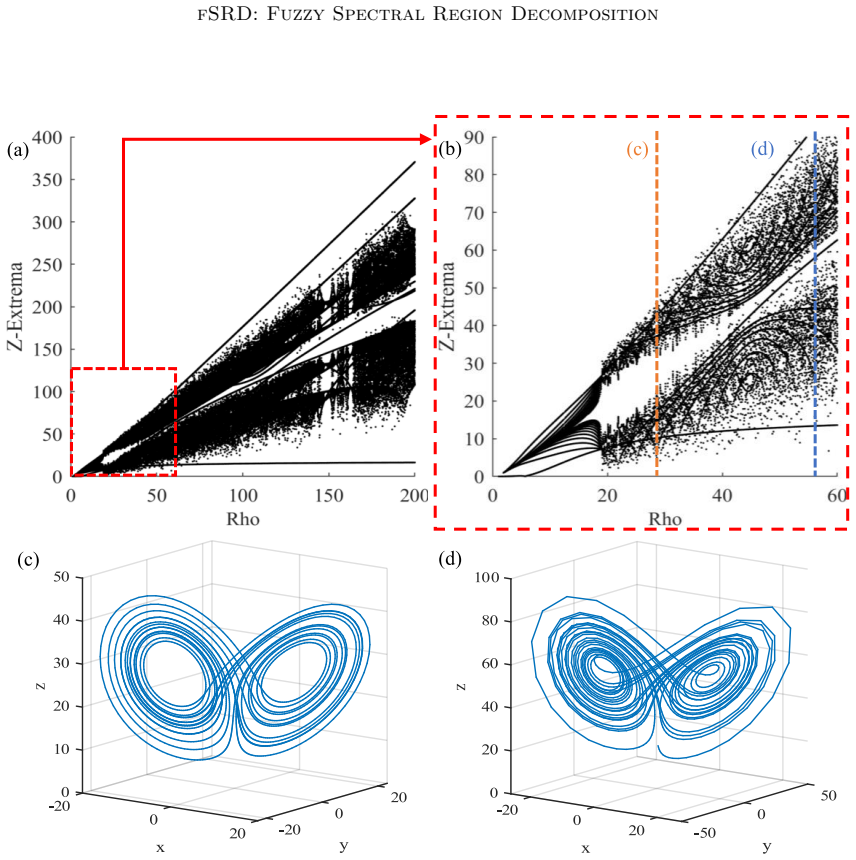
Summary. The paper introduces fSRD, a fuzzy hierarchical tree architecture that partitions a data matrix X into overlapping regions via sigmoidal activation functions, fits a local DMD spectral model to each region after applying a 'topological transform' ϑ, and aggregates the local models with fuzzy weights. The authors claim that this constitutes an automated multi-operator finite Koopman representation for nonlinear, chaotic, and high-dimensional systems, and they support the claim with case studies on the Duffing oscillator, the Lorenz system (including a bifurcation study), and solar imagery. The paper also conjectures universal-approximator capability for sequential data matrices, while explicitly noting that a proof is beyond the scope of the work (Section 2.9).
Significance. If the core assertion were established — that fuzzy matrix-coordinate splits correspond to restricted spectral integrals of the Koopman operator and that the topological transform ϑ preserves the local spectral content — the contribution would be significant: a fully automated, prior-free, interpretable alternative to global Koopman methods and black-box sequence models. The paper is commendably transparent about several limitations: Section 2.9 admits the universality claim is unproved, Section 3.2.2 documents difficulties with pure continuous spectra, and Section 3.3 notes that the regularization procedure is not yet scalable. The case studies are extensive and include a high-dimensional real-world dataset. However, the paper does not ship machine-checked proofs or code, and the main text defers many key derivations to supplementary material and to a thesis [15] that is 'submitted, availability pending.' The significance is therefore entirely conditional on resolving the spectral-preservation question.
major comments (4)
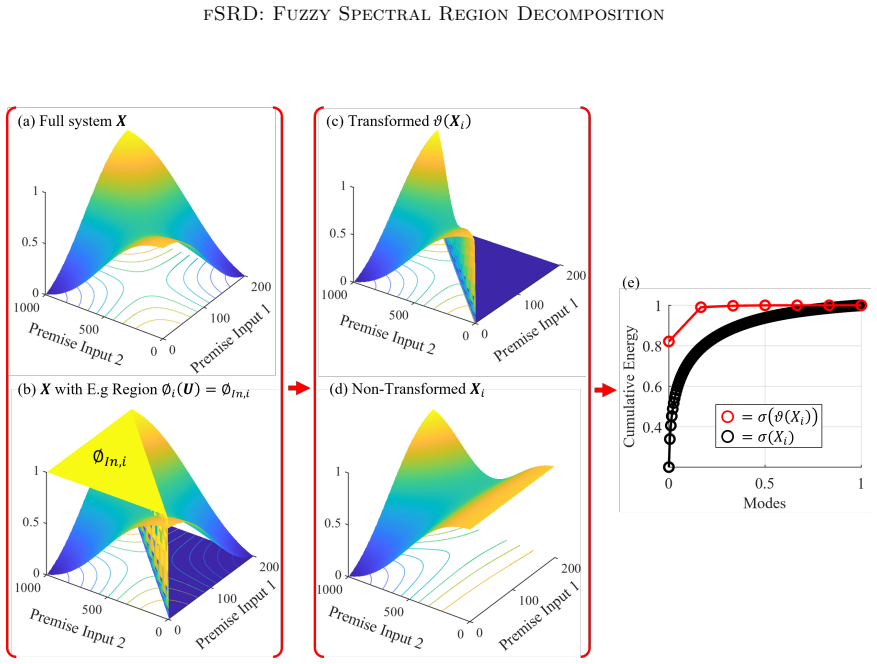
- [§2.6.3, Eq. (38)] The topological transform ϑ is the load-bearing step of the method. It stretches each row of the non-rectangular region Xi to the full width q before DMD is applied, and then maps the fitted model back by ϑ^{-1}. This is a per-row reparameterization of the time axis: rows with different active interval lengths receive different stretch factors, so the fitted DMD eigenvalues ω_i are defined in a row-dependent stretched coordinate, not in the original evolution time. No theorem or numerical diagnostic establishes that ϑ preserves the Koopman spectrum of the local dynamics. The inverse interpolation only guarantees that the reconstructed training rows match the input, which explains why in-sample NRMSE can be small. Without an argument that ϑ is a local conjugacy or at least a spectral-preserving isomorphism, the operators in Eq. (38) cannot be called finite Koopman representations of the o
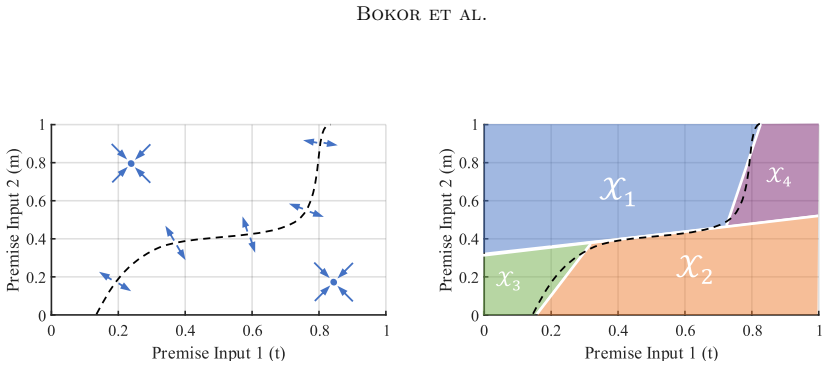
- [§2.2, Eqs. (30)–(36)] The paper asserts a correspondence between fuzzy splits in data-matrix coordinates and restricted spectral integrals 1_{[a,b]} dE(ω)g of the Koopman operator. The indicator 1_{[a,b]} is a frequency-domain multiplier, while the sigmoidal membership functions ∅_i(U) act on row and column indices of X. No mapping between these two domains is provided, and Eq. (36) is presented as an equality/approximation without proof. This is not a purely formal gap: the split positions are optimized by PSO to minimize reconstruction error, so the resulting partitions may simply carve the training matrix into blocks that are easy to fit linearly. The claimed 'invariant decomposition' and the partition categories I, cS, G, pO in Eqs. (36) and (48) are therefore not established.
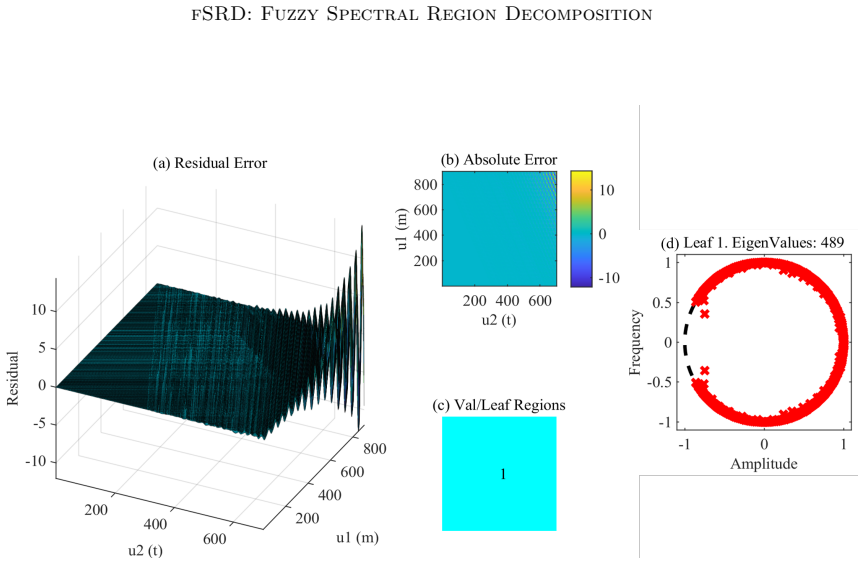
- [§3, all case studies] All reported quantitative results (e.g., Duffing NRMSE 0.026, Lorenz Hankel 0.0068, Lorenz bifurcation 0.0377, solar 0.03) are reconstructions of the same data matrix X that was used to fit the local DMD models and to optimize the fuzzy split positions via PSO. This is an in-sample fit. A flexible piecewise-linear interpolator would also achieve small reconstruction error on training data. The abstract and Section 4 use terms such as 'strong predictive accuracy' and 'one shot model robustness,' but no held-out forecasting, cross-validation, or train/test split is reported anywhere in the manuscript. Without out-of-sample evaluation, the empirical results do not distinguish a learned Koopman representation from a high-capacity interpolator.
- [§2.9 and §4] The paper explicitly states that a proof of universal approximator capability is beyond its scope, which is acceptable for a conjecture. However, Sections 2.9 and 4 repeatedly assert that the case studies 'suggest' universality and that fSRD is 'a general alternative to a broad class of non-parametric estimators.' Given the absence of any generalization test and the unproven spectral-preservation step, these statements overstate the evidence. The authors should either supply a proof under explicit assumptions, or clearly restrict the claims to in-sample reconstruction by a heuristic piecewise-DMD architecture.
minor comments (4)
- [Eq. (14)] The last column of Y2 is written as xt_{m-1}; this appears to be a typo and should presumably be y_{t_{m-1}}.
- [§3.2.2] The text refers to 'figure-6.18-(a)' and 'figure-6.33-(a)', which appear to be thesis numbering, not the numbering of this manuscript. Please update all such cross-references.
- [Eq. (51)] The notation B^{-1} - δ B^{-2}, and the statement that the superscript for symmetric matrices refers to multiplication, is confusing and should be defined more carefully; the domain of the matrix B is not stated before the equation.
- [Throughout] Many key derivations (e.g., SM-2, SM-6, SM-8, SM-11, SM-12, SM-14, SM-15) are relegated to supplementary material, and reference [15] is a thesis listed as 'submitted, availability pending.' For a self-contained review, the main text should include at least the essential steps supporting Eqs. (41) and (51), as these are used to justify the pruning and regularization procedures.
Circularity Check
Reported 'predictive accuracy' is in-sample NRMSE minimized by the same split/DMD fitting procedure; otherwise the Koopman architecture has independent content.
-
fitted input called prediction
[Abstract; §2.3 Eq. (37); §2.5.1 Eq. (41); §2.5.2; §3.1.2 (Fig. 11)]
"Empirical results across canonical chaotic systems ... demonstrate strong predictive accuracy ... X≈ eX= pX i=1 ∅i(U)⊙ efK,i(Xi) (37) ... N RM SEi = ∥ϑ(∅i(U)⊙X In,i )−Φ idiag(bi)T(ωDM D,i)∥F ∥ϑ(∅i(U)⊙X In,i )−µJ f,q ∥F (41) ... Figure-11 illustrates the application of fSRD on the identical set of Monte Carlo sampling (figure-10), improving performance withN RM SE∼0.026, i.e., 97.4% accuracy."
The global model (37) is a weighted sum of local DMD reconstructions, and the NRMSE in (41) is both the split-selection/optimization objective (via (42) and PSO in §2.5.2) and the headline accuracy reported in §3 (e.g., 0.026). Since the same X is used to fit the DMD operators and to compute the reported errors, the reported 'highly accurate reconstructions'/'strong predictive accuracy' measure training fit, not a prediction or an independent Koopman property. No held-out forecasting test is presented, and the paper's own §2.9 concedes universality is unproved. Hence the empirical support for the central claim reduces by construction to the fit objective.
full rationale
The paper's methodological chain (Koopman spectral restriction, local DMD, fuzzy aggregation) is not itself circular: it builds on external DMD/Koopman results and standard LMN machinery, and the text explicitly labels the universal-approximation claim as a hypothesis ('A proof of this universal approximator capability was beyond the scope of this work'). The self-citations to [15], [22], and [23] are used for implementation details and derivation provenance rather than as an imported theorem that forces the main conclusion. However, the headline empirical evidence is circular in the narrower sense: the reported NRMSEs are computed on the same data matrix used to fit the local DMD operators and to optimize the fuzzy split positions via the same NRMSE criterion. The abstract's 'strong predictive accuracy' is thus supported only by in-sample reconstructions that are forced by the fitting procedure. Because the architecture has independent representational content beyond this fit, the score is 6 rather than 8–10; because the central empirical demonstration reduces to a training objective, it is not 0–2.
Assumptions & free parameters
free parameters (7)
- split coefficient vectors v_j =
optimized via PSO per split
- sigmoid slope τ_j =
not specified in main text
- activation cutoff η =
not specified
- SVD truncation threshold r =
1e-4 in all experiments
- ridge parameter δ_BIC =
data-driven fixed-point per region
- BIC complexity scaling Θ =
Θ=3 in factorial experiment
- PSO hyperparameters =
unknown (SM-22)
assumptions (6)
- domain assumption A Koopman operator exists for the observed system and can be approximated by finite-dimensional DMD on local regions.
- ad hoc to paper Fuzzy splits in the row/column indices of X correspond to invariant interfaces and restricted spectral integrals of the Koopman operator.
- ad hoc to paper The observable g(x)=x is sufficient for highly nonlinear dynamics provided regions are partitioned finely enough.
- ad hoc to paper The topological transform ϕ(·) and its inverse preserve the dynamical and spectral content of the local region.
- domain assumption Measurement error is IID normal with covariance σ^2 W and can be removed by SVDe whitening.
- standard math Takens' embedding theorem justifies the Hankel matrix construction for the Lorenz system.
invented entities (1)
-
Invariant decomposition and its partition categories (I, cS, G, pO)
Cite this review
Pith. "Pith review of fSRD: Fuzzy Spectral Region Decomposition -- Automated Multi Operator Koopman Representations via an Adaptive Spectral Learning Architecture." pith.science (2026). https://pith.science/paper/2KZTRSI5
@misc{pith2026260717990,
  author       = {Pith},
  title        = {Pith review of: fSRD: Fuzzy Spectral Region Decomposition -- Automated Multi Operator Koopman Representations via an Adaptive Spectral Learning Architecture},
  year         = {2026},
  howpublished = {\url{https://pith.science/paper/2KZTRSI5}},
  note         = {Machine review of arXiv:2607.17990}
}
read the original abstract
Highly nonlinear chaotic dynamical systems remain difficult to model due to fundamental trade-offs between complexity, expressivity, and data efficiency. Modern machine learning methods achieve strong predictive performance but often rely on a-priori system knowledge or curated data with limited interpretability. Koopman operator theory offers a promising direction via linear representation in an infinite-dimensional observable space. However, many data-driven Koopman methods seek globally valid operators for which useful finite-dimensional spectral embeddings remain difficult to identify under these constraints. To overcome associated limitations, we introduce Fuzzy Spectral Region Decomposition (fSRD), a fully automated learning framework for estimating finite Koopman representation via multiple operators. The proposed method realizes a data-adaptive framework for assembling locally invariant embeddings, termed Invariant Decomposition. fSRD achieves highly accurate linear reconstructions of nonlinear systems while learning finite-dimensional representations of their induced evolution operators, bridging interpretable operator-theoretic models with expressive data-driven sequence learning. These embeddings are adaptively constructed via a global fuzzy tree model, drawing inspiration from fuzzy neural architectures to learn the induced dynamics while prioritizing parsimonious solutions. Empirical results across canonical chaotic systems (e.g., Lorenz and Duffing) and high-dimensional real-world data demonstrate strong predictive accuracy, interpretability, and robust expressivity across data-rich and data-limited regimes, highlighting the method's generality.
Figures


Figures from the paper (27 more)










Reference graph
Works this paper leans on
-
[15]
Bokor.fSRD: Fuzzy Spectral Region Decomposition – Automated Multi Operator Koopman Representations via an Adaptive Spectral Learning Architecture
C. Bokor.fSRD: Fuzzy Spectral Region Decomposition – Automated Multi Operator Koopman Representations via an Adaptive Spectral Learning Architecture. PhD thesis, Oxford Brookes University, 2026. submitted, availability pending
2026
-
[1]
A. A. Adeniran and S. E. Ferik. Modeling and identification of nonlinear systems: A review of the multimodel approach—part 1.IEEE Transactions on Systems, Man, and Cybernetics: Systems, 47:1149–1159, 7 2017. ISSN 2168-2216. doi: 10.1109/ TSMC.2016.2560147. URLhttp://ieeexplore.ieee.org/document/7469784/
arXiv 2017
-
[2]
L. Alzubaidi, J. Zhang, A. J. Humaidi, A. Al-Dujaili, Y. Duan, O. Al-Shamma, J. San- tamar ´ ıa, M. A. Fadhel, M. Al-Amidie, and L. Farhan. Review of deep learning: concepts, cnn architectures, challenges, applications, future directions.Journal of Big Data, 8:53, 3 2021. ISSN 2196-1115. doi: 10.1186/s40537-021-00444-8. URL https://doi.org/10.1186/s40537-...
-
[3]
H. Arbabi and I. Mezi´ c. Ergodic theory, dynamic mode decomposition, and compu- tation of spectral properties of the koopman operator.SIAM Journal on Applied Dy- namical Systems, 16:2096–2126, 1 2017. ISSN 1536-0040. doi: 10.1137/17M1125236
-
[4]
Babuˇ ska and H
R. Babuˇ ska and H. Verbruggen. Neuro-fuzzy methods for nonlinear system identifi- cation.Annual Reviews in Control, 27:73–85, 1 2003. ISSN 13675788. doi: 10.1016/ S1367-5788(03)00009-9. URLhttps://linkinghub.elsevier.com/retrieve/pii/ S1367578803000099
2003
-
[5]
S. Bagheri. Effects of weak noise on oscillating flows: Linking quality factor, floquet modes, and koopman spectrum.Physics of Fluids, 26, 9 2014. ISSN 1070-6631. doi: 10.1063/1.4895898
-
[6]
O. B¨ anfer and O. Nelles. Polynomial model tree (polymot) — a new training algorithm for local model networks with higher degree polynomials. In2009 IEEE International Conference on Control and Automation, pages 1571–1576. IEEE, 12 2009. ISBN 978- 1-4244-4706-0. doi: 10.1109/ICCA.2009.5410547. URLhttp://ieeexplore.ieee. org/document/5410547/
arXiv 2009
-
[7]
O. B¨ anfer, M. Franke, and O. Nelles. Adaptive local model networks with higher degree polynomials. InICCAS 2010, pages 168–171. IEEE, 10 2010. ISBN 978-1- 4244-7453-0. doi: 10.1109/ICCAS.2010.5669893
arXiv 2010
Show all 125 references
-
[8]
B¨ anfer, B
O. B¨ anfer, B. Hartmann, and O. Nelles. Comparison of different subset selection algorithms for learning local model networks with higher degree polynomials. In2010 11th International Conference on Control Automation Robotics & Vision, pages 30–
-
[9]
B¨ anfer, B
O. B¨ anfer, B. Hartmann, and O. Nelles. Polymot versus hilomot - a comparison of two different training algorithms for local model networks.IF AC Proceedings Volumes, 45: 1569–1574, 7 2012. ISSN 14746670. doi: 10.3182/20120711-3-BE-2027.00354
2012
-
[10]
W. T. Barnes, M. G. Bobra, S. D. Christe, N. Freij, L. A. Hayes, J. Ireland, S. Mum- ford, D. Perez-Suarez, D. F. Ryan, A. Y. Shih, P. Chanda, K. Glogowski, R. Hewett, V. K. Hughitt, A. Hill, K. Hiware, A. Inglis, M. S. F. Kirk, S. Konge, J. P. Mason, S. A. Maloney, S. A. Murr...
2020
-
[11]
N. S. Bedrossian.Nonlinear control using linearizing transformations. PhD thesis, Massachusetts Institute of Technology, 1991
1991
-
[12]
A. O. Benz. Flare observations.Living Reviews in Solar Physics, 14:2, 12 2017. ISSN 2367-3648. doi: 10.1007/s41116-016-0004-3
2017 doi
-
[13]
C. M. Bishop.Pattern Recognition and Machine Learning. Springer, 2006. ISBN 978-0387310732
2006
-
[14]
C. Bokor. Solar anomaly detector, 2026. URLhttps://github.com/cbokor/ solar-anomaly-detector. GitHub repository
2026
-
[16]
S. L. Brunton and J. N. Kutz.Data-Driven Science and Engineering: Machine Learn- ing, Dynamical Systems, and Control. Cambridge University Press, 1 2019. ISBN 9781108380690. doi: 10.1017/9781108380690
2019 doi
-
[17]
S. L. Brunton, B. W. Brunton, J. L. Proctor, and J. N. Kutz. Koopman invariant subspaces and finite linear representations of nonlinear dynamical systems for control. PLOS ONE, 10 2016. doi: 10.1371/journal.pone.0150171. URLhttp://dx.doi.org/ 10.1371/journal.pone.0150171
2016 doi
-
[18]
S. L. Brunton, B. W. Brunton, J. L. Proctor, E. Kaiser, and J. N. Kutz. Chaos as an intermittently forced linear system.Nature Communications, 19, 2017. doi: 10.1038/ s41467-017-00030-8. URLhttp://dx.doi.org/10.1038/s41467-017-00030-8
2017 doi
-
[19]
S. L. Brunton, M. Budiˇ si´ c, E. Kaiser, and J. N. Kutz. Modern koopman theory for dynamical systems, 2021. URLhttp://arxiv.org/abs/2102.12086
2021 arXiv
-
[20]
Budiˇ si´ c and I
M. Budiˇ si´ c and I. Mezi´ c. Geometry of the ergodic quotient reveals coherent struc- tures in flows.Physica D: Nonlinear Phenomena, 241(15):1255–1269, 2012. ISSN 0167-2789. doi: https://doi.org/10.1016/j.physd.2012.04.006. URLhttps://www. sciencedirect.com/science/article/p...
2012 doi
-
[21]
Budiˇ si´ c, R
M. Budiˇ si´ c, R. Mohr, and I. Mezi´ c. Applied koopmanism.Chaos: An Interdisciplinary Journal of Nonlinear Science, 22, 12 2012. ISSN 1054-1500. doi: 10.1063/1.4772195
2012 doi
-
[22]
Cary and C
M. Cary and C. Bokor. Regularised iterative generalised least squares with optimal selection of the hyper-parameter for identifying nonlinear phenomenological models. arXiv preprint, 2026. 58 fSRD: Fuzzy Spectral Region Decomposition
2026
-
[23]
Cary and C
M. Cary and C. Bokor. A repeated measurements approach to soh battery modelling of cyclic aged data in a laboratory environment.arXiv preprint, 2026
2026
-
[24]
Chai and R
J. Chai and R. G. Sanfelice. On notions and sufficient conditions for forward invariance of sets for hybrid dynamical systems. In2015 54th IEEE Conference on Decision and Control (CDC), pages 2869–2874. IEEE, 12 2015. doi: 10.1109/CDC.2015.7402652
2015
-
[25]
Champion, B
K. Champion, B. Lusch, J. N. Kutz, and S. L. Brunton. Data-driven discovery of coordinates and governing equations.Proceedings of the National Academy of Sciences of the United States of America, 116:22445–22451, 2019. ISSN 10916490. doi: 10.1073/ pnas.1906995116
2019
-
[26]
M. J. Colbrook. The multiverse of dynamic mode decomposition algorithms, 11 2023. URLhttp://arxiv.org/abs/2312.00137
2023 arXiv
-
[27]
M. J. Colbrook. The mpedmd algorithm for data-driven computations of measure- preserving dynamical systems.SIAM Journal on Numerical Analysis, 61:1585–1608, 6 2023. ISSN 0036-1429. doi: 10.1137/22M1521407
2023 doi
-
[28]
Colonius and W
F. Colonius and W. Kliemann.The Dynamics of Control. Birkh¨ auser Boston,
-
[29]
G. Cybenko. Approximation by superpositions of a sigmoidal function.Mathematics of Control, Signals, and Systems, 2:303–314, 12 1989. ISSN 0932-4194. doi: 10.1007/ BF02551274. URLhttp://link.springer.com/10.1007/BF02551274
1989 doi
-
[30]
A. C. Davison and D. V. Hinkley.Bootstrap Methods and their Application. Cambridge University Press, 10 1997. ISBN 9780521573917. doi: 10.1017/CBO9780511802843
1997 doi
-
[31]
S. T. M. Dawson, M. S. Hemati, M. O. Williams, and C. W. Rowley. Characterizing and correcting for the effect of sensor noise in the dynamic mode decomposition.Ex- periments in Fluids, 57:42, 3 2016. ISSN 0723-4864. doi: 10.1007/s00348-016-2127-7
2016 doi
-
[32]
de la Madrid
R. de la Madrid. The role of the rigged hilbert space in quantum mechanics.European Journal of Physics, 26:287–312, 4 2005. ISSN 0143-0807. doi: 10.1088/0143-0807/26/ 2/008
2005 doi
-
[33]
Duffing.Erzwungene Schwingungen bei ver¨ anderlicher Eigenfrequenz und ihre tech- nische Bedeutung
G. Duffing.Erzwungene Schwingungen bei ver¨ anderlicher Eigenfrequenz und ihre tech- nische Bedeutung. Vieweg & Sohn, 1918
1918
-
[34]
B. P. Epps and E. M. Krivitzky. Singular value decomposition of noisy data: mode corruption.Experiments in Fluids, 60:121, 8 2019. ISSN 0723-4864. doi: 10.1007/ s00348-019-2761-y
2019
-
[35]
ISBN 978-1-4244-7814-9
IEEE, 12 2010. ISBN 978-1-4244-7814-9. doi: 10.1109/ICARCV.2010.5707393
2010
-
[36]
Eykhoff and K
P. Eykhoff and K. Astrom. System identification - a survey.Automatica, 7:123–162, 1971
1971
-
[37]
B. P. Epps and E. M. Krivitzky. Singular value decomposition of noisy data: noise filtering.Experiments in Fluids, 60:126, 8 2019. ISSN 0723-4864. doi: 10.1007/ s00348-019-2768-4. 59 Bokor et al
2019
-
[38]
Ghosh and J
R. Ghosh and J. Marecek. Iterated function systems: A comprehensive survey, 11
-
[39]
Folkestad, D
C. Folkestad, D. Pastor, I. Mezi´ c, R. Mohr, M. Fonoberova, and J. Burdick. Extended dynamic mode decomposition with learned koopman eigenfunctions for prediction and control. In2020 American Control Conference (ACC), pages 3906–3913. IEEE, 7 2020. ISBN 978-1-5386-8266-1. doi...
2020
-
[40]
G. H. Golub and C. F. V. Loan.Matrix Computations. Johns Hopkins University Press, 4th edition, 2013
2013
-
[41]
Goodfellow, Y
I. Goodfellow, Y. Bengio, and A. Courville.Deep Learning. MIT Press,
-
[42]
Gohel, P
P. Gohel, P. Singh, and M. Mohanty. Explainable ai: current status and future directions, 7 2021. URLhttp://arxiv.org/abs/2107.07045
2021 arXiv
-
[43]
D. Grobman. Homeomorphisms of systems of differential equations.Doklady Akademii Nauk SSSR, 128:880–881, 1959
1959
-
[44]
C. Gros. Pushing the complexity barrier: diminishing returns in the sciences, 9 2012. URLhttp://arxiv.org/abs/1209.2725
2012 arXiv
-
[45]
Guckenheimer and P
J. Guckenheimer and P. Holmes.Nonlinear Oscillations, Dynamical Systems, and Bifurcations of Vector Fields, volume 42. Springer New York, 1983. ISBN 978-1- 4612-7020-1. doi: 10.1007/978-1-4612-1140-2. URLhttp://link.springer.com/ 10.1007/978-1-4612-1140-2
1983 doi
-
[46]
Goutte.Statistical learning and regularisation for regression
C. Goutte.Statistical learning and regularisation for regression. PhD thesis, Munich, 1997
1997
-
[47]
P. Hartman. A lemma in the theory of structural stability of differential equations.Proceedings of the American Mathematical Society, 11:610, 8 1960. ISSN 00029939. doi: 10.2307/2034720. URLhttps://doi.org/10.1090/ S0002-9939-1960-0121542-7
1960 doi
-
[48]
Hartman.Ordinary Differential Equations
P. Hartman.Ordinary Differential Equations. Society for Industrial and Applied Mathematics, 1 2002. ISBN 978-0-89871-510-1. doi: 10.1137/1.9780898719222. URL http://epubs.siam.org/doi/book/10.1137/1.9780898719222
2002 doi
-
[49]
Hartmann and O
B. Hartmann and O. Nelles. Structure trade-off strategy for local model networks. In 2012 IEEE International Conference on Control Applications, pages 451–456. IEEE, 10 2012. ISBN 978-1-4673-4505-7. doi: 10.1109/CCA.2012.6402404. URLhttp: //ieeexplore.ieee.org/document/6402404...
2012
-
[50]
Hall.Quantum Theory for Mathematicians
B. Hall.Quantum Theory for Mathematicians. Springer, 2013. ISBN 9781461471158
2013
-
[51]
Hoffman and R
K. Hoffman and R. Kunze.Linear Algebra. Pearson, 2nd edition, 1971. ISBN 978- 0135367971
1971
-
[52]
Horn and C
R. Horn and C. Johnson.Matrix Analysis. Cambridge University Press, 2nd edition,
-
[53]
K. Hornik. Approximation capabilities of multilayer feedforward networks.Neural Networks, 4:251–257, 1991. ISSN 08936080. doi: 10.1016/0893-6080(91)90009-T
1991 doi
-
[54]
Hartmann, O
B. Hartmann, O. Nelles, I. ˇSkrjanc, and A. Sodja. Supervised hierarchical clustering (suhiclust) for nonlinear system identification. In2009 IEEE Symposium on Com- putational Intelligence in Control and Automation, CICA 2009 - Proceedings, pages 41–48, 2009. ISBN 978142442752...
2009
-
[55]
Johnson-Groh
M. Johnson-Groh. How nasa tracked the most intense solar storm in decades, 5 2024. URLhttps://science.nasa.gov/science-research/heliophysics/ how-nasa-tracked-the-most-intense-solar-storm-in-decades/
2024
-
[56]
M. R. Jovanovi´ c, P. J. Schmid, and J. W. Nichols. Sparsity-promoting dynamic mode decomposition.Physics of Fluids, 26, 2 2014. ISSN 1070-6631. doi: 10.1063/1.4863670
2014 doi
-
[57]
M. Kamb, E. Kaiser, S. L. Brunton, and J. N. Kutz. Time-delay observables for koopman: Theory and applications.SIAM Journal on Applied Dynamical Systems, 19:886–917, 2020. ISSN 15360040. doi: 10.1137/18M1216572
2020 doi
-
[58]
Y. Jin, L. Hou, and S. Zhong. Extended dynamic mode decomposition with invertible dictionary learning.Neural Networks, 173:106177, 5 2024. ISSN 08936080. doi: 10.1016/j.neunet.2024.106177
2024
-
[59]
B. O. Koopman. Hamiltonian systems and transformation in hilbert space.Pro- ceedings of the National Academy of Sciences, 17:315–318, 5 1931. ISSN 0027-8424. doi: 10.1073/pnas.17.5.315. URLhttps://pnas.org/doi/full/10.1073/pnas.17. 5.315
1931 doi
-
[60]
Korda and I
M. Korda and I. Mezi´ c. Optimal construction of koopman eigenfunctions for prediction and control, 10 2018. URLhttp://arxiv.org/abs/1810.08733
2018 arXiv
-
[61]
Korda and I
M. Korda and I. Mezi´ c. On convergence of extended dynamic mode decomposition to the koopman operator.Journal of Nonlinear Science, 28:687–710, 4 2018. ISSN 0938-8974. doi: 10.1007/s00332-017-9423-0
2018 doi
-
[62]
S. Klus, P. Koltai, and C. Sch¨ utte. On the numerical approximation of the perron- frobenius and koopman operator.Journal of Computational Dynamics, 12 2015. doi: 10.3934/jcd.2016003. URLhttp://dx.doi.org/10.3934/jcd.2016003
2015 doi
-
[63]
Lang.Linear Algebra
S. Lang.Linear Algebra. Springer New York, 1987. ISBN 978-1-4419-3081-
1987
-
[64]
J. R. Lemen, A. M. Title, D. J. Akin, P. F. Boerner, C. Chou, J. F. Drake, D. W. Duncan, C. G. Edwards, F. M. Friedlaender, G. F. Heyman, N. E. Hurlburt, N. L. Katz, G. D. Kushner, M. Levay, R. W. Lindgren, D. P. Mathur, E. L. McFeaters, S. Mitchell, R. A. Rehse, C. J. Schrijv...
-
[65]
Lepot, J.-B
M. Lepot, J.-B. Aubin, and F. Clemens. Interpolation in time series: An introductive overview of existing methods, their performance criteria and uncertainty assessment. Water, 9:796, 10 2017. ISSN 2073-4441. doi: 10.3390/w9100796
2017 doi
-
[66]
Lan and I
Y. Lan and I. Mezi´ c. Linearization in the large of nonlinear systems and koopman operator spectrum.Physica D: Nonlinear Phenomena, 242:42–53, 1 2013. ISSN 01672789. doi: 10.1016/j.physd.2012.08.017. 61 Bokor et al
2013 doi
-
[67]
L. Liberti. Introduction to global optimization. 2006. URLhttps://api. semanticscholar.org/CorpusID:14115596
2006
-
[68]
URLhttp://link.springer.com/10.1007/ 978-1-4757-1949-9
doi: 10.1007/978-1-4757-1949-9. URLhttp://link.springer.com/10.1007/ 978-1-4757-1949-9
1949 doi
-
[69]
E. N. Lorenz. Deterministic nonperiodic flow.Journal of the Atmospheric Sciences, 20:130–141, 1963. doi: https://doi.org/10.1175/1520-0469(1963)020%3C0130:DNF% 3E2.0.CO;2. URLhttps://doi.org/10.1175/1520-0469(1963)020%3C0130:DNF% 3E2.0.CO;2
1963 doi
-
[70]
Lusch, J
B. Lusch, J. N. Kutz, and S. L. Brunton. Deep learning for universal linear embeddings of nonlinear dynamics.Nature Communications, 9, 12 2018. ISSN 20411723. doi: 10.1038/s41467-018-07210-0
2018 doi
-
[71]
Mahfuz, M
A. Mahfuz, M. A. Mannan, and S. M. Muyeen. Enhancement of the hilomot algorithm with modified em and modified pso algorithms for nonlinear systems identification. Electronics, 11:729, 2 2022. ISSN 2079-9292. doi: 10.3390/electronics11050729
2022 doi
-
[72]
X. Li, H. Xiong, X. Li, X. Wu, X. Zhang, J. Liu, J. Bian, and D. Dou. Interpretable deep learning: Interpretation, interpretability, trustworthiness, and beyond, 3 2021. URLhttp://arxiv.org/abs/2103.10689
2021 arXiv
-
[73]
I. Mezi´ c. Spectral properties of dynamical systems, model reduction and de- compositions.Nonlinear Dynamics, 41:309–325, 8 2005. ISSN 0924090X. doi: 10.1007/s11071-005-2824-x. 62 fSRD: Fuzzy Spectral Region Decomposition
2005 doi
-
[74]
Ljung.System Identification: Theory for the User
L. Ljung.System Identification: Theory for the User. Pearson Education Limited, 2nd edition, 1999. ISBN 978-0136566953
1999
-
[75]
I. Mezi´ c. Spectrum of the koopman operator, spectral expansions in functional spaces, and state space geometry, 2 2017. URLhttp://arxiv.org/abs/1702.07597
2017 arXiv
-
[76]
Mezi´ c and A
I. Mezi´ c and A. Banaszuk. Comparison of systems with complex behavior.Physica D: Nonlinear Phenomena, 197:101–133, 10 2004. ISSN 01672789. doi: 10.1016/j.physd. 2004.06.015
2004 doi
-
[77]
Mezi´ c and S
I. Mezi´ c and S. Wiggins. A method for visualization of invariant sets of dynami- cal systems based on the ergodic partition.Chaos: An Interdisciplinary Journal of Nonlinear Science, 9(1):213–218, 3 1999. doi: 10.1063/1.166399
1999 doi
-
[78]
J. D. Meiss.Differential Dynamical Systems. Society for Industrial and Applied Mathematics, 1 2007. ISBN 978-0-89871-635-1. doi: 10.1137/1.9780898718232. URL http://epubs.siam.org/doi/book/10.1137/1.9780898718232
2007 doi
-
[79]
D. C. Montgomery, E. A. Peck, and G. G. Vining.Introduction to Linear Regression Analysis. Wiley, 5th edition, 2012
2012
-
[80]
I. Mezi´ c. Analysis of fluid flows via spectral properties of the koopman opera- tor.Annual Review of Fluid Mechanics, 45:357–378, 1 2013. ISSN 0066-4189. doi: 10.1146/annurev-fluid-011212-140652. URLhttps://www.annualreviews.org/ doi/10.1146/annurev-fluid-011212-140652
2013 doi
-
[81]
S. P. Nandanoori, S. Sinha, and E. Yeung. Data-driven operator theoretic methods for phase space learning and analysis, 6 2021. URLhttp://arxiv.org/abs/2106.15678
2021 arXiv
-
[82]
O. Nelles. Local basis function networks for identification of a turbocharger. In UKACC International Conference on Control. Control ’96, volume 1996, pages 7–
1996
-
[83]
Nelles.Nonlinear System Identification
O. Nelles.Nonlinear System Identification. Springer Berlin Heidelberg, 2001. ISBN 978-3-642-08674-8. doi: 10.1007/978-3-662-04323-3. URLhttp://link.springer. com/10.1007/978-3-662-04323-3
2001 doi
-
[84]
D. C. Montgomery.Design and Analysis of Experiments. Wiley, 2019. ISBN 978-1-119-49244-3. URLhttps://www.wiley.com/en-us/Design+and+Analysis+ of+Experiments%2C+10th+Edition-p-9781119492443
2019
-
[85]
Niederreiter.Random Number Generation and Quasi-Monte Carlo Methods
H. Niederreiter.Random Number Generation and Quasi-Monte Carlo Methods. So- ciety for Industrial and Applied Mathematics, 1 1992. ISBN 978-0-89871-295-7. doi: 10.1137/1.9781611970081
1992 doi
-
[86]
S. P. Nandanoori, S. Sinha, and E. Yeung. Data-driven operator theoretic methods for global phase space learning, 10 2019. URLhttp://arxiv.org/abs/1910.03011
2019 arXiv
-
[87]
Ott.Chaos in Dynamical Systems
E. Ott.Chaos in Dynamical Systems. Cambridge University Press, 8 2002. ISBN 9780521811965. doi: 10.1017/CBO9780511803260
2002 doi
-
[88]
E. Ott, C. Grebogi, and J. A. Yorke. Controlling chaos.Physical Review Letters, 64: 1196–1199, 3 1990. ISSN 0031-9007. doi: 10.1103/PhysRevLett.64.1196
1990 doi
-
[89]
ISBN 0 85296 666 0
IEE, 1996. ISBN 0 85296 666 0. doi: 10.1049/cp:19960518. URLhttps:// ieeexplore.ieee.org/document/651344
1996 doi
-
[90]
Queff´ elec.Substitution Dynamical Systems - Spectral Analysis, volume 1294
M. Queff´ elec.Substitution Dynamical Systems - Spectral Analysis, volume 1294. Springer Berlin Heidelberg, 2010. ISBN 978-3-642-11211-9. doi: 10.1007/ 978-3-642-11212-6
2010
-
[91]
O. Nelles. Axes-oblique partitioning strategies for local model networks. InIEEE International Symposium on Intelligent Control, pages 2378–2383. IEEE, 10 2006. ISBN 0-7803-9798-3. doi: 10.1109/ISIC.2006.285656. URLhttps://ieeexplore. ieee.org/document/4064981
2006
-
[92]
C. W. Rowley, I. Mezi´ c, S. Bagheri, P. Schlatter, and D. S. Henningson. Spectral analysis of nonlinear flows.Journal of Fluid Mechanics, 641:115–127, 2009. ISSN 14697645. doi: 10.1017/S0022112009992059
2009 doi
-
[93]
A. V. Oppenheim, R. W. Schafer, and J. R. Buck.Discrete-Time Signal Processing. Pearson, 3rd edition, 1998. 63 Bokor et al
1998
-
[94]
E. N. Sanchez and A. Y. Alanis. Adaptive approximation based control: Unifying neural, fuzzy and traditional adaptive approximation approaches (farrell, j.a. and polycarpou, m.m. [book review].IEEE Transactions on Neural Networks, 19:731– 732, 4 2008. ISSN 1045-9227. doi: 10.1...
2008
-
[95]
I. H. Sarker. Machine learning: Algorithms, real-world applications and re- search directions.SN Computer Science, 2:160, 5 2021. ISSN 2662-995X. doi: 10.1007/s42979-021-00592-x. URLhttps://link.springer.com/10.1007/ s42979-021-00592-x
2021 doi
-
[96]
J. L. Proctor, S. L. Brunton, and J. N. Kutz. Dynamic mode decomposition with con- trol.SIAM Journal on Applied Dynamical Systems, 15:142–161, 2016. ISSN 15360040. doi: 10.1137/15M1013857
2016 doi
-
[97]
Schm¨ olter and J
E. Schm¨ olter and J. Berdermann. The impact of the 2024 mother’s day storm on aircraft surveillance across europe.Space Weather, 23, 12 2025. ISSN 1542-7390. doi: 10.1029/2025SW004718
2024 doi
-
[98]
L. M. Rios and N. V. Sahinidis. Derivative-free optimization: a review of algorithms and comparison of software implementations.Journal of Global Optimization, 56: 1247–1293, 7 2013. ISSN 0925-5001. doi: 10.1007/s10898-012-9951-y
2013 doi
-
[99]
Searle and A
S. Searle and A. Khuri.Matrix Algebra Useful for Statistics. Wiley, 2nd edition, 2017. ISBN 978-1-118-93514-9. 64 fSRD: Fuzzy Spectral Region Decomposition
2017
-
[100]
Salova, J
A. Salova, J. Emenheiser, A. Rupe, J. P. Crutchfield, and R. M. D’Souza. Koopman operator and its approximations for systems with symmetries.Chaos, 29, 9 2019. ISSN 10541500. doi: 10.1063/1.5099091
2019 doi
-
[101]
Sinha, S
S. Sinha, S. P. Nandanoori, and E. Yeung. Koopman operator methods for global phase space exploration of equivariant dynamical systems. InIF AC-PapersOnLine, volume 53, pages 1150–1155. Elsevier B.V., 2020. doi: 10.1016/j.ifacol.2020.12.1322
2020 doi
-
[102]
Sparrow.The Lorenz Equations: Bifurcations, Chaos, and Strange Attractors, volume 41
C. Sparrow.The Lorenz Equations: Bifurcations, Chaos, and Strange Attractors, volume 41. Springer New York, 1982. ISBN 978-0-387-90775-8. doi: 10.1007/ 978-1-4612-5767-7
1982
-
[103]
P. J. SCHMID. Dynamic mode decomposition of numerical and experimental data.Journal of Fluid Mechanics, 656:5–28, 8 2010. ISSN 0022-1120. doi: 10.1017/S0022112010001217. URLhttps://doi.org/10.1017/S0022112010001217
2010 doi
-
[104]
Staffans.Well-Posed Linear Systems
O. Staffans.Well-Posed Linear Systems. Cambridge University Press, 2 2005. ISBN 9780521825849. doi: 10.1017/CBO9780511543197
2005 doi
-
[105]
G. Schwarz. Estimating the dimension of a model.The Annals of Statistics, 6, 3 1978. ISSN 0090-5364. doi: 10.1214/aos/1176344136
1978
-
[106]
Takagi and M
T. Takagi and M. Sugeno. Fuzzy identification of systems and its applications to modeling and control.IEEE Transactions on Systems, Man, and Cybernetics, SMC- 15:116–132, 1 1985. ISSN 0018-9472. doi: 10.1109/TSMC.1985.6313399
1985
-
[107]
Shahzad.Pruned hierarchical local model networks for nonlinear system identifi- cation
A. Shahzad.Pruned hierarchical local model networks for nonlinear system identifi- cation. PhD thesis, Loughborough University, 2020
2020
-
[108]
A. N. Tikhonov and V. Y. Arsenin.Solution of ill-posed problems. D.C.: John Wiley & Sons, 1977
1977
-
[109]
J. H. Tu, C. W. Rowley, D. M. Luchtenburg, S. L. Brunton, and J. N. Kutz. On dynamic mode decomposition: Theory and applications.Journal of Computational Dynamics, 1:391–421, 2014. ISSN 21582505. doi: 10.3934/jcd.2014.1.391. URL https://www.aimsciences.org/article/doi/10.3934/...
2014 doi
-
[110]
J. C. Sprott.Chaos and Time-Series Analysis. Oxford University PressOxford, 1
-
[111]
Valentin, A
A. Valentin, A. Luo, and X. Fu.Nonlinear Dynamics and Complexity, vol- ume 8. Springer International Publishing, 2014. ISBN 978-3-319-02352-6. doi: 10.1007/978-3-319-02353-3. URLhttps://link.springer.com/10.1007/ 978-3-319-02353-3
2014 doi
-
[112]
B. Verd, A. Crombach, and J. Jaeger. Classification of transient behaviours in a time- dependent toggle switch model.BMC Systems Biology, 8, 4 2014. ISSN 17520509. doi: 10.1186/1752-0509-8-43. 65 Bokor et al
2014 doi
-
[113]
N. Sugiura. Further analysis of the data by akaike’s information criterion and the finite corrections.Communications in Statistics - Theory and Methods, 7:13–26, 1
-
[114]
M. O. Williams, C. W. Rowley, and I. G. Kevrekidis. A kernel-based method for data- driven koopman spectral analysis.Journal of Computational Dynamics, 2:247–265,
-
[116]
A. K. Tangirala.Principles of System Identification. CRC Press, 1st edition,
-
[120]
E. Turco. Tools for the numerical solution of inverse problems in structural mechanics: review and research perspectives.European Journal of Environmental and Civil En- gineering, 21:509–554, 5 2017. ISSN 1964-8189. doi: 10.1080/19648189.2015.1134673
2017
-
[123]
M. O. Williams, I. G. Kevrekidis, and C. W. Rowley. A data–driven approximation of the koopman operator: Extending dynamic mode decomposition.Journal of Nonlin- ear Science, 25:1307–1346, 12 2015. ISSN 14321467. doi: 10.1007/s00332-015-9258-5
2015 doi
- [125]
- [1978]
-
[2000]
doi: 10.1007/978-1-4612-1350-5
ISBN 978-1-4612-7107-9. doi: 10.1007/978-1-4612-1350-5. URLhttp: //link.springer.com/10.1007/978-1-4612-1350-5
-
[2003]
doi: 10.1093/oso/9780198508397.001.0001
ISBN 9780198508397. doi: 10.1093/oso/9780198508397.001.0001
- [2012]
-
[2015]
doi: 10.1201/9781315222509
ISBN 9781315222509. doi: 10.1201/9781315222509. URLhttps://www. taylorfrancis.com/books/9781439896020
-
[2016]
URLhttps://mitpress.mit.edu/9780262035613/ deep-learning/
ISBN 9780262035613. URLhttps://mitpress.mit.edu/9780262035613/ deep-learning/
-
[2022]
URLhttp://arxiv.org/abs/2211.14661
Reviewed August 1, 2026 · model on record in the stance chip above.
Discussion (0). Continue with ORCID to comment.