REVIEW 2 major objections 5 minor 71 references
Improving Punching "Power": Reconsidering the roles of initial strike velocity and effective mass
T0 review · 2 major / 5 minor · reviewed 2026-08-02 · deepseek-v4-flash
Pith's one-line read Raising the effective mass of a punch can increase the target's post-impact velocity as much as or more than raising punch speed, within realistic combat ranges.
desk verdict Sound textbook math, honest about its own limits, but the practical punchline depends on an untested training assumption that the paper itself flags. read the letter →
The pith
A machine-rendered reading of the paper's core claim, the machinery that carries it, and where it could break.
The reading
What carries the argument
The load-bearing object is the classical elastic collision solution for two point masses: Vf = [2m/(m+M)]v, often written with mass ratio u = m/M, together with the fold-change formula k = c(u+1)/(cu+1) for a c-fold increase in effective mass. This identity separates the linear, unbounded-in-principle influence of speed v from the saturating, ratio-dependent influence of mass m. The paper then imposes realistic dynamical bounds (v ≈ 6–10 m/s, m from roughly 5 kg to 20–60 kg, M ≈ 60 kg) to argue that within the occupied region of parameter space, mass can match or exceed speed as a lever on target velocity and energy.
What would settle it
Measure effective mass and punch speed of a cohort before and after a training intervention aimed at mass recruitment. If the maximum c achieved is ≤ 1.5 while speed can still be improved by up to 1.67-fold, then the claim that mass can rival speed collapses for practical training; likewise, if instrumented targets never show target-velocity fold increases above 1.5 for any recorded technique, the regime the paper relies on would be empirically absent.
Extended reading notes
Core claim
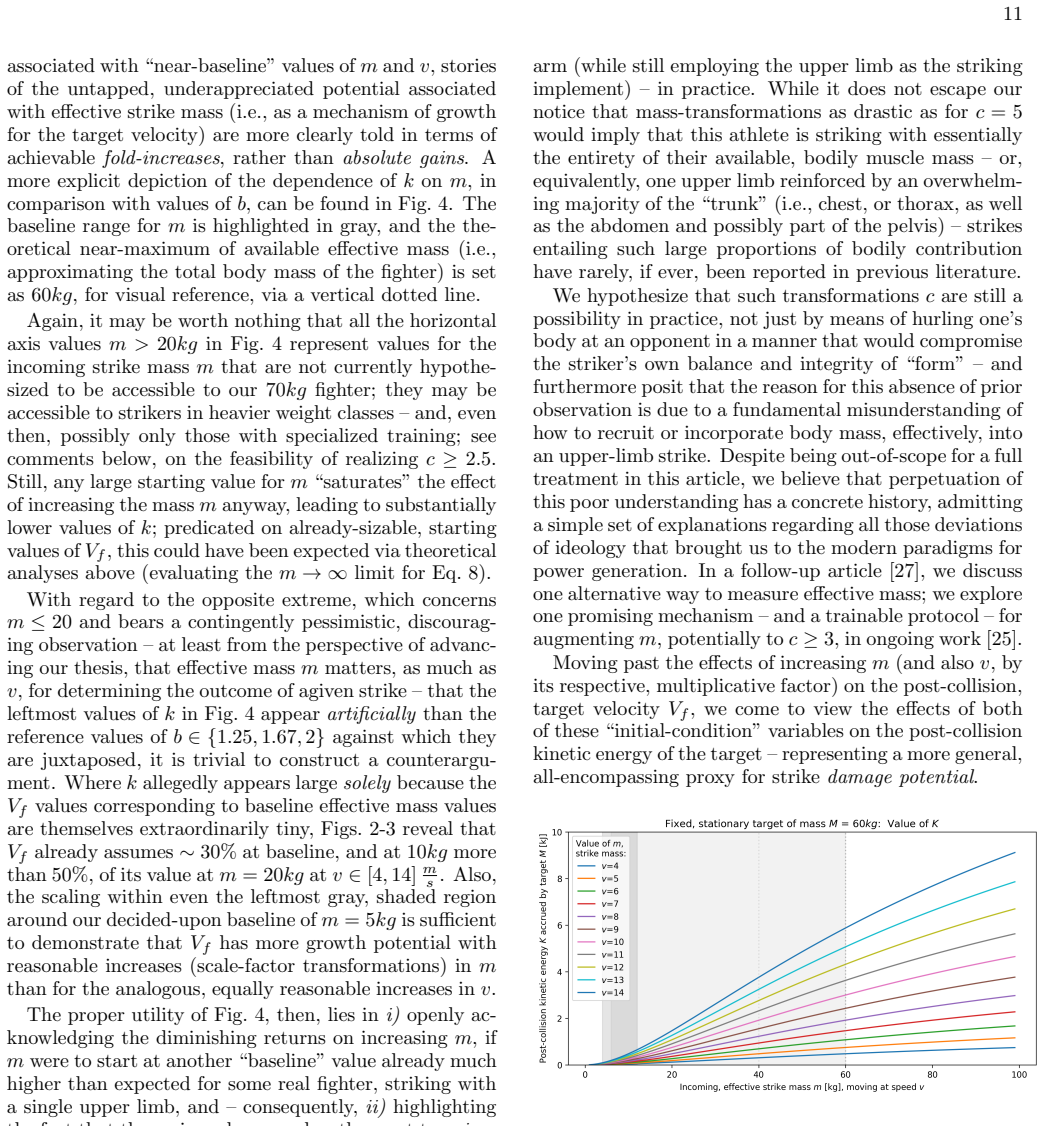
The central claim is that the post-collision speed of a stationary target, Vf = [2m/(m+M)]v, responds linearly to strike speed v, but the realizable range of v is narrow (roughly 6–10 m/s), capping the maximum speed-driven gain at about 1.67-fold. By contrast, the effective striking mass m, though loosely defined and hard to measure, may be trainable from a roughly 5 kg baseline to several-fold multiples (c ∈ [2,5)). Within intermediate mass ratios u = m/M, this yields fold-increases k = c(u+1)/(cu+1) in Vf that rival or exceed the speed-driven gain. Numerical evaluation for a 60 kg target and m from 5 to 20 kg at fixed speeds 6–10 m/s shows target kinetic energy increasing by an order of ma
Load-bearing premise
The central practical premise is that a fighter can raise effective mass by a factor of at least 1.75, and perhaps 2–5, through training or technique; the paper provides no data or mechanical mechanism for this, only a hypothesis deferred to future work.
Editorial extensions
If this is right
- If a fighter can raise effective mass from about 5 kg to 10–20 kg (c = 2–4), the post-impact target speed gain matches or exceeds the maximum realistic speed gain of about 1.67-fold at speeds of 6–10 m/s.
- For a roughly 60 kg target, increasing m from 5 to 20 kg at fixed v raises the target's post-collision kinetic energy by roughly an order of magnitude, comparable to the entire achievable speed-driven range.
- Real strike speeds have a bounded improvement ceiling of about b = 1.67, so any training that achieves c ≥ 1.75 gives at least the same target velocity as the maximum usable speed increase.
- A coach can use the presence of strong whiplash motion of the target, rather than quantitative velocity data, as a practical indicator that the incoming effective mass is comparable to the target mass.
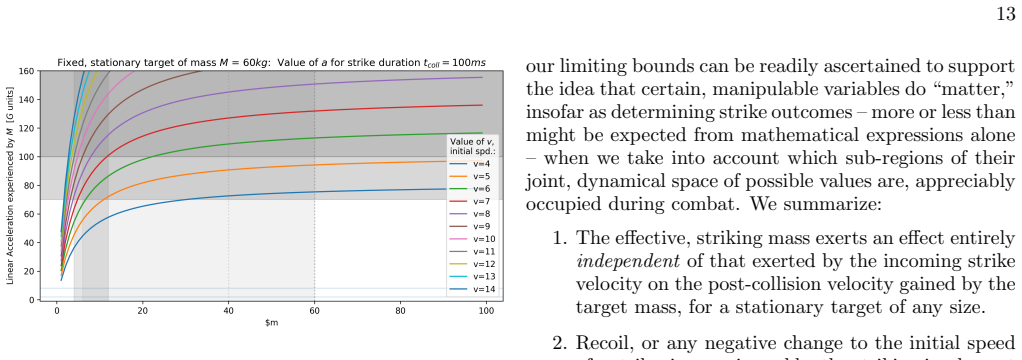
- For head-like small targets (roughly 5 kg), strikes can exceed concussion-level accelerations even at speeds below the median measured punch speed, provided contact times are about 10 ms or less.
- Even within an elastic model, the limiting bounds on speed and mass show that the effective striking mass matters as much as, or more than, strike velocity for determining target acceleration and injury risk in realistic combat.
Reading between the lines
- If the central claim is right, the most direct testable extension is a training study: one group trained to maximize effective-mass recruitment, another to maximize hand speed, with target velocity measured on an instrumented target. The model predicts mass-trained fighters would match or beat speed-trained fighters in target velocity.
- The paper's logic implies that current effective-mass estimates near 5–10% of bodyweight may be measuring the wrong thing; if c ≥ 2 is achievable through technique, standardized protocols for measuring effective mass would become as important as speed measurement for assessing strike quality.
- A cross-weight-class implication left implicit by the author is that because k saturates when m ≫ M, heavier effective masses confer diminishing returns in target velocity, so the biggest payoff is for fighters whose current masses sit near the low end (about 5 kg) rather than those already near 20 kg.
- The same collision identity could be repurposed for protective-equipment design: materials that selectively absorb energy to reduce target velocity would weaken the mass leverage identified here, meaning padding research should report effective-mass ratios, not just peak forces.
Editorial analysis
A structured set of objections, weighed in public.
Referee Report
Summary. The paper models a punch as a one-dimensional elastic collision between an incoming effective mass m moving at speed v and a stationary target mass M. It derives the post-collision target velocity V_f = 2m v/(m+M), the fold-change k = c(u+1)/(c u+1) under m→c m, and corresponding scalings for kinetic energy and target acceleration. It argues that because realistic strike speeds are effectively bounded to a fold-increase of roughly b≈1.67 (from ~6 to ~10 m/s), while effective mass might be trainable by c∈[2,5), mass increases can match or exceed speed increases in raising V_f, particularly for a baseline m≈5 kg and a target M≈60 kg. The paper also discusses whiplash, kinetic energy as a damage proxy, the inelastic variant, and concussion-acceleration thresholds. The central practical conclusion is that increasing effective mass through training could produce target-velocity gains comparable to or larger than the maximum practical speed improvement.
Significance. The algebraic core (Eqs. 1–8 and Eq. 10) is correct and clearly presented. The observation that, for small u=m/M, the fold-change k is nearly linear in the mass multiplier c is a useful corrective to the common heuristic that velocity dominates because kinetic energy scales as v². If the trainability of effective mass were established, the practical implications for combat-sports training would be substantial. The paper is also commendable for providing explicit numerical analyses and for distinguishing the 'in principle' claim from the trainability assumption, although that distinction is not carried through consistently in the abstract and summary. The main weakness is that the load-bearing practical premise—that a fighter can raise effective mass by c≥1.75–5—is unsupported and explicitly deferred to future work.
major comments (2)
- [Eq. (8) and Sec. II C] The claim that mass fold-changes can rival velocity fold-changes is an artifact of the chosen baseline u=m/M≈1/12. From Eq. (8), k=c(u+1)/(cu+1). For the paper's m=5 kg, M=60 kg, u≈0.083, so k≈c. But for a less favorable baseline, say m=20 kg and M=40 kg (u=0.5), k=2c/(c+2), which for c=5 is only 1.43 and cannot match b=1.67. The abstract's statement that effective mass 'can, in principle, match or exceed' strike velocity is therefore not a general property but a property of the selected normalization. The parameter dependence should be stated explicitly, and the claimed regimes should be qualified accordingly.
- [Secs. II C, IV, and Summary item 7] The practical conclusion that training can raise effective mass by c≥1.75–5 is unsupported. The paper itself notes that muscle-mass gain saturates at c≤1.5 and states 'All that remains to be seen is whether any training-mediated increases in effective mass ... can approximate c≥1.75' (Sec. II C), and in Sec. IV it says 'We hypothesize that such transformations c are still a possibility in practice' with a deferral to the author's own future work [25]. Without independent evidence for c≥1.75, the speed improvement b≈1.67 yields a V_f gain of ≈2.35 m/s at baseline m=5 kg, which exceeds the gains from any mass transformation at the currently supported ceiling. The abstract and Summary item 7 should either present the trainability claim as a conditional hypothesis clearly separated from the established algebra, or provide supporting data; as written, the central practical message is not esta
minor comments (5)
- [Section III A] There is a typo: '(see Section Za)' should be a proper reference to the relevant section or appendix.
- [Section IV, final paragraph] The text refers to 'the set of curves in Fig V'—this should be 'Fig. 7'.
- [References] Several load-bearing premises and proposed measurement protocols are delegated to unpublished or in-preparation manuscripts ([24], [25], [27], [42], [48], [49], [53]). These cannot be checked by the reader and should either be made available or removed from the argument; at minimum, the dependence on unpublished work should be flagged in the abstract.
- [Section II B] The statement that doubling the mass from m=M to m=2M gives 'V_f →1.3V_f' is approximate; Eq. (4) gives exactly 4/3. Consider writing 4/3 or '≈1.33'.
- [Section IV] The sentence 'the leftmost values of k in Fig. 4 appear artificially than the reference values' appears to be missing a word (likely 'larger').
Circularity Check
No significant circularity: the core collision algebra is derived from conservation laws, and the trainability of c is explicitly left as an open hypothesis rather than a predicted result.
full rationale
The central derivation chain is Eqs. (1)-(4), which follow directly from conservation of momentum and kinetic energy for a 1D elastic collision, and Eqs. (5)-(8), which are algebraic manipulations of Eq. (4). No parameter is fitted to data and then re-presented as a prediction; no equation is simultaneously used as input and output. The k-vs-b comparison (Eq. 8) is a conditional sensitivity statement: the paper itself notes that k≈c only for small u≡m/M and that the comparison depends on the chosen ranges (m=5 kg, M=60 kg, c∈[2,5), b≈1.67). Different baselines would change the numerical conclusion, but this is a parameterization/robustness concern, not circularity. The practical weak point is the assumption that a fighter can raise effective mass to c≥1.75 through training. The paper flags this as unresolved: 'All that remains to be seen is whether any training-mediated increases in effective mass [39] can approximate c≥1.75; even maximizing muscle-mass gain [40] saturates c≤1.5.' It then labels the mechanism as a hypothesis: 'We hypothesize that such transformations c are still a possibility in practice... we explore one promising mechanism – and a trainable protocol – for augmenting m, potentially to c≥3, in ongoing work [25].' This is an explicit evidence gap and a deferral to the author's own future work, but it is not a circular reduction: no result is derived from [25], and the algebra stands independently of whether c is trainable. The numerous self-citations ([24], [25], [27], [42], [48], [49], [53]) concern measurement methodology, follow-up studies, and future mechanisms; they do not carry the derivation of Eqs. (1)-(8). Under the required standard of quotable reduction (Eq. X = Eq. Y by construction, or fitted parameter renamed as a prediction), no circular step exists. The manuscript's own limitation statements are flagged here and weighed: they reduce the practical, empirical force of the 'trainable goal' claim, but they do not make the theoretical derivation circular.
Assumptions & free parameters
free parameters (5)
- baseline effective mass m0 =
4.9 kg ≈ 5 kg (7% of a 70 kg fighter)
- target effective mass M =
60 kg
- accessible velocity improvement factor b =
max ≈1.67 (v from 6 to 10 m/s)
- accessible mass improvement factor c =
c≥1.75 threshold; c∈[2,5) hypothesized
- collision time t_coll =
≈10 ms
assumptions (5)
- standard math Collision is one-dimensional and perfectly elastic between point masses; momentum and kinetic energy are conserved (Eqs 1-2, 3-4).
- domain assumption A stationary human target can be represented by a single effective mass M≈60 kg that remains fixed during the collision.
- domain assumption Post-collision target velocity Vf is a useful proxy for punch efficacy and damage, and maximizing Vf maximizes impulse for fixed M.
- domain assumption Effective mass is a well-defined quantity that can be meaningfully compared across studies despite the lack of a standardized measurement protocol.
- ad hoc to paper Training or technique can multiply effective mass by c≈1.75-5 without compromising balance or form.
Cite this review
Pith. "Pith review of Improving Punching "Power": Reconsidering the roles of initial strike velocity and effective mass." pith.science (2026). https://pith.science/paper/ZMEM25QU
@misc{pith2026260718276,
  author       = {Pith},
  title        = {Pith review of: Improving Punching "Power": Reconsidering the roles of initial strike velocity and effective mass},
  year         = {2026},
  howpublished = {\url{https://pith.science/paper/ZMEM25QU}},
  note         = {Machine review of arXiv:2607.18276}
}
read the original abstract
We review the principal features of one-dimensional, elastic collisions pertinent to modeling strike-mediated impacts in martial arts and combat sports contexts. Arguing for the post-collision velocity of a stationary, target mass as a useful proxy for determining overall punch efficacy, we demonstrate that pre-collision velocities for real strikes are bounded, such that speed prior to impact has a more limited effect on the impulse experienced by said target than suggested by supporting literature. We find that the value of incoming, "effective" mass -- despite eluding uniform establishment criteria or measurement protocols across the same body of literature -- exerts an independent influence on the target velocity which can, in principle, match or exceed that of the strike speed. We perform explicit numerical analyses to supplement these theoretical considerations, in dynamical regimes relevant to real human combat, and then briefly discuss the potential for a given fighter to attain a fold-increase in effective mass (from a reasonable baseline value based on bodyweight, and supported by previous work) sufficient to realize limits for upper-limb strikes to the body, in practice, as a trainable goal.
Figures


Figures from the paper (5 more)



Reference graph
Works this paper leans on
-
[25]
The effect of core train- ing on distal limb performance during ballistic strike ma- noeuvres.Journal of Sports Sciences, 35(18):1768–1780, 2017
Benjamin Lee and Stuart McGill. The effect of core train- ing on distal limb performance during ballistic strike ma- noeuvres.Journal of Sports Sciences, 35(18):1768–1780, 2017
2017
-
[35]
Hand speed mea- surements in boxing.Procedia Engineering, 112:502–506, 2015
Dennis Kimm and David V Thiel. Hand speed mea- surements in boxing.Procedia Engineering, 112:502–506, 2015
2015
-
[1]
The effective, striking mass exerts an effect entirely independentof that exerted by the incoming strike velocity on the post-collision velocity gained by the target mass, for a stationary target of any size
-
[2]
Recoil, or any negative change to the initial speed of a strike, is experienced by the striking implement exclusively when that strike is delivered to atarget whose mass exceeds that of theincomingmass
-
[3]
whiplash
The opposite scenario – of no recoil, and possibly the continuation of movement of the incoming mass malong the line of impact – guaranteesm≥M; this may be experienced as a “whiplash”-like effect, from the perspective ofM, if the target is composed of coupled components far from the impact point
-
[4]
upstream
The accessible values of bothabsolutechanges and fold-changes in the inducible post-collision, target velocities corresponding to any “upstream” changes in effective striking mass tend to be of magnitudes similar to those associated with upstream changes in the initial strike speed, over a broad input space comprising nearly the full range of realizable v...
-
[5]
There exist regimes – well within the subspaces of reasonable parameter values, representative of real human combat – where the kinetic energy gained by a stationary target can also be increased by the same order of magnitude as it would by varyingv, but by increasingminstead (despite thatK∝v 2)
-
[6]
At strike durations this short, even moderate values ofmare implicated in risking neurological damage
The accelerationaof any stationary targetMsmall enough to model a defender’s head (i.e, the cranium and its organic contents, including the brain) – in collision with a moving mass (striking implement) at least as massive – can grow sufficiently large that it crosses the previously-established thresholds for inducing mild traumatic brain injury (concussio...
Show all 71 references
-
[7]
Velocity improvements are limited to a maximum scale factor of≈1.67, or certainlyb≤2
Any multiplicative mass transformationsm→cm studied herein for whichc∈[1,2.5) – and possibly evenc∈[1,5) – are hypothesized to be achievable by means of training (i.e., not augmentation of the striker’soverallbody mass, but modifications to a technique). Velocity improvements ...
-
[8]
Bluestein.Research of Martial Arts
S.J. Bluestein.Research of Martial Arts. CreateS- pace Independent Publishing Platform, 2014. ISBN 9781499122510. URLhttps://books.google.com/b ooks?id=E1U_BAAAQBAJ
2014
-
[9]
Ohara Publications, Burbank, CA, 1975
Bruce Lee.Tao of Jeet Kune Do. Ohara Publications, Burbank, CA, 1975. ISBN 978-0897500487
1975
-
[10]
Quinn.Bouncer’s Guide To Barroom Brawling: Deal- ing With The Sucker Puncher, Streetfighter, And Am- busher
P. Quinn.Bouncer’s Guide To Barroom Brawling: Deal- ing With The Sucker Puncher, Streetfighter, And Am- busher. Paladin Press, 1990. ISBN 9780873645867. URL https://books.google.com/books?id=W2uAOgAACAAJ
1990
-
[11]
Quinn.Real Fighting: Adrenaline Stress Conditioning Through Scenario-Based Training
P. Quinn.Real Fighting: Adrenaline Stress Conditioning Through Scenario-Based Training. Paladin Press, 1996. ISBN 9780873648936. URLhttps://books.google.com /books?id=gssKAAAACAAJ
1996
-
[12]
Mma judging criteria/scoring- approved august 2, 2016, 2016
Association of Boxing Commissions and Combative Sports. Mma judging criteria/scoring- approved august 2, 2016, 2016. URLhttps://www.abcboxing.com/wp-c ontent/uploads/2024/07/unified-mma-rules-rev-j uly-2024.pdf. Accessed May 21, 2026
2016
-
[13]
Mma wages: The determinants of ufc fighter’s salaries
Jordan Eisinger. Mma wages: The determinants of ufc fighter’s salaries. Unpublished Manuscript, UNL V Un- dergraduate Economics Working Paper Series, 2018
2018
-
[14]
Performance bonuses and effort: Evidence from fight night awards in mixed martial arts.Interna- tional Journal of Financial Studies, 7(1):13, 2019
Paul Gift. Performance bonuses and effort: Evidence from fight night awards in mixed martial arts.Interna- tional Journal of Financial Studies, 7(1):13, 2019
2019
-
[15]
White: Ufc to double performance bonuses, add new incentive as paramount era starts, 2026
Adam Stern. White: Ufc to double performance bonuses, add new incentive as paramount era starts, 2026. URL https://www.sportsbusinessjournal.com/Articles/2 026/01/24/white-ufc-to-double-performance-bonus es-add-new-incentive-as-paramount-era-starts/
2026
-
[16]
A cross-sectional perfor- mance analysis and projection of the UFC athlete
UFC Performance Institute. A cross-sectional perfor- mance analysis and projection of the UFC athlete. Tech- nical report, Ultimate Fighting Championship (UFC), Las Vegas, NV, 2018. URLhttp://media.ufc.tv/u fcpi/UFCPI_Book_2018.pdf. Accessed 2026
2018
-
[17]
As- sessment and contributors of punching forces in combat sports athletes: Implications for strength and condition- ing.Strength & Conditioning Journal, 35(2):1–7, 2013
Seth Lenetsky, Nigel Harris, and Matt Brughelli. As- sessment and contributors of punching forces in combat sports athletes: Implications for strength and condition- ing.Strength & Conditioning Journal, 35(2):1–7, 2013
2013
-
[18]
Saman Monfared. Contributing factors to punching power in boxing: a narrative review summarizing deter- minant factors of punching power in boxing and means of improving them.Ume ˚ a Universitet, 2021
2021
-
[19]
The role of strength on punch impact force in boxing.The Journal of Strength & Conditioning Research, 36(10):2957–2969, 2022
Kris Beattie and Alan D Ruddock. The role of strength on punch impact force in boxing.The Journal of Strength & Conditioning Research, 36(10):2957–2969, 2022
2022
-
[20]
Influence of anthropo- metric characteristics and muscle performance on punch impact.Sports, 13(8):281, 2025
Manuel Pinto, Jo˜ ao Cris´ ostomo, Christopher Kirk, Javier Abi´ an-Vic´ en, and Lu ´ ıs Monteiro. Influence of anthropo- metric characteristics and muscle performance on punch impact.Sports, 13(8):281, 2025
2025
-
[21]
Brain trauma characteristics for lightweight and heavyweight fighters in professional mixed martial arts.Sports biomechanics, 23(8):1083– 1105, 2024
Ali Khatib, Andrew Post, Thomas Hoshizaki, and Michael D Gilchrist. Brain trauma characteristics for lightweight and heavyweight fighters in professional mixed martial arts.Sports biomechanics, 23(8):1083– 1105, 2024
2024
-
[22]
Vaclav Beranek, Petr Stastny, Vit Novacek, Petr Votapek, and Josef Formanek. Upper limb strikes reac- tive forces in mix martial art athletes during ground and pound tactics.International Journal of Environmental Research and Public Health, 17(21):7782, 2020
2020
-
[23]
Performance level and strike type during ground and pound determine impact char- acteristics and net force variability.Sports, 10(12):205, 2022
Vaclav Beranek, Petr Stastny, Vit Novacek, Kajetan J S lomka, and Dan Cleather. Performance level and strike type during ground and pound determine impact char- acteristics and net force variability.Sports, 10(12):205, 2022
2022
-
[24]
Kettlebell swing, snatch, and bottoms-up carry: back and hip mus- cle activation, motion, and low back loads.The Journal of Strength & Conditioning Research, 26(1):16–27, 2012
Stuart M McGill and Leigh W Marshall. Kettlebell swing, snatch, and bottoms-up carry: back and hip mus- cle activation, motion, and low back loads.The Journal of Strength & Conditioning Research, 26(1):16–27, 2012
2012
-
[26]
Is effective mass in combat sports punching above its weight?Human movement science, 40:89–97, 2015
Seth Lenetsky, Roy J Nates, Matt Brughelli, and Nigel K Harris. Is effective mass in combat sports punching above its weight?Human movement science, 40:89–97, 2015
2015
-
[27]
Force and velocity of impact during upper limb strikes in com- bat sports: a systematic review and meta-analysis.Sports biomechanics, 22(8):921–939, 2023
Vaclav Beranek, Petr Votapek, and Petr Stastny. Force and velocity of impact during upper limb strikes in com- bat sports: a systematic review and meta-analysis.Sports biomechanics, 22(8):921–939, 2023
2023
-
[28]
Aaron Uthoff, Seth Lenetsky, Reid Reale, Felix Falken- berg, Gavin Pratt, Dean Amasinger, Frank Bourgeois, Miche´ al Cahill, Duncan French, and John Cronin. A review of striking force in full-contact combat sport ath- letes: Effects of different types of strength and condition...
2023
-
[29]
Stuart M McGill, Jon D Chaimberg, David M Frost, and Chad MJ Fenwick. Evidence of a double peak in muscle activation to enhance strike speed and force: an example with elite mixed martial arts fighters.The Journal of Strength & Conditioning Research, 24(2):348–357, 2010
2010
-
[30]
Evaluating martial arts punching kinematics using a vision and inertial sensing system.Sensors, 21(6):1948, 2021
Karlos Ishac and David Eager. Evaluating martial arts punching kinematics using a vision and inertial sensing system.Sensors, 21(6):1948, 2021
1948
-
[31]
Joseph L. Natale. Ambulatory measurement of strike forces in modern martial arts: Recommendations and roles for novel methodologies. Internal White Paper, 2026
2026
-
[32]
Joseph L. Natale. Investigation of an exception to the rules on the upper limit of effective mass: a proposed mechanism for a new kind of martial arts strike. In prepa- ration., 2026
2026
-
[33]
Pearson Education Inc., 4 edition, 2020
Richard Wolfson.Essential University Physics (Volume 1), volume 1. Pearson Education Inc., 4 edition, 2020
2020
-
[34]
effective mass
Joseph L. Natale. Making sense of peak forces and contact times in amateur boxing practitioners: a new method to measure “effective mass”. In preparation., 2026
2026
-
[36]
Impact force and velocities for kicking strikes in combat sports: A literature review.Sports, 12 (3):74, 2024
Daniel Corcoran, Mike Climstein, John Whitting, and Luke Del Vecchio. Impact force and velocities for kicking strikes in combat sports: A literature review.Sports, 12 (3):74, 2024
2024
-
[37]
Unified rules of mixed martial arts, 2024
Association of Boxing Commissions and Combative Sports. Unified rules of mixed martial arts, 2024. URL https://www.abcboxing.com/wp- content/uploads /2024/07/unified-mma- rules-rev-july-2024.pdf. Accessed May 21, 2026
2024
-
[38]
Exploring 15 patterns and predictors in ufc fight outcomes, 2024
Joshua Chin Jeremy Nichols, Joaquin Wang. Exploring 15 patterns and predictors in ufc fight outcomes, 2024. URL https://www.stat.cmu.edu/capstoneresearch/fall20 24/315files_f24/team11.html
2024
-
[39]
Mma fight outcomes by weight class, 2026
Mike Janela. Mma fight outcomes by weight class, 2026. URLhttps://www.fightmatrix.com/mma-records-sta ts/fight-outcomes-by-weight-class/
2026
-
[40]
Anatomical data for analyzing human motion
Stanley Plagenhoef, F Gaynor Evans, and Thomas Ab- delnour. Anatomical data for analyzing human motion. Research quarterly for exercise and sport, 54(2):169–178, 1983
1983
-
[41]
The mass and inertia characteristics of the main segments of the human body.Biomechanics, pages 1152–1159, 1983
Vladimir Zatsiorsky. The mass and inertia characteristics of the main segments of the human body.Biomechanics, pages 1152–1159, 1983
1983
-
[42]
Biomechanics of punching—the impact of effective mass and force transfer on strike performance
Jakub Kacprzak, Dariusz Mosler, Anatolij Tsos, and Jacek Wasik. Biomechanics of punching—the impact of effective mass and force transfer on strike performance. Applied Sciences, 15(7):4008, 2025
2025
-
[43]
Biomechanics of the head for olympic boxer punches to the face.British journal of sports medicine, 39(10):710– 719, 2005
Timothy J Walilko, David C Viano, and Cynthia A Bir. Biomechanics of the head for olympic boxer punches to the face.British journal of sports medicine, 39(10):710– 719, 2005
2005
-
[44]
Edward Stanley, Edward Thomson, Grace Smith, and Kevin L Lamb. An analysis of the three-dimensional ki- netics and kinematics of maximal effort punches among amateur boxers.International Journal of Performance Analysis in Sport, 18(5):835–854, 2018
2018
-
[45]
Fan choice record august 9, 2013
Mike Janela. Fan choice record august 9, 2013. URL https://www.guinnessworldrecords.com/news/2013/8 /fan-choice-record-august-9-50361
2013
-
[46]
The role of effective mass and hand speed in the performance of kung fu athletes compared with nonprac- titioners.Journal of applied biomechanics, 23(2):139– 148, 2007
Osmar Pinto Neto, Marcio Magini, and Marcelo MF Saba. The role of effective mass and hand speed in the performance of kung fu athletes compared with nonprac- titioners.Journal of applied biomechanics, 23(2):139– 148, 2007
2007
-
[47]
Nutri- tional strategies of high level natural bodybuilders dur- ing competition preparation.Journal of the International Society of Sports Nutrition, 15(1):4, 2018
AJ Chappell, Trevor Simper, and ME Barker. Nutri- tional strategies of high level natural bodybuilders dur- ing competition preparation.Journal of the International Society of Sports Nutrition, 15(1):4, 2018
2018
-
[48]
Linear acceleration is a primary risk factor for concussion and a target for pre- vention.ArXiv, pages arXiv–2507, 2026
Jessica A Towns, Nicholas J Cecchi, James W Hickey, William T O’Brien, Spencer SH Roberts, N Stewart Pritchard, Jillian E Urban, Joel D Stitzel, Gerald A Grant, Michael M Zeineh, et al. Linear acceleration is a primary risk factor for concussion and a target for pre- vention.A...
2026
-
[49]
Joseph L. Natale. On striking real objects and oppo- nents: the sharpess-penetration continuum. In prepara- tion., 2026
2026
-
[50]
Compressive mechanics of warp-knitted spacer fabrics
Yanping Liu and Hong Hu. Compressive mechanics of warp-knitted spacer fabrics. part ii: a dynamic model. Textile Research Journal, 85(19):2020–2029, 2015
2020
-
[51]
Chosen aspects of physics in martial arts
Jacek Wasik. Chosen aspects of physics in martial arts. Archives of Budo, 5:11–14, 02 2009
2009
-
[52]
Reliability and practical use of a commercial device for measuring punch and kick impact kinetics.Sports, 10(12):206, 2022
Luke Del Vecchio, John Whitting, Jennifer Hollier, Annabelle Keene, and Mike Climstein. Reliability and practical use of a commercial device for measuring punch and kick impact kinetics.Sports, 10(12):206, 2022
2022
-
[53]
Ling, Jeff Sanny, and William Moebs.Uni- versity Physics: Volume 1
Samuel J. Ling, Jeff Sanny, and William Moebs.Uni- versity Physics: Volume 1. OpenStax, Houston, Texas,
-
[54]
The biomechanical properties of con- cussions in high school football.Medicine and science in sports and exercise, 42(11):2064, 2010
Steven P Broglio, Brock Schnebel, Jacob J Sosnoff, Sunghoon Shin, Xingdong Feng, Xuming He, and Jer- rad Zimmerman. The biomechanical properties of con- cussions in high school football.Medicine and science in sports and exercise, 42(11):2064, 2010
-
[55]
Note1. That is, nothing explicitlyphysical; a fewphys- iologicalconstraints may play a role in preventing some athletes from attaining the high-end speeds once their weights transcend a certain level, but even this pattern is not universal; moreover, it is recommended to pursu...
-
[56]
follow-through
Joseph L. Natale. What is “follow-through”? candidate definitions for striking sports. Unpublished Manuscript, 2026
2026
-
[57]
Natale Jay Catherine Kim
Joseph L. Natale Jay Catherine Kim. Going beyond elas- tic collision models: A didactic experiment to explore collisions times and peak forces. In preparation., 2026
2026
-
[58]
Higher values of force and acceleration in rear cross than lead jab: differences in technique execution by boxers
Dariusz Mosler, Jakub Kacprzak, and Jacek Wasik. Higher values of force and acceleration in rear cross than lead jab: differences in technique execution by boxers. Applied Sciences, 14(7):2830, 2024
2024
-
[59]
Biomechanical assessment of various punching techniques.International journal of legal medicine, 135(3):853–859, 2021
Jiri Adamec, Peter Hofer, Stefan Pittner, Fabio Monti- celli, Matthias Graw, and Jutta Sch¨ opfer. Biomechanical assessment of various punching techniques.International journal of legal medicine, 135(3):853–859, 2021
2021
-
[60]
The heat of shortening and the dy- namic constants of muscle.Proceedings of the Royal So- ciety of London
Archibald Vivian Hill. The heat of shortening and the dy- namic constants of muscle.Proceedings of the Royal So- ciety of London. Series B-Biological Sciences, 126(843): 136–195, 1938
1938
-
[61]
Joseph L. Natale. The 10,000 fists study: Insights from the first 2k fists. In preparation., 2026
2026
-
[62]
Impact response of advance combat helmet pad systems.International Journal of Impact Engineering, 181:104757, 2023
Marcos Rodriguez-Millan, I Rubio, FJ Burpo, A Olmedo, JA Loya, KK Parker, and MH Migu´ elez. Impact response of advance combat helmet pad systems.International Journal of Impact Engineering, 181:104757, 2023
2023
-
[63]
Stephen Tiernan, Aidan Meagher, David O’Sullivan, Eoin O’Keeffe, Eoin Kelly, Eugene Wallace, Colin P Do- herty, Matthew Campbell, Yuzhe Liu, and August G Domel. Concussion and the severity of head impacts in mixed martial arts.Proceedings of the Institution of Me- chanical Eng...
2020
-
[64]
Striking dynamics and kinetic properties of boxing and mma gloves.Revista de Artes Marciales Asi´ aticas, 9(2), 2014
Benjamin Lee and Stuart McGill. Striking dynamics and kinetic properties of boxing and mma gloves.Revista de Artes Marciales Asi´ aticas, 9(2), 2014
2014
-
[65]
Field-based measures of head impacts in high school football athletes.Current opinion in pediatrics, 24(6):702–708, 2012
Steven P Broglio, James T Eckner, and Jeffery S Kutcher. Field-based measures of head impacts in high school football athletes.Current opinion in pediatrics, 24(6):702–708, 2012
2012
-
[66]
High school and collegiate football athlete con- cussions: a biomechanical review.Annals of biomedical engineering, 40(1):37–46, 2012
Steven P Broglio, Tyler Surma, and James A Ashton- Miller. High school and collegiate football athlete con- cussions: a biomechanical review.Annals of biomedical engineering, 40(1):37–46, 2012
2012
-
[67]
Measurement and sim- ulation of head impacts in mixed martial arts.Measure- ment, 2020:08–11, 2020
A Hons and Mr Stephen Tiernan. Measurement and sim- ulation of head impacts in mixed martial arts.Measure- ment, 2020:08–11, 2020
2020
-
[68]
Concussion biomechanics, head accel- eration exposure and brain injury criteria in sport: a review.Sports biomechanics, 23(11):1888–1916, 2024
Gregory Tierney. Concussion biomechanics, head accel- eration exposure and brain injury criteria in sport: a review.Sports biomechanics, 23(11):1888–1916, 2024
1916
-
[69]
Tolerance curves of acceleration and intracranial pressure and protective index in experimental head injury.Journal of Trauma and Acute Care Surgery, 6(5):600–604, 1966
Elisha S Gurdjian, VL Roberts, and L Murray Thomas. Tolerance curves of acceleration and intracranial pressure and protective index in experimental head injury.Journal of Trauma and Acute Care Surgery, 6(5):600–604, 1966
1966
-
[71]
A cross-sectional perfor- mance analysis and projection of the UFC athlete, vol- ume 2
UFC Performance Institute. A cross-sectional perfor- mance analysis and projection of the UFC athlete, vol- ume 2. Technical report, Ultimate Fighting Champi- 16 onship, Las Vegas, NV, 2021. URLhttps://www.uf c.com/news/ufc-performance-institute-publishes -pivotal-follow-groun...
2021
-
[2016]
URLhttps://openstax .org/details/books/university-physics-volume-1
ISBN 978-1-938168-16-1. URLhttps://openstax .org/details/books/university-physics-volume-1
Reviewed August 2, 2026 · model on record in the stance chip above.
Discussion (0). Continue with ORCID to comment.