REVIEW 3 major objections 5 minor 47 references
This paper claims that the compensated split-step theta method converges in the p-th moment to the exact solution of stochastic pantograph models with Poisson random measure, and that its numerical paths are almost surely exponentially stab
Reviewed by Pith at T0; open to challenge. T0 means a machine referee read the full paper against a public rubric. the ladder, T0–T4 →
T0 review · deepseek-v4-flash
2026-08-01 19:43 UTC pith:CNQ4ERBQ
load-bearing objection Convergence is solid; the almost-sure stability theorems rest on a false inequality and are not established. the 3 major comments →
Convergence and almost sure exponential stability of compensated split-step theta scheme for stochastic pantograph models with Poisson random measure
The pith
A machine-rendered reading of the paper's core claim, the machinery that carries it, and where it could break.
Core claim
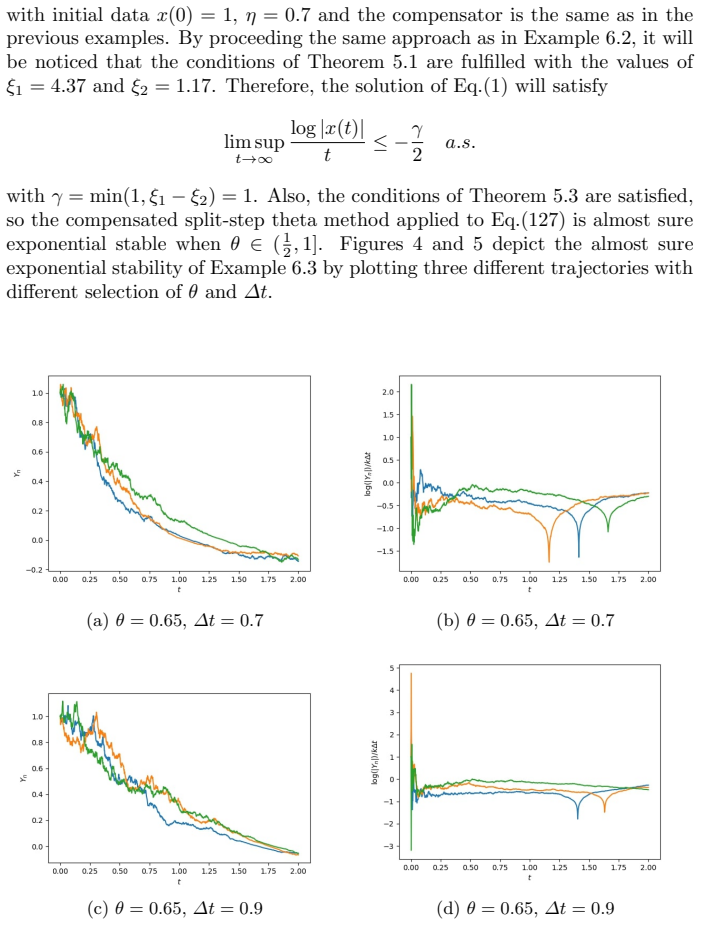
On the paper's own terms, the central discovery is that the compensated split-step theta method—a one-parameter family that includes compensated Euler–Maruyama at θ=0 and compensated split-step backward Euler at θ=1—preserves both strong convergence and long-time almost-sure exponential decay for the stochastic pantograph model with Poisson jumps. Theorem 4.1 states that lim_{Δt→0} E[sup_{0≤t≤T}|x(t)-Y(t)|^p] = 0 under local Lipschitz conditions. Theorems 5.2 and 5.3 state that limsup_{n→∞} log|Y_n|/(nΔt) ≤ -γ2/2 almost surely, where the decay rate γ2 is determined by drift-dominance conditions involving ξ1, ξ2, and the delay ratio η.
What carries the argument
The central object is the compensated split-step theta scheme (equations (6)–(7)), a one-parameter numerical method that performs an implicit correction of the drift and then an explicit update with Brownian and compensated Poisson increments. The delayed argument x(ηt) is handled by piecewise-constant interpolation to the nearest grid point from the left, producing the index [ηn]. The finite-time argument uses stopping times and Gronwall-type estimates over drift, diffusion, and jump terms. The stability argument is carried by a Lyapunov-type weighted-sum inequality (98) — which bounds the exponentially weighted delayed sum by a multiple of the undelayed weighted sum — together with the dis
Load-bearing premise
The stability theorems rest on inequality (98), which asserts that a weighted sum over delayed indices is controlled by a multiple of the same weighted sum without delay; that absorption requires both a bounded number of preimages under j↦[ηj] and no larger exponential weight on the delayed terms, and if either fails for η<1, the Lyapunov argument and Theorems 5.2–5.3 collapse.
What would settle it
Take η=0.2, Y*_j=1 for all j, and ζΔt=1; the left side of inequality (98) then contains terms e^{j+1} with j ranging up to n-1, while the right side is only about 6 times the partial sum up to [η(n-1)] ≈ 0.2n. For n large, the right side is smaller than the left by a factor of order e^{0.8n}, so a direct numerical evaluation of (98) for such n settles whether the key stability estimate holds.
If this is right
- For finite-horizon simulation, shrinking Δt drives the p-th moment error to zero, so the scheme can serve as a reliable path simulator for pantograph models with jumps under local Lipschitz coefficients.
- For long-time simulation, the numerical paths inherit almost sure exponential decay, meaning trajectories do not blow up and the scheme can be used to study asymptotic behavior.
- Setting θ=0 or θ=1 recovers the compensated Euler–Maruyama and compensated split-step backward Euler methods, so the convergence and stability results apply to both common variants.
- The sufficient stability condition is expressed directly in terms of the drift, diffusion, and jump coefficients (ξ1, ξ2, η), giving users an explicit check before running the scheme.
Where Pith is reading between the lines
- Because the stability condition involves the delay ratio η through the factor (1+[1/η]), the result suggests a general pattern: for proportional-delay equations, larger delay ratios demand stronger drift domination; quantifying the exact dependence for other delay mappings is a natural next step.
- The reported numerical rate γ2/2 is half the exact solution's guaranteed rate γ; a natural extension is to test numerically whether this factor 1/2 is sharp or an artifact of the proof technique.
- The same weighted Lyapunov argument should extend to stochastic pantograph models with Markov switching or multiple delays, provided the delay map has bounded preimage multiplicity and monotone exponential weights.
Editorial analysis
A structured set of objections, weighed in public.
Referee Report
Summary. The paper studies the stochastic pantograph equation with Poisson random measure, proposes a compensated split-step theta scheme, proves p-th moment convergence on finite intervals under local Lipschitz assumptions, and claims almost sure exponential stability of the numerical solution for theta in [0,1/2] and in (1/2,1] under Lyapunov-type conditions. The convergence part is a standard localization-plus-Gronwall argument. The stability proofs use a weighted Lyapunov inequality together with the discrete semimartingale convergence theorem. Numerical examples are provided for convergence rates and for almost sure exponential stability.
Significance. If the stability results were valid, the paper would extend split-step theta methods to pantograph jump models in a useful way. The convergence part is a technically involved but largely routine adaptation of known techniques and appears essentially sound, apart from an unstated moment assumption. The main new contribution, however, is the almost sure exponential stability of the numerical scheme, and that contribution is not established: the key delayed-sum estimate (98) is false, and both Theorem 5.2 and Theorem 5.3 depend on it. I therefore cannot recommend acceptance.
major comments (3)
- [Section 5, before Eq. (98)] The assertion before Eq. (98) that [ηj]=l ⇔ l≤j<l+1 is false. The correct preimage is l/η ≤ j < (l+1)/η. For η<1, j may be much larger than l, so the exponential weight e^{ζ(j+1)Δt} in the delayed sum can be larger than e^{ζ(l+1)Δt} by a factor growing with j−l. Concretely, take η=1/2, n=2l+2, and set Y*_l=Y*_{2l+1}=1, all other Y*=0. The left side of (98) is e^{ζ(2l+2)Δt}, while the right side is 3 e^{ζ(l+1)Δt}; for ζΔt>0 and l large the inequality fails. Since (98) is the key step converting the delayed sum into the undelayed sum in (99), Theorem 5.2 is not established.
- [Section 5, Theorem 5.3] The proof of Theorem 5.3 states that inequality (114) is obtained from (113) 'by proceeding by the same approach' used to get (99) from (97). That approach relies on the same incorrect delayed-sum bound (98), which is false for η<1. The coefficients in (114), in particular the term −2ξ2(1+[1/η])Δt, depend on that bound. Consequently Theorem 5.3 is also unsupported.
- [Section 4, Theorem 4.1] The theorem is stated under Assumption 2.1 only, but the proof uses Assumption 3.1 to bound E sup |x(t)|^ϱ and E sup |Y(t)|^ϱ in (62). Assumption 2.1, a local Lipschitz condition, does not by itself provide these moment bounds at the required order ϱ>p. Either state Assumption 3.1 (with uniform-in-p moment bounds) as a hypothesis of Theorem 4.1 or prove the needed bounds under the stated assumptions.
minor comments (5)
- [Eq. (91)] The first term on the right-hand side should involve |Y_n^*|^2, not |Y_n|^2; this is what Assumption 5.1 gives and what is needed for the coefficient A(ζ,Δt) in (95). As printed, Eq. (91) is internally inconsistent with the subsequent algebra.
- [Eq. (100)] The expression '1−[1/η]' in the numerator should read '1+[1/η]' to be consistent with (101) and with the hypothesis ξ1>ξ2(1+[1/η]).
- [Section 2] The sentence 'We have added that in the revised version' is a leftover from the submission process and should be removed.
- [Theorem 5.1] The proof is deferred to [17]. This dependence should be stated explicitly; as written, the theorem appears to be asserted without proof in the manuscript.
- [Eqs. (90) and (110)] The notation |\tilde N(ds,du)|^2 is informal; clarify that this refers to the quadratic variation of the compensated Poisson measure.
Circularity Check
No circular derivation: the stability proof gap is a correctness defect, not a circular reduction.
full rationale
The paper's derivation chain is not circular in the sense of the enumerated patterns. The convergence theorem (Theorem 4.1) is self-contained: it proceeds from Assumptions 2.1 and 4.1 through stopping times, moment bounds, Burkholder-Davis-Gundy and Kunita inequalities, and Gronwall's inequality to bound E sup |x-Y|^p. No fitted parameter is relabelled as a prediction, and the numerical examples are independent empirical checks, not inputs to the proofs. The stability section (Theorems 5.2 and 5.3) is an attempted Lyapunov/semi-martingale argument: the constants xi1, xi2, kappa1, kappa2 and zeta* are either hypotheses or solutions of explicitly defined algebraic equations; they are not fitted to the data. However, the proof of the key bound (98) is defective: the paper states that [eta j]=l iff l <= j < l+1, whereas the correct preimage is {j : l/eta <= j < (l+1)/eta}. For eta<1 the exponential weight e^{zeta(j+1)Delta t} on the delayed terms can exceed the corresponding undelayed weight by an unbounded factor, so the claimed reduction of the delayed weighted sum is false and Theorems 5.2 and 5.3 are not established. This is a genuine correctness gap, but it is not a circularity: the desired stability bound is not equivalent to an input by construction. Likewise, Theorem 5.1 delegates its proof to the external citation [17] by different authors, which may be a missing-proof or verification issue but is not self-citation load-bearing. No step in the paper reduces a 'prediction' to a fit or an ansatz, and no uniqueness claim is imported from the authors' own prior work. Hence the appropriate circularity score is 0.
Axiom & Free-Parameter Ledger
axioms (5)
- domain assumption Local Lipschitz condition with polynomial p-th moment Lipschitz for the jump coefficient (Assumption 2.1)
- domain assumption Existence of bounded p-th moments of exact and continuous-time approximate solutions (Assumption 3.1)
- domain assumption One-sided Lipschitz condition on the compensated drift \bar f (Assumption 3.2)
- domain assumption Global Lipschitz/linear growth for f, g, h (Assumption 4.1)
- domain assumption Dissipativity-type condition (Assumption 5.1) plus quadratic growth of \bar f (Eq. (85))
read the original abstract
Recently, stochastic pantograph models have gained an intensive attention and have been used in different fields such as finance, biology, control and stochastic neural networks. It is also more preferable to incorporate jumps during the study of stochastic differential equations. In this paper, stochastic pantograph model with Poisson random measure is studied. The compensated split-step theta technique is applied to the considered model. The numerical scheme exhibits a non divergent attitude and converges to the solution of our model under assumptions addressed later on. Furthermore, the almost sure exponential stability of the numerical scheme is investigated via utilizing the discrete semi-martingale convergence theorem. Finally, theoretical findings are manifested via some numerical examples.
Figures



Reference graph
Works this paper leans on
-
[1]
Agrawal and Y
N. Agrawal and Y. Hu. Jump models with delay—option pricing and log- arithmic Euler–Maruyama scheme.Mathematics, 8(11):1932–1953, 2020
1932
-
[2]
Ahmadian and O
D. Ahmadian and O. Farkhondeh Rouz. Exponential mean-square stabil- ity of numerical solutions for stochastic delay integro-differential equations with Poisson jump.Journal of Inequalities and Applications, 2020:1–33, 2020
2020
-
[3]
Albeverio, Z
S. Albeverio, Z. Brze´ zniak, and J.-L. Wu. Existence of global solutions and invariant measures for stochastic differential equations driven by Pois- son type noise with non-Lipschitz coefficients.Journal of Mathematical Analysis and Applications, 371(1):309–322, 2010
2010
-
[4]
Applebaum and M
D. Applebaum and M. Siakalli. Asymptotic stability of stochastic dif- ferential equations driven by L´ evy noise.Journal of Applied Probability, 46(4):1116–1129, 2009
2009
-
[5]
J. A. Appleby and E. Buckwar. Sufficient conditions for polynomial asymp- totic behaviour of the stochastic pantograph equation.arXiv preprint arXiv:1607.00423, 2016
Pith/arXiv arXiv 2016
-
[6]
Arriojas, Y
M. Arriojas, Y. Hu, S.-E. Mohammed, and G. Pap. A delayed Black and Scholes formula.Stochastic Analysis and Applications, 25(2):471–492, 2007
2007
-
[7]
Babasola, E
O. Babasola, E. O. Omondi, K. Oshinubi, and N. M. Imbusi. Stochastic delay differential equations: a comprehensive approach for understanding biosystems with application to disease modelling.AppliedMath, 3(4):702– 721, 2023. 31
2023
-
[8]
C. T. Baker and E. Buckwar. Continuousθ-methods for the stochastic pan- tograph equation.Electronic Transactions on Numerical Analysis, 11:131– 151, 2000
2000
-
[9]
Bao and L
X. Bao and L. Hu. Convergence and stability of split-stepθmethods for stochastic variable delay differential equations.International Journal of Computer Mathematics, 100(5):1171–1192, 2023
2023
-
[10]
R. F. Bass, K. Burdzy, and Z.-Q. Chen. Stochastic differential equations driven by stable processes for which pathwise uniqueness fails.Stochastic processes and their applications, 111(1):1–15, 2004
2004
-
[11]
Bruti-Liberati and E
N. Bruti-Liberati and E. Platen. Approximation of jump diffusions in fi- nance and economics.Computational Economics, 29:283–312, 2007
2007
-
[12]
Bruti-Liberati and E
N. Bruti-Liberati and E. Platen. Strong approximations of stochastic differ- ential equations with jumps.Journal of Computational and Applied Math- ematics, 205(2):982–1001, 2007
2007
-
[13]
Buckwar and M
E. Buckwar and M. G. Riedler. Runge–Kutta methods for jump–diffusion differential equations.Journal of Computational and Applied Mathematics, 236(6):1155–1182, 2011
2011
-
[14]
W. Cao, P. Hao, and Z. Zhang. Split-stepθ-method for stochastic delay differential equations.Applied Numerical Mathematics, 76:19–33, 2014
2014
-
[15]
Z. Fan, M. Liu, and W. Cao. Existence and uniqueness of the solutions and convergence of semi-implicit Euler methods for stochastic pantograph equa- tions.Journal of Mathematical Analysis and Applications, 325(2):1142– 1159, 2007
2007
-
[16]
Z. Fan, M. Song, and M. Liu. Theαth moment stability for the stochastic pantograph equation.Journal of Computational and Applied Mathematics, 233(2):109–120, 2009
2009
-
[17]
Guo and C.-J
P. Guo and C.-J. Li. Almost sure exponential stability of numerical solu- tions for stochastic pantograph differential equations.Journal of Mathe- matical Analysis and Applications, 460(1):411–424, 2018
2018
-
[18]
D. J. Higham. An algorithmic introduction to numerical simulation of stochastic differential equations.SIAM review, 43(3):525–546, 2001
2001
-
[19]
D. J. Higham and P. E. Kloeden. Numerical methods for nonlinear stochas- tic differential equations with jumps.Numerische Mathematik, 101(1):101– 119, 2005
2005
-
[20]
D. J. Higham, X. Mao, and A. M. Stuart. Strong convergence of Euler-type methods for nonlinear stochastic differential equations.SIAM Journal on Numerical Analysis, 40(3):1041–1063, 2002. 32
2002
-
[21]
D. G. Hobson and L. C. Rogers. Complete models with stochastic volatility. Mathematical Finance, 8(1):27–48, 1998
1998
-
[22]
Hu and S
L. Hu and S. Gan. Convergence and stability of the balanced methods for stochastic differential equations with jumps.International Journal of Computer Mathematics, 88(10):2089–2108, 2011
2089
-
[23]
Y. Hu. Semi-implicit{E}uler-{M}aruyama scheme for stiff stochastic equa- tions. InStochastic Analysis and Related Topics V: The Silivri Workshop, 1994, pages 183–202. Springer, 1996
1994
-
[24]
C. Huang. Mean square stability and dissipativity of two classes of theta methods for systems of stochastic delay differential equations.Journal of Computational and Applied Mathematics, 259:77–86, 2014
2014
-
[25]
Jacob, Y
N. Jacob, Y. Wang, and C. Yuan. Numerical solutions of stochastic differ- ential delay equations with jumps.Stochastic Analysis and Applications, 27(4):825–853, 2009
2009
-
[26]
S. G. Kou. A jump-diffusion model for option pricing.Management science, 48(8):1086–1101, 2002
2002
-
[27]
H. Kunita. Stochastic differential equations based on L´ evy processes and stochastic flows of diffeomorphisms.Real and Stochastic Analysis: New Perspectives, pages 305–373, 2004
2004
-
[28]
L. Liu, H. Mo, and F. Deng. Split-step theta method for stochastic de- lay integro-differential equations with mean square exponential stability. Applied Mathematics and Computation, 353:320–328, 2019
2019
-
[29]
Liu and Q
L. Liu and Q. Zhu. Mean square stability of two classes of theta method for neutral stochastic differential delay equations.Journal of Computational and Applied Mathematics, 305:55–67, 2016
2016
-
[30]
Maghsoodi
Y. Maghsoodi. Mean square efficient numerical solution of jump-diffusion stochastic differential equations.Sankhy¯ a: The Indian Journal of Statistics, Series A, pages 25–47, 1996
1996
-
[31]
Mao and X
W. Mao and X. Mao. Approximate solutions of hybrid stochastic pan- tograph equations with Levy jumps. InAbstract and Applied Analysis, volume 2013. Hindawi, 2013
2013
-
[32]
Mao.Stochastic differential equations and applications
X. Mao.Stochastic differential equations and applications. Elsevier, 2007
2007
-
[33]
Mao and C
X. Mao and C. Yuan.Stochastic differential equations with Markovian switching. Imperial college press, 2006
2006
-
[34]
X. Meng, S. Hu, and P. Wu. Pathwise estimation of stochastic differential equations with unbounded delay and its application to stochastic panto- graph equations.Acta Applicandae Mathematicae, 113:231–246, 2011. 33
2011
-
[35]
R. C. Merton. Option pricing when underlying stock returns are discontin- uous.Journal of financial economics, 3(1-2):125–144, 1976
1976
-
[36]
H. Mo, F. Deng, and C. Zhang. Exponential stability of the split-step θ-method for neutral stochastic delay differential equations with jumps. Applied Mathematics and Computation, 315:85–95, 2017
2017
-
[37]
J. R. Ockendon and A. B. Tayler. The dynamics of a current collection sys- tem for an electric locomotive.Proceedings of the Royal Society of London. A. Mathematical and Physical Sciences, 322(1551):447–468, 1971
1971
-
[38]
Ren and J
Y. Ren and J. Li. Stability and boundedness analysis of stochastic cou- pled systems with pantograph delay.International Journal of Control, 96(6):1389–1396, 2023
2023
-
[39]
Svishchuk and A
A. Svishchuk and A. Kalemanova. The stochastic stability of interest rates with jump changes.Theory of Probability and Mathematical Statistics, 48(61):161–172, 2000
2000
-
[40]
Tankov.Financial modelling with jump processes
P. Tankov.Financial modelling with jump processes. Chapman and Hall/CRC, 2003
2003
-
[41]
Vivek, E
D. Vivek, E. M. Elsayed, and K. Kanagarajan. Analysis of stochastic pan- tograph differential equations with generalized derivative of arbitrary order. e-Journal of Analysis and Applied Mathematics, 2022(1):24–32, 2023
2022
-
[42]
Wang and S
X. Wang and S. Gan. The improved split-step backward Euler method for stochastic differential delay equations.International Journal of Computer Mathematics, 88(11):2359–2378, 2011
2011
-
[43]
F. Wu, X. Mao, and L. Szpruch. Almost sure exponential stability of numerical solutions for stochastic delay differential equations.Numerische Mathematik, 115:681–697, 2010
2010
-
[44]
Yang and F
H. Yang and F. Jiang. Stochasticθ-methods for a class of jump-diffusion stochastic pantograph equations with random magnitude.The Scientific World Journal, 2014, 2014
2014
-
[45]
Zhang, S
H. Zhang, S. Gan, and L. Hu. The split-step backward Euler method for linear stochastic delay differential equations.Journal of Computational and Applied Mathematics, 225(2):558–568, 2009
2009
-
[46]
Zhang, Y
H. Zhang, Y. Xiao, and F. Guo. Convergence and stability of a numeri- cal method for nonlinear stochastic pantograph equations.Journal of the Franklin Institute, 351(6):3089–3103, 2014
2014
-
[47]
X. Zong, F. Wu, and C. Huang. Exponential mean square stability of the theta approximations for neutral stochastic differential delay equations. Journal of Computational and Applied Mathematics, 286:172–185, 2015. 34
2015
discussion (0)
Sign in with ORCID, Apple, or X to comment. Anyone can read and Pith papers without signing in.