REVIEW 3 major objections 4 minor 87 references
The paper argues that a kagome lattice with a quadratic band touching at 2/3 filling and repulsive interactions develops a hierarchy of zero-momentum orders, culminating in a d-wave altermagnetic ground state.
Reviewed by Pith at T0; open to challenge. T0 means a machine referee read the full paper against a public rubric. the ladder, T0–T4 →
At 2/3 filling, the repulsive kagome Hubbard model near its parabolic band touching develops loop-current, spin-loop-current, and altermagnetic order.
T0 review reviewed 2026-08-01 challenge →
load-bearing objection Solid FRG/SBMF study of a genuinely new kagome regime, but the altermagnetic ground-state claim outruns the SBMF ansatz, which cannot see the competing loop-current orders. the 3 major comments →
Exotic Electronic Order in a Parabolic Kagome Semimetal
The pith
A machine-rendered reading of the paper's core claim, the machinery that carries it, and where it could break.
The reading
Core claim
The paper's central claim is that the combination of a quadratic band touching at the kagome Γ point and repulsive interactions produces q=0 electronic order driven by cross-channel feedback. Antiferromagnetic exchange generated from Hubbard U promotes loop-current order at one loop, while spin-loop-current order requires one more loop; nearest-neighbor repulsion V inverts this hierarchy. Near particle-hole symmetry the d-wave spin-Pomeranchuk channel dominates with an algebraic divergence rather than a Stoner-like one, signaling strong coupling. Minimizing the free energy within the two-dimensional E2 representation of the point group, slave-boson mean-field selects the mirror-odd collinear
What carries the argument
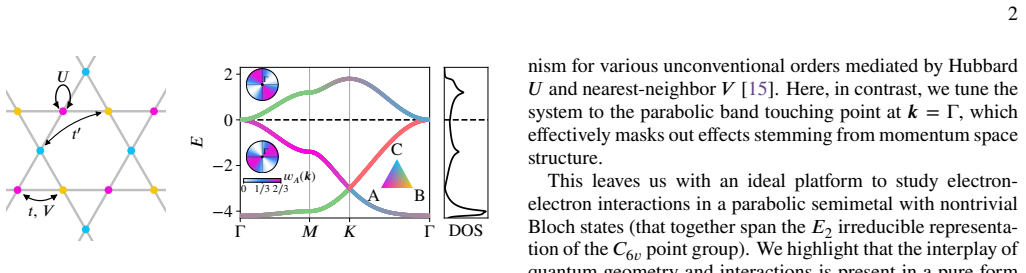
The two-dimensional E2 irreducible representation of the C6v point group at the Γ point, whose Bloch states carry the quadratic band touching. The orders live in this 2D irrep: loop-current and spin-loop-current are bond order parameters generated by cross-channel feedback from the antiferromagnetic exchange J (from U) or from nearest-neighbor V; spin-Pomeranchuk order has even and odd mirror basis vectors whose free-energy competition, evaluated in slave-boson mean field, selects the mirror-odd altermagnet while keeping the mirror-even compensated ferrimagnet nearly degenerate.
Load-bearing premise
The altermagnetic ground-state selection rests on a slave-boson mean-field ansatz with only local onsite variational fields, and the paper itself states this ansatz does not provide a complete variational description of the loop-current and spin-loop-current bond orders, which FRG finds as leading instabilities at nearby parameters.
What would settle it
Perform an unbiased numerical exact diagonalization or tensor-network calculation at t' = -1/3, U = 8, V = 0 on a large kagome cluster that includes bond-order parameters, and compare the energies of the AM, sFIM, LCO, and SLCO states; if any bond-ordered state lies below the altermagnet, the paper's central ground-state claim is false.
If this is right
- At intermediate coupling, the leading instabilities at q=0 are loop-current, spin-Pomeranchuk, and spin-loop-current order, so a quadratic band touching can replace Fermi-surface nesting as the ordering mechanism.
- The loop-current and spin-loop-current states fully gap the bands and produce isolated bands with nonzero (spin) Chern number, yielding topological order without translation symmetry breaking.
- The near-degeneracy of the mirror-odd altermagnet and mirror-even compensated ferrimagnet implies d-wave anisotropic spin-transport patterns rotated by π/4 relative to each other, a measurable signature.
- The paramagnet-to-altermagnet transition is second order, while transitions into the charge-density-wave state are first order; at large U and V the two orders coexist.
- Spontaneous altermagnetism can arise from purely repulsive Hubbard and nearest-neighbor interactions in a semimetal, with no spin-orbit coupling required.
Where Pith is reading between the lines
- The ordering mechanism is not tied to kagome-specific nesting: any lattice whose flat-band-induced quadratic touching carries a two-dimensional nontrivial representation could show analogous loop-current/altermagnet competition, making other parabolic semimetals candidate platforms.
- Because the AM and sFIM states are so close in energy, small perturbations—strain, additional hoppings, or disorder—could flip the selected mirror basis state, giving an experimental tuning knob.
- A direct check left open by the paper is computing the LCO/SLCO free energy in an unbiased variational space at the SBMF parameters; the local ansatz the paper uses cannot rule out a bond-ordered ground state.
- Materials with second-neighbor hopping around -0.3 times the nearest-neighbor hopping and intermediate Hubbard U, such as some transition-metal kagome metals, may be realistic hosts where spin-resolved photoemission or non-linear transport could detect the predicted altermagnetic spin splitting.
Editorial analysis
A structured set of objections, weighed in public.
Referee Report
Summary. The paper studies the generalized kagome Hubbard model at 2/3 filling with a negative second-neighbor hopping t', placing the Fermi level at a quadratic band-touching semimetal point. Combining truncated-unity functional renormalization group (TUFRG) and Kotliar-Ruckenstein slave-boson mean-field (SBMF), the authors map U–t' and U–V phase diagrams and report a hierarchy of q=0 instabilities: loop-current order (LCO), spin-loop-current order (SLCO), d-wave spin Pomeranchuk order (dSPOM), and d-wave charge Pomeranchuk order (dPOM). They interpret the dSPOM channel as leading to a spontaneous altermagnetic (AM) ground state, selected among E2-basis spin textures by SBMF free-energy minimization. The manuscript includes a diagrammatic argument for why AFM exchange drives LCO/SLCO, a power-law analysis of the dSPOM eigenvalue, and a transport calculation distinguishing AM from a symmetry-compensated ferrimagnet (sFIM). Appendix D explicitly discusses the inability of the local SBMF ansatz to describe LCO/SLCO bond orders.
Significance. If the central claim holds, the paper identifies a new and interesting platform for unconventional electronic order: a parabolic semimetallic kagome system where repulsive interactions favor loop-current, spin-loop-current, and altermagnetic orders without an extended Fermi surface. The FRG calculations are a strength: they use the open-source divERGe/TUFRG implementation with stated parameters (Appendix A), and the phase diagrams are computed from the model rather than obtained by assuming the target orders. The power-law scaling of the dSPOM eigenvalue and the doping sensitivity test are concrete, falsifiable diagnostics, and the transport signatures in Fig. 8 provide a useful experimental discriminator between the AM and sFIM states. However, the load-bearing claim that the ground state is an altermagnet rests on a restricted SBMF variational ansatz that cannot represent the LCO/SLCO bond orders that FRG finds as leading instabilities nearby, and no free-energy comparison against those orders is given. The AM/sFIM splitting is also reported only as 'very close' with no numerical values. These gaps currently prevent the manuscript from fully establishing its headline conclusion.
major comments (3)
- [Sec. IV B 2 and Appendix D] The statement in Sec. IV B 2 that the system's ground state 'within SBMF is always given by the mirror odd basis vector of E2 (i.e., the AM)' is load-bearing for the abstract and title. The free-energy comparison is performed only among local spin textures (AM, sFIM, 120-order), all inside the local Kotliar-Ruckenstein ansatz. Appendix D explicitly states this ansatz 'does not provide a complete variational description of the LCO and SLCO phases,' while FRG in Fig. 2 identifies LCO and SLCO as leading instabilities at nearby parameters and Sec. IV A 1 attributes them to the same AFM fluctuations that allegedly select AM. The paper never computes the energy of LCO or SLCO relative to AM. A bond-order state excluded from the variational space could have lower free energy. Additionally, the AM/sFIM splitting is described only as 'very close' with no numerical values, so the selection is del
- [Sec. IV A 2 and Fig. 5] The identification of the dSPOM region in the FRG phase diagram relies on an algebraic power-law growth λ_SPOM ~ Λ^{-α}, with α(t') obtained by fitting. The text states that a weak-coupling divergence is only recovered when the particle-particle channel is discarded, and that the full FRG flow features only a power-law growth. This makes the dSPOM 'phase' dependent on the flow-termination criterion (vertex eigenvalue > 30, Appendix A) rather than a true finite-scale divergence. The authors should show how the phase boundary changes with this threshold and justify that the algebraic growth, combined with SBMF, is sufficient to label this a phase in Fig. 2.
- [Sec. IV B 1, right panel of Fig. 6] The sentence 'This absence of an unstable regime further suggests that the saddle-point instability observed in the U–t' plane should not be interpreted as a signature of bond-ordered tendencies' is not logically supported. The absence of an unstable regime in the U–V plane is exactly what is expected from a local SBMF ansatz that cannot represent bond orders, as Appendix D explains. Using that absence as evidence against bond-order tendencies appears circular. This passage should be removed or rewritten to avoid implying that the ansatz's limitation constitutes a negative result about LCO/SLCO.
minor comments (4)
- [Fig. 2 caption and legend] In the right panel legend, the label 'SLCO' appears duplicated ('SLCOSLCO'). Please verify the legend and ensure each phase label appears once and matches the color coding.
- [Sec. IV A 2] The notation 'dSPOM' and 'dPOM' is used without an explicit definition of the 'd-wave' character at first occurrence; define these clearly, since the naming is central to the paper's message.
- [Appendix C] Equation (C1) is written as a general Kubo formula, but the subsequent text says the intraband Drude result is used. Clarify how the relaxation time τ replaces the infinitesimal broadening and whether any interband contribution is neglected in the curves shown in Fig. 8.
- [Sec. IV B 2] The phrase 'at large U and V, the system transitions into a coexistence regime of AM and CDW order' would benefit from specifying the parameter path and order-parameter definitions, since Fig. 6 shows different axes in the two panels.
Circularity Check
No significant circularity: phase diagram and order selection are computed from the model; ansatz limitations are explicit gaps, not self-referential reductions.
full rationale
The derivation is self-contained. The model in Eq. (1) is the input; FRG flows (Eqs. (3)-(6)) are integrated with standard TUFRG/divERGe and instabilities are read off as leading eigenvalues of the physical channels, with no parameter fitted to force LCO, SLCO, or AM. SBMF minimizes the Kotliar-Ruckenstein free energy over constrained local variational fields; the AM selection is a genuine free-energy comparison explicitly scoped as 'The system's ground state (within SBMF) is always given by the mirror odd basis vector of E2'. Appendix D transparently states the local ansatz 'does not provide a complete variational description of the LCO and SLCO phases found in FRG', so the missing LCO/SLCO competition is an acknowledged completeness/correctness gap, not a circular equivalence. The FRG identifications of (S)LCO are diagrammatic mechanisms (Fig. 3) computed from the same model rather than imported from a fit. Self-citations ([15], [43], [49], [52], [57], [64]) provide background, method references, or a deferred companion study; none supplies an unverified premise that forces the central claims. The deferral of SLCO phenomenology to Ref. [57] and the SBMF restriction to onsite order are flagged as limitations, but they do not reduce any prediction to its input.
Axiom & Free-Parameter Ledger
free parameters (2)
- dSPOM power-law exponent α(t′) (fitted) =
≈0.21–0.24 at U=8, peaking near t′=−1/3 (Fig. 5)
- Fierz decomposition parameter x =
0 (density–density decoupling)
axioms (4)
- domain assumption TUFRG truncation (form-factor cutoff at two lattice vectors, frequency-independent vertex, no self-energy flow) faithfully captures the leading instabilities, including the two-loop feedback separating SLCO from LCO.
- domain assumption The local Kotliar–Ruckenstein ansatz is sufficient to select the E2 ground state among spin/charge Pomeranchuk orders.
- domain assumption The two-band model (t, t′ only, no SOC, no longer-range terms) is an adequate description of parabolic kagome semimetals such as chromium-based kagome metals.
- domain assumption The algebraic growth λSPOM ∼ Λ^{−α} is a genuine precursor of strong-coupling altermagnetism rather than an artifact of the narrow fitting window or truncation.
Cite this review
Pith. "Pith review of Exotic Electronic Order in a Parabolic Kagome Semimetal." pith.science (2026). https://pith.science/paper/ZVB4D75U
@misc{pith2026260718389,
  author       = {Pith},
  title        = {Pith review of: Exotic Electronic Order in a Parabolic Kagome Semimetal},
  year         = {2026},
  howpublished = {\url{https://pith.science/paper/ZVB4D75U}},
  note         = {Machine review of arXiv:2607.18389}
}
read the original abstract
We study an interacting kagome-lattice realization of a quadratic band-touching semimetal at 2/3 filling with onsite and nearest-neighbor repulsive interactions. Combining functional renormalization group and slave-boson approaches, we map its phase diagram from intermediate to strong coupling and uncover a hierarchy of unconventional electronic orders. The leading instabilities comprise loop-current order, spontaneous altermagnetism arising from a spin-Pomeranchuk instability, and spin-loop-current order with distinctive and largely unexplored properties. We demonstrate how the interplay of band kinematics, electronic interactions, and quantum geometry governs the selection of these phases. Our findings establish quadratic band-touching semimetals as a promising platform for unconventional symmetry breaking and suggest analogous phenomena in other parabolic semimetals.
Figures


Reference graph
Works this paper leans on
-
[1]
3 we identify the lowest order diagrammatic con- tributions promoting the emergence of (S)LCO orders in the FRG
Spin and Charge loop current orders In Fig. 3 we identify the lowest order diagrammatic con- tributions promoting the emergence of (S)LCO orders in the FRG. For Hubbard-𝑈only (cf. left panel of Fig. 2), both rely on the underlying nearest-neighbor antiferromagnetic𝐽, but to different orders: The LCO is already supported on the 1- loop level when inserting...
-
[2]
2), we find a flow to strong coupling in the𝑑SPOM channel
Spin Pomeranchuk instability at particle hole symmetric filling In between the (S)LCO orders in the𝑡′–𝑈phase diagram (around𝑡 ′ = −1∕3, left panel of Fig. 2), we find a flow to strong coupling in the𝑑SPOM channel. In this region, cross- channelfeedbackpromotingtheloopcurrentphasesisheavily suppressed. Since the quadratic band touching point at𝒌=Γ becomes ...
-
[3]
Slave-Boson phase diagram The𝑈–𝑡 ′ phase diagram obtained from SBMF theory in Fig. 6 is dominated by flat-band ferromagnetism at small𝑡′, while a spin nematic phase (altermagnet, AM) appears for −𝑡′≳0.1, in agreement with the FM and𝑑SPOM phases fea- tured in the FRG phase diagram of Fig. 2. The mean-field of the spin nematic phase has the form(1,−1,0)in s...
-
[4]
Free energy comparison between different𝐸2 states EventhoughAMandCDWaswellastheirleadingscatter- ing contributions in Fig. 3(a,b) are related via crossing sym- metries𝐷↔𝐶(𝐽↔𝑉), it is interesting to note that the respective orders realize different basis states of the two di- mensional𝐸2irrepassociatedwiththetransition. TheCDWis givenbytheevenbasisvector[(...
-
[5]
Rev.102, 1030 (1956)
J.M.Luttinger,Quantumtheoryofcyclotronresonanceinsemi- conductors: General theory, Phys. Rev.102, 1030 (1956)
1956
-
[6]
A. A. Abrikosov and S. D. Beneslavskii, Possible existence of substances intermediate between metals and dielectrics, Soviet Journal of Experimental and Theoretical Physics32(1971)
1971
-
[7]
A. A. Abrikosov, Calculation of critical indices for zero-gap semiconductors, Soviet Journal of Experimental and Theoret- ical Physics39, 709 (1974)
1974
-
[8]
Kivelson and O
S. Kivelson and O. L. Chapman, Polyacene and a new class of quasi-one-dimensional conductors, Phys. Rev. B28, 7236 (1983)
1983
-
[9]
Karakonstantakis, L
G. Karakonstantakis, L. Liu, R. Thomale, and S. A. Kivelson, Correlations and renormalization of the electron-phonon cou- pling in the honeycomb hubbard ladder and superconductivity in polyacene, Phys. Rev. B88, 224512 (2013)
2013
-
[10]
Schmitteckert, R
P. Schmitteckert, R. Thomale, R. Korytár, and F.Evers, Incom- mensurate quantum-size oscillations in acene-based molecular wires—effects of quantum fluctuations, The Journal of Chemi- cal Physics146, 092320 (2017)
2017
-
[11]
K.Sun,H.Yao,E.Fradkin,andS.A.Kivelson,Topologicalin- sulatorsandnematicphasesfromspontaneoussymmetrybreak- ing in 2d fermi systems with a quadratic band crossing, Phys. Rev. Lett.103, 046811 (2009)
2009
-
[12]
B.Dóra,I.F.Herbut,andR.Moessner,Occurrenceofnematic, topological, and berry phases when a flat and a parabolic band touch, Phys. Rev. B90, 045310 (2014)
2014
-
[13]
J.Ingham,T.Li,M.S.Scheurer,andH.D.Scammell,Quadratic dirac fermions and the competition of ordered states in twisted bilayer graphene, arXiv:2308.00748 (2023)
Pith/arXiv arXiv 2023
-
[14]
E.McCannandV.I.Fal’ko,Landau-leveldegeneracyandquan- tumhalleffectinagraphitebilayer,Phys.Rev.Lett.96,086805 (2006)
2006
-
[15]
Vafek and K
O. Vafek and K. Yang, Many-body instability of coulomb in- teracting bilayer graphene: Renormalization group approach, Phys. Rev. B81, 041401(R) (2010)
2010
-
[16]
Neupert, M
T. Neupert, M. M. Denner, J.-X. Yin, R. Thomale, and M. Z. Hasan, Charge order and superconductivity in kagome materi- als, Nature Physics18, 137 (2022)
2022
-
[17]
Di Sante, T
D. Di Sante, T. Neupert, G. Sangiovanni, R. Thomale, R. Comin, J. G. Checkelsky, I. Zeljkovic, and S. D. Wilson, Kagome metals, Rev. Mod. Phys.98, 015002 (2026)
2026
-
[18]
M.R.Norman,Colloquium: Herbertsmithiteandthesearchfor the quantum spin liquid, Rev. Mod. Phys.88, 041002 (2016)
2016
-
[19]
M. L. Kiesel and R. Thomale, Sublattice interference in the kagome hubbard model, Phys. Rev. B86, 121105(R) (2012)
2012
-
[20]
M. L. Kiesel, C. Platt, and R. Thomale, Unconventional fermi surface instabilities in the kagome hubbard model, Phys. Rev. Lett.110, 126405 (2013)
2013
-
[21]
B. R. Ortiz, L. C. Gomes, J. R. Morey, M. Winiarski, M. Bor- delon, J. S. Mangum, I. W. H. Oswald, J. A. Rodriguez-Rivera, J. R. Neilson, S. D. Wilson, E. Ertekin, T. M. McQueen, and E. S. Toberer, New kagome prototype materials: discovery ofkv 3sb5,rbv3sb5, andcsv 3sb5, Phys. Rev. Mater.3, 094407 (2019)
2019
-
[22]
Schueller, A
B.R.Ortiz,S.M.L.Teicher,Y.Hu,J.L.Zuo,P.M.Sarte,E.C. Schueller, A. M. M. Abeykoon, M. J. Krogstad, S. Rosenkranz, R. Osborn, R. Seshadri, L. Balents, J. He, and S. D. Wilson, Csv3sb5: A𝕫2 topological kagome metal with a superconduct- ing ground state, Phys. Rev. Lett.125, 247002 (2020)
2020
-
[23]
L. Ye, M. Kang, J. Liu, F. von Cube, C. R. Wicker, T. Suzuki, C. Jozwiak, A. Bostwick, E. Rotenberg, D. C. Bell, L. Fu, R. Comin, and J. G. Checkelsky, Massive dirac fermions in a ferromagnetic kagome metal, Nature555, 638 (2018)
2018
-
[24]
Mielke, D
C. Mielke, D. Das, J. X. Yin, H. Liu, R. Gupta, Y. X. Jiang, M. Medarde, X. Wu, H. C. Lei, J. Chang, P. Dai, Q. Si, H. Miao, R. Thomale, T. Neupert, Y. Shi, R. Khasanov, M. Z. Hasan,H.Luetkens,andZ.Guguchia,Time-reversalsymmetry- breakingchargeorderinakagomesuperconductor,Nature602, 245 (2022)
2022
-
[25]
I. I. Mazin, H. O. Jeschke, F. Lechermann, H. Lee, M. Fink, R.Thomale,andR.Valentí,Theoreticalpredictionofastrongly correlateddiracmetal,NatureCommunications5,4261(2014)
2014
-
[26]
Mielke and H
A. Mielke and H. Tasaki, Ferromagnetism in the Hubbard model, Communications in Mathematical Physics158, 341 (1993)
1993
-
[27]
D.L.Bergman,C.Wu,andL.Balents,Bandtouchingfromreal- space topology in frustrated hopping models, Phys. Rev. B78, 125104 (2008)
2008
-
[28]
C. H. Lee, D. P. Arovas, and R. Thomale, Band flatness opti- mization through complex analysis, Phys. Rev. B93, 155155 (2016)
2016
-
[29]
Rhim and B.-J
J.-W. Rhim and B.-J. Yang, Classification of flat bands accord- ing to the band-crossing singularity of bloch wave functions, Phys. Rev. B99, 045107 (2019)
2019
-
[30]
Liu, Z.-Y
Y. Liu, Z.-Y. Liu, J.-K. Bao, P.-T. Yang, L.-W. Ji, S.-Q. Wu, Q.-X. Shen, J. Luo, J. Yang, J.-Y. Liu, C.-C. Xu, W.-Z. Yang, W.-L. Chai, J.-Y. Lu, C.-C. Liu, B.-S. Wang, H. Jiang, Q. Tao, Z. Ren, X.-F. Xu, C. Cao, Z.-A. Xu, R. Zhou, J.-G. Cheng, and G.-H. Cao, Superconductivity under pressure in a chromium- based kagome metal, Nature632, 1032 (2024)
2024
-
[31]
L. Liu, Y. Li, H. Tan, Y. Liu, K. Sun, Y. Shi, Y. Zhai, H. Lin, G. Cao, B. Yan, X. Chen, T. Wu, G.-M. Zhang, and L. Yang, Unravelingintertwinedordersinthestronglycorrelatedkagome metal cscr3sb5, National Science Review , nwag044 (2026)
2026
-
[32]
M. Crispino, N. Witt, S. Enzner, T. Gorni, L. de’ Medici, D. D. Sante, and G. Sangiovanni, Tunable electronic correlations in 135-kagome metals, arXiv:2512.22576 (2025)
arXiv 2025
-
[33]
M. Chatzieleftheriou, J. B. Profe, Y. Li, and R. Valentí, Pres- suretuningofelectroniccorrelationsandflatbandsincscr 3sb5, arXiv:2601.14439 (2026)
arXiv 2026
-
[34]
Metzner, M
W. Metzner, M. Salmhofer, C. Honerkamp, V. Meden, and K. Schönhammer, Functional renormalization group approach to correlated fermion systems, Rev. Mod. Phys.84, 299 (2012)
2012
-
[35]
C.Platt,W.Hanke,andR.Thomale,Functionalrenormalization group for multi-orbital fermi surface instabilities, Advances in Physics62, 453 (2013)
2013
-
[36]
Dupuis, L
N. Dupuis, L. Canet, A. Eichhorn, W. Metzner, J. Pawlowski, M. Tissier, and N. Wschebor, The nonperturbative functional renormalizationgroupanditsapplications,PhysicsReports910, 1 (2021)
2021
-
[37]
Lichtenstein, D
J. Lichtenstein, D. Sánchez de la Peña, D. Rohe, E. Di Napoli, C. Honerkamp, and S. Maier, High-performance functional renormalization group calculations for interacting fermions, Computer Physics Communications213, 100 (2017)
2017
-
[38]
J.Beyer,J.B.Profe,andL.Klebl,Referenceresultsforthemo- mentumspacefunctionalrenormalizationgroup,TheEuropean Physical Journal B95, 65 (2022)
2022
-
[39]
Salmhofer and C
M. Salmhofer and C. Honerkamp, Fermionic Renormalization Group Flows: Technique and Theory, Progress of Theoretical Physics105, 1 (2001)
2001
-
[40]
Husemann and M
C. Husemann and M. Salmhofer, Efficient parametrization of the vertex function,Ωscheme, and the𝑡,𝑡 ′ hubbard model at 14 van hove filling, Phys. Rev. B79, 195125 (2009)
2009
-
[41]
J. B. Profe and D. M. Kennes, TU2FRG: A scalable approach for truncated unity functional renormalization group in generic fermionic models, The European Physical Journal B95, 60 (2022)
2022
-
[42]
J. B. Profe, D. M. Kennes, and L. Klebl, divERGe implements various Exact Renormalization Group examples, SciPost Phys. Codebases , 26 (2024)
2024
-
[43]
J. B. Profe, D. M. Kennes, and L. Klebl, Codebase release 0.5 for divERGe, SciPost Phys. Codebases , 26 (2024)
2024
-
[44]
Kotliar and A
G. Kotliar and A. E. Ruckenstein, New functional integral ap- proach to strongly correlated fermi systems: The gutzwiller ap- proximationasasaddlepoint,PhysicalReviewLetters57,1362 (1986)
1986
-
[45]
R.FrésardandG.Kotliar,Interplayofmotttransitionandferro- magnetism in the orbitally degenerate hubbard model, Physical Review B56, 12909 (1997)
1997
-
[46]
Lechermann, A
F. Lechermann, A. Georges, G. Kotliar, and O. Parcollet, Ro- tationally invariant slave-boson formalism and momentum de- pendence of the quasiparticle weight, Physical Review B76, 155102 (2007)
2007
-
[47]
Riegler, M
D. Riegler, M. Klett, T. Neupert, R. Thomale, and P. Wölfle, Slave-boson analysis of the two-dimensional hubbard model, Physical Review B101, 235137 (2020)
2020
-
[48]
Seufert, D
J. Seufert, D. Riegler, M. Klett, R. Thomale, and P. Wölfle, Breakdownofchargehomogeneityinthetwo-dimensionalhub- bard model: Slave-boson study of magnetic order, Physical Re- view B103, 165117 (2021)
2021
-
[49]
Riegler, J
D. Riegler, J. Seufert, E. H. da Silva Neto, P. Wölfle, R. Thomale, and M. Klett, Interplay of spin and charge order in the electron-doped cuprates, Phys. Rev. B108, 195141 (2023)
2023
-
[50]
J. Issing, M. Dürrnagel, S. Mazumdar, A. Lorenz, N. Witt, G. Sangiovanni, M. Klett, L. Klebl, R. Thomale, and J. Seufert, Altermagnons at the metal-insulator transition, arXiv:2605.11669 (2026)
Pith/arXiv arXiv 2026
-
[51]
M. D. Johannes and I. I. Mazin, Fermi surface nesting and the origin of charge density waves in metals, Phys. Rev. B77, 165135 (2008)
2008
-
[52]
J. Beck, J. Bodky, M. Dürrnagel, R. Thomale, J. Ingham, L. Klebl, and H. Hohmann, Kekulé order from diffuse nesting nearhigher-ordervanhovepoints,Phys.Rev.Lett.136,106503 (2026)
2026
-
[53]
J. B. Profe, L. Klebl, F. Grandi, H. Hohmann, M. Dürrnagel, T. Schwemmer, R. Thomale, and D. M. Kennes, Kagome hub- bard model from a functional renormalization group perspec- tive, Phys. Rev. Res.6, 043078 (2024)
2024
-
[54]
A.Wenger,A.Consiglio,H.Hohmann,M.Dürrnagel,F.O.von Rohr,H.D.Scammell,J.Ingham,D.DiSante,andR.Thomale, Theory of unconventional magnetism in a cu-based kagome metal, Phys. Rev. B112, 214416 (2025)
2025
-
[55]
W.-S.Wang,Z.-Z.Li,Y.-Y.Xiang,andQ.-H.Wang,Competing electronic orders on kagome lattices at van hove filling, Phys. Rev. B87, 115135 (2013)
2013
-
[56]
J. Zhan, H. Hohmann, M. Dürrnagel, R. Fu, S. Zhou, Z. Wang, R. Thomale, X. Wu, and J. Hu, Loop current order on the kagome lattice, Phys. Rev. Lett.136, 126001 (2026)
2026
-
[57]
C. Bigi, M. Dürrnagel, L. Klebl, A. Consiglio, G. Pokharel, M.Zonno,F.Bertran,P.LeFèvre,T.Jaouen,H.C.Tchouekem, P.Turban,A.DeVita,J.A.Miwa,J.W.Wells,D.Oh,R.Comin, R. Thomale, I. Zeljkovic, B. R. Ortiz, S. D. Wilson, G. Sangio- vanni, F. Mazzola, and D. Di Sante, Pomeranchuk instability fromelectroniccorrelationsinCsTi3Bi5kagomemetal,Nature Communications1...
2026
-
[58]
Jiang, J.-X
Y.-X. Jiang, J.-X. Yin, M. M. Denner, N. Shumiya, B. R. Or- tiz, G. Xu, Z. Guguchia, J. He, M. S. Hossain, X. Liu, J. Ruff, L. Kautzsch, S. S. Zhang, G. Chang, I. Belopolski, Q. Zhang, T. A. Cochran, D. Multer, M. Litskevich, Z.-J. Cheng, X. P. Yang,Z.Wang,R.Thomale,T.Neupert,S.D.Wilson,andM.Z. Hasan,Unconventionalchiralchargeorderinkagomesupercon- ductor...
2021
-
[59]
Wang, Y.-X
Z. Wang, Y.-X. Jiang, J.-X. Yin, Y. Li, G.-Y. Wang, H.-L. Huang, S. Shao, J. Liu, P. Zhu, N. Shumiya, M. S. Hossain, H. Liu, Y. Shi, J. Duan, X. Li, G. Chang, P. Dai, Z. Ye, G. Xu, Y. Wang, H. Zheng, J. Jia, M. Z. Hasan, and Y. Yao, Elec- tronicnatureofchiralchargeorderinthekagomesuperconduc- torCsv 3sb5, Phys. Rev. B104, 075148 (2021)
2021
-
[60]
M. M. Denner, R. Thomale, and T. Neupert, Analysis of charge order in the kagome metal𝑎v3sb5 (𝑎= K,Rb,Cs), Phys. Rev. Lett.127, 217601 (2021)
2021
-
[61]
J.Ingham,L.Klebl,R.Thomale,andH.D.Scammell,Spinloop current order in the kagome lattice,in preparation(2026)
2026
-
[62]
Jérome, T
D. Jérome, T. M. Rice, and W. Kohn, Excitonic insulator, Phys. Rev.158, 462 (1967)
1967
-
[63]
S.UebelackerandC.Honerkamp,Instabilitiesofquadraticband crossing points, Phys. Rev. B84, 205122 (2011)
2011
-
[64]
T.KanekoandY.Ohta,ANewEraofExcitonicInsulators,Jour- nal of the Physical Society of Japan94, 012001 (2025)
2025
-
[65]
Y. He, K. Yang, J. B. Profe, E. J. Bergholtz, and D. M. Kennes, Superconductivityofrepulsivespinlessfermionswithsublattice potentials, Phys. Rev. Res.5, L012009 (2023)
2023
-
[66]
Blanco Peces and J
A. Blanco Peces and J. Merino, Altermagnetism in an inter- acting model of kagome materials, Phys. Rev. B113, 165143 (2026)
2026
-
[67]
Klett, J
M. Klett, J. Beyer, D. Riegler, J. Seufert, P. Wölfle, S. Rachel, andR.Thomale,Incommensuratemagneticorder: Afingerprint for electronic correlations in hole-doped cuprates, Phys. Rev. B 110, 085104 (2024)
2024
-
[68]
Dürrnagel, H
M. Dürrnagel, H. Hohmann, A. Maity, J. Seufert, M. Klett, L. Klebl, and R. Thomale, Altermagnetic Phase Transition in a Lieb Metal, Physical Review Letters135, 036502 (2025)
2025
-
[69]
Šmejkal, J
L. Šmejkal, J. Sinova, and T. Jungwirth, Beyond conventional ferromagnetism and antiferromagnetism: A phase with nonrel- ativistic spin and crystal rotation symmetry, Phys. Rev. X12, 031042 (2022)
2022
-
[70]
Šmejkal, J
L. Šmejkal, J. Sinova, and T. Jungwirth, Emerging research landscape of altermagnetism, Phys. Rev. X12, 040501 (2022)
2022
-
[71]
M. Roig, A. Kreisel, Y. Yu, B. M. Andersen, and D. F. Agter- berg, Minimal models for altermagnetism, Phys. Rev. B110, 144412 (2024)
2024
-
[72]
J. M. Luttinger, Fermi surface and some simple equilibrium properties of a system of interacting fermions, Phys. Rev.119, 1153 (1960)
1960
-
[73]
Wurmehl, H
S. Wurmehl, H. C. Kandpal, G. H. Fecher, and C. Felser, Va- lenceelectronrulesforpredictionofhalf-metalliccompensated- ferrimagnetic behaviour of heusler compounds with complete spin polarization, Journal of Physics: Condensed Matter18, 6171 (2006)
2006
-
[74]
I.Mazin(ThePRXEditors),Editorial: Altermagnetism—anew punchlineoffundamentalmagnetism,Phys.Rev.X12,040002 (2022)
2022
-
[75]
Liu, S.-D
Y. Liu, S.-D. Guo, Y. Li, and C.-C. Liu, Two-dimensional fullycompensatedferrimagnetism,Phys.Rev.Lett.134,116703 (2025)
2025
-
[76]
Z.Xiao,J.Zhao,Y.Li,R.Shindou,andZ.-D.Song,Spinspace groups: Full classification and applications, Phys. Rev. X14, 031037 (2024)
2024
-
[77]
C. Guo, G. Wagner, C. Putzke, D. Chen, K. Wang, L. Zhang, M.Gutierrez-Amigo,I.Errea,M.G.Vergniory,C.Felser,M.H. 15 Fischer, T. Neupert, and P. J. W. Moll, Correlated order at the tippingpointinthekagomemetalCsV3Sb5,NaturePhysics20, 579 (2024)
2024
-
[78]
Tazai, Y
R. Tazai, Y. Yamakawa, and H. Kontani, Charge-loop current order andZ3 nematicitymediated bybond orderfluctuations in kagome metals, Nature Communications14, 7845 (2023)
2023
-
[79]
R.Kubo,Statistical-mechanicaltheoryofirreversibleprocesses. i. general theory and simple applications to magnetic and con- duction problems, Journal of the Physical Society of Japan12, 570 (1957)
1957
-
[80]
D.A.Greenwood,Theboltzmannequationinthetheoryofelec- tricalconductioninmetals,ProceedingsofthePhysicalSociety 71, 585 (1958)
1958
This paper was first reviewed by deepseek-v4-flash on August 1, 2026.
discussion (0)
Sign in with ORCID, Apple, or X to comment. Anyone can read and Pith papers without signing in.