REVIEW 3 major objections 4 minor 57 references
Monolithic printed-circuit board RF-trap for electrons
T0 review · 3 major / 4 minor · reviewed 2026-08-01 · deepseek-v4-flash
Pith's one-line read Electrons can be confined in a linear Paul trap fabricated from a single printed circuit board, with measured lifetimes of 2.13 ms and secular frequencies up to 90 MHz.
desk verdict A real engineering advance in trapped-electron Paul traps: the single-PCB design is new and the characterization is honest, though the central claim would be stronger with an RF-off control and a stability argument for why Ca+ is not trapped. read the letter →
The pith
A machine-rendered reading of the paper's core claim, the machinery that carries it, and where it could break.
The reading
What carries the argument
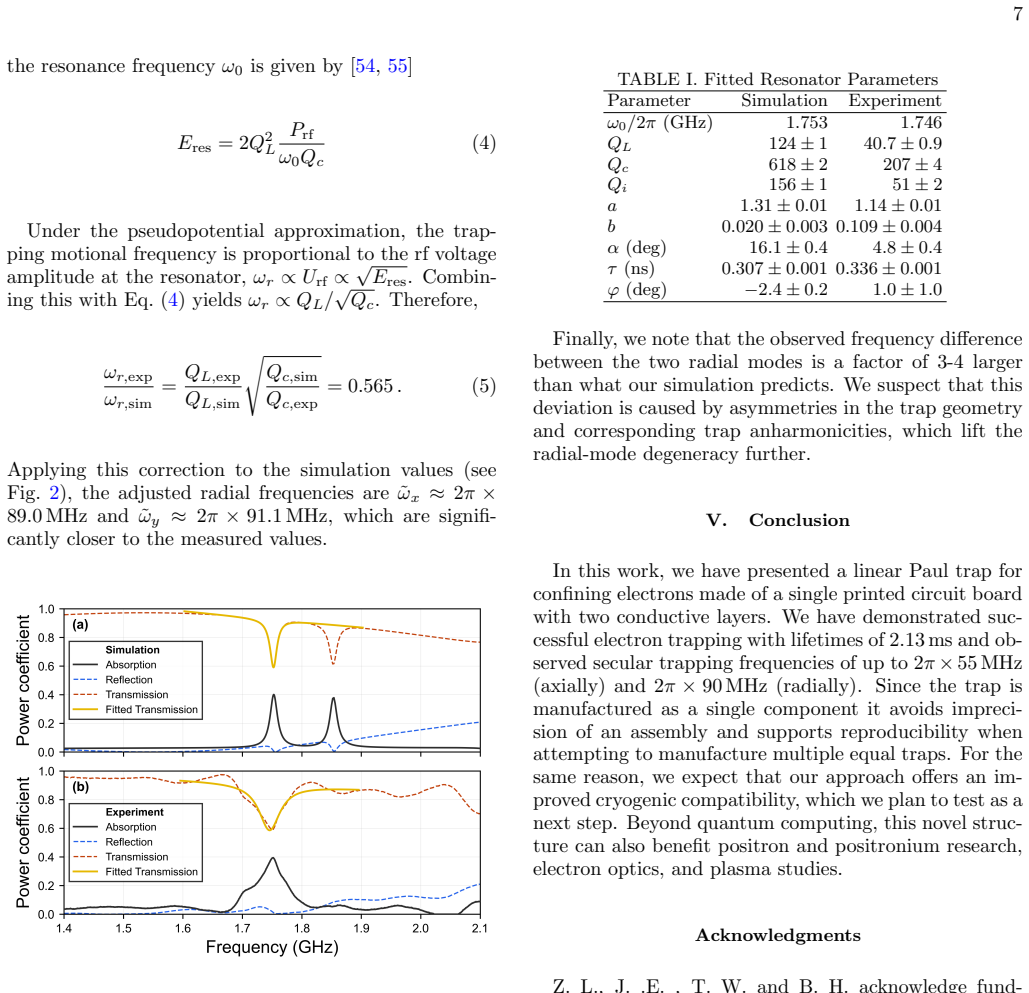
The load-bearing element is the monolithic PCB trap: a half-wave coplanar RF resonator capacitively coupled to a feedline, with a slotted pad at its end surrounded by four rows of DC electrodes on the two board layers. The RF pseudopotential provides radial confinement; the DC electrodes provide axial confinement, tickle excitation, and extraction pulses. The quantitative link between the resonator quality factors (loaded Q_L ≈ 40.7, coupling Q_c ≈ 207 experimentally) and the stored RF energy gives a correction factor that reconciles simulated and measured secular frequencies.
What would settle it
Measure the charge-to-mass ratio of the particles reaching the MCP—for instance by observing their time-of-flight after the extraction pulse through a known electric field, or by detecting cyclotron motion in an external magnetic field. A ratio differing from the electron's value by more than the experimental uncertainty would refute the claim that these are trapped electrons.
Extended reading notes
Core claim
The central claim is that electrons can be confined in a linear Paul trap whose electrodes and RF resonator are defined by a single printed circuit board with two conductive copper layers and a plated slit at the trap center. The RF drive at 1.732 GHz produces a pseudopotential that confines the electrons radially, while ten DC electrodes per layer supply axial confinement, stray-field compensation, and readout pulses. The paper reports a measured lifetime of τ = 2.13 ± 0.27 ms and radial secular frequencies up to 2π×90 MHz, and it attributes the reduction from simulated values to the finite loaded quality factor of the on-board resonator, verified through S-parameter measurements.
Load-bearing premise
The MCP counts in the waiting and extraction phases are assumed to come from electrons that were actually confined by the RF pseudopotential; if the signals were due to unconfined or non-electronic charged particles, the lifetime and frequency measurements would not support the central claim.
Editorial extensions
If this is right
- Because the trap is a single manufactured part, multiple copies can be produced with nominally identical electrode geometry, removing assembly-induced misalignment.
- The observed secular frequencies—up to 90 MHz radially—are roughly an order of magnitude above typical ion-trap frequencies, supporting the proposal that electron qubits could permit faster gates.
- The single-body design is expected to be compatible with cryogenic operation, a necessary step for electron cooling and spin readout.
- The reported lifetime of 2.13 ms and the frequency-versus-voltage scalings (with square-root behavior in both DC voltage and RF power) give a clean baseline for future compensation and cooling work.
- The trap architecture can be transferred to positron/positronium research, electron optics, and plasma studies, as the authors note.
Reading between the lines
- If active cooling were added (for example by lowering the environment temperature), the 2.13 ms lifetime, which the paper attributes to uncooled hot electrons leaving the trap, could plausibly lengthen by orders of magnitude—an improvement the authors anticipate but do not establish.
- The measured frequency shortfall relative to simulation, traced to the resonator coupling efficiency, implies that improving the impedance match alone could raise trap depth without changing electrode geometry, giving a concrete engineering lever.
- The monolithic layout naturally extends to multi-zone or segmented traps for shuttling electrons, in the spirit of QCCD ion processors, by patterning additional DC electrode sets on the same board.
- A decisive check on whether the detected particles are truly electrons would be a direct charge-to-mass measurement (e.g., time-of-flight in a known field or cyclotron frequency in a magnetic field); this is not done in the paper and would close the main interpretive gap.
Signed reviews
Editorial analysis
A structured set of objections, weighed in public.
Referee Report
Summary. The manuscript reports a linear Paul trap for electrons fabricated from a single printed circuit board, with an on-board half-wave RF resonator and 20 DC electrodes. Electrons are loaded by two-photon photoionization of a calcium beam and detected by an MCP. The authors measure a trapped-electron lifetime of 2.13 ms from the decay of an MCP survival signal and observe tickle-induced resonances at 40–55 MHz (axial) and 44–90 MHz (radial). Finite-element simulations of the pseudopotential predict radial frequencies of about 157–161 MHz at 36 dBm; the authors apply a Q-factor correction based on fitted resonator parameters to reduce the simulated values to about 89–91 MHz and thereby bring them closer to the measured data. The radial-mode splitting remains 3–4 times larger in the experiment than in simulation.
Significance. If the observed MCP counts and tickle resonances truly originate from electrons confined by the RF pseudopotential, the work is a useful engineering demonstration of a monolithic PCB electron Paul trap, with potential advantages for reproducibility and cryogenic integration. The measurements are direct, use substantial statistics, and the paper is transparent about the lifetime limitation and the radial-frequency discrepancy. The Q-factor correction of Eq. (5) is an independent characterization rather than a fit to the target frequencies, which is a strength. However, the central claim of RF confinement is under-tested because no RF-off control is reported, and the particle-identity argument relies on an unsupported statement about the instability of the trap for Ca+ ions. These issues are fixable but currently leave the main conclusion conditional.
major comments (3)
- [Section III.B and IV.A; Fig. 5] The claim that electrons are confined by the RF pseudopotential rests on MCP counts in the loading, waiting, and extraction phases, and on tickle resonances in the lost/survival signals. No control experiment with the RF drive off or strongly detuned is reported. Without such a control, one cannot exclude that the survival signal and the tickle resonances arise from a DC potential well, from particles not confined by the RF field, or from electronic pickup/artefacts. I request a simple control: repeat the loading/waiting/extraction sequence with the RF drive off, and show that both the waiting-phase loss signal and the extraction-phase survival signal, as well as the tickle resonances, disappear or shift in the expected way. This is load-bearing for the central claim.
- [Section III.A] The sentence 'the remaining calcium ion is not trapped since the trap is unstable for the heavy calcium ion' is unsupported and, if read literally, is not correct: in a Paul trap the Mathieu q parameter is proportional to q/m, so for fixed RF amplitude and frequency a Ca+ ion has a much smaller q and is deep inside the first stability region. The practical issue is that the pseudopotential depth and secular frequency scale as 1/m, so a heavy ion would be very weakly confined at room temperature. Please provide the relevant Mathieu q, secular frequency, and pseudopotential depth for Ca+ under the operating conditions. The measured 20–140 MHz secular frequencies already strongly support electron-mass particles; making that argument explicitly would strengthen the particle-identity claim.
- [Section IV.B; Fig. 7; final paragraph] The observed splitting between the two radial modes is a factor of 3–4 larger than the simulation predicts, and the manuscript attributes this to 'asymmetries in the trap geometry and corresponding trap anharmonicities' without any quantitative model. Since the radial frequency measurements are among the principal results and the comparison with simulation is used to validate the trap model, this unexplained discrepancy should be addressed—either by a refined simulation that includes the suspected asymmetries or by an explicit estimate of the anharmonic splitting expected from the manufacturing tolerances. At minimum, the impact of this discrepancy on the quoted radial frequencies and on the validity of the Q-factor correction should be discussed quantitatively.
minor comments (4)
- [Section IV heading] The heading 'Motional T rap F requencies' has stray spacing; should read 'Motional Trap Frequencies'.
- [Throughout] Several instances of 'custom-build' should be 'custom-built' (e.g., Section III.B).
- [Section II.B and IV.B] Equations (1) and (2) use fitted offsets o_ax and o_ra with implicit units; the text should state explicitly that these are phenomenological offsets and clarify the units used in the fitting.
- [References] Some reference entries have inconsistent formatting, e.g., Refs. [2] and [7] have 'Nature 2002 417:6890' and 'Nature 2022 605:46' in an abbreviated style; please standardize journal titles and year placement.
Circularity Check
No significant circularity: central measurements are direct observations or independently characterized.
full rationale
The central claims—trapped electron lifetime of 2.13 ms and secular frequencies up to 90 MHz—are direct MCP and tickle-resonance measurements. The Q-factor correction in Eq. (5) is not circular: it rescales simulated radial frequencies using resonator parameters (QL, Qc) extracted from S21 fits that are independent of the measured secular frequencies, so the correction is not fitted to the target result. The finite-element pseudopotential simulation in Sec. II.B has stated inputs (geometry, applied RF power, resonance frequency) and outputs that are compared with experiment as an external check. The only citations to prior work are contextual (design provenance from [43], scaling form from [1]) and do not supply the central result. The absence of an RF-off control is an experimental-support gap concerning particle identity, but it is not a circularity: no equation or fitted parameter is defined in terms of the claimed outcome. Thus no circular steps were identified.
Assumptions & free parameters
free parameters (7)
- alpha_ax =
90.68 MHz/(sqrt(V/mm))
- o_ax =
0.04 V/mm^2
- alpha_ra (branch b) =
40.43 MHz/sqrt(W)
- o_ra (branch b) =
1.03 W
- alpha_ra (branch c) =
41.44 MHz/sqrt(W)
- o_ra (branch c) =
0.07 W
- Q_L, Q_c, Q_i =
QL=40.7, Qc=207, Qi=51 (experiment)
assumptions (5)
- domain assumption Pseudopotential approximation describing the time-averaged trapping potential
- domain assumption Hanger resonator model (Eq. 3) accurately describes the PCB RF resonator
- domain assumption Electrons are loaded via two-photon photoionization of calcium and the Ca+ ion is not trapped
- domain assumption MCP counts reflect the number of trapped electrons in the trap
- domain assumption Exponential decay model for the trapped electron lifetime
Cite this review
Pith. "Pith review of Monolithic printed-circuit board RF-trap for electrons." pith.science (2026). https://pith.science/paper/O6XYHRIG
@misc{pith2026260718401,
  author       = {Pith},
  title        = {Pith review of: Monolithic printed-circuit board RF-trap for electrons},
  year         = {2026},
  howpublished = {\url{https://pith.science/paper/O6XYHRIG}},
  note         = {Machine review of arXiv:2607.18401}
}
read the original abstract
Qubits encoded in the spin of trapped electrons have been proposed as a promising novel platform for quantum information processing. While trapping of electrons has been largely carried out in Penning traps for precision measurement purposes, it is desirable to use linear Paul traps instead, leaning on the successes of trapped ion quantum processors. Here we present a Paul trap for electrons made of a single printed circuit board. Our approach requires no assembly and the rigid design minimizes manufacturing intolerances. We characterize the trap performance and observe trapped electron lifetimes of 2.13 ms and secular frequencies of up to 90 MHz.
Figures


Figures from the paper (4 more)


Reference graph
Works this paper leans on
-
[1]
D. J. Wineland, C. Monroe, W. M. Itano, D. Leibfried, B. E. King, and D. M. Meekhof, Experimental issues in coherent quantum-state manipulation of trapped atomic ions, Journal of Research of the National Institute of Standards and Technology103, 259 (1998)
1998
-
[2]
Blatt and D
R. Blatt and D. Wineland, Entangled states of trapped atomic ions, Nature453, 1008 (2021)
2021
-
[3]
H¨ affner, C
H. H¨ affner, C. F. Roos, and R. Blatt, Quantum comput- ing with trapped ions, Physics Reports469, 155 (2008)
2008
-
[4]
C. D. Bruzewicz, J. Chiaverini, R. McConnell, and J. M. Sage, Trapped-ion quantum computing: Progress and 8 challenges, Applied Physics Reviews6, 021314 (2019)
2019
-
[5]
T. P. Harty, D. T. Allcock, C. J. Ballance, L. Guidoni, H. A. Janacek, N. M. Linke, D. N. Stacey, and D. M. Lu- cas, High-fidelity preparation, gates, memory, and read- out of a trapped-ion quantum bit, Physical Review Let- ters113, 220501 (2021)
2021
-
[6]
Ballance, T
C. Ballance, T. Harty, N. Linke, M. Sepiol, and D. Lu- cas, High-fidelity quantum logic gates using trapped-ion hyperfine qubits, Physical Review Letters117, 060504 (2016)
2016
-
[7]
Kielpinski, C
D. Kielpinski, C. Monroe, and D. J. Wineland, Architec- ture for a large-scale ion-trap quantum computer, Nature 2002 417:6890417, 709 (2021)
2002
-
[8]
Ospelkaus, C
C. Ospelkaus, C. E. Langer, J. M. Amini, K. R. Brown, D. Leibfried, and D. J. Wineland, Trapped-ion quantum logic gates based on oscillating magnetic fields, Physical Review Letters101, 090502 (2008)
2008
Show all 57 references
-
[9]
T. P. Harty, M. A. Sepiol, D. T. Allcock, C. J. Ballance, J. E. Tarlton, and D. M. Lucas, High-fidelity trapped- ion quantum logic using near-field microwaves, Physical Review Letters117, 140501 (2021)
2021
-
[10]
Zarantonello, H
G. Zarantonello, H. Hahn, J. Morgner, M. Schulte, A. Bautista-Salvador, R. Werner, K. Hammerer, and C. Ospelkaus, Robust and resource-efficient microwave near-field entangling 9be+ gate, Physical Review Letters 123, 260503 (2019)
2019
-
[11]
Ciaramicoli, I
G. Ciaramicoli, I. Marzoli, and P. Tombesi, Realization of a quantum algorithm using a trapped electron, Physical Review A63, 052307 (2001)
2001
-
[12]
Ciaramicoli, I
G. Ciaramicoli, I. Marzoli, and P. Tombesi, Scalable quantum processor with trapped electrons, Phys. Rev. Lett.91, 017901 (2003)
2003
-
[13]
P. Peng, C. Matthiesen, and H. H¨ affner, Spin readout of trapped electron qubits, Physical Review A95, 012312 (2017)
2017
-
[14]
Kotler, R
S. Kotler, R. W. Simmonds, D. Leibfried, and D. J. Wineland, Hybrid quantum systems with trapped charged particles, Physical Review A95, 022327 (2021)
2021
-
[15]
Daniilidis, D
N. Daniilidis, D. J. Gorman, L. Tian, H. H¨ affner, and H. Hartmut, Quantum information processing with trapped electrons and superconducting electronics, New J. Phys.15, 073017 (2021)
2021
-
[16]
Q. Yu, A. M. Alonso, J. Caminiti, K. M. Beck, R. T. Sutherland, D. Leibfried, K. J. Rodriguez, M. Dhital, B. Hemmerling, and H. Haeffner, Feasibility study of quantum computing using trapped electrons, Physical Review A105, 022420 (2022)
2022
-
[17]
Osada, K
A. Osada, K. Taniguchi, M. Shigefuji, and A. Noguchi, Feasibility study on ground-state cooling and single- phonon readout of trapped electrons using hybrid quan- tum systems, Physical Review Research4(2022)
2022
-
[18]
R. T. Sutherland, Q. Yu, K. M. Beck, and H. H¨ affner, One- and two-qubit gate infidelities due to motional er- rors in trapped ions and electrons, Physical Review A 105, 022437 (2022)
2022
-
[19]
Huang, E
A. Huang, E. Hausten, Q. Yu, K. Taniguchi, N. Yadav, I. Sacksteder, A. Noguchi, R. Schneider, and H. Haeffner, Numerical investigations of electron dynamics in a linear paul trap, ArXiv:2503.12379 (2025)
2025 arXiv
-
[20]
Loss and D
D. Loss and D. P. DiVincenzo, Quantum computation with quantum dots, Phys. Rev. A57, 120 (1998)
1998
-
[21]
J. J. Pla, K. Y. Tan, J. P. Dehollain, W. H. Lim, J. J. L. Morton, D. N. Jamieson, A. S. Dzurak, and A. Morello, A single-atom electron spin qubit in silicon, Nature489, 541–545 (2012)
2012
-
[22]
Trifunovic, O
L. Trifunovic, O. Dial, M. Trif, J. R. Wootton, R. Abebe, A. Yacoby, and D. Loss, Long-distance spin-spin coupling via floating gates, Phys. Rev. X2, 011006 (2012)
2012
-
[23]
X. Li, Y. Huang, X. Han, X. Zhou, A. Yacoby, and D. Jin, Coherent manipulation of interacting electron qubits on solid neon, ArXiv:2503.23738 (2026)
2026
-
[24]
K. E. Castoria, N. R. Beysengulov, G. Koolstra, H. Byeon, E. O. Glen, M. Sammon, S. A. Lyon, J. Pol- lanen, and D. G. Rees, Sensing and control of single trapped electrons above 1 k, Phys. Rev. X15, 041002 (2025)
2025
-
[25]
Q. Chen, I. Martin, L. Jiang, and D. Jin, Electron spin coherence on a solid neon surface, Quantum Science and Technology7, 045016 (2022)
2022
-
[26]
Y. Li, S. He, M. Zhang, and L. Wei, Quantum compu- tation with electrons trapped on liquid helium by using the centimeter-wave manipulating techniques, Quantum Information Processing23, 294 (2024)
2024
-
[27]
Marzoli, P
I. Marzoli, P. Tombesi, G. Ciaramicoli, G. Werth, P. Bu- shev, S. Stahl, F. Schmidt-Kaler, M. Hellwig, C. Henkel, G. Marx, I. Jex, E. Stachowska, G. Szawiola, and A. Walaszyk, Experimental and theoretical challenges for the trapped electron quantum computer, Journal of Physics...
2009
-
[28]
Sailer, V
T. Sailer, V. Debierre, Z. Harman, F. Heiße, C. K¨ onig, J. Morgner, B. Tu, A. V. Volotka, C. H. Keitel, K. Blaum, and S. Sturm, Measurement of the bound-electron g- factor difference in coupled ions, Nature606, 479–483 (2022)
2022
-
[29]
X. Fan, T. Myers, B. Sukra, and G. Gabrielse, Measure- ment of the electron magnetic moment, Physical Review Letters130, 071801 (2023)
2023
-
[30]
X. Fan, A. Noguchi, and K. Taniguchi, Quantum-logic spectroscopy of an electron or positron for precise tests of the standard model, Physical Review A111, 042806 (2025)
2025
-
[31]
Carney, H
D. Carney, H. H¨ affner, D. C. Moore, and J. M. Taylor, Trapped electrons and ions as particle detectors, Physical Review Letters127, 061804 (2021)
2021
-
[32]
J. Walz, S. B. Ross, C. Zimmermann, L. Ricci, M. Prevedelli, and T. W. H¨ ansch, Combined trap with the potential for antihydrogen production, Physical Re- view Letters75, 3257 (2021)
2021
-
[33]
Mikhailovskii, N
V. Mikhailovskii, N. Sheth, G. Qu, M. Hejduk, N. V. Lausti, K. T. Satyajith, C. Smorra, G. Werth, N. Ya- dav, Q. Yu, C. Matthiesen, H. H¨ affner, F. Schmidt-Kaler, H. Bekker, and D. Budker, Trapping of electrons and 40ca+ ions in a dual-frequency paul trap, Physical Re- view A...
2026
-
[34]
Bushev, S
P. Bushev, S. Stahl, R. Natali, G. Marx, E. Stachowska, G. Werth, M. Hellwig, and F. Schmidt-Kaler, Electrons in a cryogenic planar penning trap and experimental chal- lenges for quantum processing, The European Physical Journal D50, 97 (2008)
2008
-
[35]
X. Zhou, G. Koolstra, X. Zhang, G. Yang, X. Han, B. Dizdar, X. Li, R. Divan, W. Guo, K. W. Murch, D. I. Schuster, and D. Jin, Single electrons on solid neon as a solid-state qubit platform, Nature 2022605, 46 (2022)
2022
-
[36]
X. Zhou, X. Li, Q. Chen, G. Koolstra, G. Yang, B. Diz- dar, Y. Huang, C. S. Wang, X. Han, X. Zhang, D. I. Schuster, and D. Jin, Electron charge qubit with 0.1 millisecond coherence time, Nature Physics20, 116–122 9 (2023)
2023
-
[37]
Kanai, D
T. Kanai, D. Jin, and W. Guo, Single-electron qubits based on quantum ring states on solid neon surface, Phys- ical Review Letters132, 250603 (2024)
2024
-
[38]
Zheng, X
K. Zheng, X. Song, and K. W. Murch, Surface- morphology-assisted trapping of strongly coupled electron-on-neon charge states, Physical Review Letters 135, 080601 (2025)
2025
-
[39]
X. Li, C. S. Wang, B. Dizdar, Y. Huang, Y. Wen, W. Guo, X. Zhang, X. Han, X. Zhou, and D. Jin, Solid neon as a noise-resilient host for electron qubits above 100 mk, Nature Electronics , 1 (2026)
2026
-
[40]
Hoffrogge, R
J. Hoffrogge, R. Fr¨ ohlich, M. A. Kasevich, and P. Hom- melhoff, Microwave guiding of electrons on a chip, Phys- ical Review Letters106, 193001 (2021)
2021
-
[41]
Hammer, S
J. Hammer, S. Thomas, P. Weber, and P. Hommel- hoff, Microwave chip-based beam splitter for low-energy guided electrons, Physical Review Letters114, 254801 (2015)
2015
-
[42]
Zimmermann, M
R. Zimmermann, M. Seidling, and P. Hommelhoff, Charged particle guiding and beam splitting with auto- ponderomotive potentials on a chip, Nature Communica- tions12, 390 (2021)
2021
-
[43]
Matthiesen, Q
C. Matthiesen, Q. Yu, J. Guo, A. M. Alonso, and H. H¨ affner, Trapping electrons in a room-temperature microwave paul trap, Physical Review X11, 011019 (2021)
2021
-
[44]
Taniguchi and A
K. Taniguchi and A. Noguchi, Image current detection of electrons in a room-temperature paul trap, Physical Review A112, 022420 (2025)
2025
-
[45]
Ponchak, D
G. Ponchak, D. Chun, J.-G. Yook, and L. Katehi, The use of metal filled via holes for improving isolation in ltcc rf and wireless multichip packages, IEEE Transactions on Advanced Packaging23, 88–99 (2000)
2000
-
[46]
D. E. Austin, B. J. Hansen, Y. Peng, and Z. Zhang, Multipole expansion in quadrupolar devices comprised of planar electrode arrays, International Journal of Mass Spectrometry295, 153 (2010)
2010
-
[47]
Gulde, D
S. Gulde, D. Rotter, P. Barton, F. Schmidt-Kaler, R. Blatt, and W. Hogervorst, Simple and efficient photo- ionization loading of ions for precision ion-trapping ex- periments, Applied Physics B73, 861 (2001)
2001
-
[48]
Vedel, M
F. Vedel, M. Vedel, and R. Evans March, New schemes for resonant ejection in r.f. quadrupolar ion traps, Inter- national Journal of Mass Spectrometry and Ion Processes 99, 125–138 (1990)
1990
-
[49]
Each channel is connected to a custom-build low-pass filter with a cutoff frequency of 33.8 Hz to minimize RF noise on the DC lines
in the range of±10 V. Each channel is connected to a custom-build low-pass filter with a cutoff frequency of 33.8 Hz to minimize RF noise on the DC lines. The DC signals are subsequently amplified by a custom-build non-inverting amplifier with a gain of 4.3, resulting in an ex...
-
[50]
D. J. Berkeland, J. D. Miller, J. C. Bergquist, W. M. Itano, and D. J. Wineland, Minimization of ion micro- motion in a paul trap, Journal of Applied Physics83, 5025 (1998)
1998
-
[51]
Bourdeauducq, R
S. Bourdeauducq, R. J¨ ordens, P. Zotov, J. Britton, D. Slichter, D. Leibrandt, D. Allcock, A. Hankin, F. Ker- marrec, Y. Sionneau, R. Srinivas, T. R. Tan, and J. Bohnet, Artiq, Zenodo (2021)
2021
-
[52]
C. M. HUR VICH and C.-L. TSAI, Regression and time series model selection in small samples, Biometrika76, 297–307 (1989)
1989
-
[53]
S.-J. Baek, A. Park, Y.-J. Ahn, and J. Choo, Base- line correction using asymmetrically reweighted penal- ized least squares smoothing, The Analyst140, 250–257 (2015)
2015
-
[54]
C. R. H. McRae, H. Wang, J. Gao, M. R. Vissers, T. Brecht, A. Dunsworth, D. P. Pappas, and J. Mutus, Materials loss measurements using superconducting mi- crowave resonators, Review of Scientific Instruments91, 091101 (2020)
2020
-
[55]
Stoica and Y
P. Stoica and Y. Selen, Model-order selection, IEEE Sig- nal Processing Magazine21, 36–47 (2004)
2004
-
[57]
M. S. Khalil, M. J. A. Stoutimore, F. C. Wellstood, and K. D. Osborn, An analysis method for asymmetric res- onator transmission applied to superconducting devices, Journal of Applied Physics111, 054510 (2012)
2012
-
[337]
This research was supported in part by grant NSF PHY-2309135 to the Kavli Insti- tute for Theoretical Physics (KITP)
This material is based upon work supported by the Air Force Office of Scientific Research under award number F A9550-21-1-0427. This research was supported in part by grant NSF PHY-2309135 to the Kavli Insti- tute for Theoretical Physics (KITP). We would like to thank Hartmut ...
Reviewed August 1, 2026 · model on record in the stance chip above.
Discussion (0). Continue with ORCID to comment.