REVIEW 3 major objections 6 minor 40 references
Coherent Magnons Driven by Photomodulated Anisotropy in Altermagnetic MnTe
T0 review · 3 major / 6 minor · reviewed 2026-08-01 · deepseek-v4-flash
Pith's one-line read The paper establishes that MnTe's intrinsic sixfold anisotropy is so weak — zero-field spin-wave gap below 2π×15 GHz, about 60 μeV — that strain sets the Néel direction, and that above 120 K a laser pulse can transiently strengthen that ani
desk verdict A serious experimental paper with a likely-right qualitative message, but the headline numbers rest on an untested calibration and a maybe-true assumption. read the letter →
The pith
A machine-rendered reading of the paper's core claim, the machinery that carries it, and where it could break.
The reading
What carries the argument
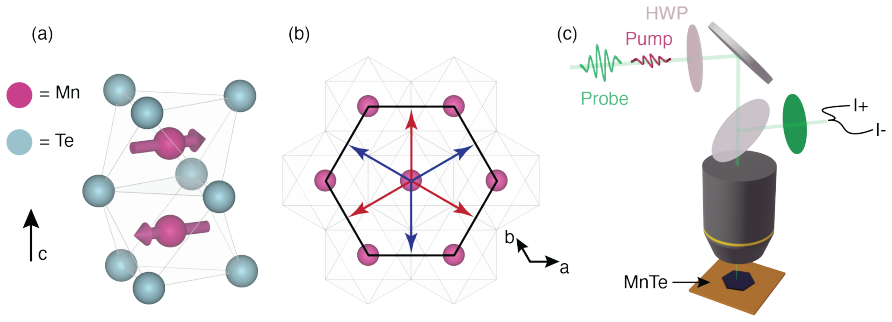
The free-energy competition F(φ) = -K6 cos(6φ) - K2 cos[2(φ - φε)] between the sixfold intrinsic magnetocrystalline anisotropy K6 and the twofold magnetoelastic coupling K2 to local uniaxial strain. This two-term energy landscape carries the argument: its minimum gives the equilibrium Néel orientation φL, its curvature determines the zero-field magnon frequency (via the exchange and easy-plane terms, simplified to f = η√(36(K6/K2)cos6φL + 4cos2(φL-φε))), and the pump-induced displacement Δφ is the shift of the minimum when K6 is replaced by K6 + δK6. The experiment's other load-bearing tool is 520 nm optical polarimetry, which reads the Néel orientation through the birefringence principal ax
What would settle it
Measure the optical birefringence principal axis at 520 nm while applying a controlled in-plane strain and independently determine the Néel direction (e.g., by X-ray magnetic scattering); if the principal axis rotates away from the Néel direction under strain, the φL maps and all orientation-dependent correlations are misattributed.
Extended reading notes
Core claim
On the paper's own terms, the central discovery is that the sixfold magnetocrystalline anisotropy K6 in MnTe is at or near zero: combining frequency maps with simultaneous maps of the equilibrium Néel orientation φL(r), the authors place an upper bound of 2π×15 GHz ≈ 60 μeV on the intrinsic zero-field spin-wave gap and derive K6 ≤ K2/9 from the observation that Néel vectors sit on hard axes. Because the twofold magnetoelastic coupling K2 to local strain dominates the free-energy landscape, the low-temperature variation of the gap (10–30 GHz across the crystal) and the lack of correlation between Ω(r) and φL(r) are attributed to strain inhomogeneity. Above about 120 K and above a threshold fl
Load-bearing premise
The entire φL(r) map — and with it the sawtooth, cycloid, and 15 GHz bound — assumes the 520 nm optical birefringence principal axis tracks the Néel vector alone, with strain-induced birefringence negligible, an assumption carried over from prior work by the same group; the quantitative bound also assumes at least one probed easy-axis spot has negligible strain anisotropy (K2 ≈ 0).
Editorial extensions
If this is right
- The zero-field spin-wave gap in MnTe is bounded by about 15 GHz (≈60 μeV, 0.7 K), making the Néel vector nearly a free rotator in the basal plane.
- Local strain, not intrinsic anisotropy, sets the equilibrium Néel texture; the spatial spread of gap frequencies (10–30 GHz) reflects strain inhomogeneity.
- A laser pulse above threshold fluence (and T ≳ 120 K) can transiently enhance K6, launching coherent magnons whose amplitude and frequency encode the local Néel orientation in a sixfold sawtooth and cycloid pattern.
- Domain walls in MnTe are at least about 180 nm wide (~400 lattice constants), implying highly mobile walls that are not atomically pinned.
- Strain applied in-plane or along the c-axis provides a practical route to control the orientation of spin-splitting and the magnitude and sign of the anomalous Hall effect.
Reading between the lines
- If the central claim holds, MnTe should show a zero-field magnon spectrum that is spatially heterogeneous (10–30 GHz) rather than a single sharp gap; a high-resolution AFMR scan at B = 0 across many spots would test this directly.
- The same δK6 mechanism implies that suitably shaped pump pulses could produce transient reorientation of the Néel vector on picosecond timescales, possibly enabling all-optical writing of the spin-splitting orientation.
- Because the model assumes δK6 is step-like and persists for the magnon lifetime, a two-pulse (pump–pump–probe) experiment with variable delay should show the magnon launch amplitude oscillating with the relative phase — a prediction not made in the paper.
- The proposed microscopic origin (out-of-plane strain εzz modifying K6 via magnetoelastic coupling) can be tested by comparing sample responses under different epitaxial strain states; δK6 should track the strain state.
Signed reviews
Editorial analysis
A structured set of objections, weighed in public.
Referee Report
Summary. This manuscript reports spatially resolved time-resolved polarimetry measurements on MnTe altermagnet crystals. The authors map the local equilibrium orientation φL(r) and simultaneously measure the frequency Ω(r) and pump-induced displacement Δφ(r) of photoexcited spin-wave oscillations. They argue that at low temperature the spin-wave gap is uncorrelated with φL, implying that the intrinsic six-fold magnetocrystalline anisotropy K6 is negligible and that the local strain anisotropy K2 dominates. From locations where φL lies near an easy axis, they place an upper bound of 2π×15 GHz (≈60 μeV, 0.7 K) on the intrinsic spin-wave gap, corresponding to K6 < 13 J/m³. Above T≈120 K and above a threshold pump fluence, they observe a six-fold sawtooth dependence of Δφ on φL and a cycloid-like modulation of Ω(φL), which they model as a step-like photoinduced enhancement δK6 of the six-fold anisotropy, with parameters K6=0, δK6/K2=0.36, and η=6 GHz. They conclude that the Néel-vector orientation in MnTe is controlled by strain and light rather than by intrinsic magnetocrystalline anisotropy, with implications for controlling the anomalous Hall effect and spin-splitting.
Significance. If the conclusions hold, the paper establishes an exceptionally weak intrinsic hexagonal anisotropy in MnTe, implies that strain controls the Néel orientation and hence the band spin-splitting and anomalous Hall response, and identifies a new mechanism for generating coherent magnons via photomodulated anisotropy. The simultaneous spatial mapping of equilibrium orientation and dynamics is a novel experimental contribution, and the observation of stable hard-axis pinning provides a parameter-free ratio bound K6 ≤ K2/9. The two-parameter model is elegant and captures the main correlations. However, the absolute claims (the 15 GHz / 60 μeV / 13 J/m³ bound and the orientation-dependent dynamics) rest on two fragile premises: the identification of the 520-nm birefringence principal axis with the Néel vector, supported only by a same-team prior study, and the assumption that K2=0 (or at least that the strain curvature term is non-negative) at the selected easy-axis spots. These need independent validation or explicit softening before the quantitative conclusions can be accepted.
major comments (3)
- [SI S2 (Determination of φL)] Every orientation-dependent conclusion in the paper — the low-T uncorrelated scatter of Ω(r) vs φL(r), the selection of easy/hard-axis spots for the K6 bound, and the high-T sawtooth/cycloid correlations in Fig. 4 — assumes that the 520-nm birefringence principal axis φb0 equals the local Néel-vector angle φL. The SI acknowledges that both strain and L contribute to the birefringence, then dismisses the strain contribution by citing the authors' own prior Ref. [26]. No independent calibration is provided on this sample. If strain-induced birefringence is non-negligible, φb0(r) is not L(r), and the central dynamical correlations are misassigned. This assumption is load-bearing and should be validated either by an independent determination of L (e.g., magnetic x-ray or neutron microdiffraction) or by a systematic strain-calibration experiment.
- [SI S4 (Eqs. S4-1–S4-2)] The absolute bound K6 < 13 J/m³ (≈60 μeV) is derived from f0 > η√(36 K6/K2), which requires the strain-curvature term 4 cos[2(φL−φε)] to be non-negative at the chosen easy-axis spot. The text concedes "it is possible that K2 is zero" at such a location, but provides no evidence that any probed easy-axis spot has negligible (or positive) strain anisotropy. If K2≠0 with a negative cos term, the same measured f0 is consistent with a larger K6, and the 15 GHz / 60 μeV / 0.7 K headline is not a valid upper bound. The observation of hard-axis pinning gives a rigorous ratio bound K6 ≤ K2/9 (conditional on the φL identification), but the conversion to an absolute gap requires additional knowledge of K2. The authors should either demonstrate K2≈0 at the selected spots or report the bound as explicitly conditional.
- [SI S3 / Fig. 4a] The solid curves in Fig. 4a are obtained by adjusting K6/K2=0, δK6/K2=0.36, and η=6 GHz to the same data they then "capture". As presented, the agreement is a consistency check, not an independent confirmation of the photomodulated-anisotropy mechanism. The qualitative zero-crossing structure follows from symmetry and is robust, but the quantitative cycloid/sawtooth fit does not by itself validate the δK6 scenario. An out-of-sample test (e.g., predicting Δφ and Ω at a different fluence or temperature using the same parameters) would materially strengthen the claim.
minor comments (6)
- [Introduction] Typo: "protypical" should be "prototypical".
- [Abstract / Nomenclature] The abstract refers to "amplitude, Δφ(r,t)", but Δφ is defined in the Nomenclature as a time-independent peak shift (max |δ⟨φ(t)⟩|). Please clarify the notation; the time-dependent quantity is δ⟨φ(t)⟩.
- [SI S3] Eq. (S3-11) introduces η without stating its value until the fit section; give η=6 GHz and its interpretation (frequency scale set by K2, ωJ, Ms) earlier for readability.
- [Fig. 4a] No residuals or uncertainties are shown for the fits. A description of the fitting procedure (least-squares, parameter ranges, error bars) and a residuals plot would improve reproducibility and allow the reader to judge fit quality.
- [References] Ref. [30] is incomplete: "Phys. Rev. B.113(2026)" lacks the article number/page; please update.
- [SI S4, Eq. (S4-1)] Eq. (S4-1) writes f0 > η√(36 K6/K2), which is formally singular as K2→0 because η∝√K2; the cancellation should be shown explicitly (K2 drops out of the product).
Circularity Check
φL(r) calibration rests on a same-team self-citation; the spin-wave gap bound and δK6 model otherwise have independent content.
-
self citation load bearing
[SI S2, 'Determination of φL'; main text Results: 'As shown in Refs. [26,30], the local direction of L can be determined by optical polarimetry.']
"Recently, Liebman-Peláez, et al. demonstrated that, for a probe wavelength near 520 nm, the amplitude of the optical birefringence remains nearly unchanged under externally applied in-plane strain, while the birefringence principal axis rotates consistently with the expected Néel-vector orientation [26]. These observations indicate that the strain contribution to the optical birefringence is negligible at this wavelength and that the birefringence is predominantly determined by the Néel order."
Every orientation-dependent result in the paper uses φb0 as φL: the low-T uncorrelated Ω(φL) claim, the selection of easy/hard-axis spots for the K6 upper bound, and the high-T sawtooth Δφ(φL) and cycloid Ω(φL) all depend on this calibration. The sole support is Ref. [26], whose authors overlap with this paper (Kruppe, Regmi, Ghimire, Analytis, Orenstein). No independent in-manuscript control is given that separates strain-induced birefringence from Néel-order birefringence at 520 nm, so the central mapping is imported via a same-team citation rather than established here.
full rationale
No significant circularity is present in the spin-wave-gap derivation: Eq. (S4-2) converts the measured zero-field frequency into K6 < 13 J/m³ without regressing the conclusion, and the hard-axis argument K6 ≤ K2/9 follows from the free-energy form. The high-temperature sawtooth/cycloid curves are explicitly labeled 'fits' with parameters K6/K2=0, δK6/K2=0.36, η=6 GHz (SI S3), so their agreement is a fit rather than a statistically forced prediction; I do not count that as circularity under the stated rules. The one load-bearing self-citation is the identification of the 520 nm birefringence axis with the Néel-vector direction: the φL(r) maps, the easy/hard-axis spot selection, and the orientation correlations all depend on it, and the only support offered is Ref. [26] by overlapping authors. Because no independent calibration separating strain birefringence from L birefringence is provided, this premise is imported from same-team prior work. The K6 bound and δK6 mechanism still rest on measured frequencies and a symmetry-based free-energy model, so the circularity is partial/self-citation-based rather than definitional.
Assumptions & free parameters
free parameters (2)
- δK6/K2 (photoinduced six-fold anisotropy enhancement, with K6/K2 = 0) =
0.36
- η (frequency scale) =
6 GHz
assumptions (7)
- domain assumption The in-plane free energy is F(φ) = −K6 cos(6φ) − K2 cos[2(φ − φε)] (Eq. 1; SI S3).
- domain assumption At 520 nm the birefringence principal axis equals the Néel direction φL; the strain contribution to birefringence is negligible (SI S2).
- standard math The k = 0 two-sublattice antiferromagnetic resonance formula Ω = sqrt(ωx(ωJ + ωx + ωz + 2ωM)) (SI S3, Eq. S3-8) from Ref [35].
- domain assumption The hierarchy ωJ ≫ ωz > ωM ≫ ωx, justifying Ω ≈ sqrt(ωx ωJ) (SI S3, after Eq. S3-9).
- ad hoc to paper Above T ≈ 120 K and threshold fluence the pump acts as a persistent (step-like) enhancement δK6 of the six-fold anisotropy.
- ad hoc to paper There exists a probed location where φL is on an easy axis and the local strain anisotropy K2 ≈ 0 (SI S4: 'it is possible that K2 is zero').
- standard math Literature input values: ωJ = 1.00×10^14 rad/s, ωz = 3.04×10^11 rad/s, Ms = 462.8 kA/m (SI Table S1, Refs [36,37]).
Cite this review
Pith. "Pith review of Coherent Magnons Driven by Photomodulated Anisotropy in Altermagnetic MnTe." pith.science (2026). https://pith.science/paper/DZAOSIGX
@misc{pith2026260718421,
  author       = {Pith},
  title        = {Pith review of: Coherent Magnons Driven by Photomodulated Anisotropy in Altermagnetic MnTe},
  year         = {2026},
  howpublished = {\url{https://pith.science/paper/DZAOSIGX}},
  note         = {Machine review of arXiv:2607.18421}
}
abstract
Manganese telluride ($\text{MnTe}$) has recently emerged as a prototypical $g$-wave altermagnet, providing an ideal platform to investigate the non-equilibrium excitations of altermagnetic order. Here, we report simultaneous spatial mapping of the local equilibrium orientation of the N\'eel vector, $\varphi_L(\mathbf{r})$, alongside the amplitude, $\Delta\varphi(\mathbf{r},t)$, and frequency, $\Omega(\mathbf{r})$, of photoexcited spin waves. Based on these measurements, we place a remarkably low upper bound of $\approx 60~\mu\text{eV}$ (0.7 K) on the spin-wave gap arising from intrinsic anisotropy. This exceptionally weak hexagonal anisotropy ($K_6$) renders the altermagnetic order highly susceptible to optical tuning, allowing coherent spin waves to be driven by a photoinduced enhancement of $K_6$. Above a threshold pump fluence, our spatial maps reveal that this photomodulation manifests as a six-fold symmetric sawtooth dependence of $\Delta\varphi$ on $\varphi_L$ and a cycloid-like modulation of $\Omega$. Ultimately, the near-isotropy of the N\'eel vector in $\text{MnTe}$ enables optical and mechanical control over the orientation of spin-splitting in the electronic band structure, offering new pathways for altermagnetic spintronics.
Figures


Figures from the paper (1 more)

Reference graph
Works this paper leans on
-
[26]
A. Liebman-Peláez, J. Kruppe, R. B. Regmi, N. J. Ghimire, Y. Sun, I. I. Mazin, H. M. L. Noad, J. Analytis, V. Sunko, and J. Orenstein, Strain continuously rotates the Néel vector in altermagnetic MnTe (2026), arXiv:2604.07653
arXiv 2026
-
[1]
L.Šmejkal, R.González-Hernández, T.Jungwirth,andJ.Sinova,ScienceAdvances6,eaaz8809 (2020)
2020
-
[2]
Hayami, Y
S. Hayami, Y. Yanagi, and H. Kusunose, Journal of the Physical Society of Japan88, 123702 (2019)
2019
-
[3]
Šmejkal, A
L. Šmejkal, A. H. MacDonald, J. Sinova, S. Nakatsuji, and T. Jungwirth, Nature Reviews Materials7, 482 (2022)
2022
-
[4]
Šmejkal, J
L. Šmejkal, J. Sinova, and T. Jungwirth, Physical Review X12, 040501 (2022)
2022
-
[5]
Šmejkal, J
L. Šmejkal, J. Sinova, and T. Jungwirth, Phys. Rev. X.12(2022). 11
2022
-
[6]
L. Bai, W. Feng, S. Liu, L. Šmejkal, Y. Mokrousov, and Y. Yao, Advanced Functional Materials 34, 2409327 (2024)
2024
-
[7]
P. A. McClarty and J. G. Rau, Physical Review Letters132, 176702 (2024)
2024
Show all 40 references
-
[8]
C. Song, H. Bai, Z. Zhou, L. Han, H. Reichlova, J. H. Dil, J. Liu, X. Chen, and F. Pan, Nature Reviews Materials10, 473 (2025)
2025
-
[9]
Jungwirth, R
T. Jungwirth, R. M. Fernandes, E. Fradkin, A. H. MacDonald, J. Sinova, and L. Å mejkal, Newton1, 100162 (2025)
2025
-
[10]
S. S. Fender, O. Gonzalez, and D. K. Bediako, Journal of the American Chemical Society147, 2257 (2025)
2025
-
[11]
Jungwirth, J
T. Jungwirth, J. Sinova, R. M. Fernandes, Q. Liu, H. Watanabe, S. Murakami, S. Nakatsuji, and L. Šmejkal, Nature649, 837 (2026)
2026
-
[12]
S. W. Lovesey, D. D. Khalyavin, and G. Van Der Laan, Physical Review B108, 174437 (2023)
2023
-
[13]
Osumi, S
T. Osumi, S. Souma, T. Aoyama, K. Yamauchi, A. Honma, K. Nakayama, T. Takahashi, K. Ohgushi, and T. Sato, Physical Review B109, 115102 (2024)
2024
-
[14]
Krempaský, L
J. Krempaský, L. Šmejkal, S. W. D’Souza, M. Hajlaoui, G. Springholz, K. Uhlířová, F. Alarab, P. C. Constantinou, V. Strocov, D. Usanov, W. R. Pudelko, R. González-Hernández, A. Birk Hellenes, Z. Jansa, H. Reichlová, Z. Šobáň, R. D. Gonzalez Betancourt, P. Wadley, J. Sinova, D....
2024
-
[15]
O. J. Amin, A. Dal Din, E. Golias, Y. Niu, A. Zakharov, S. C. Fromage, C. J. B. Fields, S. L. Heywood, R. B. Cousins, F. Maccherozzi, J. Krempaský, J. H. Dil, D. Kriegner, B. Kiraly, R. P. Campion, A. W. Rushforth, K. W. Edmonds, S. S. Dhesi, L. Šmejkal, T. Jungwirth, and P. W...
2024
-
[16]
S. Lee, S. Lee, S. Jung, J. Jung, D. Kim, Y. Lee, B. Seok, J. Kim, B. G. Park, L. Šmejkal, C.-J. Kang, and C. Kim, Physical Review Letters132, 036702 (2024)
2024
-
[17]
P. Negi, S. S. S. A. Aradhyula, S. Dutta, and S. Roychowdhury, Chemistry of Materials37, 6097 (2025)
2025
-
[18]
Wasscher, Solid State Communications3, 169 (1965)
J. Wasscher, Solid State Communications3, 169 (1965)
1965
-
[19]
R. D. Gonzalez Betancourt, J. Zubáč, R. Gonzalez-Hernandez, K. Geishendorf, Z. Šobáň, G. Springholz, K. Olejník, L. Šmejkal, J. Sinova, T. Jungwirth, S. T. B. Goennenwein, A. Thomas, H. Reichlová, J. Železný, and D. Kriegner, Physical Review Letters130, 036702 (2023). 12
2023
-
[20]
I. I. Mazin and K. D. Belashchenko, Physical Review B110, 214436 (2024)
2024
-
[21]
K. P. Kluczyk, K. Gas, M. J. Grzybowski, P. Skupiński, M. A. Borysiewicz, T. Fąs, J. Suf- fczyński, J.Z.Domagala, K.Grasza, A.Mycielski, M.Baj, K.H.Ahn, K.Výborný, M.Sawicki, and M. Gryglas-Borysiewicz, Physical Review B110, 155201 (2024)
2024
-
[22]
S. Bey, S. S. Fields, N. G. Combs, B. G. Márkus, J. Wang, L. Schmidt, L. Curtis, A. Dodd- Noble, A. Poulin, S. M. Shahed, R. Regmi, M. Holub, P. Ohresser, A. Bansil, S. Kar, H. Am- baye, V. Lauter, L. Forró, C. D. Cress, J. C. Prestigiacomo, N. Ghimire, A. de la Torre, S. P. B...
2026
-
[23]
Z. Liu, S. Xu, J. M. DeStefano, E. Rosenberg, T. Zhang, J. Li, M. B. Stone, F. Ye, W. Tian, S. Edwards, R. Cong, S. Pan, C.-W. Chu, L. Deng, E. Morosan, R. M. Fernandes, J.-H. Chu, and P. Dai, Strain-tunable anomalous Hall effect in hexagonal MnTe (2025)
2025
-
[24]
Smolenski, N
S. Smolenski, N. Mao, D. Zhang, Y. Guo, A. K. M. A. Shawon, M. Xu, E. Downey, T. Musall, M. Yi, W. Xie, C. Jozwiak, A. Bostwick, N. Tamura, E. Rotenberg, L. Li, K. Sun, Y. Zhang, and N. H. Jo, Strain-tunability of the multipolar Berry curvature in altermagnet MnTe (2025), arXi...
2025
-
[25]
Z. Liu, S. Asai, S. Takahashi, H. Saito, T. Nakajima, and T. Masuda, Physical Review Letters 136, 256704 (2026)
2026
-
[27]
Szuszkiewicz, B
W. Szuszkiewicz, B. Hennion, B. Witkowska, E. Łusakowska, and A. Mycielski, Phys. Status Solidi C2, 1141 (2005)
2005
-
[28]
Kunitomi, Y
N. Kunitomi, Y. Hamaguchi, and S. Anzai, Journal de Physique25, 568 (1964)
1964
-
[29]
K. Y. Povarov, J. Wosnitza, S. Rößler, M. Schmidt, A. A. Tsirlin, and S. A. Zvyagin, Low- energy magnons in the altermagnetα-MnTe (2025), arXiv:2510.24376
2025 arXiv
-
[30]
Liebman-Peláez, S
A. Liebman-Peláez, S. J. Garratt, V. Sunko, Y. Sun, J. R. Soh, D. Prabhakaran, A. T. Boothroyd, and J. Orenstein, Phys. Rev. B.113(2026)
2026
-
[31]
Mondal and A
S. Mondal and A. Barman, Physical Review Applied10, 054037 (2018)
2018
-
[32]
T. Xia, Y. Chen, J. Zhang, L. Wang, C. Wang, R. Qi, and Z. Sheng, Applied Physics Letters 124, 152402 (2024). 13
2024
-
[33]
Hubert and R
A. Hubert and R. Schäfer, Magnetic Domains: The Analysis of Magnetic Microstructures (Springer, Berlin, Heidelberg, 1998)
1998
-
[34]
Z. Liu, M. Ozeki, S. Asai, S. Itoh, and T. Masuda, Physical Review Letters133, 10.1103/phys- revlett.133.156702 (2024)
2024 doi
-
[35]
Y. Sun, F. Meng, C. Lee, A. Soll, H. Zhang, R. Ramesh, J. Yao, Z. Sofer, and J. Orenstein, Nature Physics20, 794–800 (2024)
2024
-
[36]
Dzian, P
J. Dzian, P. Kubaščík, S. Tázlarů, M. Białek, M. Šindler, F. Le Mardelé, C. Kadlec, F. Kadlec, M. Gryglas-Borysiewicz, K. P. Kluczyk, A. Mycielski, P. Skupiński, J. Hejtmánek, R. Tesař, J.Železný, A.-L.Barra, C.Faugeras, J.Volný, K.Uhlířová, L.Nádvorník, M.Veis, K.Výborný, and...
2025 doi
-
[37]
Efrem D’Sa, P
J. Efrem D’Sa, P. Bhobe, K. Priolkar, A. Das, S. Paranjpe, R. Prabhu, and P. Sarode, Journal of Magnetism and Magnetic Materials285, 267–271 (2005). 14 NOMENCLATURE φ: azimuthal angle ofL ⟨φ(t)⟩: instantaneous mean azimuthal angle ofL, defined as the average of the upper and l...
2005
-
[38]
By fine-tuning HWP2 to balance the detector at individualφp, the DC polarization rotation signal is eliminated
[Re(b0) sin(2φp −2φ b0) + Re(k0)].(S2-5) The last term represents the cross-coupling between the transient reflectivity and DC polarization rotation resulting from birefringence and MOKE effects. By fine-tuning HWP2 to balance the detector at individualφp, the DC polarization ...
-
[39]
The local maxima and minima of theδφ(t)trace are identified
-
[40]
3)δ⟨φ(t)⟩is then estimated byδ⟨φ(t)⟩= 0.5 [U(t) +L(t)]
The upper and lower envelopes,U(t)andL(t), are obtained by piecewise-linear interpo- lation through the maxima and minima, respectively. 3)δ⟨φ(t)⟩is then estimated byδ⟨φ(t)⟩= 0.5 [U(t) +L(t)]. Finally, the peak pump-induced shift of equilibrium azimuthal angle is estimated by ...
Reviewed August 1, 2026 · model on record in the stance chip above.
Discussion (0). Continue with ORCID to comment.