REVIEW 3 major objections 5 minor 83 references
Data-driven Design of Metal-Organic Frameworks with Tunable Negative Thermal Expansion
T0 review · 3 major / 5 minor · reviewed 2026-08-01 · deepseek-v4-flash
Pith's one-line read The paper argues that negative thermal expansion in metal-organic frameworks can be designed rather than stumbled upon, and demonstrates the recipe with a record-setting measurement.
desk verdict Valuable 12k-MOF phonon database and a plausible design recipe, but the -593 MK^-1 record claim rests on a phase transition the authors themselves flag. read the letter →
The pith
A machine-rendered reading of the paper's core claim, the machinery that carries it, and where it could break.
The reading
What carries the argument
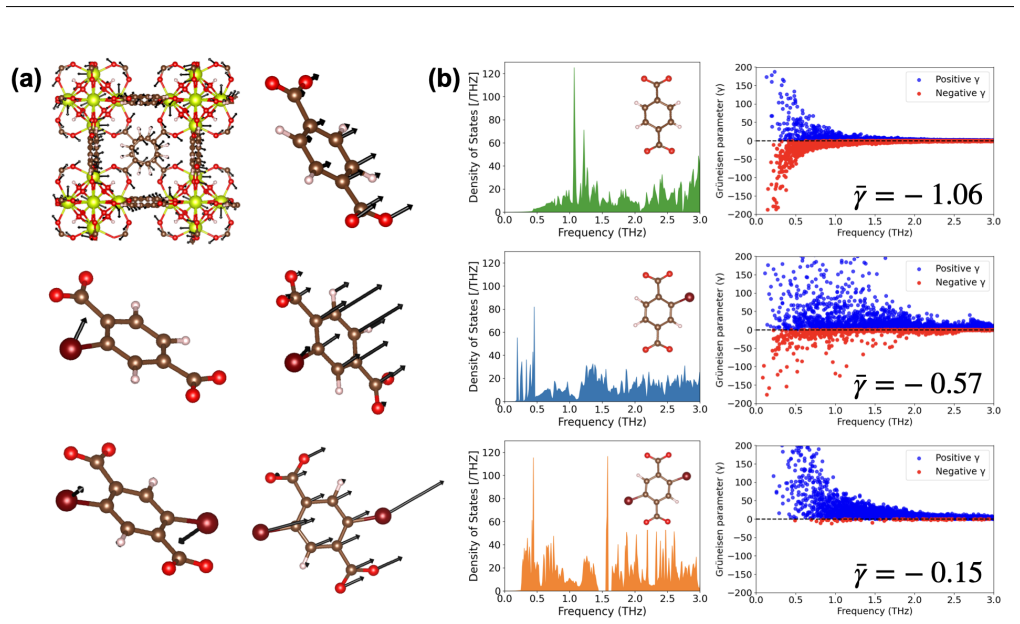
The argument is carried by a phonon-centric screening workflow. A machine-learned interatomic potential fitted to MOF energetics is used within the quasi-harmonic approximation to compute harmonic phonons, phonon densities of states, heat capacities, and bulk moduli for roughly 12,000 MOFs. The key proxy is the low-frequency (0–2 THz) density of states: modes in this window include the transverse linker vibrations and rigid-unit modes whose Grüneisen parameters (the volume sensitivity of each mode's frequency) are negative; a high density of such modes is taken as a fingerprint for negative thermal expansion. This proxy turns an otherwise prohibitive first-principles phonon calculation into
What would settle it
Compute the low-frequency Grüneisen parameters from density-functional-theory phonons for a sample of the screened candidates (especially triclinic and heavy-metal structures) and compare with the database: mismatches would invalidate the screen. Alternatively, an independent high-resolution diffraction or single-crystal study of the mono-brominated cerium-based UiO-66 variant between 250 and 350 K would test whether the −593(25) × 10⁻⁶ K⁻¹ value is a genuine bulk phase transition or an artifact of peak broadening and Le Bail fitting.
Extended reading notes
Core claim
The central claim is that the magnitude and sign of volumetric thermal expansion in MOFs can be predictably engineered by choosing topology, metal node, and linker chemistry. Analyzing a new database of phonon-derived properties for over 12,000 MOFs, the paper finds that frameworks with cubic topologies, high porosity, and heavier, lower-valent metal nodes concentrate their low-frequency vibrations — transverse linker modes and rigid-unit rotations — into modes with strongly negative Grüneisen parameters, producing large negative thermal expansion. Linker functionalization, such as adding bromine to the BDC linker, progressively suppresses these modes and can flip negative expansion to posit
Load-bearing premise
The load-bearing premise is that the machine-learned potential's low-frequency phonons — the volume-dependent mode softening that actually produces negative thermal expansion — are accurate across the diverse chemical space of the database; if those modes are biased for triclinic or heavy-metal frameworks, the candidate pool and the record material could be artifacts.
Editorial extensions
If this is right
- If the recipe holds, engineers can choose an expansion coefficient for a MOF — negative, near-zero, or positive — by picking a topology and adding substituents, without redesigning the framework class.
- Heavy-node substitution (cerium or hafnium instead of zirconium) should enhance negative thermal expansion in other fcu frameworks, not just UiO-66.
- Linker elongation boosts negative thermal expansion but softens the framework; the 1 GPa bulk-modulus cutoff marks a practical stability boundary for screening.
- More than ten colossal-negative-thermal-expansion candidates (|αV| ≥ 100 × 10⁻⁶ K⁻¹) are flagged for experimental follow-up.
- The database extends to anisotropic, non-cubic MOFs, where volumetric negative thermal expansion is less studied than in cubic isoreticular families.
Reading between the lines
- The 0–2 THz density-of-states proxy, if it holds up, could be exported to any phonon-producing machine-learned potential, letting other groups screen their own MOF libraries without re-running the full quasi-harmonic workflow.
- The high-temperature colossal contraction in the brominated variant sits outside the quasi-harmonic approximation; anharmonicity or a structural phase transition is probably at work, and that regime may be a separate, designable phenomenon.
- The mass–charge argument suggests mixed-metal-node or isotope studies could directly test whether heavier nodes always enhance negative thermal expansion.
- The screening's reliance on one machine-learned potential is the evident risk: a density-functional-theory re-check of low-frequency Grüneisen parameters for even ten of the candidates would show whether the trends are robust.
Signed reviews
Editorial analysis
A structured set of objections, weighed in public.
Referee Report
Summary. The paper presents a high-throughput workflow using a MOF-tuned machine-learned potential (MACE-MP-MOF0) to compute phonon properties for roughly 12,000 QMOF structures, forming the PhononMOFdb resource. Screening based on low-frequency phonon DOS together with quasi-harmonic approximation (QHA) yields 178 mechanically stable volumetric negative thermal expansion (NTE) candidates. Analysis of descriptors (crystal system, topology, metal node, linker length/functionalization) leads to a proposed design recipe: cubic topologies, heavier and/or lower-valent metal nodes, and linker functionalization as a tuning handle. The recipe is experimentally tested by synchrotron powder X-ray diffraction on Ce-UiO-66-H, -Br, and -2Br; the data confirm that bromination suppresses NTE below 250 K. The paper further reports a very large alpha_V = -593(25) (M K)^{-1} for Ce-UiO-66-Br above 250 K and claims this as a record volumetric NTE coefficient for MOFs.
Significance. If the design rules are valid, the work constitutes a substantial advance: it provides a large open phonon database for MOFs, a transferable MLIP-based screening strategy, and an experimental demonstration that linker functionalization can systematically tune NTE. Strengths include the release of the database and workflow, the INS benchmarking against DFT and experiment, and the internal consistency of the low-temperature experimental trends with the computational predictions. The independent experimental check on three Ce-UiO-66 variants below 250 K is a genuine step beyond purely computational design rules. However, the record NTE claim and the generality of the screening-based recipe rest on assumptions that are not fully validated in the present manuscript; these issues are load-bearing for the central claims.
major comments (3)
- [Section 4 / Abstract] The headline claim of record volumetric NTE, alpha_V = -593(25) (M K)^-1 for Ce-UiO-66-Br above 250 K, is not supported by the experimental analysis as presented. The authors state that this regime 'falls outside the QHA regime' and coincides with 'peak broadening and intensity loss... possibly due to a structural transition between 250 K and 350 K' (Fig. 3c,e). Under a possible structural transition or phase mixture, the lattice parameter extracted from single-phase Le Bail refinement is not a well-defined single-phase lattice parameter, and a finite-difference alpha_V across 250-350 K mixes cell constants (or fit artifacts) from different phases. Since the abstract's 'surpassing current records' rests entirely on this number, either remove or appropriately qualify the record claim, or provide evidence for a single-phase assignment (e.g., two-phase or Pawley refinement, analysis of peak
- [Section 3.1, Fig. S3] The screening filter and the ensuing design recipe depend on the accuracy of MACE-MP-MOF0 + QHA for NTE across diverse QMOF structures, but the validation in the main text is limited to DOS features for MOF-5, UiO-66, and MOF-74 and to QHA trends for 'several well-characterized MOFs' (Fig. S3). NTE is governed by the volume dependence of phonon frequencies (Gruneisen parameters), a more sensitive quantity than the 0-2 THz DOS; the INS benchmarks against MOF-5 and ZIF-8 validate spectral positions, not phonon volume derivatives. Since the 178-candidate pool and the metal/linker/length trends, including the choice of Ce-UiO-66, are obtained from this MLIP, a systematic comparison of computed alpha_V against DFT or experimental data for a more diverse set (especially non-cubic and heavy-metal frameworks) is needed to support the claim of a general, data-driven recipe.
- [Section 3.1.1 vs Section 3.2] The design recipe instructs readers to 'favor cubic crystal systems for larger NTE' (Section 3.2), but Section 3.1.1 and Fig. 2a report that the largest NTE magnitudes in the screened pool are predominantly triclinic and monoclinic, with only 0.5% cubic candidates, and conclude that crystal system alone is insufficient. If the recipe is instead intended to favor cubic systems for isotropic contraction or mechanical stability, that rationale is not stated. This internal contradiction should be resolved; otherwise the general recipe is ambiguous.
minor comments (5)
- [Section 4] The text cites 'Figure 2c' for the abrupt transition to colossal NTE; the correct reference is Figure 3c.
- [Throughout] The unit is written as '(M K)^{-1}'; if this means 10^-6 K^-1, please use conventional notation (e.g., MK^-1, ppm K^-1, or 10^-6 K^-1) consistently.
- [Section 6] Data Availability: 'The database and codes will are available' should be corrected to 'will be available' or 'are available'.
- [Abstract / Section 3.1.2] The phrase 'heavier, lower-valent metal nodes' conflates mass and valency; Section 3.1.2 treats them as independent handles (lower charge and heavier mass both soften modes). Please rephrase to avoid an apparent contradiction with the tetravalent Ce/Hf examples.
- [Section 3.1.1] The colossal-NTE threshold |alpha_V| >= 100 is not defined with units in the main text; please specify the units (presumably 10^-6 K^-1) and state the criterion explicitly.
Circularity Check
No circularity: design rules come from an independently benchmarked MLIP and QHA, not from fitted NTE data; experimental PXRD provides an external out-of-sample check.
full rationale
The paper's derivation chain is not circular. PhononMOFdb is generated with the authors' MACE-MP-MOF0 potential (ref 21), which is a computational surrogate for DFT energies/forces; it is not fitted to the NTE coefficients or thermal-expansion trends that the paper later reports. The authors also validate the potential against experimental INS spectra for MOF-5 and ZIF-8 and against DOS features for MOF-5, UiO-66, and MOF-74, so the model is not accepted solely through self-citation. The screening uses low-frequency DOS only as an initial filter, but the actual volumetric NTE values are computed with the quasi-harmonic approximation from the volume dependence of phonons; no experimental alpha_V value is fed back into the model or used to define the screening outcome. The design recipe (cubic topology, heavy metal nodes, linker functionalization) is extracted from the screened pool by descriptor analysis, not imposed on the data, and the subsequent Ce-UiO-66 measurements are independent experimental checks. Below 250 K, the measured trends — heavier node enhances NTE relative to Zr-UiO-66, and increasing bromination suppresses NTE — validate the recipe out of sample. The high-temperature record claim is an experimental measurement, not a computational prediction, and the paper explicitly flags that it lies outside the QHA regime and coincides with possible structural transition. Even if that claim is weakened by phase-mixing or peak-broadening artifacts, that is an experimental interpretation risk, not a circular reduction of the derivation to its inputs. There is no equation fitted to data that is then renamed a prediction, no self-citation invoked as a uniqueness theorem, and no ansatz smuggled in via citation. The main vulnerabilities are model-transferability and data-interpretation concerns, not circularity.
Assumptions & free parameters
free parameters (3)
- Low-frequency screening cutoff =
0–2 THz
- Bulk modulus stability threshold =
B ≥ 1 GPa at 100 K
- Colossal NTE threshold =
|αV| ≥ 100 (MK^-1)
assumptions (6)
- domain assumption Quasi-harmonic approximation (QHA) is valid for these MOFs over the computed temperature range.
- domain assumption MACE-MP-MOF0 accurately reproduces DFT-PBE phonons and derived thermodynamics for MOFs outside its training distribution.
- domain assumption Intense low-frequency (0–2 THz) phonon DOS is a necessary indicator of volumetric NTE in MOFs.
- domain assumption QMOF database structures are representative of the broader MOF chemical space.
- domain assumption The harmonic ω ∝ sqrt(k/m) relation captures metal-node effects on NTE.
- domain assumption Le Bail refined lattice parameters accurately represent the true unit-cell volume during a possible phase transition.
Cite this review
Pith. "Pith review of Data-driven Design of Metal-Organic Frameworks with Tunable Negative Thermal Expansion." pith.science (2026). https://pith.science/paper/63FOXYEF
@misc{pith2026260718594,
  author       = {Pith},
  title        = {Pith review of: Data-driven Design of Metal-Organic Frameworks with Tunable Negative Thermal Expansion},
  year         = {2026},
  howpublished = {\url{https://pith.science/paper/63FOXYEF}},
  note         = {Machine review of arXiv:2607.18594}
}
read the original abstract
Materials with negative thermal expansion (NTE) are essential for applications requiring precise control of thermal expansion. Owing to their exceptional chemical tunability, flexible architectures, and low-energy lattice vibrations, metal-organic frameworks (MOFs) represent a rich platform for exploring NTE. However, uncovering the structural motifs that govern NTE across the enormous MOF design space remains experimentally challenging, and large-scale first-principles phonon calculations are computationally prohibitive. Here, we comprehensively evaluate the factors influencing NTE in MOFs by utilizing a high-throughput workflow based on MACE-MP-MOF0, a machine learning interatomic potential fine-tuned for MOFs with near-ab initio accuracy, to construct PhononMOFdb, a database of phonons, inelastic neutron scattering spectra, bulk moduli, and heat capacities for over 12,000 MOFs. High-throughput screening of this database reveals that highly porous cubic topology frameworks with heavier, lower-valent metal nodes favor strong NTE, while linker functionalization provides a practical handle for tuning NTE magnitude and sign without compromising mechanical stability. Experimental validation via high-resolution temperature-dependent synchrotron powder X-ray diffraction on the Ce-UiO-66 MOF and its brominated variants confirms the design recipe and yields volumetric NTE coefficients surpassing current records. This work establishes a data-driven strategy for engineering NTE in MOFs, showing how machine learning-accelerated discovery and targeted experimental validation together unlock predictive materials design.
Figures


Figures from the paper (1 more)
Reference graph
Works this paper leans on
-
[1]
Negative thermal expansion: a review.J
Miller, W.; Smith, C.; Mackenzie, D.; Evans, K. Negative thermal expansion: a review.J. Mater. Sci.2009,44, 5441–5451
2009
-
[2]
Negative thermal expansion in molecu- lar materials.Chem
Liu, Z.; Gao, Q.; Chen, J.; Deng, J.; Lin, K.; Xing, X. Negative thermal expansion in molecu- lar materials.Chem. Commun.2018,54, 5164– 5176
2018
-
[3]
Negative thermal expansion in functional materials: con- trollable thermal expansion by chemical modifi- cations.Chem
Chen, J.; Hu, L.; Deng, J.; Xing, X. Negative thermal expansion in functional materials: con- trollable thermal expansion by chemical modifi- cations.Chem. Soc. Rev.2015,44, 3522–3567
2015
-
[4]
Yang, H.; Xu, P.; Al-Maythalony, B. A.; Huang, Y.; Xu, M.; Hua, Y.; Zhang, W.; Wang, X.; Cui, S.; Zhu, H.; others Negative- thermal-expansion particles enable high- performance and ultradurable thermoelectric modules.Sci. Adv.2026,12, eaed3783
2026
-
[5]
A novel negative thermal expansion metamaterial for supersonic aerothermoelastic flutter suppression.Aerosp
Zhu, Y.; Yao, G.; Liu, R.; Chen, J.; Gao, K.; Wang, M. A novel negative thermal expansion metamaterial for supersonic aerothermoelastic flutter suppression.Aerosp. Sci. Technol.2025, 165, 110493
2025
-
[6]
S.; Elbestawi, M
Dubey, D.; Mirhakimi, A. S.; Elbestawi, M. A. Negative thermal expansion metamaterials: a review of design, fabrication, and applications. J. Manuf. Mater. Process.2024,8, 40
2024
-
[7]
Sci.2026, e75748
Qian, J.; Long, F.; Liu, Y.; Fan, L.; Liao, M.; Gao, Q.; Lu, H.; Gao, D.; Kang, L.; Song, Y.; others Wide Temperature Zero Thermal Expan- sion in Al Matrix Composites with High Ther- mal Conductivity.Adv. Sci.2026, e75748
2026
-
[8]
Makouei, S.; Nuri, H.; Nuri, M. M. R. NTE ma- terial employment in temperature resistive high sensitive fiber optic strain sensor development. Optik2021,231, 166395
Show all 83 references
-
[9]
J.; Pe- terson, V
Wu, Y.; Kobayashi, A.; Halder, G. J.; Pe- terson, V. K.; Chapman, K. W.; Lock, N.; Southon, P. D.; Kepert, C. J. Negative Thermal Expansion in the Metal–Organic Framework Material Cu3 (1, 3, 5-benzenetricarboxylate) 2. Angew. Chem., Int. Ed.2008,47, 8929–8932
2008
-
[10]
S.; Ellis, D
Dubbeldam, D.; Walton, K. S.; Ellis, D. E.; Snurr, R. Q. Exceptional negative thermal ex- pansion in isoreticular metal–organic frame- works.Angew. Chem.2007,119, 4580–4583
2007
-
[11]
R.; Walker, A
Zhou, W.; Wu, H.; Yildirim, T.; Simpson, J. R.; Walker, A. H. Origin of the exceptional negative thermal expansion in metal-organic framework- 5 Zn 4 O (1, 4-benzenedicarboxylate) 3.Phys. Rev. B:Condens. Matter Mater. Phys.2008, 78, 054114
2008
-
[12]
R.; Yaghi, O
Zhou, H.-C.; Long, J. R.; Yaghi, O. M. Intro- duction to Metal–Organic Frameworks.Chem. Rev.2012,112, 673–674
2012
-
[13]
E.; O’Keeffe, M.; Yaghi, O
Furukawa, H.; Cordova, K. E.; O’Keeffe, M.; Yaghi, O. M. The Chemistry and Applications of Metal-Organic Frameworks.Science2013, 341, 1230444
-
[14]
M.; O’Keeffe, M.; Ockwig, N
Yaghi, O. M.; O’Keeffe, M.; Ockwig, N. W.; Chae, H. K.; Eddaoudi, M.; Kim, J. Reticu- lar synthesis and the design of new materials. Nature2003,423, 705–714
-
[15]
P.; Schmid, R.; Bedoya-Mart ´ ınez, N.; Zojer, E
Wieser, S.; Kamencek, T.; D¨ urholt, J. P.; Schmid, R.; Bedoya-Mart ´ ınez, N.; Zojer, E. Identifying the Bottleneck for Heat Transport in Metal–Organic Frameworks.Adv. Theory Simul.2021,4, 2000211
2021
-
[16]
Hoffman, A. E. J.; Senkovska, I.; Abylgaz- ina, L.; Bon, V.; Grzimek, V.; Dominic, A. M.; Russina, M.; Kraft, M. A.; Weidinger, I.; Zeier, W. G.; Van Speybroeck, V.; Kaskel, S. The role of phonons in switchable MOFs: a model material perspective.J. Mater. Chem. A 2023,11, 15286–15300
2023
-
[17]
V.; Firlej, L
Kuchta, B.; Formalik, F.; Rogacka, J.; Neimark, A. V.; Firlej, L. Phonons in de- formable microporous crystalline solids.Z. Kristallogr. - Cryst. Mater.2019,234, 513–527
2019
-
[18]
M.Electrons and Phonons: The The- ory of Transport Phenomena in Solids; Oxford University Press, 2001; Vol
Ziman, J. M.Electrons and Phonons: The The- ory of Transport Phenomena in Solids; Oxford University Press, 2001; Vol. 540
2001
-
[19]
Negative thermal expansion ma- terials: technological key for control of thermal expansion.Sci
Takenaka, K. Negative thermal expansion ma- terials: technological key for control of thermal expansion.Sci. Technol. Adv. Mater.2012,13, 013001. 10
2012
-
[20]
D.; D¨ urholt, J
Evans, J. D.; D¨ urholt, J. P.; Kaskel, S.; Schmid, R. Assessing negative thermal expan- sion in mesoporous metal–organic frameworks by molecular simulation.J. Mater. Chem. A 2019,7, 24019–24026
2019
-
[21]
M.; Kamath, P
Elena, A. M.; Kamath, P. D.; Jaffrelot In- izan, T.; Rosen, A. S.; Zanca, F.; Persson, K. A. Machine learned potential for high-throughput phonon calculations of metal–organic frame- works.npj Comput. Mater.2025,11, 125
2025
-
[22]
Understanding the origin of the par- ticularly small and anisotropic thermal expan- sion of MOF-74.Adv
Kamencek, T.; Schrode, B.; Resel, R.; Ricco, R.; Zojer, E. Understanding the origin of the par- ticularly small and anisotropic thermal expan- sion of MOF-74.Adv. Theory Simul.2022,5, 2200031
2022
-
[23]
Tran- sition from isotropic positive to negative ther- mal expansion by local Zr6O8 node distortion in MOF-801.Microstructures2024,4, N–A
Ma, R.; Liu, Z.; Chen, L.; Li, Q.; Lin, K.; Chen, X.; Deng, J.; Ohara, K.; Xing, X. Tran- sition from isotropic positive to negative ther- mal expansion by local Zr6O8 node distortion in MOF-801.Microstructures2024,4, N–A
-
[24]
C.; Baxter, S
Burtch, N. C.; Baxter, S. J.; Heinen, J.; Bird, A.; Schneemann, A.; Dubbeldam, D.; Wilkinson, A. P. Negative thermal expansion design strategies in a diverse series of metal– organic frameworks.Adv. Funct. Mater.2019, 29, 1904669
2019
-
[25]
J.; Schneemann, A.; Ready, A
Baxter, S. J.; Schneemann, A.; Ready, A. D.; Wijeratne, P.; Wilkinson, A. P.; Burtch, N. C. Tuning thermal expansion in metal–organic frameworks using a mixed linker solid solu- tion approach.J. Am. Chem. Soc.2019,141, 12849–12854
2019
-
[26]
J.; Hill, J
Cliffe, M. J.; Hill, J. A.; Murray, C. A.; Coud- ert, F.-X.; Goodwin, A. L. Defect-dependent colossal negative thermal expansion in UiO- 66 (Hf) metal–organic framework.Phys. Chem. Chem. Phys.2015,17, 11586–11592
2015
-
[27]
G.; Crocell` a, V.; Mink, J.; Fis- cher, R
Schneider, C.; Bodesheim, D.; Ehrenre- ich, M. G.; Crocell` a, V.; Mink, J.; Fis- cher, R. A.; Butler, K. T.; Kieslich, G. Tun- ing the negative thermal expansion behavior of the metal–organic framework Cu3BTC2 by retrofitting.J. Am. Chem. Soc.2019,141, 10504–10509
2019
-
[28]
M.; Chen, Z.; Hofmann, J.; Chap- man, K
Vornholt, S. M.; Chen, Z.; Hofmann, J.; Chap- man, K. W. Node distortions in UiO-66 inform negative thermal expansion mechanisms: ki- netic effects, frustration, and lattice hysteresis. J. Am. Chem. Soc.2024,146, 16977–16981
2024
-
[29]
A.; Jiang, J
Yue, Y.; Mohamed, S. A.; Jiang, J. Classifying and predicting the thermal expansion proper- ties of metal–organic frameworks: a data-driven approach.J. Chem. Inf. Model.2024,64, 4966– 4979
2024
-
[30]
T.; Wei, Z.; Phillips, A
Dove, M. T.; Wei, Z.; Phillips, A. E.; Keen, D. A.; Refson, K. Which phonons con- tribute most to negative thermal expansion in ScF3?APL Mater.2023,11
2023
-
[31]
K.; Casewit, C
Rappe, A. K.; Casewit, C. J.; Colwell, K. S.; Goddard, W. A. I.; Skiff, W. M. UFF, a full periodic table force field for molecular mechan- ics and molecular dynamics simulations.J. Am. Chem. Soc.1992,114, 10024–10035
1992
-
[32]
K.; Schmid, R
Bureekaew, S.; Amirjalayer, S.; Tafipolsky, M.; Spickermann, C.; Roy, T. K.; Schmid, R. MOF- FF – A flexible first-principles derived force field for metal-organic frameworks.Phys. Status So- lidi B2013,250, 1128–1141
-
[33]
Machine learned force- fields for an Ab-initio quality description of metal–organic frameworks.npj Comput
Wieser, S.; Zojer, E. Machine learned force- fields for an Ab-initio quality description of metal–organic frameworks.npj Comput. Mater. 2024,10, 18
2024
-
[34]
K.; Skelton, J
Bristow, J. K.; Skelton, J. M.; Svane, K. L.; Walsh, A.; Gale, J. D. A general forcefield for accurate phonon properties of metal–organic frameworks.Phys. Chem. Chem. Phys.2016, 18, 29316–29329
2016
-
[35]
M.; Novotny, B
Moosavi, S. M.; Novotny, B. ´A.; Ongari, D.; Moubarak, E.; Asgari, M.; Kadioglu, ¨O.; Charalambous, C.; Ortega-Guerrero, A.; Farmahini, A. H.; Sarkisov, L.; others A data- science approach to predict the heat capacity of nanoporous materials.Nat. Mater.2022, 21, 1419–1425
2022
-
[36]
A.; Loh, N
Yue, Y.; Mohamed, S. A.; Loh, N. D.; Jiang, J. Toward a Generalizable Machine-Learned Po- tential for Metal–Organic Frameworks.ACS Nano2025,19, 933–949
-
[37]
D.; Persson, K
Kamath, P. D.; Persson, K. A. The impact of spurious imaginary phonon modes on ther- mal properties of Metal-organic Frameworks. npj Comput. Mat.2026, 11
2026
-
[38]
Loew, A.; Sun, D.; Wang, H.-C.; Botti, S.; Mar- ques, M. A. Universal machine learning inter- atomic potentials are ready for phonons.npj Comput. Mater.2025,11, 178
2025
-
[39]
Kraß, H.; Huang, J.; Moosavi, S. M. MOFSim- Bench: evaluating universal machine learning interatomic potentials in metal-organic frame- work molecular modeling.npj Comput. Mater. 2025,12, 4
2025
-
[40]
Batatia, I. et al. A foundation model for atom- istic materials chemistry.J. Chem. Phys2025, 163, 184110
-
[41]
S.; Iyer, S
Rosen, A. S.; Iyer, S. M.; Ray, D.; Yao, Z.; Aspuru-Guzik, A.; Gagliardi, L.; Notestein, J. M.; Snurr, R. Q. Machine learn- ing the quantum-chemical properties of metal– organic frameworks for accelerated materials discovery.Matter2021,4, 1578–1597
-
[42]
S.; Fung, V.; Huck, P.; O’Donnell, C
Rosen, A. S.; Fung, V.; Huck, P.; O’Donnell, C. T.; Horton, M. K.; Truh- lar, D. G.; Persson, K. A.; Notestein, J. M.; Snurr, R. Q. High-throughput predictions of metal–organic framework electronic properties: theoretical challenges, graph neural networks, and data exploration...
2022
-
[43]
Implementation strategies in phonopy and phono3py.J
Togo, A.; Chaput, L.; Tadano, T.; Tanaka, I. Implementation strategies in phonopy and phono3py.J. Phys. Condens. Matter2023,35, 353001
-
[44]
First-principles Phonon Calculations with Phonopy and Phono3py.J
Togo, A. First-principles Phonon Calculations with Phonopy and Phono3py.J. Phys. Soc. Jpn. 2023,92, 012001
2023
-
[45]
F.; Fern´ andez- Alonso, F.; Mukhopadhyay, S
Dymkowski, K.; Parker, S. F.; Fern´ andez- Alonso, F.; Mukhopadhyay, S. AbINS: The modern software for INS interpretation.Phys. B2018,551, 443–448
-
[46]
Arnold, O. et al. Mantid-Data analysis and visualization package for neutron scattering andµSR experiments.Nucl. Instrum. Methods Phys. Res., Sect. A2014,764, 156–166
-
[47]
S.; Rudi´ c, S.; Parker, S
Pinna, R. S.; Rudi´ c, S.; Parker, S. F.; Arm- strong, J.; Zanetti, M.; ˇSkoro, G.; Waller, S. P.; Zacek, D.; Smith, C. A.; Capstick, M. J.; McPhail, D. J.; Pooley, D. E.; Howells, G. D.; Gorini, G.; Fernandez-Alonso, F. The neutron guide upgrade of the TOSCA spectrometer. Nuc...
2018
-
[48]
Efficient iterative schemes for ab initio total-energy calculations using a plane-wave basis set.Phys
Kresse, G.; Furthm¨ uller, J. Efficient iterative schemes for ab initio total-energy calculations using a plane-wave basis set.Phys. Rev. B 1996,54, 11169–11186
1996
-
[49]
From ultrasoft pseu- dopotentials to the projector augmented-wave method.Phys
Kresse, G.; Joubert, D. From ultrasoft pseu- dopotentials to the projector augmented-wave method.Phys. Rev. B1999,59, 1758–1775
-
[50]
Efficiency of ab- initio total energy calculations for metals and semiconductors using a plane-wave basis set
Kresse, G.; Furthm¨ uller, J. Efficiency of ab- initio total energy calculations for metals and semiconductors using a plane-wave basis set. Comput. Mater. Sci.1996,6, 15–50
1996
-
[51]
Ab initio molecular dy- namics for liquid metals.Phys
Kresse, G.; Hafner, J. Ab initio molecular dy- namics for liquid metals.Phys. Rev. B1993, 47, 558–561
-
[52]
P.; Burke, K.; Ernzerhof, M
Perdew, J. P.; Burke, K.; Ernzerhof, M. Gen- eralized Gradient Approximation Made Simple. Phys. Rev. Lett.1996,77, 3865–3868
1996
-
[53]
Effect of the damping function in dispersion corrected density functional theory.J
Grimme, S.; Ehrlich, S.; Goerigk, L. Effect of the damping function in dispersion corrected density functional theory.J. Comput. Chem. 2011,32, 1456–1465
2011
-
[54]
A consistent and accurate ab initio parametriza- tion of density functional dispersion correction (DFT-D) for the 94 elements H-Pu.J
Grimme, S.; Antony, J.; Ehrlich, S.; Krieg, H. A consistent and accurate ab initio parametriza- tion of density functional dispersion correction (DFT-D) for the 94 elements H-Pu.J. Chem. Phys.2010,132, 154104
2010
-
[55]
High intrinsic proton conduction in cerium(IV) metal-organic framework constructed by bromine-grafted terephthalic acid.J
Gao, L.-L.; Feng, J.-Y.; Ren, H.-M.; Li, G. High intrinsic proton conduction in cerium(IV) metal-organic framework constructed by bromine-grafted terephthalic acid.J. Solid State Chem.2024,333, 124597
2024
-
[56]
H.; Von Dreele, R
Toby, B. H.; Von Dreele, R. B. GSAS-II: the genesis of a modern open-source all pur- pose crystallography software package.J. Appl. Crystallogr.2013,46, 544–549
2013
-
[57]
Snurr, R. Q. It’s an Interesting MOF, but Is It Stable?Matter2019,1, 26–27
-
[58]
K.; Kancharlapalli, S.; Mor, J.; Armstrong, J.; Sen, D
Bahadur, J.; Sharma, S. K.; Kancharlapalli, S.; Mor, J.; Armstrong, J.; Sen, D. Competitive 12 Host–Guest and Guest–Guest Interaction De- pendent Flexibility of Crystal-Size-Engineered ZIF-8: An Inelastic Neutron Scattering Study. J. Phys. Chem. Lett.2025,16, 5496–5505
2025
-
[59]
E.; Rey, F.; Jord´ a, J
Casco, M. E.; Rey, F.; Jord´ a, J. L.; Rudi´ c, S.; Fauth, F.; Martinez-Escandell, M.; Rodriguez- Reinoso, F.; Ramos-Fern´ andez, E. V.; Silvestre- Albero, J. Paving the way for methane hy- drate formation on metal–organic frameworks (MOFs).Chem. Sci.2016,7, 3658–3666
2016
-
[60]
K.; Ramirez-Cuesta, A
Callear, S. K.; Ramirez-Cuesta, A. J.; David, W. I.; Millange, F.; Walton, R. I. High-resolution inelastic neutron scattering and neutron powder diffraction study of the adsorption of dihydrogen by the Cu (II) metal– organic framework material HKUST-1.Chem. Phys.2013,427, 9–17
2013
-
[61]
Anal- ysis and refinement of host–guest interactions in metal–organic frameworks.Acc
Chen, Y.; Lu, W.; Schroder, M.; Yang, S. Anal- ysis and refinement of host–guest interactions in metal–organic frameworks.Acc. Chem. Res. 2023,56, 2569–2581
2023
-
[62]
K.; Thomsen, M
Lock, N.; Christensen, M.; Wu, Y.; Peter- son, V. K.; Thomsen, M. K.; Piltz, R. O.; Ramirez-Cuesta, A. J.; McIntyre, G. J.; Nor´ en, K.; Kutteh, R.; others Scrutinizing neg- ative thermal expansion in MOF-5 by scatter- ing techniques and ab initio calculations.Dalton Trans.201...
2013
-
[63]
Lattice dynamics of metal-organic frameworks: Neutron inelas- tic scattering and first-principles calculations
Zhou, W.; Yildirim, T. Lattice dynamics of metal-organic frameworks: Neutron inelas- tic scattering and first-principles calculations. Phys. Rev. B:Condens. Matter Mater. Phys. 2006,74, 180301
2006
-
[64]
Benchmarking univer- sal machine learning interatomic potentials for rapid analysis of inelastic neutron scattering data.Mach
Han, B.; Cheng, Y. Benchmarking univer- sal machine learning interatomic potentials for rapid analysis of inelastic neutron scattering data.Mach. Learn.: Sci. Technol.2025,6, 030504
2025
-
[65]
K.; Kancharlapalli, S.; Mor, J.; Armstrong, J.; Sen, D
Bahadur, J.; Sharma, S. K.; Kancharlapalli, S.; Mor, J.; Armstrong, J.; Sen, D. Competitive Host–Guest and Guest–Guest Interaction De- pendent Flexibility of Crystal-Size-Engineered ZIF-8: An Inelastic Neutron Scattering Study. J. Phys. Chem. Lett.2025,16, 5496–5505
2025
-
[66]
E.; Cheng, Y.; Daemen, L
Casco, M. E.; Cheng, Y.; Daemen, L. L.; Fairen- Jimenez, D.; Ramos-Fern´ andez, E. V.; Ram ´ ırez- Cuesta, A. J.; Silvestre-Albero, J. Gate-opening effect in ZIF-8: the first experimental proof us- ing inelastic neutron scattering.Chem. Com- mun.2016,52, 3639–3642
2016
-
[67]
E.; Fern´ andez-Catal´ a, J.; Cheng, Y.; Daemen, L.; Ramirez-Cuesta, A
Casco, M. E.; Fern´ andez-Catal´ a, J.; Cheng, Y.; Daemen, L.; Ramirez-Cuesta, A. J.; Cuadrado- Collados, C.; Silvestre-Albero, J.; Ramos- Fernandez, E. V. Understanding ZIF-8 Per- formance upon Gas Adsorption by Means of Inelastic Neutron Scattering.ChemistrySelect 2017,2, 2750–2753
2017
-
[68]
J.; Lindman, A.; Ekl¨ of- ¨Osterberg, C.; Karlsson, M.; Parker, S
Granhed, E. J.; Lindman, A.; Ekl¨ of- ¨Osterberg, C.; Karlsson, M.; Parker, S. F.; Wahnstr¨ om, G. Band vs. polaron: vibrational motion and chemical expansion of hydride ions as signatures for the electronic character in oxyhydride barium titanate.J. Mater. Chem. A2019,7, 16211–16221
-
[69]
Structural, vibrational, and quasi- particle properties of the Peierls semiconduc- tor BaBiO 3: A hybrid functional and self- consistent GW+ vertex-corrections study.Phys
Franchini, C.; Sanna, A.; Marsman, M.; Kresse, G. Structural, vibrational, and quasi- particle properties of the Peierls semiconduc- tor BaBiO 3: A hybrid functional and self- consistent GW+ vertex-corrections study.Phys. Rev. B:Condens. Matter Mater. Phys.2010, 81, 085213
2010
-
[70]
B.; Ramirez-Cuesta, A
Cheng, Y.; Stone, M. B.; Ramirez-Cuesta, A. J. A database of synthetic inelastic neutron scat- tering spectra from molecules and crystals.Sci. Data2023,10, 54
-
[71]
Henke, S.; Schneemann, A.; Fischer, R. A. Mas- sive anisotropic thermal expansion and thermo- responsive breathing in metal–organic frame- works modulated by linker functionalization. Adv. Funct. Mater.2013,23, 5990–5996
2013
-
[72]
3D negative thermal expan- sion in orthorhombic MIL-68 (In).Chem
Liu, Z.; Li, Q.; Zhu, H.; Lin, K.; Deng, J.; Chen, J.; Xing, X. 3D negative thermal expan- sion in orthorhombic MIL-68 (In).Chem. Com- mun.2018,54, 5712–5715
2018
-
[73]
J.; Peterson, V
Lock, N.; Wu, Y.; Christensen, M.; Cameron, L. J.; Peterson, V. K.; Bridge- man, A. J.; Kepert, C. J.; Iversen, B. B. Elucidating negative thermal expansion in MOF-5.J. Phys. Chem. C2010,114, 16181– 16186. 13
-
[74]
L.; Brown, C
Queen, W. L.; Brown, C. M.; Britt, D. K.; Za- jdel, P.; Hudson, M. R.; Yaghi, O. M. Site- specific CO2 adsorption and zero thermal ex- pansion in an anisotropic pore network.J. Phys. Chem. C2011,115, 24915–24919
-
[75]
Linnera, J.; Erba, A.; Karttunen, A. J. Neg- ative thermal expansion of Cu2O studied by quasi-harmonic approximation and cubic force- constant method.J. Chem. Phys.2019,151
2019
-
[76]
T.; Zhou, H.-C
Yuan, S.; Qin, J.-S.; Lollar, C. T.; Zhou, H.-C. Stable metal–organic frameworks with group 4 metals: current status and trends.ACS Cent. Sci.2018,4, 440–450
2018
-
[77]
Imaging the dy- namic influence of functional groups on metal- organic frameworks.Nat
Liu, B.; Chen, X.; Huang, N.; Liu, S.; Wang, Y.; Lan, X.; Wei, F.; Wang, T. Imaging the dy- namic influence of functional groups on metal- organic frameworks.Nat. Commun.2023,14, 4835
2023
-
[78]
A.; Smit, B.; Ranocchiari, M
Taddei, M.; Tiana, D.; Casati, N.; Van Bokhoven, J. A.; Smit, B.; Ranocchiari, M. Mixed-linker UiO-66: structure–property re- lationships revealed by a combination of high-resolution powder X-ray diffraction and density functional theory calculations.Phys. Chem. Chem. Phys.201...
2017
-
[79]
Goodenough, I.; Devulapalli, V. S. D.; Xu, W.; Boyanich, M. C.; Luo, T.-Y.; De Souza, M.; Richard, M.; Rosi, N. L.; Borguet, E. Interplay between intrinsic thermal stability and expan- sion properties of functionalized UiO-67 metal– organic frameworks.Chem. Mater.2020,33, 910–920
2020
-
[80]
C.; van Beek, W.; Marshall, K.; Pet- titi, I.; Latini, A.; D’Angelo, P
Tavani, F.; Tofoni, A.; Pietropaoli, E.; Stoian, D. C.; van Beek, W.; Marshall, K.; Pet- titi, I.; Latini, A.; D’Angelo, P. Decoding the Water Harvesting Mechanism of MIL-100(Fe) Across Short- and Long-Range Length Scales. J. Am. Chem. Soc.2025,147, 40507–40518
2025
-
[81]
G.; Armstrong, A
Tavani, F.; Tofoni, A.; Vandone, M.; Busato, M.; Braglia, L.; Torelli, P.; Stanzione, M. G.; Armstrong, A. R.; Mor- ris, R. E.; Colombo, V.; D’Angelo, P. A combined soft X-ray and theoretical investiga- tion discloses the water harvesting behaviour of Mg-MOF-74 at the crystal ...
2025
-
[82]
S.; Gao, M.-Y.; G´ andara, F.; Wang, K.; Tavani, F.; Zhu, H.; Proserpio, D
Mirzaei, S.; Mirzaei, M. S.; Gao, M.-Y.; G´ andara, F.; Wang, K.; Tavani, F.; Zhu, H.; Proserpio, D. M.; Yaghi, O. M. Single- Crystalline Twelve-Connected Nanographene- Based Covalent Organic Frameworks.J. Am. Chem. Soc.2026,148, 25241–25248
2026
-
[83]
Explor- ing the Methane to Methanol Oxidation over Iron and Copper Sites in Metal–Organic Frame- works.Catalysts2023,13
Tavani, F.; Tofoni, A.; D’Angelo, P. Explor- ing the Methane to Methanol Oxidation over Iron and Copper Sites in Metal–Organic Frame- works.Catalysts2023,13. 14
Reviewed August 1, 2026 · model on record in the stance chip above.
Discussion (0). Continue with ORCID to comment.