REVIEW 2 major objections 5 minor 50 references
This paper identifies 'topology distortion' — the destruction of item-neighbor structure when RQ-VAE quantizes continuous embeddings into discrete IDs — as a hidden bottleneck in generative recommendation, and claims that a coarse-to-fine m
Reviewed by Pith at T0; open to challenge. T0 means a machine referee read the full paper against a public rubric. the ladder, T0–T4 →
T0 review · deepseek-v4-flash
2026-08-01 14:52 UTC pith:2FEQFIZQ
load-bearing objection Solid three-level topology distillation for RQ-VAE tokenization; the accuracy gains hold up, but the mechanism isn't fully isolated from generic regularization. the 2 major comments →
Topology-Aware Tokenization for Generative Recommendation
The pith
A machine-rendered reading of the paper's core claim, the machinery that carries it, and where it could break.
Core claim
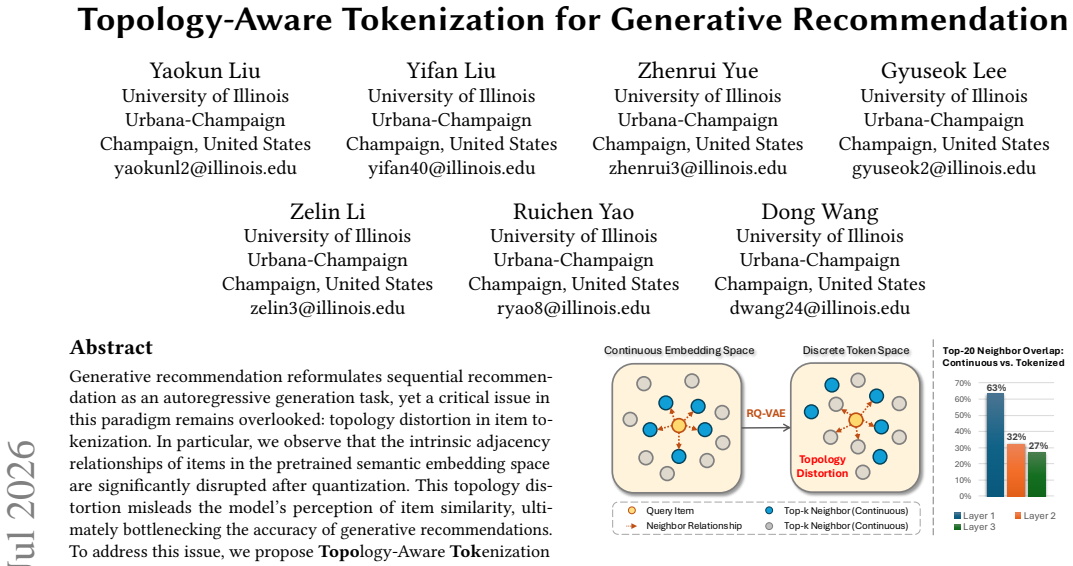
The central discovery is a measurable failure mode: on real recommendation data, only 63% of top-20 item neighbors survive layer 1 of RQ-VAE quantization, and only 27% survive layer 3. The paper argues that this 'topology distortion' — not the generator — is what limits generative recommendation accuracy, and that injecting topology-preserving supervision into each quantization layer, one objective per semantic granularity, recovers it. TopoTok aligns the rankings of neighbors in the continuous semantic space with those in the quantized code space, layer by layer from coarse to fine. In the paper's experiments this raises neighbor overlap from 27% to 37% at the deepest layer, for example, an
What carries the argument
The central machinery is the RQ-VAE residual codebook hierarchy plus a decomposed topology-distillation objective. For each level, the method builds pairwise distance matrices in the teacher space (pretrained item embeddings) and student space (code or reconstructed representations), converts each row into a softmax similarity distribution, and minimizes the KL divergence between teacher and student rows. This recasts topology preservation as neighbor-ranking alignment, which works across heterogeneous spaces. The three distillation levels — Inter-Group at the first layer, Intra-Group at the second, and Inter-Item at deeper layers — are assigned to match the coarse-to-fine semantic role of e
Load-bearing premise
The argument rests on the pretrained semantic embedding space being a faithful, useful source of item-item similarity; if that teacher space encodes noise or the wrong notion of similarity, TopoTok bakes that flawed topology into the tokenizer and the reported gains should shrink or vanish.
What would settle it
Run TopoTok with an intentionally corrupted teacher — for example, permute an increasing fraction of embedding coordinates or replace the pretrained embeddings with random vectors — and measure whether Recall@5 gains decline monotonically. If recommendation accuracy stays high when the teacher topology is destroyed, the paper's causal story is wrong; if gains track teacher quality, the assumption is confirmed.
If this is right
- RQ-VAE-based tokenizers should be trained with hierarchical topology supervision, not just reconstruction and commitment losses, because neighbor distortion is a quantifiable cause of recommendation error.
- Tokenizer evaluation for generative recommendation should include neighborhood-overlap metrics alongside reconstruction quality, since relational fidelity to the original embedding space predicts downstream accuracy.
- The same tokenizer-level fix transfers across both two-stage and end-to-end training paradigms, making it a drop-in training-time modification with no serving-time cost.
- The distillation weight matters: too weak fails to preserve topology, too strong over-regularizes and harms semantic reconstruction, so the objective needs balancing against reconstruction.
- The method remains effective across different quantization depths, with the largest relative gains where the shallow hierarchy loses the most information.
Where Pith is reading between the lines
- Because the entire method inherits whatever noise or misalignment exists in the pretrained teacher embedding space, TopoTok's success should depend on teacher quality; a natural stress test is to corrupt the teacher embeddings and observe whether the recall gains shrink correspondingly. The paper itself shows smaller gains when the teacher is derived from collaborative signals rather than text sem
- The ranking-based KL formulation is not specific to item tokenization: it should transfer to any setting where a continuous space is quantized into discrete codes and neighborhood relations matter, such as codebook-based retrieval, image or audio tokenization, and hierarchical product quantization.
- TopoTok's layer-wise neighbor-overlap numbers could serve as a cheap diagnostic: model builders could estimate tokenizer quality and likely recommendation gains without running the full autoregressive generator.
- A further testable extension is to make the teacher space itself adaptive — for instance, refining the semantic embedding with collaborative feedback before distillation — which would directly attack the load-bearing assumption that the pretrained topology is the right one to preserve.
Editorial analysis
A structured set of objections, weighed in public.
Referee Report
Summary. The paper proposes TopoTok, a tokenization framework for generative recommendation that augments RQ-VAE training with three hierarchical topology-distillation losses. These losses align neighbor-ranking structure between a pretrained teacher embedding space and the quantized student space at three granularities: inter-group (layer 1), intra-group (layer 2), and inter-item (layers 3+). The method is evaluated on three Amazon subsets using TIGER and ETEGRec backbones, reporting consistent improvements (up to +9.42% Recall@5) over several baselines, along with ablations, depth robustness, and hyperparameter sensitivity. The central claim is that this multi-level topology supervision alleviates topology distortion in RQ-VAE tokenization and thereby improves generative recommendation accuracy.
Significance. If the causal claim is established, TopoTok is a simple, training-only enhancement to a widely used tokenization backbone, with no inference-time cost. The hierarchical decomposition is well motivated by the residual-quantization structure, and the paper includes three datasets, ablations across distillation components, robustness experiments over quantization depth, and a hyperparameter study. The formalization of topology distillation via softmax-ranked KL divergence is clean and reusable. However, the current evidence does not isolate the topology-preservation mechanism from generic regularization, and the fidelity of the teacher space is an untested load-bearing assumption. The paper is publishable if these gaps are addressed.
major comments (2)
- [Section 3.2.4 / Table 2] The claim that topology alignment is the operative cause of the gains is not isolated from a generic regularization effect. The top-20 overlap metric in Table 2 is a direct manifestation of the KL objective in Eqs. 8-9, so improving it is a training effect, not independent confirmation. The ablation cannot rule out that any auxiliary loss that smooths codebook structure yields similar gains. Please add a control that applies the same three-level losses with a semantically meaningless teacher (e.g., random or shuffled teacher distance rankings) and an equal-strength non-topological regularizer (e.g., weight decay or assignment entropy). If the random-teacher version retains most of the R@10 improvement, the stated topology motivation is not the active cause.
- [Section 4.1.2 / Table 1] The method assumes the pretrained embedding space (Sentence-T5 or SASRec) is a faithful and useful source of item-item topology. The results in Table 1 show smaller gains with the SASRec teacher on ETEGRec (+3-6%) than with Sentence-T5 on TIGER (+4-9%), hinting at sensitivity to teacher quality, but no analysis is provided. To support the generality claim, please test sensitivity to teacher quality: inject controlled noise into the teacher embeddings, use a deliberately non-semantic teacher (random projections), and compare teachers with different known quality. Without such experiments, the reader cannot tell when TopoTok is expected to help and when it might bake flawed topology into the tokenizer.
minor comments (5)
- [Section 4.1.3 / Table 1] The text says statistical significance is assessed via a paired t-test over five independent runs, but Table 1 reports only a single seed (2025) and no standard deviations or confidence intervals. Please report mean+/-std for the five runs (or include the full five-run results in an appendix) and clarify how the asterisks were computed from the single-seed table.
- [Section 3.2.3] The recommendation to use codebook utilization rate for adaptive layer-deployment is described but never evaluated. Either report experiments using this adaptive selection or remove the recommendation to avoid a dangling claim.
- [Table 3] The table reports only R@10 and NDCG@10 for varying depths. Consider reporting R@5 and NDCG@5 as well, and explicitly note that the Improv. column is computed on R@10. The L=2 deployment (inter-group + inter-item) is mentioned in Section 3.2.3 but not repeated in the table, which could confuse readers.
- [Figure 1] The bar chart labels Layer 1, Layer 2, Layer 3 are visually ambiguous - the percentages 63%, 32%, 27% appear to correspond to layers 1, 2, 3, but the caption and axis order should be clarified.
- [Section 3.2.3] The phrase architecture-agnostic is an overstatement: TopoTok still requires an RQ-VAE-style hierarchical tokenizer and a pretrained teacher space. Consider softening the claim.
Circularity Check
Top-20 overlap evidence reduces to the training objective; held-out accuracy keeps the central claim partly independent.
specific steps
-
fitted input called prediction
[Sec. 3.2.1 Eqs. 8-9; Sec. 4.3.1 Table 2]
"topology distillation is achieved by minimizing the KL divergence between the teacher and student similarity distributions: L_TD = 1/M Σ_i KL(P^t[i,:] ∥ P^s[i,:]) ... We also report the top-20 neighborhood overlap across the three codebook layers, which is computed as the average ratio of shared top-20 nearest neighbors between the original semantic embeddings and the reconstructed representations at each layer."
The top-20 overlap reported in Table 2 as evidence of 'alleviating topology distortion' is the hard-thresholded version of the same neighbor-ranking alignment that Eqs. 8-9 directly optimize: Eq. 8 converts pairwise distances into row-wise softmax similarity distributions and Eq. 9 minimizes their KL divergence, i.e., it fits the student representations to the teacher's neighborhood ranking. Moreover, Eqs. 13 and 16 define the student representations in the distillation losses as the cumulative reconstructed representations, which are exactly the objects whose top-20 overlap Table 2 measures. Thus the claimed topology-preservation improvement is a direct training effect of minimizing L_TopoTok, not independent confirmation that topology alignment is the operative cause of the recommendatio
full rationale
The primary empirical claim — that TopoTok improves recall/NDCG on held-out user interactions — is not circular: Table 1 is evaluated by leave-one-out next-item prediction on interaction sequences, independent of the teacher embeddings and of the auxiliary distillation losses. The one self-citation ([23], a general generative-recommendation reference) is not load-bearing. However, the paper's mechanism claim that TopoTok 'effectively alleviates topology distortion' is supported by Table 2's top-20 overlap, and that metric is the discrete, hard version of the soft neighbor-ranking distribution optimized in Eqs. 8-9; the student representations are the same reconstructed representations used in the loss. Reporting that optimizing the loss increases the loss's own metric is a fit, not independent verification. A separate, non-circular experimental concern (not counted in the score) is that no control with a shuffled teacher or an equal-strength non-topological regularizer isolates the topology signal from generic smoothing; this leaves the causal attribution underdetermined but does not by itself make the held-out accuracy result circular. Score 6 reflects one load-bearing evidence step that reduces by construction while the primary accuracy result remains externally benchmarked.
Axiom & Free-Parameter Ledger
free parameters (2)
- topology distillation weight α =
0.1 (Scientific, Instrument), 0.3 (Game)
- softmax temperature in Eq. 8 =
1 (implicit)
axioms (3)
- domain assumption The pretrained semantic embedding space (Sentence-T5 or SASRec) provides a meaningful and stable teacher topology for item similarity that is beneficial for next-item prediction.
- ad hoc to paper KL divergence between row-softmaxed distance matrices is a valid proxy for preserving neighborhood ranking across heterogeneous spaces.
- ad hoc to paper The fixed deployment of inter-group at layer 1, intra-group at layer 2, inter-item at layers 3+ aligns with the semantic granularity of residual layers.
read the original abstract
Generative recommendation reformulates sequential recommendation as an autoregressive generation task, yet a critical issue in this paradigm remains overlooked: topology distortion in item tokenization. In particular, we observe that the intrinsic adjacency relationships of items in the pretrained semantic embedding space are significantly disrupted after quantization. This topology distortion misleads the model's perception of item similarity, ultimately bottlenecking the accuracy of generative recommendations. To address this issue, we propose Topology-Aware Tokenization (TopoTok), an item tokenization framework that preserves item relational structure throughout the quantization hierarchy. Different from the prior monolithic supervision in tokenization, TopoTok introduces a multi-level distillation scheme to progressively recover the topology from coarse to fine granularity: 1) Inter-Group Distillation to capture global cluster-wise relations; 2) Intra-Group Distillation to refine local structures within semantic clusters; and 3) Inter-Item Distillation to enforce fine-grained alignment at the individual item level. Extensive experiments on three benchmark datasets demonstrate that TopoTok effectively alleviates topology distortion and consistently outperforms state-of-the-art tokenizers, achieving significant performance gains of up to 9.42% in Recall@5.
Figures


Reference graph
Works this paper leans on
-
[1]
Keqin Bao, Jizhi Zhang, Wenjie Wang, Yang Zhang, Zhengyi Yang, Yanchen Luo, Chong Chen, Fuli Feng, and Qi Tian. 2025. A bi-step grounding paradigm for large language models in recommendation systems.ACM Transactions on Recommender Systems3, 4 (2025), 1–27
2025
-
[2]
Keqin Bao, Jizhi Zhang, Yang Zhang, Wenjie Wang, Fuli Feng, and Xiangnan He. 2023. Tallrec: An effective and efficient tuning framework to align large language model with recommendation. InProceedings of the 17th ACM Conference on Recommender Systems. 1007–1014
2023
-
[3]
Zhixuan Chu, Hongyan Hao, Xin Ouyang, Simeng Wang, Yan Wang, Yue Shen, Jinjie Gu, Qing Cui, Longfei Li, Siqiao Xue, et al. 2023. Leveraging large language models for pre-trained recommender systems.arXiv preprint arXiv:2308.10837 (2023)
Pith/arXiv arXiv 2023
-
[4]
Paul Covington, Jay Adams, and Emre Sargin. 2016. Deep neural networks for youtube recommendations. InProceedings of the 10th ACM conference on recommender systems. 191–198
2016
-
[5]
Sunhao Dai, Ninglu Shao, Haiyuan Zhao, Weijie Yu, Zihua Si, Chen Xu, Zhongx- iang Sun, Xiao Zhang, and Jun Xu. 2023. Uncovering chatgpt’s capabilities in recommender systems. InProceedings of the 17th ACM Conference on Recom- mender Systems. 1126–1132
2023
-
[6]
Yashar Deldjoo, Zhankui He, Julian McAuley, Anton Korikov, Scott Sanner, Arnau Ramisa, René Vidal, Maheswaran Sathiamoorthy, Atoosa Kasirzadeh, and Silvia Milano. 2024. A Review of Modern Recommender Systems Using Generative Models (Gen-RecSys). InProceedings of the 30th ACM SIGKDD Conference on Knowledge Discovery and Data Mining(Barcelona, Spain)(KDD ’2...
doi:10.1145/3637528 2024
-
[7]
Jiaxin Deng, Shiyao Wang, Kuo Cai, Lejian Ren, Qigen Hu, Weifeng Ding, Qiang Luo, and Guorui Zhou. 2025. Onerec: Unifying retrieve and rank with generative recommender and iterative preference alignment.arXiv preprint arXiv:2502.18965 (2025)
Pith/arXiv arXiv 2025
-
[8]
Tiezheng Ge, Kaiming He, Qifa Ke, and Jian Sun. 2013. Optimized product quantization.IEEE transactions on pattern analysis and machine intelligence36, 4 (2013), 744–755
2013
-
[9]
Shijie Geng, Shuchang Liu, Zuohui Fu, Yingqiang Ge, and Yongfeng Zhang. 2022. Recommendation as language processing (rlp): A unified pretrain, personalized prompt & predict paradigm (p5). InProceedings of the 16th ACM conference on recommender systems. 299–315
2022
-
[10]
Yupeng Hou, Jiacheng Li, Zhankui He, An Yan, Xiusi Chen, and Julian McAuley
-
[11]
Yupeng Hou, Junjie Zhang, Zihan Lin, Hongyu Lu, Ruobing Xie, Julian McAuley, and Wayne Xin Zhao. 2024. Large language models are zero-shot rankers for recommender systems. InEuropean Conference on Information Retrieval. Springer, 364–381
2024
-
[12]
Michael E Houle and Michael Nett. 2014. Rank-based similarity search: Reducing the dimensional dependence.IEEE transactions on pattern analysis and machine intelligence37, 1 (2014), 136–150
2014
-
[13]
Wenyue Hua, Shuyuan Xu, Yingqiang Ge, and Yongfeng Zhang. 2023. How to index item ids for recommendation foundation models. InProceedings of the Annual International ACM SIGIR Conference on Research and Development in Information Retrieval in the Asia Pacific Region. 195–204
2023
-
[14]
Dietmar Jannach and Malte Ludewig. 2017. When recurrent neural networks meet the neighborhood for session-based recommendation. InProceedings of the eleventh ACM conference on recommender systems. 306–310
2017
-
[15]
Herve Jegou, Matthijs Douze, and Cordelia Schmid. 2010. Product quantization for nearest neighbor search.IEEE transactions on pattern analysis and machine intelligence33, 1 (2010), 117–128
2010
-
[16]
SeongKu Kang, Junyoung Hwang, Wonbin Kweon, and Hwanjo Yu. 2021. Topol- ogy distillation for recommender system. InProceedings of the 27th ACM SIGKDD Conference on Knowledge Discovery & Data Mining. 829–839
2021
-
[17]
Wang-Cheng Kang and Julian McAuley. 2018. Self-attentive sequential recom- mendation. In2018 IEEE international conference on data mining (ICDM). IEEE, 197–206
2018
-
[18]
Doyup Lee, Chiheon Kim, Saehoon Kim, Minsu Cho, and Wook-Shin Han. 2022. Autoregressive image generation using residual quantization. InProceedings of the IEEE/CVF conference on computer vision and pattern recognition. 11523–11532
2022
-
[19]
Yongqi Li, Nan Yang, Liang Wang, Furu Wei, and Wenjie Li. 2023. Generative retrieval for conversational question answering.Information Processing & Man- agement60, 5 (2023), 103475
2023
-
[20]
Jiayi Liao, Sihang Li, Zhengyi Yang, Jiancan Wu, Yancheng Yuan, and Xiang Wang
-
[21]
Jiayi Liao, Sihang Li, Zhengyi Yang, Jiancan Wu, Yancheng Yuan, Xiang Wang, and Xiangnan He. 2024. Llara: Large language-recommendation assistant. In Proceedings of the 47th International ACM SIGIR Conference on Research and Development in Information Retrieval. 1785–1795
2024
-
[22]
Enze Liu, Bowen Zheng, Cheng Ling, Lantao Hu, Han Li, and Wayne Xin Zhao
-
[23]
Yifan Liu, Yaokun Liu, Zelin Li, Zhenrui Yue, Gyuseok Lee, Ruichen Yao, Yang Zhang, and Dong Wang. 2025. Learning Decomposed Contextual Token Repre- sentations from Pretrained and Collaborative Signals for Generative Recommen- dation.arXiv preprint arXiv:2509.10468(2025)
Pith/arXiv arXiv 2025
-
[24]
Ilya Loshchilov and Frank Hutter. 2019. Decoupled Weight Decay Regulariza- tion. In7th International Conference on Learning Representations, ICLR 2019, New Orleans, LA, USA, May 6-9, 2019
2019
-
[25]
arXiv preprint arXiv:2409.05546(2024)
Generative Recommender with End-to-End Learnable Item Tokenization. arXiv preprint arXiv:2409.05546(2024)
Pith/arXiv arXiv 2024
-
[26]
Jianmo Ni, Gustavo Hernandez Abrego, Noah Constant, Ji Ma, Keith Hall, Daniel Cer, and Yinfei Yang. 2022. Sentence-t5: Scalable sentence encoders from pre- trained text-to-text models. InFindings of the association for computational lin- guistics: ACL 2022. 1864–1874
2022
-
[27]
Colin Raffel, Noam Shazeer, Adam Roberts, Katherine Lee, Sharan Narang, Michael Matena, Yanqi Zhou, Wei Li, and Peter J Liu. 2020. Exploring the limits of transfer learning with a unified text-to-text transformer.Journal of machine learning research21, 140 (2020), 1–67
2020
-
[28]
Marius Muja and David G Lowe. 2014. Scalable nearest neighbor algorithms for high dimensional data.IEEE transactions on pattern analysis and machine intelligence36, 11 (2014), 2227–2240
2014
-
[29]
Fei Sun, Jun Liu, Jian Wu, Changhua Pei, Xiao Lin, Wenwu Ou, and Peng Jiang
-
[30]
Juntao Tan, Shuyuan Xu, Wenyue Hua, Yingqiang Ge, Zelong Li, and Yongfeng Zhang. 2024. Towards llm-recsys alignment with textual id learning.arXiv e-prints(2024), arXiv–2403
2024
-
[31]
Shashank Rajput, Nikhil Mehta, Anima Singh, Raghunandan Hulikal Keshavan, Trung Vu, Lukasz Heldt, Lichan Hong, Yi Tay, Vinh Tran, Jonah Samost, et al
-
[32]
Recommender systems with generative retrieval.Advances in Neural Information Processing Systems36 (2023), 10299–10315
2023
-
[33]
Wenjie Wang, Honghui Bao, Xinyu Lin, Jizhi Zhang, Yongqi Li, Fuli Feng, See- Kiong Ng, and Tat-Seng Chua. 2024. Learnable Item Tokenization for Generative Recommendation. InProceedings of the 33rd ACM International Conference on Information and Knowledge Management(Boise, ID, USA)(CIKM ’24). Association for Computing Machinery, New York, NY, USA, 2400–240...
doi:10.1145/3627673 2024
-
[34]
Yidan Wang, Zhaochun Ren, Weiwei Sun, Jiyuan Yang, Zhixiang Liang, Xin Chen, Ruobing Xie, Su Yan, Xu Zhang, Pengjie Ren, et al. 2024. Enhanced generative recommendation via content and collaboration integration.CoRR(2024)
2024
-
[35]
Ye Wang, Jiahao Xun, Minjie Hong, Jieming Zhu, Tao Jin, Wang Lin, Haoyuan Li, Linjun Li, Yan Xia, Zhou Zhao, et al . 2024. Eager: Two-stream generative recommender with behavior-semantic collaboration. InProceedings of the 30th ACM SIGKDD Conference on Knowledge Discovery and Data Mining. 3245–3254
2024
-
[36]
Jiaxi Tang and Ke Wang. 2018. Personalized top-n sequential recommenda- tion via convolutional sequence embedding. InProceedings of the eleventh ACM international conference on web search and data mining. 565–573
2018
-
[37]
Hugo Touvron, Thibaut Lavril, Gautier Izacard, Xavier Martinet, Marie-Anne Lachaux, Timothée Lacroix, Baptiste Rozière, Naman Goyal, Eric Hambro, Faisal Azhar, et al. 2023. Llama: Open and efficient foundation language models.arXiv preprint arXiv:2302.13971(2023)
Pith/arXiv arXiv 2023
-
[38]
Tingting Zhang, Pengpeng Zhao, Yanchi Liu, Victor S Sheng, Jiajie Xu, Deqing Wang, Guanfeng Liu, Xiaofang Zhou, et al . 2019. Feature-level deeper self- attention network for sequential recommendation.. InIJCAI. 4320–4326
2019
-
[39]
Yuhui Zhang, Hao Ding, Zeren Shui, Yifei Ma, James Zou, Anoop Deoras, and Hao Wang. 2021. Language models as recommender systems: Evaluations and limitations. (2021)
2021
-
[40]
Bowen Zheng, Yupeng Hou, Hongyu Lu, Yu Chen, Wayne Xin Zhao, Ming Chen, and Ji-Rong Wen. 2024. Adapting large language models by integrating collaborative semantics for recommendation. In2024 IEEE 40th International Conference on Data Engineering (ICDE). IEEE, 1435–1448
2024
-
[41]
Jun Yin, Zhengxin Zeng, Mingzheng Li, Hao Yan, Chaozhuo Li, Weihao Han, Jianjin Zhang, Ruochen Liu, Hao Sun, Weiwei Deng, et al. 2025. Unleash LLMs Potential for Sequential Recommendation by Coordinating Dual Dynamic Index Mechanism. InProceedings of the ACM on Web Conference 2025. 216–227
2025
-
[42]
Junjie Zhang, Ruobing Xie, Yupeng Hou, Xin Zhao, Leyu Lin, and Ji-Rong Wen
-
[43]
Yaochen Zhu, Liang Wu, Qi Guo, Liangjie Hong, and Jundong Li. 2024. Collab- orative large language model for recommender systems. InProceedings of the ACM Web Conference 2024. 3162–3172
2024
-
[47]
Kun Zhou, Hui Wang, Wayne Xin Zhao, Yutao Zhu, Sirui Wang, Fuzheng Zhang, Zhongyuan Wang, and Ji-Rong Wen. 2020. S3-rec: Self-supervised learning for se- quential recommendation with mutual information maximization. InProceedings of the 29th ACM international conference on information & knowledge management. 1893–1902
2020
-
[48]
Jieming Zhu, Mengqun Jin, Qijiong Liu, Zexuan Qiu, Zhenhua Dong, and Xiu Li
-
[49]
InProceedings of the 18th ACM Conference on Recommender RecSys ’26, September 27-October 02, 2026, Minneapolis, MN, USA Yaokun Liu et al
Cost: Contrastive quantization based semantic tokenization for generative recommendation. InProceedings of the 18th ACM Conference on Recommender RecSys ’26, September 27-October 02, 2026, Minneapolis, MN, USA Yaokun Liu et al. Systems. 969–974
2026
-
[2019]
InProceedings of the 28th ACM international conference on information and knowledge management
BERT4Rec: Sequential recommendation with bidirectional encoder rep- resentations from transformer. InProceedings of the 28th ACM international conference on information and knowledge management. 1441–1450
-
[2023]
Llara: Aligning large language models with sequential recommenders.CoRR (2023)
2023
-
[2024]
Bridging Language and Items for Retrieval and Recommendation.arXiv preprint arXiv:2403.03952(2024)
Pith/arXiv arXiv 2024
-
[2025]
Recommendation as instruction following: A large language model em- powered recommendation approach.ACM Transactions on Information Systems 43, 5 (2025), 1–37
2025
discussion (0)
Sign in with ORCID, Apple, or X to comment. Anyone can read and Pith papers without signing in.