REVIEW 2 major objections 5 minor 56 references
Collective Coherent Perfect Absorption in a Synthetic Photon-Phonon Lattice
T0 review · 2 major / 5 minor · reviewed 2026-08-01 · deepseek-v4-flash
Pith's one-line read Collective interference lets optomechanical perfect absorption reach high cooperativity, where the mechanical oscillator cools to its ground state.
desk verdict Two-tone Floquet driving shifts optomechanical CPA to high cooperativity with a broadened linewidth; the experiment looks credible, but the ground-state cooling claim is inferred, not measured. read the letter →
The pith
A machine-rendered reading of the paper's core claim, the machinery that carries it, and where it could break.
The reading
What carries the argument
The key machinery is the synthetic photon–phonon lattice formed by Floquet sidebands. Two pump tones at detunings Δ± = Δ ± σ create time-dependent couplings G± e^{±iσt} â b† + H.c.; expanding in harmonics maps the driven optomechanical system onto a non-Hermitian bipartite chain with on-site energies nσ − iκ/2 (photons) and nσ − iγ_m/2 (phonons), and hopping amplitudes iG±. The reflection coefficient R is a Jacobi continued fraction whose overlapping terms J[n] = |G+|^2|G−|^2|χ_m[n]|^2 capture collective interference. At resonance, zero reflection occurs when Cγ_m ≈ (2η−1)^2 σ, tying the perfect-absorption point to the modulation frequency σ and making the effective linewidth ~2σ instead of
What would settle it
Measuring the mechanical phonon occupancy at the C-CPA point — for example via sideband asymmetry or a phonon-number readout — and finding N_m ≥ 1 would falsify the quantum-compatible claim. Alternatively, a measured critical cooperativity that deviates from C_CPA ≈ (2η−1)^2 σ/γ_m by significantly more than the experimental uncertainty would contradict the collective-interference model.
Extended reading notes
Core claim
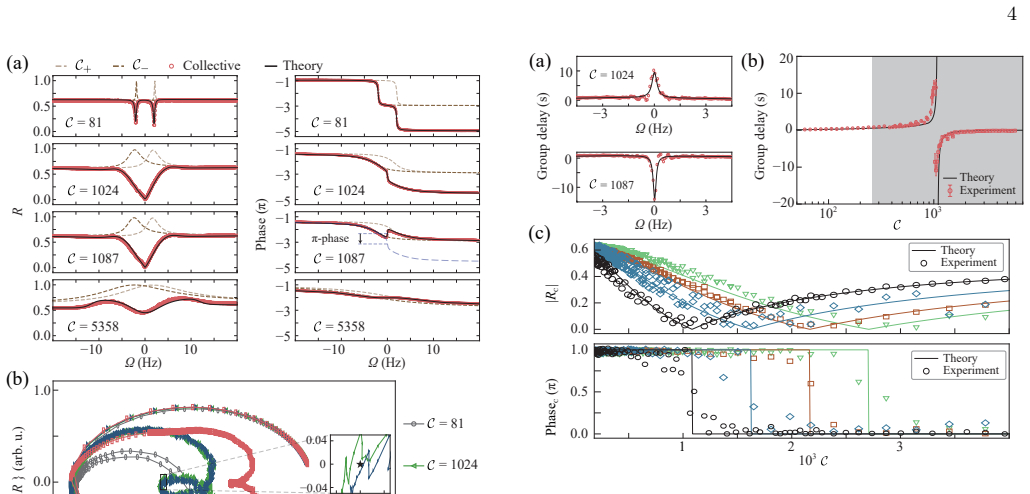
Collective interference among Floquet lattice sites shifts coherent perfect absorption (CPA) from weak cooperativity (C<1) to the high-cooperativity regime (C~10^3). In the experiment, two pump tones detuned by σ map the optomechanical system onto a non-Hermitian bipartite lattice of photonic and phononic sidebands. At balanced couplings, the critical cooperativity is C_CPA ≈ (2η−1)^2 σ/γ_m, tunable via σ. There the reflected power drops to |R|^2 ≈ 2×10^−4, the absorption linewidth broadens to ~2σ (≈10^3×γ_m), and the phase singularity yields group delays up to 10 s. Because this occurs at high cooperativity, the pumps cool the mechanical mode, with estimated phonon number N_m = N_T/(C_+ + C
Load-bearing premise
The claim that the mechanical oscillator reaches its ground state depends on the formula N_m = N_T/(C_+ + C_− + 1), which neglects photon-number fluctuations in the input fields; no thermometric measurement in the paper confirms N_m < 1.
Editorial extensions
If this is right
- The absorption bandwidth becomes set by the modulation frequency σ rather than the mechanical linewidth, so the experiment achieves a ~10^3-fold broadening of the CPA window.
- The critical cooperativity C_CPA is tunable through σ, so perfect absorption can be placed anywhere in the high-cooperativity regime, including the region where sideband cooling puts the mechanical mode near its ground state.
- The phase singularity at C-CPA produces a divergent group delay; the experiment observes delays (or advances) on the order of 10 s, with a sign reversal across the critical point.
- The coexistence of perfect absorption and ground-state cooling points to a route for thermal-noise-free, long-lived optomechanical memory for microwave photons.
- The Floquet-lattice description of CPA is general and could be realized in other cavity-based platforms with modulated couplings.
Reading between the lines
- If the scaling C_CPA ∝ σ generalizes, the same collective scheme in systems with larger mechanical frequencies could push perfect absorption to even higher cooperativity or wider bandwidth, perhaps into the optical domain.
- The ground-state claim rests on an ideal cooling formula; a direct thermometric measurement (e.g., sideband asymmetry) would determine whether photon-number fluctuations or Floquet sideband heating spoil the N_m < 1 prediction.
- The continued-fraction reflection structure might connect collective CPA to exceptional-point physics in synthetic dimensions, where the winding-number change from 2 to 1 could be probed independently.
- The same mechanism could allow dynamically reconfigurable slow/fast light, since the group delay sign and magnitude are controlled by how far the cooperativity sits from C_CPA.
Editorial analysis
A structured set of objections, weighed in public.
Referee Report
Summary. The paper reports an experiment in a superconducting SiC-membrane microwave optomechanical system driven by two pump tones separated by a small frequency offset σ, which maps the system onto a synthetic frequency lattice of coupled photon and phonon Floquet sites. The central claim is that collective interference among the lattice sites shifts the condition for coherent perfect absorption from the conventional weak-cooperativity regime (C<1) to a high-cooperativity regime (reported critical cooperativity C_CPA≈1083 at σ/2π=2 Hz). At this point the measured reflection dips to |R|^2≈2×10^-4, a non-Lorentzian absorption window of width ~2σ is observed, and the reflection phase shows a singularity accompanied by group delays of order 10 s. The authors further claim that, because the CPA condition now lies at high cooperativity, the mechanical oscillator enters its ground state, and they present this as the first demonstration of quantum-compatible optomechanical CPA.
Significance. If the experimental claims hold, this is a substantial advance: it extends optomechanical CPA from a few-mode, weak-coupling effect to a collective, high-cooperativity regime enabled by Floquet synthetic dimensions, with a clear tunability knob in σ. The reported two-dimensional cooperativity maps, the measured deep reflection dip, and the sign-reversing group delay near the phase singularity are concrete and impressive. The theory is built from a first-principles Floquet Hamiltonian and input-output formalism, and the device parameters (κ, γ_m, η, G_±) are stated as independently calibrated rather than fitted to the CPA condition. The main weakness is that the headline 'quantum-compatible' and ground-state claims rest on an ideal cooling formula rather than on any measured phonon occupation, and there is an unexplained factor ~4.7 discrepancy between the stated approximate CPA condition and the reported critical cooperativity. Both issues are load-bearing and need to be fixed before the strongest conclusions can be accepted.
major comments (2)
- [Infinite group delay in quantum regime, paragraph beginning 'Furthermore...'] The claim that the mechanical oscillator 'enters its ground state' is not supported by measurement. The only evidence is the formula N_m = N_T/(C_+ + C_- + 1), which the text itself qualifies with 'neglecting photon number fluctuations in the input fields.' No sideband-asymmetry measurement, phonon-number readout, or independent thermometry is reported. This matters because the two strong pump tones may add technical noise, amplitude fluctuations, or Floquet-induced heating beyond this ideal expression, and because the inferred occupancy N_m≈0.24 for N_T≈530 and total cooperativity 2166 leaves only a factor ~4 margin before N_m exceeds unity. The abstract's statement that 'the mechanical oscillator enters its ground state' should either be backed by a direct thermometric measurement or explicitly weakened to a theoretical prediction of compatibility with ground-state cooling.
- [Critical condition and mode hybridization] The stated approximate C-CPA condition Cγ_m≈(2η−1)^2σ is quantitatively inconsistent with the reported experimental value. Inserting η=0.8125, γ_m/2π=3.4 mHz, and σ/2π=2 Hz gives C_CPA≈230, whereas the text reports C_CPA=1083—a factor 4.7 discrepancy that is never discussed. This condition is used to justify the tunability of C_CPA with σ and the central 'order 10^3' claim, so the discrepancy cannot be dismissed as a mere approximation. The authors should give the exact root from the continued-fraction expression, state explicitly whether the closed form is only an order-of-magnitude estimate, and compare the measured C_CPA(σ) with the exact theoretical prediction.
minor comments (5)
- [Eq. (2)] The continued-fraction expression for R is stated without specifying the truncation order or the convergence criterion used in the numerical evaluation. Please state how many Floquet sidebands were retained and justify that the truncation error is negligible over the plotted frequency range.
- [Device characterization] The text states the device is mounted on the mixing chamber stage at 10 mK, but the thermal occupation is later computed with T=30 mK. Please clarify whether 30 mK is the independently calibrated effective mechanical bath temperature and, if so, how it was determined.
- [Figs. 2 and 3] The agreement between measurement and simulation is presented visually. For a quantitative paper, it would help to include error bars or a goodness-of-fit metric for the reflection/phase maps, especially because Fig. 4 does show error bars.
- [References] References [9] and [15] appear to be the same publication (H. Noh, 'Perfect coupling of light to surface plasmons by coherent absorption,' Phys. Rev. Lett. 108, 186805 (2012)). Please deduplicate.
- [Data availability] The statement 'There are no publicly available research data or software supporting this manuscript' is surprising for an experimental Letter of this type. Sharing the raw reflection/phase maps and the analysis code, or at least depositing the reduced data in a public repository, would materially strengthen the reproducibility of the main claims.
Circularity Check
No circularity found: the C-CPA derivation is self-contained and the measured critical point is compared with, not fitted to, the Floquet-lattice model.
full rationale
The paper's derivation chain is not circular. It starts from a first-principles two-tone optomechanical Hamiltonian, performs a Floquet expansion to obtain the synthetic lattice Hamiltonian (Eq. 1), and then derives the continued-fraction reflection coefficient (Eq. 2) via input-output theory. No target quantity (e.g., the critical cooperativity or the group delay) is inserted as an input. The parameters κ/2π=158.8 kHz, γ_m/2π=3.4 mHz, and η=0.8125 are stated as independently calibrated device properties. The experimental C_CPA=1083 is read from the measured |R_c| versus cooperativity map and compared with the theoretical curves, not extracted by fitting the model to the data. The approximate closed-form condition Cγ_m≈(2η−1)^2σ is a derived consequence; although inserting the stated parameters gives a numerical value (~230) different from the reported 1083, this is an internal consistency/calibration concern, not circularity, because the critical point is not defined by that formula. The ground-state-cooling claim rests on the standard sideband-cooling expression N_m=N_T/(C_++C_-+1), explicitly qualified by 'Neglecting photon number fluctuations in the input fields'; this is an independently known formula rather than a fitted or renamed prediction from this experiment. The absence of direct thermometry weakens the quantum-regime claim, but that is an evidence limitation, not a circular derivation. Self-citations (Refs. [36,37,40,43,49]) appear but are non-load-bearing for the central prediction: they support device fabrication, prior OM-CPA phenomenology, and supplemental derivations, while the collective-interference mechanism is derived in this paper from the Hamiltonian and compared with external measurements. Therefore the paper shows no significant circularity.
Assumptions & free parameters
free parameters (1)
- Residual imbalance between C+ and C− =
not quantified
assumptions (4)
- domain assumption The hierarchy γm ≪ σ ≪ κ makes the cavity act as a common reservoir shared by all Floquet lattice sites.
- ad hoc to paper The reflection coefficient is given by the continued-fraction expression Eq. (2) from input-output theory.
- domain assumption The effective phonon occupancy is N_m = N_T/(C+ + C− + 1), neglecting photon number fluctuations of the input fields.
- ad hoc to paper The approximate C-CPA condition Cγm ≈ (2η−1)^2σ is valid.
Cite this review
Pith. "Pith review of Collective Coherent Perfect Absorption in a Synthetic Photon-Phonon Lattice." pith.science (2026). https://pith.science/paper/C4I3LXDA
@misc{pith2026260718902,
  author       = {Pith},
  title        = {Pith review of: Collective Coherent Perfect Absorption in a Synthetic Photon-Phonon Lattice},
  year         = {2026},
  howpublished = {\url{https://pith.science/paper/C4I3LXDA}},
  note         = {Machine review of arXiv:2607.18902}
}
read the original abstract
Coherent perfect absorption (CPA) has emerged as a powerful paradigm for controlling classical and quantum light, and has been demonstrated across a broad range of physical platforms. CPA realized in optomechanics relies on interference between the input field and the mechanically scattered field, but is intrinsically confined to the weak-cooperativity regime, resulting in a narrow absorption bandwidth and the mechanical mode remains thermally occupied. Here, we experimentally demonstrate collective interference-induced CPA in a synthetic photon--phonon lattice. By harnessing cavity-reservoir-mediated interactions among Floquet lattice sites, collective interference shifts the CPA condition deep into the high-cooperativity regime. This enables CPA to coexist with ground-state cooling of the mechanical oscillator, together with a broadened non-Lorentzian absorption lineshape and a singular group-delay response. Our results identify collective interference as a route to quantum-compatible perfect absorption and long-lived quantum storage.
Figures


Reference graph
Works this paper leans on
-
[1]
D. G. Baranov, A. Krasnok, T. Shegai, A. Al` u, and Y. Chong, Coherent perfect absorbers: Linear control of light with light, Nat. Rev. Mater2, 17064 (2017)
2017
-
[2]
Y. D. Chong, L. Ge, H. Cao, and A. D. Stone, Coher- ent Perfect Absorbers: Time-Reversed Lasers, Phys. Rev. Lett.105, 053901 (2010)
2010
-
[3]
W. Wan, Y. Chong, L. Ge, H. Noh, A. D. Stone, and H. Cao, Time-Reversed Lasing and Interferometric Con- trol of Absorption, Science331, 889 (2011)
2011
-
[4]
C. Wang, W. R. Sweeney, A. D. Stone, and L. Yang, Co- herent perfect absorption at an exceptional point, Science 373, 1261 (2021)
2021
-
[5]
H¨ orner, L
H. H¨ orner, L. Wild, Y. Slobodkin, G. Weinberg, O. Katz, and S. Rotter, Coherent Perfect Absorption of Arbitrary Wavefronts at an Exceptional Point, Phys. Rev. Lett. 133, 173801 (2024)
2024
-
[6]
B. Xue, J. Lin, J. Hou, Y. Zhu, R. Ma, X. Chen, Y. Cheng, L. Ge, and W. Wan, Dual-Color Coherent Per- fect Absorber, Phys. Rev. Lett.134, 013802 (2025)
2025
-
[7]
Galiffi, A
E. Galiffi, A. C. Harwood, S. Vezzoli, R. Tirole, A. Al` u, and R. Sapienza, Optical coherent perfect absorption and amplification in a time-varying medium, Nat. Photonics 20, 163 (2026). 6
2026
-
[8]
Horodynski, M
M. Horodynski, M. K¨ uhmayer, C. Ferise, S. Rotter, and M. Davy, Anti-reflection structure for perfect transmis- sion through complex media, Nature607, 281 (2022)
2022
Show all 56 references
-
[9]
Noh, Perfect coupling of light to surface plasmons by coherent absorption, Phys
H. Noh, Perfect coupling of light to surface plasmons by coherent absorption, Phys. Rev. Lett.108, 186805 (2012)
2012
-
[10]
Roger, S
T. Roger, S. Vezzoli, E. Bolduc, J. Valente, J. J. F. Heitz, J. Jeffers, C. Soci, J. Leach, C. Couteau, N. I. Zheludev, and D. Faccio, Coherent perfect absorption in deeply sub- wavelength films in the single-photon regime, Nat. Com- mun.6, 7031 (2015)
2015
-
[11]
G. Ma, M. Yang, S. Xiao, Z. Yang, and P. Sheng, Acous- tic metasurface with hybrid resonances, Nat. Mater.13, 873 (2014)
2014
-
[12]
Xia, Z.-X
Y.-F. Xia, Z.-X. Xu, Y.-T. Yan, A. Chen, J. Yang, B. Liang, J.-C. Cheng, and J. Christensen, Observation of Coherent Perfect Acoustic Absorption at an Exceptional Point, Phys. Rev. Lett.135, 067001 (2025)
2025
-
[13]
Y. Sun, W. Tan, H.-q. Li, J. Li, and H. Chen, Experimen- tal demonstration of a coherent perfect absorber with pt phase transition, Phys. Rev. Lett.112, 143903 (2014)
2014
-
[14]
L. Feng, R. El-Ganainy, and L. Ge, Non-Hermitian pho- tonics based on parity–time symmetry, Nat. Photonics 11, 752 (2017)
2017
-
[15]
H. Noh, Y. Chong, A. D. Stone, and H. Cao, Perfect cou- pling of light to surface plasmons by coherent absorption, Phys. Rev. Lett.108, 186805 (2012)
2012
-
[16]
Zanotto, F
S. Zanotto, F. P. Mezzapesa, F. Bianco, G. Biasiol, L. Baldacci, M. S. Vitiello, L. Sorba, R. Colombelli, and A. Tredicucci, Perfect energy-feeding into strongly cou- pled systems and interferometric control of polariton ab- sorption, Nat. Phys.10, 830 (2014)
2014
-
[17]
Zhang, X.-Q
D. Zhang, X.-Q. Luo, Y.-P. Wang, T.-F. Li, and J. Q. You, Observation of the exceptional point in cavity magnon-polaritons, Nat. Commun.8, 1368 (2017)
2017
-
[18]
S. Weis, R. Rivi` ere, S. Del´ eglise, E. Gavartin, O. Arcizet, A. Schliesser, and T. J. Kippenberg, Optomechanically Induced Transparency, Science330, 1520 (2010)
2010
-
[19]
Massel, T
F. Massel, T. T. Heikkil¨ a, J.-M. Pirkkalainen, S. U. Cho, H. Saloniemi, P. J. Hakonen, and M. A. Sillanp¨ a¨ a, Mi- crowave amplification with nanomechanical resonators, Nature480, 351 (2011)
2011
-
[20]
A. H. Safavi-Naeini, T. P. M. Alegre, J. Chan, M. Eichen- field, M. Winger, Q. Lin, J. T. Hill, D. E. Chang, and O. Painter, Electromagnetically induced transparency and slow light with optomechanics, Nature472, 69 (2011)
2011
-
[21]
Hocke, X
F. Hocke, X. Zhou, A. Schliesser, T. J. Kippenberg, H. Huebl, and R. Gross, Electromechanically induced ab- sorption in a circuit nano-electromechanical system, New J. Phys.14, 123037 (2012)
2012
-
[22]
X. Zhou, F. Hocke, A. Schliesser, A. Marx, H. Huebl, R. Gross, and T. J. Kippenberg, Slowing, advancing and switching of microwave signals using circuit nanoelec- tromechanics, Nat. Phys.9, 179 (2013)
2013
-
[23]
J. B. Pendry, D. Schurig, and D. R. Smith, Controlling Electromagnetic Fields, Science312, 1780 (2006)
2006
-
[24]
M. C. Rechtsman, Optical sensing gets exceptional, Na- ture548, 161 (2017)
2017
-
[25]
N. Liu, M. Mesch, T. Weiss, M. Hentschel, and H. Giessen, Infrared Perfect Absorber and Its Applica- tion As Plasmonic Sensor, Nano Lett.10, 2342 (2010)
2010
-
[26]
A. N. Vetlugin, Coherent perfect absorption of quantum light, Phys. Rev. A104, 013716 (2021)
2021
-
[27]
Vest, M.-C
B. Vest, M.-C. Dheur, ´E. Devaux, A. Baron, E. Rousseau, J.-P. Hugonin, J.-J. Greffet, G. Messin, and F. Marquier, Anti-coalescence of bosons on a lossy beam splitter, Sci- ence356, 1373 (2017)
2017
-
[28]
Roger, S
T. Roger, S. Restuccia, A. Lyons, D. Giovannini, J. Romero, J. Jeffers, M. Padgett, and D. Faccio, Co- herent absorption of N00N states, Phys. Rev. Lett.117, 023601 (2016)
2016
-
[29]
Altuzarra, S
C. Altuzarra, S. Vezzoli, J. Valente, W. Gao, C. Soci, D. Faccio, and C. Couteau, Coherent perfect absorption in metamaterials with entangled photons, ACS Photonics 4, 2124 (2017)
2017
-
[30]
Hern´ andez, A
O. Hern´ andez, A. Ortega-Gomez, M. Bravo, and I. Lib- eral, Quantum interference in wilkinson power dividers, Laser Photonics Rev.16, 2200095 (2022)
2022
-
[31]
M¨ ullers, B
A. M¨ ullers, B. Santra, C. Baals, J. Jiang, J. Benary, R. Labouvie, D. A. Zezyulin, V. V. Konotop, and H. Ott, Coherent perfect absorption of nonlinear matter waves, Sci. Adv.4, eaat6539 (2018)
2018
-
[32]
Y. Lai, D. D. A. Clarke, P. Grimm, A. Devi, D. Wig- ger, T. Helbig, T. Hofmann, R. Thomale, J.-S. Huang, B. Hecht, and O. Hess, Room-temperature quantum nanoplasmonic coherent perfect absorption, Nat. Com- mun.15, 6324 (2024)
2024
-
[33]
Aspelmeyer, T
M. Aspelmeyer, T. J. Kippenberg, and F. Marquardt, Cavity optomechanics, Rev. Mod. Phys.86, 1391 (2014)
2014
-
[34]
Pirkkalainen, S
J.-M. Pirkkalainen, S. U. Cho, J. Li, G. S. Paraoanu, P. J. Hakonen, and M. A. Sillanp¨ a¨ a, Hybrid circuit cavity quantum electrodynamics with a micromechanical res- onator, Nature494, 211 (2013)
2013
-
[35]
A. D. O’Connell, M. Hofheinz, M. Ansmann, R. C. Bial- czak, M. Lenander, E. Lucero, M. Neeley, D. Sank, H. Wang, M. Weides, J. Wenner, J. M. Martinis, and A. N. Cleland, Quantum ground state and single-phonon control of a mechanical resonator, Nature464, 697 (2010)
2010
-
[36]
Y. Liu, Q. Liu, S. Wang, Z. Chen, M. A. Sillanp¨ a¨ a, and T. Li, Optomechanical Anti-Lasing with Infinite Group Delay at a Phase Singularity, Phys. Rev. Lett.127, 273603 (2021)
2021
-
[37]
Y. Liu, H. Sun, Q. Liu, H. Wu, M. A. Sillanp¨ a¨ a, and T. Li, Degeneracy-breaking and long-lived multimode microwave electromechanical systems enabled by cubic silicon-carbide membrane crystals, Nat. Commun.16, 1207 (2025)
2025
-
[38]
J. D. Teufel, T. Donner, D. Li, J. W. Harlow, M. S. Allman, K. Cicak, A. J. Sirois, J. D. Whittaker, K. W. Lehnert, and R. W. Simmonds, Sideband cooling of mi- cromechanical motion to the quantum ground state, Na- ture475, 359 (2011)
2011
-
[39]
T. A. Palomaki, J. W. Harlow, J. D. Teufel, R. W. Sim- monds, and K. W. Lehnert, Coherent state transfer be- tween itinerant microwave fields and a mechanical oscil- lator, Nature495, 210 (2013)
2013
-
[40]
Y. Liu, Q. Liu, H. Sun, M. Chen, S. Wang, and T. Li, Coherent memory for microwave photons based on long- lived mechanical excitations, npj Quantum Inf.9, 80 (2023)
2023
-
[41]
A. B. Bozkurt, O. Golami, Y. Yu, H. Tian, and M. Mirhosseini, A mechanical quantum memory for mi- crowave photons, Nat. Phys. , 1 (2025)
2025
-
[42]
Bukov, L
M. Bukov, L. D’Alessio, and A. Polkovnikov, Univer- sal high-frequency behavior of periodically driven sys- tems: From dynamical stabilization to Floquet engineer- 7 ing, Adv. Phys.64, 139 (2015)
2015
-
[43]
collective coherent perfect absorption in a synthetic photon-phonon lattice
Supplemental material for “collective coherent perfect absorption in a synthetic photon-phonon lattice”,(i) Flo- quet photon-phonon lattice, (ii) collective dynamics and coherent perfect absorption, (iii) microwave optomechan- ical device and characterization, (iv) sideband co...
2026
-
[44]
Mirhosseini, A
M. Mirhosseini, A. Sipahigil, M. Kalaee, and O. Painter, Superconducting qubit to optical photon transduction, Nature588, 599 (2020)
2020
-
[45]
I. C. Rodrigues, D. Bothner, and G. A. Steele, Coupling microwave photons to a mechanical resonator using quan- tum interference, Nat. Commun.10, 5359 (2019)
2019
-
[46]
Zoepfl, M
D. Zoepfl, M. L. Juan, C. M. F. Schneider, and G. Kirch- mair, Single-Photon Cooling in Microwave Magnetome- chanics, Phys. Rev. Lett.125, 023601 (2020)
2020
-
[47]
Fazio, J
R. Fazio, J. Keeling, L. Mazza, and M. Schir` o, Many- Body Open Quantum Systems (2025), arXiv:2409.10300 [quant-ph]
2025 arXiv
-
[48]
Diehl, A
S. Diehl, A. Tomadin, A. Micheli, R. Fazio, and P. Zoller, Dynamical Phase Transitions and Instabilities in Open Atomic Many-Body Systems, Phys. Rev. Lett.105, 015702 (2010)
2010
-
[49]
S. Wang, C. Wang, M. H. J. de Jong, L. Mercier de L´ epinay, J. Zhou, M. A. Sillanp¨ a¨ a, and Y. Liu, Pump- threshold-free frequency comb via cavity floquet engi- neering, Nat. Commun.17, 5811 (2026)
2026
-
[50]
Youssefi, S
A. Youssefi, S. Kono, A. Bancora, M. Chegnizadeh, J. Pan, T. Vovk, and T. J. Kippenberg, Topological lat- tices realized in superconducting circuit optomechanics, Nature612, 666 (2022)
2022
-
[51]
A. Y. Kitaev, Unpaired Majorana fermions in quantum wires, Phys. Usp44, 131 (2001)
2001
-
[52]
N. H. Lindner, G. Refael, and V. Galitski, Floquet topo- logical insulator in semiconductor quantum wells, Nat. Phys.7, 490 (2011)
2011
-
[53]
Walther, B
H. Walther, B. T. H. Varcoe, B.-G. Englert, and T. Becker, Cavity quantum electrodynamics, Rep. Prog. Phys.69, 1325 (2006)
2006
-
[54]
J. Zhao, L. Wu, T. Li, Y.-x. Liu, F. Nori, Y. Liu, and J. Du, Phase-Controlled Pathway Interferences and Switchable Fast-Slow Light in a Cavity-Magnon Polari- ton System, Phys. Rev. Appl.15, 024056 (2021)
2021
-
[55]
Blais, A
A. Blais, A. L. Grimsmo, S. M. Girvin, and A. Wallraff, Circuit quantum electrodynamics, Rev. Mod. Phys.93, 025005 (2021)
2021
-
[56]
K.¨Ozdemir, S
S ¸. K.¨Ozdemir, S. Rotter, F. Nori, and L. Yang, Parity– time symmetry and exceptional points in photonics, Nat. Mater.18, 783 (2019)
2019
Reviewed August 1, 2026 · model on record in the stance chip above.
Discussion (0). Sign in to comment.