REVIEW 4 major objections 4 minor 49 references
Refactoring a serving engine's sequential cold-start program into communicating finite automata lets independent initialization steps run concurrently and merge I/O, cutting time to first token by up to 7.2× while preserving program semanti
Reviewed by Pith at T0; open to challenge. T0 means a machine referee read the full paper against a public rubric. the ladder, T0–T4 →
T0 review · deepseek-v4-flash
2026-08-01 13:46 UTC pith:LQ7ODTPM
load-bearing objection Solid systems result with a formal correctness claim that doesn't cover its own biggest optimization; read it for the engineering, not the proof. the 4 major comments →
InstantInfer: Enabling Fast LLM Cold Start with Communicating Finite Automata
The pith
A machine-rendered reading of the paper's core claim, the machinery that carries it, and where it could break.
Core claim
The central claim is that the cold-start bottleneck is not the initialization work itself but the ordering forced by sequential control flow. The paper defines each physical or logical component as a finite automaton with monotonic, irreversible states; dependencies are declared as (component, state) prerequisites, and a channel runtime publishes states and wakes waiters. Because transitions are monotonic, the whole cold start forms a DAG, and the paper proves (Theorems 1 and 2) that any DAG CFA terminates at the same final states as the original chain, provided each automaton's own transition order is unchanged. InstantInfer instantiates this in three places: parent and child processes gain
What carries the argument
The Communicating Finite Automaton (CFA) abstraction: each initialization component is an automaton with a monotonic, finite, ordered state variable, and a dependency (c_i, s_i) → (c_j, s_j) means c_j's transition out of s_j waits until c_i reaches s_i. A channel daemon maintains wait queues and published-state flags, exposing set_state and wait_state primitives so developers keep the original code and insert declarations rather than rewriting components. The proof machinery is the DAG/Chain equivalence: sequential execution is a Chain CFA, and any DAG CFA in which every automaton preserves its per-FA transition sequence terminates in the same final states. This equivalence is what licenses
Load-bearing premise
The argument assumes that every real ordering constraint between initialization code blocks is declared as a state dependency, so any shared state that is not mentioned—globals, GPU context creation, IPC handles, inherited file descriptors—is safe under arbitrary interleaving; if one undeclared dependency exists, the concurrently refactored program can race or crash.
What would settle it
Instrument a refactored component pair that shares a hidden resource—for example, two processes that both write to the same configuration file or one process that uses a GPU context created by another—without declaring a state dependency, run the pipeline many times, and check whether final states ever differ or the process crashes.
If this is right
- Cold-start time stops being the sum of all process initialization times; with an intermediate state per process, startup becomes the max over root-to-leaf paths plus the ordered dependent stages.
- Model loading can become a hardware-bound transfer: a chunked disk-to-host-to-GPU pipeline with cross-GPU AllGather reaches near-link storage throughput, so remaining gains require faster storage or interconnects.
- Model switching can overlap teardown and initialization safely by declaring GPU-memory release as the one blocking dependency, shrinking the window in which no requests are served.
- The approach is incremental: because the original code structure is preserved and only state declarations are inserted, the same CFA framework can be applied phase by phase to other startup stages.
- If the claimed speedups hold, cold-start TTFT no longer needs to dominate user-perceived latency in serverless LLM serving; bursts can be absorbed by quickly bringing new engines online.
Where Pith is reading between the lines
- The equivalence theorem covers final states of declared automata, not data-race-freedom of every shared object; extending InstantInfer to a new component safely requires tooling that verifies all real shared-state interactions are captured by declared dependencies, or the safety guarantee may not transfer.
- The chunk loading strategy assumes tensor-to-chunk mappings are precomputed offline; an untested extension is adaptive chunk sizing or dynamic repartitioning based on measured storage and interconnect bandwidth.
- The model-switch schedule uses profiled predictions of new-model environment init time and old-model GPU release time; prediction error would shift the overlap point, suggesting a feedback or online-control variant as a natural follow-up.
- The CFA abstraction likely generalizes beyond LLM cold starts to any multi-component initialization pipeline with monotonic progress, such as database startup or container image materialization, though the paper only evaluates LLM serving.
Editorial analysis
A structured set of objections, weighed in public.
Referee Report
Summary. The paper proposes the Communicating Finite Automata (CFA) abstraction to model LLM cold-start components as monotonic state machines with explicit state dependencies, and uses it to refactor vLLM's sequential startup into concurrent, I/O-merged execution. Three cold-start procedures are refactored: process-tree materialization, tensor loading, and model switching. The authors claim a rigorous proof that CFA-based refactoring is equivalent to the original sequential program (Theorems 1–2, §3.3 and §8), and report end-to-end TTFT speedups up to 7.2×, model-loading speedups up to 32.3×, and model-switching stall reductions up to 11.8× across two GPU clusters and four models each.
Significance. If the correctness claim were established, this would be a valuable contribution: a unified abstraction that exposes cross-component concurrency and I/O-granularity mismatches in LLM cold start, with a practical framework integrated into vLLM. The empirical evaluation is broad and credible: two clusters, multiple dense and MoE models, burst workloads, multi-instance scaling, ablations, and hardware utilization. The paper also measures CPU and memory overhead transparently. However, the formal correctness argument, which is a central advertised contribution, is much weaker than claimed: the main theorem is near-tautological and does not cover the chunk-based tensor-loading refactor that yields the largest speedup. The data-safety arguments for all three refactorings are informal prose. The empirical results are likely to stand on their own, but the paper currently overstates its formal guarantees.
major comments (4)
- [§3.3, Theorem 2] Theorem 2 is essentially a tautology. It assumes that each FA in the DAG CFA has an internal transition sequence identical to that in the Chain CFA, then concludes the final states are the same. With that hypothesis, the conclusion follows by definition; the proof in §8 simply observes that both terminate at final states. The theorem does not show that respecting the declared state dependencies is sufficient to preserve per-FA transition sequences in a real concurrent execution, nor does it address undeclared shared-state interactions (e.g., global variables, CUDA context creation, IPC endpoints, file descriptors). The claim in §1 and §3.3 of a 'rigorous proof' for the refactoring is therefore materially overstated.
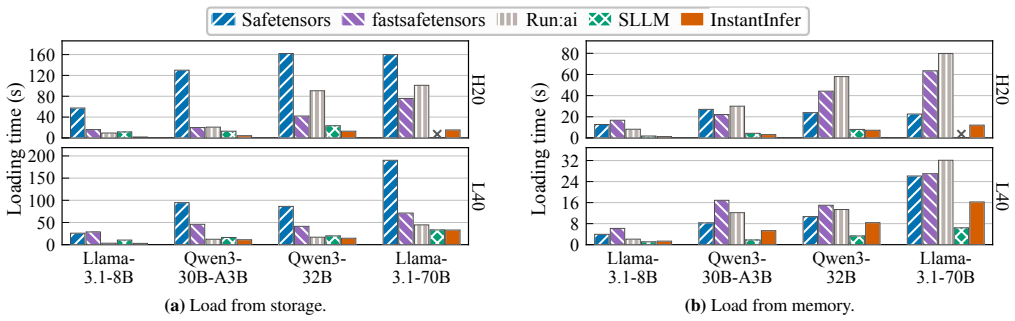
- [§4.2, refined tensor CFA] The chunk-based tensor-loading refactor, which drives the largest speedup in the ablation (2.4×–3.7× in §6.5), is not covered by Theorems 1–2. In the refined model, tensor state spaces are redefined from {InDisk, InMem, InGPU} to {Alloc, Loaded}, and new chunk FAs with states {InDisk, InMem, InGPU, Destroyed} (plus Gathered in the distributed variant) are introduced. The original sequential vLLM loader has no chunk components and uses a different tensor state space, so there is no Chain CFA containing the same per-FA sequences. Consequently Theorem 2 cannot be instantiated to prove equivalence for this refactoring. The correctness-and-safety paragraph ("each logical tensor is assigned values after its own allocation and its associated chunks' readiness") is informal prose, not a proof. The formal guarantee therefore has a gap exactly where the main optimization lives.
- [§4.1–§4.3, data-safety arguments] The correctness of all three refactorings rests on the unstated axiom that the only ordering constraints are those the programmer explicitly declares as CFA state dependencies. The framework provides no static check or proof that the original vLLM initialization code has no other shared-state dependencies between the concurrent code blocks. The data-safety paragraphs in §4.1–4.3 are informal and non-quantitative; for instance, the chunk-to-tensor dependency is written as (C_i, InGPU) → (T_j, Alloc) and (T_i, Loaded) → (C_j, InGPU), but the text says a chunk is destroyed only after *all* associated tensors are Loaded. The formal model does not define conjunctive (AND) dependencies, so the written dependencies do not express the intended safety condition. If any undeclared dependency exists, the refactored program can race or crash, and neither Theorem 1 nor Theorem 2 rules this out.
- [§3.1, FA merging] The FA-merging operation described in §3.1 ('multiple related FAs can be safely merged and simplified... reduce state transitions while maintaining the same semantics') is not formalized or proved. The refined tensor model is not a simple merge of existing FAs; it changes state spaces and introduces new component types. The paper should either provide a precise semantics-preservation theorem for the merge/refinement operation or explicitly present the tensor-loading correctness argument as an engineering claim supported by testing, not as a consequence of Theorems 1–2.
minor comments (4)
- [§7, Related Work] The text mentions 'InstaInfer' instead of 'InstantInfer' in the sentence about loading-oriented systems. Please fix the typo.
- [§6.5, Ablation] The reported compounded speedup (5.0×–7.8×) is not obviously consistent with the individual contributions (2.4×–3.7×, 1.2×–1.5×, 1.6×–2.1×) if they are intended to be multiplicative. The text should clarify whether the later numbers are additional normalized reductions on the already-optimized baseline, or whether the total is computed differently.
- [§4.2, dependencies] The notation for chunk-to-tensor dependencies is ambiguous: a single dependency (T_i, Loaded) → (C_j, InGPU) suggests one tensor can trigger destruction, whereas the prose requires all associated tensors to be Loaded. Please define AND-dependencies explicitly in the CFA model.
- [§8, Theorem 1 proof] The proof of Theorem 1 states that any incomplete DAG has a state with in-degree 0 and out-degree > 0. This is true for a DAG but should be stated as a lemma with a short justification, since the graph contains both internal transition edges and cross-FA dependency edges that can interact.
Circularity Check
Theorem 2's equivalence proof is definitional and does not cover the chunk-merged tensor refactor producing the main speedup; the empirical results remain independent.
specific steps
-
self definitional
[§3.3 Theorem 2; §8 proof; §4.2 'Correctness and Safety']
"Theorem 2. If the internal state transition sequence of each FA in a DAG CFA is identical to that in a Chain CFA, then when both CFAs terminate, the final states of all FAs will be exactly the same. ... In both CFAs, the partial order of states for each FA is identical. With (1), the final states of all FAs in both the DAG CFA and the Chain CFA are guaranteed to be identical when they terminate. ... By theorems in §3.3, the CFA-refined program converges to the same state as the original program."
The claimed proof of refactoring correctness reduces to the theorem's own hypothesis: if every FA has the same internal transition sequence, then each FA's final state is already determined by that sequence, so 'same final states' is a restatement of the premise rather than an independently derived guarantee. The theorem therefore cannot by itself establish that the actual refactored vLLM code is equivalent to the sequential original. For the main speedup, tensor materialization, the refined model redefines tensor state spaces as {Alloc, Loaded} and introduces chunk FAs with states {InDisk, InMem, InGPU, Destroyed}; the original sequential loader has no such components, so no Chain CFA with identical per-FA sequences exists and Theorem 2 is not instantiable. The 'By theorems in §3.3' asser
full rationale
The empirical evaluation is self-contained and not circular: InstantInfer is benchmarked against external systems (vLLM, SGLang, ServerlessLLM, Safetensors, fastsafetensors, Run:ai), and the headline speedups are measured end-to-end rather than derived from the CFA theorem. There is no load-bearing self-citation and no fitted parameter is renamed as a prediction; the model-switching schedule uses offline profiling (t'_1, t'_2) only as a scheduling heuristic. The notable circularity-like issue is confined to the formal correctness claim: Theorem 2 is definitionally true and is invoked for the tensor-loading refactor even though the refactor changes per-FA state spaces and adds new chunk FAs, so the theorem's key hypothesis is not satisfied. This makes the formal guarantee overstate what is proved, but it does not contaminate the experimental comparisons. Accordingly, a modest score of 3 is appropriate: partial circularity in the formal derivation chain, independent empirical content.
Axiom & Free-Parameter Ledger
free parameters (3)
- chunk_size
- CPU/GPU buffer sizes
- model-switch schedule predictions t'_1, t'_2
axioms (3)
- domain assumption All component state transitions are monotonic and irreversible
- standard math Every state transition finishes in finite time
- ad hoc to paper Declared state dependencies are sufficient to guarantee data safety
invented entities (2)
-
channel daemon (runtime)
independent evidence
-
data chunk
independent evidence
read the original abstract
Cold starts in large language model (LLM) inference services significantly affect user experience, yet they remain inefficient due to sequential initialization and a massive number of fine-grained I/O requests issued by complex software components. Although refactoring the program can yield advantages such as concurrent execution and I/O merging, this approach is error-prone and carries correctness risks when dealing with massive, heterogeneous components. We propose the Communicating Finite Automata (CFA) abstraction to systematically analyze cross-component optimization opportunities, and design a programming framework to enable CFA-based component program refactoring. This framework preserves the original sequential program structure while enabling safe concurrent component execution. We prove the correctness of the program refactoring. We apply the CFA abstraction and framework to refactor process tree creation, tensor loading, and model switching in vLLM, forming a new cold-start system named InstantInfer. Extensive experiments demonstrate that InstantInfer substantially accelerates LLM cold starts (achieving up to 7.2 times speedup) and exhibits robustness across diverse GPUs, workloads, and scales.
Figures




Reference graph
Works this paper leans on
-
[1]
ShareGPT Datasets.https://huggingface.co/datasets/Ryok oAI/ShareGPT52K
2023. ShareGPT Datasets.https://huggingface.co/datasets/Ryok oAI/ShareGPT52K
2023
-
[2]
IBM Storage Scale.https://www.ibm.com/docs/storage- scale
2026. IBM Storage Scale.https://www.ibm.com/docs/storage- scale
2026
-
[3]
Run:ai Model Streamer.https://github.com/run-ai/runai- model-streamer
2026. Run:ai Model Streamer.https://github.com/run-ai/runai- model-streamer
2026
-
[4]
Anthropic. 2026. Claude Code.https://claude.com/product/claude- code
2026
-
[5]
Jiabin Chen, Fei Xu, Yikun Gu, Li Chen, Fangming Liu, and Zhi Zhou. 2024. HarmonyBatch: Batching multi-SLO DNN Inference with Heterogeneous Serverless Functions. In2024 IEEE/ACM 32nd International Symposium on Quality of Service (IWQoS). 1–10. doi: 10.1109/IWQoS61813.2024.10682915
arXiv 2024
-
[6]
Lequn Chen, Zihao Ye, Yongji Wu, Danyang Zhuo, Luis Ceze, and Arvind Krishnamurthy. 2024. Punica: Multi-Tenant LoRA Serving. In Proceedings of Machine Learning and Systems, P. Gibbons, G. Pekhi- menko, and C. De Sa (Eds.), V ol. 6. 1–13.https://proceedings.mlsy s.org/paper_files/paper/2024/file/054de805fcceb78a201f5e9d 53c85908-Paper-Conference.pdf
2024
-
[7]
Jiangfei Duan, Runyu Lu, Haojie Duanmu, Xiuhong Li, Xingcheng Zhang, Dahua Lin, Ion Stoica, and Hao Zhang. 2024. MuxServe: Flexible Spatial-Temporal Multiplexing for Multiple LLM Serving. arXiv:2404.02015 [cs.DC]https://arxiv.org/abs/2404.02015
Pith/arXiv arXiv 2024
-
[8]
Hugging Face. 2023. Safetensors.https://github.com/huggingface /safetensors
2023
-
[9]
Yao Fu, Leyang Xue, Yeqi Huang, Andrei-Octavian Brabete, Dmitrii Ustiugov, Yuvraj Patel, and Luo Mai. 2024. ServerlessLLM: Low- Latency Serverless Inference for Large Language Models. In18th USENIX Symposium on Operating Systems Design and Implementation (OSDI 24). USENIX Association, Santa Clara, CA, 135–153.https: //www.usenix.org/conference/osdi24/pres...
2024
-
[10]
GitHub. 2026. GitHub Copilot.https://github.com/features/copilot
2026
-
[11]
Daya Guo, Dejian Yang, Haowei Zhang, Junxiao Song, Peiyi Wang, Qihao Zhu, Runxin Xu, Ruoyu Zhang, Shirong Ma, Xiao Bi, Xiaokang Zhang, Xingkai Yu, Yu Wu, Z. F. Wu, Zhibin Gou, Zhihong Shao, Zhuoshu Li, Ziyi Gao, Aixin Liu, Bing Xue, Bingxuan Wang, Bochao Wu, Bei Feng, Chengda Lu, Chenggang Zhao, Chengqi Deng, Chong Ruan, Damai Dai, Deli Chen, Dongjie Ji, ...
2025
-
[12]
Zicong Hong, Jian Lin, Song Guo, Sifu Luo, Wuhui Chen, Roger Wattenhofer, and Yue Yu. 2024. Optimus: Warming Serverless ML Inference via Inter-Function Model Transformation. InProceedings of the Nineteenth European Conference on Computer Systems(Athens, Greece)(EuroSys ’24). Association for Computing Machinery, New York, NY , USA, 1039–1053. doi:10.1145/3...
arXiv 2024
-
[13]
Junhao Hu, Jiang Xu, Zhixia Liu, Yulong He, Yuetao Chen, Hao Xu, Jiang Liu, Jie Meng, Baoquan Zhang, Shining Wan, Gengyuan Dan, Zhiyu Dong, Zhihao Ren, Changhong Liu, Tao Xie, Dayun Lin, Qin Zhang, Yue Yu, Hao Feng, Xusheng Chen, and Yizhou Shan
-
[14]
Nikoleta Iliakopoulou, Jovan Stojkovic, Chloe Alverti, Tianyin Xu, Hubertus Franke, and Josep Torrellas. 2025. Chameleon: Adaptive Caching and Scheduling for Many-Adapter LLM Inference Environ- ments. InProceedings of the 58th IEEE/ACM International Sympo- sium on Microarchitecture (MICRO 2025). ACM, 217–231. doi: 10.1145/3725843.3756083
arXiv 2025
-
[15]
Woosuk Kwon, Zhuohan Li, Siyuan Zhuang, Ying Sheng, Lianmin Zheng, Cody Hao Yu, Joseph Gonzalez, Hao Zhang, and Ion Stoica
-
[16]
Baolin Li, Yankai Jiang, Vijay Gadepally, and Devesh Tiwari. 2024. LLM Inference Serving: Survey of Recent Advances and Opportunities. arXiv:2407.12391 [cs.DC]https://arxiv.org/abs/2407.12391
Pith/arXiv arXiv 2024
-
[17]
Suyi Li, Hanfeng Lu, Tianyuan Wu, Minchen Yu, Qizhen Weng, Xusheng Chen, Yizhou Shan, Binhang Yuan, and Wei Wang. 2024. CaraServe: CPU-Assisted and Rank-Aware LoRA Serving for Genera- tive LLM Inference. arXiv:2401.11240 [cs.DC]https://arxiv.org/ab s/2401.11240
Pith/arXiv arXiv 2024
-
[18]
Suyi Li, Hanfeng Lu, Tianyuan Wu, Minchen Yu, Qizhen Weng, Xusheng Chen, Yizhou Shan, Binhang Yuan, and Wei Wang. 2025. TOPPINGS: CPU-assisted, rank-aware adapter serving for LLM in- ference. InProceedings of the 2025 USENIX Conference on Usenix Annual Technical Conference(Boston, MA, USA)(USENIX ATC ’25). USENIX Association, USA, Article 37, 17 pages.htt...
arXiv 2025
-
[19]
Chongpeng Liu, Xiaojian Liao, Hancheng Liu, Limin Xiao, and Jianxin Li. 2025. PipeBoost: Resilient Pipelined Architecture for Fast Serverless LLM Scaling. arXiv:2503.17707 [cs.DC]https: //arxiv.org/abs/2503.17707
Pith/arXiv arXiv 2025
-
[20]
Xueshen Liu, Yongji Wu, Yuncheng Yao, Danyang Zhuo, Ion Sto- ica, and Z. Morley Mao. 2026. Foundry: Template-Based CUDA Graph Context Materialization for Fast LLM Serving Cold Start. arXiv:2604.06664 [cs.DC]https://arxiv.org/abs/2604.06664
Pith/arXiv arXiv 2026
-
[21]
Chiheng Lou, Sheng Qi, Chao Jin, Dapeng Nie, Haoran Yang, Yu Ding, Xuanzhe Liu, and Xin Jin. 2025. HydraServe: Minimizing Cold Start Latency for Serverless LLM Serving in Public Clouds. arXiv:2502.15524 [cs.DC]https://arxiv.org/abs/2502.15524
arXiv 2025
-
[22]
Chiheng Lou, Sheng Qi, Rui Kang, Yong Zhang, Chen Sun, Pengcheng Wang, Bingyang Liu, Xuanzhe Liu, and Xin Jin. 2025. WarmServe: Enabling One-for-Many GPU Prewarming for Multi-LLM Serving. arXiv:2512.09472 [cs.DC]https://arxiv.org/abs/2512.09472
Pith/arXiv arXiv 2025
-
[24]
Ziming Mao, Tian Xia, Zhanghao Wu, Wei-Lin Chiang, Tyler Griggs, Romil Bhardwaj, Zongheng Yang, Scott Shenker, and Ion Stoica
-
[25]
Meta. 2024. Introducing Llama 3.1: Our most capable models to date. https://ai.meta.com/blog/meta-llama-3-1
2024
-
[26]
Xupeng Miao, Gabriele Oliaro, Zhihao Zhang, Xinhao Cheng, Hongyi Jin, Tianqi Chen, and Zhihao Jia. 2025. Towards Efficient Generative Large Language Model Serving: A Survey from Algorithms to Systems. Comput. Surveys58, 1 (Sept. 2025), 1–37. doi:10.1145/3754448
doi:10.1145/3754448 2025
-
[27]
InProceedings of the Twentieth European Con- ference on Computer Systems (EuroSys’25)
SkyServe: Serving AI Models across Regions and Clouds with Spot Instances. InProceedings of the Twentieth European Con- ference on Computer Systems (EuroSys’25). ACM, 159–175. doi: 10.1145/3689031.3717459
-
[28]
Yinan Ni, Xiao Yang, Yuqi Tang, Zhimin Qiu, Chen Wang, and Tingzhou Yuan. 2025. Predictive-LoRA: A Proactive and Fragmentation-Aware Serverless Inference System for LLMs. arXiv:2512.20210 [cs.DC]https://arxiv.org/abs/2512.20210
arXiv 2025
-
[29]
OpenAI. 2026. OpenAI Codex.https://openai.com/codex/
2026
-
[30]
Microsoft. 2026. Microsoft 365 Copilot.https://www.microsoft.co m/en-us/microsoft-365/copilot
2026
-
[31]
Ying Sheng, Shiyi Cao, Dacheng Li, Coleman Hooper, Nicholas Lee, Shuo Yang, Christopher Chou, Banghua Zhu, Lianmin Zheng, Kurt Keutzer, Joseph E. Gonzalez, and Ion Stoica. 2024. S-LoRA: Serving Thousands of Concurrent LoRA Adapters. arXiv:2311.03285 [cs.LG] https://arxiv.org/abs/2311.03285
Pith/arXiv arXiv 2024
-
[32]
Yifan Sui, Hao Wang, Hanfei Yu, Yitao Hu, Jianxun Li, and Hao Wang
-
[33]
OpenClaw. 2026. OpenClaw.https://openclaw.ai/
2026
-
[34]
PyTorch Team. 2026. Compile Time Caching in torch.compile. https://docs.pytorch.org/tutorials/recipes/torch_compile_cachi ng_tutorial.html
2026
-
[35]
vLLM Team. 2026. Parallelism and Scaling of vLLM.https://docs.v llm.ai/en/latest/serving/parallelism_scaling/
2026
-
[36]
arXiv:2505.14468 [cs.LG]https: //arxiv.org/abs/2505.14468
ServerlessLoRA: Minimizing Latency and Cost in Serverless Inference for LoRA-Based LLMs. arXiv:2505.14468 [cs.LG]https: //arxiv.org/abs/2505.14468
-
[37]
Yifan Sui, Hanfei Yu, Yitao Hu, Jianxun Li, and Hao Wang. 2024. Pre-Warming is Not Enough: Accelerating Serverless Inference With Opportunistic Pre-Loading. InProceedings of the 2024 ACM Sympo- sium on Cloud Computing(Redmond, W A, USA)(SoCC ’24). Associa- tion for Computing Machinery, New York, NY , USA, 178–195. doi: 10.1145/3698038.3698509
arXiv 2024
-
[38]
Takeshi Yoshimura, Tatsuhiro Chiba, Manish Sethi, Daniel Waddington, and Swaminathan Sundararaman. 2025. Speeding up Model Loading with fastsafetensors. arXiv:2505.23072 [cs.DC]https://arxiv.org/ab s/2505.23072
Pith/arXiv arXiv 2025
-
[39]
Minchen Yu, Ao Wang, Dong Chen, Haoxuan Yu, Xiaonan Luo, Zhuo- hao Li, Wei Wang, Ruichuan Chen, Dapeng Nie, Haoran Yang, and Yu Ding. 2025. Torpor: GPU-Enabled Serverless Computing for Low- Latency, Resource-Efficient Inference. arXiv:2306.03622 [cs.DC] https://arxiv.org/abs/2306.03622
Pith/arXiv arXiv 2025
-
[40]
Yuxing Xiang, Xue Li, Kun Qian, Yufan Yang, Diwen Zhu, Wenyuan Yu, Ennan Zhai, Xuanzhe Liu, Xin Jin, and Jingren Zhou. 2025. Ae- gaeon: Effective GPU Pooling for Concurrent LLM Serving on the Market. InProceedings of the ACM SIGOPS 31st Symposium on Oper- ating Systems Principles(Lotte Hotel World, Seoul, Republic of Korea) (SOSP ’25). Association for Com...
arXiv 2025
-
[41]
An Yang, Anfeng Li, Baosong Yang, Beichen Zhang, Binyuan Hui, Bo Zheng, Bowen Yu, Chang Gao, Chengen Huang, Chenxu Lv, Chu- jie Zheng, Dayiheng Liu, Fan Zhou, Fei Huang, Feng Hu, Hao Ge, Haoran Wei, Huan Lin, Jialong Tang, Jian Yang, Jianhong Tu, Jianwei Zhang, Jianxin Yang, Jiaxi Yang, Jing Zhou, Jingren Zhou, Junyang Lin, Kai Dang, Keqin Bao, Kexin Yang...
Pith/arXiv arXiv 2025
-
[42]
Shaoxun Zeng, Minhui Xie, Shiwei Gao, Youmin Chen, and Youyou Lu. 2025. Medusa: Accelerating Serverless LLM Inference with Mate- rialization. InProceedings of the 30th ACM International Conference on Architectural Support for Programming Languages and Operating Systems, Volume 1(Rotterdam, Netherlands)(ASPLOS ’25). Associa- tion for Computing Machinery, N...
arXiv 2025
-
[43]
Dingyan Zhang, Haotian Wang, Yang Liu, Xingda Wei, Yizhou Shan, Rong Chen, and Haibo Chen. 2025. BlitzScale: Fast and Live Large Model Autoscaling with O (1) Host Caching. In19th USENIX Sym- posium on Operating Systems Design and Implementation (OSDI 25). 275–293.https://www.usenix.org/conference/osdi25/presentati on/zhang-dingyan
2025
-
[44]
Minchen Yu, Rui Yang, Chaobo Jia, Zhaoyuan Su, Sheng Yao, Tingfeng Lan, Yuchen Yang, Zirui Wang, Yue Cheng, Wei Wang, Ao Wang, and Ruichuan Chen. 2026. 𝜆Scale: Enabling Fast Scaling for Serverless Large Language Model Inference. arXiv:2502.09922 [cs.DC]https: //arxiv.org/abs/2502.09922
arXiv 2026
-
[45]
Shan Yu, Jiarong Xing, Yifan Qiao, Mingyuan Ma, Yangmin Li, Yang Wang, Shuo Yang, Zhiqiang Xie, Shiyi Cao, Ke Bao, Ion Stoica, Harry Xu, and Ying Sheng. 2025. Prism: Unleashing GPU Sharing for Cost- Efficient Multi-LLM Serving. arXiv:2505.04021 [cs.DC]https: //arxiv.org/abs/2505.04021
Pith/arXiv arXiv 2025
-
[48]
Gonzalez, Clark Barrett, and Ying Sheng
Lianmin Zheng, Liangsheng Yin, Zhiqiang Xie, Chuyue Sun, Jeff Huang, Cody Hao Yu, Shiyi Cao, Christos Kozyrakis, Ion Stoica, Joseph E. Gonzalez, Clark Barrett, and Ying Sheng. 2024. SGLang: Ef- ficient Execution of Structured Language Model Programs. InAdvances in Neural Information Processing Systems, A. Globerson, L. Mackey, D. Belgrave, A. Fan, U. Paqu...
2024
-
[49]
Wenbin Zhu, Zhaoyan Shen, Zili Shao, Hongjun Dai, and Feng Chen
-
[50]
A", "A1") 4await A_init2() 5channel.set_state(
Tangram: Accelerating Serverless LLM Loading through GPU Memory Reuse and Affinity. arXiv:2512.01357 [cs.DC]https://arxiv. org/abs/2512.01357 14 vLLM SGLang SLLM InstantInfer 0 50100 Qwen3- 30B-A3B 0.00 0.25 0.50 0.75 1.00 0 150300 Llama- 3.1-70B 0 150300 Qwen3- 235B-A22B 0 150300 DeepSeek- R1 CDF of TTFT (s) Figure 17.[H20] Cold-start TTFT under a reques...
-
[2023]
InProceedings of the 29th Symposium on Operat- ing Systems Principles
Efficient memory management for large language model serving with pagedattention. InProceedings of the 29th Symposium on Operat- ing Systems Principles. 611–626.https://doi.org/10.1145/3600006. 3613165
-
[2025]
arXiv:2501.14417 [cs.DC]https://arxiv.org/abs/2501.14417
DeepServe: Serverless Large Language Model Serving at Scale. arXiv:2501.14417 [cs.DC]https://arxiv.org/abs/2501.14417
discussion (0)
Sign in with ORCID, Apple, or X to comment. Anyone can read and Pith papers without signing in.