REVIEW 3 major objections 5 minor 65 references
FlexiAvatar: Unified 3D Gaussian Human Avatars Under Arbitrary Body Visibility
T0 review · 3 major / 5 minor · reviewed 2026-08-01 · deepseek-v4-flash
Pith's one-line read FlexiAvatar claims that 3D Gaussian human avatars can be reconstructed from monocular video of any body visibility—full, upper, or head-only—by optimizing only regions the camera sees, one pipeline for all settings.
desk verdict A useful visibility-aware optimization for Gaussian avatars with broad experiments, but the diffusion-generated view pillar is under-validated in the partial-body settings that matter most. read the letter →
The pith
A machine-rendered reading of the paper's core claim, the machinery that carries it, and where it could break.
The reading
What carries the argument
The machinery is the per-Gaussian visibility rate, computed by averaging binary rasterizer flags over all frames and thresholded automatically so that Gaussians without visual evidence are removed from the forward pass and from Laplacian regularization. This converts 'what has the camera seen?' into a per-Gaussian optimization mask, and it is what prevents unobserved regions from corrupting observed ones through the shared triplane feature field. Supporting it is a hybrid mesh–Gaussian representation anchored to an up-sampled SMPL-X body mesh, with a diffusion-based generator supplying a synthetic 360-degree rotation to supervise never-seen texture.
What would settle it
Run the same upper-body sequence with the visibility mask inverted—keep only the low-visibility Gaussians in the optimization and drop the high-visibility ones; if PSNR on the visible torso does not collapse, the claim that unseen Gaussians corrupt visible regions is falsified. Separately, compute silhouette overlap or multi-view reprojection error on the generated rotation views; if those views disagree with captured-view geometry, the unseen-region completion premise fails.
Extended reading notes
Core claim
FlexiAvatar's central claim is that hallucinated limbs are not just an aesthetic flaw—they actively corrupt the visible parts of an avatar. Every Gaussian surface point gets a visibility rate: the share of training frames in which it contributes to a rendered pixel. An automatic threshold then splits Gaussians into observed and unobserved sets, and the unobserved set is excluded from rasterization and regularization, stopping gradients from leaking through the shared triplane feature field into unseen regions. Around this mask, FlexiAvatar adds confidence-masked SMPL-X tracking, diffusion-generated 360-degree views to fill the back, and part-specific residual networks for face and hand detai
Load-bearing premise
The load-bearing assumption is that accumulated visibility rate cleanly separates 'seen' from 'never seen' Gaussians and that deleting the never-seen ones cannot corrupt seen regions through the shared triplane decoder; secondarily, the diffusion-generated 360-degree views must preserve the subject's identity and geometry well enough to supervise unseen texture.
Editorial extensions
If this is right
- One pipeline covers full-body, upper-body, and head-only monocular inputs, so practitioners no longer need separate avatar systems per framing.
- Visibility pruning directly cuts cost: in head-only tests the paper reports roughly 50% fewer Gaussians, about 50% less asset memory, and about 25% lower animation time.
- Unseen regions such as the back are supervised by generated rotating views instead of being hallucinated by optimization, enabling more consistent novel-view renders.
- The automatic threshold adapts to each sequence's body-coverage fraction, removing the need to hand-tune a visibility cutoff per dataset.
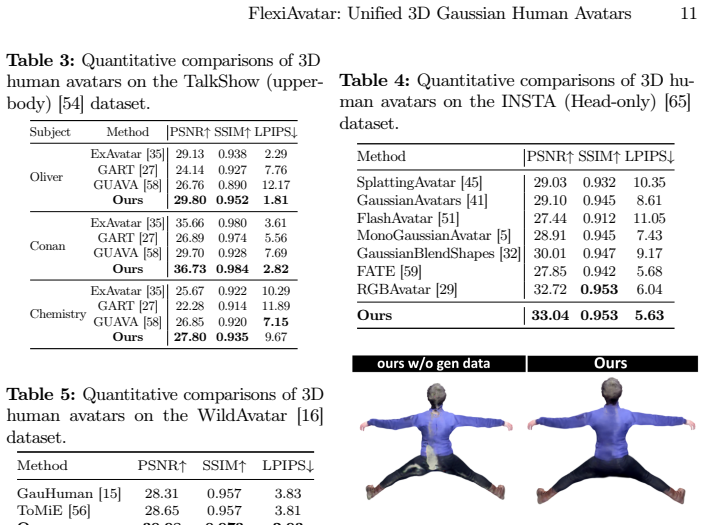
- The largest single-component ablation drop on head-only data comes from removing confidence-masked SMPL-X tracking (31.07 to 33.04 PSNR), making reliable body fitting a prerequisite for the visibility mask's gains.
Reading between the lines
- The visibility rate is effectively an evidence map; it could be reused for adaptive training schedules, model compression, or deciding which frames are safe to trust during fitting.
- If the core mechanism is as general as argued, the same evidence-based masking should transfer to other avatar representations that share a latent decoder; swapping the triplane for a different shared field would be a direct test.
- The generative completion step is verified only by face-recognition similarity, not by geometric fidelity, so silhouette or multi-view consistency of the generated rotation views would tell whether unseen-region texture can be fully trusted.
- The paper's own conclusion notes that dynamically deforming clothing remains unsolved, which bounds the unified-pipeline claim to relatively rigid garments and motivates extending the visibility mask to adaptively refine non-rigid regions.
Editorial analysis
A structured set of objections, weighed in public.
Referee Report
Summary. The paper proposes FlexiAvatar, a 3D Gaussian Splatting framework for reconstructing animatable human avatars from monocular video under arbitrary body visibility (full-body, upper-body, head-only). The method combines SMPL-X registration with confidence-weighted keypoint masking, a triplane-conditioned hybrid mesh–Gaussian representation, per-Gaussian visibility rates used to prune unseen Gaussians via an Otsu threshold, part-specific residual color MLPs for face and hands, and diffusion-generated auxiliary views intended to complete never-observed regions. Experiments are reported on NeuMan, ZJU-MoCap, WildAvatar, TalkShow, and INSTA, with state-of-the-art or competitive PSNR/SSIM/LPIPS numbers, plus ablations on NeuMan and INSTA and runtime/memory comparisons. The central claim is that restricting optimization to observed regions eliminates hallucinated geometry and texture drift and enables a single pipeline across the visibility spectrum.
Significance. If the claims hold, FlexiAvatar addresses a real and increasingly important limitation of 3DGS avatar methods: the assumption of full-body visibility during training. The unified treatment of full-body, upper-body, and head-only inputs is a worthwhile goal, and the reported results on multiple benchmarks, including in-the-wild data, are substantially stronger than existing baselines on several metrics. The paper also provides useful ablations, quantitative runtime/memory savings, and an explicit limitation statement. However, the load-bearing component for the partial-body regime — diffusion-generated auxiliary views — is validated almost entirely on full-body NeuMan, and the paper's 'consistently outperforms' and 'approximately 3%' statements are not supported by the reported tables as written. The core idea is plausible and the evidence is broad, but the current presentation overclaims and leaves the most novel regime under-tested.
major comments (3)
- [Sec. 3.2, Supp. B, Tab. 6, Tab. A2, Supp. E.2] The diffusion-generated auxiliary views are the least validated pillar of the partial-body pipeline. The only quantitative ablations involving them (Tab. 6 'w/o gen. data' and Tab. A2 synthetic-view loss weight) are on NeuMan, a full-body dataset where the 360° rotation is well supported by real full-body observations. For TalkShow and INSTA, Supp. B explicitly switches to a 'full-body-then-crop' strategy, but no ablation on those datasets varies the synthetic-view weight or removes generated views. The claim that down-weighting to 0.1 'prevents propagating errors to observed regions' (end of Sec. 4.4 and Supp. D) is therefore unverified exactly where the method's novelty is strongest. The identity check in Supp. E.2 (Tab. A3) is ArcFace only, which says nothing about body geometry or texture consistency. I ask for partial-body synthetic-view ablations and a body-level consistency check
- [Sec. 4.2, Tab. 3, Abstract] The claim that FlexiAvatar 'consistently outperforms' baselines is contradicted by the reported numbers. On Chemistry (Tab. 3), Ours has LPIPS 9.67, which is worse than GUAVA's 7.15 and also worse than ExAvatar's 10.29? No — ExAvatar is 10.29, so GUAVA is the counterexample. Similarly, on INSTA (Tab. 4) SSIM is tied with RGBAvatar at 0.953. The abstract's 'approximately 3%' average PSNR improvement is not derivable from the tables: relative improvements vary from about 0.98% on INSTA (33.04 vs 32.72 for RGBAvatar) to about 9.4% on NeuMan (35.77 vs 32.71 for Vid2AvatarPro). Please report the exact averaging procedure, specify the baseline used for each dataset, and qualify the 'consistently' language where individual metrics are not uniformly better.
- [Sec. 4.1, Tab. 1, Tab. 4] The NeuMan evaluation protocol is not fully comparable across methods. The paper states that baseline numbers are 'taken directly from the corresponding papers' (Sec. 4.1), while for TalkShow and INSTA results are obtained from official implementations. Test-time per-frame SMPL-X optimization for NeuMan is a protocol choice that can favor methods with a strong registration prior; it should be explicitly verified that all baselines used the same protocol before claiming consistent superiority. The lack of error bars or multiple seeds further weakens statements like 'consistently outperforms.' At minimum, report variance or paired per-subject comparisons, and clarify which baselines were re-run and which were copied.
minor comments (5)
- [Abstract / Project page] The project page link is given as 'here' with no URL in the text; please include the full URL.
- [Tab. 8] In the header, '5122' should be '512²'; the table would be easier to read with consistent units and column alignment.
- [Sec. 3.4, Eq. (6)] Please define v_f^i precisely as the rasterizer-provided binary visibility flag and state how it is aggregated over frames (e.g., only frames where the Gaussian is in frustum vs. all frames).
- [Fig. 3] The gradient magnitude visualization lacks a color scale and quantitative units; a marginal histogram would better support the qualitative claim.
- [Supp. A] In the sentence defining λ_reg, the symbol is used inconsistently with the main text (λsreg in Eq. (1) vs λreg in Supp. A). Please align notation.
Circularity Check
No constructional circularity; minor self-citations are non-load-bearing; synthetic-view validation is a robustness gap, not a circularity.
full rationale
FlexiAvatar's derivation chain does not reduce any reported result to its own inputs. The visibility-aware objective (Eq. 6, Sec. 3.4) uses rasterizer-accumulated visibility flags to compute per-Gaussian visibility and then masks low-evidence Gaussians; this is a training-time optimization heuristic, not a fitted parameter later reported as a prediction. The diffusion-generated auxiliary views (Sec. 3.2) are external priors, not a restatement of the target metric; the paper explicitly down-weights their loss (Supp. D, E.1) and evaluates on held-out real test frames (Sec. 4.1), so the PSNR/SSIM/LPIPS comparisons are not forced by the construction. The only weak link is the thin validation of synthetic views (Supp. E.2 checks only ArcFace face consistency, FC=0.7903, rather than body geometry), but that is a correctness/falsifiability concern, not circularity. Self-citations [6,13,17,44] appear in motivational or architectural context (e.g., 'residual appearance refinement module [13]') and are supported by independent ablations such as Tab. A7, so they are not load-bearing. No equation is equivalent by construction to its input, and no benchmark number is obtained by fitting the test set. Score 2 reflects only the presence of minor, non-load-bearing self-citations.
Assumptions & free parameters
free parameters (6)
- Keypoint confidence threshold tau =
0.4
- Warm-up iterations =
2000
- Synthetic-view loss weight =
0.1
- Reconstruction loss weights lambda_L1, lambda_ssim, lambda_lpips, lambda_face, lambda_reg =
0.8, 0.2, 0.2, 0.8, 1.0
- Number of generated auxiliary frames =
~500 per subject
- Otsu visibility threshold tau* =
data-dependent (e.g., 0.490 on Biden)
assumptions (5)
- domain assumption Off-the-shelf SMPL-X and whole-body keypoint estimators provide reliable initialization across visibility settings.
- domain assumption MimicMotion-generated auxiliary views preserve subject identity and geometry well enough to serve as supervision.
- domain assumption SAM foreground masks plus the ExAvatar masking strategy accurately isolate the person.
- domain assumption 3DGS rasterizer visibility flags faithfully reflect image-space evidence per Gaussian.
- standard math Standard projection, linear blend skinning, and Gaussian splatting equations are correct and differentiable as used.
Cite this review
Pith. "Pith review of FlexiAvatar: Unified 3D Gaussian Human Avatars Under Arbitrary Body Visibility." pith.science (2026). https://pith.science/paper/WMQ2LKDO
@misc{pith2026260719100,
  author       = {Pith},
  title        = {Pith review of: FlexiAvatar: Unified 3D Gaussian Human Avatars Under Arbitrary Body Visibility},
  year         = {2026},
  howpublished = {\url{https://pith.science/paper/WMQ2LKDO}},
  note         = {Machine review of arXiv:2607.19100}
}
read the original abstract
Reconstructing animatable 3D human avatars from monocular video is a fundamental problem in computer vision with broad applications in AR/VR and digital content creation. Existing approaches typically couple parametric body models with neural rendering or 3D Gaussian splatting and optimize all body regions jointly from short videos, which often degrades fidelity in the visible areas. To overcome this limitation, we introduce FlexiAvatar, a unified framework that explicitly optimizes only the visible body regions, effectively eliminating artifacts arising from unobserved limbs. Our method integrates occlusion-robust SMPL-X tracking with part-specific residual refinement to capture high-frequency geometric and appearance details. To complete entirely unseen regions (e.g., back views), we leverage a diffusion-based approach to generate texture consistent with the observed appearance. Experiments on full-body (NeuMan, ZJU-MoCap, WildAvatar), upper/half-body (talk-show clips), and head-only (INSTA) inputs show that FlexiAvatar delivers consistently higher reconstruction quality, outperforming state-of-the-art methods by an average PSNR improvement of approximately 3% across datasets. Finally, by restricting optimization to observed regions, our method reduces the effective number of Gaussians that must be optimized and rendered, leading to reduced runtime and memory overhead in partial-visibility scenarios.
Figures


Figures from the paper (4 more)


Reference graph
Works this paper leans on
-
[1]
IEEE Transactions on Circuits and Systems for Video Technology (2026)
Ali,M.S.,Zhang,C.,Cagnazzo,M.,Valenzise,G.,Tartaglione,E.,Bae,S.H.:Compression in 3d gaussian splatting: A survey of methods, trends, and future directions. IEEE Transactions on Circuits and Systems for Video Technology (2026)
2026
-
[2]
In: CVPR (2019)
Alldieck, T., Magnor, M., Bhatnagar, B.L., Theobalt, C., Pons-Moll, G.: Learning to reconstruct people in clothing from a single rgb camera. In: CVPR (2019)
2019
-
[3]
In: ICML (2024)
Chang, D., Shi, Y., Gao, Q., Xu, H., Fu, J., Song, G., Yan, Q., Zhu, Y., Yang, X., Soleymani, M.: Magicpose: Realistic human poses and facial expressions retargeting with identity-aware diffusion. In: ICML (2024)
2024
-
[4]
arXiv preprint arXiv:2106.13629 (2021)
Chen, J., Zhang, Y., Kang, D., Zhe, X., Bao, L., Jia, X., Lu, H.: Animatable neural radiance fields from monocular rgb videos. arXiv preprint arXiv:2106.13629 (2021)
arXiv 2021
-
[5]
In: SIGGRAPH (2024)
Chen, Y., Wang, L., Li, Q., Xiao, H., Zhang, S., Yao, H., Liu, Y.: Monogaussianavatar: Monocular gaussian point-based head avatar. In: SIGGRAPH (2024)
2024
-
[6]
IEEE Access9, 165005–165013 (2021)
Cho, I., Shin, E., Ali, M.S., Bae, S.H.: Dynamic structured pruning with novel filter importanceandleakymaskingbasedonconvolutionandbatchnormalizationparameters. IEEE Access9, 165005–165013 (2021)
2021
-
[7]
In: 3DV (2022)
Choi,H.,Moon,G.,Armando,M.,Leroy,V.,Lee,K.M.,Rogez,G.:Mononhr:Monocular neural human renderer. In: 3DV (2022)
2022
-
[8]
In: CVPR (2019)
Deng, J., Guo, J., Xue, N., Zafeiriou, S.: Arcface: Additive angular margin loss for deep face recognition. In: CVPR (2019)
2019
Show all 65 references
-
[9]
ToG (2021) 16 Y
Feng, Y., Feng, H., Black, M.J., Bolkart, T.: Learning an animatable detailed 3d face model from in-the-wild images. ToG (2021) 16 Y. Tiruneh et al
2021
-
[10]
In: 2023 IEEE Conference Virtual Reality and 3D User Interfaces (VR) (2023)
Fidalgo, C.G., Sousa, M., Mendes, D., Dos Anjos, R.K., Medeiros, D., Singh, K., Jorge, J.: Magic: Manipulating avatars and gestures to improve remote collaboration. In: 2023 IEEE Conference Virtual Reality and 3D User Interfaces (VR) (2023)
2023
-
[11]
In: CVPR (2023)
Guo, C., Jiang, T., Chen, X., Song, J., Hilliges, O.: Vid2avatar: 3d avatar reconstruction from videos in the wild via self-supervised scene decomposition. In: CVPR (2023)
2023
-
[12]
In: CVPR (2025)
Guo, C., Li, J., Kant, Y., Sheikh, Y., Saito, S., Cao, C.: Vid2avatar-pro: Authentic avatar from videos in the wild via universal prior. In: CVPR (2025)
2025
-
[13]
In: Proceedings of the AAAI Conference on Artificial Intelligence
Haider,A.,Ali,M.S.,Qamar,M.,Khalil,T.,Kim,S.Y.,Oh,J.,Tartaglione,E.,Bae,S.H.: I-inr: iterative implicit neural representations. In: Proceedings of the AAAI Conference on Artificial Intelligence. vol. 40, pp. 4520–4528 (2026)
2026
-
[14]
In: CVPR (2024)
Hu, L., Zhang, H., Zhang, Y., Zhou, B., Liu, B., Zhang, S., Nie, L.: Gaussianavatar: Towardsrealistichumanavatarmodelingfromasinglevideoviaanimatable3dgaussians. In: CVPR (2024)
2024
-
[15]
In: CVPR (2024)
Hu, S., Hu, T., Liu, Z.: Gauhuman: Articulated gaussian splatting from monocular human videos. In: CVPR (2024)
2024
-
[16]
In: CVPR (2025)
Huang, Z., Hu, S., Wang, G., Liu, T., Zang, Y., Cao, Z., Li, W., Liu, Z.: Wildavatar: Learning in-the-wild 3d avatars from the web. In: CVPR (2025)
2025
-
[17]
In: IEEE Conf
Jeong, U., Tiruneh, Y.Y., Chang, H.J., Baek, S., Kim, K.I.: Thom: Generating physically plausible hand-object meshes from text. In: IEEE Conf. Comput. Vis. Pattern Recog. Findings. pp. 3653–3664 (June 2026)
2026
-
[18]
In: CVPR (2023)
Jiang,T.,Chen,X.,Song,J.,Hilliges,O.:Instantavatar:Learningavatarsfrommonocular video in 60 seconds. In: CVPR (2023)
2023
-
[19]
In: ECCV (2022)
Jiang, W., Yi, K.M., Samei, G., Tuzel, O., Ranjan, A.: Neuman: Neural human radiance field from a single video. In: ECCV (2022)
2022
-
[20]
IEEE Access11, 34198–34209 (2023)
Kang, J.H., Ali, M.S., Jeong, H.W., Choi, C.K., Kim, Y., Jeong, S.Y., Bae, S.H., Kim, H.Y.: A super-resolution-based feature map compression for machine-oriented video coding. IEEE Access11, 34198–34209 (2023)
2023
-
[21]
In: ICCV (2023)
Karras, J., Holynski, A., Wang, T.C., Kemelmacher-Shlizerman, I.: Dreampose: Fashion image-to-video synthesis via stable diffusion. In: ICCV (2023)
2023
-
[22]
ToG (2023)
Kerbl, B., Kopanas, G., Leimkühler, T., Drettakis, G., et al.: 3d gaussian splatting for real-time radiance field rendering. ToG (2023)
2023
-
[23]
In: ICLR (2015)
Kingma, D.P., Ba, J.: Adam: A method for stochastic optimization. In: ICLR (2015)
2015
-
[24]
In: ICCV (2023)
Kirillov, A., Mintun, E., Ravi, N., Mao, H., Rolland, C., Gustafson, L., Xiao, T., Whitehead, S., Berg, A.C., Lo, W.Y., et al.: Segment anything. In: ICCV (2023)
2023
-
[25]
Computer Graphics Forum (Proceedings of the Eurographics Symposium on Rendering) (2021)
Kopanas, G., Philip, J., Leimkühler, T., Drettakis, G.: Point-based neural rendering with per-view optimization. Computer Graphics Forum (Proceedings of the Eurographics Symposium on Rendering) (2021)
2021
-
[26]
In: CVPR (2024)
Lee, I., Kim, B., Joo, H.: Guess the unseen: Dynamic 3d scene reconstruction from partial 2d glimpses. In: CVPR (2024)
2024
-
[27]
In: CVPR (2024)
Lei, J., Wang, Y., Pavlakos, G., Liu, L., Daniilidis, K.: Gart: Gaussian articulated template models. In: CVPR (2024)
2024
-
[28]
In: CVPR (2025)
Li, J., Zhang, J., Bai, X., Zheng, J., Zhou, J., Gu, L.: Instag: Learning personalized 3d talking head from few-second video. In: CVPR (2025)
2025
-
[29]
In: CVPR (2025)
Li, L., Li, Y., Weng, Y., Zheng, Y., Zhou, K.: Rgbavatar: Reduced gaussian blendshapes for online modeling of head avatars. In: CVPR (2025)
2025
-
[30]
ToG (2017)
Li, T., Bolkart, T., Black, M.J., Li, H., Romero, J.: Learning a model of facial shape and expression from 4d scans. ToG (2017)
2017
-
[31]
ToG (2015)
Loper, M., Mahmood, N., Romero, J., Pons-Moll, G., Black, M.J.: SMPL: A skinned multi-person linear model. ToG (2015)
2015
-
[32]
In: SIGGRAPH (2024) FlexiAvatar: Unified 3D Gaussian Human Avatars 17
Ma,S.,Weng,Y.,Shao,T.,Zhou,K.:3dgaussianblendshapesforheadavataranimation. In: SIGGRAPH (2024) FlexiAvatar: Unified 3D Gaussian Human Avatars 17
2024
-
[33]
In: CVPR (2021)
Ma, S., Simon, T., Saragih, J., Wang, D., Li, Y., De La Torre, F., Sheikh, Y.: Pixel codec avatars. In: CVPR (2021)
2021
-
[34]
In: ECCV (2020)
Mildenhall, B., Srinivasan, P.P., Tancik, M., Barron, J.T., Ramamoorthi, R., Ng, R.: Nerf: Representing scenes as neural radiance fields for view synthesis. In: ECCV (2020)
2020
-
[35]
In: ECCV (2024)
Moon, G., Shiratori, T., Saito, S.: Expressive whole-body 3d gaussian avatar. In: ECCV (2024)
2024
-
[36]
Automatica (1979)
Otsu, N., et al.: A threshold selection method from gray-level histograms. Automatica (1979)
1979
-
[37]
In: NeurIPS (2019)
Paszke, A., Gross, S., Massa, F., Lerer, A., Bradbury, J., Chanan, G., Killeen, T., Lin, Z., Gimelshein, N., Antiga, L., et al.: Pytorch: An imperative style, high-performance deep learning library. In: NeurIPS (2019)
2019
-
[38]
In: CVPR (2019)
Pavlakos, G., Choutas, V., Ghorbani, N., Bolkart, T., Osman, A.A., Tzionas, D., Black, M.J.: Expressive body capture: 3d hands, face, and body from a single image. In: CVPR (2019)
2019
-
[39]
In: CVPR (2021)
Peng, S., Zhang, Y., Xu, Y., Wang, Q., Shuai, Q., Bao, H., Zhou, X.: Neural body: Implicit neural representations with structured latent codes for novel view synthesis of dynamic humans. In: CVPR (2021)
2021
-
[40]
In: Proceedings of the 2018 CHI conference on human factors in computing systems (2018)
Piumsomboon, T., Lee, G.A., Hart, J.D., Ens, B., Lindeman, R.W., Thomas, B.H., Billinghurst, M.: Mini-me: An adaptive avatar for mixed reality remote collaboration. In: Proceedings of the 2018 CHI conference on human factors in computing systems (2018)
2018
-
[41]
In: CVPR (2024)
Qian, S., Kirschstein, T., Schoneveld, L., Davoli, D., Giebenhain, S., Nießner, M.: Gaussianavatars: Photorealistic head avatars with rigged 3d gaussians. In: CVPR (2024)
2024
-
[42]
In: CVPR (2024)
Qian,Z.,Wang,S.,Mihajlovic,M.,Geiger,A.,Tang,S.:3dgs-avatar:Animatableavatars via deformable 3d gaussian splatting. In: CVPR (2024)
2024
-
[43]
In: CVPR (2025)
Qiu, L., Zhu, S., Zuo, Q., Gu, X., Dong, Y., Zhang, J., Xu, C., Li, Z., Yuan, W., Bo, L., et al.: Anigs: Animatable gaussian avatar from a single image with inconsistent gaussian reconstruction. In: CVPR (2025)
2025
-
[44]
In: Proceedings of the IEEE/CVF Conference on Computer Vision and Pattern Recognition
Sayem, M., Chowdhury, M.T., Tiruneh, Y.Y., Khan, M.A., Ali, M.S., Bhattarai, B., Baek, S.: Handvqa: Diagnosing and improving fine-grained spatial reasoning about hands in vision-language models. In: Proceedings of the IEEE/CVF Conference on Computer Vision and Pattern Recognit...
2026
-
[45]
In: CVPR (2024)
Shao, Z., Wang, Z., Li, Z., Wang, D., Lin, X., Zhang, Y., Fan, M., Wang, Z.: Splattin- gAvatar: Realistic Real-Time Human Avatars with Mesh-Embedded Gaussian Splatting. In: CVPR (2024)
2024
-
[46]
In: CVPR (2023)
Shen, K., Guo, C., Kaufmann, M., Zarate, J.J., Valentin, J., Song, J., Hilliges, O.: X-avatar: Expressive human avatars. In: CVPR (2023)
2023
-
[47]
In: ICCV (2025)
Sim, G., Moon, G.: Persona: personalized whole-body 3d avatar with pose-driven deformations from a single image. In: ICCV (2025)
2025
-
[48]
In: CVPR (2025)
Wang, C., Kang, D., Sun, H., Qian, S., Wang, Z., Bao, L., Zhang, S.H.: Mega: Hybrid mesh-gaussian head avatar for high-fidelity rendering and head editing. In: CVPR (2025)
2025
-
[49]
In: The thrity-seventh asilomar conference on signals, systems & computers, 2003 (2003)
Wang, Z., Simoncelli, E.P., Bovik, A.C.: Multiscale structural similarity for image quality assessment. In: The thrity-seventh asilomar conference on signals, systems & computers, 2003 (2003)
2003
-
[50]
Weng, C.Y., Curless, B., Srinivasan, P.P., Barron, J.T., Kemelmacher-Shlizerman, I.: Humannerf:Free-viewpointrenderingofmovingpeoplefrommonocularvideo.In:CVPR (2022)
2022
-
[51]
In: CVPR (2024)
Xiang, J., Gao, X., Guo, Y., Zhang, J.: Flashavatar: High-fidelity head avatar with efficient gaussian embedding. In: CVPR (2024)
2024
-
[52]
arXiv preprint arXiv:2401.00431 (2023)
Xiang, T., Sun, A., Delp, S., Kozuka, K., Fei-Fei, L., Adeli, E.: Wild2avatar: Rendering humans behind occlusions. arXiv preprint arXiv:2401.00431 (2023)
2023 arXiv
-
[53]
In: ICCV (2023) 18 Y
Yang,Z.,Zeng,A.,Yuan,C.,Li,Y.:Effectivewhole-bodyposeestimationwithtwo-stages distillation. In: ICCV (2023) 18 Y. Tiruneh et al
2023
-
[54]
In: CVPR (2023)
Yi,H.,Liang,H.,Liu,Y.,Cao,Q.,Wen,Y.,Bolkart,T.,Tao,D.,Black,M.J.:Generating holistic 3d human motion from speech. In: CVPR (2023)
2023
-
[55]
TPAMI (2025)
Yin, W., Cai, Z., Wang, R., Zeng, A., Wei, C., Sun, Q., Mei, H., Wang, Y., Pang, H.E., Zhang, M., et al.: Smplest-x: Ultimate scaling for expressive human pose and shape estimation. TPAMI (2025)
2025
-
[56]
In: ICCV (2025)
Zhan, Y., Zhu, Q., Niu, M., Ma, M., Zhao, J., Zhong, Z., Sun, X., Qiao, Y., Zheng, Y.: Towards explicit exoskeleton for the reconstruction of complicated 3d human avatars. In: ICCV (2025)
2025
-
[57]
In: CVPR (2025)
Zhang, D., Liu, Y., Lin, L., Zhu, Y., Chen, K., Qin, M., Li, Y., Wang, H.: Hravatar: High-quality and relightable gaussian head avatar. In: CVPR (2025)
2025
-
[58]
In: ICCV (2025)
Zhang, D., Liu, Y., Lin, L., Zhu, Y., Li, Y., Qin, M., Li, Y., Wang, H.: Guava: General- izable upper body 3d gaussian avatar. In: ICCV (2025)
2025
-
[59]
In: CVPR (2025)
Zhang, J., Wu, Z., Liang, Z., Gong, Y., Hu, D., Yao, Y., Cao, X., Zhu, H.: Fate: Full-head gaussian avatar with textural editing from monocular video. In: CVPR (2025)
2025
-
[60]
In: CVPR (2018)
Zhang,R.,Isola,P.,Efros,A.A.,Shechtman,E.,Wang,O.:Theunreasonableeffectiveness of deep features as a perceptual metric. In: CVPR (2018)
2018
-
[61]
In: ICML (2025)
Zhang, Y., Gu, J., Wang, L.W., Wang, H., Cheng, J., Zhu, Y., Zou, F.: Mimicmotion: High-quality human motion video generation with confidence-aware pose guidance. In: ICML (2025)
2025
-
[62]
In: Computer Graphics International Conference (2023)
Zheng, W., Zhao, J., Liu, X., Pan, Y., Gan, Z., Han, H., Liu, N.: Flame-based multi-view 3d face reconstruction. In: Computer Graphics International Conference (2023)
2023
-
[63]
In: ECCV (2024)
Zhu, S., Chen, J.L., Dai, Z., Dong, Z., Xu, Y., Cao, X., Yao, Y., Zhu, H., Zhu, S.: Champ: Controllable and consistent human image animation with 3d parametric guidance. In: ECCV (2024)
2024
-
[64]
In: CVPR (2025)
Zielonka, W., Bolkart, T., Beeler, T., Thies, J.: Gaussian eigen models for human heads. In: CVPR (2025)
2025
-
[65]
Zielonka, W., Bolkart, T., Thies, J.: Instant volumetric head avatars. In: CVPR (2023) FlexiA vatar: Unified 3D Gaussian Human A vatars Under Arbitrary Body Visibility Supplementary Materials Yihalem Yimolal Tiruneh1, Muhammad Salman Ali1, Uyoung Jeong1, Muneeb A. Khan1, MD Kh...
2023
Reviewed August 1, 2026 · model on record in the stance chip above.
Discussion (0). Sign in to comment.