REVIEW 4 major objections 4 minor 300 references
A sample of 10,236 blue horizontal-branch stars, identified with 80–90% recovery and ≤10% contamination, receives atmospheric parameters from a color-augmented data-driven model.
Reviewed by Pith at T0; open to challenge. T0 means a machine referee read the full paper against a public rubric. the ladder, T0–T4 →
T0 review · deepseek-v4-flash
2026-08-01 13:13 UTC pith:R3RJ5OOV
load-bearing objection A solid, standard BHB catalog paper with an unspecified reddening step in the color inputs—addressable, not fatal. the 4 major comments →
Identifying and Determining Atmospheric Parameters of BHB Stars Based on LAMOST DR11
The pith
A machine-rendered reading of the paper's core claim, the machinery that carries it, and where it could break.
Core claim
The central discovery is that combining photometric colors with spectral fluxes in a support-vector-regression-based labeler yields reliable atmospheric parameters for BHB stars, overcoming the well-known Teff–logg degeneracy that makes hot giants and cool dwarfs mimic each other in hydrogen-line profiles. Applied to 13,988 BHB spectra from LAMOST DR11, the method yields median parameters (Teff ≈ 8270 K, logg ≈ 3.41, [Fe/H] ≈ −2.16) consistent with literature BHB values. The paper also reports a secondary bump in the [Fe/H] distribution around −0.5, and shows through kinematics and spatial distribution that most of these metal-rich BHB stars are likely disk members, rather than halo contamin
What carries the argument
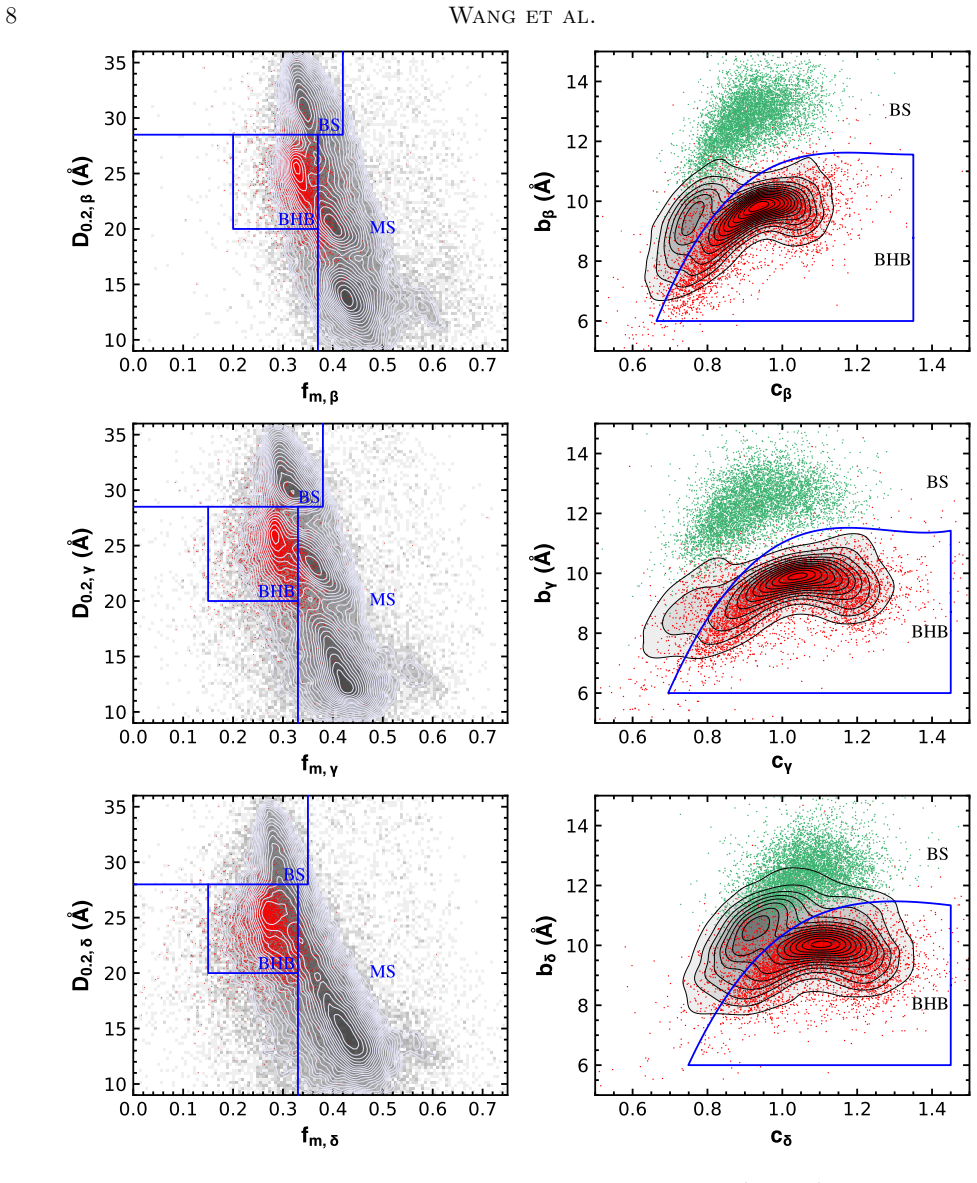
The key machinery is the combination of two established Balmer-line diagnostics—the D0.2 method (line width at 20% below the continuum) and the scale width-shape method (Sérsic-profile fit yielding width b and shape c) applied to Hβ, Hγ, and Hδ—for identification, and the Stellar LAbel Machine (SLAM), a support vector regression trained on a synthetic spectral grid, for parameter estimation. The crucial novelty is that SLAM is fed both normalized spectral fluxes and four appended color indices (BP−G, G−RP, BP−RP, J−H); these colors act as an independent temperature indicator that breaks the degeneracy between effective temperature and surface gravity. The identification step uses the Balmer
Load-bearing premise
The parameter catalog assumes that the observed Gaia and 2MASS colors fed into the model are extinction-free; if reddening is not corrected, the color inputs are systematically too red, which would shift the predicted temperatures and gravities.
What would settle it
Check whether the predicted Teff of BHB stars correlates with their reddening (EBV): if the observed colors are not dereddened, de reddened stars should show systematically lower Teff than unreddened stars of the same true temperature, a signature that would contradict the derived parameter scale.
If this is right
- The catalog of 10,236 BHB stars with atmospheric parameters enables studies of the Galactic halo's substructure, kinematics, and mass distribution out to distances where BHB stars serve as standard candles.
- The demonstration that color indices break the Teff–logg degeneracy suggests that similar color-augmented labelers could improve atmospheric parameter estimates for other spectral types where Balmer lines are degenerate, especially in low-signal-to-noise data.
- The metal-rich BHB population with [Fe/H] > −1, shown to be mostly disk members, implies that BHB stars are not exclusively halo objects; this may complicate distance-based halo studies but also opens a path to studying disk stellar populations via BHB stars.
- The published list of 4,282 blue straggler stars with parameters provides a ready-made negative sample for refining future BHB selections and for studying blue straggler formation channels.
- The identification rate of ~80–90% and contamination ≲10% quantify the reliability of the combined D0.2 and scale width-shape approach, giving future surveys a benchmark for spectroscopic BHB selection.
Where Pith is reading between the lines
- The same color-index augmentation could be extended to hotter BHB subcategories (HBB and EHB stars) if the synthetic training grid were expanded above 12,000 K; the method's success in the 7000–12,000 K range suggests it would generalize.
- If the metal-rich bump at [Fe/H] ≈ −0.5 is a genuine disk BHB population, it may imply a formation pathway for BHB stars at near-solar metallicity, possibly related to helium enrichment in massive globular clusters or a separate field population; this hypothesis could be tested with high-resolution follow-up spectroscopy.
- The lack of an explicit dereddening step for the observed colors in the SLAM input is a potential systematic: if reddening is uncorrected, the color inputs would be shifted redward, biasing Teff estimates for reddened stars. A testable extension would be to apply the catalog to a sample with known extinctions and check whether Teff correlates with EBV.
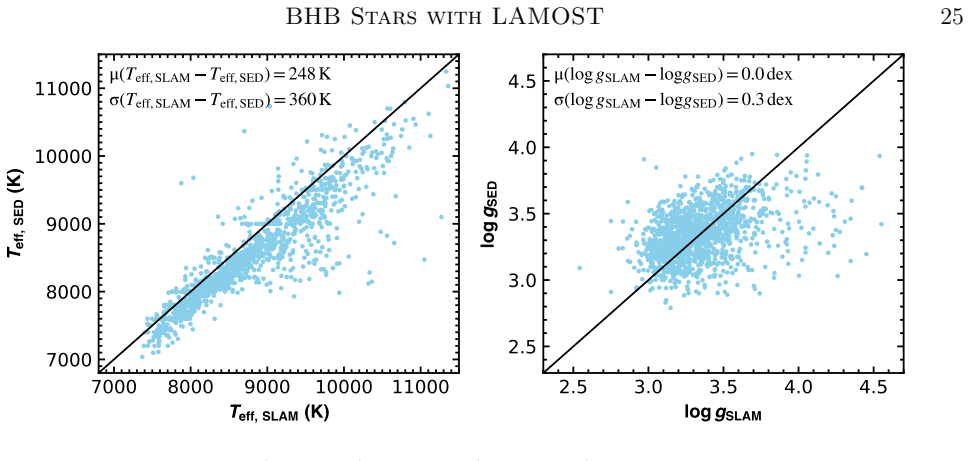
- The systematic ~250 K offset between SLAM and SED-based Teff, attributed to differences between model atmospheres, suggests that the absolute temperature scale of the catalog carries an unknown model-dependent zero-point; cross-calibration with asteroseismic or interferometric temperatures could anchor it.
Editorial analysis
A structured set of objections, weighed in public.
Referee Report
Summary. The paper presents a systematic search for blue horizontal-branch (BHB) stars in LAMOST DR11, using equivalent-width cuts on Hγ and G4300, the D0.2 Balmer-line width method, and the Sérsic scale width-shape method on Hβ, Hγ, and Hδ. It reports 13,988 BHB spectra, corresponding to 10,236 unique stars, and also provides 4,282 blue straggler (BS) stars. Atmospheric parameters (Teff, logg, [Fe/H]) are derived with the data-driven SLAM method, trained on synthetic ATLAS9 spectra, with and without appended Gaia/2MASS color indices. The authors estimate an identification rate of ~80–90% and contamination of ≲10%, and discuss a metal-rich [Fe/H]~−0.5 bump whose members are primarily kinematically disk-like. The manuscript includes comparisons with previous BHB catalogs, globular-cluster tests, and a comparison of SLAM parameters with the SED-based catalog of Culpan et al. (2024).
Significance. If the catalog is reliable, it would be one of the largest spectroscopically selected, parameterized samples of BHB and BS stars in the LAMOST era, useful for halo kinematics, substructure studies, and tests of horizontal-branch evolution. The study also re-emphasizes, with synthetic tests, that including color indices helps break the Teff–logg degeneracy for low-SNR spectra. The comparison with Culpan et al. (2024) provides an external anchor, and the globular-cluster CMD checks are a useful, albeit small, independent validation. However, the reliability of the identification rate and the atmospheric parameters depends on resolving the issues below.
major comments (4)
- [Section 4.4, Figures 10 and 12, Table 1] The SLAM training uses intrinsic synthetic colors (Section 4.2), but the inference on observed spectra in Section 4.4 is described only as applying the machine to ‘observed spectra’ and ‘observed color’ (Figure 10). The text never states whether the observed Gaia/2MASS colors are dereddened before being passed to SLAM. The catalog lists EBV, and CMD analyses elsewhere use Schlegel et al. (1998) with Wang & Chen (2019), so this omission is conspicuous. If reddened colors are used, the input distribution at inference differs systematically from the training distribution. Since BP−RP and J−H are monotonic Teff indicators and strongly influence the SLAM outputs, this can bias Teff and, through the degeneracy, logg for a large fraction of the catalog. The synthetic CV tests (Section 4.3) add Gaussian noise but not reddening, so they do not probe this effect. The +250 K offset versus Culpan et
- [Section 5.1 vs. Section 3.2] The claimed identification rate of ~80–90% is partly circular. The selection boxes in Equations (2) and (6) were drawn using ‘known BHB stars’ from Xue et al. (2008; 2011) and Ju et al. (2024) as references. Section 5.1 then measures recovery against Ju et al. (2024), Xue et al. (2011), and Vickers et al. (2021); the latter used Xue et al. (2008; 2011) as its training set. Thus these recovery fractions are not fully independent. The globular-cluster test is more independent, but it rests on only 18 BHB stars in 8 clusters (and 16 outside two clusters), yielding an identification rate of 13/16 ≈ 81%. That is consistent with the stated range, but the statistical weight is small. The authors should explicitly acknowledge this circularity and present the GC result as the primary independent completeness estimate, or add an independent validation sample with a larger number of stars.
- [Equation (2) and Equation (3)] The notation in the selection cuts appears inconsistent: the second line of Equation (2) reads ‘20.0 ≤ D0.2,γ ≤ 28.5, and 0.15 ≤ fm,β ≤ 0.33’ and the third line reads ‘20.0 ≤ D0.2,δ ≤ 28.0, and 0.15 ≤ fm,γ ≤ 0.33’ – i.e., the fm variable does not match the Balmer line being used. The same pattern appears in Equation (3). If these are typographical errors and the actual analysis used the matching fm values, the text should be corrected. If the analysis actually used the printed conditions, the selection is not the one described in the prose and the numbers in Section 3.2.3 could change. Because these cuts are the core of the BHB/BS classification, the correct conditions must be stated unambiguously.
- [Section 4.4, Figure 12] The paper knowingly retains a clump of ~7500–8000 K stars with logg > 4.0 that deviates significantly from the ZAHB and is described as having potentially higher contamination, with more than half having [Fe/H] ≥ −1. These stars are included in the published BHB catalog for completeness. This is transparent, but it complicates the claim of a ≲10% contamination rate, since that estimate is based on GC stars falling in the selection boxes and does not directly account for the known parameter-based contamination in this clump. The authors should either quantify the fraction of the catalog in this clump and its likely contamination, or state more carefully how the ≲10% figure relates to the full catalog.
minor comments (4)
- [Section 5.1, globular clusters] The text reports both ‘16 BHB stars in the other 6 clusters’ with 13 identified, and ‘we identify 18 BHB stars in the 8 GCs, 15 of them are within the selection boxes’. The relationship between these numbers, and how the 18 were selected, should be clarified so that the denominator of the contamination estimate is transparent.
- [Section 3.2.1, paragraph after Eq. (2)] The sentence listing the numbers of BHB candidates after the D0.2 cuts gives 15,197, 13,713, and 19,470 for Hβ, Hγ, and Hδ. The prose should indicate whether these are after the fm-cuts in Eq. (2) or after the initial A-type selection, since the logical flow is otherwise ambiguous.
- [Section 4.3, Figure 8] The rightmost point in each panel is defined as representing SNRg = ∞, but the x-axis extends to 100. The label should be explicit that this is the noise-free case, and the axis tick should probably be annotated separately to avoid implying a real SNR.
- [Table 1] The table lists EBV from Schlegel et al. (1998) but no dereddened photometry or extinction-law column. If dereddened colors are used in Section 4.4, the catalog should either include the dereddened colors or state the procedure clearly in the table description.
Circularity Check
Identification rate is partly in-sample: Eqs. 2/6 boxes drawn on known BHB stars (Xue 2008/2011, Ju 2024) and §5.1 recovery measured against the same families; external checks keep overall circularity moderate.
specific steps
-
fitted input called prediction
[Sec. 3.2.1 (Eq. 2), Sec. 3.2.2 (Eq. 6), and Sec. 5.1]
"Based on the distribution in theD0.2 versus fm planes, and using the known BHB stars as references, we flag a spectrum as a BHB candidate ... Of the 5250 matches in LAMOST DR11, 4593 (∼90%) are identified as BHB stars in this work as well."
The selection boxes (Eq. 2, D0.2–fm; Eq. 6, b–c) are drawn using 'the known BHB stars as references' — 'compiled from Xue et al. 2008, 2011; Ju et al. 2024' (Sec. 3.2.1). Sec. 5.1 then measures the headline 'identification rate ∼80%–90%' against these same families: 90% of Ju et al. 2024 and 80% of Xue et al. 2011 are recovered. Since the cuts were placed on the locus of these reference stars, high recovery is partly guaranteed by construction — the rate is a box-to-calibration-sample goodness-of-fit. Vickers et al. (2021) is also not independent (its ML training set was Xue et al. 2008). Culpan, GCs, and CaMD provide external support but do not remove the in-sample component of the headline rate.
full rationale
The paper's central new products are (i) the 13,988-spectrum BHB/BS catalog from LAMOST DR11, selected by the D0.2 and scale width-shape cuts, and (ii) the SLAM atmospheric-parameter estimates trained on the external ATLAS9 synthetic grid of Allende Prieto et al. (2018). Neither product reduces to its inputs by construction: the catalog counts are the plain outcome of the cuts, and the SLAM labels are a learned inversion of an independent physical model grid, with held-out synthetic CV tests. The conspicuous methodological weak point identified in review — observed, possibly reddened Gaia/2MASS colors fed to a machine trained on synthetic intrinsic colors (§4.2 vs §4.4, Figure 10), with no stated dereddening before inference — is a distribution-shift/systematics risk (potentially biasing Teff/logg, and interacting with the +250 K offset vs Culpan et al. 2024), not a circularity: the color-to-label mapping is still inferred from external synthetic physics rather than from the observed labels themselves. The one genuine circular component is the headline identification rate: the Eq. 2 and Eq. 6 selection boxes were drawn 'using the known BHB stars as references' (compiled from Xue et al. 2008/2011 and Ju et al. 2024, the latter co-authored here), and §5.1 then reports recovery of those same families (90% Ju, 80% Xue, 80% Vickers — Vickers itself trained on Xue et al. 2008) as 'an identification rate ∼80%–90%.' That rate is partly in-sample by construction. The paper does provide independent evidence — 81% recovery in 6 GCs using external Vickers et al. 2012 boxes, CaMD placement, and ~90% recovery of the external Culpan et al. (2024) sample — so the central claim retains independent content. No load-bearing uniqueness theorem, ansatz-smuggling citation, or renamed known result was found. Overall: moderate partial circularity, confined to the in-sample component of the selection-validation loop.
Axiom & Free-Parameter Ledger
free parameters (5)
- D0.2/fm selection boxes for Hβ/Hγ/Hδ =
D0.2 between 20.0–28.5/28.0 Å and fm ranges as in Eq. (2)
- b–c boundary polynomials (Eq. 6) =
Quartic coefficients per Balmer line (e.g., bβ ≤ -8.66 cβ^4 + ...)
- EW cuts EWHγ ≥ 6 Å, EWG4300 ≤ 2 Å =
6 Å, 2 Å
- SLAM hyperparameters C, γ, ε =
not reported
- Vφ threshold for disk membership =
200 km/s
axioms (5)
- domain assumption Synthetic spectra from Allende Prieto et al. (2018) computed with ATLAS9 accurately represent real BHB and BS spectra over Teff=7000–12000 K, logg=2–5, [Fe/H]=-5 to 1.
- domain assumption The Sersic profile (Eq. 5) and the D0.2 width parametrize Balmer lines in a way that separates temperature and gravity for A-type stars.
- domain assumption The reference BHB samples of Xue et al. (2008, 2011) and Ju et al. (2024) are complete and accurate enough to serve as ground truth for setting selection boundaries.
- domain assumption Observed Gaia/2MASS colors can be compared directly with the intrinsic synthetic colors used to train SLAM (i.e., extinction is either negligible or corrected), although no dereddening step is described in Sec. 4.4.
- domain assumption Schlegel et al. (1998) extinction map and Wang & Chen (2019) extinction law are accurate for dereddening in the CMD and spatial analyses.
read the original abstract
Large catalogs of blue horizontal-branch (BHB) stars are essential for studying substructures and kinematics of the Galactic halo. And accurate determination of atmospheric parameters for BHB stars provides insight into stellar evolution. In this work, we perform a systematic search for BHB stars based on LAMOST DR11, and identify $13\,988$ BHB spectra, corresponding to $10\,236$ unique BHB stars. We estimate an identification rate of $\sim80\%-90\%$, and a contamination rate of $\lesssim10\%$ for our sample. Atmospheric parameters for these BHB stars are estimated via the data-driven method named the Stellar LAbel Machine (SLAM). We demonstrate the necessity of including color indices in the spectral labeling to effectively break the degeneracy between effective temperature and surface gravity. We note a bump in the distribution of [Fe/H], and most of these metal-rich BHB stars belong to the disk population. We also provide a list of 4282 blue straggler (BS) stars with determined atmospheric parameters.
Figures





Reference graph
Works this paper leans on
-
[1]
Abdul-Masih, M. and Pr. AJ , keywords =. doi:10.3847/0004-6256/151/4/101 , eprint =
-
[2]
Abolfathi, B. and Aguado, D. S. and Aguilar, G. and. APJS , keywords =. doi:10.3847/1538-4365/aa9e8a , eprint =
-
[3]
Acke, B. and van den Ancker, M. E. and Dullemond, C. P. , doi =. arXiv , arxivid =:astro-ph/0502504 , journal =
-
[4]
Acke, B. and van den Ancker, M. E. , doi =. arXiv , arxivid =:astro-ph/0512562 , journal =
-
[5]
Adams, F. C. , doi =. arXiv , arxivid =:1001.5444 , journal =
-
[6]
Adams, J. D. and Herter, T. L. and Hora, J. L. and Schneider, N. and Lau, R. M. and Staguhn, J. G. and Simon, R. and Smith, N. and Gehrz, R. D. and Allen, L. E. and Bontemps, S. and Carey, S. J. and Fazio, G. G. and Gutermuth, R. A. and. APJ , keywords =. doi:10.1088/0004-637X/814/1/54 , eprint =
-
[7]
and Christensen-Dalsgaard, J
Aerts, C. and Christensen-Dalsgaard, J. and Kurtz, D. W. , doi =
-
[8]
Aerts, C. and Mathis, S. and Rogers, T. M. , doi =. arXiv , arxivid =:1809.07779 , journal =
-
[9]
Aguado, D. S. and. A&A , keywords =. doi:10.1051/0004-6361/201731320 , eprint =
-
[10]
Aguado, D. S. and. A&A , keywords =. doi:10.1051/0004-6361/201730654 , eprint =
-
[11]
Ahumada, R. and. APJS , keywords =. doi:10.3847/1538-4365/ab929e , eprint =
-
[12]
Aigrain, S. and Parviainen, H. and Pope, B. J. S. , doi =. arXiv , arxivid =:1603.09167 , journal =
-
[13]
Aigrain, S. and Foreman-Mackey, D. , doi =. arXiv , arxivid =:2209.08940 , journal =
-
[14]
Aihara, H. and. APJS , keywords =. doi:10.1088/0067-0049/193/2/29 , eprint =
-
[15]
Aikawa, Y. and Cataldi, G. and Yamato, Y. and Zhang, K. and Booth, A. S. and Furuya, K. and Andrews, S. M. and Bae, J. and Bergin, E. A. and Bergner, J. B. and Bosman, A. D. and Cleeves, L. I. and Czekala, I. and Guzm. APJS , keywords =. doi:10.3847/1538-4365/ac143c , eprint =
-
[16]
, journal =
Akaike, H. , journal =
-
[17]
Alarc. APJS , keywords =. doi:10.3847/1538-4365/ac22ae , eprint =
-
[18]
doi:10.1051/0004-6361:20066101 , eprint =
A&A , keywords =. doi:10.1051/0004-6361:20066101 , eprint =
-
[19]
Albacete-Colombo, J. F. and Flaccomio, E. and Drake, J. J. and Wright, N. J. and Guarcello, M. and Kashyap, V. , doi =. APJS , keywords =
-
[20]
Albacete-Colombo, J. F. and Drake, J. J. and Flaccomio, E. and Wright, N. J. and Kashyap, V. and Guarcello, M. G. and Briggs, K. and Drew, J. E. and Fenech, D. M. and Micela, G. and McCollough, M. and Prinja, R. K. and Schneider, N. and Sciortino, S. and Vink, J. S. , doi =. APJS , keywords =
-
[21]
Alcal. APJ , keywords =. doi:10.1086/527315 , eprint =
-
[22]
doi:10.1002/asna.201111526 , journal =
Alcal. doi:10.1002/asna.201111526 , journal =
-
[23]
Alcal. A&A , keywords =. doi:10.1051/0004-6361/201322254 , eprint =
-
[24]
Alcal. A&A , keywords =. doi:10.1051/0004-6361/201629929 , eprint =
-
[25]
Alcal. A&A , keywords =. doi:10.1051/0004-6361/201935657 , eprint =
-
[26]
Alcal. A&A , keywords =. doi:10.1051/0004-6361/202140918 , eprint =
-
[27]
Alecian, E. and Wade, G. A. and Catala, C. and Grunhut, J. H. and Landstreet, J. D. and Bagnulo, S. and B. MNRAS , keywords =. doi:10.1093/mnras/sts383 , eprint =
-
[28]
Alencar, S. H. P. and Teixeira, P. S. and Guimar. A&A , keywords =. doi:10.1051/0004-6361/201014184 , eprint =
-
[29]
Alencar, S. H. P. and Bouvier, J. and Walter, F. M. and Dougados, C. and Donati, J.-F. and Kurosawa, R. and Romanova, M. and Bonfils, X. and Lima, G. H. R. A. and Massaro, S. and Ibrahimov, M. and Poretti, E. , doi =. arXiv , arxivid =:1203.6331 , journal =
-
[30]
Alexander, R. D. and Clarke, C. J. and Pringle, J. E. , doi =. arXiv , arxivid =:astro-ph/0603254 , journal =
-
[31]
Alexander, R. , doi =. arXiv , arxivid =:0712.0388 , journal =
-
[32]
and Preibisch, T
Alexander, F. and Preibisch, T. , booktitle =
-
[33]
Alexander, F. and Preibisch, T. , doi =. arXiv , arxivid =:1112.4290 , journal =
-
[34]
Alexander, R. and Pascucci, I. and Andrews, S. and Armitage, P. and Cieza, L. , booktitle =. doi:10.2458/azu_uapress_9780816531240-ch021 , editor =. arXiv , arxivid =:1311.1819 , keywords =
-
[35]
Alfonso, J. and Garc. A&A , keywords =. doi:10.1051/0004-6361/202346569 , eprint =
-
[36]
Allard, F. and Hauschildt, P. H. , doi =. arXiv , arxivid =:astro-ph/9601150 , journal =
-
[37]
Allard, F. and Homeier, D. and Freytag, B. , booktitle =. arXiv , arxivid =:1011.5405 , keywords =
-
[38]
Allard, F. and Homeier, D. and Freytag, B. , doi =. arXiv , arxivid =:1112.3591 , journal =
-
[39]
, booktitle =
Allard, F. , booktitle =
-
[40]
Allen, L. E. and Strom, K. M. , doi =. AJ , keywords =
-
[41]
Allen, L. E. and Calvet, N. and D'Alessio, P. and Merin, B. and Hartmann, L. and Megeath, S. T. and Gutermuth, R. A. and Muzerolle, J. and Pipher, J. L. and Myers, P. C. and Fazio, G. G. , doi =. APJS , keywords =
-
[42]
Allen, L. and Megeath, S. T. and Gutermuth, R. and Myers, P. C. and Wolk, S. and Adams, F. C. and Muzerolle, J. and Young, E. and Pipher, J. L. , booktitle =. doi:10.48550/arXiv.astro-ph/0603096 , editor =. arXiv , arxivid =:astro-ph/0603096 , keywords =
- [43]
-
[44]
doi:10.1051/0004-6361/201424053 , eprint =
A&A , keywords =. doi:10.1051/0004-6361/201424053 , eprint =
-
[45]
doi:10.1051/0004-6361/201628789 , eprint =
A&A , keywords =. doi:10.1051/0004-6361/201628789 , eprint =
-
[46]
doi:10.1051/0004-6361/201732484 , eprint =
A&A , keywords =. doi:10.1051/0004-6361/201732484 , eprint =
-
[47]
doi:10.3847/2515-5172/abc1dc , eprint =
Research Notes of the American Astronomical Society , keywords =. doi:10.3847/2515-5172/abc1dc , eprint =
-
[48]
Allers, K. N. and Liu, M. C. , doi =. arXiv , arxivid =:2008.00010 , journal =
Pith/arXiv arXiv 2008
-
[49]
Allison, J. R. and Sadler, E. M. and Whiting, M. T. , doi =. arXiv , arxivid =:1109.3539 , journal =
-
[50]
Almeida, D. and Moitinho, A. and Moreira, S. , doi =. arXiv , arxivid =:2412.19204 , journal =
-
[51]
偏微分方程讲义 , translator =
奥列尼克 , edition =. 偏微分方程讲义 , translator =
-
[52]
Alonso-Garc. A&A , keywords =. doi:10.1051/0004-6361/201833432 , eprint =
-
[53]
Alonso-Santiago, J. and Frasca, A. and Catanzaro, G. and Bragaglia, A. and Magrini, L. and Vallenari, A. and Carretta, E. and Lucatello, S. , doi =. arXiv , arxivid =:2312.08581 , journal =
-
[54]
机器学习导论 , translator =
埃塞姆.阿培丁 , edition =. 机器学习导论 , translator =
-
[55]
Altman, N. S. , doi =. The American Statistician , number =
-
[56]
and Plez, B
Alvarez, R. and Plez, B. , eprint =. A&A , keywords =
-
[57]
doi:10.1051/0004-6361:20079146 , eprint =
A&A , keywords =. doi:10.1051/0004-6361:20079146 , eprint =
-
[58]
doi:10.1051/0004-6361/200913900 , eprint =
A&A , keywords =. doi:10.1051/0004-6361/200913900 , eprint =
-
[59]
doi:10.1051/0004-6361/201118230 , eprint =
A&A , keywords =. doi:10.1051/0004-6361/201118230 , eprint =
-
[60]
doi:10.1051/0004-6361/201220229 , eprint =
A&A , keywords =. doi:10.1051/0004-6361/201220229 , eprint =
-
[61]
Alves, J. and Lada, C. J. and Lada, E. A. and Kenyon, S. J. and Phelps, R. , doi =. arXiv , arxivid =:astro-ph/9805141 , journal =
-
[62]
Alves, J. and Lada, C. J. and Lada, E. A. , doi =. arXiv , arxivid =:astro-ph/9809027 , journal =
-
[63]
Alves, J. F. and Lada, C. J. and Lada, E. A. , doi =. Nature , month =
-
[64]
Alves, J. and Bouy, H. , doi =. arXiv , arxivid =:1209.3787 , journal =
-
[65]
Alves, J. and Lombardi, M. and Lada, C. J. , doi =. arXiv , arxivid =:1401.2857 , journal =
-
[66]
Alves, J. and Zucker, C. and Goodman, A. A. and Speagle, J. S. and Meingast, S. and Robitaille, T. and Finkbeiner, D. P. and Schlafly, E. F. and Green, G. M. , doi =. arXiv , arxivid =:2001.08748 , journal =
Pith/arXiv arXiv 2001
-
[67]
Amarante, J. A. S. and Koposov, S. E. and Laporte, C. F. P. , doi =. arXiv , arxivid =:2404.09825 , journal =
-
[68]
Ambikasaran, S. and Foreman-Mackey, D. and Greengard, L. and Hogg, D. W. and O'Neil, M. , doi =. arXiv , arxivid =:1403.6015 , journal =
-
[69]
An, D. and Johnson, J. A. and Clem, J. L. and Yanny, B. and Rockosi, C. M. and Morrison, H. L. and Harding, P. and Gunn, J. E. and. APJS , keywords =. doi:10.1086/592090 , eprint =
-
[70]
An, D. and Pinsonneault, M. H. and Masseron, T. and Delahaye, F. and Johnson, J. A. and Terndrup, D. M. and Beers, T. C. and Ivans, I. I. and Ivezi. APJ , keywords =. doi:10.1088/0004-637X/700/1/523 , eprint =
-
[71]
Anathpindika, S. and Burkert, A. and Kuiper, R. , doi =. arXiv , arxivid =:1710.07479 , journal =
-
[72]
Anderl, S. and Maret, S. and Cabrit, S. and Maury, A. J. and Belloche, A. and Andr. A&A , keywords =. doi:10.1051/0004-6361/201936926 , eprint =
-
[73]
Anders, F. and Khalatyan, A. and Chiappini, C. and Queiroz, A. B. and Santiago, B. X. and Jordi, C. and Girardi, L. and Brown, A. G. A. and Matijevi. A&A , keywords =. doi:10.1051/0004-6361/201935765 , eprint =
-
[74]
Anders, F. and Khalatyan, A. and Queiroz, A. B. A. and Chiappini, C. and Ard. A&A , keywords =. doi:10.1051/0004-6361/202142369 , eprint =
-
[75]
Anderson, A. R. and Williams, J. P. and van der Marel, N. and Law, C. J. and Ricci, L. and Tobin, J. J. and Tong, S. , doi =. arXiv , arxivid =:2204.08731 , journal =
-
[76]
and Lazarian, A
Andersson, B.-G. and Lazarian, A. and Vaillancourt, J. E. , doi =. ARA&A , month =
-
[77]
Andrae, R. and Fouesneau, M. and Creevey, O. and Ordenovic, C. and Mary, N. and Burlacu, A. and Chaoul, L. and Jean-Antoine-Piccolo, A. and Kordopatis, G. and Korn, A. and Lebreton, Y. and Panem, C. and Pichon, B. and Th. A&A , keywords =. doi:10.1051/0004-6361/201732516 , eprint =
-
[78]
Andrae, R. and Fouesneau, M. and Sordo, R. and Bailer-Jones, C. A. L. and Dharmawardena, T. E. and Rybizki, J. and. A&A , keywords =. doi:10.1051/0004-6361/202243462 , eprint =
-
[79]
Andrae, R. and Rix, H.-W. and Chandra, V. , doi =. arXiv , arxivid =:2302.02611 , journal =
- [80]
discussion (0)
Sign in with ORCID, Apple, or X to comment. Anyone can read and Pith papers without signing in.