REVIEW 3 major objections 4 minor 26 references
Opto-ViT-v2: Noise-Resilient On-Chip Fine-Tuning for Photonic Near-Sensor Vision Transformer Accelerators
T0 review · 3 major / 4 minor · reviewed 2026-08-01 · deepseek-v4-flash
Pith's one-line read Opto-ViT-v2 claims to be the first framework that makes on-chip fine-tuning practical on a silicon-photonic Vision Transformer accelerator by keeping pretrained weights frozen on optical microring cores and updating only ~8K electronic fact
desk verdict First on-chip PEFT dataflow for photonic ViT, but the 192× activation-storage claim doesn't survive the U-gradient recomputation arithmetic; needs a major correction. read the letter →
The pith
A machine-rendered reading of the paper's core claim, the machinery that carries it, and where it could break.
The reading
What carries the argument
The load-bearing object is the tensorized low-rank decomposition W_i = W0_i + s·U Σ_i V^T, with U,V shared across all 12L sub-layers and per-layer Σ_i. At rank r=4 for ViT-Base this leaves 8,448 trainable parameters. The identity carrying the argument is ∂L/∂Σ_i = s·(X_i U)^T(G_i V): the factor gradient needs only the cached N×r product X_i U, not the full N×d activation, yielding a 192× activation-storage reduction and eliminating MRR retuning because W0 is never modified. Supporting mechanisms are the gradient-accumulated sparse head, which fixes a top-k mask from ten mini-batches of gradient magnitudes, and the photonic noise model, which injects power- and spacing-dependent thermo-optic
What would settle it
Run the actual Opto-ViT-v2 chip (or a multi-core MRR array in simultaneous forward/backward operation) through a full fine-tuning session and compare final accuracy against the noise-free software baseline; if the gap exceeds ~0.8%, or if microring resonances drift enough that W0 must be retuned mid-training, the central claim fails. A simpler check is whether the ~220 KB cached-activation footprint actually fits the electronic unit's SRAM during the proposed five-core pipeline.
Extended reading notes
Core claim
The central discovery is that parameter-efficient fine-tuning maps naturally onto a silicon-photonic accelerator when the weight update is written as W_i = W0_i + s·U Σ_i V^T, with U and V shared across all sub-layers and a small per-layer Σ_i. The pretrained W0 stays streamed onto the microring banks as a static store, so no MRR retuning or write-back is needed; all trainable parameters live in the electronic unit. The structural identity that makes this practical is ∂L/∂Σ_i = s·(X_i U)^T(G_i V): the gradient depends only on the cached N×r projection X_i U, not the full N×d activation, cutting activation storage ~192×. The paper further claims that this low-rank, electronically confined upd
Load-bearing premise
The load-bearing premise is that microring noise measured on individual fabricated cells—both structured thermal crosstalk and residual random fluctuations—matches what happens on the full five-core, 64-arm, 32-wavelength chip during simultaneous forward and backward passes; if dense-chip crosstalk or long-run drift is larger, the claimed accuracy recovery is not established.
Editorial extensions
If this is right
- On-chip domain adaptation becomes feasible for photonic ViTs: the pretrained backbone stays frozen on the optical cores, so the slow, energy-hungry microring write-back that dominates fully optical training is eliminated entirely.
- Backpropagation fits within photonic on-chip memory: caching only X_i U instead of full activations cuts the activation footprint ~192× (from ~42 MB to ~220 KB for ViT-Base), removing the need for off-chip activation storage.
- Training under photonic noise is tolerably accurate: across VTAB-1K and FGVC few-shot tasks, the method recovers within 0.3–0.8% of clean software accuracy while exceeding 100 KFPS/W.
- Low-rank factor updates appear to be the stable choice on noisy analog hardware: the paper's noise-model experiments indicate they degrade more gracefully than full fine-tuning or per-layer low-rank adaptation under identical structured noise.
- After low-rank decomposition, the classifier head—not the backbone—becomes the main training bottleneck; a one-shot gradient-magnitude mask can freeze 40% of head parameters with negligible accuracy loss.
Reading between the lines
- If the single-cell noise calibration transfers to the full chip, the same 'frozen heavy weights plus trainable light electronic factors' pattern should port to other analog accelerators where weight write-back dominates training cost—though noise statistics and crosstalk geometry would need re-measuring for each technology.
- The activation-compression identity is a software-visible property, not only a hardware trick: low-rank PEFT training on ordinary digital hardware could also use the fact that factor gradients depend on projected intermediates to cut activation memory and recomputation.
- A testable extension the paper leaves implicit: the sparse head fixes its mask once after warm-up; periodically re-estimating the mask, or re-masking on a schedule, might help tasks where gradient importance shifts during training.
- The 0.3–0.8% recovery figure is tied to the calibrated noise levels; the paper's own ablation shows accuracy dropping several points at higher fabrication noise, so the robustness headline depends on holding microring precision near the measured σ_weight=0.12.
Editorial analysis
A structured set of objections, weighed in public.
Referee Report
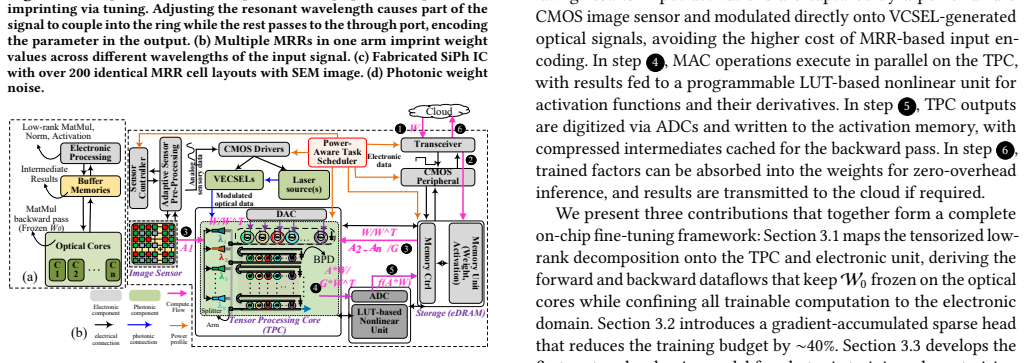
Summary. The paper proposes Opto-ViT-v2, a silicon-photonic ViT accelerator that supports on-chip parameter-efficient fine-tuning. It combines a tensorized low-rank (FacT-style) decomposition of weight increments—pretrained weights stay frozen on optical MRR cores while about 8K electronic factors are trained—with a gradient-accumulated sparse classifier head. The authors derive forward/backward dataflows, claim a 192× reduction in cached activations (220 KB), elimination of MRR write-back, and a five-core pipelined schedule. They also introduce a noise model for photonic training calibrated on more than 200 fabricated MRR cells and evaluate on VTAB-1K and FGVC few-shot benchmarks, reporting recovery within 0.3–0.8% of clean accuracy and >100 KFPS/W.
Significance. If the storage and recomputation story can be made consistent, the paper is significant: it is the first concrete mapping of PEFT onto a photonic near-sensor ViT accelerator, with mathematically sound factor gradients (Eqs. 2–5), a very small trainable parameter budget, and a device-calibrated noise model that covers both forward and backward passes. The five-core scheduling and full-stack device-to-application evaluation are substantial engineering contributions. However, the central feasibility claim—192× activation reduction to 220 KB—depends on a checkpointing scheme that is inconsistent with the U-gradient computation, and the FGVC robustness comparison uses a noise-free baseline for FacT. These issues must be resolved before the paper's main claims are supported.
major comments (3)
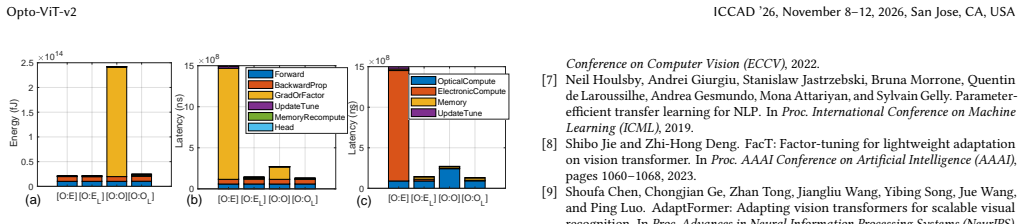
- [§3.1.2, Eq. (5); §3.1.3, Stage B3] The claimed 192× activation-storage reduction to 220 KB is not supported by the stated dataflow. Computing ∂L/∂U = s Σ_i X_iᵀ (G_i V Σ_iᵀ) requires the full X_i ∈ R^{N×d} for each of the 144 sub-layers, whereas only X_i U ∈ R^{N×r} is cached. The paper proposes reconstructing X_i by “a single forward evaluation of the preceding sub-layer using the stored layer-boundary checkpoint.” If checkpoints are at every sub-layer boundary, the full 144·N·d activations (~42 MB) are resident—exactly the footprint the method claims to eliminate. If checkpoints are only at encoder-layer boundaries, reconstructing X_i for sub-layer i requires a forward pass through all preceding sub-layers of that layer (up to 12 sub-layer calls, not one), adding 144 extra optical sub-layer invocations per backward pass. These extra invocations are absent from the §4.3 energy/latency model and from the >100 KFPS/W claim
- [Table 2 and Table 1] The FGVC comparison is not apples-to-apples. The Table 2 caption states that FacT-TT rank-16 results are obtained under noise-free conditions, while the proposed FiT variants are evaluated under hardware-induced noise. Since the paper’s central robustness claim is that low-rank factor updates are more robust under identical noise conditions, the FGVC table cannot support it; FacT-TT must be run under the same injected photonic noise. In addition, parameter counts are inconsistent: Table 2 reports #param = 58K/86K for ViT-B4 (FiT) and ViT-B16 (FiT), while Table 1 reports #p = 44K/72K for the same configurations. The stated 40% sparse head for C=100 would also yield about 54K params, not 44K. Please reconcile these counts and report all baselines under consistent noise settings.
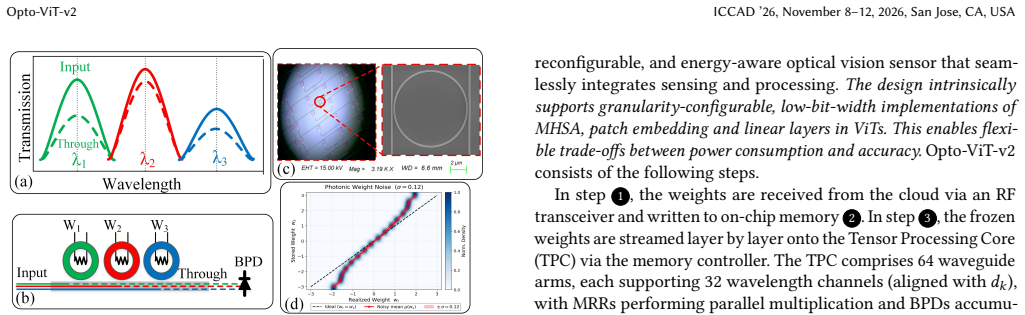
- [§3.3 and §4.1] The noise model is calibrated on more than 200 isolated fabricated MRR cells, but it is applied to a full 5-core, 64-arm, 32-wavelength machine with simultaneous forward/backward passes. The paper does not validate that the LUT-based thermo-optic crosstalk coefficients and Gaussian residuals (σ_weight = 0.12, σ_act = 0.03) transfer to dense multi-core operation, where inter-core thermal coupling and long-session drift may be larger. The headline 0.3–0.8% recovery and the robustness comparison against full fine-tuning rest on this transfer. At minimum, report sensitivity of the VTAB-1K results to σ_weight and σ_act, and state what validation, if any, was performed at the full-array level. Table 3 only sweeps σ_fab at 0.1–0.3, not the model’s actual σ values.
minor comments (4)
- [Table 3] The reported # Head Params values (10K/15K/20K for retention ratios 0.4/0.6/0.8) are not consistent with d=768 and the VTAB class counts. For CIFAR-100 alone, a 60% retention mask would give about 46K head parameters; the caption says these are averages, but even averaging the listed tasks gives ~20K at 60%, not 15K. Please clarify how the head parameter counts are computed and whether the mask is applied to the full head or to a per-task subset.
- [§3.2 and Table 3 caption] There are typos: “phase„ reducing” in §3.2 and “serveral Vtab1K datasets” in the Table 3 caption. Also, the main experimental setup uses σ = 0.12 for weights and σ = 0.03 for activations, but Table 3’s noise sweep fixes σ_fab = 0.1 for the retention-ratio study; the relation between σ_fab and the §4.1 noise hyperparameters should be stated.
- [Eq. (7)] The inter-channel crosstalk formula φ_ij is defined in Eq. (7) but never used in the subsequent forward/backward noise equations (Eqs. (8)–(9)). Either show how φ_ij enters 𝝐_fwd and 𝝐_bwd, or remove it to avoid an unused definition.
- [Conclusion] The conclusion refers to “FiT-ViT” rather than “Opto-ViT-v2”; please use consistent naming throughout. Also, the abstract and introduction use “first framework” multiple times; given prior photonic training proposals, a more precise claim about what is new (PEFT specifically on a near-sensor SiPh ViT) would be preferable.
Circularity Check
No significant circularity: the low-rank training math is standard differentiation and the noise model is calibrated to external fabricated-device measurements.
full rationale
The paper's central derivation is not circular. The tensorized low-rank update W_i = W0,i + s U Σ_i V^T is taken from the external FacT work [8], and the factor-gradient equations in Sec. 3.1.2 follow by ordinary differentiation: Eq. (4) indeed needs only the cached X_i U for ∂L/∂Σ_i, while Eq. (5) requires full X_i for ∂L/∂U, which the paper acknowledges and addresses by recomputation. The advertised 192× activation-storage reduction is an arithmetic consequence of caching the N×r product rather than the N×d activation, not a fitted prediction masquerading as a result. The photonic noise model in Sec. 3.3 is not sustained by a self-citation chain: although it extends the authors' prior Opto-ViT pipeline model [4], the current paper states the noise equations itself and calibrates them against >200 fabricated MRR devices plus Lumerical/Cadence simulations, so the calibration is external evidence. The sparse-head cost reduction is definitional once a 60% retain mask is chosen, but the paper presents it as a design choice with an empirical accuracy assessment, not as a derived prediction of accuracy. The self-citations to [4] and [18] are not load-bearing in the way that would make the argument reduce to its own claims. Concerns about the Table 2 comparison (FacT noise-free vs FiT noisy) and the under-accounting of X_i recomputation for Eq. (5) are benchmarking and system-consistency issues, not circularity; they do not meet the threshold of a claim whose output equals its input by construction.
Assumptions & free parameters
free parameters (6)
- low-rank update scaling s =
not reported
- rank r =
4 and 16
- head retention ratio k =
0.6 (60%)
- gradient accumulation window B_acc =
10 mini-batches
- noise sigmas σ_weight, σ_activation =
0.12, 0.03
- thermo-optic crosstalk coefficients α_i(P), ρ(d_i), LUT =
calibrated, values not released
assumptions (5)
- standard math Standard backpropagation chain rule; low-rank gradient identities (Eqs. 3–5).
- domain assumption MRR banks act as linear, 8-bit weight multipliers whose noise is captured by Eqs. (7)–(9).
- domain assumption ImageNet-21K pretrained ViT-Base transfers to VTAB-1K and FGVC via low-rank updates on 1K/few-shot samples.
- ad hoc to paper Accumulated gradient magnitude over 10 batches identifies head weights that can be frozen for the rest of training.
- domain assumption Nonlinearities and their derivatives are computed exactly by the LUT-based electronic unit.
Cite this review
Pith. "Pith review of Opto-ViT-v2: Noise-Resilient On-Chip Fine-Tuning for Photonic Near-Sensor Vision Transformer Accelerators." pith.science (2026). https://pith.science/paper/CZZH35I3
@misc{pith2026260719421,
  author       = {Pith},
  title        = {Pith review of: Opto-ViT-v2: Noise-Resilient On-Chip Fine-Tuning for Photonic Near-Sensor Vision Transformer Accelerators},
  year         = {2026},
  howpublished = {\url{https://pith.science/paper/CZZH35I3}},
  note         = {Machine review of arXiv:2607.19421}
}
read the original abstract
Silicon-photonic (SiPh) accelerators have emerged as a promising platform for Vision Transformer (ViT) inference by performing matrix multiplications on microring-resonator (MRR) banks with high throughput and energy efficiency. Extending these platforms to support on-chip fine-tuning remains challenging because backpropagation requires large activation storage, frequent weight write-back to MRRs, and tolerance to device-level noise. We present Opto-ViT-v2, the first framework for parameter-efficient fine-tuning (PEFT) on a near-sensor SiPh ViT accelerator. Our tensorized low-rank decomposition separates pretrained optical weights from a small set of trainable electronic factors (as few as 8K parameters for ViT-Base), greatly reducing activation storage and weight updates while enabling practical on-chip training. We further introduce a gradient-accumulated sparse classifier that freezes low-importance weights through one-shot top-k gradient masking, reducing classifier training cost by about 40 percent. We also develop the first system-level noise model for photonic on-chip training, capturing the effects of MRR crosstalk, thermal drift, and laser amplitude noise during both forward and backward propagation. Calibrated using measurements from more than 200 fabricated MRR devices, the model shows that low-rank factor updates are more robust than full fine-tuning and conventional layer-wise low-rank adaptation under identical noise conditions. Experiments on VTAB-1K (19 tasks) and FGVC few-shot benchmarks demonstrate that Opto-ViT-v2 recovers within 0.3 to 0.8 percent of clean software accuracy under measured photonic noise while achieving more than 100 KFPS/W, enabling practical on-chip domain adaptation for photonic edge vision systems.
Figures

Figures from the paper (5 more)


Reference graph
Works this paper leans on
-
[1]
An image is worth 16x16 words: Transformers for image recognition at scale
Alexey Dosovitskiy, Lucas Beyer, Alexander Kolesnikov, Dirk Weissenborn, Xi- aohua Zhai, Thomas Unterthiner, Mostafa Dehghani, Matthias Minderer, Georg Heigold, Sylvain Gelly, Jakob Uszkoreit, and Neil Houlsby. An image is worth 16x16 words: Transformers for image recognition at scale. InProc. International Conference on Learning Representations (ICLR), 2021
2021
-
[2]
CrossLight: A cross-layer optimized silicon photonic neural network accelerator
Febin Sunny, Asif Mirza, Mahdi Nikdast, and Sudeep Pasricha. CrossLight: A cross-layer optimized silicon photonic neural network accelerator. InProc. Design Automation Conference (DAC), pages 1069–1074, 2021
2021
-
[3]
Lightator: An optical near-sensor accelerator with compressive acquisition enabling versa- tile image processing
Mehrdad Morsali, Brendan Reidy, Deniz Najafi, Sepehr Tabrizchi, Mohsen Imani, Mahdi Nikdast, Arman Roohi, Ramtin Zand, and Shaahin Angizi. Lightator: An optical near-sensor accelerator with compressive acquisition enabling versa- tile image processing. InProceedings of the 61st ACM/IEEE Design Automation Conference, pages 1–6, 2024
2024
-
[4]
Opto-ViT: Architecting a near-sensor region of interest-aware vision transformer accelerator with silicon photonics
Mehrdad Morsali, Chengwei Zhou, Deniz Najafi, Sreetama Sarkar, Pietro Mercati, Navid Khoshavi, Peter Beerel, Mahdi Nikdast, Gourav Datta, and Shaahin Angizi. Opto-ViT: Architecting a near-sensor region of interest-aware vision transformer accelerator with silicon photonics. InProc. International Conference on Computer- Aided Design (ICCAD), 2025
2025
-
[5]
Hu, Yelong Shen, Phillip Wallis, Zeyuan Allen-Zhu, Yuanzhi Li, Shean Wang, Lu Wang, and Weizhu Chen
Edward J. Hu, Yelong Shen, Phillip Wallis, Zeyuan Allen-Zhu, Yuanzhi Li, Shean Wang, Lu Wang, and Weizhu Chen. LoRA: Low-rank adaptation of large language models. InProc. International Conference on Learning Representations (ICLR), 2022
2022
-
[6]
Belongie, Bharath Hariharan, and Ser-Nam Lim
Menglin Jia, Luming Tang, Bor-Chun Chen, Claire Cardie, Serge J. Belongie, Bharath Hariharan, and Ser-Nam Lim. Visual prompt tuning. InProc. European Conference on Computer Vision (ECCV), 2022
2022
-
[7]
Parameter- efficient transfer learning for NLP
Neil Houlsby, Andrei Giurgiu, Stanislaw Jastrzebski, Bruna Morrone, Quentin de Laroussilhe, Andrea Gesmundo, Mona Attariyan, and Sylvain Gelly. Parameter- efficient transfer learning for NLP. InProc. International Conference on Machine Learning (ICML), 2019
2019
-
[8]
FacT: Factor-tuning for lightweight adaptation on vision transformer
Shibo Jie and Zhi-Hong Deng. FacT: Factor-tuning for lightweight adaptation on vision transformer. InProc. AAAI Conference on Artificial Intelligence (AAAI), pages 1060–1068, 2023
2023
Show all 26 references
-
[9]
AdaptFormer: Adapting vision transformers for scalable visual recognition
Shoufa Chen, Chongjian Ge, Zhan Tong, Jiangliu Wang, Yibing Song, Jue Wang, and Ping Luo. AdaptFormer: Adapting vision transformers for scalable visual recognition. InProc. Advances in Neural Information Processing Systems (NeurIPS), 2022
2022
-
[11]
LightBulb: A photonic-nonvolatile-memory-based accelerator for binarized convolutional neural networks
Farzaneh Zokaee, Qian Lou, Nathan Youngblood, Weichen Liu, Yuan Xie, and Lei Jiang. LightBulb: A photonic-nonvolatile-memory-based accelerator for binarized convolutional neural networks. InProc. Design, Automation and Test in Europe Conference (DATE), pages 1438–1443, 2020
2020
-
[12]
HolyLight: A nanophotonic accelerator for deep learning in data centers
Weichen Liu, Wenyang Liu, Yun Ye, Qian Lou, Yuan Xie, and Lei Jiang. HolyLight: A nanophotonic accelerator for deep learning in data centers. InProc. Design, Automation and Test in Europe Conference (DATE), pages 1483–1488, 2019
2019
-
[13]
Sunny, Asif Mirza, Mahdi Nikdast, and Sudeep Pasricha
Febin P. Sunny, Asif Mirza, Mahdi Nikdast, and Sudeep Pasricha. ROBIN: A robust optical binary neural network accelerator.ACM Transactions on Embedded Computing Systems (TECS), pages 1–24, 2021
2021
-
[14]
TRON: Transformer neural network acceleration with non-coherent silicon photonics
Salma Afifi, Sajjad Moazeni, and Sudeep Pasricha. TRON: Transformer neural network acceleration with non-coherent silicon photonics. InProc. Great Lakes Symposium on VLSI (GLSVLSI), pages 15–21, 2023
2023
-
[15]
AdapterFusion: Non-destructive task composition for transfer learning
Jonas Pfeiffer, Aishwarya Kamath, Andreas Rücklé, Kyunghyun Cho, and Iryna Gurevych. AdapterFusion: Non-destructive task composition for transfer learning. InProc. European Chapter of the Association for Computational Linguistics (EACL), 2021
2021
-
[16]
Fast and robust analog in-memory deep neural network training.Nature Communi- cations, 15(1):7133, 2024
Malte J Rasch, Fabio Carta, Omobayode Fagbohungbe, and Tayfun Gokmen. Fast and robust analog in-memory deep neural network training.Nature Communi- cations, 15(1):7133, 2024
2024
-
[17]
ReTransformer: ReRAM- based processing-in-memory architecture for transformer acceleration
Xiaoxuan Yang, Bonan Yan, Hai Li, and Yiran Chen. ReTransformer: ReRAM- based processing-in-memory architecture for transformer acceleration. InProc. International Conference on Computer-Aided Design (ICCAD), 2020
2020
-
[18]
Light-bound transformers: Hardware-anchored robustness for silicon-photonic computer vision systems.arXiv preprint arXiv:2604.04330, 2026
Xuming Chen, Deniz Najafi, Chengwei Zhou, Pietro Mercati, Arman Roohi, Mohsen Imani, Mahdi Nikdast, Shaahin Angizi, and Gourav Datta. Light-bound transformers: Hardware-anchored robustness for silicon-photonic computer vision systems.arXiv preprint arXiv:2604.04330, 2026
2026 arXiv
-
[19]
Neural prompt search.arXiv preprint arXiv:2206.04673, 2022
Yuanhan Zhang, Kaiyang Zhou, and Ziwei Liu. Neural prompt search.arXiv preprint arXiv:2206.04673, 2022
2022 arXiv
-
[20]
Freepdk45: An open-source predictive process design kit
North Carolina State University. Freepdk45: An open-source predictive process design kit. https://eda.ncsu.edu/freepdk/freepdk45/, 2011. Accessed: 2026
2011
-
[21]
Synopsys design compiler, product version 14.9.2014, 2014
Synopsys, Inc. Synopsys design compiler, product version 14.9.2014, 2014
2014
-
[22]
The visual task adaptation benchmark.arXiv preprint arXiv:1910.04867, 2019
Xiaohua Zhai, Joan Puigcerver, Alexander Kolesnikov, Pierre Ruyssen, Carlos Riquelme, Mario Lucic, Josip Djolonga, Andre Susano Pinto, Maxim Neumann, Alexey Dosovitskiy, Lucas Beyer, Olivier Bachem, Michael Tschannen, Marcin Michalski, Olivier Bousquet, Sylvain Gelly, and Neil...
1910 arXiv
-
[23]
Food-101 – mining discriminative components with random forests
Lukas Bossard, Matthieu Guillaumin, and Luc Van Gool. Food-101 – mining discriminative components with random forests. InEuropean Conference on Computer Vision (ECCV), 2014
2014
-
[24]
3D object representa- tions for fine-grained categorization
Jonathan Krause, Michael Stark, Jia Deng, and Li Fei-Fei. 3D object representa- tions for fine-grained categorization. InProc. IEEE/CVF Conference on Computer Vision and Pattern Recognition Workshops, 2013
2013
-
[25]
Automated flower classification over a large number of classes
Maria-Elena Nilsback and Andrew Zisserman. Automated flower classification over a large number of classes. InIndian Conference on Computer Vision, Graphics and Image Processing (ICVGIP), 2008
2008
-
[26]
Fine-grained visual classification of aircraft
Subhransu Maji, Juho Kannala, Esa Rahtu, Matthew Blaschko, and Andrea Vedaldi. Fine-grained visual classification of aircraft. Technical report, arXiv preprint arXiv:1306.5151, 2013
2013 arXiv
-
[27]
Parkhi, Andrea Vedaldi, Andrew Zisserman, and C
Omkar M. Parkhi, Andrea Vedaldi, Andrew Zisserman, and C. V. Jawahar. Cats and dogs. InIEEE Conference on Computer Vision and Pattern Recognition (CVPR), 2012
2012
Reviewed August 1, 2026 · model on record in the stance chip above.
Discussion (0). Sign in to comment.