REVIEW 3 major objections 5 minor 40 references
Generating Bearing Vibration Signals at User-Specified Fault Probabilities Using PR-GAN and Counterfactual Methods
T0 review · 3 major / 5 minor · reviewed 2026-08-01 · deepseek-v4-flash
Pith's one-line read Direct optimization of each signal against a frozen ensemble classifier can produce bearing vibration windows at user-chosen fault probabilities far more reliably than a trained probability-regularized GAN.
desk verdict A clean, honest application of known templates; the CF results are real but partly by design, and the realism question is left open. read the letter →
The pith
A machine-rendered reading of the paper's core claim, the machinery that carries it, and where it could break.
The reading
What carries the argument
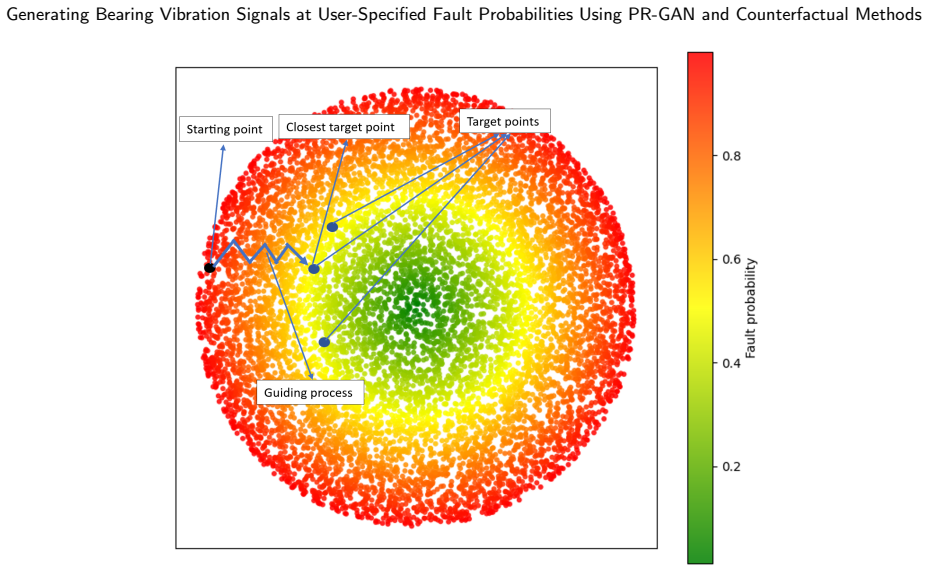
The load-bearing object is the "probability oracle": a fixed, gradient-accessible heterogeneous ensemble classifier whose averaged output is treated as a continuous function of the input. Both generation methods steer this output to a target probability: PR-GAN trains a residual generator x̂ = x + Δ(x, p*) with a Wasserstein-GAN adversarial loss, a binary-cross-entropy alignment term between the classifier output and p*, and an L1 residual penalty; CF runs per-sample gradient-based optimization on BCE(p*, f(x_cf)) plus an L2 proximity term to the source, with amplitude clipping and an early-stop tolerance of 0.05. The paper also gives an intermediate-value existence argument (continuity, pat
What would settle it
Compute expected calibration error and reliability diagrams for the guidance ensemble, then run envelope-spectrum analysis at the characteristic bearing-fault frequencies on the CF-generated p* = 0.5 samples (or pass them through a second, independently trained classifier). If the samples are detected as out-of-distribution or the 0.5 outputs do not coincide with genuinely ambiguous vibration signatures, the central practical claim that these are useful borderline samples collapses.
Extended reading notes
Core claim
On its own terms, the paper establishes that user-specified fault probabilities can be imposed on bearing vibration windows by directly optimizing each window against a frozen ensemble classifier: a per-sample counterfactual procedure using binary cross-entropy to a soft target plus an L2 proximity penalty achieved mean absolute error 0.005–0.008 and 100% within-tolerance success across all retained samples and both benchmark datasets, with smaller average L1 edits than the residual GAN. The trained PR-GAN, which augments a Wasserstein GAN with gradient penalty by adding a probability-alignment term and a residual edit, was systematically less reliable (MAE 0.046–0.059, success 0.501–0.680),
Load-bearing premise
The approach assumes the ensemble classifier's predicted probability is a trustworthy guide to real fault likelihood; if that output is uncalibrated—or if a p* = 0.5 edit is just an adversarial perturbation of the source rather than a plausible vibration condition—the generated "borderline" samples do not deliver the maintenance value the paper motivates.
Editorial extensions
If this is right
- For a fixed classifier with accessible gradients, per-sample counterfactual optimization can hit a user-chosen fault probability almost exactly (mean absolute error ≤ 0.008) on every retained window, while keeping time-domain and spectral edits smaller than the trained GAN's.
- The trained residual GAN is not a reliable way to control probability: on roughly a third to half of its retained samples it misses the ±0.05 tolerance, so amortized inference speed does not compensate for probability-steering failure on individual outputs.
- Generated p* = 0.5 samples should be read as "the classifier is locally uncertain on this perturbation," not as calibrated 50% fault likelihood; the paper states this explicitly as a limitation.
- The CF-versus-PR-GAN comparison is a system-level comparison, not a controlled ablation, so the reliability gap should not be attributed to any single design axis.
- Probability-targeted samples provide a practical way to populate the boundary region of a fixed classifier with controlled probabilities that are otherwise scarce in standard bearing datasets, subject to the realism caveat.
Reading between the lines
- A strong reading of the CF result is that it is a targeted adversarial perturbation under an L2 budget; whether that is useful for maintenance hinges on external validation (e.g., a second held-out classifier or envelope-spectrum features agreeing with the oracle), which the paper leaves as future work.
- The 100% success rate may partly reflect the generous 300-step optimization budget and the oracle's smoothness; a fairer apples-to-apples comparison would give PR-GAN per-sample verification or a comparable per-sample budget, which the paper does not do.
- If the guidance ensemble were replaced by a calibrated one, the per-sample targeting mechanism would likely still work—binary-cross-entropy targeting depends on relative ordering—but the physical meaning of the resulting probability would become stronger; this is a testable extension.
- A direct downstream test: use the generated gray-zone samples as training augmentation and measure whether boundary robustness or uncertainty estimates improve; the paper lists this as future work but does not run it.
Editorial analysis
A structured set of objections, weighed in public.
Referee Report
Summary. The manuscript addresses the scarcity of samples with intermediate predicted fault probabilities in bearing vibration classifiers. It proposes two generation methods: PR-GAN, a WGAN-GP extension with a residual generator and a BCE probability-alignment term against a frozen heterogeneous ensemble CNN, and CF, a Wachter-style per-sample counterfactual that optimizes a BCE plus L2 proximity objective with early stopping at tolerance epsilon=0.05. Experiments on CWRU and Paderborn report that CF achieves MAE_p 0.005--0.008 and SR_tau=1.000 on retained samples, whereas PR-GAN achieves MAE_p 0.046--0.059 and SR_tau 0.501--0.680 on retained samples; CF also has lower Delta-L1 and dPSD in most settings, while PR-GAN has lower reported runtime in most settings. The authors position both methods as instantiations of existing templates applied to vibration windows, and they include a GitHub repository for reproducibility.
Significance. If the results are taken at face value, the paper provides a reproducible comparison of training-based and training-free probability-targeted generation on two standard bearing datasets. The manuscript is honest about several confounders and limitations, and it ships code. However, the headline CF success rate is largely a consequence of the method's own stopping rule, and the realism evaluation is only a source-proximity proxy, with the paper itself conceding that p*=0.5 samples may be adversarial rather than physically meaningful. The central practical motivation---generating plausible borderline samples for maintenance decisions---therefore remains unsupported. These issues are addressable with additional reporting and experiments, so the paper has a useful core if revised substantially.
major comments (3)
- [§3.8, Algorithm 2; §3.9, Eq. (18)] CF's reported SR_tau=1.000 is a tautology. Algorithm 2 breaks when |p_f - p*| <= epsilon, with epsilon=0.05, and Eq. (18) defines success as |p_f - p*| <= tau with tau=0.05. Since N_failed=0, every returned sample satisfies the success criterion by construction; the 1.000 'success rate' is not an independent empirical outcome. The MAE_p values are not directly forced by the bound, but the comparison is still not like-for-like because PR-GAN has no early-exit oracle. Please report CF's error distribution under a fixed step budget (or at least how often the early-exit condition binds) and use the same evaluation procedure for both methods.
- [§3.9, Eqs. (17)--(18); Tables 4--5] All probability metrics are computed only on samples retained after the 0.25 filtering threshold. For PR-GAN this excludes 77, 74, and 3 samples (CWRU) and 20, 15, and 0 (Paderborn) out of 500. Thus SR_tau is a conditional proportion among retained samples, not the success rate over all attempted generations. For example, CWRU p*=0.25 PR-GAN's full-attempt success rate is roughly (500-77)/500 * 0.501 = 0.424, not 0.501. The paper does disclose the conditioning, but the abstract's presentation of 'success rates between 0.501 and 0.680' is misleading without full-attempt rates. Please report full-attempt MAE/SR or a combined metric such as retention rate times SR_tau.
- [§3.9, §4.5.3, §5] The central motivation is to generate practically useful borderline samples, but the realism metrics Delta-L1, Delta-TV, and dPSD measure proximity to the source, not physical plausibility. Section 4.5.3 explicitly concedes that p*=0.5 samples 'may lie closer to adversarial perturbations of the source than to physically meaningful borderline conditions.' Because no direct realism check (envelope-spectrum analysis, a realism classifier, or a downstream task) is provided, the practical-value claim is unsupported. This is a load-bearing limitation; either add at least one direct realism evaluation or substantially narrow the claims to 'edits that steer a fixed classifier's probability' rather than 'realistic bearing vibration signals.'
minor comments (5)
- [§4.3] The sentence 'The results are reported in Table 4.' appears twice consecutively. Please remove the duplicate.
- [Tables 4--5 and §4.5.1] The 'Time (minute)' column mixes PR-GAN training time with CF generation time. The text explains this, but the table should annotate the distinction more clearly (e.g., separate rows for training and per-sample generation) to avoid an apples-to-oranges runtime comparison.
- [§3.8, Algorithm 2] The values of alpha_ce and beta_l2 in the CF objective are not reported. Since they control the trade-off between probability alignment and source proximity, please include the values used in the experiments.
- [Abstract and §3.9] The abstract says CF 'requires smaller average L1 changes,' but CF's optimization objective uses an L2 proximity term; Delta-L1 is only an evaluation metric. Clarify this distinction to avoid confusion.
- [§3.2] The paper states that classifier calibration is not measured. This is a legitimate scoping choice, but it should be tied more prominently to the interpretation of p* in the abstract and conclusion, since 'fault probability' could be read as a physical probability rather than a model output.
Circularity Check
CF's reported success rate of 1.000 is the Algorithm 2 stopping rule restated as Eq. (18); the rest of the comparison is transparent but the headline probability-steering claim is partly forced.
-
self definitional
[§3.8 (Algorithm 2, lines 8–9) and §3.9 (Eq. 18)]
"We set the stopping tolerance to ε = 0.05. ... Algorithm 2: 8: if |p_f − p∗| ≤ ε then 9: break ... SRτ = 1/M ∑_{i=1}^M 1(||pfault(xi)−p∗|| ≤ τ), where 1(·) is the indicator function, τ corresponds to the tolerance parameter which is 0.05."
For CF, every sample that exits through Algorithm 2's early break satisfies |pf−p∗|≤0.05 by construction, and Eq. (18) defines success as exactly |pf−p∗|≤τ with τ=0.05. Thus SRτ=1.000 on retained samples is the stopping rule renamed as an evaluation result, not an empirical finding about steering accuracy. The MAE values are also measured on the same fixed, gradient-accessible oracle whose BCE drives the optimization, so they report fit to the generation objective. The comparison is therefore partly forced: PR-GAN has no per-sample early-stop guarantee, so the headline CF-vs-PR-GAN success-rate gap is not a fully independent test of the two methods.
full rationale
The one concrete circular step is the CF success-rate metric: the generation stopping tolerance ε=0.05 and the evaluation tolerance τ=0.05 are the same quantity, making CF's SRτ=1.000 definitional rather than predictive. The paper itself is transparent about the related confounds: §4.5.1 notes CF is given 300 Adam steps against a direct probability objective, §3.9 warns that the similarity metrics measure edit aggressiveness rather than absolute realism, §4.5.3 cautions that p∗=0.5 samples may be closer to adversarial perturbations than to physical borderline conditions, and the conclusion explicitly lists calibration and downstream validation as open. These are honest limitations, not circularity. I found no load-bearing self-citation chain, no imported uniqueness theorem, and no ansatz smuggled in by citation; PR-GAN is openly presented as a combination of existing components. The central derivation—that direct optimization of a real window against a fixed classifier can match a target probability—is self-contained and true by construction, but the headline 'success rate 1.000' is forced, so the circularity score is 6 rather than 0.
Assumptions & free parameters
free parameters (5)
- alpha_ce / beta_l2 (CF objective weights) =
not reported
- CF max steps and stopping tolerance =
S=300, epsilon=0.05
- PR-GAN loss weights (alpha_adv, lambda_bce, lambda_res) =
not reported
- PR-GAN WGAN-GP hyperparameters (lambda_gp, critic iterations) =
not reported
- Retention threshold for evaluation =
0.25
assumptions (4)
- domain assumption The admissible signal space is path-connected and the classifier probability f is continuous, with signals on both sides of p*.
- domain assumption The ensemble classifier's averaged probabilities are informative enough to guide generation.
- ad hoc to paper Source-similarity metrics (Delta-L1, Delta-TV, dPSD) are valid proxies for signal realism.
- domain assumption All fault types can be collapsed into a single binary fault class.
Cite this review
Pith. "Pith review of Generating Bearing Vibration Signals at User-Specified Fault Probabilities Using PR-GAN and Counterfactual Methods." pith.science (2026). https://pith.science/paper/BVZNIKT6
@misc{pith2026260719455,
  author       = {Pith},
  title        = {Pith review of: Generating Bearing Vibration Signals at User-Specified Fault Probabilities Using PR-GAN and Counterfactual Methods},
  year         = {2026},
  howpublished = {\url{https://pith.science/paper/BVZNIKT6}},
  note         = {Machine review of arXiv:2607.19455}
}
read the original abstract
In bearing vibration datasets, most samples receive predicted fault probabilities close to 0 or 1, while samples with intermediate (gray-zone) probabilities are rare. Such borderline samples are important because they reflect conditions in which maintenance decisions may require additional inspection or a conservative response and are useful for studying decision boundaries. To address this scarcity, this paper proposes and compares two approaches that generate vibration signals whose predicted fault probability matches a target probability of 0.25, 0.50, or 0.75. We use the average output of a heterogeneous ensemble classifier with different architectures and random initializations as a fixed, gradient-accessible probability oracle. The first, training-based approach, Probability-Regularized Generative Adversarial Network (PR-GAN), extends Wasserstein Generative Adversarial Network with Gradient Penalty (WGAN-GP) and edits a real signal through a residual generator while pushing the classifier output toward the target probability. The second is a training-free, per-sample Wachter-style counterfactual (CF) procedure that directly optimizes each input signal to reach the target probability while remaining close to the source signal. We evaluate both methods on the Case Western Reserve University (CWRU) and Paderborn bearing datasets using mean absolute target-probability error, time-domain total variation, and frequency-domain log power spectral density (log-PSD) differences. Across all settings, CF reaches the target with a mean absolute probability error of 0.005-0.008 and a within-tolerance success rate of 1.000 on retained samples, whereas PR-GAN's mean error is 0.046-0.059 with success rates between 0.501 and 0.680. CF therefore steers the probability more reliably and requires smaller average L1 changes, whereas PR-GAN has a lower reported runtime in most settings.
Figures


Figures from the paper (8 more)


Reference graph
Works this paper leans on
-
[1]
Synthesizing rolling bearing fault samples in new conditions: A framework based on a modified CGAN
Ahang, M., Jalayer, M., Shojaeinasab, A., Ogunfowora, O., Charter, T., Najjaran, H., 2022. Synthesizing rolling bearing fault samples in new conditions: A framework based on a modified CGAN. Sensors
2022
-
[2]
What regularized auto-encoders learn from the data-generating distribution
Alain, G., Bengio, Y., 2014. What regularized auto-encoders learn from the data-generating distribution. Journal of Machine Learning Research
2014
-
[3]
Generalized denoising auto-encoders as generative modelsarXiv:1305.6663
Bengio, Y., Yao, L., Alain, G., Vincent, P., 2013. Generalized denoising auto-encoders as generative modelsarXiv:1305.6663
arXiv 2013
-
[4]
Basic vibration theory
Blake, R.E., . Basic vibration theory. Chapter 2
-
[5]
Bearing data center.https://engineering.case.edu/bearingdatacent er
Case Western Reserve University, Case School of Engineering, n.d. Bearing data center.https://engineering.case.edu/bearingdatacent er. Accessed: 2026-01-07
2026
-
[6]
A new safe-level enabled borderline-smote for condition recognition of imbalanced dataset
Chen, C., Shen, W., Yang, C., Fan, W., Liu, X., Li, Y., 2023. A new safe-level enabled borderline-smote for condition recognition of imbalanced dataset. IEEE Transactions on Instrumentation and Measurement
2023
-
[7]
Abearingfaultdiagnosismethodinscenariosofimbalancedsamples and insufficient labeled samples
Cheng, X., Lu, Y., Liang, Z., Zhao, L., Gong, Y., Wang, M., 2024. Abearingfaultdiagnosismethodinscenariosofimbalancedsamples and insufficient labeled samples. Applied Sciences
2024
-
[8]
Generative alignment of posterior probabilities for source-free domain adaptation
Chhabra, S., Venkateswara, H., Li, B., . Generative alignment of posterior probabilities for source-free domain adaptation
Show all 40 references
-
[9]
Instance-based counter- factual explanations for time series classificationarXiv:2009.13211
Delaney, E., Greene, D., Keane, M.T., 2021. Instance-based counter- factual explanations for time series classificationarXiv:2009.13211
2021 arXiv
-
[10]
Data Sets and Download — Bearing Data Center
DesignandDriveTechnology(KAt),PaderbornUniversity,n.d. Data Sets and Download — Bearing Data Center. Website. URL:https: //mb.uni-paderborn.de/en/kat/research/bearing-datacenter/data-s ets-and-download. accessed January 7, 2026
2026
-
[11]
Dropoutasabayesianapproximation: Representing model uncertainty in deep learning, in: Proceedings of the 33rd International Conference on Machine Learning, pp
Gal,Y.,Ghahramani,Z.,2016. Dropoutasabayesianapproximation: Representing model uncertainty in deep learning, in: Proceedings of the 33rd International Conference on Machine Learning, pp. 1050– 1059
2016
-
[12]
Rudin–osher–fatemi total variation denoising using split bregman
Getreuer, P., 2012. Rudin–osher–fatemi total variation denoising using split bregman. Image Processing On Line
2012
-
[13]
Reg- ularisation of neural networks by enforcing lipschitz continuity
Gouk, H., Frank, E., Pfahringer, B., Cree, M.J., 2020. Reg- ularisation of neural networks by enforcing lipschitz continuity. arXiv:1804.04368
2020 arXiv
-
[14]
Gulrajani, I., Ahmed, F., Arjovsky, M., Dumoulin, V., Courville, A.,
-
[15]
On calibration of modern neural networks, in: Proceedings of the 34th International Conference on Machine Learning
Guo, C., Pleiss, G., Sun, Y., Weinberger, K.Q., 2017. On calibration of modern neural networks, in: Proceedings of the 34th International Conference on Machine Learning
2017
-
[16]
Adaptive sv-borderline smote-svmalgorithmforimbalanceddataclassification
Guo, J., Wu, H., Chen, X., Lin, W., 2024. Adaptive sv-borderline smote-svmalgorithmforimbalanceddataclassification. AppliedSoft Computing
2024
-
[17]
Evaluating deep learning models for fault diagnosis of a rotating machinery with epistemic and aleatoric uncertainty
Jalayer, R., Jalayer, M., Mor, A., Orsenigo, C., Vercellis, C., 2024. Evaluating deep learning models for fault diagnosis of a rotating machinery with epistemic and aleatoric uncertainty. arXiv preprint arXiv:2412.18980
2024 arXiv
-
[18]
Obgan:Minorityoversamplingnearborderline with generative adversarial networks
Jo,W.,Kim,D.,2022. Obgan:Minorityoversamplingnearborderline with generative adversarial networks. Expert Systems with Applica- tions
2022
-
[19]
Therelativeperformance of ensemble methods with deep convolutional neural networks for image classification.arXiv:1704.01664
Ju,C.,Bibaut,A.,vanderLaan,M.J.,2017. Therelativeperformance of ensemble methods with deep convolutional neural networks for image classification.arXiv:1704.01664
2017 arXiv
-
[20]
Lessmeier, C., Kimotho, J.K., Zimmer, D., Sextro, W., 2016. Con- dition monitoring of bearing damage in electromechanical drive sys- tems by using motor current signals of electric motors: A benchmark datasetfordata-drivenclassification,in:EuropeanConferenceofthe Prognostics a...
2016
-
[21]
Representations aligned counterfactual domain learning for open-set fault diagnosis under speed transient conditions
Liu, S., Chen, J., Shi, Z., Song, L., He, S., 2025. Representations aligned counterfactual domain learning for open-set fault diagnosis under speed transient conditions. Knowledge-Based Systems
2025
-
[22]
Counterfactual-augmented few-shotcontrastivelearningformachineryintelligentfaultdiagnosis with limited samples
Liu,Y.,Jiang,H.,Yao,R.,Zeng,T.,2024. Counterfactual-augmented few-shotcontrastivelearningformachineryintelligentfaultdiagnosis with limited samples. Mechanical Systems and Signal Processing
2024
-
[23]
Fault diagnosis based on counterfactual inference for the batch fermentation process
Liu, Z., Lou, X., 2024. Fault diagnosis based on counterfactual inference for the batch fermentation process. ISA Transactions
2024
-
[24]
A case study of conditional deep convolutional generative adversarial networks in machine fault diagnosis
Luo, J., Huang, J., Li, H., 2021. A case study of conditional deep convolutional generative adversarial networks in machine fault diagnosis. Journal of Intelligent Manufacturing 32, 407–425
2021
-
[25]
Imbalanced fault diagnosis of rolling bearing based on generative adversarial network: A com- parative study
Mao, W., Liu, Y., Ding, L., Li, Y., 2019. Imbalanced fault diagnosis of rolling bearing based on generative adversarial network: A com- parative study. IEEE Access 7, 9515–9530
2019
-
[26]
Bearing fault detection and diagnosis using case western reserve university dataset with deep learning approaches: A review
Neupane, D., Seok, J., 2020. Bearing fault detection and diagnosis using case western reserve university dataset with deep learning approaches: A review. IEEE Access
2020
-
[27]
Plug & play generative networks: Conditional iterative generation of images in latent space
Nguyen,A.,Clune,J.,Bengio,Y.,Dosovitskiy,A.,Yosinski,J.,2017. Plug & play generative networks: Conditional iterative generation of images in latent space
2017
-
[28]
A novel class imbalance-robust network for bearing fault diagnosis utilizing raw vibration signals
Qian, W., Li, S., 2020. A novel class imbalance-robust network for bearing fault diagnosis utilizing raw vibration signals. Measurement 156, 107567
2020
-
[29]
Improvement of Generative Adversarial Network and its application in bearing fault diagnosis: A review
Ruan, D., Chen, X., Gühmann, C., Yan, J., 2023. Improvement of Generative Adversarial Network and its application in bearing fault diagnosis: A review. Lubricants
2023
-
[30]
Improved techniques for training GANs arXiv:1606.03498
Salimans, T., Goodfellow, I., Zaremba, W., Cheung, V., Radford, A., Chen, X., 2016. Improved techniques for training GANs arXiv:1606.03498
2016 arXiv
-
[31]
A novel deep autoen- coder feature learning method for rotating machinery fault diagnosis
Shao, H., Jiang, H., Zhao, H., Wang, F., 2017. A novel deep autoen- coder feature learning method for rotating machinery fault diagnosis. Mechanical Systems and Signal Processing 95, 187–204
2017
-
[32]
A novel intelligent fault diagnosis method for rolling bearings based on wasserstein generative adversarial network and convolutional neural network under unbalanced dataset
Tang, H., Gao, S., Wang, L., Li, X., Li, B., Pang, S., 2021. A novel intelligent fault diagnosis method for rolling bearings based on wasserstein generative adversarial network and convolutional neural network under unbalanced dataset. Sensors 21, 6754
2021
-
[33]
Counterfactual expla- nations without opening the black box: Automated decisions and the gdpr
Wachter, S., Mittelstadt, B., Russell, C., 2018. Counterfactual expla- nations without opening the black box: Automated decisions and the gdpr
2018
-
[34]
Coun- terfactual data generation method for fault diagnosis of complex electromechanical systems
Wang, C., Liu, J., Cao, J., Chen, X., Chen, L., Ji, Y., 2025. Coun- terfactual data generation method for fault diagnosis of complex electromechanical systems. IEEE Transactions on Instrumentation and Measurement
2025
-
[35]
Wang, Z., Samsten, I., Miliou, I., Mochaourab, R., Papapetrou, P.,
-
[36]
Anewconvolutionalneural network-baseddata-drivenfaultdiagnosismethod.IEEETransactions on Industrial Electronics 65, 5990–5998
Wen,L.,Li,X.,Gao,L.,Zhang,Y.,2018. Anewconvolutionalneural network-baseddata-drivenfaultdiagnosismethod.IEEETransactions on Industrial Electronics 65, 5990–5998
2018
-
[37]
Counterfactual inference for generalized zero-shot compound-fault diagnosis
Xu, J., Kong, H., Ding, X., Yuan, X., 2025. Counterfactual inference for generalized zero-shot compound-fault diagnosis. IEEE Transac- tions on Instrumentation and Measurement
2025
-
[38]
Deep learning algorithms for bearing fault diagnostics—a comprehensive review
Zhang, S., Zhang, S., Wang, B., Habetler, T.G., 2020. Deep learning algorithms for bearing fault diagnostics—a comprehensive review. IEEE Access 8, 29857–29881. M.Alavi et al. Page 15 of 15
2020
-
[2017]
Improved training of wasserstein GANsarXiv:1704.00028
-
[2024]
Machine Learning
Glacier:guidedlocallyconstrainedcounterfactualexplanations for time series classification. Machine Learning
Reviewed August 1, 2026 · model on record in the stance chip above.
Discussion (0). Sign in to comment.