REVIEW 3 major objections 4 minor 42 references
FullPASS: Geometry Optimization for Full-Duplex Pinching-Antenna Systems
T0 review · 3 major / 4 minor · reviewed 2026-08-01 · deepseek-v4-flash
Pith's one-line read A full-duplex pinching-antenna transceiver can pick its active elements so that self-interference stays below a hard limit while desired-link rates land within 0.95% of the best discrete selection.
desk verdict First full-duplex PASS formulation with a sound two-stage solver; the load-bearing caveat is that the passive SI-suppression claim rests on an unvalidated free-space model. read the letter →
The pith
A machine-rendered reading of the paper's core claim, the machinery that carries it, and where it could break.
The reading
What carries the argument
The central object is the joint binary activation vector pair (a_TX, a_RX), with effective weights y_i = a_i tau^{cumulative upstream activations}. The load-bearing identity is the bilinear SI form H_SI = delta_RX delta_TX y_RX^T G_SI y_TX, which turns the SI-leakage constraint into a second-order-cone constraint once one side is fixed. Stage 1 solves phase-anchored second-order-cone relaxations over a finite grid of reference phases (maximizing the rotated real part approximates maximizing the channel magnitude), then deterministically rounds the relaxed vector to binary trial patterns; Stage 2 runs alternating best-improvement local search over add, remove, and swap moves under the full pr
What would settle it
Choose any activation pattern the algorithm selects for a scenario, then measure the actual SI power at the receiver input of a two-waveguide prototype (or in a full-wave electromagnetic simulation) and compare it to the predicted P_TX|H_SI|^2. If, across a meaningful fraction of random scenarios, the measured leakage exceeds the prescribed limit by more than the calibrated guard margin, the central claim that geometry-based selection alone keeps SI within budget is falsified.
Extended reading notes
Core claim
The discovery is that the coupling between the transmit and receive waveguides can be treated as a bilinear function of the binary activation vectors: the aggregate self-interference channel is the coherent double sum H_SI = delta_RX delta_TX y_RX^T G_SI y_TX, where y_TX and y_RX are the effective weights, each active element scaled by the pass-through loss of upstream active elements. Because this form is bilinear in the activation variables, fixing one side makes the other side's self-interference constraint second-order-conic, which is exactly the structure the algorithm exploits. The paper argues, and simulates, that the finite set of phase-anchored convex subproblems plus local search r
Load-bearing premise
The load-bearing premise is that the transmit-to-receive coupling is exactly the analytic line-of-sight double sum of free-space spherical waves with fixed per-element coupling and no mutual coupling, radiation-pattern distortion, or leaky-wave leakage—plus perfect channel knowledge; if a real waveguide deviates from that sum, the selected activation patterns may not deliver the claimed SI suppression.
Editorial extensions
If this is right
- If the model holds, a full-duplex waveguide transceiver can enforce a hard self-interference budget by geometry alone—no per-element phase shifters or dedicated isolation hardware are required to get within 0.95% of the exhaustive-selection rate.
- On a 15x15 candidate grid the method is more than an order of magnitude faster than exhaustive search on average, and average runtime stays below one second up to 60 candidates per waveguide, so the selection can be re-run as the user moves.
- Against a same-hardware half-duplex TDD reference with independently optimized per-direction selections, the proposed full-duplex selection delivers roughly a 91–97% increase in average bidirectional spectral efficiency.
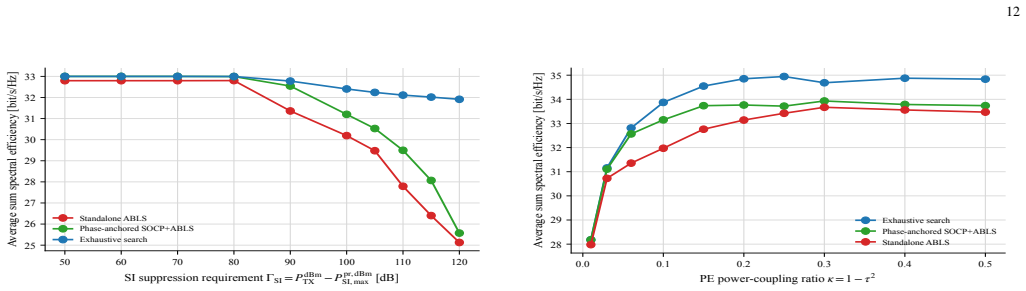
- The parameter sweeps imply a concrete design tradeoff: stronger SI suppression and higher in-waveguide attenuation each shrink the set of favorable transmit–receive geometries; per-element coupling helps only up to a saturation point.
- The two-stage approach recovers about three-quarters of the optimality gap that standalone local search leaves, so the convex initialization is what buys most of the near-optimality.
Reading between the lines
- A hardware-in-the-loop variant is the natural next step: measure the actual SI coupling matrix on a prototype, plug it into the same optimization, and re-calibrate the guard margin from measured mismatch; the algorithm's structure would not change, only the channel table.
- The same geometric-SI-suppression logic applies to any reconfigurable-aperture system whose receive elements can be placed far from transmit elements; the question is whether the aperture span is large enough to reproduce the isolation margins demonstrated here.
- The method's treatment of SI as a hard constraint rather than an additive noise term suggests a system-level design knob: relax the leakage budget to the level that downstream analog and digital cancellation can handle, and let element selection maximize the desired-link rate for that budget.
- Because the SI channel is nearly static for a fixed activation pattern, run-time re-estimation of the coupling matrix after each selection change could replace analytic coefficients in a deployment, sidestepping the model's main approximation.
Editorial analysis
A structured set of objections, weighed in public.
Referee Report
Summary. The paper proposes FullPASS, an in-band full-duplex pinching-antenna architecture with two parallel waveguides. It derives a geometry-based line-of-sight channel model for the downlink, uplink, and transmit-to-receive self-interference paths, including free-space propagation, waveguide phase/attenuation, and activation-dependent pass-through loss. It formulates joint binary transmit/receive pinching-element selection that maximizes the bidirectional sum spectral efficiency subject to a self-interference leakage constraint, then solves the nonconvex combinatorial problem with a two-stage method: phase-anchored SOCP relaxations with deterministic rounding under a simplified model, followed by alternating best-improvement local search under the full model. Simulations report an average sum spectral efficiency within 0.95% of exhaustive search on 13x13 and 15x15 grids, a more than one order-of-magnitude runtime reduction at 15x15, scalability to N=60, and a substantial full-duplex gain over a same-hardware HD-TDD reference.
Significance. The paper is a well-structured model-based algorithmic contribution. If the reported results are taken as claims about the adopted channel model, the two-stage algorithm is non-trivial, clearly explained, and evaluated against an exact finite-grid exhaustive benchmark, which is a notable strength. The computational complexity analysis is useful, and the parameter sweeps expose the main trade-offs. The central limitation is that the claimed passive self-interference suppression relies on a coherent free-space SI model (Eqs. (12)-(15)) that neglects mutual coupling, radiation patterns, and hardware-specific effects, and the paper explicitly defers full-wave validation to future work. This limits the external validity of the architecture-level full-duplex gain claim (Fig. 5), although it does not undermine the internal consistency of the optimization study.
major comments (3)
- [Sec. II-C, Eqs. (12)-(15)] The central architecture-level claim of passive SI suppression rests on the coherent double-sum SI model in Eq. (15), which neglects mutual coupling, radiation patterns, leaky-wave crosstalk, and hardware-specific scattering. The paper itself acknowledges at Sec. II-C that full-wave modeling is needed for these effects and is left for future work. Because suppression is achieved by selecting activation patterns whose coherent SI sum lies below a hard threshold, small phase errors from neglected coupling can turn predicted nulls into peaks and invalidate the SI constraint in Eq. (27) in a physical deployment. I request either (i) a full-wave or measured validation on a representative small-scale dual-waveguide configuration, or (ii) a robustness study in which the entries of G_SI in Eq. (12) are perturbed by random phase/gain errors and the selected activation patterns are re-evaluated; a
- [Sec. IV-B, Eq. (35)] The guard margin Delta_guard is calibrated on uniformly random nonempty activation patterns, but it is then applied to trial patterns produced by the SOCP+rounding pipeline, which are not representative of the random calibration set. The distribution of Delta_SI for optimized patterns can differ, especially at strong per-PE coupling as Sec. V-G shows. The final practical feasibility check guarantees constraint satisfaction, but an under- or over-conservative guard biases Stage 1 trial generation and can affect the claimed 0.95% gap to exhaustive search. Please either calibrate the margin on patterns generated by the same Stage-1 procedure, or sweep the mismatch target epsilon and show that the quality gap is stable. The paper should also state whether the 50,000 calibration patterns are independent of the 150 evaluation scenarios.
- [Sec. V-C, Figs. 3-5] The central near-optimality claim is supported by averages over 150 scenarios, but the 15x15 case does not report the numerical means corresponding to the 0.95% gap, and no confidence intervals or standard errors are given for any of the averages. On the 13x13 grid the gap is about 0.31 bit/s/Hz, which is small relative to the scale of the curves; the reader cannot tell whether the gap is statistically significant. Please report means with standard errors or quantiles, and give the exact 13x13 and 15x15 mean values in the text.
minor comments (4)
- [Sec. IV-B] Eqs. (32)-(35) mix dBm and linear power notation. Please state explicitly that Delta_guard is in dB and define F^{-1} as the empirical quantile function. Also clarify the relationship between P^pr_SI,max in watts and the dBm value in Table II.
- [Sec. V-B] The 'common seed' used to initialize both standalone ABLS and Stage 2 is not described. Please specify how this feasible activation is generated.
- [Table II] The effective noise-plus-interference power is given as -103.01 dBm, but the receiver noise figure is 4 dB. Please state the assumed bandwidth or measurement reference so the value can be reproduced.
- [Sec. V-D] Fig. 4 shows exhaustive search only up to N=15, which is clear, but the main text should explicitly state that the 0.95% near-optimality guarantee is validated only for N=13 and N=15; for larger N the method is not benchmarked against the finite-grid optimum.
Circularity Check
No significant circularity: the paper's near-optimality claims are benchmarked against exhaustive search on the same problem, the only fitted quantity (guard margin) affects heuristic trial generation rather than the final objective, and the load-bearing channel-model ingredients are cited from independent prior work.
full rationale
The derivation chain runs: geometry-based channel model (Eqs. 8-15), binary selection problem (Eq. 27), simplified-model SOCP initialization with deterministic rounding, practical-model ABLS refinement, and finally comparison with exhaustive search on the same practical model. The central claim — within 0.95% of exhaustive search — is an optimization-gap statement evaluated under the paper's own model, not a quantity derived from fitted data or from self-citation. The only calibrated parameter, Delta_guard in Eq. (35), is an offline-determined guard on the mismatch between simplified and practical SI predictions; it is used only to generate candidate trial patterns, and every final activation is independently checked against the hard practical constraint P_TX|H_SI|^2 <= P^pr_SI,max. Thus the fitted guard does not define the reported spectral efficiency or the feasibility of final solutions. The channel model is explicitly adopted from prior works [9] and [38], which are not authored by the present paper's authors, so no self-citation is load-bearing; nor is any uniqueness theorem or ansatz smuggled in via self-citation. The paper does contain a clear limitation statement in Sec. II-C that full-wave electromagnetic modeling, mutual coupling, radiation patterns, and hardware-specific scattering are left for future work; this is a correctness/external-validity caveat about the SI model, not a circularity in the optimization or in the benchmark comparison. No equation in the paper reduces by construction to its own inputs, and no fitted parameter is renamed as a prediction. Accordingly, the appropriate finding is no significant circularity.
Assumptions & free parameters
free parameters (6)
- Guard margin Delta_guard =
0.43 dB for epsilon=0.05
- Phase-grid size Q_phi =
16
- Guard mismatch target epsilon =
0.05
- Max accepted ABLS moves per block I_local =
20
- Deterministic rounding threshold =
0.5
- Improvement tolerance epsilon_imp =
1e-12
assumptions (7)
- domain assumption Lossless local power conservation at each activated PE: delta^2 + tau^2 = 1 (Eq. (4))
- domain assumption Proportional-power coupling: each active PE extracts a fixed fraction of the remaining guided power, giving cumulative pass-through loss (Eq. (5))
- domain assumption Attenuation-aware analytic channel decomposition: free-space spherical spreading, guided phase k0 n_e d, and continuous dB/m attenuation (Eqs. (8), (10), (12))
- domain assumption SI is a coherent double sum of pairwise free-space couplings between active TX and RX PEs (Eqs. (15), (21))
- domain assumption Perfect CSI at the FullPASS transceiver
- domain assumption Terminal-side SI is independently controlled and unaffected by the FullPASS PE selection
- domain assumption Line-of-sight propagation with co-located user TX/RX ports
Cite this review
Pith. "Pith review of FullPASS: Geometry Optimization for Full-Duplex Pinching-Antenna Systems." pith.science (2026). https://pith.science/paper/7KMXPY2A
@misc{pith2026260719546,
  author       = {Pith},
  title        = {Pith review of: FullPASS: Geometry Optimization for Full-Duplex Pinching-Antenna Systems},
  year         = {2026},
  howpublished = {\url{https://pith.science/paper/7KMXPY2A}},
  note         = {Machine review of arXiv:2607.19546}
}
read the original abstract
This paper proposes FullPASS, an in-band full-duplex architecture for pinching-antenna systems (PASSs) based on two parallel waveguides. The FullPASS transceiver simultaneously communicates with a single full-duplex user terminal over the same time-frequency resource: the transmit waveguide delivers the downlink signal, while the receive waveguide collects the uplink signal. Candidate pinching elements are placed along both waveguides, and the FullPASS transceiver jointly selects the active transmit and receive elements. We derive a geometry-based channel model for the downlink, uplink, and transmit-to-receive self-interference paths, including free-space propagation, in-waveguide propagation phase and attenuation, and the attenuation caused by upstream activated elements along each waveguide. The joint activation problem is formulated as a binary optimization that maximizes the bidirectional sum spectral efficiency while keeping the self-interference leakage at the FullPASS receiver below a prescribed threshold. To solve the resulting nonconvex combinatorial problem, we develop a two-stage algorithm. The first stage uses phase-anchored second-order-cone relaxations and deterministic rounding to generate binary trial activation patterns under a simplified propagation model. The second stage applies alternating best-improvement local search with add, remove, and swap operations evaluated under the full propagation model. Simulations show that the proposed method achieves an average sum spectral efficiency within 0.95% of exhaustive search on both the 13-by-13 and 15-by-15 candidate grids. On the 15-by-15 grid, it reduces the average runtime by more than one order of magnitude relative to exhaustive search and remains applicable to substantially larger candidate sets.
Figures


Figures from the paper (4 more)



Reference graph
Works this paper leans on
-
[9]
Modeling and beam- forming optimization for pinching-antenna systems,
Z. Wang, C. Ouyang, X. Mu, Y . Liu, and Z. Ding, “Modeling and beam- forming optimization for pinching-antenna systems,”IEEE Transactions on Communications, vol. 73, no. 12, pp. 13 904–13 919, 2025
2025
-
[38]
Pinching-antenna systems with in-waveguide attenuation: Performance analysis and algorithm design,
Y . Xu, Z. Ding, R. Schober, and T.-H. Chang, “Pinching-antenna systems with in-waveguide attenuation: Performance analysis and algorithm design,”IEEE Transactions on Wireless Communications, vol. 25, pp. 14 564–14 580, 2026
2026
-
[1]
A tutorial on fluid antenna system for 6G networks: Encompassing communication theory, optimization methods and hardware designs,
W. K. New, K.-K. Wong, H. Xu, C. Wang, F. R. Ghadi, J. Zhang, J. Rao, R. Murch, P. Ram ´ırez-Espinosa, D. Morales-Jimenez, C.-B. Chae, and K.-F. Tong, “A tutorial on fluid antenna system for 6G networks: Encompassing communication theory, optimization methods and hardware designs,”IEEE Communications Surveys & Tutorials, vol. 27, no. 4, pp. 2325–2377, 2025
2025
-
[2]
Movable antenna-enhanced wireless communications: General archi- tectures and implementation methods,
B. Ning, S. Yang, Y . Wu, P. Wang, W. Mei, C. Yuen, and E. Bj ¨ornson, “Movable antenna-enhanced wireless communications: General archi- tectures and implementation methods,”IEEE Wireless Communications, vol. 32, no. 5, pp. 108–116, 2025
2025
-
[3]
Pinching antenna systems versus reconfigurable in- telligent surfaces in mmwave,
M. Samy, H. Al-Hraishawi, M. Alsenwi, A. B. M. Adam, S. Chatzinotas, and B. Ottersten, “Pinching antenna systems versus reconfigurable in- telligent surfaces in mmwave,”IEEE Wireless Communications Letters, vol. 14, no. 12, pp. 4022–4026, 2025
2025
-
[4]
Pinching antenna: Using a dielectric waveguide as an antenna,
A. Fukuda, H. Yamamoto, H. Okazaki, Y . Suzuki, and K. Kawai, “Pinching antenna: Using a dielectric waveguide as an antenna,”NTT DOCOMO Technical Journal, vol. 23, no. 3, pp. 5–12, Jan. 2022
2022
-
[5]
Flexible-antenna systems: A pinching-antenna perspective,
Z. Ding, R. Schober, and H. V . Poor, “Flexible-antenna systems: A pinching-antenna perspective,”IEEE Transactions on Communications, vol. 73, no. 10, pp. 9236–9253, 2025
2025
-
[6]
Pinching antennas: Principles, applications and challenges,
Z. Yang, N. Wang, Y . Sun, Z. Ding, R. Schober, G. K. Karagiannidis, V . W. S. Wong, and O. A. Dobre, “Pinching antennas: Principles, applications and challenges,”IEEE Wireless Communications, vol. 33, no. 2, pp. 175–184, Apr. 2026
2026
Show all 42 references
-
[7]
Pinching- antenna systems: Architecture designs, opportunities, and outlook,
Y . Liu, Z. Wang, X. Mu, C. Ouyang, X. Xu, and Z. Ding, “Pinching- antenna systems: Architecture designs, opportunities, and outlook,” IEEE Communications Magazine, vol. 64, no. 1, pp. 190–196, 2026
2026
-
[8]
Pinching-antenna systems (PASS): A tutorial,
Y . Liu, H. Jiang, X. Xu, Z. Wang, J. Guo, C. Ouyang, X. Mu, Z. Ding, A. Nallanathan, G. K. Karagiannidis, and R. Schober, “Pinching-antenna systems (PASS): A tutorial,”IEEE Transactions on Communications, vol. 74, pp. 4881–4918, 2026
2026
-
[10]
Capacity charac- terization of pinching-antenna systems,
C. Ouyang, Z. Wang, Y . Liu, H. Shin, and Z. Ding, “Capacity charac- terization of pinching-antenna systems,”IEEE Transactions on Wireless Communications, vol. 25, pp. 10 387–10 404, 2026
2026
-
[11]
Waveguide division multiple access for pinching-antenna systems (PASS),
J. Zhao, X. Mu, K. Cai, Y . Zhu, and Y . Liu, “Waveguide division multiple access for pinching-antenna systems (PASS),”IEEE Transactions on Wireless Communications, vol. 25, pp. 13 761–13 775, 2026
2026
-
[12]
Rate maximization for downlink pinching-antenna systems,
Y . Xu, Z. Ding, and G. K. Karagiannidis, “Rate maximization for downlink pinching-antenna systems,”IEEE Wireless Communications Letters, vol. 14, no. 5, pp. 1431–1435, 2025
2025
-
[13]
Minimum data rate maximization for uplink pinching-antenna systems,
S. A. Tegos, P. D. Diamantoulakis, Z. Ding, and G. K. Karagiannidis, “Minimum data rate maximization for uplink pinching-antenna systems,” IEEE Wireless Communications Letters, vol. 14, no. 5, pp. 1516–1520, 2025
2025
-
[14]
Two-timescale joint transmit and pinching beamforming for pinching-antenna systems,
L. Zhang, X. Mu, A. Liu, and Y . Liu, “Two-timescale joint transmit and pinching beamforming for pinching-antenna systems,”IEEE Wireless Communications Letters, vol. 14, no. 9, pp. 2897–2901, 2025
2025
-
[15]
Energy- efficient resource allocation for NOMA-assisted uplink pinching-antenna systems,
M. Zeng, X. Li, J. Wang, G. Huang, O. A. Dobre, and Z. Ding, “Energy- efficient resource allocation for NOMA-assisted uplink pinching-antenna systems,”IEEE Wireless Communications Letters, vol. 14, no. 11, pp. 3695–3699, 2025
2025
-
[16]
Robust resource allocation for pinching-antenna systems under user location uncertainty,
M. Zeng, X. Wang, Y . Liu, Z. Ding, G. K. Karagiannidis, and H. V . Poor, “Robust resource allocation for pinching-antenna systems under user location uncertainty,”IEEE Transactions on Vehicular Technology, pp. 1–5, 2026, early access
2026
-
[17]
Pinching antenna system (PASS) enhanced covert communications: Against war- den via sensing,
H. Jiang, Z. Wang, Y . Liu, A. Nallanathan, and Z. Ding, “Pinching antenna system (PASS) enhanced covert communications: Against war- den via sensing,”IEEE Journal on Selected Areas in Communications, vol. 44, pp. 4254–4270, 2026
2026
-
[18]
Channel estimation for pinching-antenna systems (PASS),
J. Xiao, J. Wang, and Y . Liu, “Channel estimation for pinching-antenna systems (PASS),”IEEE Communications Letters, vol. 29, no. 8, pp. 1789–1793, 2025
2025
-
[19]
A graph neural network for learning beamforming in pinching antenna systems (PASS),
J. Guo, Y . Liu, and A. Nallanathan, “A graph neural network for learning beamforming in pinching antenna systems (PASS),”IEEE Wireless Communications Letters, vol. 14, no. 12, pp. 3962–3966, 2025
2025
-
[20]
Antenna activation for NOMA assisted pinching-antenna systems,
K. Wang, Z. Ding, and R. Schober, “Antenna activation for NOMA assisted pinching-antenna systems,”IEEE Wireless Communications Letters, vol. 14, no. 5, pp. 1526–1530, 2025
2025
-
[21]
Antenna activation and resource allocation in multi-waveguide pinching-antenna systems,
K. Wang, Z. Ding, and G. K. Karagiannidis, “Antenna activation and resource allocation in multi-waveguide pinching-antenna systems,”IEEE Transactions on Wireless Communications, vol. 25, pp. 4070–4082, 2026
2026
-
[22]
Multi-pin and movable-pin enabled discretely-activated pinching antenna systems,
L. Cao, H. Yin, X. Pei, R. Song, and Y . Liu, “Multi-pin and movable-pin enabled discretely-activated pinching antenna systems,”IEEE Wireless Communications Letters, vol. 15, pp. 590–594, 2026
2026
-
[23]
Joint uplink and downlink resource allocation and antenna activation for pinching antenna systems,
S. Khisa, A. Amhaz, M. Elhattab, C. Assi, and S. Sharafeddine, “Joint uplink and downlink resource allocation and antenna activation for pinching antenna systems,” 2025. [Online]. Available: https: //arxiv.org/abs/2510.23467
2025
-
[24]
Achieving single channel, full duplex wireless communication,
J. I. Choi, M. Jain, K. Srinivasan, P. Levis, and S. Katti, “Achieving single channel, full duplex wireless communication,” inProceedings of the 16th Annual International Conference on Mobile Computing and Networking (MobiCom), 2010, pp. 1–12
2010
-
[25]
Practical, real-time, full duplex wireless,
M. Jain, J. I. Choi, T. Kim, D. Bharadia, S. Seth, K. Srinivasan, P. Levis, S. Katti, and P. Sinha, “Practical, real-time, full duplex wireless,” in Proceedings of the 17th Annual International Conference on Mobile Computing and Networking (MobiCom), 2011, pp. 301–312
2011
-
[26]
Full duplex radios,
D. Bharadia, E. McMilin, and S. Katti, “Full duplex radios,” inPro- ceedings of the ACM SIGCOMM Conference, 2013, pp. 375–386
2013
-
[27]
In-band full-duplex wireless: Challenges and opportuni- ties,
A. Sabharwal, P. Schniter, D. Guo, D. W. Bliss, S. Rangarajan, and R. Wichman, “In-band full-duplex wireless: Challenges and opportuni- ties,”IEEE Journal on Selected Areas in Communications, vol. 32, no. 9, pp. 1637–1652, 2014
2014
-
[28]
Full-duplex wireless communications: Challenges, solutions, and future research directions,
Z. Zhang, K. Long, A. V . Vasilakos, and L. Hanzo, “Full-duplex wireless communications: Challenges, solutions, and future research directions,” Proceedings of the IEEE, vol. 104, no. 7, pp. 1369–1409, 2016
2016
-
[29]
MIDU: Enabling MIMO full duplex,
E. Aryafar, M. A. Khojastepour, K. Sundaresan, S. Rangarajan, and M. Chiang, “MIDU: Enabling MIMO full duplex,” inProceedings of the 18th Annual International Conference on Mobile Computing and Networking (MobiCom), 2012, pp. 257–268
2012
-
[30]
Full duplex MIMO radios,
D. Bharadia and S. Katti, “Full duplex MIMO radios,” inProceedings of the 11th USENIX Symposium on Networked Systems Design and Implementation (NSDI), 2014, pp. 359–372
2014
-
[31]
Design and characterization of a full-duplex multiantenna system for WiFi networks,
M. Duarte, A. Sabharwal, V . Aggarwal, R. Jana, K. K. Ramakrishnan, C. W. Rice, and N. K. Shankaranarayanan, “Design and characterization of a full-duplex multiantenna system for WiFi networks,”IEEE Trans- actions on Vehicular Technology, vol. 63, no. 3, pp. 1160–1177, 2014
2014
-
[32]
Mitigation of loopback self- interference in full-duplex MIMO relays,
T. Riihonen, S. Werner, and R. Wichman, “Mitigation of loopback self- interference in full-duplex MIMO relays,”IEEE Transactions on Signal Processing, vol. 59, no. 12, pp. 5983–5993, 2011
2011
-
[33]
Joint transmitter- receiver optimization and self-interference suppression in full-duplex MIMO systems,
R. Sultan, K. Seddik, Z. Han, and B. Aazhang, “Joint transmitter- receiver optimization and self-interference suppression in full-duplex MIMO systems,”IEEE Transactions on Vehicular Technology, vol. 70, no. 7, pp. 6913–6929, 2021
2021
-
[34]
Ten years of research advances in full-duplex massive MIMO,
M. Mohammadi, Z. Mobini, H. Q. Ngo, and M. Matthaiou, “Ten years of research advances in full-duplex massive MIMO,”IEEE Transactions on Communications, vol. 73, no. 3, pp. 1756–1786, 2025
2025
-
[35]
Fluid antenna-aided full-duplex communications: A macroscopic point-of-view,
C. Skouroumounis and I. Krikidis, “Fluid antenna-aided full-duplex communications: A macroscopic point-of-view,”IEEE Journal on Se- lected Areas in Communications, vol. 41, no. 9, pp. 2879–2892, Sep. 2023
2023
-
[36]
Fluid antenna system-assisted self-interference cancellation for in-band full duplex communications,
H. Hong, K.-K. Wong, H. Xu, Y . Wu, S. Xu, B. Liu, K.-F. Tong, and C.-B. Chae, “Fluid antenna system-assisted self-interference cancellation for in-band full duplex communications,”IEEE Transactions on Wireless Communications, vol. 25, pp. 7476–7489, 2026
2026
-
[37]
Full-duplex fas-assisted base station for isac,
B. Tang, H. Xu, K.-K. Wong, K. Meng, R. Murch, C.-B. Chae, and Y . Zhang, “Full-duplex fas-assisted base station for isac,”IEEE Transactions on Wireless Communications, vol. 25, 2026
2026
-
[39]
Applications of second-order cone programming,
M. S. Lobo, L. Vandenberghe, S. Boyd, and H. Lebret, “Applications of second-order cone programming,”Linear Algebra and its Applications, vol. 284, no. 1–3, pp. 193–228, 1998
1998
-
[40]
Boyd and L
S. Boyd and L. Vandenberghe,Convex Optimization. Cambridge University Press, 2004
2004
-
[41]
Cvxpy: a python-embedded modeling lan- guage for convex optimization,
S. Diamond and S. Boyd, “Cvxpy: a python-embedded modeling lan- guage for convex optimization,”J. Mach. Learn. Res., vol. 17, no. 1, p. 2909–2913, Jan. 2016
2016
-
[42]
Clarabel: An interior-point solver for conic programs with quadratic objectives,
P. J. Goulart and Y . Chen, “Clarabel: An interior-point solver for conic programs with quadratic objectives,” 2024. [Online]. Available: https://arxiv.org/abs/2405.12762
2024 arXiv
Reviewed August 1, 2026 · model on record in the stance chip above.
Discussion (0). Sign in to comment.