REVIEW 3 major objections 5 minor 29 references
Photoemission from Semi-Infinite Crystals: An \emph{Ab Initio} Scattering-State Approach
T0 review · 3 major / 5 minor · reviewed 2026-08-01 · deepseek-v4-flash
Pith's one-line read A parameter-free Wannier + Green-function embedding constructs continuum-normalized time-reversed LEED final states for semi-infinite crystal-vacuum interfaces, and the resulting Ag(111) photoemission observables land on the experimental sc
desk verdict A real advance: parameter-free semi-infinite scattering states with absolute-scale Ag(111) agreement; the occupied-state truncation needs convergence data before the quantitative claim fully lands. read the letter →
The pith
A machine-rendered reading of the paper's core claim, the machinery that carries it, and where it could break.
The reading
What carries the argument
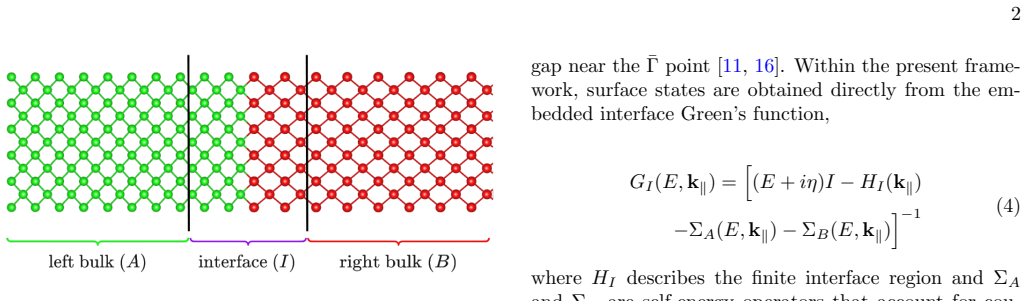
The load-bearing mechanism is the hybrid Wannier representation combined with Green-function embedding. Fourier transforming maximally localized Wannier functions over lattice vectors parallel to the surface gives a short-ranged effective one-dimensional chain along the surface normal for each transverse momentum. The semi-infinite crystal and vacuum half-spaces are integrated out via retarded surface Green's functions, leaving a finite interface problem; solving it with a source term that fixes the incoming Bloch mode yields the complete scattering wave function — the continuum-normalized time-reversed LEED final state. Continuum normalization and microscopic attenuation are built in by the
What would settle it
Repeat the Ag(111) calculation with two, four, and eight additional bulk principal layers in the occupied-state construction and recompute the absolute quantum efficiency and mean transverse energy at a fixed excess photon energy; if the results shift by more than the experimental scatter, the open-boundary final states are not the sole determinant of the reported observables.
Extended reading notes
Core claim
The central claim is that a parameter-free hybrid-Wannier plus Green-function embedding construction yields the full scattering wave function of the semi-infinite crystal-vacuum system, not merely transmission probabilities. The final states are continuum-normalized time-reversed LEED states; adding a first-principles complex self-energy to the Wannier Hamiltonian produces inelastic attenuation inside the crystal while leaving the vacuum channel propagating. Using these states in one-step photoemission matrix elements, with the Fresnel-transmitted optical field and its surface divergence included, the method reproduces the absolute scale of Ag(111) quantum efficiency, the vectorial photoelec
Load-bearing premise
The occupied initial states are obtained by diagonalizing a finite Hamiltonian with an artificial termination, and the paper gives no convergence test against the number of appended bulk layers; if that termination shifts surface-state energies or occupations relative to the Fermi level, the absolute emission yield and the surface/bulk balance would change.
Editorial extensions
If this is right
- One-step photoemission calculations can proceed without a periodic supercell, an empirical optical potential, or a fitted inelastic mean free path.
- Momentum-resolved observables and matrix elements that depend on the full quantum state become directly accessible, not just total transmission probabilities.
- The same scattering-state construction applies to any lattice-matched or commensurate interface for which a localized Wannier representation exists, covering transport and interface spectroscopy.
- The inelastic mean free path emerges from the first-principles self-energy, so it can be extracted as a function of energy, momentum, and temperature rather than supplied as an input.
- The symmetrized optical perturbation, including the surface divergence term, gives a first-principles account of polarization-dependent emission such as the vectorial photoelectric effect.
Reading between the lines
- A natural test is to compare the energy-dependent inelastic mean free path extracted from these scattering states against independent attenuation-length measurements; the paper treats it as an output rather than an input.
- The finite-slab treatment of occupied states is the least protected part of the calculation; systematic convergence checks against the number of appended bulk layers would sharpen every absolute number reported.
- The interface optical field is modeled with a delta-function sheet charge; probing s- versus p-polarized emission over a broader frequency range would test that approximation independently of the electronic-structure machinery.
- Because explicit wave functions are produced, the same embedding could be used for higher-order processes (for example, phonon-assisted or two-step emission) without changing the boundary-condition construction.
Signed reviews
Editorial analysis
A structured set of objections, weighed in public.
Referee Report
Summary. The paper presents an ab initio one-step photoemission formalism for semi-infinite crystal–vacuum interfaces. It combines hybrid Wannier functions, Green-function embedding of semi-infinite leads, and first-principles G0W0/Fan–Migdal self-energies to construct time-reversed LEED final states with microscopically computed attenuation. For Ag(111), the method is used to predict absolute quantum efficiency, the vectorial photoelectric effect, and mean transverse energy; the results are compared directly with experiment on an absolute scale without rescaling. The central claim is that this procedure is parameter-free and removes the need for a periodic box, an empirical optical potential, or an externally imposed inelastic mean free path.
Significance. If the construction is sound, this is a significant advance for first-principles photoemission: it supplies explicit open-boundary scattering wave functions rather than transmission probabilities, and it replaces phenomenological damping with computed self-energies. The absolute-scale agreement for Ag(111) QE and MTE is a nontrivial, falsifiable test that goes beyond the usual band-structure comparisons. The method's applicability to other interfaces is also plausible. However, the validation depends on two under-documented elements — the finite-slab construction of the occupied initial states and the inputs entering the Fresnel optical field — so the significance is currently conditional.
major comments (3)
- [End Matter, Occupied-state construction] The occupied initial states, which dominate the near-threshold emission and the surface/bulk balance, are obtained by diagonalizing a finite Hamiltonian with 'many bulk principal layers appended,' but no layer count, no energy-shift data, and no observable convergence tests are reported. The claim that the states 'were converged with respect to the artificial termination' is therefore unsupported. This is load-bearing: the paper itself attributes the remaining QE shape discrepancies to 'the relative weight of surface-state and bulk-state emission' (Results, QE paragraph). Please provide convergence of the Shockley surface-state energy and occupation, and of the computed QE and MTE, as a function of the number of appended bulk layers. Also specify how the finite set of occupied bulk states samples the near-surface continuum and whether the thresholds in Fig. 3 shift with termination.
- [Methods, Optical Transition Matrix Elements and Eq. (19)] The abstract and conclusion call the approach 'parameter-free,' but the optical field entering Eq. (19) is determined by the complex dielectric function of Ag, described as the sum of an independent-particle interband response and a metallic intraband Drude response 'following Ref. [19].' It is not stated whether the Drude plasma frequency, damping rate, or any other dielectric input is computed from first principles or taken from experiment/fitted. Since the absolute QE and the vectorial effect depend sensitively on the Fresnel-transmitted field and on the delta-function surface term, any empirical or fitted dielectric parameter would directly affect the headline claim. Please list all parameters entering ε and state explicitly whether any is adjusted to improve agreement with the photoemission data.
- [End Matter, Hybrid Wannier construction] The vacuum sector is an essential part of the open-boundary construction, but the regular close-packed vacuum Wannier lattice is said to be 'developed in Ref. [14],' which appears to be an unpublished companion paper. The brief description in the End Matter (Gaussian trial orbitals projected onto the empty-state manifold) is not sufficient for a reader to reproduce or independently assess the method. Please either expand the description so that the vacuum Wannier construction is self-contained, or provide a published or otherwise available reference with full computational details.
minor comments (5)
- [Title] The title contains a typo: 'AnAb Initio' should be 'An Ab Initio.'
- [Fig. 4] The y-axis label 'Absolute QE 1e 5' is ambiguous; it appears to indicate a multiplicative factor of 10^5, but the figure would be clearer with explicit units (e.g., 'QE (×10^−5)').
- [Abstract/Conclusion] The word 'parameter-free' is used prominently, but the manuscript does not provide a complete list of numerical inputs (plane-wave cutoff, k-mesh densities, number of principal layers, Gaussian trial orbital widths, etc.). A concise input table or statement of defaults would make the claim verifiable.
- [Results, QE paragraph] The text lists several sources of remaining discrepancy but does not quantify them (e.g., how much the calculated QE rises earlier at low excess energy, or the magnitude of the underestimate at higher excess energy). Quantitative error measures would strengthen the comparison and make future improvements trackable.
- [End Matter, Optical matrix elements, Eq. (19)] The surface delta-function term assumes a sharp interface at z=0 with a discontinuous dielectric function. For a real Ag(111) surface the profile has finite width; please comment on the sensitivity of the vectorial effect to this idealization and, if possible, test a broadened profile.
Circularity Check
No significant circularity: the scattering-state construction and observables are computed from first-principles inputs, not from the target data.
full rationale
I walked the derivation chain from the Wannier Hamiltonian and Green-function embedding through the scattering states, quasiparticle self-energy, optical matrix elements, and final QE/MTE observables. The final states are obtained by solving the embedded interface problem (Eq. 6) with lead self-energies from iterative Green functions and quasiparticle self-energies from G0W0/Fan-Migdal (End Matter). The occupied initial states are obtained by diagonalizing a finite Hamiltonian in the same Wannier representation, which is an approximation with convergence asserted but not quantified, but it is not a circular step: it does not use the experimental QE/MTE or the paper's conclusions as inputs. The optical response uses a dielectric function from Ref. [19] and Fresnel equations, with no parameter fitted to the photoemission observables. Self-citations to Refs. [14] and [21] supply vacuum Wannier functions and DFT machinery as building blocks, while Refs. [11] and [20] provide experimental comparisons; none is an unverified premise that contains the paper's conclusion. The finite-slab termination concern is a correctness/missing-support risk, not an equation-level reduction to inputs, so it does not raise the circularity score.
Assumptions & free parameters
free parameters (1)
- none identified
assumptions (5)
- domain assumption The hybrid Wannier representation remains short-ranged and converged with a tractable number of layers, including vacuum Wannier functions placed on a close-packed grid (Eqs. 1-3).
- domain assumption The G0W0 and Fan-Migdal self-energies, computed in bulk or slab, remain valid as local-in-energy and momentum-dependent attenuation when inserted into the Wannier Hamiltonian of the interface (Eqs. 8, 14-17).
- domain assumption The classical Fresnel field profile with a sharp interface, including the delta-function surface term (Eqs. 18-20), adequately represents the microscopic optical field at a metal-vacuum surface.
- ad hoc to paper Direct diagonalization of a large finite extended Hamiltonian yields converged occupied initial states, including surface states, for the purpose of absolute photoemission amplitudes.
- domain assumption The plane-wave DFT/GGA electronic structure plus Wannier interpolation is an adequate starting point for the near-threshold photoemission matrix elements.
invented entities (1)
-
hybrid vacuum Wannier functions on a regular close-packed lattice
Cite this review
Pith. "Pith review of Photoemission from Semi-Infinite Crystals: An \emph{Ab Initio} Scattering-State Approach." pith.science (2026). https://pith.science/paper/EUIE6JC7
@misc{pith2026260719551,
  author       = {Pith},
  title        = {Pith review of: Photoemission from Semi-Infinite Crystals: An \emphAb Initio Scattering-State Approach},
  year         = {2026},
  howpublished = {\url{https://pith.science/paper/EUIE6JC7}},
  note         = {Machine review of arXiv:2607.19551}
}
read the original abstract
Photoemission is an escape problem, yet first-principles calculations usually trap the electron in a periodic box. We present a parameter-free \emph{ab initio} framework that removes this artificial boundary by constructing open scattering states for semi-infinite crystal-vacuum interfaces from Wannier Hamiltonians and Green-function embedding. The method gives continuum-normalized time-reversed LEED final states with microscopic quasiparticle attenuation. For Ag(111), it predicts absolute quantum efficiency, vectorial photoemission, and mean transverse energy on the experimental scale.
Figures


Figures from the paper (1 more)

Reference graph
Works this paper leans on
-
[19]
Claudia Ambrosch-Draxl and Jorge O. Sofo. Linear opti- cal properties of solids within the full-potential linearized augmented planewave method.Computer Physics Com- munications, 175(1):1–14, 2006
2006
-
[14]
Vacuum wannier functions for first-principles scattering and photoemission
Tyler Wu and Tom´ as Arias. Vacuum wannier functions for first-principles scattering and photoemission. 2026
2026
-
[1]
Sobota, Yu He, and Zhi-Xun Shen
Jonathan A. Sobota, Yu He, and Zhi-Xun Shen. Angle- resolved photoemission studies of quantum materials. Rev. Mod. Phys., 93:025006, May 2021
2021
-
[2]
C. T. Parzyck, A. Galdi, J. K. Nangoi, W. J. I. DeBenedetti, J. Balajka, B. D. Faeth, H. Paik, C. Hu, T. A. Arias, M. A. Hines, D. G. Schlom, K. M. Shen, and J. M. Maxson. Single-crystal alkali antimonide pho- tocathodes: High efficiency in the ultrathin limit.Phys. Rev. Lett., 128:114801, Mar 2022
2022
-
[3]
W. E. Spicer. Photoemissive, photoconductive, and op- tical absorption studies of alkali-antimony compounds. Phys. Rev., 112:114–122, Oct 1958
1958
-
[4]
Kevin Nangoi, Siddharth Karkare, Ravishankar Sundararaman, Howard A
J. Kevin Nangoi, Siddharth Karkare, Ravishankar Sundararaman, Howard A. Padmore, and Tom´ as A. Arias. Importance of bulk excitations and coher- ent electron-photon-phonon scattering in photoemission from pbte(111): Ab initio theory with experimental com- parisons.Phys. Rev. B, 104:115132, Sep 2021
2021
-
[5]
Dim- itrov, Jai Kwan Bae, Luca Cultrera, Ivan Bazarov, and Andrei Afanasev
Oksana Chubenko, Siddharth Karkare, Dimitre A. Dim- itrov, Jai Kwan Bae, Luca Cultrera, Ivan Bazarov, and Andrei Afanasev. Monte carlo modeling of spin-polarized photoemission from p-doped bulk gaas.Journal of Ap- plied Physics, 130(6):063101, 08 2021
2021
-
[6]
Ultrabright and ultrafast iii–v semiconductor photocathodes.Phys
Siddharth Karkare, Laurent Boulet, Luca Cultrera, Bruce Dunham, Xianghong Liu, William Schaff, and Ivan Bazarov. Ultrabright and ultrafast iii–v semiconductor photocathodes.Phys. Rev. Lett., 112:097601, Mar 2014
2014
Show all 29 references
-
[7]
J.B. Pendry. Theory of photoemission.Surface Science, 57(2):679–705, 1976
1976
-
[8]
J. Braun. The theory of angle-resolved ultraviolet pho- toemission and its applications to ordered materials.Re- ports on Progress in Physics, 59(10):1267–1338, 1996
1996
-
[9]
E. E. Krasovskii and W. Schattke. Angle-resolved photoemission from surface states.Phys. Rev. Lett., 93:027601, Jul 2004
2004
-
[10]
E. E. Krasovskii. Augmented-plane-wave approach to scattering of bloch electrons by an interface.Phys. Rev. B, 70:245322, Dec 2004
2004
-
[11]
Chi- ang, and Howard A
Siddharth Karkare, Weishi Wan, Jun Feng, Tai C. Chi- ang, and Howard A. Padmore. One-step model of pho- toemission from single-crystal surfaces.Phys. Rev. B, 95:075439, Feb 2017
2017
-
[12]
Lippmann- schwinger approach for accurate photoelectron wave 6 functions and angle-resolved photoemission spectra from first principles.Physical Review Letters, 135:056403, 2025
Ji Hoon Ryoo and Cheol-Hwan Park. Lippmann- schwinger approach for accurate photoelectron wave 6 functions and angle-resolved photoemission spectra from first principles.Physical Review Letters, 135:056403, 2025
2025
-
[13]
S. A. Rozhkov, V. V. Bakin, H. E. Scheibler, V. S. Ruset- sky, D. V. Gorshkov, D. A. Kustov, V. A. Golyashov, V. L. Alperovich, and O. E. Tereshchenko. Subthermal mean transverse energies induced by electron refraction on the jump in mass at the surface of multialkali photo- c...
2026
-
[15]
Mostofi, Jonathan R
Nicola Marzari, Arash A. Mostofi, Jonathan R. Yates, Ivo Souza, and David Vanderbilt. Maximally localized wannier functions: Theory and applications.Rev. Mod. Phys., 84:1419–1475, Oct 2012
2012
-
[16]
On the surface states associated with a periodic potential.Phys
William Shockley. On the surface states associated with a periodic potential.Phys. Rev., 56:317–323, Aug 1939
1939
-
[17]
M. P. Lopez Sancho, J. M. Lopez Sancho, and J. Ru- bio. Highly convergent schemes for the calculation of bulk and surface green functions.Journal of Physics F: Metal Physics, 15(4):851–858, 1985
1985
-
[18]
Chico and L
L. Chico and L. M. Falicov. Electron scattering at inter- faces: A tight-binding approach.Phys. Rev. B, 52:6640– 6646, Sep 1995
1995
-
[20]
Karkare, H
S. Karkare, H. A. Padmore, G. Adhikari, and W. A. Schroeder. Intrinsic emittance of single crystal cathodes. InProceedings of the 9th International Particle Acceler- ator Conference (IPAC2018), pages 4263–4266, Vancou- ver, BC, Canada, 2018. JACoW Publishing
2018
-
[21]
Schwarz, Deniz Gunceler, Yalcin Ozhabes, and T.A
Ravishankar Sundararaman, Kendra Letchworth- Weaver, Kathleen A. Schwarz, Deniz Gunceler, Yalcin Ozhabes, and T.A. Arias. Jdftx: Software for joint density-functional theory.SoftwareX, 6:278–284, 2017
2017
-
[22]
Advanced capabilities for materials modelling with quantum espresso.Journal of Physics: Condensed Mat- ter, 29(46):465901, oct 2017
P Giannozzi, O Andreussi, T Brumme, O Bunau, M Buongiorno Nardelli, M Calandra, R Car, C Cavaz- zoni, D Ceresoli, M Cococcioni, N Colonna, I Carnimeo, A Dal Corso, S de Gironcoli, P Delugas, R A DiStasio, A Ferretti, A Floris, G Fratesi, G Fugallo, R Gebauer, U Gerstmann, F Gi...
2017
-
[23]
Quantum espresso: a modular and open-source software project for quantum simulations of materials.Journal of Physics: Condensed Matter, 21(39):395502, sep 2009
Paolo Giannozzi, Stefano Baroni, Nicola Bonini, Mat- teo Calandra, Roberto Car, Carlo Cavazzoni, Davide Ceresoli, Guido L Chiarotti, Matteo Cococcioni, Ismaila Dabo, Andrea Dal Corso, Stefano de Gironcoli, Ste- fano Fabris, Guido Fratesi, Ralph Gebauer, Uwe Ger- stmann, Christ...
2009
-
[24]
Optimization algo- rithm for the generation of oncv pseudopotentials.Com- puter Physics Communications, 196:36–44, 2015
Martin Schlipf and Fran¸ cois Gygi. Optimization algo- rithm for the generation of oncv pseudopotentials.Com- puter Physics Communications, 196:36–44, 2015
2015
-
[25]
Strubbe, Manish Jain, Marvin L
Jack Deslippe, Georg Samsonidze, David A. Strubbe, Manish Jain, Marvin L. Cohen, and Steven G. Louie. Berkeleygw: A massively parallel computer package for the calculation of the quasiparticle and optical proper- ties of materials and nanostructures.Computer Physics Communicat...
2012
-
[26]
M. S. Hybertsen and S. G. Louie. Electron correlation in semiconductors and insulators: Band gaps and quasi- particle energies.Physical Review B, 34(8):5390–5413, 1986
1986
-
[27]
da Jornada, Gabriel Antonius, Tonatiuh Rangel, Steven G
Mauro Del Ben, Felipe H. da Jornada, Gabriel Antonius, Tonatiuh Rangel, Steven G. Louie, Jack Deslippe, and Andrew Canning. Static subspace approximation for the evaluation ofg 0w0 quasiparticle energies within a sum- over-bands approach.Physical Review B, 99(12):125128, 2019
2019
-
[28]
da Jornada, Andrew Canning, Nicole Wichmann, Koushik Raman, R
Mauro Del Ben, Felipe H. da Jornada, Andrew Canning, Nicole Wichmann, Koushik Raman, R. Sasanka, Chao Yang, Steven G. Louie, and Jack Deslippe. Large-scale gw calculations on pre-exascale hpc systems.Computer Physics Communications, 235:187–195, 2019
2019
-
[29]
Electron-phonon interactions from first principles.Rev
Feliciano Giustino. Electron-phonon interactions from first principles.Rev. Mod. Phys., 89:015003, Feb 2017. 7 End Matter Hybrid Wannier construction.—All density- functional-theory calculations were performed using JDFTx [21] and Quantum ESPRESSO [22, 23], with SG15 optimized...
2017
Reviewed August 1, 2026 · model on record in the stance chip above.
Discussion (0). Continue with ORCID to comment.