REVIEW 3 major objections 5 minor 42 references
Cavitation Acoustic Perturbation Equations: A Computational Framework for Source-Resolved Multiphase Hydroacoustics
T0 review · 3 major / 5 minor · reviewed 2026-08-01 · deepseek-v4-flash
Pith's one-line read Cavitation ‘singing’ is traced to near-wall, phase-locked cavity collapse by a new acoustic perturbation formulation whose phase-change and pressure-rate terms carry the sources inside the domain.
desk verdict A genuine extension of APE to cavitating multiphase flows with a clean derivation and plausible numerics; peer-review it, but treat the singing-mechanism claims as conditional on the URANS base flow. read the letter →
The pith
A machine-rendered reading of the paper's core claim, the machinery that carries it, and where it could break.
The reading
What carries the argument
The central object is the CAPE system, Eqs. (26)-(29), a set of perturbation equations for ρ′, f = ρ0u′ + ρ′U + ρ′u′, and p′. The load-bearing pieces are the phase-change source h, which injects mass-transfer-driven volume change as a monopole-like term; the mixture compressibility 1/(ρ0c²) built from Wood's relation, which makes the local sound speed collapse where vapor appears; and the base-state terms c²∂ρ0/∂t − ∂P/∂t, which turn unsteady pressure and density changes of the incompressible base flow into acoustic driving. A finite-volume predictor-corrector solver with m = 1000 acoustic substeps per flow step and a perfectly matched layer carries the waves outward and absorbs them at the
What would settle it
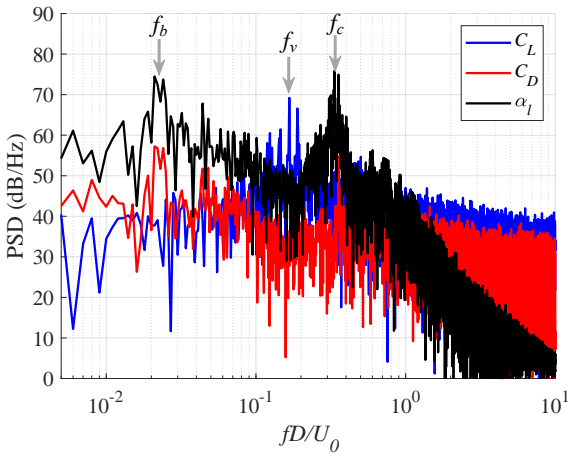
Measure or directly simulate the far-field acoustic spectrum of the same cavitating cylinder (Re ≈ 1.1×10^5, σcav = 0.8) and hydrofoil, and check whether the tonal peak sits at the cavity-shedding frequency fc ≈ 0.335 U0/D with a nearly axisymmetric directivity; a tonal line at the vortex-shedding frequency instead, or a dipole-shaped directivity, would falsify the CAPE source attribution.
Extended reading notes
Core claim
The central claim is the CAPE system, Eqs. (26)-(29): a closed acoustic perturbation system for a liquid-vapor mixture in which the source h carries phase-change mass transfer, the mixture compressibility is set by the Wood-type relation 1/(ρ0c²) = αl/(ρ0,l c_l²) + (1-αl)/(ρ0,v c_v²), and the pressure-rate term c²∂ρ0/∂t − ∂P/∂t enters through the closure ∂p/∂ρ = c². Together these allow cavitation-induced noise to be generated and propagated within the domain, with the energy balance of Eq. (43) showing the phase-change term p′h/ρ0 as a monopole-like volumetric acoustic source. Applied to a Re = 1.11×10^5 cavitating cylinder and a NACA 6412 hydrofoil, the framework finds that the far-field t
Load-bearing premise
The entire prediction rests on the incompressible URANS solution (with the Schnerr-Sauer cavitation model) faithfully supplying the impulse of cavity growth, shedding, and collapse; if the base flow blurs those events, the computed singing follows the model rather than the physics.
Editorial extensions
If this is right
- If CAPE is right, cavitation-induced ‘singing’ is a near-wall collapse phenomenon phase-locked to the cavity-shedding frequency fc, so tonal underwater noise can be attributed to specific collapse events rather than to the wake's vortex shedding.
- The same validated solver reproduces dipole radiation in the non-cavitating cylinder benchmark and monopole-like radiation in the cavitating cases, establishing a clean acoustic signature for detecting cavitation noise by directivity.
- The acoustic energy balance identifies phase-change mass transfer as a volumetric monopole source, giving a quantitative source map for the sound field, not just far-field levels.
- Because the formulation preserves the structure of conventional APE solvers, it can be dropped into existing incompressible cavitation-flow solvers with one-way coupling, making hydroacoustic prediction far cheaper than direct compressible simulation.
- The verified Stokes-law attenuation and PML behavior give confidence that the propagation part is physically consistent over a range of frequencies.
Reading between the lines
- The paper's energy balance is derived with ρ0 and c locally frozen; treating CAPE source strengths as a rigorous far-field budget would need the full variable-coefficient energy identity, which the paper does not provide.
- If collapse is truly the tonal driver, then controlling near-wall inception through surface texturing or micro-ventilation should suppress the singing peak without moving the vortex-shedding frequency—a testable design consequence the paper leaves implicit.
- Because the source chain depends on the URANS base flow, repeating the analysis with a scale-resolving base flow (LES or compressible two-phase) would show how much of the intermittent collapse structure—and therefore the predicted singing—is turbulence-model dependent.
- The linear interpolation of source terms across each flow step (Eq. 54) may smear the sharpest collapse impulses; checking spectral convergence with larger subcycling ratios would test whether the peak at fc is robust.
Editorial analysis
A structured set of objections, weighed in public.
Referee Report
Summary. The paper derives and implements the Cavitation Acoustic Perturbation Equations (CAPE) for a homogeneous liquid-vapor mixture. The formulation decomposes the flow into an incompressible URANS base state and small acoustic perturbations, and introduces three cavitation-related source contributions: phase-change mass transfer, mixture-compressibility variation, and the base-pressure time derivative. A segregated finite-volume predictor-corrector scheme with acoustic subcycling and an absorbing PML-type region is presented. Verification is performed on 1D wave propagation (mesh/time-step convergence, PML, frequency preservation, Stokes attenuation), followed by application to non-cavitating and cavitating flow past a cylinder and a cavitating hydrofoil. The non-cavitating case reproduces the dipole directivity of Shen et al.; the cavitating cases show near-axisymmetric/monopole-like radiation and tonal peaks aligned with the cavity-shedding frequency, which the authors interpret as collapse-driven singing.
Significance. The CAPE derivation appears algebraically consistent, and the energy balance in Eq. (43) is a useful device for interpreting the volumetric source. A notable strength is that the acoustic system contains no fitted constants: all parameters (C_c, C_v, n0, d_Nuc, sigma_max, m) belong to the base-flow or numerical setup, not to the acoustic model. The 1D verification is systematic, and the non-cavitating benchmark against Shen et al. provides a credible check of the numerical implementation. If the physical application claims can be secured, the framework would be a valuable, efficient tool for hydroacoustic source analysis in cavitating flows. However, the application-level claims currently rest on unvalidated URANS collapse dynamics, and the Stokes-law verification is incomplete; these are the main barriers to accepting the physical conclusions.
major comments (3)
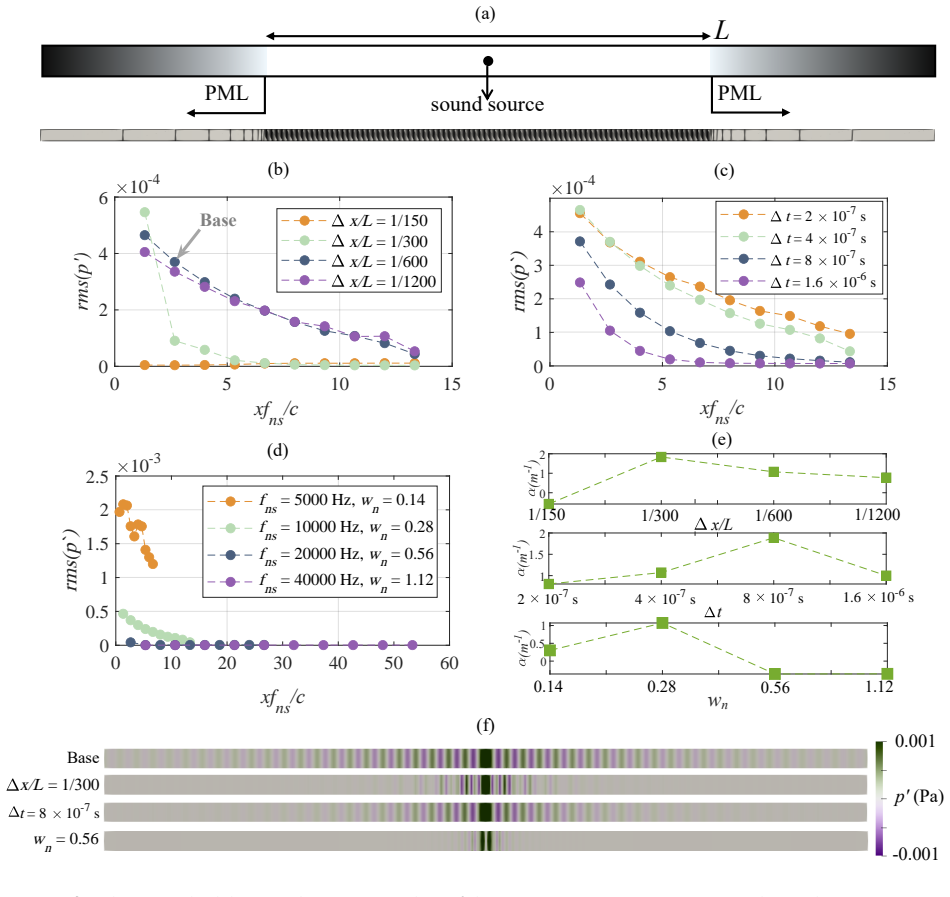
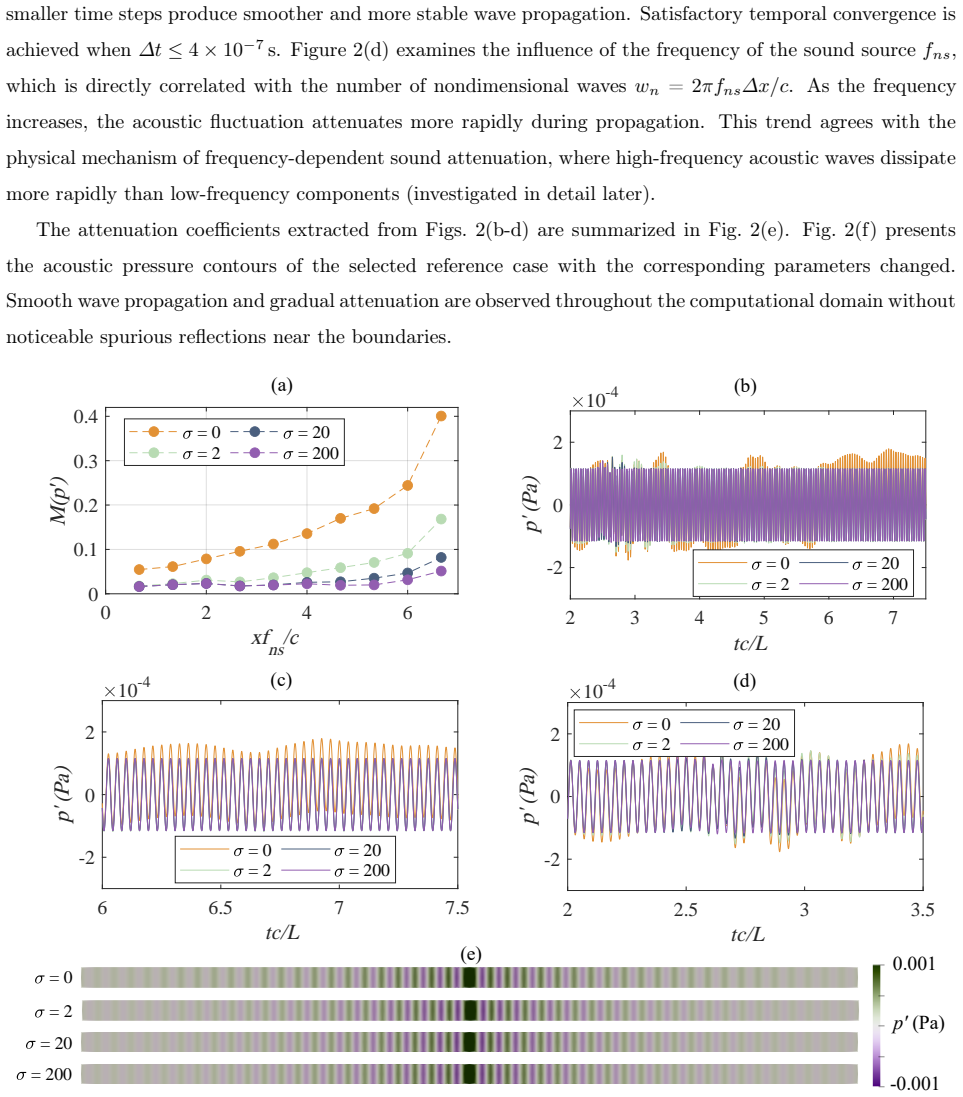
- [§4.2 (Fig. 6b)] The Stokes-law verification only checks the f² scaling, not the absolute attenuation coefficient. The reported values α ≈ 0.01–0.07 m⁻¹ at 100–200 Hz are orders of magnitude larger than the physical Stokes coefficient for water: α = 2μω²/(3ρc³) ≈ 8×10⁻¹¹ m⁻¹ at 100 Hz for μ ≈ 10⁻³ Pa·s, c ≈ 1500 m/s. Agreement with Eq. (55) therefore reflects numerical/PML dissipation rather than physical viscous attenuation. To support the claim that the solver 'follows Stokes’ law' (abstract and §5), the authors should compare the extracted coefficient with the analytic value, or use a setup in which numerical dissipation is demonstrably subdominant.
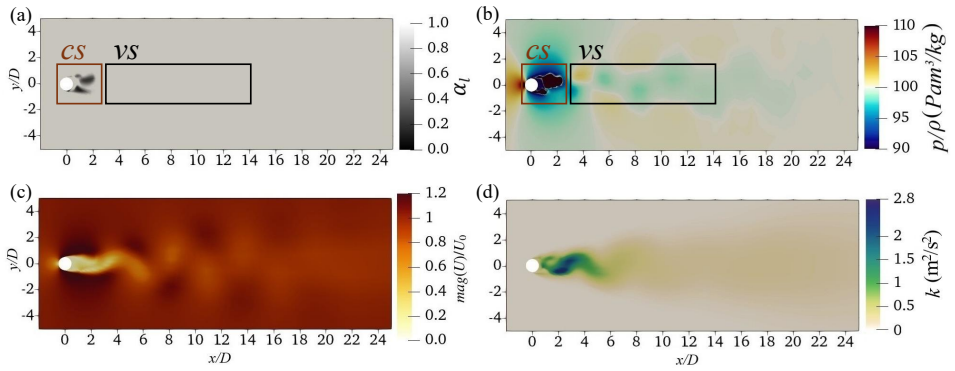
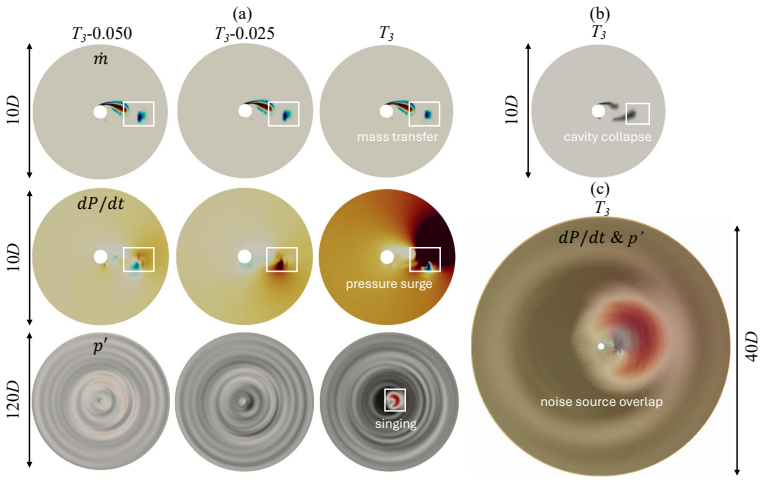
- [§4.4–§4.5, Eqs. (26)–(39), Figs. 15, 17, 18] The central claim—that collapse-induced pressure-rate amplification generates tonal singing—is not independently established. All acoustic sources are evaluated one-way from the URANS/Schnerr–Sauer base flow (§2.3–2.4), and Fig. 15(c) shows the acoustic spectrum peaking at exactly the URANS cavity-shedding frequency f_c identified in Fig. 12. This is a necessary self-consistency of the one-way coupling, not a physical prediction. URANS with k-ω SST cannot resolve the impulsive, small-scale collapse transients that Figs. 17–18 identify as the singing trigger; the dP/dt surge is a RANS-filtered, grid-dependent surrogate. Without an experimental singing-frequency baseline, a scale-resolving base flow, or at least a grid/closure sensitivity study of the source statistics, the mechanism claim remains conditional on the base-flow model.
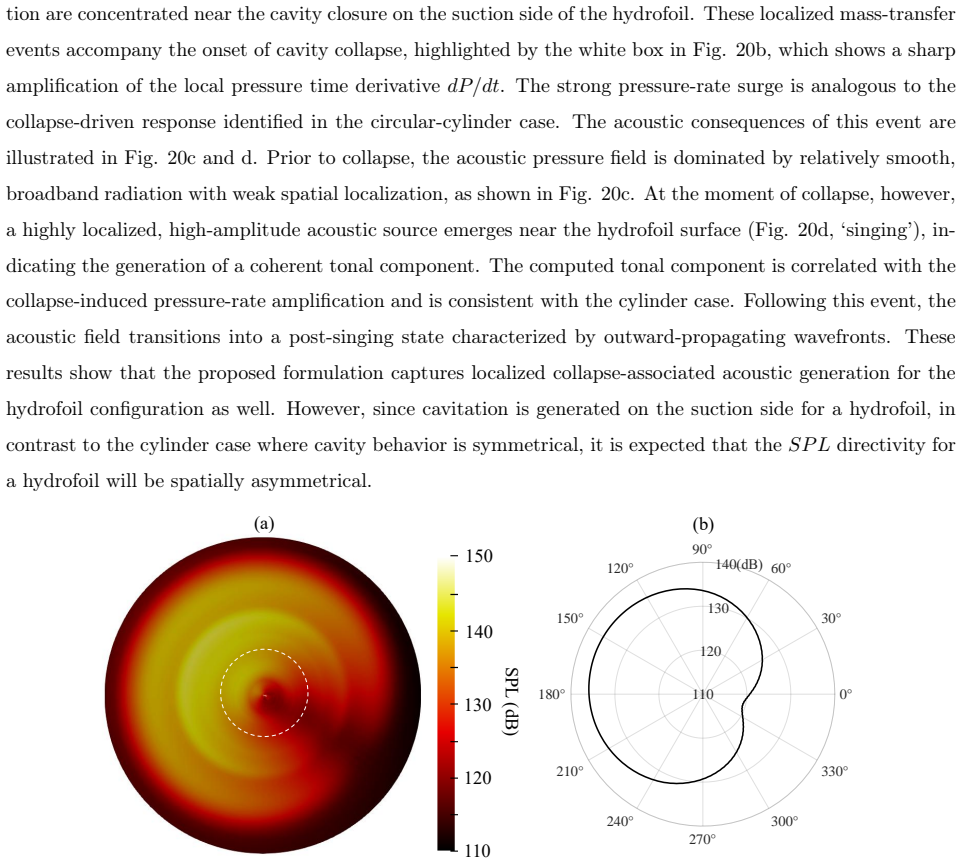
- [§4.4–§4.5 (Figs. 16, 21)] No quantitative validation is provided for the cavitating cases. The only external benchmark is the non-cavitating Re=200 directivity (§4.3, Fig. 9), which is a low-Reynolds, single-phase check. The cavitating SPL levels (e.g., ~126 dB re 1 μPa at 20D in Fig. 16) depend on the prescribed nuclei parameters n0, d_Nuc and mass-transfer coefficients C_c, C_v, none of which are varied or tied to experimental data. The absolute levels and the claimed monopole/singing signatures should be tested against measurements or against parameter sensitivity before being presented as physical predictions.
minor comments (5)
- [§4.2 / Fig. 6] The text says 'attenuation exponents (referred to the general attenuation from 5000 to 12,500)', but the axis is labeled α (m⁻¹). Clarify the normalization and the extraction procedure.
- [§4.3] Placeholder '(author?)' appears before Ref. [22] in the text and in the Fig. 9 caption; this should be replaced with the actual citation.
- [§2.1, Eqs. (13) and (26)] The notation ρ_l/ρ_v versus ρ_{0,l}/ρ_{0,v} appears to denote the same quantities; use one set of symbols consistently.
- [§2.2, Eqs. (32)–(35)] The added damping terms form an absorbing layer, but the term 'perfectly matched' is not demonstrated analytically (no complex-coordinate stretching or auxiliary variables). If a simple sponge layer is intended, the terminology should be adjusted; the numerical reflection tests are nevertheless useful.
- [Eq. (51)] The density update uses coefficients 1.5 and 0.5 without derivation. Please provide the implicit time-integration formula from which these coefficients arise.
Circularity Check
No load-bearing circularity; the CAPE derivation is self-contained and acoustic parameters are not fitted.
full rationale
The derivation chain from the compressible mixture equations to CAPE (Eqs. 26-29) is algebraic and self-contained: pressure, velocity, and density are decomposed into base and perturbed parts, and the perturbation system is obtained by subtraction, with h, c^2 ∂ρ0/∂t, and −∂P/∂t appearing as explicit source terms rather than as fitted data. No acoustic output is used to determine the model constants (C_c, C_v, n0, d_Nuc, σ_max, m are all prescribed before the acoustic solve), so there is no fitted-input-called-prediction pattern. The numerical verification (mesh/time-step convergence, PML performance, frequency preservation, Stokes-law attenuation) is external to the acoustic physics being tested, and the non-cavitating cylinder directivity is compared with an independent published result. The main concern raised by a circularity reviewer—that the acoustic pressure spectrum inherits the base-flow cavity-shedding frequency f_c because the acoustic equation is driven one-way by ∂P/∂t, h, and ∂ρ0/∂t—is a linear-response property of any one-way hybrid method, not a definitional or statistical circularity. The paper does not use that alignment to fit a parameter; it interprets it as source-term consistency. Whether the URANS base flow faithfully captures physical collapse transients is a modeling/validation risk, not a circularity. The only self-citation, [42], supports the peripheral 'global cavity breathing mode' interpretation and is not load-bearing for the central CAPE derivation, so the score remains at the minor/non-significant end of the scale.
Assumptions & free parameters
free parameters (5)
- n0 (Schnerr-Sauer nuclei number density) =
1.6e13 m^-3
- d_Nuc (Schnerr-Sauer nuclei diameter) =
6e-5 m
- C_c, C_v (condensation/vaporization coefficients) =
1.0, 1.0
- PML damping σ_max =
2
- Subcycling ratio m =
1000
assumptions (5)
- domain assumption Homogeneous two-phase mixture with no slip between phases and mechanical equilibrium (Wood's formula, Eq. 19)
- domain assumption One-way flow-acoustic coupling: acoustic perturbations do not feed back into the cavitating base flow (Eq. 39)
- domain assumption The incompressible URANS base state (Eqs. 36-37) faithfully captures the cavitating hydrodynamics that drive the acoustic sources
- domain assumption Local acoustic closure p' = c²ρ' with c from Eq. 19 applied to the perturbation field
- domain assumption Linearity of acoustic perturbations in cavitating regions (small p', ρ', u' relative to local scales)
Cite this review
Pith. "Pith review of Cavitation Acoustic Perturbation Equations: A Computational Framework for Source-Resolved Multiphase Hydroacoustics." pith.science (2026). https://pith.science/paper/CCBEAVHD
@misc{pith2026260719567,
  author       = {Pith},
  title        = {Pith review of: Cavitation Acoustic Perturbation Equations: A Computational Framework for Source-Resolved Multiphase Hydroacoustics},
  year         = {2026},
  howpublished = {\url{https://pith.science/paper/CCBEAVHD}},
  note         = {Machine review of arXiv:2607.19567}
}
read the original abstract
This work develops a cavitation-consistent acoustic perturbation framework for predicting sound generation and propagation in cavitating flows. Unlike conventional acoustic perturbation equations for single-phase or weakly compressible flows, the proposed formulation embeds cavitation physics directly into the acoustic equations. The cavitation acoustic perturbation equations (CAPE) incorporate vapor mass transfer, mixture compressibility, and pressure-rate effects within a unified formulation, allowing cavitation-induced noise sources to be resolved in the computational domain. The numerical framework is verified using one-dimensional wave-propagation problems. The solutions become insensitive to further mesh and time-step refinement, the perfectly matched layer suppresses boundary reflections, and the predicted attenuation over a range of source frequencies follows Stokes' sound attenuation law. The framework is then applied to cavitating flow past a circular cylinder and a NACA hydrofoil. The non-cavitating benchmark shows dipole-like radiation associated with unsteady loading, whereas cavitating cases exhibit monopole-like or geometry-modulated radiation caused by volumetric phase change. Source-term analyses identify tonal frequencies associated with vortex shedding, cavity shedding, and collapse-induced excitation. The phase-change terms provide a direct volumetric contribution to the monopole-like source, while localized collapse events appear through amplification of the pressure-rate source. The proposed framework extends acoustic perturbation methods to cavitating multiphase flows and provides an efficient tool for hydroacoustic prediction, source localization, and mechanism analysis in marine and hydraulic applications.
Figures

Figures from the paper (19 more)







Reference graph
Works this paper leans on
-
[1]
W. K. Blake, Mechanics of flow-induced sound and vibration, Academic Press, 2017
2017
-
[2]
C. E. Brennen, Cavitation and bubble dynamics, Cambridge University Press, 2014
2014
-
[3]
Leighton, The acoustic bubble, Academic Press, 2012
T. Leighton, The acoustic bubble, Academic Press, 2012
2012
-
[4]
R. E. Arndt, Cavitation in fluid machinery and hydraulic structures, Annual Review of Fluid Mechanics 13 (1) (1981) 273–326
1981
-
[5]
X. Wang, X. Bai, H. Cheng, B. Ji, X. Peng, Numerical investigation of cavitating tip vortex dynamics and how they influence the acoustic characteristics, Physics of Fluids 35 (6) (2023) 062119
2023
-
[6]
Arndt, P
R. Arndt, P. Pennings, J. Bosschers, T. van Terwisga, The singing vortex, Interface Focus 5 (5) (2015) 20150025
2015
-
[7]
Maines, R
B. Maines, R. E. A. Arndt, The Case of the Singing Vortex, Journal of Fluids Engineering 119 (2) (1997) 271–276
1997
-
[8]
Higuchi, R
H. Higuchi, R. E. A. Arndt, M. F. Rogers, Characteristics of Tip Vortex Cavitation Noise, Journal of Fluids Engineering 111 (4) (1989) 495–501
1989
Show all 42 references
-
[9]
W. Kerr, J. Shannon, R. Arnold, The problems of the singing propeller, Proceedings of the Institution of Mechanical Engineers 144 (1) (1940) 54–90
1940
-
[10]
C. E. Brennen, Fundamentals of multiphase flow, Cambridge University Press, 2005
2005
-
[11]
Ross, Mechanics of underwater noise, Elsevier, 2013
D. Ross, Mechanics of underwater noise, Elsevier, 2013
2013
-
[12]
Carlton, Marine propellers and propulsion, Butterworth-Heinemann, 2018
J. Carlton, Marine propellers and propulsion, Butterworth-Heinemann, 2018
2018
-
[13]
J. H. Seo, Y. J. Moon, B. R. Shin, Prediction of cavitating flow noise by direct numerical simulation, Journal of Computational Physics 227 (13) (2008) 6511–6531
2008
-
[14]
T.Colonius, S.K.Lele, Computationalaeroacoustics: progressonnonlinearproblemsofsoundgeneration, Progress in Aerospace sciences 40 (6) (2004) 345–416
2004
-
[15]
J. B. Freund, Noise sources in a low-Reynolds-number turbulent jet at Mach 0.9, Journal of Fluid Me- chanics 438 (2001) 277–305
2001
-
[16]
J. E. Ffowcs Williams, D. L. Hawkings, Sound generation by turbulence and surfaces in arbitrary motion, Philosophical Transactions of the Royal Society of London. Series A, Mathematical and Physical Sciences 264 (1151) (1969) 321–342
1969
-
[17]
Farassat, K
F. Farassat, K. S. Brentner, The acoustic analogy and the prediction of the noise of rotating blades, Theoretical and Computational Fluid Dynamics 10 (1-4) (1998) 155–170
1998
-
[18]
Farassat, Theory of Noise Generation From Moving Bodies With an Application to Helicopter Rotors, NASA Langley Technical Report Server, 1975
F. Farassat, Theory of Noise Generation From Moving Bodies With an Application to Helicopter Rotors, NASA Langley Technical Report Server, 1975
1975
-
[19]
Farassat, Linear acoustic formulas for calculation of rotating blade noise, AIAA Journal 19 (9) (1981) 1122–1130
F. Farassat, Linear acoustic formulas for calculation of rotating blade noise, AIAA Journal 19 (9) (1981) 1122–1130. 31
1981
-
[20]
Farassat, K
F. Farassat, K. S. Brentner, The uses and abuses of the acoustic analogy in helicopter rotor noise predic- tion, Journal of the American Helicopter Society 33 (1) (1988) 29–36
1988
-
[21]
S.Sezen, M.Atlar, MarinepropellerunderwaterradiatednoisepredictionwiththeFW-Hacousticanalogy Part 1: Assessment of model scale propeller hydroacoustic performance under uniform and inclined flow conditions, Ocean Engineering 279 (2023) 114552
2023
-
[22]
W. Z. Shen, J. A. Michelsen, J. N. Sørensen, A collocated grid finite volume method for aeroacoustic computations of low-speed flows, Journal of Computational Physics 196 (1) (2004) 348–366
2004
-
[23]
Ewert, W
R. Ewert, W. Schröder, Acoustic perturbation equations based on flow decomposition via source filtering, Journal of Computational Physics 188 (2) (2003) 365–398
2003
-
[24]
J. H. Seo, Y. J. Moon, Linearized perturbed compressible equations for low Mach number aeroacoustics, Journal of Computational Physics 218 (2) (2006) 702–719
2006
-
[25]
J. H. Seo, Y. J. Moon, Aerodynamic noise prediction for long-span bodies, Journal of Sound and Vibration 306 (3-5) (2007) 564–579
2007
-
[26]
Zhang, P
Q. Zhang, P. Bui, W. A. El-Askary, M. Meinke, W. Schröder, A Hybrid LES/CAA Method for Aeroa- coustic Applications, in: High Performance Computing on Vector Systems: Proceedings of the High Performance Computing Center Stuttgart, March 2005, Springer, 2006, pp. 139–153
2005
-
[27]
M. L. Shur, P. R. Spalart, M. K. Strelets, A. K. Travin, A hybrid RANS-LES approach with delayed- DES and wall-modelled LES capabilities, International Journal of Heat and Fluid Flow 29 (6) (2008) 1638–1649
2008
-
[28]
J. H. Seo, R. Mittal, A high-order immersed boundary method for acoustic wave scattering and low-Mach number flow-induced sound in complex geometries, Journal of Computational Physics 230 (4) (2011) 1000–1019
2011
-
[29]
C. K. Tam, Computational aeroacoustics: An overview of computational challenges and applications, International Journal of Computational Fluid Dynamics 18 (6) (2004) 547–567
2004
-
[30]
P. G. Tucker, Unsteady computational fluid dynamics in aeronautics, Springer Science & Business Media, 2013
2013
-
[31]
V. Rosa, C. Deschamps, J. Salazar, C. Ilário, Comparison of RANS-based jet noise models and assessment of a ray tracing method, Journal of the Brazilian Society of Mechanical Sciences and Engineering 39 (6) (2017) 1859–1872
2017
-
[32]
Ewert, J
R. Ewert, J. Dierke, J. Siebert, A. Neifeld, C. Appel, M. Siefert, O. Kornow, CAA broadband noise prediction for aeroacoustic design, Journal of Sound and Vibration 330 (17) (2011) 4139–4160
2011
-
[33]
R. C. Engel, C. R. Silva, C. J. Deschamps, Application of RANS-based method to predict acoustic noise of chevron nozzles, Applied Acoustics 79 (2014) 153–163
2014
-
[34]
Kadar, P
A. Kadar, P. Martinez-Lera, C. F. Schram, W. De Roeck, W. Desmet, M. Tournour, Trailing-edge noise prediction using synthetic turbulence and acoustic perturbation equations in a hybrid methodology, in: 23rd AIAA/CEAS Aeroacoustics Conference, 2017, p. 3846. 32
2017
-
[35]
F. R. Menter, Two-equation eddy-viscosity turbulence models for engineering applications, AIAA Journal 32 (8) (1994) 1598–1605
1994
-
[36]
J. Sauer, Development of a new cavitation model based on bubble dynamics, ZAMM-Journal of Applied Mathematics and Mechanics/Zeitschrift für Angewandte Mathematik und Mechanik 81 (S3) (2001) 561– 562
2001
-
[37]
Asnaghi, A
A. Asnaghi, A. Feymark, R. Bensow, Improvement of cavitation mass transfer modeling based on local flow properties, International Journal of Multiphase Flow 93 (2017) 142–157
2017
-
[38]
S. R. Kashyap, R. K. Jaiman, Unsteady cavitation dynamics and frequency lock-in of a freely vibrating hydrofoil at high Reynolds number, International Journal of Multiphase Flow 158 (2023) 104276
2023
-
[39]
Patankar, D
S. Patankar, D. Spalding, A calculation procedure for heat, mass and momentum transfer in three- dimensional parabolic flows, International Journal of Heat and Mass Transfer 15 (10) (1972) 1787–1806
1972
-
[40]
R. I. Issa, Solution of the implicitly discretised fluid flow equations by operator-splitting, Journal of Computational Physics 62 (1) (1986) 40–65
1986
-
[41]
G. G. Stokes, On the Theories of the Internal Friction of Fluids in Motion, and of the Equilibrium and Motion of Elastic Solids, Vol. 1 of Cambridge Library Collection - Mathematics, Cambridge University Press, 2009, p. 75–129
2009
-
[42]
S. Lak, R. Jaiman, A numerical study on the oscillatory dynamics of tip vortex cavitation, Journal of Fluid Mechanics 998 (2024) A13. 33
2024
Reviewed August 1, 2026 · model on record in the stance chip above.
Discussion (0). Continue with ORCID to comment.