REVIEW 4 major objections 4 minor 44 references
Decoding molecular distributional codes through collective instabilities
T0 review · 4 major / 4 minor · reviewed 2026-08-01 · deepseek-v4-flash
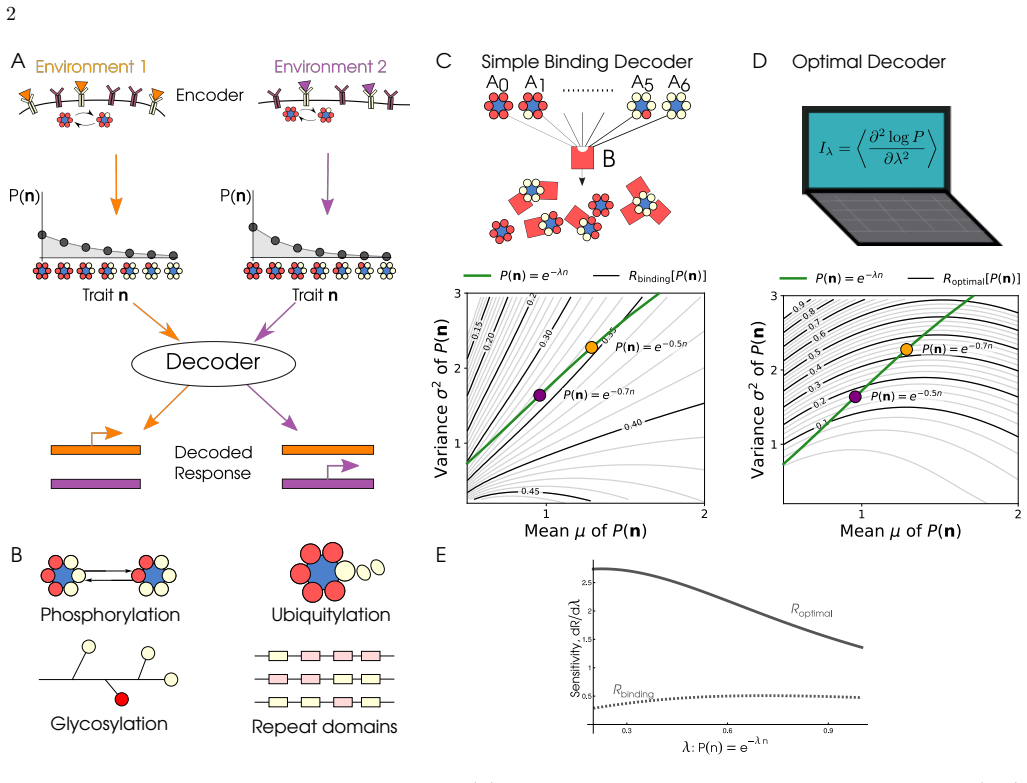
Pith's one-line read This paper claims that collective physical instabilities—phase separation, percolation, and membrane curvature remodeling—can act as near-optimal decoders of molecular distributional codes, while simple one-site mass-action binding cannot.
desk verdict Useful conceptual framing, but the optimality claim needs work: the Fisher-information approximation drops a positive term, and the Monte-Carlo readout is fit to the task. read the letter →
The pith
A machine-rendered reading of the paper's core claim, the machinery that carries it, and where it could break.
The reading
What carries the argument
The central object is the Fisher-information matching condition Iλ = (δ⟨R⟩/δP(n) · ∂P(n)/∂λ)^2 / (σ²_dec + σ²_enc), which factorizes decoder and encoder contributions and yields the geometric criterion that constant-response contours should be orthogonal to the encoder's curve in distribution space. The paper applies this to three collective processes—phase separation, percolation, and membrane curvature—using the exponential family P(n) ∝ e^{-λn} as the reference encoder. The load-bearing identity is that each collective instability has a convex response kernel in the trait n (e.g., the spinodal depends on μ and σ², percolation on ⟨n(n−1)⟩, membrane instability on ⟨n²⟩), whereas the mass-ac
What would settle it
Measure the noise statistics and Fisher information of a phase-separating readout in a reconstituted system as λ is varied. If the response–noise relation near the phase boundary does not follow σ_dec ∝ ⟨R⟩^{1/2}, or if a decoder whose contours are not orthogonal to the exponential encoder curve achieves higher Fisher information than an orthogonal one, the paper's central claim fails.
Extended reading notes
Core claim
The central discovery is a geometric matching principle for decoding molecular distributions. Information theory shows that the Fisher information of a response R about an environmental parameter λ factorizes into a decoder sensitivity and an encoder direction, implying that optimal decoders have response contours orthogonal to the curve traced by P(n;λ) as λ varies. For the exponential encoder family P(n) ∝ e^{-λn}, phase separation, percolation, and membrane curvature remodeling all produce response contours that cut across the encoder trajectory, and their response kernels are convex in the trait n, amplifying high-n tails. Simple mass-action binding, by contrast, is concave and its conto
Load-bearing premise
The derivation assumes the readout noise is Gaussian, independent of λ, and scales as the square root of the mean response; if real cellular readouts are strongly non-Gaussian or if noise near a phase boundary scales differently, the geometric orthogonality criterion and the near-optimality conclusion do not follow.
Editorial extensions
If this is right
- If the claim holds, a single phase-separating system could replace many tailored sensors for reading molecular distributions.
- Near phase boundaries, the Fisher information extracted by phase separation scales superlinearly with system size and approaches the information limit set by counting individual molecules.
- Phase separation can discriminate variance and skewness of input distributions, not just the mean, expanding what a cell can learn from a distribution.
- Finite valency—through the threshold for network formation and monovalent sequestration—creates new discrimination axes that mean-field theory misses.
- The encoder–decoder matching criterion provides a principled way to evaluate other collective readouts, such as cooperative binding, linker flexibility, or multi-component condensates.
Reading between the lines
- Our inference: the geometric orthogonality criterion could be used experimentally as a diagnostic—measure a candidate decoder's response contours in the mean-variance plane and check whether they cross the encoder family's curve.
- Our inference: the framework suggests a general evolutionary rationale for why cells often encode information in distributions over related variants rather than distinct species: both encoding and decoding use physically natural, relatively non-specific processes.
- Our inference: because the authors note their models are equilibrium, active or driven versions of these instabilities might show different information scaling or even sharper discrimination, an untested extension.
- Our inference: a synthetic reconstitution experiment with a multivalent binder and controlled substrate valency distribution could directly test the predicted superlinear information gain near the phase boundary.
Signed reviews
Editorial analysis
A structured set of objections, weighed in public.
Referee Report
Summary. The paper argues that collective physical instabilities—phase separation, percolation, and membrane curvature remodeling—can act as "natural decoders" of molecular distributional codes, i.e., of information carried by the full distribution P(n) over a low-dimensional trait n. The core idea is an information-theoretic matching condition: an efficient decoder should have response contours in the (mean, variance) plane orthogonal to the trajectory traced by the encoder family, here taken to be exponential distributions. The authors derive a Gaussian-noise Fisher-information expression, show that simple mass-action binding has contours nearly parallel to the exponential encoder, and that phase separation, percolation, and membrane curvature have nearly orthogonal contours. For phase separation they add mean-field spinodal/critical-point analysis (Eq. 2) and lattice Monte Carlo simulations, claiming robust discrimination of mean and variance, weaker discrimination of skewness, near-total information capture near phase boundaries, and additional discriminatory power from finite valency. The Discussion generalizes these results into a proposed biological design principle.
Significance. If the central claims hold, the paper offers a genuinely new and compact principle for biological sensing: a single collective instability can integrate information from an entire molecular distribution without a large array of tailored sensors. The manuscript contains substantial technical assets: the mean-field spinodal condition (Eq. 2) is derived in closed form, the critical-point conditions are explicit, the binodal construction via exponential tilting is elegant, and the lattice Monte Carlo scheme is described with enough detail to be reproducible. The paper also makes falsifiable predictions, such as the n≥3 bridging threshold creating a discrimination axis absent from mean-field theory. These strengths are real. However, the information-theoretic optimality claims are not yet fully supported: a term is dropped from the Fisher-information expression in precisely the regime where the paper claims saturation, and the Monte Carlo readout is a fitted classifier, so part of the "natural decoding" claim is built in by construction. The manuscript is therefore valuable and promising, but needs substantial revision before the central optimality statements can be accepted.
major comments (4)
- [SI Section I, Eq. (1); main text Fig. 3D] The exact Gaussian Fisher information contains a term (∂λ σ_R²)²/(2 σ_R⁴). The paper neglects it on the stated assumption that "encoder and decoder noise vary slowly with the environment". But in the regime advertised as the main result—near the phase boundary—the paper's own fluctuation calculations (SI Section III) give σ_R² ~ ξ^{2d}/V_tot in the dilute phase and droplet-volume fluctuations that diverge near critical points; these are strongly λ-dependent. Without quantifying the dropped term, the saturation of Iλ to I_A in Fig. 3D and the geometric orthogonality criterion are not established. This is a load-bearing assumption for the paper's central optimality claim.
- [Abstract, Fig. 1C, SI Section II] The statement that "mass-action binding detects only the mean" is contradicted by the paper's own formula R_binding = 1 − Σ_n P(n)(1−p_bind)^n. At finite p_bind this is a nonlinear functional of P(n), not just of the mean; two distributions with identical mean and different variance will generally give different R_binding because (1−p)^n is convex. The claim is only true in the small-p_bind linear-response limit. Since this contrast anchors the paper's narrative, it should be explicitly qualified to that limit, or the stronger claim should be removed.
- [Fig. 4, SI Section IV] The Monte Carlo readout R_MC is defined as a linear classifier on binned cluster-size distributions, with weights fit to separate the two target distributions. Any true difference in the cluster-size distributions then yields a nonzero discriminative readout by construction. The claim that finite valency enhances discrimination beyond mean-field theory therefore needs out-of-sample evaluation (e.g., cross-validation) or, ideally, a fixed physical readout such as largest-cluster size or a prescribed functional of the cluster distribution. As written, the broad discriminable regions in Fig. 4C–D may substantially overstate the natural, un-tuned decoding capacity of the phase-separating system.
- [Main text after Eq. (2); SI Section III] The paper infers that distributions differing only in kurtosis have identical spinodal and critical-point loci and therefore a "vanishing bound on robustness" for kurtosis discrimination. This inference is not proven. The binodal away from the critical point is governed by the exponential-tilting relation Z(γ); as the SI itself notes, "away from the critical point all γ contribute to the shape of the binodal, albeit at higher and higher orders." Identical spinodal/critical-point structure therefore does not imply vanishing binodal-region sensitivity. Either prove the stated bound or soften the conclusion; this is important because the Monte Carlo section is framed as lifting this mean-field bound.
minor comments (4)
- [SI Section I] The intermediate expression for the Gaussian Fisher information contains a factor 1/2 in the first term that is not carried into the final Eq. (1). Please clarify whether this is a typo or an intended approximation, and define σ_R² consistently in the main text.
- [Fig. 3G] The robustness metric r = Perfect/(Perfect + Imperfect) excludes the entire "outside both" region where weak dilute-phase amplification is available. Since the text says this region can still support discrimination near critical points, please state explicitly why excluding it does not bias the robustness comparison.
- [SI Section IV] The cluster-size bins are described as "logarithmically spaced" but the listed edges [1,5,10,50,100,500,1000] are not logarithmically spaced. Correct the description or the bin edges.
- [Main text Eq. (1)] In the membrane-curvature free energy, the notation σ_mem is used both for surface tension and as a coefficient multiplying |∇h|²; the displayed equation is missing the factor 1/2 in the tension term. Please make the notation consistent.
Circularity Check
Monte-Carlo readout is fit to the target distributions and then used as evidence they are discriminable; the analytic core and spinodal analysis are self-contained.
-
fitted input called prediction
[Main text, 'Discriminating molecular distributions with Monte-Carlo simulations' (Fig. 4); SI Section IV 'Quantifying Monte-Carlo Simulations']
"The readout R_MC[P(n)] is a linear classifier on the binned cluster-size distribution, with weights fit to separate the two target distributions. ... If we demand the readout is higher for one ‘target’ distribution than another, the resulting optimization just assigns those bins the maximum weight c_max = 1, and all other states c_min = 0."
The readout weights are the solution to the objective of maximizing separation between the two distributions being compared. The paper then reports ΔR_MC = R_MC(P1) − R_MC(P2) as evidence that phase separation with finite valency can discriminate variance and skewness, concluding 'Skewness is not visibly harder than variance'. Because the weights are fit to the same two target distributions, a large differential response is guaranteed whenever the simulated binned cluster-size distributions differ; it is an in-sample training value, not an independent physical prediction. The comparison to the mean-field bounds of Fig. 3G is asymmetric: the mean-field readout has fixed physical weights, while the MC readout is an oracle linear classifier re-fit to each task. Thus the finite-valency and ske
full rationale
The core information-theoretic and phase-separation derivations are self-contained. SI Section I starts from the definition of Fisher information and derives the encoder–decoder alignment/orthogonality criterion; SI Section III analytically derives the spinodal, critical-point, and fluctuation scaling of the phase-separation readout. The percolation and membrane-curvature models are likewise derived from standard physical theories (Molloy–Reed criterion, Canham–Helfrich free energy). No load-bearing self-citation chain or author-imported uniqueness theorem was found, and the paper does not rely on its own prior work to justify the matching condition. The principal circularity is confined to the Monte-Carlo section: the linear classifier readout is explicitly fit to separate the two target distributions, and the resulting differential response is then presented as evidence of the physical system's discriminatory capacity. This makes the finite-valency 'lifting' of the mean-field bound and the skewness-versus-variance comparison partly in-sample artifacts of the fitting procedure. The analytic mean-field phase-separation results, including variance sensitivity and the skewness dependence of critical points, are independent of this issue and remain internally consistent.
Assumptions & free parameters
free parameters (4)
- Optimal-decoder exponent α =
not specified; chosen near λ for high gain
- Monte-Carlo readout classifier weights =
binary weights (0/1) on logarithmically binned cluster sizes, fit to separate the two target distributions
- Binder interaction J_B and valency n_B=4 =
swept; exact simulation values not fully specified
- Maximum-entropy moment constraints (µ1=3, µ2=1.6, µ3=0) =
specified targets
assumptions (6)
- domain assumption Exponential (or maximum-entropy) distributions are the relevant biological encoder family (P(n)∝e^{-λn})
- ad hoc to paper Decoder noise is Gaussian, independent of λ, and scales as σ_dec ∝ ⟨R⟩^{1/2}
- domain assumption The response R_phase (dense-phase volume, or correlation volume) is the biologically relevant readout
- ad hoc to paper Identical spinodal and critical-point loci imply vanishing robustness for higher-moment discrimination
- domain assumption Equilibrium thermodynamics describes the relevant cellular processes
- standard math Woodbury identity, Molloy-Reed criterion, Canham-Helfrich free energy
Cite this review
Pith. "Pith review of Decoding molecular distributional codes through collective instabilities." pith.science (2026). https://pith.science/paper/DK6SXVCK
@misc{pith2026260719637,
  author       = {Pith},
  title        = {Pith review of: Decoding molecular distributional codes through collective instabilities},
  year         = {2026},
  howpublished = {\url{https://pith.science/paper/DK6SXVCK}},
  note         = {Machine review of arXiv:2607.19637}
}
read the original abstract
Biological information is often encoded in molecular variants that differ in just a few chemical traits, such as the number of phosphorylated sites or ubiquitin chain length, rather than in arbitrarily distinct species. These molecular distributions carry information about cellular state, yet reading them with conventional molecular circuits requires prohibitively many distinct sensors. In contrast, we show that collective physical instabilities can naturally integrate the information encoded in such distributions. Using an information-theoretic matching condition between an encoded distribution and a physical readout, we derive a geometric condition that any good decoder must satisfy, and establish that phase separation, percolation, and membrane curvature instabilities all approach it for biologically natural distributions while simple mass-action binding does not. Using mean-field theory and lattice Monte Carlo simulations, we find that phase separation reads the shape of a distribution beyond its mean, robustly capturing its variance and, more weakly, its skewness, whereas mass-action binding detects only the mean. Near phase boundaries the readout captures nearly all the information present in the molecular population. Finite valency, through the threshold for network formation, adds discriminatory power invisible to mean-field theory. These results suggest that cells can exploit collective physical instabilities as natural, compact, yet near-optimal sensors for decoding molecular distributional codes.
Figures


Figures from the paper (2 more)


Reference graph
Works this paper leans on
-
[1]
Yang, Multisite protein modification and in- tramolecular signaling, Oncogene24, 1653 (2005)
X.-J. Yang, Multisite protein modification and in- tramolecular signaling, Oncogene24, 1653 (2005)
2005
-
[2]
Roach, Multisite and hierarchal protein phosphoryla- tion, Journal of Biological Chemistry266, 14139 (1991)
P. Roach, Multisite and hierarchal protein phosphoryla- tion, Journal of Biological Chemistry266, 14139 (1991)
1991
-
[3]
R.-C. Wu, J. Qin, P. Yi, J. Wong, S. Y. Tsai, M.-J. Tsai, and B. W. O’Malley, Selective phosphorylations of the src-3/aib1 coactivator integrate genomic reponses to multiple cellular signaling pathways, Molecular cell15, 937 (2004)
2004
-
[4]
K.-S. Park, D. P. Mohapatra, H. Misonou, and J. S. Trim- mer, Graded regulation of the kv2. 1 potassium channel by variable phosphorylation, Science313, 976 (2006)
2006
-
[5]
Tsuchiya, D
H. Tsuchiya, D. Burana, F. Ohtake, N. Arai, A. Kaiho, M. Komada, K. Tanaka, and Y. Saeki, Ub-prot reveals global length and composition of protein ubiquitylation in cells, Nature communications9, 524 (2018)
2018
-
[6]
G. Prus, S. Satpathy, B. T. Weinert, T. Narita, and C. Choudhary, Global, site-resolved analysis of ubiquity- lation occupancy and turnover rate reveals systems prop- erties, Cell187, 2875 (2024)
2024
-
[7]
Bard and J
F. Bard and J. Chia, Cracking the glycome encoder: sig- naling, trafficking, and glycosylation, Trends in cell biol- ogy26, 379 (2016)
2016
-
[8]
K. T. Schjoldager, Y. Narimatsu, H. J. Joshi, and H. Clausen, Global view of human protein glycosylation pathways and functions, Nature reviews Molecular cell biology21, 729 (2020)
2020
Show all 44 references
-
[9]
Kuriyan and D
J. Kuriyan and D. Cowburn, Modular peptide recogni- tion domains in eukaryotic signaling, Annual review of biophysics and biomolecular structure26, 259 (1997)
1997
-
[10]
H. Yoo, C. Triandafillou, and D. A. Drummond, Cellular sensing by phase separation: Using the process, not just the products, Journal of Biological Chemistry294, 7151 (2019)
2019
-
[11]
Duke and D
T. Duke and D. Bray, Heightened sensitivity of a lat- tice of membrane receptors, Proceedings of the National Academy of Sciences96, 10104 (1999)
1999
-
[12]
Bray and T
D. Bray and T. Duke, Conformational spread: the propa- gation of allosteric states in large multiprotein complexes, Annu. Rev. Biophys. Biomol. Struct.33, 53 (2004)
2004
-
[13]
B. J. Reynwar, G. Illya, V. A. Harmandaris, M. M. M¨ uller, K. Kremer, and M. Deserno, Aggregation and vesiculation of membrane proteins by curvature-mediated interactions, Nature447, 461 (2007)
2007
-
[14]
Burlacu, P
S. Burlacu, P. Janmey, and J. Borejdo, Distribution of actin filament lengths measured by fluorescence mi- croscopy, American Journal of Physiology-Cell Physiol- ogy262, C569 (1992)
1992
-
[15]
Romberg, M
L. Romberg, M. Simon, and H. P. Erickson, Polymeriza- tion of ftsz, a bacterial homolog of tubulin: is assembly cooperative?, Journal of Biological Chemistry276, 11743 (2001)
2001
-
[16]
Salazar and T
C. Salazar and T. H¨ ofer, Multisite protein phosphorylation–from molecular mechanisms to ki- netic models, The FEBS journal276, 3177 (2009)
2009
-
[17]
Leibler, Curvature instability in membranes, Journal de Physique47, 507 (1986)
S. Leibler, Curvature instability in membranes, Journal de Physique47, 507 (1986)
1986
-
[18]
A. N. Semenov and M. Rubinstein, Thermoreversible gelation in solutions of associative polymers. 1. statics, Macromolecules31, 1373 (1998)
1998
-
[19]
J.-M. Choi, A. S. Holehouse, and R. V. Pappu, Physical principles underlying the complex biology of intracellular phase transitions, Annual review of biophysics49, 107 (2020)
2020
-
[20]
K. Lu, F. den Brave, and S. Jentsch, Receptor oligomer- ization guides pathway choice between proteasomal and 7 autophagic degradation, Nature cell biology19, 732 (2017)
2017
-
[21]
D. Sun, R. Wu, J. Zheng, P. Li, and L. Yu, Polyubiqui- tin chain-induced p62 phase separation drives autophagic cargo segregation, Cell research28, 405 (2018)
2018
-
[22]
Fujioka, J
Y. Fujioka, J. M. Alam, D. Noshiro, K. Mouri, T. Ando, Y. Okada, A. I. May, R. L. Knorr, K. Suzuki, Y. Ohsumi, et al., Phase separation organizes the site of autophago- some formation, Nature578, 301 (2020)
2020
-
[23]
S. K. Nandi, D. ¨Osterle, M. Heidenreich, E. D. Levy, and S. A. Safran, Affinity and valence impact the extent and symmetry of phase separation of multivalent proteins, Physical review letters129, 128102 (2022)
2022
-
[24]
R. P. Sear and J. A. Cuesta, Instabilities in complex mix- tures with a large number of components, Physical review letters91, 245701 (2003)
2003
-
[25]
Shrinivas and M
K. Shrinivas and M. P. Brenner, Phase separation in fluids with many interacting components, Proceedings of the National Academy of Sciences118, e2108551118 (2021)
2021
-
[26]
Zwicker and L
D. Zwicker and L. Laan, Evolved interactions stabi- lize many coexisting phases in multicomponent liquids, Proceedings of the National Academy of Sciences119, e2201250119 (2022)
2022
-
[27]
Sollich, P
P. Sollich, P. B. Warren, and M. E. Cates, Moment free energies for polydisperse systems, Advances in Chemical Physics , 265 (2001)
2001
-
[28]
I. R. Graf and B. B. Machta, Thermodynamic sta- bility and critical points in multicomponent mixtures with structured interactions, Physical review research4, 033144 (2022)
2022
-
[29]
S. C. Strickfaden, M. J. Winters, G. Ben-Ari, R. E. Lam- son, M. Tyers, and P. M. Pryciak, A mechanism for cell- cycle regulation of map kinase signaling in a yeast differ- entiation pathway, Cell128, 519 (2007)
2007
-
[30]
Mukhopadhyay, B
H. Mukhopadhyay, B. de Wet, L. Clemens, P. K. Maini, J. Allard, P. A. van der Merwe, and O. Dushek, Multisite phosphorylation modulates the t cell receptorζ-chain po- tency but not the switchlike response, Biophysical journal 110, 1896 (2016)
2016
-
[31]
Kirby and A
D. Kirby and A. Zilman, Proofreading does not result in more reliable ligand discrimination in receptor signal- ing due to its inherent stochasticity, Proceedings of the National Academy of Sciences120, e2212795120 (2023)
2023
-
[32]
W.-L. Lo, N. H. Shah, S. A. Rubin, W. Zhang, V. Horkova, I. R. Fallahee, O. Stepanek, L. I. Zon, J. Kuriyan, and A. Weiss, Slow phosphorylation of a tyro- sine residue in lat optimizes t cell ligand discrimination, Nature immunology20, 1481 (2019)
2019
-
[33]
D. B. McAffee, M. K. O’Dair, J. J. Lin, S. T. Low-Nam, K. B. Wilhelm, S. Kim, S. Morita, and J. T. Groves, Dis- crete lat condensates encode antigen information from single pmhc: Tcr binding events, Nature Communica- tions13, 7446 (2022)
2022
-
[34]
X. Su, J. A. Ditlev, E. Hui, W. Xing, S. Banjade, J. Okrut, D. S. King, J. Taunton, M. K. Rosen, and R. D. Vale, Phase separation of signaling molecules promotes t cell receptor signal transduction, Science352, 595 (2016)
2016
-
[35]
Kneˇ zevi´ c, H
M. Kneˇ zevi´ c, H. Jiang, and S. Wang, Active tuning of synaptic patterns enhances immune discrimination, Physical review letters121, 238101 (2018)
2018
-
[36]
Jiang and S
H. Jiang and S. Wang, Physical extraction of antigen and information, Proceedings of the National Academy of Sciences121, e2320537121 (2024)
2024
-
[37]
B. Xu, G. He, B. G. Weiner, P. Ronceray, Y. Meir, M. C. Jonikas, and N. S. Wingreen, Rigidity enhances a magic- number effect in polymer phase separation, Nature com- munications11, 1561 (2020)
2020
-
[38]
Linne, E
C. Linne, E. Heemskerk, J. W. Zwanikken, D. J. Kraft, and L. Laan, Optimality and cooperativity in superselec- tive surface binding by multivalent dna nanostars, Soft Matter20, 8515 (2024)
2024
-
[39]
S. A. Quinodoz, L. Jiang, A. A. Abu-Alfa, T. J. Comi, H. Zhao, Q. Yu, L. W. Wiesner, J. F. Botello, A. Don- lic, E. Soehalim,et al., Mapping and engineering rna- driven architecture of the multiphase nucleolus, Nature , 1 (2025). 8 Phase separation Percolation Membrane Curvatu...
2025
-
[40]
Using the above expansion we obtain the noise: σ2 dec =⟨f(n)⟩σ 2 0 = f(µ) + 1 2 ∂2f ∂µ2 σ2 +. . . σ2 0 The shot noise can be computed as before, pushing the response through the covariance matrix; for an exponentially distributed inputs this σ2 shot = 1 Ntot f(n) 2 − ⟨f(n)⟩2 =...
-
[41]
Molloy and B
M. Molloy and B. Reed, A critical point for random graphs with a given degree sequence, Random structures & algorithms 6, 161 (1995)
1995
-
[42]
Zimmerberg and M
J. Zimmerberg and M. M. Kozlov, How proteins produce cellular membrane curvature, Nature reviews Molecular cell biology 7, 9 (2006)
2006
-
[43]
D. H. Johnson, O. H. Kou, N. Bouzos, and W. F. Zeno, Protein–membrane interactions: sensing and generating curvature, Trends in biochemical sciences49, 401 (2024)
2024
-
[44]
Helfrich, Elastic properties of lipid bilayers: theory and possible experiments, Zeitschrift f¨ ur Naturforschung c28, 693 (1973)
W. Helfrich, Elastic properties of lipid bilayers: theory and possible experiments, Zeitschrift f¨ ur Naturforschung c28, 693 (1973)
1973
Reviewed August 1, 2026 · model on record in the stance chip above.
Discussion (0). Continue with ORCID to comment.