REVIEW 3 major objections 5 minor 86 references
CMB and cosmic-infrared maps cross-correlate at 4.8σ, favoring a cosmological constant
Reviewed by Pith at T0; open to challenge. T0 means a machine referee read the full paper against a public rubric. the ladder, T0–T4 →
T0 review · deepseek-v4-flash
2026-08-01 12:07 UTC pith:O7OL4IR7
load-bearing objection A careful, transparent ISW/CIB measurement with a new statistic; the model-independent null is only 2.3σ, so the 4.8σ template result should be read as conditional on the mock calibration. the 3 major comments →
Dynamical Test of Cosmic Acceleration: k-nearest Neighbor Cross Correlation of Cosmic Microwave Background and Cosmic Infrared Background
The pith
A machine-rendered reading of the paper's core claim, the machinery that carries it, and where it could break.
Core claim
The central claim is that the 100 µm CIB map, built from ~600 million WISE galaxies, is positively cross-correlated with the COSMIC MICROWAVE BACKGROUND temperature, and that this correlation is quantitatively consistent with the ΛCDM prediction. The null hypothesis of no correlation is rejected at p=0.02 (χ² test), and the best-fit amplitude A_kNN = 0.95 ± 0.20 gives a 4.8σ detection of the ISW/RS effect. The kNN-CDF analysis improves the detection significance by ~20% over the standard two-point angular power spectrum. The authors interpret this as dynamical evidence for the late-time evolution of gravitational potentials, consistent with a cosmological constant as the driver of cosmic acc
What carries the argument
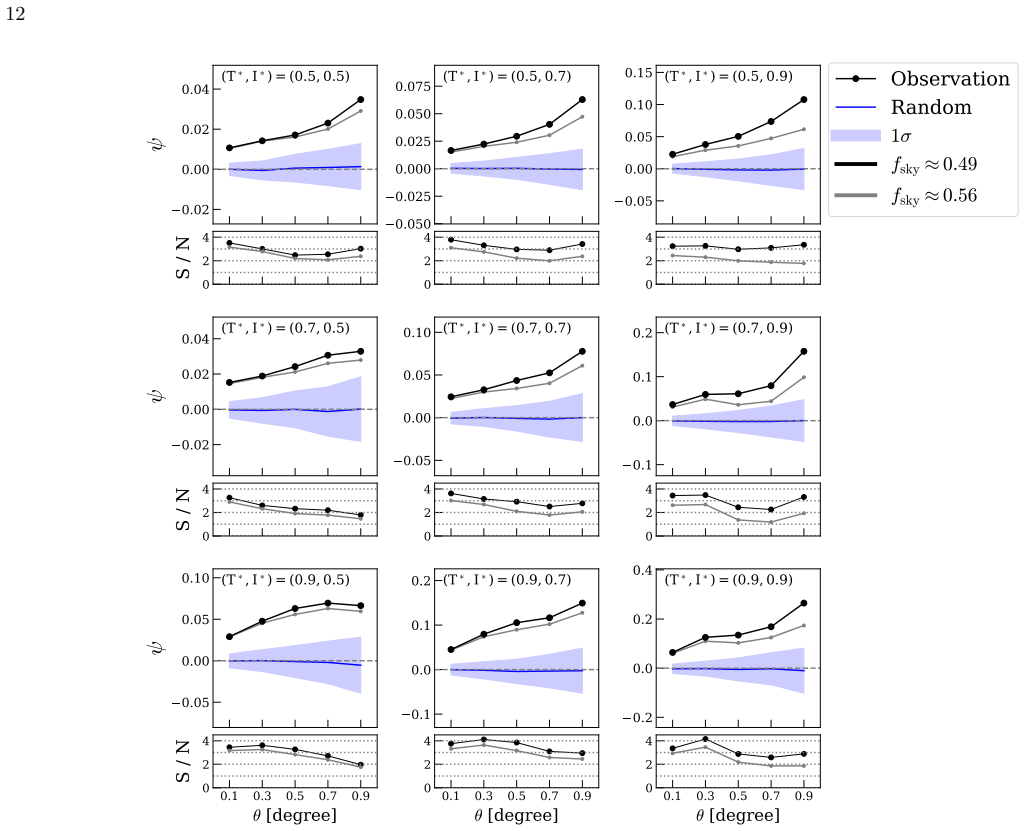
The k-nearest neighbor cumulative distribution function (kNN-CDF) is the central statistic. For two continuous fields (CMB temperature and CIB intensity), it measures the joint probability that pixels exceed specified thresholds, normalized by the product of the individual probabilities. This statistic is sensitive to integrated higher-order clustering information, which captures the cross-correlation signal more efficiently than the two-point function. The method works by counting, for each pixel, the fraction of its k nearest neighbors in the other field above a threshold, then combining thresholds and angular scales (0.1°–0.9°) into a 45-element data vector whose covariance is estimated f
Load-bearing premise
The mock CIB map is calibrated to the real CIB only through its angular power spectrum and pixel intensity distribution, not through higher-order phase information; if the simulation's phase structure differs from reality, the template ψ_model could be biased, shifting the measured amplitude and its significance.
What would settle it
A direct comparison of the measured kNN-CDF statistic with a mock catalog that explicitly matches the CIB's two-point correlation function at all scales, while also matching higher-order (bispectrum or trispectrum) statistics, would test whether the inferred A_kNN is robust. Alternatively, repeating the analysis with a different CIB reconstruction (e.g., from Planck's 545 GHz map or from SPHEREx-like multi-band data) and a different CMB map (e.g., ACT) and checking whether the amplitude remains consistent would settle the matter.
If this is right
- If the ISW/RS signal is real, it provides a direct dynamical measurement of the growth of gravitational potentials, consistent with a cosmological constant.
- The improved significance over two-point analysis suggests that kNN-CDF-style statistics can extract additional non-Gaussian information from CMB–large-scale-structure cross-correlations.
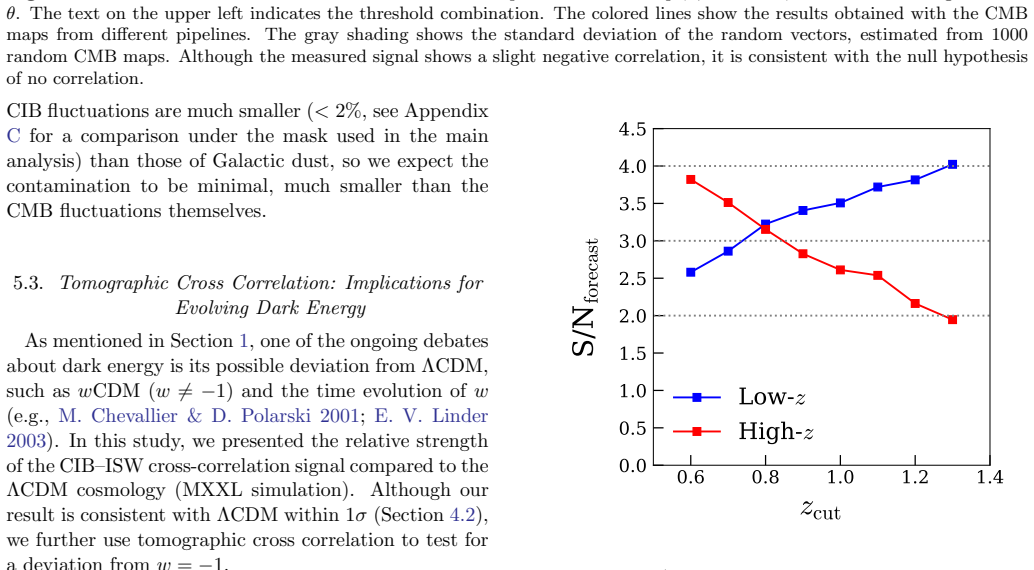
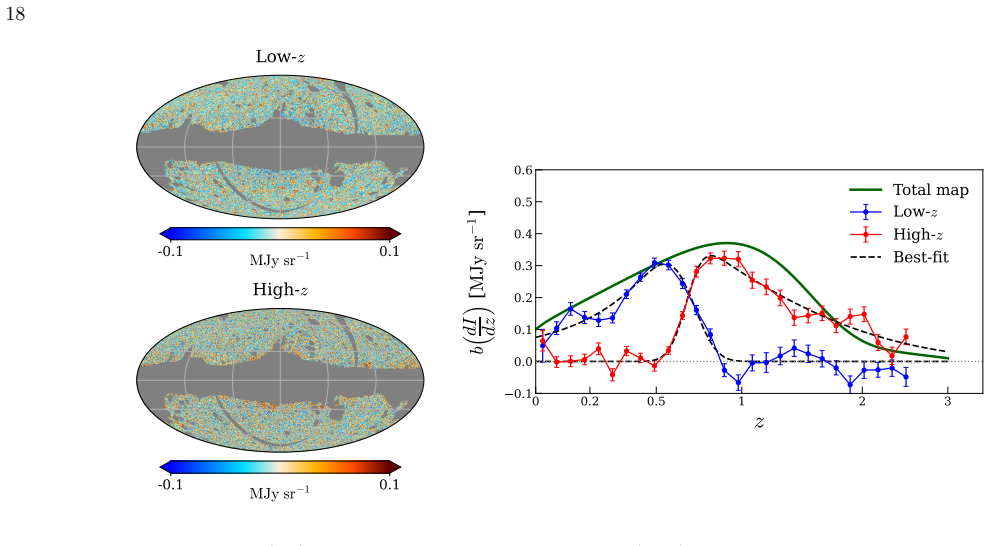
- The tomographic split into low- and high-redshift CIB bins yields amplitudes consistent with ΛCDM, placing constraints on evolving dark energy, albeit with weaker significance (3.0σ and 2.0σ).
- The success of this approach motivates using CIB reconstructions and kNN statistics for future surveys like SPHEREx to probe dark energy dynamics.
Where Pith is reading between the lines
- The 4.8σ significance may be optimistic given the substantial correlations between angular bins (up to 0.93) and the reliance on mock data that are calibrated to the observed CIB only through its power spectrum and PDF; higher-order phase information is not explicitly matched.
- The two tomographic bin amplitudes (1.41 ± 0.47 and 1.66 ± 0.81) are both above unity, hinting at a possible excess, but the large uncertainties and redshift overlap make it premature to interpret this as evidence for evolving dark energy.
- This result could be tested by applying the same kNN-CDF cross-correlation to independent CMB maps (e.g., from ACT or SPT) and other large-scale structure tracers such as DESI galaxies or the thermal Sunyaev-Zel'dovich effect, which would provide a clean consistency check.
- The improvement over two-point statistics suggests that kNN-CDF methods could be applied to other delicate cross-correlations, such as CMB lensing–galaxy or 21 cm–galaxy correlation, where higher-order information may help beat down noise.
Editorial analysis
A structured set of objections, weighed in public.
Referee Report
Summary. The paper measures the cross-correlation between Planck CMB temperature and the reconstructed 100 μm CIB map of Chiang (2023) using the k-nearest neighbor cumulative distribution function (kNN-CDF). It reports a positive correlation: the null hypothesis of no correlation is rejected at p=0.02 (2.3σ) via a chi-square test, and an amplitude fit relative to ΛCDM mock data from the MXXL simulation (including ISW and RS effects) yields A_kNN=0.95±0.20 (4.8σ). The paper compares this with a two-point angular power spectrum analysis (≈4σ), performs extensive systematics tests with different CMB pipelines, dust maps, masks, and outlier cuts, and tomographically splits the CIB into two redshift bins; the results are reported as consistent with ΛCDM. The claimed improvement of kNN over two-point statistics is ~20% in detection significance.
Significance. If the claimed signal is real, the paper provides a new dynamical probe of late-time potential evolution, complementary to geometric dark-energy measurements, and demonstrates the utility of kNN-CDF for ISW-type cross-correlations. The analysis is thorough: it uses a public foreground-cleaned CIB map, constructs mocks from a large N-body simulation, and performs multiple robustness tests (CMB pipelines, masks, outlier cuts, covariance estimators). However, the model-independent null signal is only 2.3σ, and the headline 4.8σ amplitude significance is conditional on the mock template. The central risk is whether the mock CIB/ISWRS template faithfully reproduces the higher-order phase information that kNN-CDF is designed to extract; the paper's own outlier-cut sensitivity and its different amplitudes between Planck and MXXL cosmologies in the two-point analysis underline this concern. The paper is valuable and likely correct in its broad claims, but the headline significance needs stronger validation.
major comments (3)
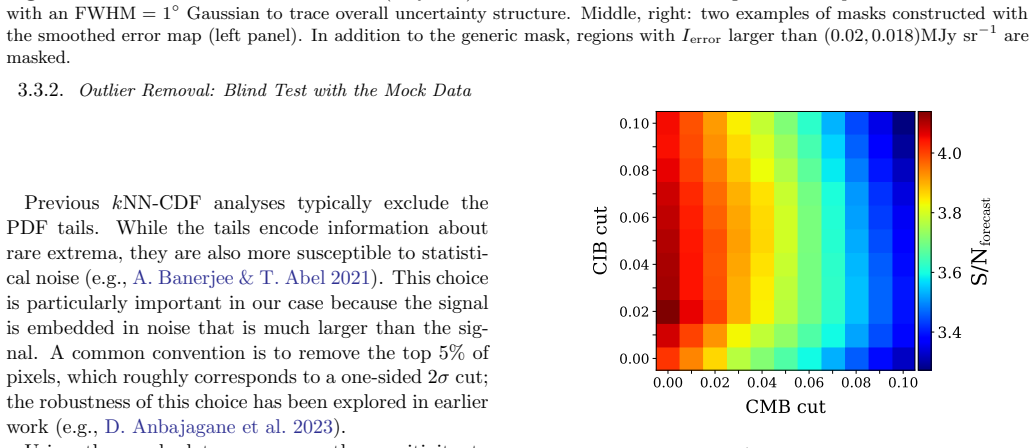
- [§3.2, §4.2, Eq. (11)–(14)] The 4.8σ significance is a matched-filter amplitude A_kNN obtained by projecting the observed data vector onto a template ψ_model built from MXXL mock data. The mock CIB is calibrated to the observed CIB only through its angular power spectrum and pixel PDF (Eq. 3, Figs. 4–5), not through higher-order phase information. Since kNN-CDF is explicitly designed to capture integrated higher-order clustering, the template shape could be biased if the simulation's phase structure differs from the real CIB reconstruction (a linear combination of galaxy templates). The paper itself reports that A_kNN varies by ~10% for a 1% change in the CIB outlier cut (§4.2) and that reconstruction errors are not included in the mocks (§3.3.2). A biased template would not affect the χ²_null=2.3σ result but could over- or under-state the amplitude significance. I ask the authors to validate the template against a
- [§2.2, §5.1, Fig. 14] The mock ISWRS map is generated from the MXXL simulation, which assumes Ωm=0.25, σ8=0.9, differing from Planck cosmology. The two-point analysis in §5.1 shows that the best-fit amplitude changes by more than 1σ between Planck and MXXL cosmologies (A_ISW=0.97±0.25 vs 0.63±0.16). The kNN template is only from MXXL; if the true cosmology is closer to Planck, the template shape may be biased. The paper should quantify the cosmology dependence of A_kNN, for instance by constructing ψ_model from linear theory with Planck parameters or by reweighting the mock, and state the expected shift in the amplitude and significance.
- [§3.2, §4.1, Eq. (10)] The null-test significance is quoted as χ²_null≈66.6 for 45 degrees of freedom, p=0.02 (2.3σ). However, the covariance matrix is estimated from only 200 realizations, and the 45-element data vector is highly correlated (correlation coefficients up to 0.93 in Fig. 10). The Hartlap factor partially debiases the inverse covariance but does not by itself make the χ² statistic follow a chi-square distribution with 45 dof; the appropriate null distribution is closer to a Hotelling T². The authors should validate the p-value with an empirical null distribution (e.g., from the random realizations) or use a T² statistic. Without this, the model-independent 2.3σ rejection quoted in the abstract may not be precisely calibrated.
minor comments (5)
- [§3.1, Eq. (6)] The definition of ψ uses the notation P_{>T*,>I*}, P_{>T*}, P_{>I*}; please define these explicitly in the text or a table, and state that ψ is a function of θ.
- [Fig. 1 caption] The caption says the CIB map is 'extracted from the SFD dust map'; this could be misread as a simple subtraction. The reconstruction is based on template galaxy density fields and cross-correlations with SFD; please rephrase for clarity.
- [§2.2.1, Eq. (3)] The iterative procedure for finding (b_ℓ, σ_N1, σ_N2) is described qualitatively; please state the convergence criterion and the resulting uncertainties on these fitted quantities.
- [§5.1] The phrase 'increasing the independent data volume by (4.8/4.0)^2−1=44%' is loose; the gain in S/N does not necessarily translate directly into an independent data volume. Consider rephrasing as 'equivalent to a 44% increase in effective survey volume under inverse-variance scaling.'
- [Eq. (7)] There is a formatting issue: 'atop−hat' should be 'a_{ℓm}^{top-hat}' or similar.
Circularity Check
No material circularity: the ISWRS template is a forward N-body prediction, and the observed CIB–CMB cross-correlation is not an input to the mock calibration.
full rationale
The central amplitude A_kNN is measured by projecting the observed kNN-CDF data vector onto a template ψ_model built from MXXL mock CIB and ISWRS maps (Eqs. 11–14). No parameter of the mock is fitted to the observed CIB–CMB cross-correlation. The mock CIB is calibrated only to the observed CIB auto power spectrum and pixel PDF (Eq. 3, Figs. 4–5), and the mock ISWRS map is generated independently from the N-body potential evolution (Eq. 4). Equation 15 is used only as a separate linear-theory comparison, not as a calibration input. The CIB map and its bias-weighted redshift distribution come from Chiang (2023) and Chiang et al. (2025), but these are external observed data products, and the cross-correlation with Planck is not used to construct them. The paper's own caveats—mock data omit reconstruction errors (Sec. 3.3.2) and A_kNN varies by ~10% for a 1% outlier-cut change (Sec. 4.2)—are robustness limitations, not circular reductions. The model-independent χ²_nul = 2.3σ and the template-based 4.8σ are distinct measures, and the paper explicitly labels them as such. No equation in the paper defines the prediction in terms of the fitted quantity or vice versa.
Axiom & Free-Parameter Ledger
free parameters (6)
- b dI/dz fitting parameters (α, z0, β; a=-0.03, b=0.1) =
Not quoted in text; fitted to clustering-redshift measurements from C23/Chiang+2025
- Transfer function parameters (A, a, b) in bℓ = A exp(-a ℓ^b) =
Not quoted; fitted to the ratio of observed to simulated CIB Cℓ, normalized at ℓ=20
- White noise amplitudes (σ_N1, σ_N2) =
(0, 0.02) MJy/sr
- Outlier cuts (CMB cut, CIB cut) =
(0, 0.02)
- Fiducial sky fraction fsky =
≈0.49
- Tomographic redshift boundary z_cut =
≈0.7
axioms (5)
- domain assumption MXXL simulation (H0=73, Ωm=0.25, ΩΛ=0.75, σ8=0.9, ns=1) adequately represents ΛCDM for generating both the ISWRS map and the CIB mock.
- domain assumption The C23 reconstructed 100 µm CIB map is a faithful tracer of large-scale structure, with reconstruction errors small enough after masking not to bias the cross-correlation.
- domain assumption Matching the angular power spectrum and pixel PDF of the mock CIB to observation (Eq. 3) is sufficient to reproduce the higher-order phase information relevant for kNN-CDF cross-correlation.
- standard math The Poisson equation in Fourier space, Φ(k,t) = (3/2)(H0/k)^2 Ωm,0 δ(k,t)/a, and cubic spline interpolation in scale factor provide an accurate lightcone ISWRS map.
- standard math The kNN-CDF statistic ψ (Eq. 6) is an unbiased cross-correlation estimator, and the covariance estimated from 200 realizations is a valid measure of the noise.
read the original abstract
The physical origin of cosmic acceleration remains one of the central questions in modern cosmology. The integrated Sachs-Wolfe (ISW) and Rees-Sciama (RS) effects, which arise from the evolution of gravitational potentials, provide a dynamical test of cosmic acceleration. We measure the cross correlation between the Planck temperature map of the cosmic microwave background (CMB) and a foreground-free map of the $100\,\mu\mathrm{m}$ cosmic infrared background (CIB) from Y.-K. Chiang (2023), using the $k$-nearest neighbor cumulative distribution function ($k$NN-CDF). As the CIB map is reconstructed from ${\sim}600$ million Wide-field Infrared Survey Explorer galaxies extending to $z\approx2.5$, the measurement is equivalent to a galaxy-CMB cross correlation. We find evidence for a positive cross correlation, rejecting the null hypothesis of no correlation at $p=0.02~(2.3\sigma)$ using the $\chi^2$ test. We further quantify its amplitude with $A_{k\mathrm{NN}}$, defined relative to an assumed cosmological model, and obtain $A_{k\mathrm{NN}}=0.95\pm0.20~(4.8\sigma)$ with respect to $\Lambda\mathrm{CDM}$ mock data including the ISW and RS effects. The $k$NN-CDF analysis improves the detection significance by ${\sim}20\%$ over the two-point correlation function. We also explore evolving dark energy by constructing two tomographic maps from the full CIB map; the results are consistent with $\Lambda$CDM. Finer tomographic reconstruction of the CIB, for example from multiband data of SPHEREx, would further tighten constraints on evolving dark energy.
Figures






Reference graph
Works this paper leans on
-
[1]
Abbott , T. M. C., Aguena , M., Alarcon , A., et al. 2022, title Dark Energy Survey Year 3 results: Cosmological constraints from galaxy clustering and weak lensing , , 105, 023520, 10.1103/PhysRevD.105.023520
-
[2]
G., Aguilar , J., Ahlen , S., et al
Adame , A. G., Aguilar , J., Ahlen , S., et al. 2025, title DESI 2024 VI: cosmological constraints from the measurements of baryon acoustic oscillations , , 2025, 021, 10.1088/1475-7516/2025/02/021
-
[3]
Afshordi , N. 2004, title Integrated Sachs-Wolfe effect in cross-correlation: The observer's manual , , 70, 083536, 10.1103/PhysRevD.70.083536
-
[4]
Alam , S., Aubert , M., Avila , S., et al. 2021, title Completed SDSS-IV extended Baryon Oscillation Spectroscopic Survey: Cosmological implications from two decades of spectroscopic surveys at the Apache Point Observatory , , 103, 083533, 10.1103/PhysRevD.103.083533
-
[5]
2019, title A unified pseudo-C _ framework , , 484, 4127, 10.1093/mnras/stz093
Alonso , D., Sanchez , J., Slosar , A., & LSST Dark Energy Science Collaboration . 2019, title A unified pseudo-C _ framework , , 484, 4127, 10.1093/mnras/stz093
-
[6]
Anbajagane , D., Chang , C., Banerjee , A., et al. 2023, title Beyond the 3rd moment: a practical study of using lensing convergence CDFs for cosmology with DES Y3 , , 526, 5530, 10.1093/mnras/stad3118
-
[8]
Ballardini , M., Paoletti , D., Finelli , F., et al. 2019, title On the ISW-cluster cross-correlation in future surveys , , 482, 2670, 10.1093/mnras/sty2795
-
[9]
Banerjee , A., & Abel , T. 2021, title Cosmological cross-correlations and nearest neighbour distributions , , 504, 2911, 10.1093/mnras/stab961
-
[10]
Banerjee , A., & Abel , T. 2023, title Tracer-field cross-correlations with k-nearest neighbour distributions , , 519, 4856, 10.1093/mnras/stac3813
-
[11]
L., Halpern , M., Hinshaw , G., et al
Bennett , C. L., Halpern , M., Hinshaw , G., et al. 2003, title First-Year Wilkinson Microwave Anisotropy Probe (WMAP) Observations: Preliminary Maps and Basic Results , , 148, 1, 10.1086/377253
doi:10.1086/377253 2003
-
[12]
Bilicki , M., Peacock , J. A., Jarrett , T. H., et al. 2016, title WISE SuperCOSMOS Photometric Redshift Catalog: 20 Million Galaxies over 3/pi Steradians , , 225, 5, 10.3847/0067-0049/225/1/5
-
[13]
Bobin , J., Sureau , F., & Starck , J.-L. 2016, title Cosmic microwave background reconstruction from WMAP and Planck PR2 data , , 591, A50, 10.1051/0004-6361/201527822
-
[14]
Bock , J. J., Aboobaker , A. M., Adamo , J., et al. 2026, title The SPHEREx Satellite Mission , , 999, 139, 10.3847/1538-4357/ae2be2
-
[15]
Cabr \'e , A., Fosalba , P., Gazta \ n aga , E., & Manera , M. 2007, title Error analysis in cross-correlation of sky maps: application to the Integrated Sachs-Wolfe detection , , 381, 1347, 10.1111/j.1365-2966.2007.12280.x
arXiv 2007
-
[16]
Cai , Y.-C., Cole , S., Jenkins , A., & Frenk , C. 2009, title Towards accurate modelling of the integrated Sachs-Wolfe effect: the non-linear contribution , , 396, 772, 10.1111/j.1365-2966.2009.14780.x
arXiv 2009
-
[17]
Cai , Y.-C., Cole , S., Jenkins , A., & Frenk , C. S. 2010, title Full-sky map of the ISW and Rees-Sciama effect from Gpc simulations , , 407, 201, 10.1111/j.1365-2966.2010.16946.x
arXiv 2010
-
[18]
C., Szapudi , I., Cole , S., & Frenk , C
Cai , Y.-C., Neyrinck , M. C., Szapudi , I., Cole , S., & Frenk , C. S. 2014, title A Possible Cold Imprint of Voids on the Microwave Background Radiation , , 786, 110, 10.1088/0004-637X/786/2/110
-
[20]
Chen , T., Remazeilles , M., & Dickinson , C. 2018, title Impact of SZ cluster residuals in CMB maps and CMB-LSS cross-correlations , , 479, 4239, 10.1093/mnras/sty1730
-
[21]
Chevallier , M., & Polarski , D. 2001, title Accelerating Universes with Scaling Dark Matter , International Journal of Modern Physics D, 10, 213, 10.1142/S0218271801000822
-
[22]
Chiang , Y.-K. 2023, title Corrected SFD: A More Accurate Galactic Dust Map with Minimal Extragalactic Contamination , , 958, 118, 10.3847/1538-4357/acf4a1
-
[23]
Chiang , Y.-K., Makiya , R., & M \'e nard , B. 2025, title Cosmic Infrared Background Tomography and a Census of Cosmic Dust and Star Formation , , 992, 65, 10.3847/1538-4357/adfb6a
-
[24]
Dong , F., Park , C., Hong , S. E., et al. 2023, title Tomographic Alcock-Paczy \'n ski Test with Redshift-space Correlation Function: Evidence for the Dark Energy Equation-of-state Parameter w > -1 , , 953, 98, 10.3847/1538-4357/acd185
-
[25]
Dong , F., Yu , Y., Zhang , J., Yang , X., & Zhang , P. 2021, title Measuring the integrated Sachs-Wolfe effect from the low-density regions of the universe , , 500, 3838, 10.1093/mnras/staa3194
-
[26]
Dup \'e , F. X., Rassat , A., Starck , J. L., & Fadili , M. J. 2011, title Measuring the integrated Sachs-Wolfe effect , , 534, A51, 10.1051/0004-6361/201015893
-
[27]
Is the Rees-Sciama effect detectable by the next generation of cosmological experiments?
Ferraro , S., Schaan , E., & Pierpaoli , E. 2022, title Is the Rees-Sciama effect detectable by the next generation of cosmological experiments? , arXiv e-prints, arXiv:2205.10332, 10.48550/arXiv.2205.10332
work page internal anchor Pith review Pith/arXiv arXiv doi:10.48550/arxiv.2205.10332 2022
-
[28]
Ferraro , S., Sherwin , B. D., & Spergel , D. N. 2015, title WISE measurement of the integrated Sachs-Wolfe effect , , 91, 083533, 10.1103/PhysRevD.91.083533
-
[29]
Fixsen , D. J. 2009, title The Temperature of the Cosmic Microwave Background , , 707, 916, 10.1088/0004-637X/707/2/916
-
[30]
Flender , S., Hotchkiss , S., & Nadathur , S. 2013, title The stacked ISW signal of rare superstructures in CDM , , 2013, 013, 10.1088/1475-7516/2013/02/013
-
[31]
Frommert , M., En lin , T. A., & Kitaura , F. S. 2008, title Optimal integrated Sachs-Wolfe detection and joint likelihood for cosmological parameter estimation , , 391, 1315, 10.1111/j.1365-2966.2008.13971.x
arXiv 2008
-
[32]
Gaia Collaboration , Vallenari , A., Brown , A. G. A., et al. 2023, title Gaia Data Release 3. Summary of the content and survey properties , , 674, A1, 10.1051/0004-6361/202243940
-
[33]
Gangopadhyay , K., Banerjee , A., & Abel , T. 2025, title Geometric interpretations of the k-nearest neighbour distributions , , 543, 3409, 10.1093/mnras/staf1637
-
[34]
Giannantonio , T., Crittenden , R., Nichol , R., & Ross , A. J. 2012, title The significance of the integrated Sachs-Wolfe effect revisited , , 426, 2581, 10.1111/j.1365-2966.2012.21896.x
arXiv 2012
-
[35]
Goldstein , S., & Hill , J. C. 2025, title Evidence of galaxy cluster rotation in the cosmic microwave background , arXiv e-prints, arXiv:2512.10951, 10.48550/arXiv.2512.10951
-
[36]
G \'o rski , K. M., Hivon , E., Banday , A. J., et al. 2005, title HEALPix: A Framework for High-Resolution Discretization and Fast Analysis of Data Distributed on the Sphere , , 622, 759, 10.1086/427976
doi:10.1086/427976 2005
-
[37]
Goto , T., Szapudi , I., & Granett , B. R. 2012, title Cross-correlation of WISE galaxies with the cosmic microwave background , , 422, L77, 10.1111/j.1745-3933.2012.01240.x
arXiv 2012
-
[38]
Granett , B. R., Neyrinck , M. C., & Szapudi , I. 2008, title An Imprint of Superstructures on the Microwave Background due to the Integrated Sachs-Wolfe Effect , , 683, L99, 10.1086/591670
doi:10.1086/591670 2008
-
[39]
Gupta , K. R., & Banerjee , A. 2024, title Spatial clustering of gravitational wave sources with k-nearest neighbour distributions , , 531, 4619, 10.1093/mnras/stae1424
-
[40]
Hang , Q., Alam , S., Cai , Y.-C., & Peacock , J. A. 2021 a , title Stacked CMB lensing and ISW signals around superstructures in the DESI Legacy Survey , , 507, 510, 10.1093/mnras/stab2184
-
[41]
Hang , Q., Alam , S., Peacock , J. A., & Cai , Y.-C. 2021 b , title Galaxy clustering in the DESI Legacy Survey and its imprint on the CMB , , 501, 1481, 10.1093/mnras/staa3738
-
[42]
2007, title Why your model parameter confidences might be too optimistic
Hartlap , J., Simon , P., & Schneider , P. 2007, title Why your model parameter confidences might be too optimistic. Unbiased estimation of the inverse covariance matrix , , 464, 399, 10.1051/0004-6361:20066170
-
[43]
Hern \'a ndez-Monteagudo , C., & Smith , R. E. 2013, title On the signature of z 0.6 superclusters and voids in the Integrated Sachs-Wolfe effect , , 435, 1094, 10.1093/mnras/stt1322
-
[44]
Hern \'a ndez-Monteagudo , C., Ross , A. J., Cuesta , A., et al. 2014, title The SDSS-III Baryonic Oscillation Spectroscopic Survey: constraints on the integrated Sachs-Wolfe effect , , 438, 1724, 10.1093/mnras/stt2312
-
[45]
2008, title Correlation of CMB with large-scale structure
Ho , S., Hirata , C., Padmanabhan , N., Seljak , U., & Bahcall , N. 2008, title Correlation of CMB with large-scale structure. I. Integrated Sachs-Wolfe tomography and cosmological implications , , 78, 043519, 10.1103/PhysRevD.78.043519
-
[46]
W., & Eastwood , J
Hockney , R. W., & Eastwood , J. W. 1988, Computer simulation using particles
1988
-
[47]
2015, title The Jubilee ISW Project - II
Hotchkiss , S., Nadathur , S., Gottl \"o ber , S., et al. 2015, title The Jubilee ISW Project - II. Observed and simulated imprints of voids and superclusters on the cosmic microwave background , , 446, 1321, 10.1093/mnras/stu2072
-
[48]
Ili \'c , S., Langer , M., & Douspis , M. 2013, title Detecting the integrated Sachs-Wolfe effect with stacked voids , , 556, A51, 10.1051/0004-6361/201321150
-
[49]
Jang , J., Choi , C., Hwang , H. S., et al. 2026, title Characterization of the Commercial Spectrograph System for Astronomical Observations: PIXIS 1300BX Camera and IsoPlane 320A Spectrograph , Journal of Korean Astronomical Society, 59, 11, 10.5303/JKAS.2026.59.1.11
-
[50]
Kim, D., Jo, Y., Hwang, H. S., et al. 2026, title Constructing a Mock Galaxy Catalog for the All-sky Spectroscopic Survey of Nearby Galaxies (A-SPEC) Using the Machine-assisted Semi-Simulation Model, The Astrophysical Journal Supplement Series, 285, 46, 10.3847/1538-4365/ae80aa
-
[51]
Komatsu , E., Smith , K. M., Dunkley , J., et al. 2011, title Seven-year Wilkinson Microwave Anisotropy Probe (WMAP) Observations: Cosmological Interpretation , , 192, 18, 10.1088/0067-0049/192/2/18
-
[52]
Kov \'a cs , A., Beck , R., Smith , A., et al. 2022, title Evidence for a high-z ISW signal from supervoids in the distribution of eBOSS quasars , , 513, 15, 10.1093/mnras/stac903
-
[53]
Krolewski , A., & Ferraro , S. 2022, title The Integrated Sachs Wolfe effect: unWISE and Planck constraints on dynamical dark energy , , 2022, 033, 10.1088/1475-7516/2022/04/033
-
[54]
Kwon , M., Hwang , H. S., Lee , J. C., et al. 2026, title A New Collision Avoidance Fiber Assignment Algorithm for Robotic Fiber Positioners in Multi-Object Spectroscopy , Journal of Korean Astronomical Society, 59, 1, 10.5303/JKAS.2026.59.1.1
-
[55]
Lewis , A., Challinor , A., & Lasenby , A. 2000, title Efficient Computation of Cosmic Microwave Background Anisotropies in Closed Friedmann-Robertson-Walker Models , , 538, 473, 10.1086/309179
doi:10.1086/309179 2000
-
[56]
Limber , D. N. 1953, title The Analysis of Counts of the Extragalactic Nebulae in Terms of a Fluctuating Density Field. , , 117, 134, 10.1086/145672
doi:10.1086/145672 1953
-
[57]
Linder , E. V. 2003, title Exploring the Expansion History of the Universe , , 90, 091301, 10.1103/PhysRevLett.90.091301
-
[58]
2008, title Extended Limber approximation , , 78, 123506, 10.1103/PhysRevD.78.123506
LoVerde , M., & Afshordi , N. 2008, title Extended Limber approximation , , 78, 123506, 10.1103/PhysRevD.78.123506
-
[59]
Maniyar , A., Lagache , G., B \'e thermin , M., & Ili \'c , S. 2019, title Constraining cosmology with the cosmic microwave and infrared backgrounds correlation , , 621, A32, 10.1051/0004-6361/201833765
-
[60]
Marocco , F., Eisenhardt , P. R. M., Fowler , J. W., et al. 2021, title The CatWISE2020 Catalog , , 253, 8, 10.3847/1538-4365/abd805
-
[61]
M \'e nard , B., Scranton , R., Schmidt , S., et al. 2013, title Clustering-based redshift estimation: method and application to data , arXiv e-prints, arXiv:1303.4722, 10.48550/arXiv.1303.4722
-
[62]
Merson , A. I., Baugh , C. M., Helly , J. C., et al. 2013, title Lightcone mock catalogues from semi-analytic models of galaxy formation - I. Construction and application to the BzK colour selection , , 429, 556, 10.1093/mnras/sts355
-
[63]
Nadathur , S., & Crittenden , R. 2016, title A Detection of the Integrated Sachs-Wolfe Imprint of Cosmic Superstructures Using a Matched-filter Approach , , 830, L19, 10.3847/2041-8205/830/1/L19
-
[64]
Nadathur , S., Hotchkiss , S., & Sarkar , S. 2012, title The integrated Sachs-Wolfe imprint of cosmic superstructures: a problem for CDM , , 2012, 042, 10.1088/1475-7516/2012/06/042
-
[65]
Penzias , A. A., & Wilson , R. W. 1965, title A Measurement of Excess Antenna Temperature at 4080 Mc/s. , , 142, 419, 10.1086/148307
doi:10.1086/148307 1965
-
[66]
1999, title Measurements of and from 42 High-Redshift Supernovae , , 517, 565, 10.1086/307221
Perlmutter , S., Aldering , G., Goldhaber , G., et al. 1999, title Measurements of and from 42 High-Redshift Supernovae , , 517, 565, 10.1086/307221
doi:10.1086/307221 1999
-
[67]
Planck Collaboration , Ade , P. A. R., Aghanim , N., et al. 2011, title Planck early results. I. The Planck mission , , 536, A1, 10.1051/0004-6361/201116464
-
[68]
Planck Collaboration , Ade , P. A. R., Aghanim , N., et al. 2014 a , title Planck 2013 results. XIX. The integrated Sachs-Wolfe effect , , 571, A19, 10.1051/0004-6361/201321526
-
[69]
Planck Collaboration , Ade , P. A. R., Aghanim , N., et al. 2014 b , title Planck 2013 results. XXX. Cosmic infrared background measurements and implications for star formation , , 571, A30, 10.1051/0004-6361/201322093
-
[70]
Planck Collaboration , Ade , P. A. R., Aghanim , N., et al. 2016 a , title Planck 2015 results. XXI. The integrated Sachs-Wolfe effect , , 594, A21, 10.1051/0004-6361/201525831
-
[71]
Planck Collaboration , Ade , P. A. R., Aghanim , N., et al. 2016 b , title Planck 2015 results. XII. Full focal plane simulations , , 594, A12, 10.1051/0004-6361/201527103
-
[72]
2020 a , title Planck 2018 results
Planck Collaboration , Aghanim , N., Akrami , Y., et al. 2020 a , title Planck 2018 results. VI. Cosmological parameters , , 641, A6, 10.1051/0004-6361/201833910
-
[73]
2020 b , title Planck 2018 results
Planck Collaboration , Aghanim , N., Akrami , Y., et al. 2020 b , title Planck 2018 results. I. Overview and the cosmological legacy of Planck , , 641, A1, 10.1051/0004-6361/201833880
-
[74]
2020 c , title Planck 2018 results
Planck Collaboration , Akrami , Y., Ashdown , M., et al. 2020 c , title Planck 2018 results. IV. Diffuse component separation , , 641, A4, 10.1051/0004-6361/201833881
-
[75]
Rees , M. J., & Sciama , D. W. 1968, title Large-scale Density Inhomogeneities in the Universe , , 217, 511, 10.1038/217511a0
doi:10.1038/217511a0 1968
-
[76]
Riess , A. G., Filippenko , A. V., Challis , P., et al. 1998, title Observational Evidence from Supernovae for an Accelerating Universe and a Cosmological Constant , , 116, 1009, 10.1086/300499
doi:10.1086/300499 1998
-
[77]
Sachs , R. K., & Wolfe , A. M. 1967, title Perturbations of a Cosmological Model and Angular Variations of the Microwave Background , , 147, 73, 10.1086/148982
doi:10.1086/148982 1967
-
[78]
Schlegel , D. J., Finkbeiner , D. P., & Davis , M. 1998, title Maps of Dust Infrared Emission for Use in Estimation of Reddening and Cosmic Microwave Background Radiation Foregrounds , , 500, 525, 10.1086/305772
doi:10.1086/305772 1998
-
[79]
Sheth , R. K., & Tormen , G. 1999, title Large-scale bias and the peak background split , , 308, 119, 10.1046/j.1365-8711.1999.02692.x
arXiv 1999
-
[80]
Smith , A., Cole , S., Baugh , C., et al. 2017, title A lightcone catalogue from the Millennium-XXL simulation , , 470, 4646, 10.1093/mnras/stx1432
-
[81]
Springel , V., White , S. D. M., Jenkins , A., et al. 2005, title Simulations of the formation, evolution and clustering of galaxies and quasars , , 435, 629, 10.1038/nature03597
-
[82]
St \"o lzner , B., Cuoco , A., Lesgourgues , J., & Bilicki , M. 2018, title Updated tomographic analysis of the integrated Sachs-Wolfe effect and implications for dark energy , , 97, 063506, 10.1103/PhysRevD.97.063506
discussion (0)
Sign in with ORCID, Apple, or X to comment. Anyone can read and Pith papers without signing in.