REVIEW 3 major objections 5 minor 19 references
DrongoNet-Micro, a 919-parameter INT8 CNN, can replace the Goertzel trigger in tropical bird recorders, raising recall by 8 percentage points and extending a 32 GB card from about 28 to about 45 days.
Reviewed by Pith at T0; open to challenge. T0 means a machine referee read the full paper against a public rubric. the ladder, T0–T4 →
T0 review · deepseek-v4-flash
2026-08-01 11:53 UTC pith:RJBKL5MF
load-bearing objection DrongoNet's core TinyML results are solid, but the headline storage gain over Goertzel is built on mismatched prevalence assumptions and needs recomputation. the 3 major comments →
Ultra-Compact CNN Architectures for Tropical Bird Audio Detection on Microcontrollers
The pith
A machine-rendered reading of the paper's core claim, the machinery that carries it, and where it could break.
Core claim
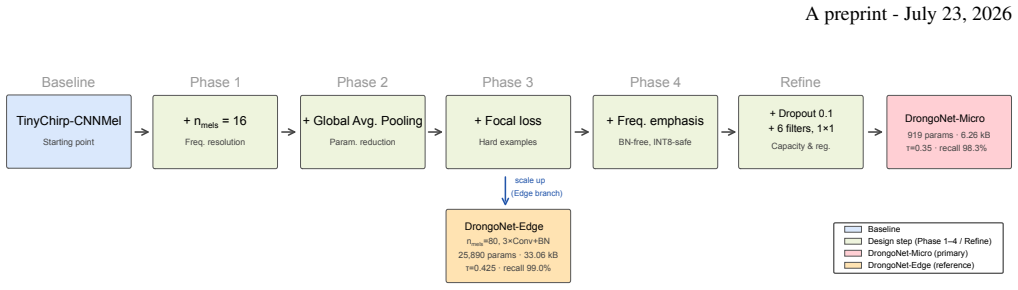
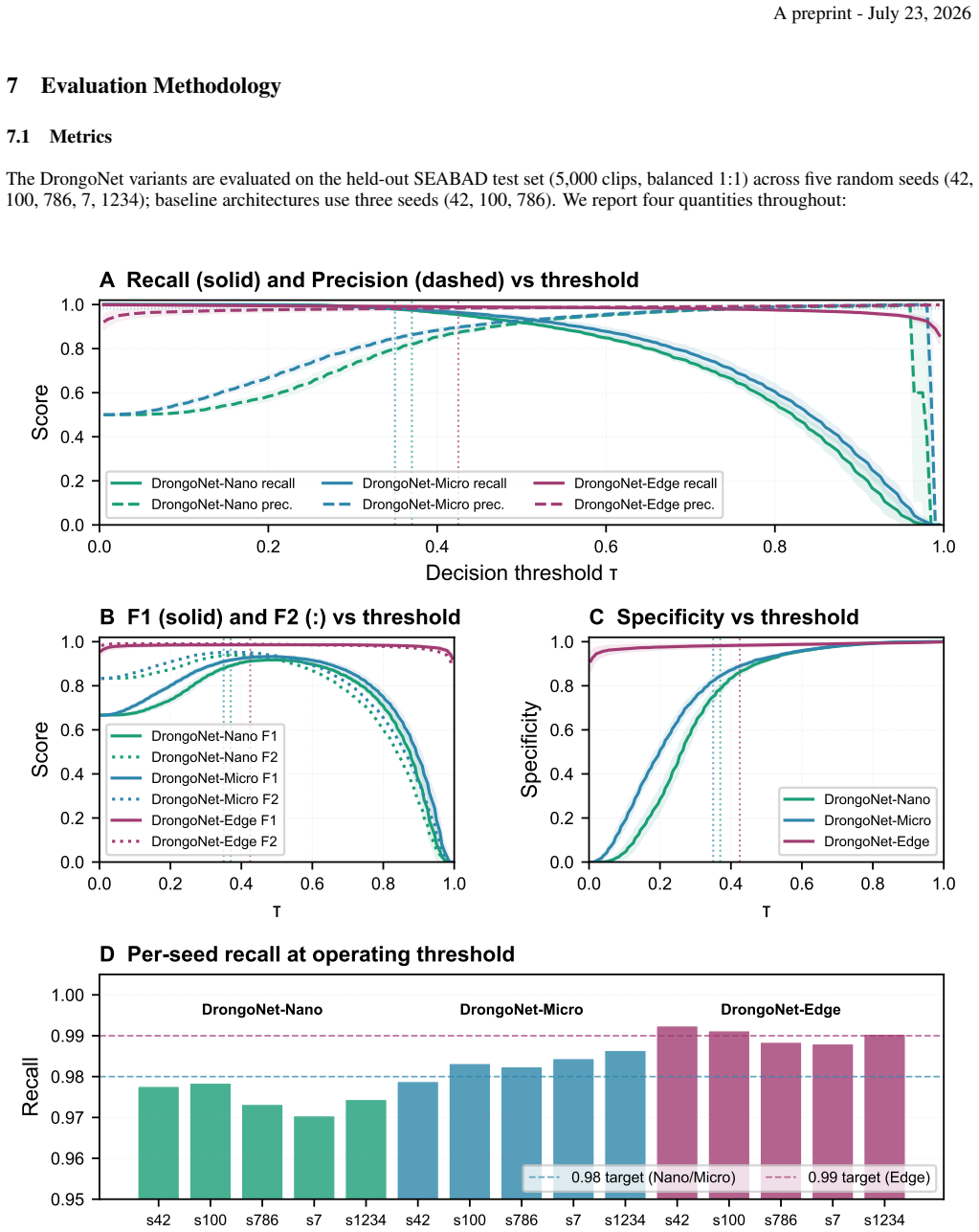
The central claim is that at a six-kilobyte size scale, a binary CNN can do what a bird trigger needs: high recall on species-rich tropical soundscapes at a false-positive rate that saves storage rather than flooding it. On SEABAD—50,000 three-second clips, 1,677 species—DrongoNet-Micro achieves AUC 0.9810 ± 0.0016 and, at threshold 0.35, 98.3% recall at 84.7% precision. INT8 quantisation costs less than 0.12% AUC across the three variants. The smallest variant, Nano, sits at 5.09 kB and 0.9727 AUC; the largest, Edge, reaches 0.9991 AUC in 33.06 kB. Against a retrained TinyChirp CNN-Mel baseline, Micro is within 0.1 pp of AUC at 28x fewer parameters, and the difference is not statistically s
What carries the argument
The load-bearing design is a four-phase ablation from a compact CNN baseline. For the microcontroller-size branch, the winning combination is global average pooling (removes the heavy classifier), focal loss (recovers the sensitivity lost to pooling by focusing on hard examples), and a 17-parameter learnable frequency-emphasis layer that scales each mel bin by sigma(w·s). That layer exists not for accuracy but because it gives batch-normalisation-like spectral normalisation without BN's instability under INT8 quantisation. Strided and depthwise-separable convolutions were tested and rejected at 16-mel resolution; standard 3x3 convolutions plus a 1x1 channel-mix stage survived. The operating
Load-bearing premise
The result rests on SEABAD's auto-curated labels (audited at 97.8% +/- 0.9% on 1,000 clips) being accurate and on the negative corpus covering the tropical sounds—insect stridulation, wind/vegetation, primate calls—that dominate the model's false positives. If label noise or negative-set gaps are systematic, the reported 0.9810 AUC and 98.3% recall are optimistic.
What would settle it
Deploy DrongoNet-Micro at tau=0.35 on an AudioMoth-class recorder for several weeks in a Southeast Asian forest, and hand-label every triggered clip plus a random sample of untriggered ones. If measured recall is well below 98% at ~10% prevalence, or if the fraction of windows written is far from 25.8%, the central deployment claim fails. A lab check: run the model on an independently human-audited tropical test set and compare AUC/recall with the SEABAD results.
If this is right
- On an AudioMoth-class recorder, replacing Goertzel with DrongoNet-Micro at threshold 0.35 raises recall by about 8 percentage points and extends a 32 GB card from roughly 28 to 45 days at 10% bird-segment prevalence.
- The full pipeline fits the device envelope: a 23 kB tensor arena (inside 32 kB SRAM), an inference time of 21 ms on a Cortex-M7, and a projected ~480 ms mel-plus-inference time on an AudioMoth-class Cortex-M4F—well inside the 3-second analysis window.
- The architecture is deployable across acoustic domains once retrained on regional data: 0.9757 AUC on a Corn Bunting corpus at 28x fewer parameters than the dedicated baseline, and within 0.4 pp of a 14x larger model on DCASE-2018 in-domain.
- Zero-shot transfer across domains does not work at this scale—Micro and Nano fall to near chance—so the paper's deployment claim is explicitly in-region and per-region retraining is required.
- Full INT8 quantisation costs below 0.01% AUC for Nano/Micro and below 0.12% for Edge, so the tiny sizes are the real deployed sizes.
Where Pith is reading between the lines
- A field-deployable extension is to make the decision threshold adaptive to estimated local prevalence, since the paper shows precision collapses from 85% at balanced prevalence to 22-36% at 1:10-1:20; an operator could raise tau automatically under sparse conditions.
- The paper's gatekeeper framing suggests a cascade: let DrongoNet-Micro run always-on as a wake-up trigger and gate a more expensive species classifier; this is implied by the design but not built here.
- The learnable frequency-emphasis trick is a small, portable solution to INT8-safe spectral normalisation; it could plausibly improve other tiny audio models with narrow mel front ends.
- The negative results on augmentation and distillation imply that for sub-1 kB detectors, collecting better regional training data will help more than algorithmic tweaks.
Editorial analysis
A structured set of objections, weighed in public.
Referee Report
Summary. The paper presents DrongoNet, a family of three INT8-quantised CNNs for bird-presence detection on microcontroller-class hardware, trained and evaluated on SEABAD, a 50,000-clip Southeast Asian dataset. Through a four-phase ablation from a retrained TinyChirp baseline, the authors develop Nano/Micro/Edge (763/919/25,890 parameters; 5.09/6.26/33.06 kB; AUC 0.9727/0.9810/0.9991), with full-INT8 degradation below 0.12%. They report on-device latency and power on a Portenta H7 and project AudioMoth-class latency, SD-card storage life, and battery life, claiming that Micro is a drop-in Goertzel replacement at α=0.10 prevalence, capturing 8 pp more bird vocalisations and extending a 32 GB card from about 28 to about 45 days. The paper also reports transfer experiments to TinyChirp's Corn Bunting corpus, DCASE-2018, and BirdVox-DCASE-20k, and includes several negative results.
Significance. The measured core of the paper is strong: five-seed means with standard deviations, significance tests against the retrained TinyChirp baseline, a careful zero-shot/transfer analysis, and unusually candid reporting of negative results and limitations. The code and data release supports reproducibility. If the deployment claims survive a corrected common-prevalence comparison, the paper makes a useful contribution to TinyML bioacoustics by showing that sub-10-kB CNN gatekeepers can match a much larger baseline and potentially replace coarse energy triggers. The DCASE-2018 re-measurement, the 'in-region retraining' scope, and the explicit negative results on distillation and augmentation are valuable for practitioners.
major comments (3)
- [§7.3, Table 8] The Goertzel reference row is not at α=0.10. From the tabulated Goertzel values, PPV = α·Recall / hit_rate, so α = 0.71×0.417/0.90 ≈ 0.33. Recomputing Goertzel at α=0.10 using the FPR implied by its own operating point (FPR ≈ 0.18) gives a hit rate of ≈0.25, versus Micro's 0.258; the claimed '~28 to ~45 day' storage gain essentially disappears and may reverse slightly. The 8 pp recall advantage is valid, but the card-life claim in the abstract and Section 10.2 compares Micro at α=0.10 with Goertzel at α≈0.33. Recompute all storage and battery comparisons at a common prevalence, and distinguish balanced-test precision (0.847) from field precision at α=0.10 (about 36% per Table 16).
- [§10.4] As written, the operating threshold is selected by sweeping recall on the held-out test set (Table 8 reports test-set metrics), and the same test set is then used to report recall at the selected τ. The mean-recall floor is therefore a selection outcome rather than an unbiased performance estimate. If τ was actually chosen on validation, the text should say so and report that sweep; otherwise select τ on validation (or nested cross-validation) and re-report the test recall/FPR used in the deployment calculations. This is load-bearing because the recall–FPR pair at the operating point feeds directly into Tables 14–16.
- [§9–§10] The paper itself states that residual false positives are dominated by insect stridulation, wind/vegetation rustle, and primate vocalisations, which are underrepresented in the negative training corpus. The deployment projections in Sections 9–10 use the balanced SEABAD test FPR=0.178; if field FPR is materially higher, the storage and battery numbers in Tables 14–15 degrade. The 'conservative for tropical soundscapes' argument only bounds Goertzel's FPR, not Micro's. Please add a sensitivity analysis of the claimed day/hour figures to plausible FPR inflation, or present the numbers explicitly as conditional on the SEABAD negative distribution.
minor comments (5)
- [Figure 5 vs Table 7] The Edge AUC is reported as 0.9986±0.0001 in Figure 5A but as 0.9991±0.0002 in Table 7, Table 10, and Section 8.2. Reconcile this inconsistency.
- [Throughout] The surname Benhamadi/Benhammadi is spelled inconsistently (e.g., Section 10.2, Eq. (2), and the reference list). Use one spelling consistently.
- [Abstract and §10.2] The abstract says '8 pp more bird vocalisations'; at the stated operating points the recall difference is 0.983 − 0.90 = 8.3 pp. Use the precise value.
- [Table 14 caption] The caption claims Goertzel and DrongoNet-Micro 'operate at matched high recall'; their recalls are 0.90 and 0.983, so 'matched' is inaccurate. Rephrase once the comparison prevalence is fixed.
- [Abstract] The phrase 'drop-in replacement for the Goertzel trigger' overstates the evidence, since no on-AudioMoth firmware port is reported and the AudioMoth latency/battery numbers are projections from Portenta H7 measurements and Benhamadi et al.'s coefficients. The limitations section already acknowledges this; consider softening the abstract wording.
Circularity Check
No significant circularity: DrongoNet's headline numbers are empirical measurements on held-out and external test sets, and the self-authored SEABAD corpus is publicly released and independently checkable.
full rationale
The paper's central performance claims (AUC, recall, model size, quantization loss) are measured on a held-out SEABAD test split across multiple seeds, not derived from fitted constants or from the paper's own equations. The storage and battery projections in Section 10 are explicit applications of Benhamadi et al.'s external energy and storage models, using DrongoNet's measured recall/FPR and stated prevalence assumptions; the paper twice acknowledges that the on-AudioMoth battery numbers are projections pending INA219 validation. SEABAD is self-authored, but it is released on Zenodo with code and an independent audit, so the self-citation is externally falsifiable rather than load-bearing. The threshold-selection rule chooses the largest threshold meeting a recall floor, which is calibration rather than a prediction derived from the target; it is a possible evaluation-validity concern but not a definitional reduction. The Goertzel-vs-Micro storage comparison mixes operating points (Goertzel's 41.7% hit rate implies a higher prevalence than the α=0.10 used for Micro); this is a correctness/validity concern, not a circularity step, because no equation reduces the claimed extension to the paper's own fitted inputs. The paper's own limitations — label noise, negative-corpus coverage, zero-shot transfer failure, projected rather than measured field lifetime — are acknowledged and do not create circularity.
Axiom & Free-Parameter Ledger
free parameters (5)
- Operating thresholds (tau_Micro=0.35, tau_Edge=0.425, tau_Nano=0.37) =
0.35 / 0.425 / 0.37
- Focal loss hyperparameters =
gamma=2.0, alpha=0.5
- Input spectrogram resolution =
Nano: 16 mel/512 FFT; Micro: 16 mel/1024 FFT; Edge: 80 mel/1024 FFT
- Dropout and augmentation settings =
Micro dropout 0.1; Edge dropout 0.2; Gaussian sigma=0.02; +/-10-frame shift p=0.5
- INT8 calibration set =
500 validation clips
axioms (5)
- domain assumption SEABAD labels are accurate enough (audited at 97.8% +/- 0.9% on 1,000 clips) to be treated as ground truth for detection evaluation.
- domain assumption A log-mel spectrogram of 3 seconds at 16 kHz contains enough information for binary bird-presence detection.
- domain assumption Benhamadi et al.'s AudioMoth energy model and measured coefficients (I_always_on=11.45 mA, C=2600 mAh, etc.) apply to DrongoNet-Micro in tropical field conditions.
- domain assumption The 10x clock-rate scaling from Portenta H7 to AudioMoth M4F gives a valid latency lower bound.
- standard math Standard ML background: AdamW, focal loss, global average pooling, and INT8 post-training quantisation behave as described in the cited literature.
invented entities (1)
-
Learnable frequency-emphasis layer (Eq. 1)
no independent evidence
read the original abstract
Passive acoustic monitoring of tropical biodiversity is bottlenecked by the storage and battery cost of continuously recording soundscapes in which bird vocalisations typically occupy less than 10% of the audio. Autonomous recording units built on low-power microcontrollers (typically ARM Cortex-M with $\leq$256 kB of RAM) address this by triggering only on likely-positive segments, but the on-device options are unsatisfying: coarse frequency-energy triggers such as Goertzel filters flood SD cards with false positives at $\sim$71% precision, whereas neural detectors developed for temperate single-species tasks are either too large to deploy or transfer poorly to species-rich tropical settings. We present DrongoNet, a family of three INT8 CNN detectors sized for this envelope and validated on a 50,000-clip, 1,677-species Southeast Asian tropical dataset (SEABAD). The headline model, DrongoNet-Micro (919 parameters, 6.26 kB, 0.9810 AUC, 98.3\% mean recall at {\tau} = 0.35), is a drop-in replacement for the Goertzel trigger used in commodity field recorders: at {\alpha} = 0.10 tropical prevalence it captures 8 pp more bird vocalisations than Goertzel and extends a 32 GB card from $\sim$28 to $\sim$45 days of monitoring. DrongoNet-Nano (5.09 kB) bounds the ultra-low-flash extreme; DrongoNet-Edge (33.06 kB, 0.9991 AUC) targets Linux SBCs. On SEABAD, Micro matches a retrained TinyChirp CNN-Mel baseline within 0.1 pp AUC at 28$\times$ fewer parameters, confirming that the family is deployment-agnostic across mel-spectrogram bird corpora but requires per-environment retraining. Full INT8 quantisation costs $<$0.12% AUC across all three variants.
Figures



Reference graph
Works this paper leans on
-
[3]
Cramer, H.-H
23 A preprint - July 23, 2026 J. Cramer, H.-H. Wu, J. Salamon, and J. P. Bello. Look, listen, and learn more: Design choices for deep audio embeddings. In ICASSP 2019 – IEEE International Conference on Acoustics, Speech and Signal Processing, pages 3852–3856,
2026
-
[4]
doi: 10.1016/j.ecolind.2025.114550. T. Grill and J. Schluter. Two convolutional neural networks for bird detection in audio signals. In25th European Signal Processing Conference, EUSIPCO 2017, pages 1764–1768. IEEE,
arXiv 2025
-
[8]
arXiv:2504.12272. L. Lai, N. Suda, and V . Chandra. CMSIS-NN: Efficient neural network kernels for ARM Cortex-M CPUs.arXiv preprint arXiv:1801.06601, pages 1–10,
-
[12]
Pérez-Granados et al
24 A preprint - July 23, 2026 C. Pérez-Granados et al. WABAD: A world annotated bird acoustic dataset for passive acoustic monitoring.Ecology, 107(2): e70317,
2026
-
[14]
Solomes and D
A. Solomes and D. Stowell. Efficient bird sound detection on the Bela embedded system. InICASSP 2020 – IEEE International Conference on Acoustics, Speech and Signal Processing, pages 746–750,
2020
-
[16]
Accessed 2025-12-29. D. Stowell, M. D. Wood, H. Pamula, Y . Stylianou, and H. Glotin. Automatic acoustic detection of birds through deep learning: the first Bird Audio Detection challenge.Methods in Ecology and Evolution, 10(3):368–380,
2025
-
[17]
doi: 10.1016/j.ecoinf.2022.101927. M. M. A. Zabidi, M. Y . I. Idris, and N. Idris. SEABAD: A tropical bird activity detection dataset for passive acoustic monitoring. arXiv preprint arXiv:2605.20853,
arXiv 2022
-
[18]
doi: 10.5281/zenodo.18290494. N. Zeghidour, O. Teboul, F. de Chaumont Quitry, and M. Tagliasacchi. LEAF: A learnable frontend for audio classification. In International Conference on Learning Representations (ICLR),
-
[19]
A SEABAD Dataset: Detailed Curation Methodology Curation Pipeline.SEABAD’s construction follows a six-stage pipeline: (1) Xeno-Canto acquisition from Malaysia and neighbouring Southeast Asian countries, (2) format unification (FLAC, 16 kHz mono) with peak normalisation and soft-clip mitigation, (3) FAISS-based acoustic deduplication over mel-spectrogram e...
2019
-
[2016]
Stowell, Y
D. Stowell, Y . Stylianou, M. Wood, H. Pamuła, and H. Glotin. DCASE 2018 task 3: Bird audio detection.https://dcase. community/challenge2018/task-bird-audio-detection,
2018
-
[2017]
J. Hu, L. Shen, and G. Sun. Squeeze-and-excitation networks. InCVPR 2018, pages 7132–7141,
2018
-
[2018]
Lin, W.-M
J. Lin, W.-M. M. Chen, Y . Lin, J. Cohn, C. Gan, and S. Han. MCUNet: Tiny deep learning on IoT devices.Advances in Neural Information Processing Systems, 2020-Decem(NeurIPS):1–15,
2020
-
[2019]
ISSN 24680672. A. G. Howard, M. Zhu, B. Chen, D. Kalenichenko, W. Wang, T. Weyand, M. Andreetto, and H. Adam. MobileNets: Efficient convolutional neural networks for mobile vision applications.CoRR, abs/1704.04861,
-
[2020]
ISSN 10495258. URLhttps://tinyml.mit.edu. M. Lin, Q. Chen, and S. Yan. Network in network.arXiv preprint arXiv:1312.4400,
-
[2021]
K. H. Kong, M. Behjati, V . Saleh, K. M. Yap, A. P. P. A. Majeed, and Y . Zheng. Edge intelligence for wildlife conservation: Real- time hornbill call classification using TinyML. InSelected Proceedings of the 2nd International Conference on Innovations in Manufacturing Research (ICIMR 2024), Lecture Notes in Networks and Systems. Springer,
2024
-
[2023]
D. Ruiz, J. S. Ulloa, Z. Miao, N. Betancourt, M. P. Toro-Gómez, A. Hernández, B. Demuro, E. Barona-Cortés, A. M. Mendoza- Henao, A. Sierra-Ricaurte, S. Pérez-Peña, R. Dodhia, P. Arbeláez, and J. Lavista. A strongly annotated passive acoustic dataset for tropical bird monitoring.arXiv preprint arXiv:2605.20578,
-
[2024]
Majumdar and B
S. Majumdar and B. Ginsburg. MatchboxNet: 1D time-channel separable convolutional neural network architecture for speech commands recognition. InInterspeech 2020,
2020
-
[2025]
S. Ciapponi, L. Mannini, J. Scanferla, M. Anderle, and E. Farella. Enabling multi-species bird classification on low-power bioacoustic loggers.arXiv preprint arXiv:2509.20103,
-
[2026]
Carmantini, V
A. Carmantini, V . Lostanlen, M. Lagrange, et al. Bioacoustics on tiny hardware at the BioDCASE 2025 challenge. InProceedings of the Detection and Classification of Acoustic Scenes and Events 2025 Workshop (DCASE2025),
2025
discussion (0)
Sign in with ORCID, Apple, or X to comment. Anyone can read and Pith papers without signing in.