REVIEW 3 major objections 5 minor 55 references
Instability of regular black holes in non-minimally coupled scalar field theories: an analytical approach
T0 review · 3 major / 5 minor · reviewed 2026-08-01 · deepseek-v4-flash
Pith's one-line read The paper derives closed-form critical coupling constants beyond which regular black holes become unstable under non-minimal scalar-field perturbations, identifying the threshold with an extremum of the near-horizon effective potential loca
desk verdict Useful analytic formulas for instability thresholds in regular black holes, but the central threshold criterion is asserted rather than proven, and the QNM/area-quantization section contains a factor-of-two error. read the letter →
The pith
A machine-rendered reading of the paper's core claim, the machinery that carries it, and where it could break.
The reading
What carries the argument
The machinery is the near-horizon expansion of the effective potential in the Regge-Wheeler equation for a static spherically symmetric metric with f(r_h) = 0. Writing f(r) ≈ 2κ x + (1/2) f''(r_h) x² with x = r − r_h, and expanding the potential as V(x) ≈ a x² + b x, the paper identifies the instability threshold with b = 0, i.e. V'(r_h) = 0. Solving b = 0 for the coupling ζ gives the critical values. In the Ricci-coupled model this is a direct equation; in the Einstein-tensor-coupled model the coefficients a and b themselves come from the near-horizon expansion of the more complicated kinetic coupling, which is an additional approximation the paper notes.
What would settle it
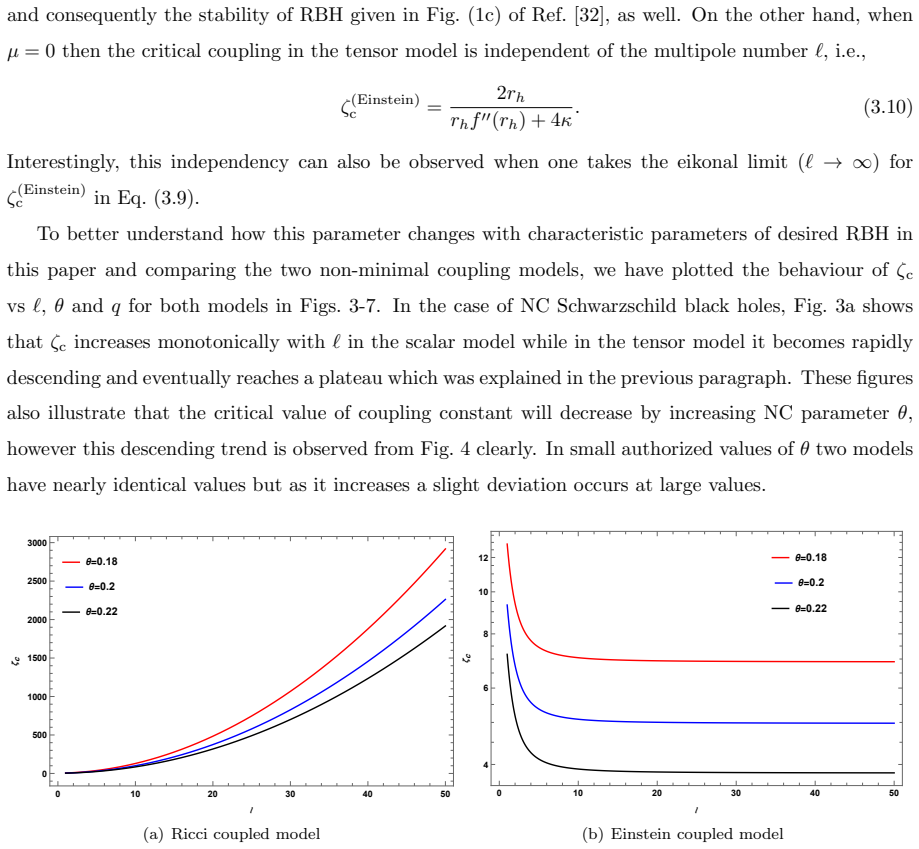
For the NC Schwarzschild tensor model with θ = 0.2, ℓ = 2, μ = 0.5, the paper predicts ζ_c = 5.673. Numerically integrate the exact Regge-Wheeler equation for ζ = 5.6 (just below) and search for a negative well outside r_h or late-time growth in the time-domain profile; finding either would contradict the claim that the threshold sits exactly at b = 0. Alternatively, check directly whether the exact first derivative V'(r_h) vanishes at the predicted ζ_c for the tensor model using the full potential, not the near-horizon approximation.
Extended reading notes
Core claim
At the critical value of the non-minimal coupling, the near-horizon effective potential of the Regge-Wheeler equation, V(x) ≈ a x² + b x, has its extremum exactly at the event horizon; the condition is b = 0. For the Ricci-coupled scalar model this condition is exact and yields ζ_c(Ricci) = [r_h² μ² + 2 r_h κ + ℓ(ℓ+1)] / [r_h² f''(r_h) + 8 r_h κ − 2]. For the Einstein-tensor-coupled model, after a near-horizon expansion, it yields ζ_c(Einstein) = 2 r_h [r_h(r_h μ² + 2κ) + ℓ(ℓ+1)] / [(2 r_h κ + ℓ(ℓ+1))(r_h f''(r_h) + 4κ)]. At this threshold the perturbations neither ring nor decay — the late-time tail is a straight line — and the real part of the near-horizon quasi-normal frequency vanishes,
Load-bearing premise
The load-bearing premise, asserted and supported by one plotted numerical example rather than proved, is that the onset of instability is exactly the condition b = 0, i.e. an extremum of the near-horizon effective potential located on the horizon; if a negative potential well could already exist for smaller coupling without touching the horizon, the derived critical values would be wrong, and the tensor-model formula further inherits the near-horizon approximation the paper i
Editorial extensions
If this is right
- For any spherically symmetric black hole whose metric function has a Taylor expansion near the horizon, Eqs. (3.8) and (3.9) give a direct algebraic prediction of the coupling at which scalar perturbations become unstable, without solving the full perturbation equations.
- In the Schwarzschild limit both formulas diverge, recovering the known linear stability of Schwarzschild against these scalar perturbations for any finite coupling.
- In the tensor model, the critical coupling becomes independent of the multipole ℓ in both the massless (μ = 0) and eikonal (ℓ → ∞) limits, while in the Ricci model ℓ → ∞ removes the instability entirely; these are testable predictions.
- At ζ = ζ_c the near-horizon QNM frequencies become purely imaginary, so the onset of instability is accompanied by a mode that neither oscillates nor decays.
- The spacing of near-horizon QNM frequencies at criticality is Δω = κ = 2πT_H, reproducing the area spectrum A = 8πn without invoking highly damped modes.
Reading between the lines
- Inference: Because the two closed-form formulas depend only on r_h, κ, f''(r_h), μ, and ℓ, they should be directly testable against full numerical integration of the Regge-Wheeler equation for any metric in the same class, including the singular Reissner-Nordström geometry; the paper does not carry out that check.
- Inference: The paper's b = 0 criterion, if true, implies a geometric picture of the onset of instability: the negative well is born exactly on the horizon and then migrates outward; this could be checked by tracking the location of the minimum of V(r) as ζ is swept through ζ_c for all four families.
- Inference: The area-quantization result at ζ_c suggests that critical coupling could serve as a proxy for highly damped modes in other contexts, such as computing grey-body factors or entropy spectra, though the authors do not explore those.
- Inference: A gap in the argument is that absence of instability for ζ < ζ_c is not proven analytically; a full proof would need to show the exact potential has no negative well outside the horizon whenever ζ is below the b = 0 value.
Editorial analysis
A structured set of objections, weighed in public.
Referee Report
Summary. The paper analyses linear scalar perturbations of spherically symmetric regular black holes (non-commutative Schwarzschild and Bardeen/Hayward/ABG) in two non-minimally coupled models: Ricci coupling and Einstein-tensor coupling. Expanding the metric near the horizon as f ≈ 2κx + ..., the effective potential is approximated by V(x) ≈ a x² + b x. The instability threshold is identified with V'(r_h) = 0, which yields closed-form critical couplings, Eqs. (3.8) and (3.9). The authors further derive near-horizon QNM frequencies, argue that at the critical coupling the modes become purely imaginary, and use the spacing of these modes to reproduce an equidistant area spectrum A = 8πn without the highly-damped approximation. Numerical verification is based on time-domain profiles reported in the authors' earlier work.
Significance. If correct, Eqs. (3.8)-(3.9) would be remarkably simple horizon-data formulas for the onset of instability, with no fitted parameters. The paper performs several sensible consistency checks (Schwarzschild limit, eikonal limits, mass dependence) and the qualitative trends in ℓ, θ, q match the authors' earlier numerics. The derivation of the threshold, however, rests on an unproved equivalence between V'(r_h) = 0 and the appearance of an unstable mode, and the QNM section contains a factor-of-two algebraic error. The manuscript is therefore a promising but incomplete treatment; its main claims need additional spectral justification.
major comments (3)
- [Sec. 3.1, Eq. (3.3)] The identification of the instability threshold with b = 0 is the load-bearing step, but it is not proved. b = 0 is only the condition that the near-horizon effective potential has an extremum at the horizon. For a Schrödinger operator with potential a x² + b x (or any generic potential with a negative well), the onset of a zero-energy bound state is controlled by the lowest eigenvalue crossing zero, which generally occurs at a finite negative b, not at b = 0. The evidence offered, Fig. 1 for a single NC-Schwarzschild configuration and a sentence that other plots behave similarly, is heuristic. Please prove the equivalence or provide a controlled numerical test (e.g., compute the fundamental QNM frequency as a function of ζ and show that Im ω → 0 exactly at b = 0), or Eqs. (3.8)-(3.9) remain unjustified.
- [Sec. 3.2, Eq. (3.14)] The Gamma-pole algebra is incorrect. Solving the displayed condition gives ω = -b/(2√-a) - iκ(2n+1), not ω = -b/(2√-a) - iκ(n+1/2). Consequently the spacing of near-horizon modes is Δω = 2κ rather than κ, so the area quantization in Sec. 3.3 becomes A = 4πn, not A = 8πn. The qualitative result Re ω = 0 at b = 0 survives, but Eq. (3.17), the area-spectrum claim, and the comparison with the highly-damped literature must be revised.
- [Abstract, Sec. 3.1, Eqs. (3.8)-(3.9)] The abstract describes Eqs. (3.8) and (3.9) as 'exact expressions', but the text states that the near-horizon recipe gives the exact result only for the scalar model and that the tensor case requires the near-horizon expansion. Eq. (3.9) is therefore approximate, and no error estimate is given. Please either limit the exactness claim to the scalar-model formula or quantify the accuracy of Eq. (3.9) by comparing with higher-order terms or with direct numerical solution of the full potential.
minor comments (5)
- [Sec. 1] The term 'the so-called RGB' should be 'RBH'.
- [Sec. 2.1, footnote 1] The d-dimensional redefinition A = ψ/r^{(d-2)/2} is stated only for the Ricci-coupled model; clarify whether the tensor-model reduction in Sec. 2.2 has an analogous form.
- [Eqs. (3.12)-(3.13)] The generalized Laguerre function notation is incomplete (missing script L) and parentheses are unbalanced; please rewrite these equations for readability.
- [Fig. 4 caption] 'Comparying' should be 'Comparing'.
- [Sec. 3.3] 'General area quantization' overstates the result; the derivation applies to the near-horizon sector of spherically symmetric backgrounds and should be phrased accordingly.
Circularity Check
No circularity found: the critical-coupling formulas follow from the stated near-horizon condition b=0, and the threshold identification is an external numerical premise, not a fitted input or self-referential reduction.
full rationale
The central derivation is self-contained. The paper starts from the full effective potentials (2.6) and (2.11), expands f(r) near the horizon as f(x)=2κx+..., substitutes into those potentials to obtain the near-horizon form V(x)≈ax²+bx with the explicit coefficients (3.4)-(3.7), and then imposes V'(0)=0, i.e. b=0, to solve for ζ_c in Eqs. (3.8) and (3.9). No constant in these formulas is fitted to instability data; the formulas are algebraic solutions of a stated horizon-locality condition. The identification of b=0 with the onset of tachyonic instability is an assumption supported by the authors' earlier numerical time-domain work [31,32] and by the plotted example in Fig. 1, but that is an evidential/conjectural link rather than a circular definition: the instability threshold is not inserted into the derivation, and the derivation does not presuppose the value of ζ_c. The purely imaginary mode result follows from the derived formula ω=-b/(2√-a)-iκ(n+1/2) evaluated at b=0, and the area-quantization result follows from Δω=κ; both are consequences, not inputs. The self-citations [31,32] provide prior numerical support and do not constitute a load-bearing self-citation chain, since the analytic expressions would stand or fall on the independent numerical check of the threshold criterion. Any deficiency in the threshold criterion is a correctness risk, not circularity.
Assumptions & free parameters
assumptions (5)
- domain assumption Test-field approximation: the non-minimally coupled scalar field does not backreact on the RBH background.
- ad hoc to paper The instability threshold coincides with an extremum of the effective potential located exactly on the event horizon.
- domain assumption The near-horizon expansion f(x) = 2κx + (1/2)f''(r_h)x² + ... is sufficient to determine the threshold.
- domain assumption The Regge-Wheeler effective potentials (2.6) and (2.11) are correct reductions of the scalar field equations.
- domain assumption Maggiore's quantization relation Δω = |ω_I|_n - |ω_I|_{n-1} applies to the near-horizon modes.
Cite this review
Pith. "Pith review of Instability of regular black holes in non-minimally coupled scalar field theories: an analytical approach." pith.science (2026). https://pith.science/paper/4OAL2KH7
@misc{pith2026260719755,
  author       = {Pith},
  title        = {Pith review of: Instability of regular black holes in non-minimally coupled scalar field theories: an analytical approach},
  year         = {2026},
  howpublished = {\url{https://pith.science/paper/4OAL2KH7}},
  note         = {Machine review of arXiv:2607.19755}
}
read the original abstract
In this paper, we show that the robustness of black hole stability is not preserved when the perturbations are disposed on some critical values of the coupling constant in two non-minimally coupled scalar-tensor models, in particular for a number of regular black holes. Using an analytical demonstration in the near-horizon approximation, we obtain exact expressions for the critical coupling constant in two models for which the instability will occur. The numerical analysis show that these critical values are consistent with the threshold points in time-domain profiles of field perturbations. At that threshold value, the effective potential of the Regge-Wheeler equation exhibits an extremum exactly on the location of event horizon. We also show that the real part of the quasi-normal frequencies vanish in the near-horizon regime at critical coupling constant -- recently addressed as purely imaginary modes. Finally, we recover the general area quantization of the spherical black holes at that critical coupling without invoking to highly-damped mode approximation and the result is independent of a specific coupling model.
Figures


Figures from the paper (4 more)


Reference graph
Works this paper leans on
-
[1]
Observation of Gravitational Waves from a Binary Black Hole Merger,
B. P. Abbottet al.[LIGO Scientific and Virgo], “Observation of Gravitational Waves from a Binary Black Hole Merger,” Phys. Rev. Lett.116, no.6, 061102 (2016)
2016
-
[2]
GW151226: Observation of Gravitational Waves from a 22-Solar-Mass Binary Black Hole Coalescence,
B. P. Abbottet al.[LIGO Scientific and Virgo], “GW151226: Observation of Gravitational Waves from a 22-Solar-Mass Binary Black Hole Coalescence,” Phys. Rev. Lett.116, no.24, 241103 (2016)
2016
-
[3]
First M87 Event Horizon Telescope Results. I. The Shadow of the Supermassive Black Hole,
K. Akiyamaet al.[Event Horizon Telescope Collaboration], “First M87 Event Horizon Telescope Results. I. The Shadow of the Supermassive Black Hole,” Astrophys. J.875, no. 1, L1 (2019)
2019
-
[4]
Quasinormal modes of black holes and black branes,
E. Berti, V. Cardoso and A. O. Starinets, “Quasinormal modes of black holes and black branes,” Class. Quant. Grav.26, 163001 (2009)
2009
-
[5]
Quasinormal modes of black holes: From astrophysics to string theory,
R. A. Konoplya and A. Zhidenko, “Quasinormal modes of black holes: From astrophysics to string theory,” Rev. Mod. Phys.83, 793-836 (2011)
2011
-
[6]
Occurrence of singularities in open universes,
S. Hawking, “Occurrence of singularities in open universes,” Phys. Rev. Lett.15, 689-690 (1965)
1965
-
[7]
Gravitational collapse and space-time singularities,
R. Penrose, “Gravitational collapse and space-time singularities,” Phys. Rev. Lett.14, 57-59 (1965)
1965
-
[8]
J. M. Bardeen, in Proceedings of GR5, Tbilisi, USSR, 1968 (unpublished), p. 174
1968
Show all 55 references
-
[9]
Open and closed universes, initial singularities and inflation,
A. Borde, “Open and closed universes, initial singularities and inflation,” Phys. Rev. D50, 3692-3702 (1994)
1994
-
[10]
Regular black holes and topology change,
A. Borde, “Regular black holes and topology change,” Phys. Rev. D55, 7615-7617 (1997). 15
1997
-
[11]
Regular black hole in general relativity coupled to nonlinear elec- trodynamics,
E. Ayon-Beato and A. Garcia, “Regular black hole in general relativity coupled to nonlinear elec- trodynamics,” Phys. Rev. Lett.80, 5056 (1998)
1998
-
[12]
Nonsingular charged black hole solution for nonlinear source,
E. Ayon-Beato and A. Garcia, “Nonsingular charged black hole solution for nonlinear source,” Gen. Rel. Grav.31, 629 (1999)
1999
-
[13]
The Bardeen model as a nonlinear magnetic monopole,
E. Ayon-Beato and A. Garcia, “The Bardeen model as a nonlinear magnetic monopole,” Phys. Lett. B493, 149 (2000)
2000
-
[14]
Comment on ‘Regular black hole in general relativity coupled to nonlinear elec- trodynamics’,
K. A. Bronnikov, “Comment on ‘Regular black hole in general relativity coupled to nonlinear elec- trodynamics’,” Phys. Rev. Lett.85, 4641 (2000)
2000
-
[15]
Regular electrically charged structures in nonlinear electrodynamics coupled to gen- eral relativity,
I. Dymnikova, “Regular electrically charged structures in nonlinear electrodynamics coupled to gen- eral relativity,” Class. Quant. Grav.21, 4417 (2004)
2004
-
[16]
Formation and evaporation of regular black holes,
S. A. Hayward, “Formation and evaporation of regular black holes,” Phys. Rev. Lett.96, 031103 (2006)
2006
-
[17]
Noncommutative geometry inspired Schwarzschild black hole,
P. Nicolini, A. Smailagic and E. Spallucci, “Noncommutative geometry inspired Schwarzschild black hole,” Phys. Lett. B632, 547 (2006)
2006
-
[18]
Noncommutative geometry inspired charged black holes,
S. Ansoldi, P. Nicolini, A. Smailagic and E. Spallucci, “Noncommutative geometry inspired charged black holes,” Phys. Lett. B645, 261 (2007)
2007
-
[19]
Noncommutative Black Holes, The Final Appeal To Quantum Gravity: A Review,
P. Nicolini, “Noncommutative Black Holes, The Final Appeal To Quantum Gravity: A Review,” Int. J. Mod. Phys. A24, 1229 (2009)
2009
-
[20]
Real Part Emergence in Purely Imaginary Quasi- normal Modes in Perturbed de Sitter Braneworlds,
H. L. Jia, W. D. Guo, Y. T. Gu and Y. X. Liu, “Real Part Emergence in Purely Imaginary Quasi- normal Modes in Perturbed de Sitter Braneworlds,” [arXiv:2606.04424 [gr-qc]]
-
[21]
Near-Horizon Deformation of Metric and the Black Hole Instability,
S. J. Ma, Z. F. Mai and R. Q. Yang, “Near-Horizon Deformation of Metric and the Black Hole Instability,” [arXiv:2606.02066 [gr-qc]]
-
[22]
When the Ringing Stops: Purely Imaginary Modes in the Ringdown Spectrum of Dynamical Black Holes,
L. Capuano, T. Lovo, G. Prieto-Varela, S. Sarkar, A. Kuntz, E. Barausse and D. Kothawala, “When the Ringing Stops: Purely Imaginary Modes in the Ringdown Spectrum of Dynamical Black Holes,” [arXiv:2605.28951 [gr-qc]]
-
[23]
Extending Phenomenological Crystal-Field Methods toC 1 Point-Group Symmetry: Characteriza- tion of the Optically-Excited Hyperfine Structure of 167Er3+:Y2SiO5,
S. P. Horvath, J. V. Rakonjac, Y. H. Chen, J. J. Longdell, P. Goldner, J. P. R. Wells and M. F. Reid, “Extending Phenomenological Crystal-Field Methods toC 1 Point-Group Symmetry: Characteriza- tion of the Optically-Excited Hyperfine Structure of 167Er3+:Y2SiO5,” Phys. Rev. Le...
2019
-
[24]
Scaling and Universality in Extremal Black Hole Perturbations,
S. E. Gralla and P. Zimmerman, “Scaling and Universality in Extremal Black Hole Perturbations,” JHEP06, 061 (2018). 16
2018
-
[25]
Holography of the photon ring,
S. Hadar, D. Kapec, A. Lupsasca and A. Strominger, “Holography of the photon ring,” Class. Quant. Grav.39, no.21, 215001 (2022)
2022
-
[26]
Near Horizon Geometries and Black Hole Holograph,
J. Lewandowski, I. Racz and A. Szereszewski, “Near Horizon Geometries and Black Hole Holograph,” Phys. Rev. D96, no.4, 044001 (2017)
2017
-
[27]
Brick wall in an AdS-Schwarzschild black hole: Normal modes and emerging thermality,
S. Das, S. Porey and B. Roy, “Brick wall in an AdS-Schwarzschild black hole: Normal modes and emerging thermality,” Phys. Rev. D112, no.10, 106013 (2025)
2025
-
[28]
Feynman path integral on the noncommutative plane,
A. Smailagic and E. Spallucci, “Feynman path integral on the noncommutative plane,” J. Phys. A 36, L467 (2003)
2003
-
[29]
Non-commutative effects on gravitational measure- ments,
M. Karimabadi, S. A. Alavi and D. M. Yekta, “Non-commutative effects on gravitational measure- ments,” Class. Quant. Grav.37, no.8, 8 (2020)
2020
-
[30]
Gravitational Measurements in Higher Dimensions,
D. M. Yekta, S. A. Alavi and M. Karimabadi, “Gravitational Measurements in Higher Dimensions,” Galaxies9, no.1, 4 (2021)
2021
-
[31]
Quasinormal modes for non-minimally coupled scalar fields in regular black hole spacetimes: Grey-body factors, area spectrum and shadow radius,
D. Mahdavian Yekta, M. Karimabadi and S. A. Alavi, “Quasinormal modes for non-minimally coupled scalar fields in regular black hole spacetimes: Grey-body factors, area spectrum and shadow radius,” Annals Phys.434, 168603 (2021)
2021
-
[32]
Scalar field perturbations in Non-commutative Schwarzschild spacetime: Comparative analysis and Upper bound on non-commutativity,
M. Karimabadi, D. M. Yekta and S. A. Alavi, “Scalar field perturbations in Non-commutative Schwarzschild spacetime: Comparative analysis and Upper bound on non-commutativity,” [arXiv:2508.13820 [gr-qc]]
-
[33]
Introductory Notes on Non-linear Electrodynamics and its Applications,
D. P. Sorokin, “Introductory Notes on Non-linear Electrodynamics and its Applications,” Fortsch. Phys.70, no.7-8, 2200092 (2022)
2022
-
[34]
Second-order scalar-tensor field equations in a four-dimensional space,
G. W. Horndeski, “Second-order scalar-tensor field equations in a four-dimensional space,” Int. J. Theor. Phys.10, 363-384 (1974)
1974
-
[35]
Late time behavior of stellar collapse and explosions: 2. Nonlinear evolution,
C. Gundlach, R. H. Price and J. Pullin, “Late time behavior of stellar collapse and explosions: 2. Nonlinear evolution,” Phys. Rev. D49, 890-899 (1994)
1994
-
[36]
Quasinormal modes of test fields around regular black holes,
B. Toshmatov, A. Abdujabbarov, Z. Stuchl ´ ık and B. Ahmedov, “Quasinormal modes of test fields around regular black holes,” Phys. Rev. D91, no. 8, 083008 (2015)
2015
-
[37]
Modified Gravity and Cosmology,
T. Clifton, P. G. Ferreira, A. Padilla and C. Skordis, “Modified Gravity and Cosmology,” Phys. Rept.513, 1-189 (2012)
2012
-
[38]
Stability of a Schwarzschild singularity,
T. Regge and J. A. Wheeler, “Stability of a Schwarzschild singularity,” Phys. Rev.108, 1063 (1957). 17
1957
-
[39]
Exact cosmological solutions with nonminimal derivative coupling,
S. V. Sushkov, “Exact cosmological solutions with nonminimal derivative coupling,” Phys. Rev. D 80, 103505 (2009)
2009
-
[40]
Note on the stability of the Schwarzschild metric,
R. M. Wald, “Note on the stability of the Schwarzschild metric,” J. Math. Phys.20(1979) no.6, 1056
1979
-
[41]
The linear stability of the Schwarzschild solution to gravitational perturbations,
M. Dafermos, G. Holzegel and I. Rodnianski, “The linear stability of the Schwarzschild solution to gravitational perturbations,” Acta Mat.222(2019) no.1, 1-214
2019
-
[42]
Quasinormal modes of scalar field coupled to Einstein’s tensor in the non-commutative geometry inspired black hole,
Z. Yan, C. Wu and W. Guo, “Quasinormal modes of scalar field coupled to Einstein’s tensor in the non-commutative geometry inspired black hole,” Nucl. Phys. B973(2021), 115595
2021
-
[43]
Shadows and quasinormal modes of a charged non- commutative black hole by different methods,
Z. Yan, X. Zhang, M. Wan and C. Wu, “Shadows and quasinormal modes of a charged non- commutative black hole by different methods,” Eur. Phys. J. Plus138(2023) no.5, 377
2023
-
[44]
Massive nonminimally coupled scalar field in Reissner- Nordstr¨ om spacetime: Long-lived quasinormal modes and instability,
R. A. Konoplya, Z. Stuchl ´ ık and A. Zhidenko, “Massive nonminimally coupled scalar field in Reissner- Nordstr¨ om spacetime: Long-lived quasinormal modes and instability,” Phys. Rev. D98(2018) no.10, 104033
2018
-
[45]
(In)stability of D-dimensional black holes in Gauss-Bonnet the- ory,
R. A. Konoplya and A. Zhidenko, “(In)stability of D-dimensional black holes in Gauss-Bonnet the- ory,” Phys. Rev. D77(2008), 104004
2008
-
[46]
Charged scalar perturbations on charged black holes in de Rham-Gabadadze-Tolley massive gravity,
P. Burikham, S. Ponglertsakul and L. Tannukij, “Charged scalar perturbations on charged black holes in de Rham-Gabadadze-Tolley massive gravity,” Phys. Rev. D96, no.12, 124001 (2017)
2017
-
[47]
The quantum mass spectrum of the Kerr black hole,
J. D. Bekenstein, “The quantum mass spectrum of the Kerr black hole,” Lett. Nuovo Cim.11, 467 (1974)
1974
-
[48]
Spectroscopy of the quantum black hole,
J. D. Bekenstein and V. F. Mukhanov, “Spectroscopy of the quantum black hole,” Phys. Lett. B 360, 7-12 (1995)
1995
-
[49]
Bohr’s correspondence principle and the area spectrum of quantum black holes,
S. Hod, “Bohr’s correspondence principle and the area spectrum of quantum black holes,” Phys. Rev. Lett.81, 4293 (1998)
1998
-
[50]
d-dimensional black hole entropy spectrum from quasinormal modes,
G. Kunstatter, “d-dimensional black hole entropy spectrum from quasinormal modes,” Phys. Rev. Lett.90, 161301 (2003)
2003
-
[51]
Quasinormal modes, the area spectrum, and black hole entropy,
O. Dreyer, “Quasinormal modes, the area spectrum, and black hole entropy,” Phys. Rev. Lett.90, 081301 (2003)
2003
-
[52]
The Physical interpretation of the spectrum of black hole quasinormal modes,
M. Maggiore, “The Physical interpretation of the spectrum of black hole quasinormal modes,” Phys. Rev. Lett.100, 141301 (2008)
2008
-
[53]
Black holes and entropy,
J. D. Bekenstein, “Black holes and entropy,” Phys. Rev. D7, 2333-2346 (1973). 18
1973
-
[54]
Particle Creation by Black Holes,
S. W. Hawking, “Particle Creation by Black Holes,” Commun. Math. Phys.43, 199-220 (1975) [erratum: Commun. Math. Phys.46, 206 (1976)]
1975
-
[55]
Is gravitational entropy quantized?,
D. Kothawala, T. Padmanabhan and S. Sarkar, “Is gravitational entropy quantized?,” Phys. Rev. D 78, 104018 (2008). 19
2008
Reviewed August 1, 2026 · model on record in the stance chip above.
Discussion (0). Continue with ORCID to comment.