REVIEW 3 major objections 4 minor 11 references
WASABI: Whole-graph Assignment-based Stabilizer for lAne topology By Inter-frame tracking
T0 review · 3 major / 4 minor · reviewed 2026-08-01 · deepseek-v4-flash
Pith's one-line read WASABI claims that lane-topology perception can be stabilized in real time by tracking lane segments and their inter-lane connectivity as a joint graph target, cutting connection-state flips by 63% and centerline lateral error from 2.50 m t
desk verdict Practical lane-topology stabilizer with a real methodological contribution, but the headline accuracy gains are measured on the same validation set used to tune the pipeline — treat the numbers as preliminary until a held-out evaluation exists. read the letter →
The pith
A machine-rendered reading of the paper's core claim, the machinery that carries it, and where it could break.
The reading
What carries the argument
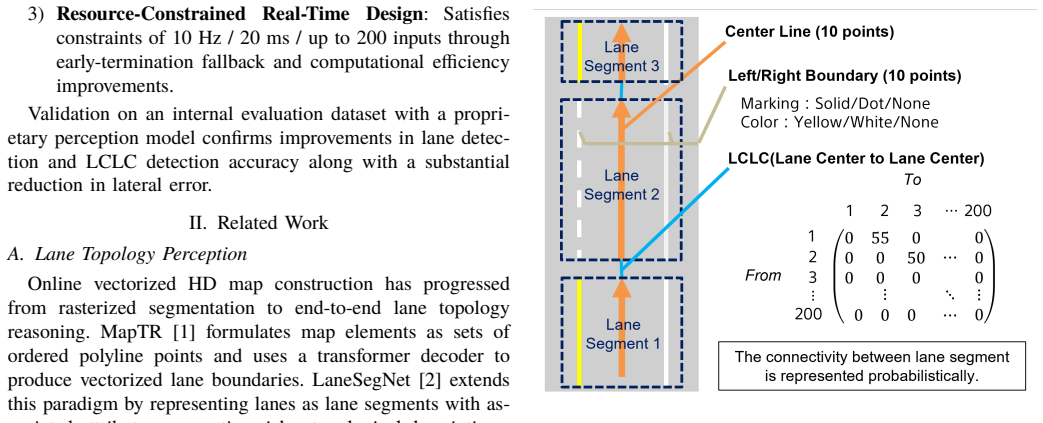
The central machinery is the graph-tracking state. Each lane segment carries a Track ID with a four-state lifecycle (Tentative, Tracking, TemporaryLost, Delete), and each LCLC is stored as a (FromID, ToID) pair whose confidence scores are integrated over a sliding window of length 10 with a majority-vote threshold of 5. Frame-to-frame assignment between observed and buffered segments uses a same-index discrete Fréchet approximation plus a point-to-line distance, computed under heading partitioning and gating to reduce the pair space; output junctions are smoothed with C0/C1 Bézier fits. This joint state is what lets the pipeline stabilize connectivity across frames rather than only positions
What would settle it
Run WASABI on a held-out set of driving sequences disjoint from the 16 used for tuning, or on a public lane-topology benchmark, without retuning the geometric thresholds; if the LCLC F1 gain over the baseline falls materially below the reported +0.114 or the toggle-rate reduction falls well short of 63.3%, the headline metrics partly reflect overfitting to the validation set.
Extended reading notes
Core claim
The central discovery is that treating lane segments and their LCLC connectivity as joint tracking targets—with a Track ID per segment and a (FromID, ToID) pair per connection—lets temporal history recover connections that are unstable in single frames. A sliding-window majority vote over per-frame connection scores suppresses connectivity gaps, while frame-internal deduplication and output-side topology correction remove duplicates and spurious edges. The experiments show the largest gain in LCLC F1, driven by a 70.1% drop in false-positive edges, and an across-frame toggle-rate reduction that per-frame F1 cannot capture. The ablation study confirms that tracking alone does not produce thes
Load-bearing premise
The reported gains rest on the assumption that the thresholds and output-selection weights tuned on the same 16-sequence validation set used for evaluation generalize to other roads, so the measured improvements are not inflated by tuning to that set.
Editorial extensions
If this is right
- Downstream planners can receive lane topology with roughly 70% fewer false connections and 63% fewer connection-state toggles, reducing route-disruption events caused by flicker.
- The post-processing recipe is model-agnostic: it operates on perception outputs and can be attached to different lane-topology models without retraining.
- The O(n) Fréchet approximation plus heading partitioning keeps average per-frame cost at roughly 7.5 ms on a single Arm Cortex-A78 core, about one-third of a 20 ms budget, even with up to roughly 135 tracked lanes.
- Tracking without refinement re-emits duplicates and spurious connections over time; the reported gains arise only from the combination of temporal association and noise-robust structuring.
- The same-index Fréchet approximation produces results identical to exact discrete Fréchet on this dataset, so low-cost matching is sufficient for lane segment association.
Reading between the lines
- Even if the reported gains hold, the paper's own stated limitations bound them: absolute detection precision/recall remain below 0.5, attribute accuracy sits at 0.74–0.83, and per-frame cost grows quadratically with lane count, so the stabilizer helps but does not close the full perception gap.
- Because geometric thresholds and output-selection weights are tuned on the same 16 sequences used to report the metrics, the absolute gains probably shrink on genuinely held-out scenes; a comparison on a public lane-topology benchmark would quantify this.
- A natural next step is closed-loop evaluation: the 63% toggle-rate reduction should reduce planner replanning events, but the paper stops at per-frame and temporal metrics, so the driving-level benefit remains an inference rather than a demonstrated result.
Editorial analysis
A structured set of objections, weighed in public.
Referee Report
Summary. The paper proposes WASABI, a real-time post-processing pipeline that jointly tracks lane segments and their connectivity (LCLC) across frames for autonomous driving perception. It combines frame-internal preprocessing, segment-to-segment association with a heading-partitioned Hungarian assignment and same-index Fréchet approximation, temporal state management, sliding-window majority voting for LCLC, output lane selection, topology correction, and near-endpoint Bézier smoothing. The authors report large improvements on an internal 16-sequence validation set: LCLC F1 from 0.834 to 0.948, centerline lateral error from 2.50 m to 0.95 m, a 24.6% reduction in detection false positives, and 63.3%/30.2% reductions in LCLC toggle and boundary-label flicker rates. A runtime study on a distinct intersection scene shows an average of 7.46 ms per frame on a single Arm Cortex-A78 core, within the 20 ms budget.
Significance. If the reported gains generalize, the paper makes a useful industrial contribution: it demonstrates that lane topology perception can be stabilized substantially by treating lane segments and their connectivity as joint tracking targets, and it provides a concrete real-time design under embedded constraints. The pipeline is clearly specified, the temporal metrics are GT-anchored and reasonable, and the runtime stress test on a scene distinct from the validation set is a notable strength. However, the significance is currently tempered by the fact that all headline accuracy claims are measured on the same internal validation set used to tune a large set of thresholds and weights, with no held-out evaluation and no public benchmark comparison. The central quantitative claims therefore remain conditional on the absence of validation-set overfitting.
major comments (3)
- [Section IV-A2 and Section III-C] The evaluation set and the hyperparameter-tuning set are the same 16 internal sequences. Section III-C states that the geometric/score thresholds (τθ, τL2, τPtoL, τov, τend, τcos, τψ) and the output-selection weights (wlen, wyaw, wlat) are 'tuned per sensor configuration and dataset' and omitted; Section IV-A2 then reports all main metrics (Tables II–VI) on that same validation dataset. This in-sample evaluation makes the headline improvements (+0.114 LCLC F1, 2.50→0.95 m lateral error, −24.6% FP) vulnerable to overfitting of the many gates and weights. The ablation in Table VII is also run on the same data and cannot detect such overfitting. I request a held-out evaluation (e.g., a separate test split or cross-validation over the 16 sequences), plus a sensitivity analysis of the headline metrics as the omitted thresholds/weights are varied. Without this, the central generalization claim
- [Section III-C, Eqs. (4)–(6)] The numerical values of the thresholds and weights used in the deduplication predicate, LCLC addition rule, and output-selection score are omitted. This is not merely a presentation issue: the pipeline has many free parameters (at least seven thresholds and three weights), and the reader cannot reproduce the experiments, judge the robustness of the reported gains to these settings, or assess whether the large improvements are driven by a few carefully chosen gates. Please provide a full parameter table (at least in supplementary material) and report the sensitivity of Tables II–VI to these parameters.
- [Section IV-B, Table V] The LCLC F1 improvement is restricted to connections whose endpoint lanes are both TP-matched to GT. Because WASABI and the baseline have different TP lane sets (215,167 vs. 190,169 TP), the evaluated LCLC populations differ between the two systems. The authors claim this ensures independence from detection-stage differences, but it also means the LCLC comparison is not made over a fixed set of lane pairs. This should be clarified: either compute LCLC metrics on the union of lane pairs that are TP-matched in at least one system, or explicitly report the size of the evaluated pair populations for baseline and WASABI. Without this, part of the LCLC F1 gain could be an artifact of the changing evaluation population.
minor comments (4)
- [Abstract and Section I] Minor typos: 'traffic' should be 'traffic'; 'W ASABI' spacing is inconsistent. Similar typographical issues appear in Section V ('difficult').
- [Table I] The parameter names are typeset with broken spacing ('NT rackStM ove', 'NT entDrop'), which should be fixed. Also, the table lists structural hyperparameters but omits the thresholds mentioned in Section III-C; if those are intentionally omitted, a reference to the supplementary table is needed.
- [Section IV-A3] The temporal stability metrics are only computed on GT lanes that are TP-matched in both frames. This is a reasonable choice, but the paper should state explicitly how many GT lanes/pairs are included in each sequence, and whether the common population differs between baseline and WASABI for the toggle-rate comparison.
- [Section IV-C, Table VII] For the 'Exact Fréchet' variant, the table reports only accuracy metrics, not runtime. Since the motivation for the same-index approximation is computational, adding the runtime of the exact variant would strengthen the claim that the approximation is necessary for the real-time budget.
Circularity Check
Headline accuracy numbers are measured on the same 16-sequence validation set used to tune the pipeline's thresholds and weights, making the reported improvements in-sample rather than independent predictions.
-
fitted input called prediction
[Section III-C (Table I, Eqs. 4-5); Section IV-A2; Abstract]
"thresholds determined empirically from validation data. Geometric and score thresholds (τθ,τL2,τPtoL,τov,τend,τcos,τψ) are omitted here as they are tuned per sensor configuration and dataset ... Evaluation uses the validation dataset of the perception model (16 sequences with ground truth), where WASABI post-processes the inference results ... On internal validation data (16 sequences), WASABI improves LCLC detection F1 from 0.834 to 0.948"
The gating thresholds in Eqs. (4)-(5) are fit to the validation data, and the paper's central accuracy/stability metrics (LCLC F1, detection F1, temporal rates) are computed on that same 16-sequence validation set. The reported improvement is therefore an in-sample measurement of a tuned filter, not an out-of-sample prediction. The evaluation set is identical to the tuning set, so the headline numbers are not independent of the parameter selection.
-
fitted input called prediction
[Section III-C2 (Eq. 6); Table III; Section IV-A2]
"Each candidate c is scored by a weighted sum of three components ... s(c)=wlenSlen(c)+wyawSyaw(c)+wlatSlat(c) (6) ... The weights wlen,wyaw,wlat are omitted here as they are tuned per sensor configuration and dataset. ... Centerline lateral error improves substantially from 2.50 m to 0.95 m, and boundary lateral error from 3.21 m to 1.06 m (Table III)."
Eq. (6) determines which per-zone priority lanes are emitted. The headline geometry gain (lateral error 2.50 m -> 0.95 m) is measured on the same validation data used to tune wlen/wyaw/wlat. The selection rule is thus fit to the evaluation set, so the lateral-error reduction can be partially produced by selecting outputs that score best under the tuned weights on the evaluation set, making the metric non-independent of the fitting.
full rationale
WASABI's algorithmic components (tracking, majority-vote LCLC history, Fréchet association, Bézier smoothing) are not defined in terms of the reported accuracy numbers, and the paper does not rely on self-citations. However, the central quantitative evidence is circular in an evaluation sense: the pipeline's thresholds and output-selection weights are explicitly tuned on the 16-sequence validation data (Section III-C), and every headline improvement (LCLC F1, detection F1, lateral error, temporal stability) is reported on that same data (Section IV-A2, Tables II-VI). Equations 4-6 directly embed these tuned parameters, and the ablation study (Table VII) also runs on the same set, so it cannot detect overfitting. The paper openly says it uses an internal dataset and leaves external comparison to future work, which mitigates concealment but not the structural in-sample circularity. This is the fitted-input-called-prediction pattern: the validation set serves both as the tuning set and as the evaluation set, so the gains do not demonstrate generalization. Score 6 reflects that the central validation claims reduce to the tuning set, even though the pipeline itself has independent algorithmic content and no self-citation chain.
Assumptions & free parameters
free parameters (4)
- geometric/score threshold set {τθ, τL2, τPtoL, τov, τend, τcos, τψ_dot} =
omitted (tuned per sensor/dataset)
- LCLC score threshold τ for majority vote =
omitted
- output-selection weights wlen, wyaw, wlat =
omitted (tuned per dataset)
- structural hyperparameters W, M, K, NTrackStMove, NTentDrop, Npromote, Nlost(d), d, N =
values in Table I (e.g., W=10, M=5, K=700)
assumptions (5)
- standard math Hungarian algorithm gives optimal assignment for the cost matrix, and heading-partitioned subproblems do not sacrifice association quality.
- ad hoc to paper The same-index Fréchet approximation is valid because gating restricts candidates to spatially proximate pairs; the ablation confirms it only on internal data.
- domain assumption Ego pose / odometry is accurate enough for ego-motion compensation and world-coordinate association.
- domain assumption GT matching with greedy Fréchet distance and threshold τ=3.0 m is a valid evaluation protocol for lane detection and LCLC.
- ad hoc to paper LCLC identities defined as Track ID pairs survive state deletion/promotion, and the W=10/M=5 sliding-window majority vote is a reasonable temporal model.
Cite this review
Pith. "Pith review of WASABI: Whole-graph Assignment-based Stabilizer for lAne topology By Inter-frame tracking." pith.science (2026). https://pith.science/paper/UBBO4GXC
@misc{pith2026260719781,
  author       = {Pith},
  title        = {Pith review of: WASABI: Whole-graph Assignment-based Stabilizer for lAne topology By Inter-frame tracking},
  year         = {2026},
  howpublished = {\url{https://pith.science/paper/UBBO4GXC}},
  note         = {Machine review of arXiv:2607.19781}
}
read the original abstract
Autonomous driving requires understanding the road as a graph of drivable lanes and their connectivity, beyond the ego lane alone, to follow routes through intersections and reason about cross- and merging-traffic. Recent perception models infer such lane topology, i.e., lane segments together with their inter-lane connectivity (LCLC), from onboard sensors over a 360-degree BEV view. Due to neural perception's imperfections, their outputs retain structural instabilities such as missed detections, lost or incorrect LCLC, over-detection, and label flicker. This paper presents WASABI, a real-time post-processing pipeline that stabilizes lane topology outputs both within and across frames by treating lane segments and their LCLC connectivity as joint tracking targets, under onboard real-time constraints (10 Hz / 20 ms / up to 200 input lanes). The pipeline integrates segment tracking with connectivity, noise-robust topology-aware refinement, and a resource-constrained real-time design. On internal validation data (16 sequences), WASABI improves LCLC detection F1 from 0.834 to 0.948 (+0.114, +13.6%) and reduces centerline lateral error from 2.50 m to 0.95 m, while reducing detection false-positives by 24.6%. Temporal-stability metrics on the same data show LCLC toggle rate reduced by 63.3% and boundary-label flicker rate by 30.2%, confirming across-frame stabilization beyond per-frame accuracy.
Figures


Figures from the paper (1 more)

Reference graph
Works this paper leans on
-
[1]
MapTR: Structured Modeling and Learning for Online Vectorized HD Map Construction
Bencheng Liao, Shaoyu Chen, Xinggang Wang, Tian- heng Cheng, Qian Zhang, Wenyu Liu, and Chang Huang. “MapTR: Structured Modeling and Learning for Online Vectorized HD Map Construction”. In: The Eleventh International Conference on Learning Repre- sentations, ICLR 2023 . 2023
2023
-
[2]
LaneSegNet: Map Learning with Lane Segment Perception for Au- tonomous Driving
Tianyu Li, Peijin Jia, Bangjun Wang, Li Chen, Kun Jiang, Junchi Yan, and Hongyang Li. “LaneSegNet: Map Learning with Lane Segment Perception for Au- tonomous Driving”. In: The Twelfth International Con- ference on Learning Representations, ICLR 2024 . 2024. url: https://openreview.net/forum?id=LsURkIPYR5
2024
-
[3]
Graph-based Topology Reasoning for Driving Scenes
Tianyu Li, Li Chen, Huijie Wang, Yang Li, Jiazhi Yang, Xiangwei Geng, Shengyin Jiang, Yuting Wang, Hang Xu, Chunjing Xu, Junchi Yan, Ping Luo, and Hongyang Li. Graph-based Topology Reasoning for Driving Scenes. 2023. arXiv: 2304.05277 [cs.CV]. url: https://arxiv.org/abs/2304.05277
arXiv 2023
-
[4]
OpenLane- V2: A Topology Reasoning Benchmark for Unified 3D HD Mapping
Huijie Wang, Tianyu Li, Yang Li, Li Chen, Chonghao Sima, Zhenbo Liu, Bangjun Wang, Peijin Jia, Yuting Wang, Shengyin Jiang, Feng Wen, Hang Xu, Ping Luo, Junchi Yan, Wei Zhang, and Hongyang Li. “OpenLane- V2: A Topology Reasoning Benchmark for Unified 3D HD Mapping”. In: Advances in Neural Information Processing Systems 36, NeurIPS 2023 . 2023
2023
-
[5]
Simple Online and Realtime Track- ing
Alex Bewley, Zongyuan Ge, Lionel Ott, Fabio Ramos, and Ben Upcroft. “Simple Online and Realtime Track- ing”. In: 2016 IEEE International Conference on Image Processing, ICIP 2016, Phoenix, AZ, USA, September 25–28, 2016 . IEEE, 2016, pp. 3464–3468
2016
-
[6]
Simple Online and Realtime Tracking with a Deep As- sociation Metric
Nicolai Wojke, Alex Bewley, and Dietrich Paulus. “Simple Online and Realtime Tracking with a Deep As- sociation Metric”. In: 2017 IEEE International Confer- ence on Image Processing, ICIP 2017, Beijing, China, September 17–20, 2017 . IEEE, 2017, pp. 3645–3649
2017
-
[7]
ByteTrack: Multi-Object Tracking by Associat- ing Every Detection Box
Yifu Zhang, Peize Sun, Yi Jiang, Dongdong Yu, Fang Zhu, Zehuan Yuan, Ping Luo, Wenyu Liu, and Xinggang Wang. “ByteTrack: Multi-Object Tracking by Associat- ing Every Detection Box”. In:Computer Vision – ECCV 2022, 17th European Conference, Tel Aviv, Israel, Oc- tober 23–27, 2022, Proceedings, Part XXII . Vol. 13682. Lecture Notes in Computer Science. Spri...
2022
-
[8]
Observation-Centric SORT: Rethinking SORT for Robust Multi-Object Tracking
Jinkun Cao, Jiangmiao Pang, Xinshuo Weng, Rawal Khirodkar, and Kris Kitani. “Observation-Centric SORT: Rethinking SORT for Robust Multi-Object Tracking”. In: IEEE/CVF Conference on Computer Vi- sion and Pattern Recognition, CVPR 2023, Vancouver, BC, Canada, June 17–24, 2023 . IEEE, 2023, pp. 9686– 9696
2023
Show all 11 references
-
[9]
StreamMapNet: Streaming Mapping Network for Vectorized Online HD Map Construction
Tianyuan Yuan, Yicheng Liu, Yue Wang, Yilun Wang, and Hang Zhao. “StreamMapNet: Streaming Mapping Network for Vectorized Online HD Map Construction”. In: IEEE/CVF Winter Conference on Applications of Computer Vision, WACV 2024, Waikoloa, HI, USA, January 3–8, 2024 . IEEE, 2024...
2024
-
[10]
Computing the Fréchet Distance between Two Polygonal Curves
Helmut Alt and Michael Godau. “Computing the Fréchet Distance between Two Polygonal Curves”. In: International Journal of Computational Geometry & Applications 5.1–2 (1995), pp. 75–91
1995
-
[11]
The Hungarian Method for the Assignment Problem
Harold W. Kuhn. “The Hungarian Method for the Assignment Problem”. In: Naval Research Logistics Quarterly 2.1–2 (1955), pp. 83–97
1955
Reviewed August 1, 2026 · model on record in the stance chip above.
Discussion (0). Sign in to comment.