REVIEW 3 major objections 6 minor 130 references
Evolved stars return only a quarter of the gas M33 burns to form stars, so the galaxy will deplete its gas within a billion years unless fresh gas falls in.
Reviewed by Pith at T0; open to challenge. T0 means a machine referee read the full paper against a public rubric. the ladder, T0–T4 →
T0 review · deepseek-v4-flash
2026-08-01 11:06 UTC pith:I7CQHKGA
load-bearing objection Solid full-disc mass-loss census for M33, but the headline 3σ ISM-depletion significance is inflated once the paper's own factor-two error on ζ is propagated. the 3 major comments →
The UK Infrared Telescope M33 monitoring project. VI. Feedback from dusty stellar winds across the galactic disc
The pith
A machine-rendered reading of the paper's core claim, the machinery that carries it, and where it could break.
Core claim
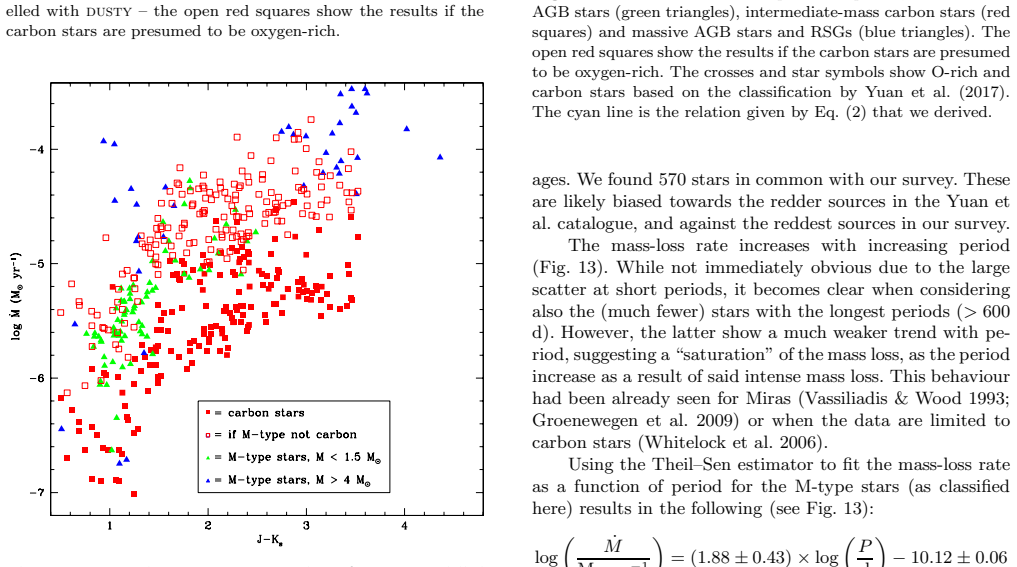
The paper claims that the total rate at which dusty winds from AGB stars and red supergiants return mass to the ISM of M33 is ζ ≈ 0.1 M⊙/yr (within a factor of two), about a factor 4.5 ± 1 below the star formation rate. It also finds that mass-loss rate is approximately proportional to luminosity (birth mass), with weaker dependences on pulsation period and amplitude; super-AGB stars exceed 10^-4 M⊙/yr, and red supergiants show three mass-loss modes (below, around, above the nuclear burning rate). The dominant mass-loss phase lasts only 6e4-2e5 yr. The authors conclude external gas supply is required.
What carries the argument
The self-similar scaling relation for radiation-driven dusty winds, (τ L^(3/4)) / (ψ^(1/2) Ṁ) ≈ constant, connects dust optical depth, luminosity, gas-to-dust ratio, and mass-loss rate. The authors calibrate this by fitting SEDs of 294 stars with a dust radiative transfer model, then build empirical relations between near-IR colour and optical depth/bolometric correction, applying them to the full variable-star sample. A radially varying gas-to-dust ratio accounts for the metallicity gradient.
Load-bearing premise
Every mass-loss rate relies on the assumption that the wind is a steady radiation-pressure-driven outflow with a specific density structure; if pulsation shocks, binarity, or other driving mechanisms are important, all rates and the total feedback are systematically off.
What would settle it
Measure the outflow kinematics of dusty AGB stars in M33 (e.g., with ALMA observations of molecular lines) and compare the density structure to the radiation-driven wind model; a mismatch would invalidate the derived mass-loss rates and the 0.1 M⊙/yr total.
If this is right
- M33 will exhaust its ISM in about 1 Gyr unless it accretes gas at roughly 0.35 M⊙/yr.
- Mass-loss rate scales linearly with luminosity, so more massive evolved stars return proportionally more mass; super-AGB stars reach extreme rates.
- The dominant mass-loss phase is a brief final episode (< 2e5 yr), much shorter than the TP-AGB or RSG phase.
- Carbon stars do not dominate dust return; silicates dominate, with carbonaceous dust contributing ~1/4 in the outer disc and ~1/7 in the centre.
Where Pith is reading between the lines
- If the feedback deficit is real, M33 should currently be accreting gas from its surroundings at a detectable rate; 21-cm observations of inflowing halo gas can test this.
- The near-linear Ṁ-L relation suggests the integrated mass return is nearly independent of short-term star-formation history, providing a robust population-wide 'recycling rate' for other galaxies.
- A targeted search for the most extreme, heavily obscured carbon stars would test whether the 0.1 M⊙/yr total is an underestimate; the authors note they may have missed a few such stars.
Editorial analysis
A structured set of objections, weighed in public.
Referee Report
Summary. This paper presents the sixth instalment of the UKIRT M33 monitoring project. The authors combine WFCAM JHKs time-series photometry with Spitzer 3.6/4.5/8 micron imaging to identify long-period variables across the M33 disc, model the SEDs of 294 evolved stars with the dusty radiative transfer code, calibrate optical-depth and bolometric-correction relations in terms of near-IR colours, and apply these to the full variable and non-variable samples. They derive approximate proportionality between mass-loss rate and luminosity, estimate that the dominant dust-producing mass-loss phase lasts ~0.6-2e5 yr, and obtain a total mass-return rate from dusty stellar winds of zeta ~ 0.1 Msun/yr ("give or take a factor two"). Comparing with the star formation rate xi = 0.45 +/- 0.10 Msun/yr, they conclude that M33's ISM will be depleted within ~1 Gyr unless external gas is accreted.
Significance. If correct, this is one of the few galaxy-wide, empirical censuses of mass return from AGB stars and RSGs, and it provides a valuable benchmark for stellar evolution and ISM feedback models. The paper's strengths are its large, multi-epoch, near- and mid-IR dataset; the direct SED modelling of 294 sources; the careful rejection of foreground stars, YSOs and other contaminants; and the systematic cross-checks against spectroscopically confirmed carbon stars, RSGs and symbiotic stars, as well as against relations from the LMC, SMC and Milky Way. The central mass-return estimate is defensible at the factor-of-two level. However, as discussed below, the headline significance of the ISM-shortfall claim and the luminosity-scaling claim are not supported by the paper's own error budget and method.
major comments (3)
- [Sec. 5.2] The claim that the mass-return rate zeta = 0.1 Msun/yr falls short of the SFR xi = 0.45 +/- 0.10 Msun/yr "at more than 3 sigma significance" is not supported by the paper's own uncertainty. Section 4.3 states zeta is "give or take a factor two". The quoted ratio xi/zeta = 4.5 +/- 1 propagates only the SFR uncertainty, treating zeta as exact. With zeta in [0.05, 0.2] Msun/yr and xi = 0.45 +/- 0.10, the ratio spans roughly 1.8 to 9. The deficit is therefore not established at 3-sigma. Please propagate the full uncertainty on zeta, or present the comparison as a factor-of-two-limited estimate, and soften the abstract and conclusion accordingly.
- [Sec. 4.2.1, Eq. (1); Sec. 3.2] The reported near-proportionality between mass-loss rate and luminosity, log Mdot = (0.98 +/- 0.18) log L - 9.35, is partly a construction artifact. In Sec. 3.2, Mdot is obtained from the self-similar radiatively driven wind scaling (tau L^{3/4})/(psi^{1/2} Mdot) ~ constant, i.e. Mdot is proportional to tau L^{3/4} psi^{-1/2}. Thus even a sample with tau independent of L would show a slope of 0.75 in log Mdot versus log L. The fitted slope 0.98 +/- 0.18 differs from 0.75 by only ~1.3 sigma, so the data do not independently establish a slope of unity; they indicate only a weak positive correlation of tau with L on top of the assumed wind scaling. Please report the fit relative to this built-in baseline and avoid presenting Eq. (1) as an empirical discovery of Mdot proportional to L.
- [Sec. 5.1.2, Eq. (7), Fig. 19] The inference that the dominant mass-loss phase lasts 0.6-2e5 yr, shorter than the TP-AGB/RSG phase, is model-dependent in a way that is not fully acknowledged. The ratio eta in Eq. (7) compares integrated mass loss (Mdot_i times delta t_i) with birth mass. A discrepancy of factors 2.5-5 could be resolved either by shortening delta t, as the paper assumes, or by a systematic overestimate of Mdot (e.g. from the wind scaling or dust opacity assumptions) or by an underestimate of birth mass. The paper gives no independent calibration of the LPV duration; it assumes a 2e5 yr duration for carbon stars and then derives the other durations. Please state this degeneracy explicitly and present the timescale as conditional on the adopted Mdot calibration and model lifetimes.
minor comments (6)
- [Sec. 1] "Messier 1771" appears to be a typo; the intended object is Messier 33.
- [References and Appendix A] Corrupted names appear in the text: "Miko/suppress lajewska" and "tjhemsleves". Please proofread the bibliographic and appendix text.
- [Sec. 5.2, Fig. 16] The text refers to "Figure 20" when discussing the radial variation of the replenishment rate; the relevant radial profile appears to be Fig. 16. Please check all cross-references.
- [Sec. 3.1] The statement that "in some cases no acceptable match" led to changing T_star or T_d should be quantified: how many stars, and by how much were the temperatures changed? This affects reproducibility of the SED fits.
- [Sec. 3, Sec. 4.3] The carbon-star classification threshold of 1.5-4 Msun is model-based. The comparison with spectroscopically confirmed stars is reassuring, but a sensitivity test using e.g. a 3.5 Msun upper limit would help quantify the effect on the total carbon-star mass-return rate.
- [Sec. 2.2, Sec. 4.3] The survey completeness factor of 0.3-0.5 is derived from the Spitzer-variable comparison. Please clarify whether this is a detection completeness for LPVs or a classification completeness, since the two could affect the mass-return correction differently.
Circularity Check
Secondary Mdot-L proportionality is partly inherited from the assumed radiatively-driven-wind scaling; central feedback budget remains independently anchored.
specific steps
-
self definitional
[§3.1–3.2 scaling relations; §4.2.1 Eq. (1); abstract]
"On the basis of self-similarity of radiatively-driven winds there are scaling relations ... such that the combination of (τL^{3/4})/(ψ^{1/2} Mdot) is approximately constant. ... The mass-loss rate then follows from the self-similar description of radiation-driven winds ... determined by the values for τ, L and ψ. ... log(Mdot/Msun/yr) = (0.98 ± 0.18) × log(L/Lsun) − 9.35 ± 0.05. This suggests proportionality between mass-loss rate and luminosity."
Eq. (1) is fitted to Mdot values that were not measured independently but computed from the adopted scaling relation, which already contains log Mdot ∝ 0.75 log L + log τ − 0.5 log ψ. The fitted luminosity exponent (0.98 ± 0.18) therefore equals the built-in 0.75 plus the τ(L) relation from the same SED models; it is not an independent empirical determination. Since 0.75 is within about 1.3σ of the fitted slope, the abstract's claim that mass loss is 'approximately proportional to luminosity' largely restates the assumed wind scaling rather than testing it. The total mass-return budget does not rely on Eq. (1), so the circularity is partial and secondary.
full rationale
The central result — the total mass-return rate ζ ≈ 0.1 M⊙/yr and its factor-four shortfall relative to the star-formation rate — is an empirical census. Individual Mdot values are obtained from SED fits (τ, L, ψ) through the dusty radiative-transfer code, summed over the LPV population, corrected for completeness, and compared with independent external calibrations (Goldman et al. 2017; van Loon et al. 2005a; Groenewegen & Sloan 2018; the initial–final mass relation). That chain is not circular: the radiatively-driven-wind scaling relation is an external, explicitly stated assumption, and the derived budget is anchored to photometry. However, one secondary conclusion — that Mdot is 'approximately proportional to luminosity' (Eq. 1 and the abstract) — is partly circular, because every Mdot in the fit was computed from the same assumed scaling relation, which already contains L^{3/4}. The fitted slope 0.98±0.18 is within ~1.3σ of the built-in 0.75, so the proportionality claim mostly restates the input scaling rather than independently measuring a luminosity law. This does not invalidate the total feedback estimate, which does not depend on Eq. (1). The statistical overstatement of the ξ/ζ significance noted by the skeptic is a correctness/error-propagation issue, not a circularity, and is therefore not scored here.
Axiom & Free-Parameter Ledger
free parameters (7)
- Radial gas-to-dust mass ratio ψ =
200 (r<2.5 kpc), 250 (2.5–3.5), 300 (3.5–4), 350 (4–4.5), 400 (>4.5 kpc)
- Inner dust temperature T_d =
900 K (sometimes changed)
- Stellar temperature T_* =
3000 K (sometimes changed)
- Carbon-star classification mass range =
1.5–4 M_sun
- Assumed LPV phase duration for carbon stars =
2 × 10^5 yr
- τ–colour and BC–colour scaling coefficients (Tables 2 & 3) =
Listed in Tables 2 and 3
- Survey completeness correction =
factor ~2–3.3 (1/0.3 to 1/0.5)
axioms (8)
- domain assumption Self-similar radiation-driven wind scaling: (τ L^{3/4})/(ψ^{1/2} Mdot) ≈ const (Ivezić & Elitzur 1999)
- domain assumption The dusty radiative-transfer code correctly models dusty circumstellar envelopes
- domain assumption All stars lie at the adopted distance modulus μ = 24.9 mag
- domain assumption Padova evolutionary models (Marigo et al. 2008, 2017) give correct birth masses, luminosities and TP-AGB lifetimes
- domain assumption Initial–final mass relation of Williams et al. (2009) is correct
- domain assumption Constant SFR over the past 10 Gyr and a Salpeter IMF for the pseudo-evolutionary tracks
- domain assumption Interstellar reddening to M33 stars is negligible compared to circumstellar reddening at near-IR wavelengths
- domain assumption The near-IR variability detection selects the stars undergoing the heaviest mass loss
read the original abstract
We have conducted a near-infrared monitoring campaign at the UK InfraRed Telescope (UKIRT), of the Local Group spiral galaxy M33 (Triangulum). In this sixth paper of the series, we measure the dust and gas mass-loss rates by the pulsating Asymptotic Giant Branch (AGB) stars and red supergiants (RSGs) across the stellar disc of M33. We combined our time-averaged near-IR photometry with the multi-epoch mid-IR photometry obtained with the Spitzer Space Telescope, and employed a combination of spectral energy distribution modelling and scaling relations. We found that the mass-loss rate is approximately proportional to luminosity (birth mass), with additional weaker dependence on pulsation period and/or amplitude (reflecting stellar evolution). As a population, AGB stars contribute most to the mass return into the interstellar medium (ISM). Super-AGB stars also reach very high mass-loss rates, in excess of $10^{-4}$ M$_\odot$ yr$^{-1}$. The mass loss of RSGs appears to be subject to different modes, with rates well below, around, and well above the nuclear burning timescale. The timescale for the dominant mass loss phase is $\sim0.6$-$2\times10^5$ yr, shorter than the thermal-pulsing AGB or RSG phases. The rate at which stars return mass to the ISM, $\sim0.1$ M$_\odot$ yr$^{-1}$ is about four times lower than the star formation rate, which would deplete the current ISM mass within about a Gyr, thus requiring additional, external gas supplies to sustain the long-term future of star formation in M33.
Figures




Reference graph
Works this paper leans on
-
[1]
Barsukova E.\ A., Govanskij V.\ P., Hornoch K., Fabrika S., Pietsch W., Sholukhova O., Valeev A.\ F., 2011, MNRAS, 413, 1797
2011
-
[2]
Beasor E.\ R., Davies B., 2016, MNRAS, 463, 1269
2016
-
[3]
Beasor E.\ R., Davies B., 2018, MNRAS, 475, 55
2018
-
[4]
Benjamin R.\ A.\ et al., 2005, ApJ, 630, L149
2005
-
[5]
Bladh S., H\"ofner S., Aringer B., Eriksson K., 2015, A&A, 575, A105
2015
-
[6]
Block D.\ L.\ et al.\ , 2007, A&, 471, 467
2007
-
[7]
Bolatto A.\ D., 2007, ApJ, 655, 212
2007
-
[8]
Bonanos A.\ Z.\ et al., 2006, ApJ, 652, 313
2006
-
[9]
Bonanos A.\ C.\ et al., 2010, AJ, 140, 416
2010
-
[10]
Boothroyd A.\ I., Sackmann I.-J., 1992, ApJ, 393, L21
1992
-
[11]
Boyer M.\ L.\ et al., 2012, ApJ, 748, 40
2012
-
[12]
Buckalew B.\ A.\ et al., 2006, ApJS, 162, 329
2006
-
[13]
Burggraf B.\ et al., 2015, A&A, 581, A12
2015
-
[14]
Cioni M.-R.\ L.\ et al., 2008, A&A, 487, 131
2008
-
[15]
Clark J.\ S.\ et al., 2012, A&A, 541, A146
2012
-
[16]
Contreras Pe\ na C.\ et al., 2017, MNRAS, 465, 3011
2017
-
[17]
Davidge T., 2000, AJ, 119, 748
2000
-
[18]
Davidge T., 2018, ApJ, 856, 129
2018
-
[19]
Deul E.\ R., van der Hulst J.\ M., 1987, A&AS, 67, 509
1987
-
[20]
Draine B.\ T., Lee H.\ M., 1984, ApJ, 285, 89
1984
-
[21]
Drout M., Massey P., Meynet G., 2012, ApJ, 750, 97
2012
-
[22]
Dwek E., ApJ, 501, 643
-
[23]
Ekstr\"om S.\ et al., 2012, A&A, 537, A146
2012
-
[24]
Freedman W.\ L., Wilson C.\ D., Madore B.\ F., 1991, ApJ, 372, 455
1991
-
[25]
Georgy C., 2012, A&A, 538, L8
2012
-
[26]
Georgy C., Ekstr\"om S., Meynet G., Massey P., Levesque E.\ M., Hirschi R., Eggenberger P., Maeder A., 2012, A&A, 542, A29
2012
-
[27]
Goldman S.\ R.\ et al., 2017, MNRAS, 465, 403
2017
-
[28]
Goldman S.\ R.\ et al., 2018, MNRAS, 473, 3835
2018
-
[29]
Gonz\'alez-L\'opezlira R.\ A., 2018, 856, 170
2018
-
[30]
Gratier P.\ et al., 2017, A&A, 600, A27
2017
-
[31]
Greenhill L.\ J., Moran J.\ M., Reid M.\ J., Gwinn C.\ R., Menten K.\ M., Eckart A., Hirabayashi H., 1990, ApJ, 364, 513
1990
-
[32]
Groenewegen M.\ A.\ T., Sloan G.\ C., Soszy\'nski I., Petersen E.\ A., 2009, A&A, 506, 1277
2009
-
[33]
Groenewegen M.\ A.\ T., Sloan G.\ C., 2018, 609, A114
2018
-
[34]
Gruendl R.\ A., Chu Y.-H., 2009, ApJS, 184, 172
2009
-
[35]
Gruendl R.\ A., Chu Y.-H., Seale J.\ P., Matsuura M., Speck A.\ K., Sloan G.\ C., Looney L.\ W., 2008, ApJ, 688, L9
2008
-
[36]
Guandalini R., Busso M., 2008, A&A, 488, 675
2008
-
[37]
Gullieuszik M.\ et al., 2012, A&A, 537A, 105
2012
-
[38]
Hanner M.\ S., 1988, NASA Conf.\ Pub.\ 3004, 22
1988
-
[39]
Hodierna G.\ B., 1654, De Systemate Orbis Cometici, Deque Admirandis Coeli Characteribus (About the systematics of the cometary orbit, and about the admirable objects of the sky), Palermo
-
[40]
H\"ofner S., 2008, A&A, 491, L1
2008
-
[41]
H\"ofner S., Olofsson H., 2018, A&ARv, 26, 1
2018
-
[42]
Hubble E., Sandage A., 1953, ApJ, 118, 353
1953
-
[43]
Humphreys R.\ M., Leitherer C., Stahl O., Wolf B., Zickgraf F.-J., 1988, A&A, 203, 306
1988
-
[44]
Iben I.\ Jr., Renzini A., 1983, ARA&A, 21, 271
1983
-
[45]
Ishihara D., Kaneda H., Onaka T., Ita Y., Matsuura M., Matsunaga N., 2011, A&A, 534, A79
2011
-
[46]
Ivezi\'c Z , Elitzur M., 1995, ApJ, 445, 415
1995
-
[47]
Ivezi\'c Z , Elitzur M., 1997, MNRAS, 287, 799
1997
-
[48]
Ivezi\'c Z , Nenkova M., Elitzur M., 1999, dusty User Manual (University of Kentucky)
1999
-
[49]
Javadi A., van Loon J.\ Th., Mirtorabi M.\ T., 2011a, MNRAS, 411, 263 (Paper I)
-
[50]
Javadi A., van Loon J.\ Th., Mirtorabi M.\ T., 2011b, MNRAS, 414, 3394 (Paper II)
-
[51]
Javadi A., van Loon J.\ Th., Mirtorabi M.\ T., 2011c, in: Why Galaxies Care About AGB Stars II, eds.\ F.\ Kerschbaum, T.\ Lebzelter & R.\ F.\ Wing, ASPC, 445, 497
-
[52]
Javadi A., van Loon J.\ Th., Khosroshahi H., Mirtorabi M.\ T., 2013, MNRAS, 432, 2824 (Paper III)
2013
-
[53]
Javadi A., Saberi M., van Loon J.\ Th., Khosroshahi H., Golabatooni N., Mirtorabi M.\ T., 2015, MNRAS, 447, 3973 (Paper IV)
2015
-
[54]
Javadi A., van Loon J.\ Th., Khosroshahi H., Tabatabaei F., Hamedani Golshan R., Rashidi M., 2017, MNRAS, 464, 2103 (Paper V)
2017
-
[55]
Jones A.\ P.\ et al., 2014, Faraday Discussions, 168, 313
2014
-
[56]
Jones O.\ C.\ et al., 2017, MNRAS, 470, 3250
2017
-
[57]
Jura M., Kleinmann S.\ G., 1989, ApJ, 341, 359
1989
-
[58]
Jura M., Kleinmann S.\ G., 1990, ApJS, 73, 769
1990
-
[59]
Kang X., Chang R., Yin J., Hou J., Zhang F., Zhang Y., Han Z., 2012, MNRAS, 426, 1455
2012
-
[60]
Khan R., Stanek K.\ Z., Kochanek C.\ S., Bonanos A.\ Z., 2011, ApJ, 732, 43
2011
-
[61]
Khan R., Stanek K.\ Z., Kochanek C.\ S., 2013, ApJ, 767, 52
2013
-
[62]
Khan R., Kochanek C.\ S., Stanek K.\ Z., Gerke J., 2015, ApJ, 799, 187
2015
-
[63]
Koch E., Rosolowsky E., Johnson M.\ C., Kepley A.\ A., Leroy A., 2018, preprint (arXiv:1801.10568)
Pith/arXiv arXiv 2018
-
[64]
Laki\'cevi\'c M.\ et al., 2015, ApJ, 799, 50
2015
-
[65]
Marigo P., Girardi L., Bressan A., Groenewegen M.\ A.\ T., Silva L., Granato G.\ L., 2008, A&A, 482, 883
2008
-
[66]
Marshall J.\ R., van Loon J.\ Th., Matsuura M., Wood P.\ R., Zijlstra A.\ A., Whitelock P.\ A., 2004, MNRAS, 355, 1348
2004
-
[67]
Massey P., Armandroff T.\ E., Pyke R., Patel K., Wilson C.\ D., 1995, AJ, 110, 2715
1995
-
[68]
Matsuura M., Woods P.\ M., Owen P.\ J., 2013, MNRAS, 429, 2527
2013
-
[69]
Matsuura M.\ et al., 2009, MNRAS, 396, 918
2009
-
[70]
Mattsson L., H\"ofner S., Herwig F., 2007, A&A, 470, 339
2007
-
[71]
Mauron N., Josselin E., 2011, A&A, 526, A156
2011
-
[72]
McDonald I., Zijlstra A.\ A., Boyer M.\ L., 2012, MNRAS, 427, 343
2012
-
[73]
McDonald I., van Loon J.\ Th., Decin L., Boyer M.\ L., Dupree A.\ K., Evans A., Gehrz R.\ D., Woodward C.\ E., 2009, MNRAS, 394, 831
2009
-
[74]
McQuinn K.\ B.\ W.\ et al., 2007, ApJ, 664, 850
2007
-
[75]
Meixner M.\ et al., 2006, AJ, 132, 2268
2006
-
[76]
Menzies J., Feast M, Whitelock P., Olivier E., Matsunaga N., da Costa G., 2008, MNRAS, 385, 1045
2008
-
[77]
Messier C., 1771, Mem.\ Acad., p448
-
[78]
Miko ajewska J., Shara M.\ M., Caldwell N., I kiewicz K., Zurek D., 2017, 465, 1699
2017
-
[79]
Montiel E.\ J., Srinivasan S., Clayton G.\ C., Engelbracht C.\ W., Johnson C.\ B., 2015, AJ, 149, 57
2015
-
[80]
Nelson E.\ J.\ et al., 2018, preprint (arXiv:1801.02647)
Pith/arXiv arXiv 2018
discussion (0)
Sign in with ORCID, Apple, or X to comment. Anyone can read and Pith papers without signing in.