REVIEW 3 major objections 6 minor 55 references
Exploring Multifunctionality in MgO-Based Magnetic Tunnel Junctions with Coexisting Magnetoresistance and Memristive Properties
T0 review · 3 major / 6 minor · reviewed 2026-08-01 · deepseek-v4-flash
Pith's one-line read MgO magnetic tunnel junctions work as both linear magnetic sensors and reversible non-volatile memristors.
desk verdict Genuine step beyond the prior MTJ+memristor work, with the reversibility claim as the main soft spot. read the letter →
The pith
A machine-rendered reading of the paper's core claim, the machinery that carries it, and where it could break.
The reading
What carries the argument
The central mechanism is a parallel two-conduction-channel model: one channel is the coherent spin-polarized tunneling through the MgO barrier that produces the tunnel magnetoresistance; the other is a voltage-tunable conductive filament (oxygen vacancies) that shunts the barrier and carries no spin polarization. The variable parallel resistance accounts for the memristive switching, the suppression of TMR in the low-resistance state, and the linear TMR-versus-resistance-area relationship, and its full dissolution in the reset step restores the pristine tunneling properties.
What would settle it
Cycle the device for at least 10,000 set/reset operations and measure the tunneling magnetoresistance after each reset; if the TMR decays or the high-resistance state drifts downward, the reversibility claim fails. Additionally, cross-sectional transmission electron microscopy of a device in the reset state should show an intact MgO barrier with no residual filament connecting the electrodes.
Extended reading notes
Core claim
The paper demonstrates that a 55 μm CoFeB/MgO/CoFeB magnetic tunnel junction exhibits a tunneling magnetoresistance of about 45% in the high-resistance state and a bipolar resistive switching ratio of about 100 between the high- and low-resistance states, at room temperature. The low-resistance state shorts out the tunneling magnetoresistance, and the reset process restores the original barrier, recovering the TMR to its pre-forming value. The resistance can be set to intermediate levels by partial reset pulses, with a linear correlation between the TMR and the resistance–area product, explained by a two-channel model: a spin-dependent tunneling path in parallel with a variable, spin-indepen
Load-bearing premise
The reset process completely and repeatedly removes the conductive filament, so the recovered tunneling magnetoresistance comes from a reconstructed MgO barrier rather than from a new non-magnetic conduction path.
Editorial extensions
If this is right
- A single MTJ device can be used as both a magnetic field sensor and a non-volatile memory element, enabling reconfigurable sensor bridges that can be switched into gradiometer mode after fabrication.
- Because the memristive state can fully suppress and then recover the TMR, spintronic circuits can have their functionality reprogrammed post-fabrication by a simple pulsing protocol.
- The nanosecond write pulses and picojoule-level energy consumption put these devices in the range needed for neuromorphic synapses and crossbar arrays.
- The observed area scaling suggests that smaller junctions will have larger resistance ratios, so the multifunctional behavior should improve when scaled toward nanometer dimensions.
- Ta doping of the MgO barrier reduces the forming energy by about 20%, providing a concrete materials route to low-power operation, albeit with reduced TMR.
Reading between the lines
- If the filament is indeed oxygen-vacancy based, then controlling oxygen stoichiometry or using reactive electrode materials could further tune forming voltage, endurance, and retention in these MTJs.
- The reversibility claim rests on the reset pulse fully dissolving the filament; an endurance test over thousands of cycles with TMR recovery measured after each reset would be a natural stress test of this assumption.
- The two-channel model is generic: any defect or parasitic conduction path in an MTJ could be exploited to program TMR, which might extend to STT-MRAM cells as multi-level analog synapses.
- The Ta doping trade-off suggests that other dopants or barrier engineering might achieve even lower switching energy while preserving a larger fraction of the TMR.
Signed reviews
Editorial analysis
A structured set of objections, weighed in public.
Referee Report
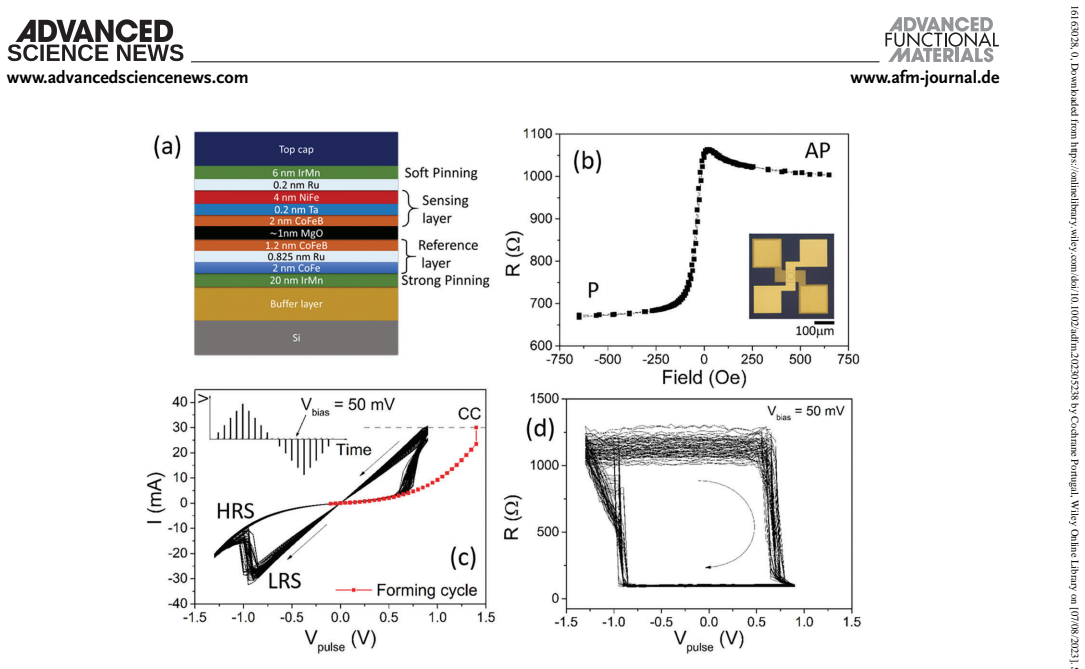
Summary. The paper reports MgO-based magnetic tunnel junctions that simultaneously exhibit a linear, low-hysteresis TMR response (~45%) suitable for magnetic field sensing and a non-volatile, bipolar memristive resistance-switching effect (HRS/LRS ratio up to ~100). The authors show that the TMR is suppressed when the device is set to the LRS and recovered after reset to the HRS, and that intermediate resistance states can be programmed quasi-analogously. They also show area-dependent switching, attribute the LRS to a filamentary conduction path, and demonstrate that inserting an ultrathin Ta layer in the MgO barrier lowers the forming energy by ~20% at the cost of reducing TMR to 25%. The central claim is that memristive switching can reversibly and completely suppress and recover the spintronic functionality without degradation of either property.
Significance. If the reversibility claim holds, this is a significant advance: it would provide a single device that can be electrically reconfigured between a sensitive magnetic sensor and a high-resistance memristive state, opening a route to reprogrammable spintronic circuits and multifunctional sensor arrays. The paper's strengths include a clear device stack and fabrication description, a direct two-terminal pulsed measurement protocol, and a simple two-channel shunt model whose signature (linear TMR vs RxA relation in Fig. 3d) is explicitly verified. The area dependence of HRS/LRS (Fig. 4) is consistent with filamentary switching. However, the central reversibility claim rests largely on a single representative reset cycle and on the interpretation of a Simmons fit, and the paper lacks the statistical evidence needed to establish that full barrier recovery is repeatable. The result is credible but not yet convincingly supported as a general property of the devices.
major comments (3)
- [§2.2, Fig. 2a and Fig. 3b] The paper's key differentiator is that the TMR can be 'completely suppress[ed] and recover[ed]' after reset, but the evidence is one R(H) cycle in Fig. 3b and the statement that measurements 'have been performed for several cycles, showing systematic results without degradation.' No number of cycles, quantitative recovery values, or error bars are provided. Moreover, the Fig. 2a caption explicitly states that the HRS dispersion is 'expected since the filament is not always 100% recovered in the reset process.' This admission directly weakens the claim of full barrier recovery; at minimum, the manuscript must quantify the distribution of recovered TMR and resistance after many set/reset cycles and show that the recovery is not accompanied by a progressive degradation of the magnetic response.
- [§2.2, Eq. (1) and Fig. 2c] The Simmons fit is used as evidence that 'the original barrier is recovered in the reset process,' but the fit is performed on a single HRS I-V curve and has two free parameters (barrier thickness t and average barrier height φ/2). The extracted values may also be consistent with a partially dissolved filament that leaves a non-magnetic, tunneling-like conduction path in parallel with the spin-dependent channel. The linear TMR–RxA relation in Fig. 3d is indeed the signature of a parallel shunt, but it does not identify the physical nature of the shunt. To support the barrier-recovery claim, the authors should show fits to multiple HRS cycles, report fitting residuals and the range of the data used, and compare the HRS I-V with the pristine (pre-forming) I-V. Without this, the claim that the original coherent tunneling channel is regenerated is not established.
- [§2.2, Fig. 1d, Fig. 2a, Fig. 3, and Experimental Section] The paper states that 'all studied areas show a similar RxA, TMR, and memristive properties,' but the detailed characterization is presented for a single 55 μm device, and many key plots (RHSL, retention, resistive-switching distributions, intermediate-state R(H) curves) lack error bars or device-to-device statistics. For a device-oriented claim of multifunctionality and reproducibility, the absence of raw data and statistical measures (e.g., device counts, standard deviations, box plots) makes it impossible to assess whether the observed coexistence is a robust property or a singular result. The authors should provide statistics across several devices and cycles, at least for the main claims of TMR value, HRS/LRS ratio, and TMR recovery.
minor comments (6)
- [Eq. (1)] The symbol φ is used in the equation and later defined as ϕ/2 (average barrier height). Please clarify whether φ in Eq. (1) is the same as the average barrier height or the full barrier height; the current notation is confusing.
- [Experimental Section] In stack 1, the target RxA is given as '2.4 MΩ μcm2'; this should presumably be μm², and the same unit is used as MΩ μm² earlier. Please make the notation consistent.
- [Throughout] The abbreviation for the resistance hysteresis switching loop is inconsistent: the text uses both 'RSHL' and 'RHSL' (Fig. 1d caption vs. §2.2). Please unify to one abbreviation.
- [Fig. 2a inset] The text says the standard deviation of Vset and Vreset is 0.5 V, 'which is lower than the step utilized to measure the IV curve (0.1V).' Since 0.5 V > 0.1 V, this appears to be either a typo or a mistaken comparison; please verify the intended statement.
- [Table 1] The '≈100pJ' energy value for the present work likely refers to the reset operation, but the text gives 5 and 100 pJ for set and reset, and 350 pJ for forming. Please clarify which operation is quoted in the table and keep the notation consistent.
- [Reference list] Reference [49] has formatting errors ('M,C.,' and 'PREPRINT 2023'); please correct the citation.
Circularity Check
No significant circularity: central results are direct experimental observations; fits and self-citations are interpretive or supporting, not load-bearing.
full rationale
The paper's central claims—coexistence of ~45% TMR and bipolar memristive switching with HRS/LRS ratio up to ~100, and reversible suppression/recovery of TMR—are experimental observations supported by direct measurements (R(H) curves, RHSL loops, read-pulse resistances) in Figures 1–3. No derivation chain is offered in which a predicted quantity reduces by definition or by construction to a fitted input. The Simmons fit in §2.2/Fig. 2c is an interpretive characterization of one HRS I-V curve used to argue that the HRS is consistent with a recovered MgO barrier; it does not generate the TMR or switching data, and its parameters are not used to predict the observed TMR or memristive ratios. The parallel-shunt model in §2.2/Fig. 3d is likewise an explanatory framework for the observed linear TMR-vs-RxA correlation, not an input from which the coexistence or reversibility is derived. Self-citations to the authors' prior stack and annealing work (refs [42,43]) support the sensor design and processing, but those are not the target result; the claimed multifunctionality is evidenced independently by the measured device behavior. Ref [53] supports the conventional parallel-conduction picture and is corroborated by external ref [54]. The Fig. 2a caption explicitly notes that HRS dispersion is 'expected since the filament is not always 100% recovered in the reset process'; this is an admitted limitation on the strength of the reversibility claim, but it is a physical/statistical caveat, not a circular step. Overall, the central results are self-contained experimental observations rather than predictions derived from fitted parameters or from a self-citation chain.
Assumptions & free parameters
free parameters (2)
- Simmons barrier thickness t =
1.3 ± 0.2 nm
- Simmons barrier height φ/2 =
1.07 ± 0.01 eV
assumptions (4)
- domain assumption Simmons tunneling model (Eq. 1) adequately describes HRS transport through MgO.
- domain assumption A variable spin-independent conductive filament shunts the tunnel barrier in LRS and intermediate states.
- domain assumption The filament is composed of oxygen vacancies in MgO.
- domain assumption The reference and sensing magnetic layers are not irreversibly altered by electroforming or high current pulses.
Cite this review
Pith. "Pith review of Exploring Multifunctionality in MgO-Based Magnetic Tunnel Junctions with Coexisting Magnetoresistance and Memristive Properties." pith.science (2026). https://pith.science/paper/EZN6VWFO
@misc{pith2026260720040,
  author       = {Pith},
  title        = {Pith review of: Exploring Multifunctionality in MgO-Based Magnetic Tunnel Junctions with Coexisting Magnetoresistance and Memristive Properties},
  year         = {2026},
  howpublished = {\url{https://pith.science/paper/EZN6VWFO}},
  note         = {Machine review of arXiv:2607.20040}
}
read the original abstract
Magnetic tunnel junctions (MTJs) and memristors are two key emerging nanotechnologies that attracted significant interest for potential applications at the forefront of the digital revolution, including sensing, data storage, and non-conventional computation. The co-integration of these phenomena into a single multifunctional device is an important step toward harnessing the re-programmability of memristive systems with the high yield and varied functionality of MTJs. This study demonstrates the co-existence of magnetoresistance and memristive properties on MgO-based MTJs. These devices show a magnetoresistance with a linear response as a function of a magnetic field and no hysteresis, which are the requirements for good magnetic field sensors, as well as demonstrating a non-volatile and quasi-analogue memristive behavior as a function of an applied electrical field down to nanosecond pulses. Furthermore, by doping the oxide barrier, the memristive power consumption is lowered by 20% giving the multi-functionality of the devices a promising scalability potential. This study also shows that, memristive switching can be reversibly used to completely suppress and recover the spintronic functionalities. These results can pave the way for a seamless co-integration of memristors and spintronic devices in complex reprogrammable circuits addressing applications such as reprogrammable multifunctional field sensor arrays and neuromorphic computing.
Figures


Figures from the paper (2 more)


Reference graph
Works this paper leans on
-
[1]
M.N.Baibich,J.M.Broto,A.Fert,F.N.VanDau,F.Petroff,P.Etienne, G.Creuzet,A.Friederich,J.Chazelas, P h y s .R e v .L e t t .1988,61,2472
1988
-
[2]
Dieny, V
B. Dieny, V. S. Speriosu, S. S. P. Parkin, B. A. Gurney, D. R. Wilhoit, D.Mauri, Phys. Rev. B1991,43,1297
-
[3]
Tsunoda, F
S.Ikeda,J.Hayakawa,Y.Ashizawa,Y.M.Lee,K.Miura,H.Hasegawa, M. Tsunoda, F. Matsukura, H. Ohno,Appl. Phys. Lett. 2008, 93, 082508
2008
-
[4]
Cardoso, D
S. Cardoso, D. C. Leitao, L. Gameiro, F. Cardoso, R. Ferreira, E. Paz, P. P. Freitas,Microsyst. Technol.2014,20,793
2014
-
[6]
Mater.2007,6,813
C.Chappert,A.F ert,F .N.V anDau,Nat. Mater.2007,6,813
2007
-
[7]
S. S. P. Parkin, C. Kaiser, A. Panchula, P. M. Rice, B. Hughes, M. Samant,S..Yang, Nature Mater.2004,3,862
2004
-
[8]
Y.Huai, AAPPS Bull.2008,18,33
2008
-
[9]
Grollier, D
J. Grollier, D. Querlioz, K. Y. Camsari, K. Everschor-Sitte, S. Fukami, M.D.Stiles, Nat. Electron.2020,3,360
2020
Show all 55 references
-
[10]
Commun.2018,9,1533
A.Mizrahi,T.Hirtzlin,A.Fukushima,H.Kubota,S.Yuasa,J.Grollier, D.Querlioz, Nat. Commun.2018,9,1533
2018
-
[11]
Rep.2019, 9,15661
A.S.Jenkins,L.S.E.Alvarez,P.P.Freitas,R.Ferreira, Sci. Rep.2019, 9,15661
2019
-
[12]
Today2008,11,28
A.Sawa, Mater. Today2008,11,28
-
[13]
I.H.Inoue,A.Sawa, Functional Metal Oxides: New Science and Novel Applications,Wiley-VCH,Weinheim, 2013
2013
-
[14]
Haensch, A
W. Haensch, A. Raghunathan, K. Roy, B. Chakrabarti, C. M. Phatak, C.Wang,S.Guha, Adv. Mater.2023,2204944
2023
-
[15]
S.Pi,C.Li,H.Jiang,W.Xia,H.Xin,J.JoshuaYang,Q.Xia, Nat.Nan- otechnol.2019,14,35
2019
-
[16]
Mohammad, M
B. Mohammad, M. A. Jaoude, V. Kumar, D. M. Al Homouz, H. A. Nahla, M. Al-Qutayri, N. Christoforou,Nanotechnol. Rev.2016, 5, 311
2016
-
[17]
S. S. P. Parkin, C. Kaiser, A. Panchula, P. M. Rice, B. Hughes, M. Samant,S.-H.Yang, Nat. Mater.2004,3,862. [ 1 8 ]C .D i a s ,L .M .G u e r r a ,B .D .B o r d a l o ,H .L v ,A .M .F e r r a r i a ,A .M . Botelho do Rego, S. Cardoso, P. P. Freitas, J. Ventura,Phys. Chem. Chem....
2004
-
[19]
Phys.2019,2,90
B.Rana,Y.Otani, Commun. Phys.2019,2,90
2019
-
[20]
M.Mansueto,A.Chavent,S.Auffret,I.Joumard,L.Vila,R.C.Sousa, L. D. Buda-Prejbeanu, I. L. Prejbeanu, B. Dieny,Nanoscale 2021, 13, 11488
2021
-
[21]
Raymenants, A
E. Raymenants, A. Vaysset, D. Wan, M. Manfrini, O. Zografos, O. Bultynck, J. Doevenspeck, M. Heyns, I. P. Radu, T. Devolder,J. Appl. Phys.2018,124,152116
2018
-
[22]
Zhang, W
X. Zhang, W. Cai, M. Wang, B. Pan, K. Cao, M. Guo, T. Zhang, H. Cheng,S.Li,D.Zhu,L.Wang,F.Shi,J.Du,W.Zhao, Adv.Sci.(Weinh.) 2021,8,2004645
2021
-
[23]
Martins, A
L. Martins, A. S. Jenkins, L. S. E. Alvarez, J. Borme, T. Böhnert, J. Ventura,P.P.Freitas,R.Ferreira, Sci. Rep.2021,11,16094
2021
-
[24]
Mater.2019,31,1900636
A.Kurenkov,S.DuttaGupta,C.Zhang,S.Fukami,Y.Horio,H.Ohno, Adv. Mater.2019,31,1900636
2019
-
[25]
Zhong, Y
H. Zhong, Y. Wen, Y. Zhao, Q. Zhang, Q. Huang, Y. Chen, J. Cai, X. Zhang, R.-W. Li, L. Bai, S. Kang, S. Yan, Y. Tian,Adv. Funct. Mater. 2019,29,1806460
2019
-
[26]
Zhang, Z
Z.Liu,H.Wang,M.Li,L.Tao,T.R.Paudel,H.Yu,Y.Wang,S.Hong, M. Zhang, Z. Ren, Y. Xie, E. Y. Tsymbal, J. Chen, Z. Zhang, H. Tian, Nature2023,613,656
-
[27]
2017,111,182410
J.Cai,B.Fang,C.Wang,Z.Zeng, Appl.Phys.Lett. 2017,111,182410
2017
-
[28]
Chanthbouala, R
A. Chanthbouala, R. Matsumoto, J. Grollier, V. Cros, A. Anane, A. Fert, A. V. Khvalkovskiy, K. A. Zvezdin, K. Nishimura, Y. Nagamine, H.Maehara,K.Tsunekawa,A.Fukushima,S.Yuasa, Nat.Phys. 2011, 7,626
2011
-
[29]
L. Qi, J. Shen, Q. Xu, P. Lu, P. Feng, H. Sun,Chem. Phys. Lett.2022, 799,139560
2022
-
[30]
W.Hoo,E.H.Toh,W.S.Lew, Appl
S.C.W .Chow,P .A.Dananjaya,J.M.Ang,D.J.J.Loy,J.R.Thong,S. W.Hoo,E.H.Toh,W.S.Lew, Appl. Surf. Sci.2023,608,155233
2023
-
[31]
Hong, C.-F
J.-Y. Hong, C.-F. Hung, K.-H. O. Yang, K.-C. Chiu, D.-C. Ling, W.-C. Chiang,M.-T.Lin, Sci. Rep.2021,11,6027
2021
-
[32]
Krzysteczko, G
P. Krzysteczko, G. Reiss, A. Thomas,Appl. Phys. Lett. 2009, 95, 112508
2009
-
[33]
Halley, H
D. Halley, H. Majjad, M. Bowen, N. Najjari, Y. Henry, C. Ulhaq- Bouillet, W. Weber, G. Bertoni, J. Verbeeck, G. Van Tendeloo,Appl. Phys. Lett.2008,92,212115
2008
-
[34]
Lett.2008,92,113508
C.Yoshida,M.Kurasawa,Y.M.Lee,M.Aoki,Y.Sugiyama, Appl.Phys. Lett.2008,92,113508
2008
-
[35]
H. Lv, J. Fidalgo, A. V. Silva, D. C. Leitao, T. Kampfe, S. Riedel, J. L a n g e r ,J .W r o n a ,B .O c k e r ,P .P .F r e i t a s ,S .C a r d o s o ,Appl. Phys. Lett. 2019,114,102402
2019
-
[36]
Ventura, J
J. Ventura, J. Teixeira, J. Araujo, F. Carpinteiro, J. Sousa, Z. Zhang, Y. Liu,P.Freitas, J. Non-Cryst. Solids2008,354,5272
-
[37]
Actuators, A2001,91,2
C.Treutler, Sens. Actuators, A2001,91,2
-
[38]
M.Pannetier-Lecoeur,L.Parkkonen,N.Sergeeva-Chollet,H.Polovy, C.Fermon,C.Fowley, Appl. Phys. Lett.2011,98,153705
2011
-
[39]
J.Torrejon, M.Riou,F.A.Araujo,S.Tsunegi,G.Khalsa,D.Querlioz, P.Bortolotti,V.Cros,K.Yakushiji,A.Fukushima,H.Kubota,S.Yuasa, M.D.Stiles,J.Grollier, Nature2017,547,428
-
[40]
Fukami,S.Kanai,H.Ohno,J.Åkerman, Nat
M.Zahedinejad,H.Fulara,R.Khymyn,A.Houshang,M.Dvornik,S. Fukami,S.Kanai,H.Ohno,J.Åkerman, Nat. Mater.2022,21,81
2022
-
[41]
Bortolotti,L.Martins,A.Jenkins,R.Ferreira,J.Grollier, Neuromorph
N.Leroux,A.Mizrahi,D.Markovi ´c,D.Sanz-Hernández,J.Trastoy,P. Bortolotti,L.Martins,A.Jenkins,R.Ferreira,J.Grollier, Neuromorph. Comput. Eng.2021,1,011001
2021
-
[42]
Ferreira, E
R. Ferreira, E. Paz, P. P. Freitas, J. Wang, S. Xue,IEEE Trans. Magn. 2012,48,3719
2012
-
[43]
2016,52,2525772
E.Paz,R.Ferreira,P.P.Freitas, IEEETrans.Magn. 2016,52,2525772
2016
-
[44]
J.G.Simmons, J. Appl. Phys.1964,35,2655
1964
-
[45]
H. Lv, D. C. Leitao, Z. Hou, P. P. Freitas, S. Cardoso, T. Kämpfe, J. Müller,J.Langer,J.Wrona, AIP Adv.2018,8,055908
2018
-
[46]
J. M. Teixeira, J. Ventura, R. Fermento, J. P. Araujo, J. B. Sousa, P. Wisniowski,P.P.Freitas, J. Phys. D: Appl. Phys.2009,42,105407
2009
-
[47]
R.H.Koch,G.A.Keefe,G.Allen, Rev. Sci. Instrum.1996,67,230
1996
-
[48]
Romera, P
M. Romera, P. Talatchian, S. Tsunegi, F. Abreu Araujo, V. Cros, P. Bortolotti,J.Trastoy,K.Yakushiji,A.Fukushima,H.Kubota,S.Yuasa, M. Ernoult,D. Vodenicarevic, T. Hirtzlin,N. Locatelli,D. Querlioz, J. Grollier,Nature2018,563,230
-
[49]
T.Böhnert,Y.Rezaeiyan,M,C.,L.Benetti,A.S.Jenkins,H.Farkhani, F.Moradi,R.Ferreira,PREPRINT2023availableatResearchSquare, http://doi.org/10.21203/rs.3.rs-2587470/v1
-
[50]
Joksas, A
D. Joksas, A. AlMutairi, O. Lee, M. Cubukcu, A. Lombardo, H. Kurebayashi, A. J. Kenyon, A. Mehonic,Adv. Intell. Syst.2022, 4, 2200068
2022
-
[51]
C. Li, M. Hu, Y. Li, H. Jiang, N. Ge, E. Montgomery, J. Zhang, W. Song,N.Dávila,C.E.Graves,Z.Li,J.P.Strachan,P.Lin,Z.Wang,M. Barnell, Q. Wu, R. S. Williams, J. J. Yang, Q. Xia,Nat. Electron.2017, 1,52
2017
-
[52]
P.Yao,H.Wu,B.Gao,J.Tang,Q.Zhang,W.Zhang,J.J.Yang,H.Qian, Nature2020,577,641
-
[53]
J. D. Costa, S. Serrano-Guisan, B. Lacoste, A. S. Jenkins, T. Böhnert, M. Tarequzzaman, J. Borme, F. L. Deepak, E. Paz, J. Ventura, R. Ferreira, P. P. Freitas,Sci. Rep.2017,7,7237
2017
-
[54]
Ostrowski, T
S.Mao,E.Linville,J.Nowak,Z.Zhang,S.Chen,B.Karr,P.Anderson, M. Ostrowski, T. Boonstra, H. Cho, O. Heinonen, M. Kief, S. Xue, J. Price, A. Shukh, N. Amin, P. Kolbo, P.-L. Lu, P. Steiner, Y. C. Feng, N.-H.Yeh,B.Swanson,P.Ryan, IEEE Trans. Magn.2004,40,307
2004
-
[55]
J. M. Teixeira, J. Ventura, J. P. Araujo, J. B. Sousa, P. Wisniowski, S. Cardoso,P.P.Freitas, P h y s .R e v .L e t t .2011,106,196601
2011
-
[56]
W. Chen, L. Song, S. Wang, Z. Zhang, G. Wang, G. Hu, S. Gao,Adv. Electron. Mater.2023,9,2200833
2023
-
[57]
J.Zhu,T.Zhang,Y.Yang,R.Huang, Appl. Phys. Rev.2020,7,011312. Adv. Funct. Mater.2023,2305238 2305238(9of9) ©2023TheAuthors. AdvancedFunctionalMaterialspublishedbyWiley-VCHGmbH 16163028, 0, Downloaded from https://onlinelibrary.wiley.com/doi/10.1002/adfm.202305238 by Cochrane Po...
2020 doi
Reviewed August 1, 2026 · model on record in the stance chip above.
Discussion (0). Continue with ORCID to comment.