REVIEW 3 major objections 6 minor 52 references
ReferTrack claims that grounding target identification in explicit image-space bounding boxes—selecting one indexed detection before planning—makes a single-camera agent match or beat multi-camera policies on identification-heavy tracking.
Reviewed by Pith at T0; open to challenge. T0 means a machine referee read the full paper against a public rubric. the ladder, T0–T4 →
T0 review · deepseek-v4-flash
2026-08-01 10:54 UTC pith:VGAUDABA
load-bearing objection A well-built empirical extension that makes target identification an explicit indexed-bbox selection, with real gains on EVT-Bench; but the unmeasured top-K truncation/detector recall and single-run reporting keep me from fully endorsing the strong claims. the 3 major comments →
ReferTrack: Referring Then Tracking for Embodied Visual Tracking
The pith
A machine-rendered reading of the paper's core claim, the machinery that carries it, and where it could break.
Core claim
ReferTrack formulates embodied visual tracking as a two-stage operation over a discrete candidate set. At each timestep, detections from the forward camera are organized into an indexed catalog of pedestrian bounding boxes. The policy's first reasoning action is a single Refer-CoT token selecting the catalog entry that matches the language instruction (or ⟨NO EXIST⟩ if the target is absent); only then does it decode waypoints, conditioned on that selection. The selected bounding box is appended to a sliding-window queue and injected into the visual history of subsequent frames through temporal-viewpoint-bbox indicator (TVBI) tokens, giving the planner target-specific geometric memory. Co-tra
What carries the argument
The load-bearing mechanism is the indexed candidate catalog plus a single Refer-CoT token. An off-the-shelf detector and multi-object tracker produce a set of pedestrian bounding boxes; each box is assigned a special token (⟨ped_k⟩) and its coordinates are projected into the language model's embedding space. The first LLM forward pass performs a classification over these tokens (plus ⟨NO EXIST⟩), making target identification a compact, directly supervised multiple-choice decision in image space rather than an open-ended spatial abstraction. The second mechanism is the temporal-viewpoint-bbox indicator (TVBI) token: the selected target's past bounding boxes, embedded with the same projector,
Load-bearing premise
The central result depends on the off-the-shelf detector and tracker finding the instructed target and keeping it among the top-K largest bounding boxes in the current forward view; the paper does not measure how often the target is absent from the candidate catalog after that truncation.
What would settle it
On the benchmark's distracted and ambiguity splits, compute the fraction of episodes where the instructed target is not present in the detected candidate catalog (missed by the detector/tracker, or cut by the top-K area truncation). If that fraction is substantial and correlates with failures, the reported gains are partly an unmeasured detection bottleneck; if it is near zero, the referring mechanism is confirmed as the decisive factor.
If this is right
- If correct, a single forward-facing camera suffices for embodied tracking; multi-camera setups are not required for identification-heavy scenarios.
- Explicit image-space referring can substitute for expensive RL fine-tuning: the reported gains come from supervised fine-tuning with a 1:1 mix of navigation and referring-QA data.
- The candidate-catalog interface decouples identification from planning, so improvements in referring and grounding models can transfer to tracking without new closed-loop navigation data.
- The TVBI bbox-queue memory is a direct cause of stability: removing both Refer-CoT and TVBI drops success from 73.3% to 55.7% on the distracted split, showing target selection and temporal bbox memory are complementary.
- The referring-QA co-training recipe suggests a scalable data path: large existing referring and grounding datasets can be converted into tracking supervision through the same indexed-box interface.
Where Pith is reading between the lines
- The paper does not report how often the instructed target is missing from the detected candidate catalog after the top-K truncation; if the detector fails or the area-based cut removes the target, the Refer-CoT token cannot select it and the episode cannot succeed. An oracle-catalog experiment would isolate how much of the reported gain depends on raw detection recall.
- The oracle TVBI ablation (ground-truth bboxes, 81.5% SR on distracted tracking) still trails the expert policy (85.1%) and beats the full model (73.3%), so identification errors, not planning, are the main residual bottleneck; coupling ReferTrack with a re-identification module that can revisit past choices could close that gap.
- Because the design replaces abstract latent reasoning with a discrete selection, the same interface could be applied to other 'find X, then act' VLA tasks, such as following a particular vehicle or heading to a described object in a scene.
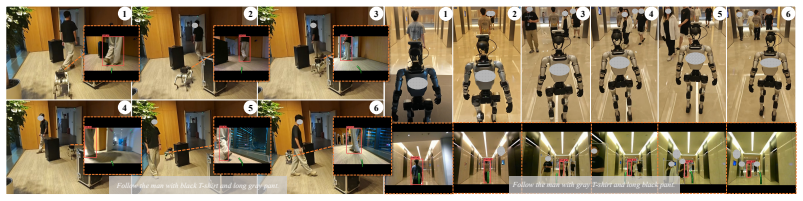
- The real-world deployments are qualitative demonstrations on a remote server at 10.6 Hz with a forward-facing camera; a quantitative field study with measured target-loss rates under occlusion and network latency would test the sim-to-real claim beyond demonstrations.
Editorial analysis
A structured set of objections, weighed in public.
Referee Report
Summary. The paper introduces ReferTrack, a 4B-parameter vision-language-action (VLA) policy for embodied visual tracking from a single forward-facing camera. The core idea is to formulate target identification as a constrained selection among an indexed set of image-space pedestrian bounding boxes, produced by YOLO11+ByteTrack and truncated to a top-K catalog. A single "Refer-CoT" token selects the target (or outputs NO EXIST), and the selected bbox is pushed into a FIFO queue whose geometric features are injected into historical visual tokens via temporal-viewpoint-bbox indicator (TVBI) tokens. The policy is trained by SFT on 1.3M navigation samples plus 1.3M synthetically generated Refer-QA samples, with losses for trajectory MSE, Refer-CoT cross-entropy, and text cross-entropy. On EVT-Bench in a single-view protocol, the paper reports state-of-the-art success rates of 89.4/73.3/74.1 on the single-target, distracted, and ambiguity splits, and shows qualitative real-robot deployment on a quadruped and a humanoid. The main claim is that explicit image-space referring can compensate for limited camera coverage and reduce the need for larger models or RL fine-tuning.
Significance. If the reported results are reproducible, the paper makes a useful conceptual contribution: it replaces abstract spatial CoT tokens with a grounded, index-based referring step, and shows that this interface can be trained jointly with navigation data and synthetic referring QA data. The architecture is described in enough detail to be internally coherent, the ablation in Table 2 isolates the contributions of Refer-CoT and TVBI, and the oracle variant provides a useful upper bound. The code release, the real-robot validation, and the explicit treatment of the target-absent case via a NO EXIST slot are also strengths. However, as detailed below, the central claim rests on an unmeasured external dependency — the candidate catalog's recall and truncation — and on several claims that lack supporting ablations or statistical grounding. The significance would be higher if these issues were addressed.
major comments (3)
- [§3.2 Candidate Catalog; Table 1] The central success claim depends on the instructed target being present in the indexed catalog. §3.2 truncates detections to the top-K bboxes by area, but K is never reported and the recall of YOLO11+ByteTrack+top-K against the ground-truth target on EVT-Bench is never measured. If the target is missed or pruned, the Refer-CoT token cannot select it and the episode cannot succeed, regardless of referring or planning quality. The oracle ablation in Table 2 (TVBI w/ GT bbox) bypasses both the detector and the truncation, so the gap from 81.5 to 73.3 SR conflates detector/pruning failures with the model's own referring errors. Please report K, measure the recall of the candidate catalog on the evaluation splits, and add an ablation that feeds ground-truth detection boxes (or a recall-controlled catalog) while still requiring Refer-CoT selection, to separate detection/truncation from referr
- [§3.3 Training; Table 2] The paper claims that co-training on the custom Refer-QA dataset 'strengthens' and 'transfers seamlessly' to online tracking, and Refer-QA constitutes half of the Stage-2 training data. Yet Table 2 contains no ablation that removes Refer-QA while keeping the navigation data fixed. Without such a variant, the contribution of the Refer-QA co-training objective to the reported DT/AT improvements is unsupported. This is load-bearing because the method's stated novelty includes the co-training recipe as a means of improving identification. Please add an ablation such as 'navigation data only, no Refer-QA' with the same model and training budget.
- [Table 1; §4.2] All EVT-Bench results are reported as single runs with no error bars, variance, or significance tests. The headline comparisons to TrackVLA++ and VLingNav are absolute differences from single runs, which is risky for a central SOTA claim. Additionally, the abstract and §4.2 state that ReferTrack 'matches or even surpasses several multi-camera baselines' on DT/AT, while Table 1 labels those rows as external references from other publications with 3–4 cameras. This is not a controlled comparison and the wording should be softened or accompanied by a statistical analysis. At minimum, report multiple seeds with mean±std and, if possible, a paired test for the single-view comparisons; for the multi-camera references, state explicitly that input settings differ.
minor comments (6)
- [§3.2] K and H are never numerically specified in the main text or Appendix, though the paper says hyperparameters are in the Appendix. Please report K, H, and the queue capacity explicitly in §3.2 or in a reproducibility table in the Appendix.
- [Eq. (1)] It would help to clarify whether E_refer^T in the second forward pass is the token embedding of the selected index or the token id itself, and how the action head consumes E_A^T.
- [Table 1] NavFoM single-view row has a missing CR entry, and the multi-camera reference rows are not visually distinguished from the single-view methods. Consider separate sub-tables or clearer formatting so the main comparison is unambiguous.
- [Figure 1] The example instruction contains 'T-shit' (should be 'T-shirt'); also the catalog in the figure uses inconsistent capitalization (<Ped_8> vs <ped_8>). Please fix.
- [§B.1] There is a typo: 'different embodiedments' should be 'different embodiments'.
- [§A.2] The referred negative caption is said to be 'not present in the image,' but it is not stated how the negative caption is selected from SYNTH-PEDES or whether it is a random or hard negative. A sentence clarifying this would aid reproducibility.
Circularity Check
No construction-level circularity; external EVT-Bench results are measured, and self-citations are lineage only.
full rationale
ReferTrack's reported SR/TR/CR numbers are empirical measurements on the held-out EVT-Bench test splits (Table 1), not quantities derived from model equations or fitted constants, so the central claim is externally falsifiable. The refer-then-track formulation (Eq. 1) requires the LLM to output a discrete bbox-index token before waypoint decoding; success is scored by the downstream Habitat following metrics, so a wrong selection fails the episode and correctness is not by construction. Refer-QA co-training is auxiliary supervision on SYNTH-PEDES composites, and TVBI tokens are an architectural mechanism (Eq. 2) whose effect is measured by ablations (Table 2); neither reduces the benchmark result to its inputs. Self-citations to TrackVLA, TrackVLA++, and NavFoM appear as related work, baseline comparisons, and a training-recipe reference (Appendix A.3); they are not used as uniqueness theorems or as the sole justification for the paradigm. The detector-recall / top-K truncation dependency highlighted by the skeptic is a real external limitation and a possible confound for the 'image-space referring beats camera coverage' interpretation, but it is not a definitional circularity: YOLO11+ByteTrack is an off-the-shelf external component whose misses would only cap measured success, not guarantee it. No equation in the paper makes a reported result equal to an input by construction. Score 2 reflects mild self-referential lineage pressure from the authors' prior EVT work, not a circular derivation.
Axiom & Free-Parameter Ledger
free parameters (5)
- Trajectory-loss weight α =
10
- Catalog top-K cap K =
not reported
- Visual history window H =
not reported
- Queue noise injection probability =
not reported
- Refer-QA composition settings =
2-3 crops, scale 0.75-1.5
axioms (5)
- domain assumption YOLO11+ByteTrack detections contain the instructed target and are sorted into a stable index order.
- domain assumption Top-K truncation by bbox area preserves the target when more than K pedestrians are visible.
- domain assumption The custom oracle expert controller generates high-quality, representative following behavior for training.
- domain assumption SYNTH-PEDES-based synthetic Refer-QA examples transfer to Habitat simulation and real robots.
- domain assumption A single special-token classification over a dynamically changing catalog is a learnable and reliable interface for a 4B LLM.
invented entities (4)
-
Refer-CoT selection token
no independent evidence
-
TVBI tokens
no independent evidence
-
NO EXIST virtual catalog slot
no independent evidence
-
Referred-target bbox queue
no independent evidence
read the original abstract
Embodied visual tracking (EVT) requires a mobile agent to continuously follow a specific target described in natural language using only onboard vision. While recent vision-language-action (VLA) policies unify target identification and trajectory planning, their chain-of-thought (CoT) reasoning often operates in abstract spatial latents that are difficult to supervise and weakly aligned with explicit image-space detections. To address this, we introduce ReferTrack, a referring-then-tracking paradigm that grounds EVT using a single forward-facing camera. Our model first selects the target from an indexed set of bounding boxes, then decodes tracking waypoints conditioned on this image-grounded decision. To preserve target motion cues over time, ReferTrack maintains a sliding-window queue of previously selected bounding boxes, injecting their geometric features into the visual history via temporal-viewpoint-bbox indicator (TVBI) tokens. We further enhance target identification by co-training on a custom Refer-QA dataset. On EVT-Bench, ReferTrack achieves state-of-the-art single-view performance with success rates of 89.4%, 73.3%, and 74.1% on the single-target, distracted, and ambiguity tracking splits, respectively -- matching or even surpassing several multi-camera baselines on identification-heavy tasks. Finally, real-world deployments on legged and humanoid robots validate its robust sim-to-real transfer capabilities. Code is available at https://github.com/MedlarTea/referTrack.
Figures




Reference graph
Works this paper leans on
-
[1]
S. Wang, J. Zhang, M. Li, J. Liu, A. Li, K. Wu, F. Zhong, J. Yu, Z. Zhang, and H. Wang. Trackvla: Embodied visual tracking in the wild. InConference on Robot Learning, pages 4139–4164. PMLR, 2025
2025
-
[2]
J. Liu, Y . Qi, J. Zhang, M. Li, S. Wang, K. Wu, H. Ye, H. Zhang, Z. Chen, F. Zhong, et al. Trackvla++: Unleashing reasoning and memory capabilities in vla models for embodied visual tracking.arXiv preprint arXiv:2510.07134, 2025
arXiv 2025
-
[3]
Zhong, P
F. Zhong, P. Sun, W. Luo, T. Yan, and Y . Wang. Ad-vat+: An asymmetric dueling mechanism for learning and understanding visual active tracking.IEEE Trans. Pattern Anal. Mach. Intell., 43(5):1467–1482, 2021
2021
-
[4]
Zhong, K
F. Zhong, K. Wu, H. Ci, C. Wang, and H. Chen. Empowering embodied visual tracking with visual foundation models and offline rl. InEuropean Conference on Computer Vision, pages 139–155. Springer, 2024
2024
-
[5]
H. Sun, K. Zhou, H. Gao, S. Zhang, J. Hu, X. Wen, Q. Ye, and M. Tan. Instance-level visual active tracking with occlusion-aware planning.arXiv preprint arXiv:2604.21453, 2026
Pith/arXiv arXiv 2026
-
[6]
Kirillov, E
A. Kirillov, E. Mintun, N. Ravi, H. Mao, C. Rolland, L. Gustafson, T. Xiao, S. Whitehead, A. C. Berg, W.-Y . Lo, et al. Segment anything. InProceedings of the IEEE/CVF international conference on computer vision, pages 4015–4026, 2023
2023
-
[7]
N. Ravi, V . Gabeur, Y .-T. Hu, R. Hu, C. Ryali, T. Ma, H. Khedr, R. R ¨adle, C. Rolland, L. Gustafson, et al. Sam 2: Segment anything in images and videos.arXiv preprint arXiv:2408.00714, 2024
Pith/arXiv arXiv 2024
-
[8]
S. Liu, Z. Zeng, T. Ren, F. Li, H. Zhang, J. Yang, Q. Jiang, C. Li, J. Yang, H. Su, et al. Grounding dino: Marrying dino with grounded pre-training for open-set object detection.arXiv preprint arXiv:2303.05499, 2023
Pith/arXiv arXiv 2023
- [9]
-
[10]
Y . Liu, L. Gao, L. Liu, M. Lv, and Y . Cai. Comatrack: Competitive multi-agent game-theoretic tracking with vision-language-action models.arXiv preprint arXiv:2603.22846, 2026
arXiv 2026
-
[11]
Zhang, K
J. Zhang, K. Wang, S. Wang, M. Li, H. Liu, S. Wei, Z. Wang, Z. Zhang, and H. Wang. Uni- navid: A video-based vision-language-action model for unifying embodied navigation tasks. InRobotics: Science and Systems, 2025
2025
-
[12]
S. Wang, Y . Luo, X. Chen, A. Luo, D. Li, C. Liu, S. Chen, Y . Zhang, and J. Yu. Vlingnav: Embodied navigation with adaptive reasoning and visual-assisted linguistic memory.arXiv pre-print, 2026. URLhttps://arxiv.org/abs/2601.08665
arXiv 2026
-
[13]
Z. Chu, S. Xie, X. Wu, Y . Shen, M. Luo, Z. Wang, F. Liu, X. Leng, J. Hu, M. Yin, et al. Abot- n0: Technical report on the vla foundation model for versatile embodied navigation.arXiv preprint arXiv:2602.11598, 2026
arXiv 2026
-
[14]
Krantz, E
J. Krantz, E. Wijmans, A. Majumdar, D. Batra, and S. Lee. Beyond the nav-graph: Vision- and-language navigation in continuous environments. InEuropean Conference on Computer Vision, pages 104–120. Springer, 2020
2020
-
[15]
Yokoyama, R
N. Yokoyama, R. Ramrakhya, A. Das, D. Batra, and S. Ha. Hm3d-ovon: A dataset and bench- mark for open-vocabulary object goal navigation. In2024 IEEE/RSJ International Conference on Intelligent Robots and Systems (IROS), pages 5543–5550. IEEE, 2024. 9
2024
-
[16]
Z. Chen, Y . Guo, Z. Chu, M. Luo, Y . Shen, M. Sun, J. Hu, S. Xie, K. Yang, P. Shi, et al. So- cialnav: Training human-inspired foundation model for socially-aware embodied navigation. arXiv preprint arXiv:2511.21135, 2025
arXiv 2025
-
[17]
Jiang, L
Q. Jiang, L. Wu, Z. Zeng, T. Ren, Y . Xiong, Y . Chen, L. Qin, and L. Zhang. Referring to any person. InProc. IEEE Int. Conf. Comput. Vis., pages 21667–21678, 2025
2025
-
[18]
J. Zuo, J. Hong, F. Zhang, C. Yu, H. Zhou, C. Gao, N. Sang, and J. Wang. Plip: Language- image pre-training for person representation learning.Advances in neural information pro- cessing systems, 37:45666–45702, 2024
2024
-
[19]
D. Shah, B. Osinski, B. Ichter, and S. Levine. Lm-nav: Robotic navigation with large pre- trained models of language, vision, and action.arXiv preprint arXiv:2207.04429, 2022
Pith/arXiv arXiv 2022
-
[20]
G. Zhou, Y . Hong, and Q. Wu. Navgpt: Explicit reasoning in vision-and-language navigation with large language models.arXiv preprint arXiv:2305.16986, 2023
Pith/arXiv arXiv 2023
-
[21]
Zhang, K
J. Zhang, K. Wang, R. Xu, G. Zhou, Y . Hong, X. Fang, Q. Wu, Z. Zhang, and H. Wang. Navid: Video-based vlm plans the next step for vision-and-language navigation.Robotics: Science and Systems, 2024
2024
-
[22]
Cheng, Y
A.-C. Cheng, Y . Ji, Z. Yang, X. Zou, J. Kautz, E. Biyik, H. Yin, S. Liu, and X. Wang. Navila: Legged robot vision-language-action model for navigation. InRobotics: Science and Systems, 2025
2025
-
[23]
M. Wei, C. Wan, X. Yu, T. Wang, Y . Yang, X. Mao, C. Zhu, W. Cai, H. Wang, Y . Chen, et al. Streamvln: Streaming vision-and-language navigation via slowfast context modeling.arXiv preprint arXiv:2507.05240, 2025
Pith/arXiv arXiv 2025
-
[24]
Zhong, P
F. Zhong, P. Sun, W. Luo, T. Yan, and Y . Wang. Towards distraction-robust active visual tracking. InInternational Conference on Machine Learning, pages 12782–12792. PMLR, 2021
2021
-
[25]
D. Peng, J. Cao, Q. Zhang, and J. Ma. Lovon: Legged open-vocabulary object navigator.arXiv preprint arXiv:2507.06747, 2025
Pith/arXiv arXiv 2025
-
[26]
Kazemzadeh, V
S. Kazemzadeh, V . Ordonez, M. Matten, and T. Berg. Referitgame: Referring to objects in photographs of natural scenes. InProceedings of the 2014 conference on empirical methods in natural language processing (EMNLP), pages 787–798, 2014
2014
-
[27]
H. Qiu, H. Li, T. Zhao, L. Wang, Q. Wu, and F. Meng. Refcrowd: Grounding the target in crowd with referring expressions. InProceedings of the 30th ACM International Conference on Multimedia, pages 4435–4444, 2022
2022
-
[28]
J. Yang, H. Zhang, F. Li, X. Zou, C. Li, and J. Gao. Set-of-mark prompting unleashes extraor- dinary visual grounding in gpt-4v.arXiv preprint arXiv:2310.11441, 2023
Pith/arXiv arXiv 2023
-
[29]
K. Chen, Z. Zhang, W. Zeng, R. Zhang, F. Zhu, and R. Zhao. Shikra: Unleashing multimodal llm’s referential dialogue magic.arXiv preprint arXiv:2306.15195, 2023
Pith/arXiv arXiv 2023
-
[30]
H. You, H. Zhang, Z. Gan, X. Du, B. Zhang, Z. Wang, L. Cao, S.-F. Chang, and Y . Yang. Ferret: Refer and ground anything anywhere at any granularity.arXiv preprint arXiv:2310.07704, 2023
Pith/arXiv arXiv 2023
-
[31]
C. Ma, Y . Jiang, J. Wu, Z. Yuan, and X. Qi. Groma: Localized visual tokenization for ground- ing multimodal large language models.arXiv preprint arXiv:2404.13013, 2024
Pith/arXiv arXiv 2024
-
[32]
Q. Jiang, Y . Yang, Y . Xiong, Y . Chen, Z. Zeng, T. Ren, L. Zhang, et al. Chatrex: Taming multimodal llm for joint perception and understanding.arXiv preprint arXiv:2411.18363, 2024. 10
Pith/arXiv arXiv 2024
-
[33]
S. Yang, T. Qu, X. Lai, Z. Tian, B. Peng, S. Liu, and J. Jia. Lisa++: An improved baseline for reasoning segmentation with large language model.arXiv preprint arXiv:2312.17240, 2023
Pith/arXiv arXiv 2023
-
[34]
Martin-Martin, M
R. Martin-Martin, M. Patel, H. Rezatofighi, A. Shenoi, J. Gwak, E. Frankel, A. Sadeghian, and S. Savarese. Jrdb: A dataset and benchmark of egocentric robot visual perception of humans in built environments.IEEE transactions on pattern analysis and machine intelligence, 2021
2021
-
[35]
H. Ye, Y . Zhan, W. Situ, G. Chen, J. Yu, Z. Zhao, K. Cai, A. Ajoudani, and H. Zhang. Tpt- bench: A large-scale, long-term and robot-egocentric dataset for benchmarking target person tracking.The International Journal of Robotics Research, page 02783649261447308, 2025
2025
-
[36]
Geiger, P
A. Geiger, P. Lenz, and R. Urtasun. Are we ready for autonomous driving? the kitti vision benchmark suite. InConference on Computer Vision and Pattern Recognition (CVPR), 2012
2012
-
[37]
J. W. Bae, J. Kim, J. Yun, C. Kang, J. Choi, C. Kim, J. Lee, J. Choi, and J. W. Choi. Sit dataset: socially interactive pedestrian trajectory dataset for social navigation robots.Advances in neural information processing systems, 36:24552–24563, 2023
2023
-
[38]
H. Liu, C. Li, Q. Wu, and Y . J. Lee. Visual instruction tuning.Advances in neural information processing systems, 36:34892–34916, 2023
2023
-
[39]
X. Zhai, B. Mustafa, A. Kolesnikov, and L. Beyer. Sigmoid loss for language image pre- training. InProc. IEEE Int. Conf. Comput. Vis., pages 11975–11986, 2023
2023
-
[40]
M. Oquab, T. Darcet, T. Moutakanni, H. V o, M. Szafraniec, V . Khalidov, P. Fernandez, D. Haz- iza, F. Massa, A. El-Nouby, et al. Dinov2: Learning robust visual features without supervision. arXiv preprint arXiv:2304.07193, 2023
Pith/arXiv arXiv 2023
-
[41]
Jocher and J
G. Jocher and J. Qiu. Ultralytics yolo11.https://github.com/ultralytics/ ultralytics, 2024
2024
-
[42]
X. Puig, E. Undersander, A. Szot, M. D. Cote, T.-Y . Yang, R. Partsey, R. Desai, A. W. Clegg, M. Hlavac, S. Y . Min, et al. Habitat 3.0: A co-habitat for humans, avatars and robots.arXiv preprint arXiv:2310.13724, 2023
Pith/arXiv arXiv 2023
-
[43]
K. Li, Y . He, Y . Wang, Y . Li, W. Wang, P. Luo, Y . Wang, L. Wang, and Y . Qiao. Mvbench: A comprehensive multi-modal video understanding benchmark. InProceedings of the IEEE/CVF Conference on Computer Vision and Pattern Recognition, pages 22216–22227, 2024
2024
-
[44]
Introducing 4o image generation.https://openai.com/index/ introducing-4o-image, 2024
OpenAI. Introducing 4o image generation.https://openai.com/index/ introducing-4o-image, 2024. Accessed: 2025-04-29
2024
-
[45]
Gupta, S
M. Gupta, S. Kumar, L. Behera, and V . K. Subramanian. A novel vision-based tracking algo- rithm for a human-following mobile robot.IEEE Transactions on Systems, Man, and Cyber- netics: Systems, 47(7):1415–1427, 2016
2016
-
[46]
K.-H. Zeng, Z. Zhang, K. Ehsani, R. Hendrix, J. Salvador, A. Herrasti, R. Girshick, A. Kem- bhavi, and L. Weihs. Poliformer: Scaling on-policy rl with transformers results in masterful navigators. In8th Annual Conference on Robot Learning, 2024
2024
-
[47]
J. Zhang, G. Zhou, H. Yin, Y . Huang, Z. Lei, Q. Peng, H. Yuan, J. Zhang, X. Guo, X. Chen, et al. Qwen-robotnav technical report: A scalable navigation model designed for an agentic navigation system.arXiv preprint arXiv:2606.18112, 2026
Pith/arXiv arXiv 2026
-
[48]
K. Lee, H. Ying, and T. Zhao. Opentrackvla: Open-source visual language action model for visual navigation and following.https://github.com/om-ai-lab/OpenTrackVLA, 2025
2025
-
[49]
A. Yang, A. Li, B. Yang, B. Zhang, B. Hui, B. Zheng, B. Yu, C. Gao, C. Huang, C. Lv, et al. Qwen3 technical report.arXiv preprint arXiv:2505.09388, 2025. 11
Pith/arXiv arXiv 2025
-
[50]
Zhang, P
Y . Zhang, P. Sun, Y . Jiang, D. Yu, F. Weng, Z. Yuan, P. Luo, W. Liu, and X. Wang. Bytetrack: Multi-object tracking by associating every detection box. InEuropean conference on computer vision, pages 1–21. Springer, 2022
2022
-
[51]
H. Ye, J. Zhao, Y . Zhan, W. Chen, L. He, and H. Zhang. Person re-identification for robot person following with online continual learning.IEEE Robotics and Automation Letters, 2024
2024
-
[52]
Track the person wearing a red and yellow superhero suit
H. Ye, J. Zhao, Y . Pan, W. Cherr, L. He, and H. Zhang. Robot person following under partial occlusion. In2023 IEEE International Conference on Robotics and Automation (ICRA), pages 7591–7597. IEEE, 2023. A Training Details A.1 Expert Tracking Data Curation We source expert tracking trajectories from the EVT-Bench training split [1] in Habitat 3.0 [42]. B...
2023
discussion (0)
Sign in with ORCID, Apple, or X to comment. Anyone can read and Pith papers without signing in.