REVIEW 3 major objections 3 minor 51 references
Forward-Reflected-Backward algorithm with Linesearch
T0 review · 3 major / 3 minor · reviewed 2026-08-01 · deepseek-v4-flash
Pith's one-line read A new linesearch rule makes the forward-reflected-backward method converge for merely continuous operators, not only for Lipschitz-continuous ones.
desk verdict The new linesearch idea is sensible and the counterexample to the old one is solid, but the main theorem is false: the well-definedness proof breaks at the boundary of dom A, and a 1D counterexample confirms it. read the letter →
The pith
A machine-rendered reading of the paper's core claim, the machinery that carries it, and where it could break.
The reading
What carries the argument
The core mechanism is a linesearch condition that includes the reflected difference v_n = Bx_n - Bx_{n-1}: γ_n∥v_{n+1}∥ ≤ θ(∥x_{n+1}-x_n∥ + γ_{n-1}∥v_n∥). The earlier linesearch omitted v_n and could loop forever for merely continuous operators. The termination proof exploits the convergence of trial resolvent points z_k = J_{α_k A}(w_n - α_k Bx_n) to the projection of w_n onto the closure of dom A, continuity of B on dom A, and a monotonicity lemma that γ ↦ γ^{-1}∥z - J_{γA}(z-γy)∥ is nonincreasing. Convergence is driven by a Lyapunov sequence Γ_n(x̂) = ∥x_n-x̂∥² - 2γ_{n-1}⟨x_n-x̂|v_n⟩ + γ_{n-1}²/ρ²∥v_n∥², whose descent under θ² + 3(θ/2)^{2/3} < 1 yields square-summable successive differenc
What would settle it
Run Algorithm 4.1 on the one-dimensional problem A = ∂(-log), B(x) = -1/x + 2, with any starting pair making the reflected point w_n = x_n - γ_{n-1}v_n negative. The trial resolvent points converge to 0 and B is unbounded at 0; the linesearch (4.2) either terminates (showing the boundedness step is unnecessary) or loops forever (disproving Proposition 4.2).
Extended reading notes
Core claim
Algorithm 4.1 uses the linesearch condition γ_n∥v_{n+1}∥ ≤ θ(∥x_{n+1}-x_n∥ + γ_{n-1}∥v_n∥), where v_n = Bx_n - Bx_{n-1}. Proposition 4.2 proves this condition is satisfied for some geometrically decreasing γ_n even when B is merely continuous, by showing that the trial resolvent points force α_k∥Bz_k - Bx_n∥ → 0. Theorem 4.5 then proves weak convergence of the iterates to a point in zer(A+B) whenever θ² + 3(θ/2)^{2/3} < 1 and either the step sizes have a positive limit inferior or B is uniformly continuous on weakly compact subsets of dom A. The Section 5 extension (Algorithm 5.2) covers a sum of a cocoercive, a Lipschitz, and a merely continuous term, with a modified linesearch and its own
Load-bearing premise
Proposition 4.2's termination argument relies on the claim that the sequence (Bz_k) is bounded when the trial resolvent points z_k converge to the projection of w_n onto the closure of dom A; this holds only if that projection lies in dom A, which is not guaranteed when dom A is non-closed.
Editorial extensions
If this is right
- The method solves the monotone inclusion problem with one evaluation of the continuous operator per iteration, removing the second activation required by the forward-backward-forward linesearch.
- Problems where the continuous operator is not locally Lipschitz are now covered, and the paper's Example 3.2 demonstrates that the previous linesearch can loop forever on such problems.
- Under Theorem 4.5, every generated sequence converges weakly to a solution whenever the linesearch parameters satisfy θ² + 3(θ/2)^{2/3} < 1 and one of the two coverage conditions holds.
- Algorithm 5.2 extends the result to inclusions with an additional cocoercive operator and a Lipschitz operator, with convergence guaranteed under the conditions in Theorem 5.4.
- Numerical experiments on saddle-point problems show the adaptive linesearch often accelerates convergence even when the operator is Lipschitz, and remains competitive with the two-evaluation forward-backward-forward linesearch.
Reading between the lines
- The same 'reflected-difference' idea could be transplanted to other momentum-based splitting methods, such as shadow-Douglas-Rachford variants, where the momentum term currently forces Lipschitz-only step-size rules.
- Because the linesearch condition involves only past operator evaluations, it might survive inexact or stochastic oracle models of the continuous operator, provided the boundedness argument is replaced by a probabilistic rate-of-growth bound.
- The paper leaves open whether the uniform-continuity assumption in Theorem 4.5(ii) is truly needed; a natural test is to try to construct a merely continuous operator on a non-closed domain where the trial resolvent points converge to a boundary point and see whether the linesearch still terminates.
Signed reviews
Editorial analysis
A structured set of objections, weighed in public.
Referee Report
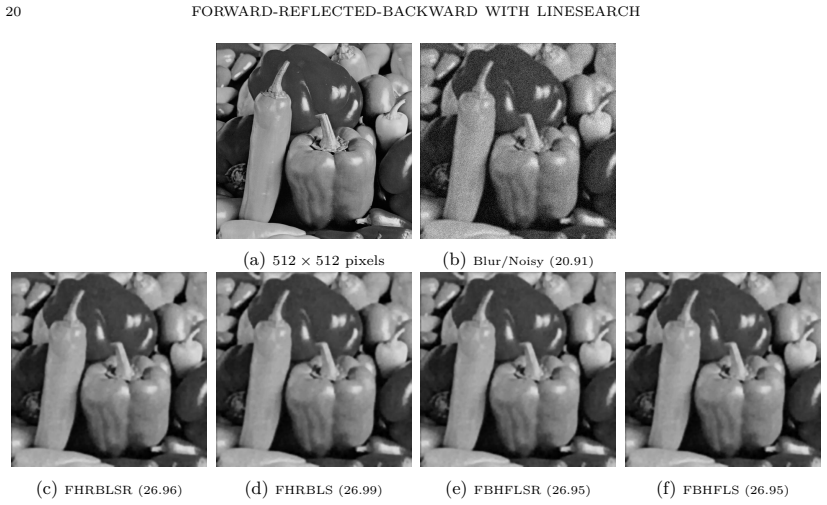
Summary. The paper proposes a forward-reflected-backward (FRB) splitting method with a new linesearch for the monotone inclusion 0∈Ax+Bx, where A is maximally monotone and B is monotone, single-valued, and continuous on dom A. Algorithm 4.1 uses one evaluation of B per iteration and the linesearch condition (4.2) involving the momentum term v_n. The main result (Theorem 4.5) claims weak convergence under θ²+3(θ/2)^{2/3}<1 and either liminf γ_n>0 or uniform continuity of B on weakly compact subsets of dom A, relying on Proposition 4.2 for well-definedness. The paper also extends the scheme to sums with cocoercive and Lipschitz operators (Section 5) and reports numerical experiments on saddle-point and image-restoration problems. The key enabling assertion is that, for every instance of Problem 3.1, the linesearch terminates in finitely many steps. I find this assertion false as stated.
Significance. If correct, the paper would close an open problem: a linesearch FRB with a single B-evaluation per iteration for merely continuous monotone B, going beyond Tseng's FBF and the locally Lipschitz linesearch FRB of [31]. The Lyapunov analysis in §4, the explicit counterexample to the earlier linesearch, the four-operator extension, and the reproducible numerical study are all useful components. However, the central well-definedness result is false: a valid instance of Problem 3.1 makes condition (4.2) fail for every γ>0. The advertised convergence theorem is therefore not established, and the Section 5 extension inherits the same difficulty.
major comments (3)
- [§4, Proposition 4.2] The step 'B is continuous in dom A, it is locally bounded on dom A, thus (Bz_k) is bounded' is invalid: z_k→P_{\overline{dom A}}w_n may lie in ∂dom A\setminus dom A, where continuity on dom A gives no bound. This is not a technicality. Counterexample: H=R, f(x)=−log x, A=∂f (dom A=(0,∞), A(x)=−1/x); B=∂(2x−log x), so B(x)=2−1/x on (0,∞). Then A+B=∂(2x−2log x) is maximally monotone and zer(A+B)={1}, so Problem 3.1 holds. Take x_{−1}=1/2, x_0=1, γ_{−1}=21, θ=0.9. Then v_0=Bx_0−Bx_{−1}=1, w_0=x_0−γ_{−1}v_0=−20. For any γ>0, z=J_{γA}(w_0−γBx_0)∈(0,1) satisfies z²+(20+γ)z−γ=0, hence γ|Bz−Bx_0|=20+z. Condition (4.2) becomes 20+z≤0.9(22−z), i.e. z≤−2/19, impossible. Thus no γ>0 satisfies (4.2) for n=0; Algorithm 4.1 is not well defined on a valid instance. Theorem 4.5, which depends on Proposition 4.2, cannot hold as stated.
- [§4, Theorem 4.5(ii)] The proof of case (ii) applies [43, Lemma 3.2] to treat {x}∪_k [x_{n_k},\hat x_{n_k+1}] as a weakly compact subset of conv dom A = dom A, and then uses uniform continuity of B there. But the weak cluster point x of (x_n) is only known to lie in the weak closure of dom A, which equals \overline{dom A}; it is not shown to belong to dom A. If x∈\overline{dom A}\setminus dom A, the displayed set is not a subset of dom A and the uniform-continuity assumption cannot be invoked. The later conclusion 0∈(A+B)x, which would imply x∈dom(A+B), is obtained only after this step. This is a further gap in the proof of the second convergence alternative.
- [§5, Proposition 5.3(i)] The proof claims that Proposition 4.2 directly provides γ_n with γ_n||Bx_{n+1}−Bx_n||≤θ(||x_{n+1}−x_n||+γ_{n−1}||v_n||). However, in Algorithm 5.2 the trial point is x_{n+1}=J_{γ_n A}(x_n−γ_n(B+C+D)x_n−γ_{n−1}v_n), whereas Proposition 4.2 concerns J_{γ_n A}(x_n−γ_n B x_n−γ_{n−1}v_n). The extra C and D terms change the resolvent argument, so the cited proposition does not directly yield the stated inequality. A separate argument, e.g. applying Proposition 4.2-style reasoning to B+C+D and then using the Lipschitz/cocoercivity of C and D, is needed but not supplied. Thus the well-definedness of Algorithm 5.2 is not established as written.
minor comments (3)
- [§6.1, Table 1] The parameters for FRBLS/FRBLSR use θ=0.3525. This violates the theorem's condition (4.18): θ²+3(θ/2)^{2/3}≈1.067>1. If these runs are meant to illustrate the proven parameter regime, they should be adjusted; otherwise the text should state that the choices are heuristic.
- [§5, Remark 5.5(iv)] The remark says 'by setting θ=0', but Algorithm 5.2 and the surrounding theory require θ∈]0,1[. The limiting statement needs a more careful formulation, e.g. θ↓0.
- [§4, Algorithm 4.1] The linesearch index k is described as a 'natural number'; since α_0=τ is allowed, it should be an integer k≥0.
Circularity Check
No significant circularity: the derivation is a self-contained monotone-operator argument; the only load-bearing self-citation (Lemma 2.1 from the authors' prior work) is an independent, parameter-free lemma that does not encode the target convergence result.
full rationale
The claimed derivation chain—well-definedness of Algorithm 4.1 (Proposition 4.2), the Lyapunov decrease (Proposition 4.3), and weak convergence (Theorem 4.5)—is argued directly from standard monotone operator theory: resolvent properties, monotonicity of A and B, and the linesearch condition (4.2). The only load-bearing self-reference is Lemma 2.1, quoted from the authors' earlier JOTA paper [12]; it is a general lemma on the linesearch quantity for maximally monotone A and continuous B, with stated assumptions that do not include the target statement zer(A+B) convergence, and it is used as an external published result rather than to define the algorithm's output. It is not fitted to data, no parameter is calibrated to the quantity that is later 'predicted,' and no uniqueness theorem or ansatz is imported from the authors' prior work. Therefore any possible gap in Proposition 4.2 (e.g., whether P_{\overline{dom A}}w_n lies in dom A when dom A is not closed) is a correctness concern, not a circularity.
Assumptions & free parameters
free parameters (6)
- θ
- σ
- τ
- ρ
- κ
- ε
assumptions (4)
- domain assumption Problem 3.1 assumptions: A maximally monotone, B single-valued and continuous on dom A, dom A ⊂ dom B, A+B maximally monotone, zer(A+B) nonempty.
- standard math Lemma 2.1 (from [12]) on monotonicity of the resolvent-path function γ ↦ (1/γ)||z − J_{γA}(z−γy)||.
- domain assumption Theorem 4.5(ii): B is uniformly continuous in any weakly compact subset of dom A.
- standard math Standard facts on maximally monotone operators from [3]: graph weak-strong closedness, resolvent convergence to the projection, and weak-cluster-point arguments.
Cite this review
Pith. "Pith review of Forward-Reflected-Backward algorithm with Linesearch." pith.science (2026). https://pith.science/paper/JR2WYGLT
@misc{pith2026260720113,
  author       = {Pith},
  title        = {Pith review of: Forward-Reflected-Backward algorithm with Linesearch},
  year         = {2026},
  howpublished = {\url{https://pith.science/paper/JR2WYGLT}},
  note         = {Machine review of arXiv:2607.20113}
}
read the original abstract
In this article, we aim to solve a monotone inclusion problem involving the sum of a maximally monotone operator and a continuous operator. While several algorithms exist to solve this problem when the continuous operator is cocoercive or Lipschitz continuous, they typically require the estimation of the global Lipschitz constant, which can be computationally expensive and often imposes overly restrictive step-sizes. To avoid these limitations and to handle merely continuous operators, linesearch subroutines are employed. A popular method in this context is the forward-backward-forward (FBF) algorithm (also known as Tseng's splitting), which utilizes a linesearch to guarantee convergence. However, a drawback of FBF is that the continuous operator must be evaluated twice per iteration. On the other hand, the forward-reflected-backward (FRB) algorithm proposed by Malitsky and Tam (2020) requires only a single evaluation of the operator per iteration. Although a linesearch version of FRB exists, its convergence is guaranteed only for locally Lipschitz operators; in fact, we present an example demonstrating that this existing linesearch can fail to terminate when the operator is merely continuous. In this work, we propose a novel linesearch strategy for FRB that is well defined and guarantees convergence even when the operator is merely continuous. We also extend the proposed algorithm to handle additional cocoercive and Lipschitz continuous operators. Finally, we provide numerical experiments on saddle-point problems and image restoration. The numerical results show that FRB with the proposed linesearch can accelerate the numerical convergence even when the operator is Lipschitz continuous. In addition, these results show that the proposed method is competitive with linesearch FBF, offering considerable computational advantages in various scenarios.
Figures


Reference graph
Works this paper leans on
-
[31]
Malitsky, Y., Tam, M.K.: A forward-backward splitting method for monotone inclusions without cocoer- civity. SIAM J. Optim. 30(2), 1451–1472 (2020). DOI 10.1137/18M1207260
-
[1]
Alacaoglu, A., Malitsky, Y., Cevher, V.: Forward-reflected-backward method with variance reduction. Comput. Optim. Appl. 80(2), 321–346 (2021). DOI 10.1007/s10589-021-00305-3
-
[2]
Aubin, J.P., Frankowska, H.: Set-valued analysis. Modern Birkhäuser Classics. Birkhäuser Boston, Inc., Boston, MA (2009). DOI 10.1007/978-0-8176-4848-0
-
[3]
CMS Books in Mathematics/Ouvrages de Mathématiques de la SMC
Bauschke, H.H., Combettes, P.L.: Convex analysis and monotone operator theory in Hilbert spaces, second edn. CMS Books in Mathematics/Ouvrages de Mathématiques de la SMC. Springer, Cham (2017). DOI 10.1007/978-3-319-48311-5
-
[4]
Bect, J., Blanc-Féraud, L., Aubert, G., Chambolle, A.: A l1-unified variational framework for image restoration. In: T. Pajdla, J. Matas (eds.) Computer Vision - ECCV 2004, pp. 1–13. Springer Berlin Heidelberg, Berlin, Heidelberg (2004)
2004
-
[5]
Princeton Series in Applied Mathematics
Ben-Tal, A., El Ghaoui, L., Nemirovski, A.: Robust optimization. Princeton Series in Applied Mathematics. Princeton University Press, Princeton, NJ (2009). DOI 10.1515/9781400831050
-
[6]
Boţ, R.I., Hendrich, C.: Convergence analysis for a primal-dual monotone + skew splitting algorithm with applications to total variation minimization. J. Math. Imaging Vision 49(3), 551–568 (2014). DOI 10.1007/s10851-013-0486-8
-
[7]
Boţ, R.I., Sedlmayer, M., Vuong, P.T.: A relaxed inertial forward-backward-forward algorithm for solving monotone inclusions with application to GANs. J. Mach. Learn. Res. 24, Paper No. [8], 37 (2023). DOI 10.4995/agt.2023.12424
arXiv 2023
Show all 51 references
-
[8]
SIAM Rev
Bottou, L., Curtis, F.E., Nocedal, J.: Optimization methods for large-scale machine learning. SIAM Rev. 60(2), 223–311 (2018). DOI 10.1137/16M1080173
2018 doi
-
[9]
Briceño, L., Cominetti, R., Cortés, C.E., Martínez, F.: An integrated behavioral model of land use and transport system: a hyper-network equilibrium approach. Netw. Spat. Econ. 8(2-3), 201–224 (2008). DOI 10.1007/s11067-007-9052-5
2008 doi
-
[10]
Briceño-Arias, L.M., Combettes, P.L., Pesquet, J.C., Pustelnik, N.: Proximal algorithms for multi- component image recovery problems. J. Math. Imaging Vision 41(1-2), 3–22 (2011). DOI 10.1007/ s10851-010-0243-1
2011
-
[11]
Briceño-Arias, L.M., Davis, D.: Forward-backward-half forward algorithm for solving monotone inclusions. SIAM J. Optim. 28(4), 2839–2871 (2018). DOI 10.1137/17M1120099
2018 doi
-
[12]
Briceño-Arias, L.M., Roldán, F.: Four-operator splitting via a forward-backward-half-forward algorithm with line search. J. Optim. Theory Appl. 195(1), 205–225 (2022). DOI 10.1007/s10957-022-02074-3
2022 doi
-
[13]
Buccini, A., Reichel, L.: An ℓp-ℓq minimization method with cross-validation for the restoration of impulse noise contaminated images. J. Comput. Appl. Math. 375, 112,824, 16 (2020). DOI 10.1016/j.cam.2020. 112824
2020 doi
-
[14]
URL https://arxiv.org/abs/1412.4237
Burger, M., Sawatzky, A., Steidl, G.: First order algorithms in variational image processing (2014). URL https://arxiv.org/abs/1412.4237
2014 arXiv
-
[15]
Set-Valued Var
Cevher, V., Vũ, B.: A reflected forward-backward splitting method for monotone inclusions involving lipschitzian operators. Set-Valued Var. Anal. (2020). DOI 10.1007/s11228-020-00542-4
2020 doi
-
[16]
Chambolle, A.: An algorithm for total variation minimization and applications. J. Math. Imaging Vision 20(1-2), 89–97 (2004). DOI 10.1023/B:JMIV.0000011320.81911.38
2004
-
[17]
Acta Numer
Chambolle, A., Pock, T.: An introduction to continuous optimization for imaging. Acta Numer. 25, 161–319 (2016). DOI 10.1017/S096249291600009X
2016 doi
-
[18]
Chen, G.H.G., Rockafellar, R.T.: Convergence rates in forward-backward splitting. SIAM J. Optim. 7(2), 421–444 (1997). DOI 10.1137/S1052623495290179
1997 doi
-
[19]
Combettes, P.L.: Monotone operator theory in convex optimization. Math. Program. 170(1), 177–206 (2018). DOI 10.1007/s10107-018-1303-3
2018 doi
-
[20]
Combettes, P.L., Hirstoaga, S.A.: Equilibrium programming in Hilbert spaces. J. Nonlinear Convex Anal. 6(1), 117–136 (2005)
2005
-
[21]
IEEE Transactions on Signal Pro- cessing 69, 3878–3905 (2021)
Combettes, P.L., Pesquet, J.C.: Fixed point strategies in data science. IEEE Transactions on Signal Pro- cessing 69, 3878–3905 (2021). DOI 10.1109/TSP.2021.3069677
2021
-
[22]
Csetnek, E.R., Malitsky, Y., Tam, M.K.: Shadow Douglas-Rachford splitting for monotone inclusions. Appl. Math. Optim. 80(3), 665–678 (2019). DOI 10.1007/s00245-019-09597-8 22 FOR W ARD-REFLECTED-BACKW ARD WITH LINESEARCH
2019 doi
-
[23]
Du, T.T.T., Nguyen, V.D.: A variable metric forward-reflected-Douglas-Rachford method for solving mono- tone inclusions. Numer. Funct. Anal. Optim. 46(3), 167–193 (2025). DOI 10.1080/01630563.2024.2405478
2025
-
[24]
Gafni, E.M., Bertsekas, D.P.: Two-metric projection methods for constrained optimization. SIAM J. Control Optim. 22(6), 936–964 (1984). DOI 10.1137/0322061
1984 doi
-
[25]
In: International Conference on Learning Representations (2019)
Gidel, G., Berard, H., Vignoud, G., Vincent, P., Lacoste-Julien, S.: A variational inequality perspective on generative adversarial networks. In: International Conference on Learning Representations (2019)
2019
-
[26]
Glowinski, R., Marrocco, A.: Sur l’approximation, par éléments finis d’ordre un, et la résolution, par pénalisation-dualité, d’une classe de problèmes de Dirichlet non linéaires. Rev. Française Automat. Informat. Recherche Opérationnelle Sér. Rouge Anal. Numér. 9(R-2), 41–76 (1975)
1975
-
[27]
BIT 57(2), 351–378 (2017)
Huang, G., Lanza, A., Morigi, S., Reichel, L., Sgallari, F.: Majorization-minimization generalized Krylov subspace methods for ℓp-ℓq optimization applied to image restoration. BIT 57(2), 351–378 (2017). DOI 10.1007/s10543-016-0643-8
2017 doi
-
[28]
Izuchukwu, C., Reich, S., Shehu, Y., Taiwo, A.: Strong convergence of forward-reflected-backward splitting methods for solving monotone inclusions with applications to image restoration and optimal control. J. Sci. Comput. 94(3), Paper No. 73, 31 (2023). DOI 10.1007/s10915-023-02132-6
2023 doi
-
[29]
Lanza, A., Morigi, S., Reichel, L., Sgallari, F.: A generalized Krylov subspace method for ℓp-ℓq minimiza- tion. SIAM J. Sci. Comput. 37(5), S30–S50 (2015). DOI 10.1137/140967982
2015 doi
-
[30]
Lions, P., Mercier, B.: Splitting algorithms for the sum of two nonlinear operators. SIAM J. Numer. Anal. 16(6), 964–979 (1979)
1979
-
[32]
régularisation d’inéquations variationnelles par approximations succes- sives
Martinet, B.: Brève communication. régularisation d’inéquations variationnelles par approximations succes- sives. ESAIM: Mathematical Modelling and Numerical Analysis - Modélisation Mathématique et Analyse Numérique 4(R3), 154–158 (1970)
1970
-
[33]
In: Proceedings of the 31st International Conference on Neural Information Processing Systems, NIPS’17, pp
Mescheder, L., Nowozin, S., Geiger, A.: The numerics of GANs. In: Proceedings of the 31st International Conference on Neural Information Processing Systems, NIPS’17, pp. 1823–1833. Curran Associates Inc., Red Hook, NY, USA (2017)
2017
-
[34]
Set-Valued Var
Morin, M., Banert, S., Giselsson, P.: Nonlinear Forward-Backward Splitting with Momentum Correction. Set-Valued Var. Anal. 31(4), 37 (2023). DOI 10.1007/s11228-023-00700-4
2023 doi
-
[35]
Princeton University Press, Princeton, NJ (1944)
von Neumann, J., Morgenstern, O.: Theory of Games and Economic Behavior. Princeton University Press, Princeton, NJ (1944). DOI 10.1017/S0770451800019801
1944 doi
-
[36]
Optimization 75(5), 983–1005 (2026)
Nguyen, V.D.: A generalization of the forward-reflected-backward splitting method for monotone inclusions. Optimization 75(5), 983–1005 (2026). DOI 10.1080/02331934.2024.2444628
2026
-
[37]
Passty, G.B.: Ergodic convergence to a zero of the sum of monotone operators in Hilbert space. J. Math. Anal. Appl. 72(2), 383–390 (1979). DOI 10.1016/0022-247X(79)90234-8
1979 doi
-
[38]
Rockafellar, R.T.: Monotone operators and the proximal point algorithm. SIAM J. Control Optim. 14(5), 877–898 (1976). DOI 10.1137/0314056
1976 doi
-
[39]
Roldán, F.: Forward-reflected-backward and shadow-Douglas-Rachford with partial inverse for solving monotone inclusions. Math. Methods Oper. Res. 100(3), 723–752 (2024). DOI 10.1007/s00186-024-00878-9
2024 doi
-
[40]
Roldán, F., Vega, C.: Relaxed and Inertial Nonlinear Forward–Backward with Momentum. J. Optim. Theory Appl. 206(2), 23 (2025). DOI 10.1007/s10957-025-02694-5
2025 doi
-
[41]
Rudin, L.I., Osher, S., Fatemi, E.: Nonlinear total variation based noise removal algorithms. Phys. D 60(1- 4), 259–268 (1992). DOI 10.1016/0167-2789(92)90242-F. Experimental mathematics: computational issues in nonlinear science (Los Alamos, NM, 1991)
1992 doi
-
[42]
Ryu, E.K., Vũ, B.C.: Finding the forward-Douglas-Rachford-forward method. J. Optim. Theory Appl. 184(3), 858–876 (2020). DOI 10.1007/s10957-019-01601-z
2020 doi
-
[43]
Salzo, S.: The variable metric forward-backward splitting algorithm under mild differentiability assump- tions. SIAM J. Optim. 27(4), 2153–2181 (2017). DOI 10.1137/16M1073741
2017 doi
-
[44]
Showalter, R.E.: Monotone Operators in Banach Space and Nonlinear Partial Differential Equations, Math- ematical Surveys and Monographs , vol. 49. American Mathematical Society, Providence, RI (1997). DOI 10.1090/surv/049
1997 doi
-
[45]
Spingarn, J.E.: Applications of the method of partial inverses to convex programming: decomposition. Math. Programming 32(2), 199–223 (1985). DOI 10.1007/BF01586091
1985 doi
-
[46]
Tibshirani, R.: Regression shrinkage and selection via the lasso. J. Roy. Statist. Soc. Ser. B 58(1), 267–288 (1996)
1996
-
[47]
Tibshirani, R.J., Taylor, J.: The solution path of the generalized lasso. Ann. Statist. 39(3), 1335–1371 (2011). DOI 10.1214/11-AOS878 FOR W ARD-REFLECTED-BACKW ARD WITH LINESEARCH 23
2011 doi
-
[48]
In: Forty-second International Conference on Machine Learning (2025)
Tran-Dinh, Q.: Variance-reduced forward-reflected-backward splitting methods for nonmonotone gener- alized equations. In: Forty-second International Conference on Machine Learning (2025). URL https: //openreview.net/forum?id=xTuWXFH8nQ
2025
-
[49]
Tseng, P.: A modified forward-backward splitting method for maximal monotone mappings. SIAM J. Control Optim. 38(2), 431–446 (2000). DOI 10.1137/S0363012998338806
2000 doi
-
[50]
Yao, Y., Adamu, A., Shehu, Y.: Forward-reflected-backward splitting algorithms with momentum: weak, linear and strong convergence results. J. Optim. Theory Appl. 201(3), 1364–1397 (2024). DOI 10.1007/ s10957-024-02410-9
2024
-
[51]
Zhang, B., Guan, X., Yin, C.: Two relaxed inertial forward-reflected-backward splitting algorithms with momentum terms. J. Math. pp. Art. ID 7014,819, 23 (2025). DOI 10.1155/jom/7014819
2025
Reviewed August 1, 2026 · model on record in the stance chip above.
Discussion (0). Continue with ORCID to comment.