REVIEW 3 major objections 5 minor 116 references
Biased-noise qubits: a guide to efficient fault-tolerance using the hierarchy of errors
T0 review · 3 major / 5 minor · reviewed 2026-08-01 · deepseek-v4-flash
Pith's one-line read The paper argues that biased-noise qubits only pay off when a bias-preserving CX gate or a high-fidelity QND readout of multi-qubit Z parity is available; with only CZ gates plus X-basis preparation and measurement, the bias buys essentiall
desk verdict A solid, useful review of biased-noise fault tolerance; the CX-based results are credible, the QND-readout breadth claim needs more support. read the letter →
The pith
A machine-rendered reading of the paper's core claim, the machinery that carries it, and where it could break.
The reading
What carries the argument
The load-bearing object is the 'hierarchy of errors': phase-flips (Z) are frequent, bit-flips (X, Y) rare, and an operation is bias-preserving if it never converts the former into the latter—formally U Z^n U† ⊆ Z^n. The key circuit identity (Fig. 21) compiles a CX from a QND measurement of Z⊗3 plus X/Z corrections tracked in the Pauli frame, so the entire CX-based architecture transfers to platforms that can only measure Z parity. In the CX-based case, the organizing scheme is concatenation: a high-threshold phase-flip repetition or cellular-automaton code for the frequent errors, wrapped by a high-rate bit-flip code (elevator codes) for the rare ones, with magic states produced by 'unfolded
What would settle it
Measure the assignment-error probability of a proposed QND M_Z⊗3 (e.g., nuclear-spin parity readout via an electron spin, or a cat-qubit parametric readout) and compare it with the platform's bit-flip probability p_X; if the assignment error exceeds p_X, the measurement-based architecture fails to preserve the bias and its overhead advantage is lost.
Extended reading notes
Core claim
The central claim is that the value of noise bias is determined almost entirely by the available bias-preserving operations, not by the bias itself. With the minimal gate set {CZ, P|+>, M_X}, numerical simulations at infinite bias and p_Z=10^-3 show that error-correction overhead is not competitive with a standard surface code, so one may as well ignore the bias. With a bias-preserving CX, the hierarchy of errors can be reflected in the code structure: frequent phase-flips are corrected by a dedicated high-threshold code, rare bit-flips by concatenation with a high-rate code, and magic-state preparation becomes dramatically cheaper (e.g. 53 qubits and 12.2 rounds for a 6×10^-8 logical error
Load-bearing premise
The measurement-based architecture assumes that reading out a three- or four-qubit Z parity can be made so reliable that its failure probability is no larger than the qubit's rare bit-flip probability—and no experiment yet demonstrates this.
Editorial extensions
If this is right
- On a CZ-only gate set, biased-noise qubits do not beat depolarizing-noise QEC at p_Z=10^-3; expecting a bias benefit without CX or QND-Z readout is misplaced.
- With bias-preserving CX, the best strategy is concatenation: a phase-flip repetition or cellular-automaton inner code plus a high-rate bit-flip outer code, reaching as few as ~8 physical qubits per logical qubit at p_Z=10^-3 in the cited scenario.
- Magic-state preparation can be made far cheaper with bias: unfolded distillation produces a 6×10^-8 logical-error magic state with 53 qubits and 12.2 rounds at p_Z=10^-3 under high bias, and remains useful at bias η=80 with 175 qubits.
- QND M_Z⊗4 readout replaces CX in syndrome extraction with comparable qubit overhead—slightly worse for repetition codes, near-equal for the XZZX code at low p_Z.
- A full universal fault-tolerant gate set can be built from {P|+>, M_X, QND-M_Z, QND-M_Z⊗3, CZ} plus X^{±1/4}, so hardware without CX can still access the bias advantage if QND readout fidelity is sufficient.
Reading between the lines
- If high-fidelity QND-Z readout is demonstrated, naturally biased platforms such as electron/nuclear spins, NV centers, or quantum dots could compete with engineered cat qubits for low-overhead fault tolerance without ever building a bias-preserving CX—shifting the engineering burden from two-qubit gates to measurement.
- The hierarchy principle suggests a general design rule: choose one code layer per error species, with each layer matched to the frequency of that error; this can be tested by benchmarking concatenated phase-flip/bit-flip codes against asymmetric monolithic codes over a range of bias values.
- The QND readout could be implemented in a separate measurement register (e.g., an electron spin coupled to nuclear spin data qubits), enabling modular architectures where data qubits need no complex gate operations—a qualitatively different hardware path than monolithic CX-based designs.
- A testable extension: if QND-Z assignment error decreases with repeated measurements, the measurement-based advantage should grow with bias; measuring this scaling on a concrete platform would sharpen the crossover bias at which measurement-based beats CZ-only.
Editorial analysis
A structured set of objections, weighed in public.
Referee Report
Summary. This review analyzes fault-tolerant protocols for biased-noise qubits, organized by the available set of bias-preserving operations. Three architectures are considered: (i) a minimal set {CZ, P|+>, M_X}, for which the authors argue the complexity of syndrome extraction cancels the benefit of noise bias; (ii) adding a bias-preserving CX, which enables a hierarchy of codes (phase-flip repetition code concatenated with high-rate bit-flip code) and hardware-efficient magic state preparation; (iii) replacing CX with a high-fidelity QND readout of multi-qubit Pauli Z operators, claimed to extend the CX-based reductions to a broader range of platforms. The paper includes Stim/PyMatching simulations for the CZ-based, CX-based and measurement-based error correction circuits, with explicit error models and overhead comparisons.
Significance. If the central claims hold, this review provides a valuable and timely map of the biased-noise landscape, with a clear message for hardware roadmaps: invest in a bias-preserving CX or in high-fidelity QND multi-Z readout. The CZ-only negative result (Section III) is a useful caution, and the CX-based positive results are supported by extensive simulations and cross-checks with prior literature. The paper also ships reproducible numerical comparisons (Stim/PyMatching) and gives explicit error models, which is a genuine strength. The main risk is the measurement-based architecture (Section V), whose central assumption—assignment error of the QND M_{Z⊗4} no larger than the physical bit-flip probability—is not demonstrated experimentally or with a quantitative error budget in this manuscript.
major comments (3)
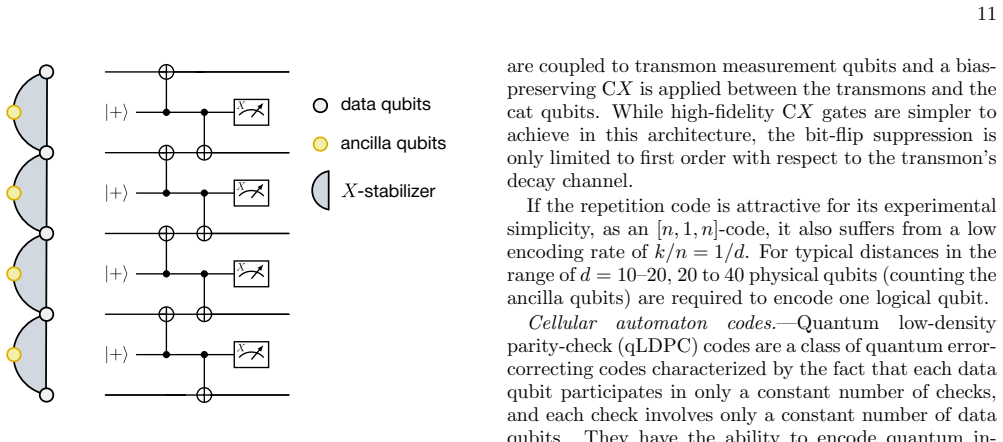
- [Section V (Figs. 23 and 26, Table IV)] The claim that a QND readout of multi-qubit Z operators extends the CX-based overhead reductions to broader platforms rests on the assumption that the assignment error of the QND measurement is no larger than the physical bit-flip probability p_X. The text itself states (Section II, near Fig. 21) that 'we need to ensure an ultra-high-fidelity QND readout ... as any assignment error leads to an X error'. The simulations in Table IV model the QND primitive as a single operation with assignment error p_X and no repetition cost. If achieving this assignment error requires repeated measurements, the repeated QND operations add extra Z error (dephasing) events, which is not accounted for in Table IV. The companion reference [61] is cited for the protocol, but no experimental demonstration or quantitative error budget is provided here. This is a load-bearing assumption for the paper's third con
- [Section III.C, Fig. 8] The negative conclusion that {CZ, P|+>, M_X} provides 'essentially no benefit' from bias is based on a single operating point p_Z=10^{-3} and infinite bias, with the comparison to a distance-9 surface code at p=10^{-3}. This is a reasonable first comparison, but the conclusion is sweeping. A reader cannot tell from Fig. 8 how the comparison degrades or improves at other p_Z values, or whether the infinite-bias assumption is the most favorable assumption for the CZ-based schemes. Because this is the paper's first major claim, at least one additional data point (e.g., p_Z=10^{-4} or a finite large bias) or a short extrapolation argument would make the claim more robust.
- [Section IV.B, Fig. 16 and extrapolation note] For the CX-based code comparison, Fig. 16 is the central evidence for the overhead advantage of concatenated codes at high bias. The caption states that for logical error rates inaccessible to Monte Carlo, results are extrapolated following the method of [101], but no systematic uncertainty or validation of the extrapolation is given. Since the recommendation for η≥10^5 rests on this figure, the extrapolation method should be described at least briefly in the text (or the criterion for trusting extrapolation, e.g., agreement with simulations at the lowest accessible rates), so the reader can judge how load-bearing the extrapolated points are.
minor comments (5)
- [General / notation] There are a few dangling references: Fig. 11 refers to 'Fig.??' for the repetition code circuit; Section IV.A.1 refers to 'Fig.??' in the Table II caption and the text near Fig. 9; Section V refers to 'Fig.??' in the caption of Fig. 23. These placeholders should be fixed.
- [Section II.A] The definition of bias-preserving operations via U Z_n U† ⊆ Z_n (near Fig. 1) is given compactly; a short explanation of why X and Y are included despite being 'Pauli gates' would help readers not expert in Pauli conjugation (e.g., X maps Z to -Z, so it preserves the Z_n subgroup up to signs).
- [Section IV.A.2 / Table III] The table caption says the bias is η = p_Z/p_X, but the table itself lists probabilities with denominators (p_Z/3, p_X/12, etc.). It is clear in context, but a sentence stating that these are conditional probabilities per channel, with the total per-operation error rates given in the text, would avoid confusion.
- [Section V, Fig. 22 caption] The logical circuit in Fig. 22 is described as 'alternating schedule, d=5' and the syndrome is σ=(m1⊕m2, m3⊕m4, m5⊕m6, m7⊕m8). It would help to state explicitly that the four syndromes are extracted from the eight measurement outcomes, since the notation m1..m8 is not defined in the caption.
- [Section VI (Conclusion)] The conclusion states 'we argue that this primitive could replace the bias-preserving CX in all previous constructions', but the body only demonstrates the replacement for the phase-flip repetition code and the XZZX code (Figs. 22–25), and gives only a brief comment for fault-tolerant operations. A more explicit discussion of which constructions are directly transposed and which require further work (e.g., elevator codes, unfolded distillation) would strengthen the review.
Circularity Check
Measurement-based extension relies on an assumed QND assignment error and the authors' own companion paper; CZ and CX comparisons are independently simulated.
-
self citation load bearing
[Section V (first paragraph), Section II.A, Table IV, and Abstract]
"In this Section, we discuss an alternative solution presented in [61]. In this approach, the main ingredient of the architecture shifts from bias-preserving CX to high-fidelity QND measurement of weight-3 or weight-4 Pauli Z operators. ... In [61], we argued that the real strength of the multi-Z measurement primitive for hardware savings relies on the fact that the measurement device does not need to be based on the same physical qubits as the ones used for computation."
The abstract's third conclusion—'extending these overhead reductions to a much broader range of physical platforms'—is supported by Figs. 23–26, whose error model (Table IV) assumes the QND M_Z⊗4 primitive has assignment error p_X. But the text itself states that this assignment-error level is exactly what preserves bias: 'any assignment error leads to an X error.' Thus the simulated overhead advantage inputs the very fidelity condition the primitive is supposed to provide. The only cited basis for realizing that condition is the authors' own companion preprint [61], not reproduced or independently demonstrated here. The broader-platform claim therefore reduces to an assumed parameter plus a self-citation, although the CZ-only and CX-based conclusions are independently simulated.
full rationale
The CZ-only negative result (Section III) and the CX-based overhead comparisons (Section IV) are supported by explicit Stim/PyMatching simulations with stated circuit-level error models (Tables I–III), including an infinite-bias model and comparisons against a surface-code benchmark. Those parts are self-contained and not circular. The measurement-based architecture in Section V, however, depends on the QND multi-qubit Z-readout primitive. The paper's own simulations fix the assignment error of this primitive to p_X (Table IV), and the text acknowledges that any larger assignment error would produce a bit-flip in the Pauli frame, destroying the bias-preserving property. The feasibility and fidelity of this primitive are attributed to the authors' companion paper [61], which is not included in the review and is not independently demonstrated. This makes the 'broader platforms' headline conclusion load-bearing on a self-citation and on an assumed error parameter. The first two central conclusions retain independent content, so the overall circularity is moderate rather than pervasive.
Assumptions & free parameters
free parameters (3)
- Uniform phase-flip rate p_Z in CZ-based simulations =
p_Z = 10^-3 for all operations; p_X = p_Y = 0 (infinite bias)
- QND MZ⊗4 error-model rates =
phase-flip 2 p_Z per MZ4; assignment error p_X; single-qubit X/Y at p_X/4
- Bias values η and p_Z in code comparison =
η ∈ {10^3, 10^5, 10^7}; p_Z ∈ {10^-3, 5×10^-3, 10^-2}
assumptions (6)
- standard math A bias-preserving operation must satisfy U Z^n U† ⊆ Z^n, mapping phase-flip errors only to phase-flip components.
- domain assumption A bias-preserving CX gate cannot be implemented in strictly two-dimensional qubit Hilbert spaces; cat qubits or other higher-dimensional encodings can bypass this no-go.
- ad hoc to paper A truly QND readout of multi-qubit Z operators can be made arbitrarily high-fidelity by repetition, so assignment errors can be reduced to the physical bit-flip level.
- domain assumption Circuit-level noise is modeled as independent single-qubit errors with the specified probabilities; correlated errors are assumed absent except where explicitly noted.
- domain assumption p_Z = 10^-3 is an experimentally relevant physical error rate for biased-noise platforms.
- domain assumption Bias-preserving CX gates with phase-flip error below the repetition-code threshold (~4%) are achievable on cat-qubit platforms.
Cite this review
Pith. "Pith review of Biased-noise qubits: a guide to efficient fault-tolerance using the hierarchy of errors." pith.science (2026). https://pith.science/paper/E52RH22O
@misc{pith2026260720143,
  author       = {Pith},
  title        = {Pith review of: Biased-noise qubits: a guide to efficient fault-tolerance using the hierarchy of errors},
  year         = {2026},
  howpublished = {\url{https://pith.science/paper/E52RH22O}},
  note         = {Machine review of arXiv:2607.20143}
}
read the original abstract
Qubits with strongly biased noise, in which phase-flip errors are orders of magnitude more frequent than bit-flips, arise both naturally, as in electron and nuclear spins, and by engineering, as in stabilized cat qubits. This noise structure holds the promise of reducing the daunting hardware overhead of fault-tolerant quantum computing, but exploiting it requires physical operations that do not convert frequent phase-flips into rare bit-flips. In this review, we analyze the most prominent fault-tolerant protocols for biased-noise qubits, organized according to the available set of such bias-preserving operations. When this set is restricted to the CZ gate together with preparation and measurement in the X basis, we show that the complexity of the required syndrome extraction gadgets essentially cancels the benefit of the noise bias: at experimentally relevant error rates, one may as well ignore the bias and rely on standard error correction designed for depolarizing noise. The situation changes drastically when a bias-preserving CX gate is available: the hierarchy of errors can then be reflected in the structure of the code, with frequent phase-flips corrected by a dedicated high-threshold code and rare bit-flips by concatenation with a high-rate code. The same hierarchy also enables hardware-efficient preparation of magic states. Finally, as a bias-preserving CX is forbidden in naturally biased platforms and challenging in engineered ones, we present a measurement-based architecture in which a high-fidelity quantum non-demolition readout of multi-qubit Pauli Z operators takes its place, extending these overhead reductions to a much broader range of physical platforms.
Figures


Figures from the paper (20 more)




Reference graph
Works this paper leans on
-
[61]
PhD thesis, ´Ecole Normale Sup´ erieure, 2021
J´ er´ emie Guillaud.Repetition Cat Qubits. PhD thesis, ´Ecole Normale Sup´ erieure, 2021
2021
-
[101]
Ultrahigh error threshold for surface codes with biased noise.Physical review letters, 120(5): 050505, 2018
David K Tuckett, Stephen D Bartlett, and Steven T Flammia. Ultrahigh error threshold for surface codes with biased noise.Physical review letters, 120(5): 050505, 2018
2018
-
[1]
In these extreme noise bias regimes, we therefore solely need to correct phase-flip errors
Phase-flip error correction For some biased-noise qubits, such as dissipative cat qubits, the bit-flip errors are sufficiently rare such that certain quantum algorithms can be run without the re- quirement of further bit-flip error correction, as seen in Subsection II B. In these extreme noise bias regimes, we therefore solely need to correct phase-flip e...
-
[2]
In this subsection, we review the most efficient schemes that have been proposed in the literature and provide a detailed comparison
Asymmetric quantum error correction For more moderate noise bias regimes, or even with strong noise biases in the case of large-scale quantum algorithms, one might need to ensure some level of bit- flip error correction. In this subsection, we review the most efficient schemes that have been proposed in the literature and provide a detailed comparison. We...
-
[3]
The |+i⟩L state allows us to perform theSgate with the teleportation circuit shown in Figure 17(a) if we are al- ready equipped with the CNOT gate and measurement in theZbasis
Clifford group In order to implement the full Clifford group, we focus on the implementation of the following gates F={P |0⟩L ,P |+⟩L ,M ZL ,M XL ,CX L,P |+i⟩L }. The |+i⟩L state allows us to perform theSgate with the teleportation circuit shown in Figure 17(a) if we are al- ready equipped with the CNOT gate and measurement in theZbasis. Note that theZgat...
-
[4]
High-fidelity magic states can be con- sumed to implement the corresponding gates, as shown in Figure 19
Magic states Magic state preparation and teleportation is the state- of-the-art method for performing fault-tolerant non- Clifford gates. High-fidelity magic states can be con- sumed to implement the corresponding gates, as shown in Figure 19. Magic state distillation.— Magic state distillation is one of the leading approaches for preparing high-fidelity ...
-
[5]
Mind the gaps: The fraught road to quantum advantage.arXiv preprint arXiv:2510.19928, 2025
Jens Eisert and John Preskill. Mind the gaps: The fraught road to quantum advantage.arXiv preprint arXiv:2510.19928, 2025
arXiv 2025
-
[6]
Scheme for reducing decoherence in quantum computer memory.Physical review A, 52(4): R2493, 1995
Peter W Shor. Scheme for reducing decoherence in quantum computer memory.Physical review A, 52(4): R2493, 1995
1995
Show all 116 references
-
[7]
Good quan- tum error-correcting codes exist.Physical Review A, 54 (2):1098, 1996
A Robert Calderbank and Peter W Shor. Good quan- tum error-correcting codes exist.Physical Review A, 54 (2):1098, 1996
1996
-
[8]
Error correcting codes in quantum theory.Physical Review Letters, 77(5):793, 1996
Andrew M Steane. Error correcting codes in quantum theory.Physical Review Letters, 77(5):793, 1996
1996
-
[9]
Perfect quantum error cor- recting code.Phys
Raymond Laflamme, Cesar Miquel, Juan Pablo Paz, and Wojciech Hubert Zurek. Perfect quantum error cor- recting code.Phys. Rev. Lett., 77:198–201, Jul 1996. doi:10.1103/PhysRevLett.77.198. URLhttps://link. aps.org/doi/10.1103/PhysRevLett.77.198
1996 doi
-
[10]
Class of quantum error- correcting codes saturating the quantum hamming bound.Phys
Daniel Gottesman. Class of quantum error- correcting codes saturating the quantum hamming bound.Phys. Rev. A, 54:1862–1868, Sep 1996. doi: 10.1103/PhysRevA.54.1862. URLhttps://link.aps. org/doi/10.1103/PhysRevA.54.1862
1996 doi
-
[11]
Quantum computations: algorithms and error correction.Russian Mathematical Surveys, 52(6): 1191, 1997
A Yu Kitaev. Quantum computations: algorithms and error correction.Russian Mathematical Surveys, 52(6): 1191, 1997
1997
-
[12]
S. B. Bravyi and A. Yu. Kitaev. Quantum codes on a lattice with boundary, 1998. URLhttps://arxiv.org/ 24 abs/quant-ph/9811052
1998 arXiv
-
[13]
Surface codes: Towards practical large-scale quantum computation.Physical Review A—Atomic, Molecular, and Optical Physics, 86 (3):032324, 2012
Austin G Fowler, Matteo Mariantoni, John M Marti- nis, and Andrew N Cleland. Surface codes: Towards practical large-scale quantum computation.Physical Review A—Atomic, Molecular, and Optical Physics, 86 (3):032324, 2012
2012
-
[14]
Fault-tolerant quantum computation by anyons.Annals of physics, 303(1):2–30, 2003
A Yu Kitaev. Fault-tolerant quantum computation by anyons.Annals of physics, 303(1):2–30, 2003
2003
-
[15]
Norris, Chris- tian Kraglund Andersen, Markus M¨ uller, Alexandre Blais, Christopher Eichler, and Andreas Wallraff
Sebastian Krinner, Nathan Lacroix, Ants Remm, Agustin Di Paolo, Elie Genois, Catherine Ler- oux, Christoph Hellings, Stefania Lazar, Francois Swiadek, Johannes Herrmann, Graham J. Norris, Chris- tian Kraglund Andersen, Markus M¨ uller, Alexandre Blais, Christopher Eichler, and...
2022 doi
-
[16]
Realization of an error-correcting surface code with superconducting qubits.Phys
Youwei Zhao, Yangsen Ye, He-Liang Huang, Yiming Zhang, Dachao Wu, Huijie Guan, Qingling Zhu, Zuolin Wei, Tan He, Sirui Cao, Fusheng Chen, Tung-Hsun Chung, Hui Deng, Daojin Fan, Ming Gong, Cheng Guo, Shaojun Guo, Lianchen Han, Na Li, Shaowei Li, Yuan Li, Futian Liang, Jin Lin, ...
2022
-
[17]
Suppressing quantum errors by scaling a surface code logical qubit.Nature, 614(7949): 676–681, 2023
Google Quantum AI. Suppressing quantum errors by scaling a surface code logical qubit.Nature, 614(7949): 676–681, 2023
2023
-
[18]
Quantum error correction below the surface code threshold.Nature, 638(8052):920–926, 2025
Google Quantum AI. Quantum error correction below the surface code threshold.Nature, 638(8052):920–926, 2025
2025
-
[19]
How to factor 2048 bit rsa integers with less than a million noisy qubits.arXiv preprint arXiv:2505.15917, 2025
Craig Gidney. How to factor 2048 bit rsa integers with less than a million noisy qubits.arXiv preprint arXiv:2505.15917, 2025
-
[20]
Assessing requirements to scale to practical quantum advantage.arXiv preprint arXiv:2211.07629, 2022
Michael E Beverland, Prakash Murali, Matthias Troyer, Krysta M Svore, Torsten Hoefler, Vadym Kliuchnikov, Guang Hao Low, Mathias Soeken, Aarthi Sundaram, and Alexander Vaschillo. Assessing requirements to scale to practical quantum advantage.arXiv preprint arXiv:2211.07629, 2022
2022 arXiv
-
[21]
Magic state distillation: Not as costly as you think.Quantum, 3:205, 2019
Daniel Litinski. Magic state distillation: Not as costly as you think.Quantum, 3:205, 2019
2019
-
[22]
Magic state cultivation: growing T states as cheap as CNOT gates.arXiv preprint arXiv:2409.17595, 2024
Craig Gidney, Noah Shutty, and Cody Jones. Magic state cultivation: growing T states as cheap as CNOT gates.arXiv preprint arXiv:2409.17595, 2024
2024 arXiv
-
[23]
Quantum low-density parity-check codes.PRX quan- tum, 2(4):040101, 2021
Nikolas P Breuckmann and Jens Niklas Eberhardt. Quantum low-density parity-check codes.PRX quan- tum, 2(4):040101, 2021
2021
-
[24]
Asymptotically good quantum and locally testable classical ldpc codes
Pavel Panteleev and Gleb Kalachev. Asymptotically good quantum and locally testable classical ldpc codes. InProceedings of the 54th annual ACM SIGACT sym- posium on theory of computing, pages 375–388, 2022
2022
-
[25]
Quantum tanner codes
Anthony Leverrier and Gilles Z´ emor. Quantum tanner codes. In2022 IEEE 63rd Annual Symposium on Foun- dations of Computer Science (FOCS), pages 872–883. IEEE, 2022
2022
-
[26]
Good quantum ldpc codes with lin- ear time decoders
Irit Dinur, Min-Hsiu Hsieh, Ting-Chun Lin, and Thomas Vidick. Good quantum ldpc codes with lin- ear time decoders. InProceedings of the 55th annual ACM symposium on theory of computing, pages 905– 918, 2023
2023
-
[27]
High-threshold and low-overhead fault-tolerant quan- tum memory.Nature, 627(8005):778–782, 2024
Sergey Bravyi, Andrew W Cross, Jay M Gambetta, Dmitri Maslov, Patrick Rall, and Theodore J Yoder. High-threshold and low-overhead fault-tolerant quan- tum memory.Nature, 627(8005):778–782, 2024
2024
-
[28]
Shaw and Barbara M
Mackenzie H. Shaw and Barbara M. Terhal. Lowering connectivity requirements for bivariate bicycle codes using morphing circuits.Phys. Rev. Lett., 134:090602, Mar 2025. doi:10.1103/PhysRevLett.134.090602. URL https://link.aps.org/doi/10.1103/PhysRevLett. 134.090602
2025 doi
-
[29]
Quantum error correc- tion for long chains of trapped ions.Quantum, 9: 1920, November 2025
Min Ye and Nicolas Delfosse. Quantum error correc- tion for long chains of trapped ions.Quantum, 9: 1920, November 2025. ISSN 2521-327X. doi:10.22331/q- 2025-11-27-1920. URLhttps://doi.org/10.22331/ q-2025-11-27-1920
1920 doi
-
[30]
Planar fault-tolerant logical measurements with low qubit overhead.npj Quantum Information, 2026
Yingli Yang, Guo Zhang, and Ying Li. Planar fault-tolerant logical measurements with low qubit overhead.npj Quantum Information, 2026. doi: 10.1038/s41534-026-01310-2. URLhttps://doi.org/ 10.1038/s41534-026-01310-2
2026 doi
-
[31]
Tradeoffs for reliable quantum information storage in 2d systems.Physical review letters, 104(5):050503, 2010
Sergey Bravyi, David Poulin, and Barbara Terhal. Tradeoffs for reliable quantum information storage in 2d systems.Physical review letters, 104(5):050503, 2010
2010
-
[32]
Logical quantum processor based on reconfigurable atom arrays.Nature, 626(7997):58–65, 2024
Dolev Bluvstein, Simon J Evered, Alexandra A Geim, Sophie H Li, Hengyun Zhou, Tom Manovitz, Sepehr Ebadi, Madelyn Cain, Marcin Kalinowski, Dominik Hangleiter, et al. Logical quantum processor based on reconfigurable atom arrays.Nature, 626(7997):58–65, 2024
2024
-
[33]
Ransfordet al.A 98-qubit trapped-ion quan- tum computer with all-to-all connectivity.Na- ture, 655(8121):81–86, 2026
A. Ransfordet al.A 98-qubit trapped-ion quan- tum computer with all-to-all connectivity.Na- ture, 655(8121):81–86, 2026. doi:10.1038/s41586- 026-10676-4. URLhttps://doi.org/10.1038/ s41586-026-10676-4
2026 doi
-
[34]
Quantum information processing with bosonic qubits in circuit qed.Quantum Science and Technology, 6(3): 033001, 2021
Atharv Joshi, Kyungjoo Noh, and Yvonne Y Gao. Quantum information processing with bosonic qubits in circuit qed.Quantum Science and Technology, 6(3): 033001, 2021
2021
-
[35]
Macroscopically distinct quantum- superposition states as a bosonic code for amplitude damping.Physical Review A, 59(4):2631, 1999
Paul T Cochrane, Gerard J Milburn, and William J Munro. Macroscopically distinct quantum- superposition states as a bosonic code for amplitude damping.Physical Review A, 59(4):2631, 1999
1999
-
[36]
Hardware-efficient autonomous quantum memory protection.Physical Review Letters, 111(12): 120501, 2013
Zaki Leghtas, Gerhard Kirchmair, Brian Vlastakis, Robert J Schoelkopf, Michel H Devoret, and Mazyar Mirrahimi. Hardware-efficient autonomous quantum memory protection.Physical Review Letters, 111(12): 120501, 2013
2013
-
[37]
New class of quantum error-correcting codes for a bosonic mode.Physical Review X, 6(3):031006, 2016
Marios H Michael, Matti Silveri, RT Brierley, Victor V Albert, Juha Salmilehto, Liang Jiang, and Steven M Girvin. New class of quantum error-correcting codes for a bosonic mode.Physical Review X, 6(3):031006, 2016
2016
-
[38]
Grimsmo, Joshua Combes, and Ben Q
Arne L. Grimsmo, Joshua Combes, and Ben Q. Bara- giola. Quantum computing with rotation-symmetric bosonic codes.Phys. Rev. X, 10:011058, Mar 2020. doi:10.1103/PhysRevX.10.011058. URLhttps://link. aps.org/doi/10.1103/PhysRevX.10.011058
2020 doi
-
[39]
Analog quantum error correction with encoding a qubit into an oscillator.Physical review letters, 119(18): 180507, 2017
Kosuke Fukui, Akihisa Tomita, and Atsushi Okamoto. Analog quantum error correction with encoding a qubit into an oscillator.Physical review letters, 119(18): 180507, 2017. 25
2017
-
[40]
Quantum error cor- rection with the toric Gottesman-Kitaev-Preskill code
Christophe Vuillot, Hamed Asasi, Yang Wang, Leonid P Pryadko, and Barbara M Terhal. Quantum error cor- rection with the toric Gottesman-Kitaev-Preskill code. Physical Review A, 99(3):032344, 2019
2019
-
[41]
Repetition cat qubits for fault-tolerant quantum computation.Physical Review X, 9(4):041053, 2019
J´ er´ emie Guillaud and Mazyar Mirrahimi. Repetition cat qubits for fault-tolerant quantum computation.Physical Review X, 9(4):041053, 2019
2019
-
[42]
Darmawan, Benjamin J
Andrew S. Darmawan, Benjamin J. Brown, Arne L. Grimsmo, David K. Tuckett, and Shruti Puri. Prac- tical quantum error correction with the xzzx code and kerr-cat qubits.PRX Quantum, 2:030345, Sep 2021. doi: 10.1103/PRXQuantum.2.030345. URLhttps://link. aps.org/doi/10.1103/PRXQua...
2021 doi
-
[43]
Building a fault-tolerant quantum computer using con- catenated cat codes.PRX Quantum, 3(1):010329, 2022
Christopher Chamberland, Kyungjoo Noh, Patricio Arrangoiz-Arriola, Earl T Campbell, Connor T Hann, Joseph Iverson, Harald Putterman, Thomas C Bo- hdanowicz, Steven T Flammia, Andrew Keller, et al. Building a fault-tolerant quantum computer using con- catenated cat codes.PRX Qu...
2022
-
[44]
Jonathan A. Gross. Designing Codes around Interac- tions: The Case of a Spin.Physical Review Letters, 127 (1):010504, July 2021. ISSN 10797114
2021
-
[45]
Gross, Cl´ ement Godfrin, Alexandre Blais, and Eva Dupont-Ferrier
Jonathan A. Gross, Cl´ ement Godfrin, Alexandre Blais, and Eva Dupont-Ferrier. Hardware-efficient error- correcting codes for large nuclear spins.Physical Review Applied, 22(1):014006, July 2024. ISSN 23317019
2024
-
[46]
Fault-tolerant quantum computation using large spin-cat codes.PRX Quantum, 5(2):020355, 2024
Sivaprasad Omanakuttan, Vikas Buchemmavari, Jonathan A Gross, Ivan H Deutsch, and Milad Mar- vian. Fault-tolerant quantum computation using large spin-cat codes.PRX Quantum, 5(2):020355, 2024
2024
-
[47]
Zache, Liang Jiang, Rick van Bijnen, and Peter Zoller
Andreas Kruckenhauser, Ming Yuan, Han Zheng, Mikhail Mamaev, Pei Zeng, Xuanhui Mao, Qian Xu, Torsten V. Zache, Liang Jiang, Rick van Bijnen, and Peter Zoller. Dark spin-cat states as biased qubits.Phys. Rev. Lett., 135:020601, Jul 2025. doi: 10.1103/w9zh-jwsx. URLhttps://link....
2025 doi
-
[48]
Wolinsky and H
M. Wolinsky and H. J. Carmichael. Quan- tum noise in the parametric oscillator: From squeezed states to coherent-state superpositions. Phys. Rev. Lett., 60:1836–1839, May 1988. doi: 10.1103/PhysRevLett.60.1836. URLhttps://link. aps.org/doi/10.1103/PhysRevLett.60.1836
1988 doi
-
[49]
Dynamically protected cat-qubits: a new paradigm for universal quantum computation.New Journal of Physics, 16(4):045014, 2014
Mazyar Mirrahimi, Zaki Leghtas, Victor V Albert, Steven Touzard, Robert J Schoelkopf, Liang Jiang, and Michel H Devoret. Dynamically protected cat-qubits: a new paradigm for universal quantum computation.New Journal of Physics, 16(4):045014, 2014
2014
-
[50]
Ex- ponential suppression of bit-flips in a qubit encoded in an oscillator.Nature Physics, 16(5):509–513, 2020
Rapha¨ el Lescanne, Marius Villiers, Th´ eau Peronnin, Alain Sarlette, Matthieu Delbecq, Benjamin Huard, Takis Kontos, Mazyar Mirrahimi, and Zaki Leghtas. Ex- ponential suppression of bit-flips in a qubit encoded in an oscillator.Nature Physics, 16(5):509–513, 2020
2020
-
[51]
Quantum control of a cat qubit with bit-flip times exceeding ten seconds.Nature, 629(8013):778–783, 2024
Ulysse R´ eglade, Adrien Bocquet, Ronan Gautier, Joachim Cohen, Antoine Marquet, Emanuele Al- bertinale, Natalia Pankratova, Mattis Hall´ en, Felix Rautschke, L-A Sellem, et al. Quantum control of a cat qubit with bit-flip times exceeding ten seconds.Nature, 629(8013):778–783, 2024
2024
-
[52]
Enhancing dissipative cat qubit protection by squeezing.arXiv preprint arXiv:2502.07892, 2025
R´ emi Rousseau, Diego Ruiz, Emanuele Albertinale, Pol d’Avezac, Danielius Banys, Ugo Blandin, Nicolas Bour- daud, Giulio Campanaro, Gil Cardoso, Nathanael Cot- tet, et al. Enhancing dissipative cat qubit protection by squeezing.arXiv preprint arXiv:2502.07892, 2025
2025 arXiv
-
[53]
A fluorescent-protein spin qubit.Nature, pages 1–7, 2025
Jacob S Feder, Benjamin S Soloway, Shreya Verma, Zhi Z Geng, Shihao Wang, Bethel B Kifle, Emmeline G Riendeau, Yeghishe Tsaturyan, Leah R Weiss, Mouzhe Xie, et al. A fluorescent-protein spin qubit.Nature, pages 1–7, 2025
2025
-
[54]
Industry-compatible silicon spin-qubit unit cells exceeding 99% fidelity.Nature, pages 1–7, 2025
Paul Steinacker, Nard Dumoulin Stuyck, Wee Han Lim, Tuomo Tanttu, MengKe Feng, Santiago Serrano, An- dreas Nickl, Marco Candido, Jesus D Cifuentes, Ensar Vahapoglu, et al. Industry-compatible silicon spin-qubit unit cells exceeding 99% fidelity.Nature, pages 1–7, 2025
2025
-
[55]
High-fidelity spin qubit oper- ation and algorithmic initialization above 1 k.Nature, 627(8005):772–777, 2024
Jonathan Y Huang, Rocky Y Su, Wee Han Lim, MengKe Feng, Barnaby Van Straaten, Brandon Severin, Will Gilbert, Nard Dumoulin Stuyck, Tuomo Tanttu, Santiago Serrano, et al. High-fidelity spin qubit oper- ation and algorithmic initialization above 1 k.Nature, 627(8005):772–777, 2024
2024
-
[56]
High-fidelity parallel entangling gates on a neutral-atom quantum computer.Nature, 622(7982): 268–272, 2023
Simon J Evered, Dolev Bluvstein, Marcin Kalinowski, Sepehr Ebadi, Tom Manovitz, Hengyun Zhou, Sophie H Li, Alexandra A Geim, Tout T Wang, Nishad Maskara, et al. High-fidelity parallel entangling gates on a neutral-atom quantum computer.Nature, 622(7982): 268–272, 2023
2023
-
[57]
A long-lived zee- man trapped-ion qubit.Applied Physics B, 122(10):254, 2016
Thomas Ruster, Christian T Schmiegelow, Henning Kaufmann, Claudia Warschburger, Ferdinand Schmidt- Kaler, and Ulrich G Poschinger. A long-lived zee- man trapped-ion qubit.Applied Physics B, 122(10):254, 2016
2016
-
[58]
Resolved-sideband laser cool- ing in a penning trap.Physical review letters, 116(14): 143002, 2016
Joseph F Goodwin, Graham Stutter, Richard C Thomp- son, and Daniel M Segal. Resolved-sideband laser cool- ing in a penning trap.Physical review letters, 116(14): 143002, 2016
2016
-
[59]
Multi- element logic gates for trapped-ion qubits.Nature, 528 (7582):380–383, 2015
Ting Rei Tan, John P Gaebler, Yiheng Lin, Yong Wan, R Bowler, D Leibfried, and David J Wineland. Multi- element logic gates for trapped-ion qubits.Nature, 528 (7582):380–383, 2015
2015
-
[60]
Fault-tolerant quan- tum computation against biased noise.Physical Re- view A—Atomic, Molecular, and Optical Physics, 78(5): 052331, 2008
Panos Aliferis and John Preskill. Fault-tolerant quan- tum computation against biased noise.Physical Re- view A—Atomic, Molecular, and Optical Physics, 78(5): 052331, 2008
2008
-
[62]
Simulated non-markovian noise resilience of silicon-based spin qubits with surface code error correction, 2025
Oscar Gravier, Thomas Ayral, Beno ˆ ıt Vermersch, Tristan Meunier, and Valentin Savin. Simulated non-markovian noise resilience of silicon-based spin qubits with surface code error correction, 2025. arXiv:2507.08713
2025 arXiv
-
[63]
Efficient one- and two-qubit pulsed gates for an oscillator-stabilized josephson qubit
Frederico Brito, David P DiVincenzo, Roger H Koch, and Matthias Steffen. Efficient one- and two-qubit pulsed gates for an oscillator-stabilized josephson qubit. New Journal of Physics, 10(3):033027, mar 2008. doi: 10.1088/1367-2630/10/3/033027. URLhttps://doi. org/10.1088/1367...
2008 doi
-
[64]
Fault-tolerant computing with biased-noise superconducting qubits: a case study
P Aliferis, F Brito, D P DiVincenzo, J Preskill, M Stef- fen, and B M Terhal. Fault-tolerant computing with biased-noise superconducting qubits: a case study. New Journal of Physics, 11(1):013061, jan 2009. doi: 10.1088/1367-2630/11/1/013061. URLhttps://doi. org/10.1088/1367-2...
2009 doi
-
[65]
Quantum non-demolition measure- ments as a practical primitive for fault-tolerant compu- tation against biased noise, 2026
Christophe Vuillot, Diego Ruiz, J´ er´ emie Guillaud, and Mazyar Mirrahimi. Quantum non-demolition measure- ments as a practical primitive for fault-tolerant compu- tation against biased noise, 2026. arXiv:2605.24262. 26
2026 arXiv
-
[66]
Jiang, M
L. Jiang, M. V. Gurudev Dutt, E. Togan, L. Childress, P. Cappellaro, J. M. Taylor, and M. D. Lukin. Co- herence of an optically illuminated single nuclear spin qubit.Phys. Rev. Lett., 100:073001, Feb 2008. doi: 10.1103/PhysRevLett.100.073001. URLhttps://link. aps.org/doi/10.11...
2008 doi
-
[67]
Taminiau, Lucio Rob- ledo, Hannes Bernien, Matthew Markham, Daniel J
Wolfgang Pfaff, Tim H. Taminiau, Lucio Rob- ledo, Hannes Bernien, Matthew Markham, Daniel J. Twitchen, and Ronald Hanson. Demonstration of entanglement-by-measurement of solid-state qubits.Na- ture Physics, 9(1):29–33, 2013. doi:10.1038/nphys2444. URLhttps://doi.org/10.1038/nphys2444
2013 doi
-
[68]
Hudson, Arne Laucht, Kohei M
Bas Hensen, Wister Wei Huang, Chih-Hwan Yang, Kok Wai Chan, Jun Yoneda, Tuomo Tanttu, Fay E. Hudson, Arne Laucht, Kohei M. Itoh, Thaddeus D. Ladd, Andrea Morello, and Andrew S. Dzurak. A silicon quantum-dot-coupled nuclear spin qubit. Nature Nanotechnology, 15(1):13–17, 2020. ...
2020 doi
-
[69]
Huang, Patrick Hogan, Philippe Gold- ner, Thierry Chaneliere, Sylvain Bertaina, Daniel Est` eve, Patrick Abgrall, Denis Vion, Emmanuel Flurin, and Patrice Bertet
Jaime Travesedo, James O’Sullivan, Louis Pallegoix, Zhiyuan W. Huang, Patrick Hogan, Philippe Gold- ner, Thierry Chaneliere, Sylvain Bertaina, Daniel Est` eve, Patrick Abgrall, Denis Vion, Emmanuel Flurin, and Patrice Bertet. All-microwave spectroscopy and polarization of indi...
2025 doi
-
[70]
Stabilization of cat-state manifolds using nonlinear reservoir engi- neering.Phys
Ivan Rojkov, Matteo Simoni, Elias Zapusek, Flo- rentin Reiter, and Jonathan Home. Stabilization of cat-state manifolds using nonlinear reservoir engi- neering.Phys. Rev. X, 16:011056, Mar 2026. doi: 10.1103/d557-9lr4. URLhttps://link.aps.org/doi/ 10.1103/d557-9lr4
2026 doi
-
[71]
En- gineering the quantum states of light in a kerr-nonlinear resonator by two-photon driving.npj Quantum Infor- mation, 3(1):18, 2017
Shruti Puri, Samuel Boutin, and Alexandre Blais. En- gineering the quantum states of light in a kerr-nonlinear resonator by two-photon driving.npj Quantum Infor- mation, 3(1):18, 2017
2017
-
[72]
Combined dissipative and hamiltonian confinement of cat qubits.PRX Quantum, 3(2):020339, 2022
Ronan Gautier, Alain Sarlette, and Mazyar Mirrahimi. Combined dissipative and hamiltonian confinement of cat qubits.PRX Quantum, 3(2):020339, 2022
2022
-
[73]
Corti˜ nas, Jayameenakshi Venka- traman, and Shruti Puri
Qile Su, Rodrigo G. Corti˜ nas, Jayameenakshi Venka- traman, and Shruti Puri. Unraveling the switching dy- namics in a quantum double-well potential.Phys. Rev. A, 112:042202, Oct 2025. doi:10.1103/dqv5-bvd4. URL https://link.aps.org/doi/10.1103/dqv5-bvd4
2025 doi
-
[74]
Stabilizing a bosonic qubit using colored dissipation.Physical Review Letters, 128(11):110502, 2022
Harald Putterman, Joseph Iverson, Qian Xu, Liang Jiang, Oskar Painter, Fernando GSL Brand˜ ao, and Kyungjoo Noh. Stabilizing a bosonic qubit using colored dissipation.Physical Review Letters, 128(11):110502, 2022
2022
-
[75]
Coherent oscillations inside a quan- tum manifold stabilized by dissipation.Physical Review X, 8(2):021005, 2018
Steven Touzard, Alexander Grimm, Zaki Leghtas, Shan- tanu O Mundhada, Philip Reinhold, Christopher Ax- line, Matt Reagor, Kevin Chou, Jacob Blumoff, Kat- rina M Sliwa, et al. Coherent oscillations inside a quan- tum manifold stabilized by dissipation.Physical Review X, 8(2):02...
2018
-
[76]
De- voret, and S
Shruti Puri, Alexander Grimm, Philippe Campagne- Ibarcq, Alec Eickbusch, Kyungjoo Noh, Gabrielle Roberts, Liang Jiang, Mazyar Mirrahimi, Michel H. De- voret, and S. M. Girvin. Stabilized cat in a driven nonlinear cavity: A fault-tolerant error syndrome de- tector.Phys. Rev. X,...
2019 doi
-
[77]
Bias-preserving gates with stabilized cat qubits.Science advances, 6(34):eaay5901, 2020
Shruti Puri, Lucas St-Jean, Jonathan A Gross, Alexan- der Grimm, Nicholas E Frattini, Pavithran S Iyer, Anirudh Krishna, Steven Touzard, Liang Jiang, Alexan- dre Blais, et al. Bias-preserving gates with stabilized cat qubits.Science advances, 6(34):eaay5901, 2020
2020
-
[78]
Engineering fast bias-preserving gates on stabilized cat qubits.Physical Review Research, 4 (1):013082, 2022
Qian Xu, Joseph K Iverson, Fernando GSL Brand˜ ao, and Liang Jiang. Engineering fast bias-preserving gates on stabilized cat qubits.Physical Review Research, 4 (1):013082, 2022
2022
-
[79]
Designing high-fidelity zeno gates for dissipative cat qubits.PRX Quantum, 4(4), October 2023
Ronan Gautier, Mazyar Mirrahimi, and Alain Sarlette. Designing high-fidelity zeno gates for dissipative cat qubits.PRX Quantum, 4(4), October 2023. ISSN 2691-3399. doi:10.1103/prxquantum.4.040316. URL http://dx.doi.org/10.1103/PRXQuantum.4.040316
2023 doi
-
[80]
Concatenated cod- ing in the presence of dephasing.Physical Review A, 62 (2):022308, 2000
Iain Gourlay and John F Snowdon. Concatenated cod- ing in the presence of dephasing.Physical Review A, 62 (2):022308, 2000
2000
-
[81]
Asymmetric quantum error- correcting codes.Physical Review A—Atomic, Molecu- lar, and Optical Physics, 75(3):032345, 2007
Lev Ioffe and Marc M´ ezard. Asymmetric quantum error- correcting codes.Physical Review A—Atomic, Molecu- lar, and Optical Physics, 75(3):032345, 2007
2007
-
[82]
Asymmetric quantum ldpc codes
Pradeep Kiran Sarvepalli, Andreas Klappenecker, and Martin Rotteler. Asymmetric quantum ldpc codes. In 2008 IEEE International Symposium on Information Theory, pages 305–309. IEEE, 2008
2008
-
[83]
Fault-tolerant quantum computation with asymmetric bacon-shor codes.Physi- cal Review A—Atomic, Molecular, and Optical Physics, 87(3):032310, 2013
Peter Brooks and John Preskill. Fault-tolerant quantum computation with asymmetric bacon-shor codes.Physi- cal Review A—Atomic, Molecular, and Optical Physics, 87(3):032310, 2013
2013
-
[84]
E. Knill. Quantum computing with realistically noisy devices.Nature, 434(7029):39–44, 2005. doi: 10.1038/nature03350. URLhttps://doi.org/10. 1038/nature03350
2005 doi
-
[85]
Universal quantum computation with ideal clifford gates and noisy ancil- las.Physical Review A—Atomic, Molecular, and Opti- cal Physics, 71(2):022316, 2005
Sergey Bravyi and Alexei Kitaev. Universal quantum computation with ideal clifford gates and noisy ancil- las.Physical Review A—Atomic, Molecular, and Opti- cal Physics, 71(2):022316, 2005
2005
-
[86]
Reducing the overhead for quantum computation when noise is biased.Physical Review A, 92(6):062309, 2015
Paul Webster, Stephen D Bartlett, and David Poulin. Reducing the overhead for quantum computation when noise is biased.Physical Review A, 92(6):062309, 2015
2015
-
[87]
Stim: a fast stabilizer circuit simulator
Craig Gidney. Stim: a fast stabilizer circuit simulator. Quantum, 5:497, 2021
2021
-
[88]
Sparse blossom: cor- recting a million errors per core second with minimum- weight matching.Quantum, 9:1600, 2025
Oscar Higgott and Craig Gidney. Sparse blossom: cor- recting a million errors per core second with minimum- weight matching.Quantum, 9:1600, 2025
2025
-
[89]
Low overhead quan- tum computation using lattice surgery.arXiv preprint arXiv:1808.06709, 2018
Austin G Fowler and Craig Gidney. Low overhead quan- tum computation using lattice surgery.arXiv preprint arXiv:1808.06709, 2018
2018 arXiv
-
[90]
Holonomic quantum control with contin- uous variable systems.Physical review letters, 116(14): 140502, 2016
Victor V Albert, Chi Shu, Stefan Krastanov, Chao Shen, Ren-Bao Liu, Zhen-Biao Yang, Robert J Schoelkopf, Mazyar Mirrahimi, Michel H Devoret, and Liang Jiang. Holonomic quantum control with contin- uous variable systems.Physical review letters, 116(14): 140502, 2016
2016
-
[91]
Hardware- efficient quantum error correction via concatenated bosonic qubits.Nature, 638(8052):927–934, 2025
Harald Putterman, Kyungjoo Noh, Connor T Hann, Gregory S MacCabe, Shahriar Aghaeimeibodi, Rishi N Patel, Menyoung Lee, William M Jones, Hesam Moradinejad, Roberto Rodriguez, et al. Hardware- efficient quantum error correction via concatenated bosonic qubits.Nature, 638(8052):9...
2025
-
[92]
Ldpc-cat codes for low-overhead quantum computing in 2d.Nature 27 Communications, 16(1):1040, 2025
Diego Ruiz, J´ er´ emie Guillaud, Anthony Leverrier, Maz- yar Mirrahimi, and Christophe Vuillot. Ldpc-cat codes for low-overhead quantum computing in 2d.Nature 27 Communications, 16(1):1040, 2025
2025
-
[93]
Im- proved decoding of circuit noise and fragile boundaries of tailored surface codes.Physical Review X, 13(3): 031007, 2023
Oscar Higgott, Thomas C Bohdanowicz, Aleksander Kubica, Steven T Flammia, and Earl T Campbell. Im- proved decoding of circuit noise and fragile boundaries of tailored surface codes.Physical Review X, 13(3): 031007, 2023
2023
-
[94]
Hybrid cat-transmon archi- tecture for scalable, hardware-efficient quantum error correction.PRX Quantum, 6(3):030305, 2025
Connor T Hann, Kyungjoo Noh, Harald Putterman, Matthew H Matheny, Joseph K Iverson, Michael T Fang, Christopher Chamberland, Oskar Painter, and Fernando GSL Brand˜ ao. Hybrid cat-transmon archi- tecture for scalable, hardware-efficient quantum error correction.PRX Quantum, 6(3...
2025
-
[95]
Decoding quan- tum tanner codes.IEEE Transactions on Information Theory, 69(8):5100–5115, 2023
Anthony Leverrier and Gilles Z´ emor. Decoding quan- tum tanner codes.IEEE Transactions on Information Theory, 69(8):5100–5115, 2023
2023
-
[96]
Information storage capacity of discrete spin systems.Annals of Physics, 338:134–166, 2013
Beni Yoshida. Information storage capacity of discrete spin systems.Annals of Physics, 338:134–166, 2013
2013
-
[97]
Correcting spanning errors with a fractal code.IEEE Transactions on Information Theory, 67(7):4504–4516, 2021
Georgia M Nixon and Benjamin J Brown. Correcting spanning errors with a fractal code.IEEE Transactions on Information Theory, 67(7):4504–4516, 2021
2021
-
[98]
Design of caecc- cellular automata based error correcting code.IEEE Transactions on Computers, 43(6):759–764, 1994
Dipanwita Roy Chowdhury, Saugata Basu, Idranil Sen Gupta, and Parimal Pal Chaudhuri. Design of caecc- cellular automata based error correcting code.IEEE Transactions on Computers, 43(6):759–764, 1994
1994
-
[99]
Glassy dynamics and aging in an exactly solvable spin model.Physical Review E, 60(5):5068, 1999
MEJ Newman and Cristopher Moore. Glassy dynamics and aging in an exactly solvable spin model.Physical Review E, 60(5):5068, 1999
1999
-
[100]
Multiple-particle interference and quantum error correction.Proceedings of the Royal So- ciety of London
Andrew Steane. Multiple-particle interference and quantum error correction.Proceedings of the Royal So- ciety of London. Series A: Mathematical, Physical and Engineering Sciences, 452(1954):2551–2577, 1996
1954
-
[102]
The xzzx surface code.Nature communications, 12(1): 2172, 2021
J Pablo Bonilla Ataides, David K Tuckett, Stephen D Bartlett, Steven T Flammia, and Benjamin J Brown. The xzzx surface code.Nature communications, 12(1): 2172, 2021
2021
-
[103]
Hierarchical memories: Simulating quantum ldpc codes with local gates.Quantum, 9:1728, 2025
Christopher A Pattison, Anirudh Krishna, and John Preskill. Hierarchical memories: Simulating quantum ldpc codes with local gates.Quantum, 9:1728, 2025
2025
-
[104]
Yoked surface codes.Nature Communi- cations, 16(1):4498, 2025
Craig Gidney, Michael Newman, Peter Brooks, and Cody Jones. Yoked surface codes.Nature Communi- cations, 16(1):4498, 2025
2025
-
[105]
Elevator codes: Con- catenation for resource-efficient quantum memory under biased noise.arXiv preprint arXiv:2601.10786, 2026
Peter Shanahan and Diego Ruiz. Elevator codes: Con- catenation for resource-efficient quantum memory under biased noise.arXiv preprint arXiv:2601.10786, 2026
2026
-
[106]
Degenerate quan- tum ldpc codes with good finite length performance
Pavel Panteleev and Gleb Kalachev. Degenerate quan- tum ldpc codes with good finite length performance. Quantum, 5:585, 2021
2021
-
[107]
Decoding across the quantum low-density parity-check code landscape.Physical Review Research, 2(4):043423, 2020
Joschka Roffe, David R White, Simon Burton, and Earl Campbell. Decoding across the quantum low-density parity-check code landscape.Physical Review Research, 2(4):043423, 2020
2020
-
[108]
Classification of topo- logically protected gates for local stabilizer codes.Phys- ical review letters, 110(17):170503, 2013
Sergey Bravyi and Robert K¨ onig. Classification of topo- logically protected gates for local stabilizer codes.Phys- ical review letters, 110(17):170503, 2013
2013
-
[109]
Methodology for quantum logic gate construction.Phys- ical Review A, 62(5):052316, 2000
Xinlan Zhou, Debbie W Leung, and Isaac L Chuang. Methodology for quantum logic gate construction.Phys- ical Review A, 62(5):052316, 2000
2000
-
[110]
´Elie Gouzien, Diego Ruiz, Francois-Marie Le R´ egent, J´ er´ emie Guillaud, and Nicolas Sangouard. Performance analysis of a repetition cat code architecture: Comput- ing 256-bit elliptic curve logarithm in 9 hours with 126 133 cat qubits.Physical review letters, 131(4):040602, 2023
2023
-
[111]
High-fidelity magic-state preparation with a biased-noise architecture.Physical Review A, 105(5):052410, 2022
Shraddha Singh, Andrew S Darmawan, Benjamin J Brown, and Shruti Puri. High-fidelity magic-state preparation with a biased-noise architecture.Physical Review A, 105(5):052410, 2022
2022
-
[112]
Unfolded distillation: very low-cost magic state preparation for biased-noise qubits.arXiv preprint arXiv:2507.12511, 2025
Diego Ruiz, J´ er´ emie Guillaud, Christophe Vuillot, and Mazyar Mirrahimi. Unfolded distillation: very low-cost magic state preparation for biased-noise qubits.arXiv preprint arXiv:2507.12511, 2025
2025 arXiv
-
[113]
Fault-tolerant quantum computation
Peter W Shor. Fault-tolerant quantum computation. In Proceedings of 37th conference on foundations of com- puter science, pages 56–65. IEEE, 1996
1996
-
[114]
Demonstrating the viability of universal quantum computation using teleportation and single-qubit operations.Nature, 402 (6760):390–393, 1999
Daniel Gottesman and Isaac L Chuang. Demonstrating the viability of universal quantum computation using teleportation and single-qubit operations.Nature, 402 (6760):390–393, 1999
1999
-
[115]
Efficient magic state factories with a catalyzed|CCZ⟩to 2|T⟩transforma- tion.Quantum, 3:135, 2019
Craig Gidney and Austin G Fowler. Efficient magic state factories with a catalyzed|CCZ⟩to 2|T⟩transforma- tion.Quantum, 3:135, 2019
2019
-
[116]
Local distillation from reed muller codes unfolding, 2026
Vivien Londe. Local distillation from reed muller codes unfolding, 2026. URLhttps://arxiv.org/abs/2605. 06284
2026
Reviewed August 1, 2026 · model on record in the stance chip above.
Discussion (0). Sign in to comment.