REVIEW 2 major objections 5 minor 41 references
AFDM's chirp parameter and receiver sparsification should be chosen jointly; a hierarchical search does this at near-linear MMSE cost, with a 1 dB BER gain over separate design.
Reviewed by Pith at T0; open to challenge. T0 means a machine referee read the full paper against a public rubric. the ladder, T0–T4 →
T0 review · deepseek-v4-flash
2026-08-01 10:25 UTC pith:AIBLLNEU
load-bearing objection Useful engineering contribution with a solid low-complexity receiver design, but the theoretical foundation of the proposed fast chirp-parameter search metric has a load-bearing algebraic error that needs fixing. the 2 major comments →
Joint Chirp Parameter Selection and Low-Complexity MMSE Receiver Design for AFDM Systems
The pith
A machine-rendered reading of the paper's core claim, the machinery that carries it, and where it could break.
Core claim
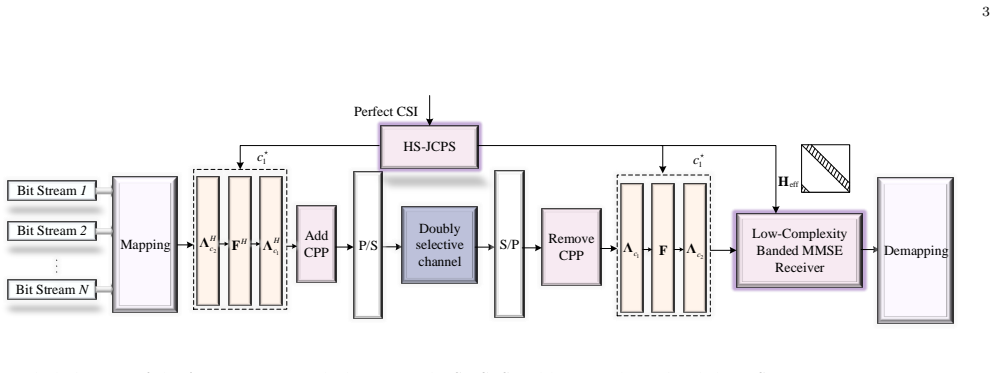
The paper sets out to show that the full MMSE receiver for AFDM can be replaced by a structured approximation with almost no performance loss. On the paper's own terms: the chirp parameter c1 affects post-MMSE SINR only through the diagonal entries of a transformed coupling matrix; the paper aggregates these into Pe(c1), a Parseval-energy metric, and observes that the c1 minimizing Pe also minimizes true BER. The receiver then sparsifies the effective channel matrix into a cyclic banded matrix, reorders it into a fixed banded form, and solves the MMSE system with banded Cholesky factorization. A hierarchical search, HS-JCPS, picks c1 and per-path pruning widths under a fixed complexity budge
What carries the argument
The engine is the identity Pe(c1)=1/N Σ_{u=1}^{N-1}|x_u|^2, which converts BER ranking of chirp parameters into an energy computation: x_u is the DFT-domain aggregate of the chirp-modulated circulant-diagonal vectors of the regularized inverse Gram matrix. On the receiver side, the load-bearing structure is a cyclic-banded binary mask S that prunes each multipath's coupling neighborhood; a sparse-matrix reordering step (RCM) turns the masked Gram matrix into a fixed banded matrix, and banded Cholesky factorization solves the MMSE system without a full inversion. The pruning widths w, the band width d, and c1 are linked: d determines the complexity, and the search must balance how much channe
Load-bearing premise
The whole fast-selection pipeline rests on the surrogate metric Pe(c1) ranking chirp parameters in the same order as true bit-error rate; the paper validates this ranking on a single simulation setting, and the derivation of Pe rests on an invariance of the diagonal of Ht under the chirp transform that is stated without proof.
What would settle it
Enumerate all candidate c1 values for several different delay-Doppler channel realizations, compute both Pe(c1) and the true MMSE BER curve, and check whether the argmin of Pe equals the argmin of BER in every case; one counterexample where the two argmins differ — especially in a channel with strongly varying diagonal channel gain — would falsify the FCDA selection claim.
If this is right
- Per-block MMSE detection in AFDM can be implemented with on the order of N d~^2 + 2N d~ + N d complex multiplications instead of roughly (4/3)N^3, making large-N blocks practical under high mobility.
- Because the optimal c1 depends on the complexity budget (the band width d~), parameter selection and receiver design cannot be decoupled; the paper shows the best c1 shifts as d~ grows.
- The c1 search becomes cheap enough to run adaptively: FCDA cuts the search time by about an order of magnitude relative to direct BER evaluation, which matters for fast-varying channels where c1 may need updating per block.
- Sparsification need not cost diversity: the retained path responses can still have full column rank, so the pruned receiver keeps the channel's path diversity while dropping only residual interference energy.
- Under equal guard overhead and perfect CSI, the joint design outperforms OFDM and OCDM and matches OTFS at the same complexity, with more headroom when the complexity budget is loosened.
Where Pith is reading between the lines
- A direct corollary the authors do not develop: the same hierarchical-search structure could be rerun per block or per slot to track a slowly drifting channel, since the reordering matrix and band pattern can be precomputed offline and only the local search cost is paid online.
- The surrogate-metric idea should transfer to MIMO-AFDM and to index-modulated AFDM, where the per-path coupling masks become per-path spatial masks; the complexity of the local search would grow, but the Parseval-based ranking would still apply to each spatial stream.
- The derivation of Pe(c1) relies on Eq. (19) treating the diagonal of Ht as invariant under FΛc1(·)Λc1^H F^H; as written, F diag(Ht) F^H has a constant diagonal equal to the average trace, not the original one. A corrected derivation would make Pe(c1) a slightly different quantity; whether its argmin still tracks BER is a test the paper leaves open.
Editorial analysis
A structured set of objections, weighed in public.
Referee Report
Summary. The paper investigates joint chirp-parameter (c1) selection and low-complexity MMSE detection for AFDM over doubly selective channels. It proposes: (i) an FCDA algorithm that selects c1 by minimizing a simplified metric P_e(c1) derived from the regularized inverse Gram matrix; (ii) an LC-BMMSE receiver that sparsifies the effective channel matrix path-wise, reorders the regularized matrix with RCM, and solves the banded system via banded Cholesky factorization; and (iii) an HS-JCPS algorithm that jointly optimizes c1 and per-path pruning widths under a fixed complexity budget. The reported results include an order-of-magnitude reduction in c1 search time and roughly 1 dB BER gain at 10^-3.
Significance. If correct, the FCDA metric would be a useful tool for AFDM parameter selection, and the LC-BMMSE receiver offers a convincing complexity reduction from O(N^3) to O(N d~^2 + N d~ + Nd), supported by Table I and the BER-versus-d~ tradeoff. The paper also provides useful waveform comparisons (AFDM vs OCDM/OFDM/OTFS) under equal guard overhead and with perfect CSI, which is a fair baseline. These are genuine strengths. The main reservation concerns the derivation of the FCDA surrogate metric, which contains an algebraic error; the LC-BMMSE and HS-JCPS parts are less affected because HS-JCPS evaluates the actual cost P_A(c1,w) rather than P_e(c1).
major comments (2)
- [Section III-B, Eq. (19)-(28)] The derivation of P_e(c1) relies on the claim that the diagonal part of H_t is invariant under the similarity transformation U = F Lambda_c1 (.) Lambda_c1^H F^H. This is false. For a diagonal matrix D, diag(U D U^H) = (tr(D)/N) 1_N, not diag(D). Therefore Eq. (19) should be [U H_t U^H]_{k,k} = c + [L]_{k,k}, with c = tr(H_t)/N and L defined by (20). Consequently, P_e in (21)-(28) omits the constant c, and since the BER in (14) is a nonlinear Q-function of SINR_k, minimizing sum_k |[L]_{k,k}|^2 is not equivalent to minimizing BER. Remark 1 overstates the metric; Fig. 5 validates it for one channel, one SNR, and one N. This error directly affects the FCDA near-optimal c1 claim and the order-of-magnitude search-time claim. Please correct the derivation (e.g., include c) or reframe FCDA as a heuristic with additional validation across SNR, N, and channel realizations.
- [Section IV / Appendix A, Lemma 1 and Proposition 2] The proof of the lower bound is not justified as written. In (51), the term (sigma_n^2 + sigma_Delta^2)/E_s [D(Psi~^{-1})^H]_{k,k} appears with a minus sign. Proposition 2 asserts that this term, together with the preceding nonnegative term, is positive and smaller than C(sigma_Delta). But D = Psi~^{-1} H~_eff^H Delta H_eff is not Hermitian, and Delta H_eff is an arbitrary pruning perturbation; the diagonal entries of D(Psi~^{-1})^H need not be real, let alone nonnegative. The inequality (54) follows from (51) only if these subtracted terms are known to be nonnegative. As it stands, Lemma 1 is not established. The HS-JCPS algorithm does not depend on this bound, but the paper explicitly lists the lower bound as a contribution and uses it in Fig. 9. Please prove the sign property or state clearly that the bound is heuristic.
minor comments (5)
- [Section II-D] The expression d = w1 - xi1 + wP + xiP appears to be off by one if d denotes the number of retained rows in the cyclic interval; it should be w1 + wP + xiP - xi1 + 1.
- [Eq. (9)] The condition (p+xi_i-w_i)_N <= q <= (p+xi_i+w_i)_N is ambiguous when the cyclic interval wraps around the index boundary. Please define the retained set using modular arithmetic or interval union notation.
- [Eq. (29)] The mask S uses negative powers of Pi_u (u = -d+1, ..., -1) but Pi_u was only defined for nonnegative u. Define Pi_{-u} as Pi_{N-u} or use a different notation.
- [Fig. 5] The right y-axis appears to be labeled '10^3' with no clear unit or scaling. Please clarify whether P_e(c1) is scaled and how the two curves are related.
- [Section III-B, complexity] The complexity comparison for FCDA does not mention the one-time cost of forming H_t = (H^H H + sigma_n^2/E_s I)^{-1}. State explicitly that this cost is amortized over all c1 candidates; otherwise the comparison is incomplete.
Circularity Check
No significant circularity: the central derivations are self-contained analytic constructions, and self-citations are background only.
full rationale
The FCDA metric P_e(c1) is derived analytically from the regularized inverse Gram matrix H_t (Eqs. 17-28), not fitted to BER data; its ranking validity is checked in Fig. 5 as external simulation. The LC-BMMSE receiver and HS-JCPS minimize the model-based P_A(c1,w) computed from Eqs. (12),(14); no parameter is fitted to an output it later claims to predict. The cited AFDM structure in Eq. (7) comes from [10] (Bemani et al.), not from the present authors, and the self-citations ([3],[12],[28]) are background related-work citations that do not carry the derivation. The mathematical flaw in Eq. (19) - namely that the diagonal part of H_t is not invariant under FΛ_{c1}(·)Λ_{c1}^H F^H, since F diag(H_t)F^H is circulant with constant diagonal - is a soundness/correctness issue in the surrogate derivation, not a circularity: it does not assume the conclusion it derives. No step reduces by construction to its own input. Minor self-citations in the introduction justify score 1 rather than 0.
Axiom & Free-Parameter Ledger
free parameters (2)
- Δw (width step size)
- Iter_max =
15
axioms (8)
- standard math Standard MMSE SINR formulas (Eqs. 12-14) from [34]-[36] are exact for the full ECM.
- standard math Parseval's theorem and DFT properties
- standard math Banded Cholesky factorization and RCM reordering preserve the solution of the linear system
- domain assumption Doubly selective channel model (Eq. 2) with P paths, integer delays and fractional Doppler; perfect CSI at receiver
- domain assumption 2N c1 is an integer and N is even, so Γ_CPP = I_N (Eq. 4)
- ad hoc to paper P_e(c1) is a faithful surrogate for BER (Remark 1)
- ad hoc to paper Sparsification perturbation can be modeled as additive noise with variance σ_Δ^2 added to the diagonal of \tildeΨ
- ad hoc to paper The local search in HS-JCPS finds a near-global optimum via multi-start initialization
read the original abstract
Affine frequency division multiplexing (AFDM) has emerged as a promising waveform against doubly selective channels under high-mobility communication scenarios. Optimal chirp parameter selection and reduced-complexity receiver design in AFDM are essential for achieving satisfactory bit error rate (BER) performance with low computational complexity. In this paper, we investigate the joint optimization of chirp-parameter selection and low-complexity minimum mean square error (MMSE)-based receiver design by exploiting the structural characteristics of the AFDM effective channel matrix (ECM). First, a simplified BER performance metric is derived by leveraging the diagonal and circulant structure of the discrete affine Fourier transformation (DAFT), based on which a fast circulant-diagonal aggregation (FCDA) algorithm is developed for efficient $c_1$ selection. Then, a low-complexity banded MMSE (LC-BMMSE) receiver is developed by constructing a cyclic-banded ECM through path-wise structured sparsification, where banded Cholesky factorization is employed to avoid direct matrix inversion. Building upon the proposed BER metric and the LC-BMMSE receiver, a hierarchical-search-based joint chirp parameter and structured sparsification (HS-JCPS) algorithm is further proposed to jointly optimize the chirp parameter and sparsification pattern under a given complexity constraint. Simulation results demonstrate that the proposed FCDA reduces the search time for the optimal $c_1$ by an order of magnitude compared with using a BER-based criterion. Moreover, the proposed HS-JCPS algorithm with the LC-BMMSE receiver can identify a near-optimal $c_1$, while attaining a superior performance-complexity tradeoff.
Figures


Reference graph
Works this paper leans on
-
[1]
Affine frequency division multiplexing (AFDM) for 6G: Properties, features, and challenges,
H. S. Rou, K. R. R. Ranasinghe, V. Savaux, G. T. F. d. Abreu, G. David González, and C. Masouros, “Affine frequency division multiplexing (AFDM) for 6G: Properties, features, and challenges,” IEEE Commun. Stand. Mag., pp. 1–10, 2025
2025
-
[2]
On the vulnerability of mega- constellation networks under geographical failure,
Q. Ouyang, N. Ye, and J. An, “On the vulnerability of mega- constellation networks under geographical failure,” IEEE Trans. Netw., vol. 33, no. 4, pp. 2049–2062, 2025
2049
-
[3]
Chirp-based OCDM and AFDM waveforms for 6G and beyond: Principles, recent advances, and future opportunities,
Q. Luo et al., “Chirp-based OCDM and AFDM waveforms for 6G and beyond: Principles, recent advances, and future opportunities,” Authorea Prepr., 2026
2026
-
[4]
AFDM-enabled integrated sensing and com- munication: Theoretical framework and pilot design,
F. Zhang et al., “AFDM-enabled integrated sensing and com- munication: Theoretical framework and pilot design,” IEEE J. Sel. Areas Commun., vol. 44, pp. 310–324, 2026
2026
-
[5]
Robust secure UA V communications with the aid of jamming beamforming,
Y. Zhang, X. Gao, M. Shi, H. Yuan, J. Kang, D. Niyato, and K. Yang, “Robust secure UA V communications with the aid of jamming beamforming,” IEEE Trans. Commun., vol. 73, no. 11, pp. 12 205–12 220, 2025
2025
-
[6]
Z. Sui et al., “Multi-functional chirp signalling for next- generation multi-carrier wireless networks: Communications, sensing and ISAC perspectives,” 2025. [Online]. A vailable: https://arxiv.org/abs/2508.06022
Pith/arXiv arXiv 2025
-
[7]
Equalization for OFDM over doubly selective channels,
I. Barhumi, G. Leus, and M. Moonen, “Equalization for OFDM over doubly selective channels,” IEEE Trans. Signal Process., vol. 54, no. 4, pp. 1445–1458, 2006
2006
-
[8]
Performance analysis of equalized OFDM systems in Rayleigh fading,
M.-X. Chang and Y. Su, “Performance analysis of equalized OFDM systems in Rayleigh fading,” IEEE Trans. Wireless Commun., vol. 1, no. 4, pp. 721–732, 2002
2002
-
[9]
Near-field terahertz covert communications with noise uncertainty,
C. Song, H. Yuan, Z. Zhang, X. Gao, M. Shi, N. Yang, and K. Yang, “Near-field terahertz covert communications with noise uncertainty,” IEEE Trans. Wireless Commun., vol. 25, pp. 7520–7534, 2026
2026
-
[10]
AFDM: A full diversity next generation waveform for high mobility communi- cations,
A. Bemani, N. Ksairi, and M. Kountouris, “AFDM: A full diversity next generation waveform for high mobility communi- cations,” in Proc. IEEE Int. Conf. Commun. Workshops (ICC Workshops), 2021, pp. 1–6
2021
-
[11]
Multi-attribute wireless interference identification under un- dersampling: A multi-domain fusion model using domain- specific hybrid sampling,
Z. Zhang, J. An, N. Ye, Z. Zhang, D. Niyato, and K. Yang, “Multi-attribute wireless interference identification under un- dersampling: A multi-domain fusion model using domain- specific hybrid sampling,” IEEE Trans. Commun., vol. 74, pp. 2701–2715, 2026
2026
-
[12]
AFDM-SCMA: A promising waveform for massive connectivity over high mobility channels,
Q. Luo, P. Xiao, Z. Liu, Z. Wan, N. Thomos, Z. Gao, and Z. He, “AFDM-SCMA: A promising waveform for massive connectivity over high mobility channels,” IEEE Trans. Wireless Commun., vol. 23, no. 10, pp. 14 421–14 436, 2024
2024
-
[13]
Affine frequency division multiple access based on DAFT spreading for next-generation wireless networks,
Y. Tao, M. Wen, Y. Ge, T. Mao, Y. Tang, and A. Doosti- Aref, “Affine frequency division multiple access based on DAFT spreading for next-generation wireless networks,” IEEE Trans. Wireless Commun., vol. 25, pp. 4626–4641, 2026
2026
-
[14]
AFDM-aided grant-free random access for LEO SIoT: Perfor- mance analysis and near-optimal joint detection,
Y. Xu, L. Xiao, C. Ding, P. Xiao, M. Wen, and T. Jiang, “AFDM-aided grant-free random access for LEO SIoT: Perfor- mance analysis and near-optimal joint detection,” IEEE Trans. Commun., 2025
2025
-
[15]
A novel angle-delay-doppler estimation scheme for AFDM- ISAC system in mixed near-field and far-field scenarios,
Y. Luo, Y. L. Guan, Y. Ge, D. González G, and C. Yuen, “A novel angle-delay-doppler estimation scheme for AFDM- ISAC system in mixed near-field and far-field scenarios,” IEEE Internet Things J., vol. 12, no. 13, pp. 22 669–22 682, 2025
2025
-
[16]
Ambiguity function analysis of AFDM under pulse-shaped random ISAC signaling,
Y. Ni, F. Liu, H. Yin, Y. Tang, Y. Ma, and Z. Wang, “Ambiguity function analysis of AFDM under pulse-shaped random ISAC signaling,” IEEE Trans. Wireless Commun., vol. 25, pp. 13 619– 13 635, 2026
2026
-
[17]
Spreading the wave: Low- complexity PAPR reduction for AFDM and OCDM in 6G networks,
A. Ali, A. Arous, and H. Arslan, “Spreading the wave: Low- complexity PAPR reduction for AFDM and OCDM in 6G networks,” IEEE Trans. Green Commun. Netw., vol. 10, pp. 1565–1577, 2026
2026
-
[18]
PAPR reduction with pre-chirp selection for affine frequency division multiplexing,
H. Yuan, Y. Xu, X. Guo, Y. Ge, T. Ma, H. Li, D. He, and W. Zhang, “PAPR reduction with pre-chirp selection for affine frequency division multiplexing,” IEEE Wirel. Commun. Lett., vol. 14, no. 3, pp. 736–740, 2025
2025
-
[19]
Chirp pa- rameter selection for AFDM with MMSE equalization in static multipath channels,
Z. Li, X. Fang, H. Dong, C. Zhang, and X. Sha, “Chirp pa- rameter selection for AFDM with MMSE equalization in static multipath channels,” in Proc. IEEE GLOBECOM Workshops (GC Wkshps), Dec. 2023, pp. 1099–1104
2023
-
[20]
Low complexity equalization for AFDM in doubly dispersive channels,
A. Bemani, N. Ksairi, and M. Kountouris, “Low complexity equalization for AFDM in doubly dispersive channels,” in Proc. IEEE Int. Conf. Acoust. Speech Signal Process. (ICASSP), 2022, pp. 5273–5277
2022
-
[21]
AFDM signal detection based on message passing scheme,
L. Wu, S. Luo, D. Song, F. Yang, R. Lin, and S. Xie, “AFDM signal detection based on message passing scheme,” Digit. Signal Process., vol. 153, p. 104633, 2024. [Online]. A vailable: https://www.sciencedirect.com/science/article/pii/ S1051200424002586
2024
-
[22]
Pre-chirp-domain index modulation for full- diversity affine frequency division multiplexing toward 6G,
G. Liu et al., “Pre-chirp-domain index modulation for full- diversity affine frequency division multiplexing toward 6G,” IEEE Trans. Wireless Commun., vol. 24, no. 9, pp. 7331–7345, 2025
2025
-
[23]
Near-field LoS MIMO with dual continuous apertures (CAPs): Channel decomposition and EDoF-optimal beamforming,
R. Song, H. Yuan, C. Song, Z. Zhang, X. Gao, D. Niyato, and K. Yang, “Near-field LoS MIMO with dual continuous apertures (CAPs): Channel decomposition and EDoF-optimal beamforming,” IEEE Trans. Commun., vol. 74, pp. 2251–2267, 2026
2026
-
[24]
Agile affine frequency division multiplexing,
Y. Cao and Y. Shao, “Agile affine frequency division multiplexing,” 2025. [Online]. A vailable: https://arxiv.org/abs/ 2512.14424
arXiv 2025
-
[25]
H. Yin et al., “From OFDM to AFDM: Enabling adaptive integrated sensing and communication in high-mobility scenarios,” 2025. [Online]. A vailable: https://arxiv.org/abs/ 2510.27192
arXiv 2025
-
[26]
Generalized spatial modulation aided affine frequency division multiplexing,
Z. Sui, Z. Liu, L. Musavian, L.-L. Yang, and L. Hanzo, “Generalized spatial modulation aided affine frequency division multiplexing,” IEEE Trans. Wireless Commun., 2025
2025
-
[27]
Time-domain zero-padding (TZP) AFDM with two-stage iterative MMSE detection,
C. Shen, J. Yuan, and J. Tong, “Time-domain zero-padding (TZP) AFDM with two-stage iterative MMSE detection,” IEEE Trans. Wireless Commun., pp. 1–1, 2025
2025
-
[28]
Joint sparse graph for enhanced MIMO-AFDM receiver design,
Q. Luo, J. Zhu, Z. Liu, Y. Tang, P. Xiao, G. Chen, and J. Shi, “Joint sparse graph for enhanced MIMO-AFDM receiver design,” IEEE Trans. Wireless Commun., pp. 1–1, 2025
2025
-
[29]
Affine frequency division multiplexing with index modula- tion: Full diversity condition, performance analysis, and low- complexity detection,
Y. Tao, M. Wen, Y. Ge, J. Li, E. Basar, and N. Al-Dhahir, “Affine frequency division multiplexing with index modula- tion: Full diversity condition, performance analysis, and low- complexity detection,” IEEE J. Sel. Areas Commun., vol. 43, no. 4, pp. 1041–1055, 2025
2025
-
[30]
Deep learning aided low complexity expectation propagation turbo detection for AFDM,
Q. Li, G. Liu, Y. Liu, H. Liu, F. Xu, and C. Liu, “Deep learning aided low complexity expectation propagation turbo detection for AFDM,” IEEE Trans. Commun., vol. 74, pp. 1451–1466, 2026
2026
-
[31]
Chirp parameter selection for affine frequency division 16 multiplexing with MMSE equalization,
Z. Li, C. Zhang, G. Song, X. Fang, X. Sha, and D. T. M. Slock, “Chirp parameter selection for affine frequency division 16 multiplexing with MMSE equalization,” IEEE Trans. Commun., vol. 73, no. 7, pp. 5079–5093, 2025
2025
-
[32]
Parameter design for secure affine frequency division multiplexing waveform,
Z. Di, W. Zeyin, T. Yanqun, W. Dongdong, and Y. Muzi, “Parameter design for secure affine frequency division multiplexing waveform,” 2025. [Online]. A vailable: https: //doi.org/10.48550/arXiv.2503.19364
-
[33]
Parameter design of AFDM for incomplete channel information over frequency selective channel,
J. Lin, Q. Lian, S. Qiu, and Q. Chen, “Parameter design of AFDM for incomplete channel information over frequency selective channel,” in Proc. Int. Conf. Electron. Inf. Technol. (EIT), 2025, pp. 356–359
2025
-
[34]
Performance indi- cator for MIMO MMSE receivers in the presence of channel estimation error,
E. Eraslan, B. Daneshrad, and C.-Y. Lou, “Performance indi- cator for MIMO MMSE receivers in the presence of channel estimation error,” IEEE Wireless Commun. Lett., vol. 2, no. 2, pp. 211–214, 2013
2013
-
[35]
BER minimized OFDM systems with channel independent precoders,
Y.-P. Lin and S.-M. Phoong, “BER minimized OFDM systems with channel independent precoders,” IEEE Trans. Signal Pro- cess., vol. 51, no. 9, pp. 2369–2380, 2003
2003
-
[36]
J. G. Proakis and M. Salehi, Digital Communications, 5th ed. New York, NY, USA: McGraw-Hill, 2008
2008
-
[37]
A. V. Oppenheim, R. W. Schafer, and J. R. Buck, Discrete- Time Signal Processing, 2nd ed. Upper Saddle River, NJ, USA: Prentice Hall, 1999
1999
-
[38]
Low-complexity LMMSE receiver design for practical-pulse-shaped MIMO- OTFS systems,
P. Singh, S. Tiwari, and R. Budhiraja, “Low-complexity LMMSE receiver design for practical-pulse-shaped MIMO- OTFS systems,” IEEE Trans. Commun., vol. 70, no. 12, pp. 8383–8399, 2022
2022
-
[39]
George and J
A. George and J. W. H. Liu, Computer Solution of Large Sparse Positive Definite Systems. Englewood Cliffs, NJ, USA: Prentice-Hall, 1981
1981
-
[40]
G. H. Golub and C. F. Van Loan, Matrix Computations, 4th Edition. Philadelphia, PA, USA: Johns Hopkins University Press, 2013
2013
-
[41]
Study on New Radio (NR) to support non-terrestrial networks,
3rd Generation Partnership Project (3GPP), “Study on New Radio (NR) to support non-terrestrial networks,” 3GPP, Tech- nical Report TR 38.811, 2019
2019
discussion (0)
Sign in with ORCID, Apple, or X to comment. Anyone can read and Pith papers without signing in.