REVIEW 4 major objections 5 minor 54 references
Competing ferromagnetic and antiferromagnetic interactions in non-altermagnetic Ru$_{1-x}$Cr$_{x}$O$_{2}$
T0 review · 4 major / 5 minor · reviewed 2026-08-01 · deepseek-v4-flash
Pith's one-line read Neutron diffraction finds that Cr-doped RuO2 lacks the long-range magnetic order needed for an altermagnet.
desk verdict The neutron null for x=0.23 is real and worth publishing, but the paper's wider claim that Cr holes stay localized goes beyond what these data show. read the letter →
The pith
A machine-rendered reading of the paper's core claim, the machinery that carries it, and where it could break.
The reading
What carries the argument
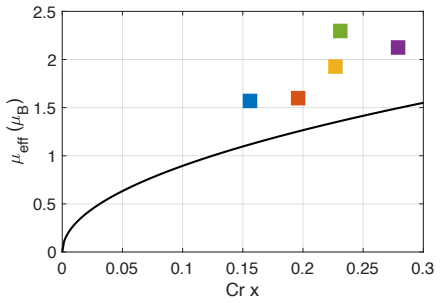
The decisive measurement is elastic neutron diffraction at the structurally forbidden (100) and (001) reciprocal-lattice positions, the predicted brightest magnetic peaks for an altermagnetic state with moments along the c-axis or in the ab-plane. The (002) nuclear peak of the film is used to normalize the expected magnetic intensity, and the comparison assumes the DFT-predicted ordered moment of about 0.5 Bohr magneton per formula unit. Supporting this are Curie-Weiss fits to the susceptibility, which yield positive Weiss temperatures and effective moments larger than the single-ion Cr prediction — fingerprints the authors read as ferromagnetically coupled Cr clusters.
What would settle it
A magnetic Bragg peak at (100) or (001) in a similarly prepared Ru0.77Cr0.23O2 film — with intensity consistent with an ordered moment of roughly 0.5 Bohr magneton per formula unit oriented along the c-axis or in the ab-plane — would contradict the null result. Alternatively, muon spin rotation showing coherent long-range magnetic order below 20 K in the same composition would falsify the localized-cluster interpretation.
Extended reading notes
Core claim
The central claim is that the x=0.23 film, like x=0, shows no magnetic Bragg scattering at the (100) and (001) positions that would signal the long-range, symmetry-breaking antiferromagnetic order of a d-wave altermagnet. The authors demonstrate for the first time, by direct probe, that Cr substitution at this level does not support the sought-after altermagnetic state. Combined with the low-temperature magnetization data — remanence and coercivity coexisting with a susceptibility downturn and enhanced effective moments — the evidence points to ferromagnetic CrO2 clusters antiferromagnetically coupled to one another, meaning the Cr-derived holes remain localized rather than hole-doping the R
Load-bearing premise
The conclusion that no long-range altermagnetic order exists rests on the assumption that the ordered moment would be large enough (about 0.5 Bohr magneton per formula unit), at the probed wavevectors and orientations, to produce a detectable neutron signal in these thin films.
Editorial extensions
If this is right
- If correct, Cr alloying is not a viable route to a thin-film d-wave altermagnet based on RuO2.
- The previously reported zero-field anomalous Hall effect in Cr-doped RuO2 is better explained by ferromagnetic CrO2 clusters coupled antiferromagnetically rather than by altermagnetic order.
- The localized nature of Cr holes means band-structure engineering via Cr substitution cannot be relied on to produce the 0.4 holes per Ru site needed for altermagnetism.
- Future searches for d-wave altermagnets in this rutile family should look beyond Ru1-xCrxO2, for example at different dopants or doping mechanisms that preserve itinerancy.
Reading between the lines
- The null result is only as strong as the assumed moment, wavevector, and orientation; a true altermagnetic moment smaller than about 0.5 Bohr magneton per formula unit, ordered at a different wavevector, or oriented so that both probed peaks are weak would be missed.
- The cluster picture could be tested directly with local probes such as muon spin rotation or resonant x-ray scattering that do not require long-range order, or by studying the field dependence of the hysteresis to estimate cluster sizes.
- If Cr clusters are indeed the source of the anomalous Hall signal, then similar alloying routes in other rutile oxides may also produce cluster magnetism rather than altermagnetism, suggesting that composition-dependent transport signatures should be reexamined.
Signed reviews
Editorial analysis
A structured set of objections, weighed in public.
Referee Report
Summary. The paper reports a combined XRD/XPS/magnetometry/neutron diffraction study of epitaxial Ru_{1-x}Cr_xO_2 thin films (0 ≤ x ≤ 0.28) to test the proposal that Cr substitution hole-dopes RuO_2 into a d-wave altermagnet. XRD and XPS establish epitaxial growth, lattice-parameter trends, and depth-uniform Cr composition, while magnetometry shows a gradual susceptibility downturn below ~20 K and ferromagnetic hysteresis/remanence for x ≥ 0.23. Neutron diffraction on x = 0 and x = 0.23 samples, scanned at the structurally forbidden (100) and (001) positions, finds no magnetic Bragg peaks at 10 K at the intensity expected for the DFT-predicted 0.5 μ_B/f.u. ordered moment. The authors conclude that long-range altermagnetic order is absent in the x = 0.23 film and interpret the combined data as evidence for antiferromagnetically coupled ferromagnetic CrO_2-rich clusters, implying that Cr 3d holes remain localized rather than doping the Ru bands.
Significance. If the central null result is accepted, it provides direct experimental evidence against an altermagnetic ground state in Cr-substituted RuO_2 at x = 0.23, complementing the recent body of work refuting altermagnetism in stoichiometric RuO_2. It also supports the cluster-based explanation of the anomalous Hall effect in Cr-doped RuO_2 proposed by Smolyanyuk et al., and it helps redirect future searches for thin-film d-wave altermagnets. Strengths of the work include the depth-resolved XPS characterization, substrate-subtracted magnetometry on a systematic composition series, and the use of neutron diffraction, a direct probe of long-range magnetic order, on a film sample with a comparison to a DFT-informed magnetic peak intensity.
major comments (4)
- [Section IV (Conclusion) and abstract] The conclusion that 'Cr ions do not hole dope Ru bands... the holes remain localized to the Cr ions' is not entailed by the observations. The neutron null constrains only long-range order at (100)/(001) under the assumed 0.5 μ_B/f.u. moment, and the magnetometry supports a cluster scenario but does not uniquely establish it. Absence of magnetic Bragg peaks could also arise from quenched disorder, strain, short-range correlations, a reduced ordered moment, or an ordering wavevector not scanned, even if the Cr holes were itinerant. The wording in the abstract and Section IV should be tempered to 'not effectively hole dope within the cluster model,' or the authors should add a direct electronic-structure/valence probe (e.g., XAS or ARPES) to substantiate the localization claim.
- [Section III.C, Fig. 5] The sensitivity of the neutron null is calibrated to a DFT-predicted ordered moment of 0.5 μ_B/f.u. from Ref. [50], but the paper does not state the counting-statistics upper limit on an ordered moment. The dashed curves in Fig. 5 represent the calculated magnetic peak, but no explicit detection threshold is given. The reader cannot assess how much smaller than 0.5 μ_B/f.u. the moment must be to escape detection. Please report an upper bound on μ_ordered derived from the noise level and normalization, and state the assumed magnetic propagation vector, since the (100)/(001) scans only constrain commensurate k=0 (or equivalent) order.
- [Section III.B, Fig. 4] The effective moments and Curie-Weiss temperatures are extracted from fits to χ = χ0 + C/(T - θ_CW), but no fit range, fit uncertainties, or goodness-of-fit are reported. The claim that the extracted effective moments are 'systematically larger' than the single-ion prediction, and the trend of increasing θ_CW with x, cannot be evaluated without error bars. This is load-bearing because the cluster picture is inferred from the composition dependence of these fitted parameters. Provide a table listing θ_CW, μ_eff, χ0, and their uncertainties for each sample, and specify the high-temperature fitting window. Also clarify how the reported phase fractions in Table I affect the volume-to-molar susceptibility conversion and hence the extracted moments.
- [Section IV and title] The neutron diffraction measurement was performed on a single doped composition, x = 0.23; the magnetometry on x ≥ 0.16 is indirect and cannot by itself establish the absence of long-range order. The conclusion that 'Cr alloying into RuO2 is not a viable route' generalizes beyond the measured composition. Either report neutron data on a higher-x sample (e.g., x = 0.28) or restrict the conclusion to x = 0.23 and explicitly state that the remaining compositions are constrained only by magnetometry. The title's blanket 'non-altermagnetic Ru1-xCrxO2' should be qualified accordingly.
minor comments (5)
- [Section II (Methods)] Typo: 'The crystal structural of the films' should read 'The crystal structure of the films'.
- [Section III.B, Fig. 3] The units 'per mol' in Fig. 3(b) should specify per mole of Cr, per mole of formula unit, or per mole of cation, since the normalization affects the extracted Curie-Weiss parameters.
- [Section III.C, Fig. 5 caption] The calculation of the dashed magnetic peak from the (002) nuclear normalization is not described in the text. A brief equation or a reference to a standard neutron-diffraction intensity formula would make the sensitivity estimate reproducible.
- [Section III.C] The sentence 'demonstrates for the first time that x=0.23 also does not support the sought-after d-wave altermagnetic state' should be supported by a brief check of prior neutron work on Cr-doped RuO2; if this truly is the first neutron measurement of this composition, state so explicitly and avoid the implication that all x are covered.
- [Section IV / Abstract] The abstract says 'samples with x = 0 and x = 0.23 at low temperatures show no evidence of long-range altermagnetic order.' This is accurate, but the phrase 'at low temperatures' is misleading for the x = 0 sample, which was measured at 100 K; consider saying 'at 10 K for x = 0.23 and at 100 K for x = 0.'
Circularity Check
No circularity: the magnetic null is calibrated against an external DFT prediction, and the Curie-Weiss parameters are openly fitted; the hole-localization conclusion is an interpretation, not a fitted prediction.
full rationale
The central derivation chain is: (1) epitaxial film quality and composition are established by XRD and XPS; (2) susceptibility is fit to Curie-Weiss plus a constant chi0 term, with theta_CW and mu_eff explicitly reported as fitted values; (3) the neutron scattering expected intensity for an altermagnetic state is estimated by normalizing to the measured (002) nuclear peak and assuming the 0.5 mu_B/f.u. ordered moment taken from Ref. [50], an external DFT study by a different group; (4) the absence of (100) and (001) magnetic intensity is then compared with that forward-calculated benchmark. No parameter is fitted to the (100)/(001) data and then relabeled as a prediction; the comparison is between data and an externally prescribed model, so there is no fitted-input-called-prediction pattern. The 'ferromagnetically coupled CrO2 clusters' picture is inferred from the enhancement of the fitted effective moment relative to a single-ion model and from the susceptibility downturn, but the paper explicitly labels this as suggestive/speculative ('suggests', 'consistent with', 'we speculate'), not as a quantity derived by construction from the same data. The paper's self-citations (Refs. [31], [46]) appear only in the literature overview of indirect probes and are not load-bearing for the null result. The conclusion that Cr holes remain localized is a physical inference with acknowledged scope limits (only the (100) and (001) positions were scanned, and the sensitivity depends on the assumed ordered moment, wavevector, and orientation), which is an evidence-strength limitation rather than a circular step. Under the hard rule that circularity requires a quotable construction—e.g., Eq. X = Eq. Y by definition, or a fitted parameter renamed as a prediction—no such step is present.
Assumptions & free parameters
free parameters (5)
- Curie-Weiss temperature θ_CW =
0.1, 1.2, 6.6, 10 K for (100) x=0.16/0.20/0.23/0.28 and 28.1 K for (001) x=0.23
- Effective moment μ_eff =
0 to ~2.5 μB (Fig. 4)
- Temperature-independent susceptibility χ0 =
Not tabulated in the text
- Assumed ordered moment for magnetic peak intensity =
0.5 μB/f.u.
- Phase fractions for two-phase films =
0.53/0.47 (x=0.20), 0.54/0.46 (x=0.28)
assumptions (5)
- standard math Magnetic neutron scattering only detects moment components perpendicular to the scattering vector; measuring (100) and (001) covers c-axis and ab-plane moments.
- domain assumption Altermagnetic order in Ru1-xCrxO2 would be commensurate and produce intensity at the structurally forbidden (100)/(001) positions.
- domain assumption The thin-film volume contributing to coherent magnetic scattering is accurately represented by the measured (002) nuclear intensity and film thickness.
- domain assumption Curie-Weiss law with a temperature-independent χ0 adequately describes the high-temperature susceptibility.
- domain assumption Subtraction of bare-substrate signals fully isolates the film magnetization.
invented entities (1)
-
Antiferromagnetically coupled ferromagnetic CrO2 clusters
Cite this review
Pith. "Pith review of Competing ferromagnetic and antiferromagnetic interactions in non-altermagnetic Ru$_{1-x}$Cr$_{x}$O$_{2}$." pith.science (2026). https://pith.science/paper/52MRERJ5
@misc{pith2026260720298,
  author       = {Pith},
  title        = {Pith review of: Competing ferromagnetic and antiferromagnetic interactions in non-altermagnetic Ru$_1-x$Cr$_x$O$_2$},
  year         = {2026},
  howpublished = {\url{https://pith.science/paper/52MRERJ5}},
  note         = {Machine review of arXiv:2607.20298}
}
abstract
We investigate the proposal of hole doping RuO$_{2}$ via alloying with Cr ions to induce altermagnetism. Thin film samples of Ru$_{1-x}$Cr$_{x}$O$_{2}$ ($0 \leq x \leq 0.28$) were prepared by reactive magnetron co-sputtering on TiO$_{2}$ substrates, with epitaxial nature verified by X-ray diffraction and composition depth profiles determined by X-ray photoelectron spectroscopy combined with Ar etching. Neutron diffraction measurements of samples with $x = 0$ and $x = 0.23$ at low temperatures show no evidence of long-range altermagnetic order with spins oriented along the $c$-axis or within the $ab$-plane. In contrast, temperature dependent susceptibility measurements in samples with $x \geq 0.16$ show a gradual downturn below $T\approx20~$K, suggestive of antiferromagnetic interactions, although this coexists with ferromagnetic hysteresis and remnant magnetization at $4~$K for samples with $x \geq 0.23$. Together, our magnetometry and neutron scattering measurements suggest the coexistence of antiferromagnetically coupled ferromagnetic CrO\textsubscript{2} clusters. This indicates that Cr ions do not hole dope Ru bands to induce an altermagnet state, but rather the holes remain localized to the Cr ions.
Figures


Figures from the paper (2 more)

Reference graph
Works this paper leans on
-
[50]
Smolyanyuk, L
A. Smolyanyuk, L. ˇSmejkal, and I. I. Mazin, Origin of the anomalous hall effect in cr-doped ruo 2, Physical Review B111, 064406 (2025)
2025
-
[1]
Julliere, Tunneling between ferromagnetic films, Physics letters A54, 225 (1975)
M. Julliere, Tunneling between ferromagnetic films, Physics letters A54, 225 (1975)
1975
-
[2]
S. S. Parkin, C. Kaiser, A. Panchula, P. M. Rice, B. Hughes, M. Samant, and S.-H. Yang, Giant tunnelling magnetoresistance at room temperature with mgo (100) tunnel barriers, Nature materials3, 862 (2004)
2004
-
[3]
Yuasa, T
S. Yuasa, T. Nagahama, A. Fukushima, Y. Suzuki, and K. Ando, Giant room-temperature magnetoresistance in single-crystal fe/mgo/fe magnetic tunnel junctions, Nature materials3, 868 (2004)
2004
-
[4]
Baltz, A
V. Baltz, A. Manchon, M. Tsoi, T. Moriyama, T. Ono, and Y. Tserkovnyak, Antiferromagnetic 16 TABLE I. Sample Properties (hkl) Sample Crx a( ˚A) b( ˚A) c( ˚A) Phase fraction thickness (nm) (001) RuO2 0±0 4.520 4.520 3.091 1 200 RuO2 0±0 4.586 4.586 3.063 1 19.5 Ru0.77Cr0.23O2 0.231±0.002 4.517 4.517 3.039 1 160 (100) Ru0.84Cr0.16O2 0.156±0.002 4.546 4.592 ...
2018
-
[5]
Jungwirth, X
T. Jungwirth, X. Marti, P. Wadley, and J. Wunderlich, Antiferromagnetic spintronics, Nature nanotechnology11, 231 (2016)
2016
-
[6]
ˇSmejkal, J
L. ˇSmejkal, J. Sinova, and T. Jungwirth, Emerging research landscape of altermagnetism, 17 Physical Review X12, 040501 (2022)
2022
-
[7]
Shao and E
D.-F. Shao and E. Y. Tsymbal, Antiferromagnetic tunnel junctions for spintronics, npj Spin- tronics2, 13 (2024)
2024
Show all 54 references
-
[8]
ˇSmejkal, R
L. ˇSmejkal, R. Gonz´ alez-Hern´ andez, T. Jungwirth, and J. Sinova, Crystal time-reversal sym- metry breaking and spontaneous hall effect in collinear antiferromagnets, Science advances6, eaaz8809 (2020)
2020
-
[9]
L.-D. Yuan, Z. Wang, J.-W. Luo, E. I. Rashba, and A. Zunger, Giant momentum-dependent spin splitting in centrosymmetric low-z antiferromagnets, Physical Review B102, 014422 (2020)
2020
-
[10]
I. I. Mazin, K. Koepernik, M. D. Johannes, R. Gonz´ alez-Hern´ andez, and L.ˇSmejkal, Prediction of unconventional magnetism in doped fesb2, Proceedings of the National Academy of Sciences 118, e2108924118 (2021)
2021
-
[11]
Krempask` y, L
J. Krempask` y, L. ˇSmejkal, S. D’souza, M. Hajlaoui, G. Springholz, K. Uhl ´ ıˇ rov´ a, F. Alarab, P. Constantinou, V. Strocov, D. Usanov,et al., Altermagnetic lifting of kramers spin degen- eracy, Nature626, 517 (2024)
2024
-
[12]
Gonz´ alez-Hern´ andez, L.ˇSmejkal, K
R. Gonz´ alez-Hern´ andez, L.ˇSmejkal, K. V` yborn` y, Y. Yahagi, J. Sinova, T. Jungwirth, and J. ˇZelezn` y, Efficient electrical spin splitter based on nonrelativistic collinear antiferromag- netism, Physical Review Letters126, 127701 (2021)
2021
-
[13]
K. D. Belashchenko, Giant strain-induced spin splitting effect in mnte, ag-wave altermagnetic semiconductor, Physical Review Letters134, 086701 (2025)
2025
-
[14]
Berlijn, P
T. Berlijn, P. C. Snijders, O. Delaire, H.-D. Zhou, T. A. Maier, H.-B. Cao, S.-X. Chi, M. Mat- suda, Y. Wang, M. R. Koehler,et al., Itinerant antiferromagnetism in ruo 2, Physical review letters118, 077201 (2017)
2017
-
[15]
Z. Zhu, J. Strempfer, R. Rao, C. Occhialini, J. Pelliciari, Y. Choi, T. Kawaguchi, H. You, J. Mitchell, Y. Shao-Horn,et al., Anomalous antiferromagnetism in metallic ruo 2 determined by resonant x-ray scattering, Physical review letters122, 017202 (2019)
2019
-
[16]
Keßler, L
P. Keßler, L. Garcia-Gassull, A. Suter, T. Prokscha, Z. Salman, D. Khalyavin, P. Manuel, F. Orlandi, I. I. Mazin, R. Valent ´ ı,et al., Absence of magnetic order in ruo2: insights fromµ sr spectroscopy and neutron diffraction, npj Spintronics2, 50 (2024)
2024
-
[17]
C. A. Occhialini, C. Nelson, A. Bombardi, S. Fan, R. Acevedo-Esteves, R. Comin, D. N. Basov, M. Musashi, M. Kawasaki, M. Uchida,et al., Structural origin of resonant diffraction 18 in ruo 2, Physical Review B113, L060411 (2026)
2026
-
[18]
B. Z. Gregory, N. Wadehra, S. Zhang, Y. Wu, S. Poage, J. Strempfer, A. K. Kundu, A. Rajapi- tamahuni, E. Vescovo, A. Verma,et al., Resonant diffraction and photoemission inconsistent with altermagnetism in epitaxial ruo 2 films, arXiv preprint arXiv:2510.13781 (2025)
2025
-
[19]
Hiraishi, H
M. Hiraishi, H. Okabe, A. Koda, R. Kadono, T. Muroi, D. Hirai, and Z. Hiroi, Nonmagnetic ground state in ruo 2 revealed by muon spin rotation, Physical Review Letters132, 166702 (2024)
2024
-
[20]
J. Liu, J. Zhan, T. Li, J. Liu, S. Cheng, Y. Shi, L. Deng, M. Zhang, C. Li, J. Ding,et al., Absence of altermagnetic spin splitting character in rutile oxide ruo 2, Physical Review Letters 133, 176401 (2024)
2024
-
[21]
Osumi, K
T. Osumi, K. Yamauchi, S. Souma, S. Paul, A. Honma, K. Nakayama, K. Ozawa, M. Kitamura, K. Horiba, H. Kumigashira,et al., Spin-degenerate bulk bands and topological surface states associated with dirac nodal lines in ruo 2, Physical Review B113, 085116 (2026)
2026
-
[22]
Z. Wu, M. Long, H. Chen, S. Paul, H. Matsuki, O. Zheliuk, U. Zeitler, G. Li, R. Zhou, Z. Zhu, et al., Fermi surface of ruo 2 measured by quantum oscillations, Physical Review X15, 031044 (2025)
2025
-
[23]
J. H. Kim, J. Choi, J. H. Lee, H. Kim, H. Seo, J. S. Lee, M. Kang, E. S. Choi, W. Kang, J. M. Ok,et al., Definitive fermi-surface mapping of high-purity ruo2 via angle-dependent quantum oscillations, Current Applied Physics (2026)
2026
-
[24]
T. Qian, A. Rutherford, E. S. Choi, H. Zhou, B. Maiorov, M. Lee, and C. A. Mizzi, Deter- mining the nature of magnetism in altermagnetic candidate ruo 2, Physical Review Research 8, L012072 (2026)
2026
-
[25]
A. N. Guthrie and L. T. Bourland, Magnetic susceptibilities and ionic moments in the palla- dium and platinum groups, Physical Review37, 303 (1931)
1931
-
[26]
J. M. Fletcher, W. E. Gardner, B. F. Greenfield, M. J. Holdoway, and M. H. Rand, Magnetic and other studies of ruthenium dioxide and its hydrate, Journal of the Chemical Society A: Inorganic, Physical, Theoretical , 653 (1968)
1968
-
[27]
Ryden and A
W. Ryden and A. Lawson, Magnetic susceptibility of iro2 and ruo2, The Journal of Chemical Physics52, 6058 (1970)
1970
-
[28]
S. Paul, G. Mattoni, H. Matsuki, T. Johnson, C. Sow, S. Yonezawa, and Y. Maeno, Growth of ultra-clean oxide single crystals of the altermagnet candidate ruo2, Journal of Crystal Growth 19 , 128405 (2025)
2025
-
[29]
Kiefer, F
L. Kiefer, F. Wirth, A. Bertin, P. Becker, L. Bohat` y, K. Schmalzl, A. Stunault, J. A. Rodr ´ ıguez-Velamaz´ an, O. Fabelo, and M. Braden, Crystal structure and absence of magnetic order in single-crystalline ruo2, Journal of Physics: Condensed Matter37, 135801 (2025)
2025
-
[30]
S. Paul, S. Paul, A. Ikeda, H. Matsuki, G. Mattoni, J. Schmalian, K. Yamauchi, C. Sow, S. Yonezawa, and Y. Maeno, Fermi-liquid behavior and characteristic temperature-dependent susceptibility in clean single crystal ruo 2, Phys. Rev. B (2026)
2026
-
[31]
F. M. Abel, S. Bhatt, S. S. Fields, V. Sharma, D. Q. Ho, D. Wines, D. Q. To, J. C. Presti- giacomo, T. Adel, R. Torsi,et al., Probing magnetic properties of ruo {2}heterostructures through the ferromagnetic layer, arXiv preprint arXiv:2508.15004 (2025)
2025 arXiv
-
[32]
S. S. Fields, J. C. Prestigiacomo, C. D. Cress, N. G. Combs, O. van’t Erve, P. G. Callahan, K. E. Knipling, M. E. Jamer, F. M. Abel, F. Ye,et al., Non-altermagnetic origin of exchange bias behaviors in incoherent ruo2/fe bilayer heterostructures, ACS Applied Materials & Inter-...
2026
-
[33]
Z. Feng, X. Zhou, L. ˇSmejkal, L. Wu, Z. Zhu, H. Guo, R. Gonz´ alez-Hern´ andez, X. Wang, H. Yan, P. Qin,et al., An anomalous hall effect in altermagnetic ruthenium dioxide, Nature Electronics5, 735 (2022)
2022
-
[34]
Tschirner, P
T. Tschirner, P. Keßler, R. D. Gonzalez Betancourt, T. Kotte, D. Kriegner, B. B¨ uchner, J. Dufouleur, M. Kamp, V. Jovic, L. Smejkal,et al., Saturation of the anomalous hall effect at high magnetic fields in altermagnetic ruo2, Apl Materials11(2023)
2023
-
[35]
S. G. Jeong, S. Lee, B. Lin, Z. Yang, I. H. Choi, J. Y. Oh, S. Song, S. W. Lee, S. Nair, R. Choudhary,et al., Metallicity and anomalous hall effect in epitaxially strained, atomically thin ruo2 films, Proceedings of the National Academy of Sciences122, e2500831122 (2025)
2025
-
[36]
Wang, Z.-Y
Y.-C. Wang, Z.-Y. Shen, C.-H. Lin, W.-C. Hsu, Y.-S. Chen, Y.-Y. Chin, A. K. Singh, W.-L. Lee, C.-T. Chen, S.-Y. Huang,et al., Absence of transport altermagnetic spin-splitting effect in ruo2, Nano Letters26, 2548 (2026)
2026
-
[37]
Z. Wang, Z. Li, L. Sun, Z. Zhang, K. He, H. Niu, J. Cheng, M. Yang, X. Yang, G. Chen, et al., Inverse spin hall effect dominated spin-charge conversion in (101) and (110)-oriented ruo 2 films, Physical Review Letters133, 046701 (2024)
2024
-
[38]
D. Yang, Z. Li, Y. Dai, L. Lang, Z. Shi, Z. Yuan, and S.-M. Zhou, Ferromagnetic interface engineering of spin-charge conversion in ruo 2, Physical Review Letters136, 026702 (2026). 20
2026
-
[39]
H. Bai, L. Han, X. Feng, Y. Zhou, R. Su, Q. Wang, L. Liao, W. Zhu, X. Chen, F. Pan,et al., Observation of spin splitting torque in a collinear antiferromagnet ruo 2, Physical Review Letters128, 197202 (2022)
2022
-
[40]
Karube, T
S. Karube, T. Tanaka, D. Sugawara, N. Kadoguchi, M. Kohda, and J. Nitta, Observation of spin-splitter torque in collinear antiferromagnetic ruo 2, Physical review letters129, 137201 (2022)
2022
-
[41]
A. Bose, N. J. Schreiber, R. Jain, D.-f. Shao, H. P. Nair, J. Sun, X. S. Zhang, D. A. Muller, E. Y. Tsymbal, D. G. Schlom,et al., Tilted spin current generated by an antiferromagnet, Nat. Electron.5, 263 (2022)
2022
-
[42]
Y. Guo, J. Zhang, Z. Zhu, Y.-y. Jiang, L. Jiang, C. Wu, J. Dong, X. Xu, W. He, B. He,et al., Direct and inverse spin splitting effects in altermagnetic ruo2, Advanced Science11, 2400967 (2024)
2024
-
[43]
Zhang, H
Y. Zhang, H. Bai, J. Dai, L. Han, C. Chen, S. Liang, Y. Cao, Y. Zhang, Q. Wang, W. Zhu, et al., Electrical manipulation of spin splitting torque in altermagnetic ruo2, Nature Commu- nications16, 5646 (2025)
2025
-
[44]
J. Qiao, Y. Jiang, B. Hong, Z. Wang, J. Liu, J. Li, Z. Liu, B. Wang, S. Wang, Y. Zhang, et al., Enhanced damping-like torque through strain modulation in ruo2, Nano Letters26, 5873 (2026)
2026
-
[45]
Y. Liu, H. Bai, Y. Song, Z. Ji, S. Lou, Z. Zhang, C. Song, and Q. Jin, Inverse altermagnetic spin splitting effect-induced terahertz emission in ruo2, Advanced Optical Materials11, 2300177 (2023)
2023
-
[46]
D. T. Plouff, L. Scheuer, S. Shrestha, W. Wu, N. J. Parvez, S. Bhatt, X. Wang, L. Gundlach, M. B. Jungfleisch, and J. Q. Xiao, Revisiting altermagnetism in ruo2: a study of laser-pulse induced charge dynamics by time-domain terahertz spectroscopy, npj Spintronics3, 17 (2025)
2025
-
[47]
Jechumt´ al, O
J. Jechumt´ al, O. Gueckstock, K. Jasensk` y, Z. Kaˇ spar, K. Olejn ´ ık, M. Gaerner, G. Reiss, S. Moser, P. Kessler, G. De Luca,et al., Spin-to-charge-current conversion in altermagnetic candidate ruo 2 probed by terahertz emission spectroscopy, arXiv preprint arXiv:2508.11481 (2025)
2025 arXiv
-
[48]
Y. Cao, D. Tian, L. Huang, H. Bai, S. Liang, L. Han, C. Chen, Y. Zhang, L. Wang, C. Zhang, et al., Insight into spin-to-charge conversion in rutile ru o 2, Physical Review B112, 064415 (2025). 21
2025
-
[49]
Smolyanyuk, I
A. Smolyanyuk, I. I. Mazin, L. Garcia-Gassull, and R. Valent ´ ı, Fragility of the magnetic order in the prototypical altermagnet ruo 2, Physical Review B109, 134424 (2024)
2024
-
[51]
K. G. West, M. Osofsky, I. Mazin, N. N. Dao, S. A. Wolf, and J. Lu, Magnetic properties and spin polarization of ru doped half metallic cro2, Applied Physics Letters107(2015)
2015
-
[52]
M. Wang, K. Tanaka, S. Sakai, Z. Wang, K. Deng, Y. Lyu, C. Li, D. Tian, S. Shen, N. Ogawa, et al., Emergent zero-field anomalous hall effect in a reconstructed rutile antiferromagnetic metal, Nature Communications14, 8240 (2023)
2023
-
[53]
Mugiraneza and A
S. Mugiraneza and A. M. Hallas, Tutorial: a beginner’s guide to interpreting magnetic sus- ceptibility data with the curie-weiss law, Communications Physics5, 95 (2022)
2022
-
[54]
Momma and F
K. Momma and F. Izumi, Vesta 3 for three-dimensional visualization of crystal, volumetric and morphology data, Applied Crystallography44, 1272 (2011). 22
2011
Reviewed August 1, 2026 · model on record in the stance chip above.
Discussion (0). Continue with ORCID to comment.