REVIEW 3 major objections 4 minor 64 references
Beyond $j=1$: Observational Constraints on Almost-$\Lambda$CDM Cosmologies
T0 review · 3 major / 4 minor · reviewed 2026-08-01 · deepseek-v4-flash
Pith's one-line read The paper claims that current geometric observations confine the cosmic jerk parameter to a small neighbourhood of j=1, driving the reconstructed dark-energy equation of state to freeze near w=-1 without crossing the phantom divide.
desk verdict Useful constraints on deviations from j=1, but the 'no phantom crossing' conclusion is closure-dependent and the model-comparison text contradicts Table IV. read the letter →
The pith
A machine-rendered reading of the paper's core claim, the machinery that carries it, and where it could break.
The reading
What carries the argument
The central object is the cosmic jerk parameter j(z) = (1/H^3)(d^3 a/dt^3)/a, whose value j=1 at all redshifts is the kinematic signature of spatially flat ΛCDM. The machinery is a set of three 'almost-ΛCDM' jerk closures—j = 1 + 3ε(q+1), j = 1 + ε, and j = 1 + 3ε(q-1/2)—together with analytic formulas that solve for h^2(z), q(z), Ωm(z), and the derived w_DE(z). A four-parameter Markov Chain Monte Carlo fit over H0, q0, j0, and Ωm0 maps the allowed deformation ε and the reconstructed equation of state, and Akaike and Bayesian information criteria compare the closures against a standard CPL parameterization.
What would settle it
Fit a different near-ΛCDM jerk closure—for example j(z) = 1 + εz or j(z) = 1 + ε/(1+z)—to the same BAO, CMB, and supernova likelihoods; if the resulting 95% interval on ε spans O(0.1) or larger, or if the reconstructed w_DE(z) crosses -1, then the paper's conclusion that geometric data confine jerk to a small ΛCDM neighbourhood is an artifact of the chosen functional forms.
Extended reading notes
Core claim
The paper's central claim is that current geometric observations tightly constrain the cosmic jerk to be close to 1, and correspondingly constrain the effective dark-energy equation of state to be close to -1 today and to freeze towards -1 toward the future, regardless of which of the three almost-ΛCDM closures is used. The argument is that this conclusion is model-independent in a specific sense: no explicit w(z) parameterization is assumed; the expansion history is fit directly through cosmographic relations with H0, q0, j0, and Ωm0 as free parameters, and w_DE(z) is derived afterward. Hence the paper concludes that the evidence for dynamical dark energy is not uniquely determined by curre
Load-bearing premise
The analysis assumes that the three particular jerk closures span the space of plausible near-ΛCDM kinematics, so the tight ε limits and the freezing w_DE(z) behavior may not apply to other jerk trajectories.
Editorial extensions
If this is right
- If the central claim is correct, current BAO, CMB, and supernova data do not require any departure from the j=1 kinematic condition that defines flat ΛCDM.
- The reconstructed dark-energy equation of state consistently freezes near w=-1 without crossing the phantom divide, so reported evidence for a phantom-to-non-phantom transition may be an artifact of assuming a specific w(z) form.
- Constraints on the expansion history are more robust than constraints on w(z): the same data allow different w_DE(z) trajectories depending on the assumed jerk closure.
- Three kinematically distinct almost-ΛCDM closures remain statistically competitive with standard dark-energy parameterizations while relying on fewer assumptions about the functional form of w(z).
- The reconstructed evolutions are compatible with freezing quintessence and freezing tachyon dark-energy models, suggesting that mild kinematic departures from ΛCDM can be embedded in physically viable dynamical scenarios.
Reading between the lines
- Inference: The tight ε bounds are conditional on the three chosen jerk closures; a different near-ΛCDM functional form for j(z) might admit larger departures with the same data, so the 'data force j≈1' conclusion should be read as applying to this family of closures.
- Inference: Since the reconstructed w(z) is methodology-dependent, a natural next test is to apply the same cosmographic reconstruction to perturbation-level observables such as growth rate or weak lensing, where almost-ΛCDM models may be more easily distinguished from ΛCDM.
- Inference: The absence of phantom crossing in the cosmographic reconstruction, in contrast to CPL fits, suggests that 'evolving dark energy' claims from DESI-era data should be validated with reconstruction methods before being interpreted as evidence for new physics.
Editorial analysis
A structured set of objections, weighed in public.
Referee Report
Summary. The paper constrains three phenomenological 'almost-LambdaCDM' cosmographic closures, in which the cosmic jerk j(z) is displaced from unity by a small deformation parameter epsilon. Using MCMC fits to DESI DR2 BAO, a compressed Planck CMB likelihood, and the Union3, Pantheon+, and DESY5 supernova compilations, the authors report that all three closures are tightly confined to j0 ~ 1 and w_DE,0 ~ -1 when Planck data are included, and that the reconstructed dark-energy equation of state shows freezing behavior without phantom crossing. They also compare the closures with the CPL w0-wa parameterization using AIC/BIC and Akaike weights, and argue that the almost-LambdaCDM models remain statistically competitive.
Significance. If the central results hold, the paper provides a useful model-independent check on the DESI-driven claims of dynamical dark energy, showing that geometric data alone remain consistent with the cosmographic LambdaCDM condition j=1. The work has clear strengths: the analytic cosmographic formulas are explicit, the MCMC code is made available on GitHub, the compressed CMB treatment is transparent, and the w-w' embedding in freezing quintessence/tachyon models is a nice physical cross-check. However, the headline interpretive claims about the no-phantom-crossing/freezing behavior are conditional on the three chosen closures, and at least one explicit model-comparison claim is contradicted by the paper's own table. These issues are local and fixable, but they require revision before the paper can be accepted.
major comments (3)
- [Section VI, Table IV] The statement that 'the Akaike weights favor model III over CPL for the dataset combinations considered here' is not supported by Table IV for the combinations without Planck. For example, in the DESI row AIC_CPL = 13.638 while AIC_Model III = 17.119; in the Pantheon+ row AIC_CPL = 1763.953 vs AIC_Model III = 1767.547; and in the SN row AIC_CPL = 3419.626 vs AIC_Model III = 3425.968. The claim holds only for Planck-containing combinations (e.g., the Planck+SN row, where Model III has AIC 3445.503 vs CPL 3461.335). Please revise the text to state precisely which dataset combinations favor which model, and temper the abstract's 'statistically competitive' wording accordingly.
- [Section III and Section IX, Fig. 2] The conclusion that the reconstructed dark-energy equation of state 'consistently exhibits a smooth freezing behaviour close to w=-1, without crossing the phantom divide' is an output of the three ad hoc j(z) closures defined in Section III. No argument is given that these closures span the space of near-LambdaCDM kinematics, and the CPL fit to the same data in Fig. 2 does show a phantom crossing. The authors themselves concede in Section IX that the equation of state 'depends non-trivially on the reconstruction methodology adopted.' The abstract and Section VII should either restrict the no-crossing/freezing claim explicitly to Models I-III or test robustness against a broader closure family, for example linear or quadratic perturbations in j(q) with free coefficients. As written, this claim likely does not generalize.
- [Section V, Eq. (10); Section IV] The combined 'SN' likelihood is constructed by summing the log-likelihoods of Union3, Pantheon+, and DESY5, which effectively treats these datasets as statistically independent. The paper itself notes in Section IV that these samples overlap and are not independent. No joint covariance or overlap correction is implemented apart from analytic marginalization over M. This double-counting directly affects the 'DESI+Planck+SN' constraints and the AIC/BIC numbers that support the paper's main conclusions. Please either use a proper joint covariance matrix, analyze the SN compilations separately (as is already done in the individual table rows), or quantitatively assess how much the double-counting alters the reported constraints and model-comparison results.
minor comments (4)
- [General] The phrase 'model-independent' is used repeatedly, but the w_DE reconstruction requires Omega_m0 and assumes flatness and a fixed sound horizon; Section V acknowledges this, but the abstract and Section IX should carry the same caveat.
- [Table V] For the DESI and SN rows, w0 and wa are reported as '–', yet Table IV still lists AIC/BIC values for the CPL model. Please state explicitly how the CPL benchmark was fitted in those cases and whether the unconstrained parameters were marginalized or held fixed.
- [Section VI, after Eq. (13)] There is a typographical/formatting issue: 'Note thatwhere refers to the Akaike weight' should be 'Note that w here refers to the Akaike weight defined in (13), not the dark-energy equation of state.'
- [Figure 3 caption] The word 'Recreated' in the caption should likely be 'Reconstructed' to match the text.
Circularity Check
No significant circularity: the w_DE reconstruction is an algebraic transform of fitted cosmographic parameters, and the self-citation lineage for the three closures is not load-bearing.
full rationale
The paper's central quantitative results are posterior constraints on free parameters (H0, q0, j0, Omega_m0) sampled with broad uniform priors against external DESI, Planck, and SNe data. The derived dark-energy equation of state is obtained from the fitted parameters through the explicit algebraic relations in Eqs. (8)-(9) and the Appendix B expressions for each jerk closure; this is a legitimate parameter conversion rather than a hidden fit or a prediction of an input. The three almost-LCDM closures are admittedly phenomenological ansatze adopted from the authors' prior work ([12], [20]), and the no-phantom-crossing/freezing behavior is conditional on those closures, but the paper explicitly acknowledges this in Section V ('the reconstruction of wDE is not completely model-independent') and Section IX ('the inferred evolution of the dark-energy equation of state is not uniquely determined by current observations alone, but depends non-trivially on the reconstruction methodology adopted'). The j0 ~ 1 and w_DE,0 ~ -1 results are not enforced by the priors, which are stated to be broad so that 'the data, rather than the priors, drive the constraints.' The self-citations supply the model family and theoretical context, but the observational constraints are independently computed against standard external datasets, so no load-bearing step reduces to a self-citation or to the paper's own inputs by construction.
Assumptions & free parameters
free parameters (4)
- H0 =
67.0-69.9 km/s/Mpc depending on dataset
- q0 =
about -0.48 to -0.64
- j0 =
about 0.62-1.31 depending on model/dataset
- Omega_m0 =
about 0.29-0.32 with Planck data
assumptions (5)
- domain assumption Spatial flatness (Omega_k = 0)
- domain assumption Flat Friedmann background with matter and dark energy in GR
- ad hoc to paper The three jerk closures (Models I-III) span near-LambdaCDM kinematics
- domain assumption Fixed Planck sound horizon and compressed CMB distance priors
- domain assumption Statistical independence of BAO, CMB, and SN likelihoods
Cite this review
Pith. "Pith review of Beyond $j=1$: Observational Constraints on Almost-$\Lambda$CDM Cosmologies." pith.science (2026). https://pith.science/paper/7U3RUUWQ
@misc{pith2026260720348,
  author       = {Pith},
  title        = {Pith review of: Beyond $j=1$: Observational Constraints on Almost-$\Lambda$CDM Cosmologies},
  year         = {2026},
  howpublished = {\url{https://pith.science/paper/7U3RUUWQ}},
  note         = {Machine review of arXiv:2607.20348}
}
abstract
The cosmographic condition $j(z)=1$ provides the kinematical signature of the spatially flat $\Lambda$CDM model independently of any specific dark-energy or modified-gravity theory. We investigate the extent to which current observations permit departures from this condition by considering three phenomenological ``almost-$\Lambda$CDM'' cosmographic closures, in which the cosmic jerk differs slightly from unity through a small deformation parameter $\epsilon$. The models are constrained using Markov Chain Monte Carlo analyses of recent DESI baryon acoustic oscillation measurements together with compressed Planck cosmic microwave background likelihoods and the Union3, Pantheon+, and DESY5 Type Ia supernova compilations. Rather than assuming a parameterized dark-energy equation of state, our cosmographic framework reconstructs the expansion history directly from observations, with the effective dark-energy equation of state emerging as a derived quantity. We find that all three closures are tightly constrained to the vicinity of the $\Lambda$CDM cosmographic fixed point, with Planck data driving the preferred evolution toward $j_0\simeq1$ and $w_{\rm DE,0}\simeq-1$. Despite their distinct kinematical constructions, the reconstructed dark-energy evolution consistently exhibits smooth freezing behaviour close to $w=-1$, without crossing the phantom divide. Model comparison using the Akaike and Bayesian information criteria shows that the almost-$\Lambda$CDM models remain statistically competitive with standard dark-energy parameterizations while requiring fewer assumptions about the functional form of $w(z)$. These results demonstrate the power of model-independent cosmography for constraining the cosmic expansion history and provide a natural framework for future studies of cosmological perturbations and structure formation.
Figures


Figures from the paper (2 more)

Reference graph
Works this paper leans on
-
[1]
A. G. Riess, A. V. Filippenko, P. Challis, A. Clocchiatti, A. Diercks, P. M. Garnavich, R. L. Gilliland, C. J. Hogan, S. Jha, R. P. Kirshner, B. Leibundgut, M. M. Phillips, D. Reiss, B. P. Schmidt, R. A. Schommer, R. C. Smith, J. Spyromilio, C. Stubbs, N. B. Suntzeff, and J. Tonry, Observational Evidence from Supernovae for an Acceler- ating Universe and ...
1998
-
[2]
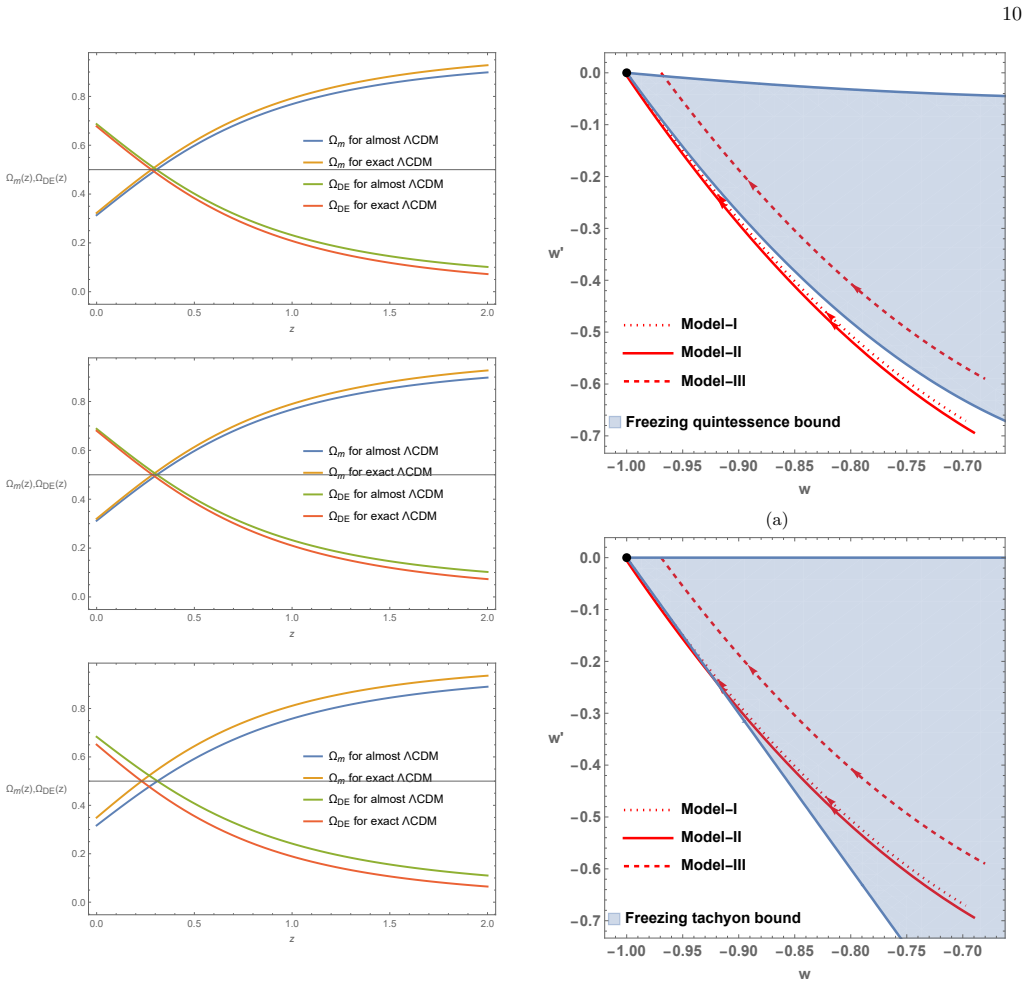
The plots in Fig.2 also show the freezing nature of the dark energy equation of state (w DE → −1 or to a value close to−1 asymptotically in the future). Interestingly, the dark energy equation of state parameter evolution does not show any phantom crossing. We discuss about this observation in§IX. VIII. Embedding the almostΛCDM evolutionary models within ...
-
[3]
Perlmutter, G
S. Perlmutter, G. Aldering, G. Goldhaber, R. A. Knop, P. Nugent, P. G. Castro, S. Deustua, S. Fabbro, A. Goo- bar, D. E. Groom, I. M. Hook, A. G. Kim, M. Y. Kim, J. C. Lee, N. J. Nunes, R. Pain, C. R. Penny- packer, R. Quimby, C. Lidman, R. S. Ellis, M. Irwin, R. G. McMahon, P. Ruiz-Lapuente, N. Walton, B. Schae- fer, B. J. Boyle, A. V. Filippenko, T. Mat...
1999
-
[4]
Ratra and P
B. Ratra and P. J. E. Peebles, Cosmological consequences of a rolling homogeneous scalar field, Physical Review D 37, 3406 (1988)
1988
-
[5]
P. J. Steinhardt, L. Wang, and I. Zlatev, Cosmological tracking solutions, Physical Review D59, 123504 (1999)
1999
-
[6]
R. R. Caldwell, M. Kamionkowski, and N. N. Weinberg, Phantom Energy: Dark Energy with$w<\ensuremath{- }1$Causes a Cosmic Doomsday, Physical Review Letters 91, 071301 (2003)
2003
-
[7]
Armendariz-Picon, V
C. Armendariz-Picon, V. Mukhanov, and P. J. Stein- hardt, Essentials of k-essence, Physical Review D63, 103510 (2001)
2001
-
[8]
Aghanim, Y
N. Aghanim, Y. Akrami, M. Ashdown, J. Aumont, C. Baccigalupi, M. Ballardini, A. J. Banday, R. B. Bar- reiro, N. Bartolo, S. Basak, K. Benabed, J.-P. Bernard, M. Bersanelli, P. Bielewicz, J. J. Bock, J. R. Bond, J. Borrill, F. R. Bouchet, F. Boulanger, M. Bucher, C. Burigana, R. C. Butler, E. Calabrese, J.-F. Car- doso, J. Carron, B. Casaponsa, A. Challino...
2018
Show all 64 references
-
[9]
D. J. Eisenstein, I. Zehavi, D. W. Hogg, R. Scoccimarro, M. R. Blanton, R. C. Nichol, R. Scranton, H.-J. Seo, M. Tegmark, Z. Zheng, S. F. Anderson, J. Annis, N. Bah- call, J. Brinkmann, S. Burles, F. J. Castander, A. Con- nolly, I. Csabai, M. Doi, M. Fukugita, J. A. Frieman, K...
2005
-
[10]
D. C. T. M. C. Abbott, M. Acevedo, M. Aguena, A. Alar- con, S. Allam, O. Alves, A. Amon, F. Andrade-Oliveira, J. Annis, P. Armstrong, J. Asorey, S. Avila, D. Bacon, B. A. Bassett, K. Bechtol, P. H. Bernardinelli, G. M. Bernstein, E. Bertin, J. Blazek, S. Bocquet, D. Brooks, D....
2024
-
[11]
P. K. S. Dunsby and O. Luongo, On the theory and ap- plications of modern cosmography, International Journal of Geometric Methods in Modern Physics13, 1630002 (2016)
2016
-
[12]
U. Alam, V. Sahni, T. Deep Saini, and A. A. Starobinsky, Exploring the expanding Universe and dark energy using the statefinder diagnostic, Monthly Notices of the Royal Astronomical Society344, 1057 (2003)
2003
-
[13]
Chakraborty, C
S. Chakraborty, C. Louw, P. K. S. Dunsby, K. MacDe- vette, and A. d. l. C. Dombriz, Dynamical dark en- ergy in models with evolution close toλCDM (2025), arXiv:2508.09813 [gr-qc]
2025
-
[14]
MacDevette, J
K. MacDevette, J. Worsley, P. Dunsby, and S. Chakraborty, A model-independent approach to the study of structure growth in f(R) gravity, Monthly Notices of the Royal Astronomical Society537, 2471 (2025), https://academic.oup.com/mnras/article- pdf/537/3/2471/61722571/staf168.pdf
2025
-
[15]
Roy and S
N. Roy and S. Chakrabarti, Is phantom barrier crossing inevitable? A cosmographic analysis, Eur. Phys. J. C86, 586 (2026), arXiv:2508.13740 [astro-ph.CO]
2026 arXiv
-
[16]
Fazzari, W
E. Fazzari, W. Giar` e, and E. Di Valentino, Cosmographic Footprints of Dynamical Dark Energy, Astrophys. J. Lett.996, L5 (2026), arXiv:2509.16196 [astro-ph.CO]
2026
-
[17]
Carloni, O
Y. Carloni, O. Luongo, and M. Biesiada, Challenging the ω0ωaCDM parametrization through rational expansions in view of the DESI DR2, Phys. Rev. D113, 103525 (2026), arXiv:2511.15472 [astro-ph.CO]
2026
-
[18]
Dunajski and G
M. Dunajski and G. Gibbons, Cosmic jerk, snap and be- yond, Classical and Quantum Gravity25, 235012 (2008)
2008
-
[19]
Luongo and H
O. Luongo and H. Quevedo, A unified dark energy model from a vanishing speed of sound with emergent cosmolog- ical constant, International Journal of Modern Physics D 23, 1450012 (2014)
2014
-
[20]
Chakraborty, D
S. Chakraborty, D. Gregoris, and B. Mishra, On the uniqueness of ΛCDM-like evolution for homogeneous and isotropic cosmology in General Relativity, Phys. Lett. B 842, 137962 (2023), arXiv:2208.04596 [gr-qc]
2023 arXiv
-
[21]
Chakraborty and P
S. Chakraborty and P. Burikham, Theory space and sta- bility analysis of General Relativistic cosmological solu- tions in modified gravity (2026), arXiv:2509.15762 [gr-qc] version: 2
2026
-
[22]
Adame, J
A. Adame, J. Aguilar, S. Ahlen, S. Alam, D. Alexan- der, M. Alvarez, O. Alves, A. Anand, U. Andrade, E. Armengaud, S. Avila, A. Aviles, H. Awan, B. Bahr- Kalus, S. Bailey, C. Baltay, A. Bault, J. Behera, S. BenZvi, A. Bera, F. Beutler, D. Bianchi, C. Blake, R. Blum, S. Brieden...
2024
-
[23]
M. S. Madhavacheril, F. J. Qu, B. D. Sherwin, N. Mac- Crann, Y. Li, I. Abril-Cabezas, P. A. R. Ade, S. Aiola, T. Alford, M. Amiri, S. Amodeo, R. An, Z. Atkins, J. E. Austermann, N. Battaglia, E. S. Battistelli, J. A. Beall, R. Bean, B. Beringue, T. Bhandarkar, E. Biermann, B. ...
2024
-
[24]
Collaboration, M
D. Collaboration, M. Abdul Karim, A. G. Adame, D. Aguado, J. Aguilar, S. Ahlen, S. Alam, G. Aldering, D. M. Alexander, R. Alfarsy, L. Allen, C. Allende Pri- eto, O. Alves, A. Anand, U. Andrade, E. Armengaud, S. Avila, A. Aviles, H. Awan, S. Bailey, A. Baleato Lizan- cos, O. Ba...
2026
-
[25]
Lodha, R
K. Lodha, R. Calderon, W. L. Matthewson, A. Shafieloo, M. Ishak, J. Pan, C. Garcia-Quintero, D. Huterer, G. Val- ogiannis, L. A. Ure˜ na-L´ opez, N. V. Kamble, D. Parkin- son, A. G. Kim, G. B. Zhao, J. L. Cervantes-Cota, J. Rohlf, F. Lozano-Rodr ´ ıguez, J. O. Rom´ an-Herrera,...
2025 arXiv
-
[26]
Rubin, G
D. Rubin, G. Aldering, M. Betoule, A. Fruchter, X. Huang, A. G. Kim, C. Lidman, E. Linder, S. Perl- mutter, P. Ruiz-Lapuente, and N. Suzuki, Union through UNITY: Cosmology with 2000 SNe Using a Unified Bayesian Framework, The Astrophysical Journal986, 231 (2025)
2000
-
[27]
Scolnic, D
D. Scolnic, D. Brout, A. Carr, A. G. Riess, T. M. Davis, A. Dwomoh, D. O. Jones, N. Ali, P. Charvu, R. Chen, E. R. Peterson, B. Popovic, B. M. Rose, C. M. Wood, P. J. Brown, K. Chambers, D. A. Coulter, K. G. Dettman, G. Dimitriadis, A. V. Filippenko, R. J. Foley, S. W. Jha, C....
2022
-
[28]
Brout, D
D. Brout, D. Scolnic, B. Popovic, A. G. Riess, A. Carr, J. Zuntz, R. Kessler, T. M. Davis, S. Hinton, D. Jones, W. D. Kenworthy, E. R. Peterson, K. Said, G. Taylor, N. Ali, P. Armstrong, P. Charvu, A. Dwomoh, C. Mel- dorf, A. Palmese, H. Qu, B. M. Rose, B. Sanchez, C. W. Stubb...
2022
-
[29]
B. O. S´ anchez, D. Brout, M. Vincenzi, M. Sako, K. Herner, R. Kessler, T. M. Davis, D. Scolnic, M. Acevedo, J. Lee, A. M¨ oller, H. Qu, L. Kelsey, P. Wiseman, P. Armstrong, B. Rose, R. Camilleri, R. Chen, L. Galbany, E. Kovacs, C. Lidman, B. Popovic, M. Smith, P. Shah, M. Sul...
2024
-
[30]
The BAO and SN datasets used in this paper can be found on the Cobaya GitHub
-
[31]
Cortˆ es and A
M. Cortˆ es and A. R. Liddle, On DESI’s DR2 exclusion of λCDM, Monthly Notices of the Royal Astronomical So- ciety: Letters544, L121 (2025), arXiv:2504.15336 [astro- ph]
2025
-
[32]
S. Alam, M. Ata, S. Bailey, F. Beutler, D. Bizyaev, J. A. Blazek, A. S. Bolton, J. R. Brownstein, A. Burden, C.-H. Chuang, J. Comparat, A. J. Cuesta, K. S. Daw- son, D. J. Eisenstein, S. Escoffier, H. Gil-Mar ´ ın, J. N. Grieb, N. Hand, S. Ho, K. Kinemuchi, D. Kirkby, F. Ki- t...
2017
-
[33]
Adame, J
A. Adame, J. Aguilar, S. Ahlen, S. Alam, D. Alexan- der, M. Alvarez, O. Alves, A. Anand, U. An- drade, E. Armengaud, S. Avila, A. Aviles, H. Awan, S. Bailey, C. Baltay, A. Bault, J. Bautista, J. Be- hera, S. BenZvi, F. Beutler, D. Bianchi, C. Blake, R. Blum, S. Brieden, A. Bro...
2024
-
[34]
Aghanim, Y
N. Aghanim, Y. Akrami, M. Ashdown, J. Aumont, C. Baccigalupi, M. Ballardini, A. J. Banday, R. B. Bar- reiro, N. Bartolo, S. Basak, R. Battye, K. Benabed, J.-P. Bernard, M. Bersanelli, P. Bielewicz, J. J. Bock, J. R. Bond, J. Borrill, F. R. Bouchet, F. Boulanger, M. Bucher, C. ...
2018
-
[35]
Tripp, A two-parameter luminosity correction for Type IA supernovae, Astronomy and Astrophysics331, 815 (1998), aDS Bibcode: 1998A&A...331..815T
R. Tripp, A two-parameter luminosity correction for Type IA supernovae, Astronomy and Astrophysics331, 815 (1998), aDS Bibcode: 1998A&A...331..815T
1998
-
[36]
Camilleri, T
R. Camilleri, T. M. Davis, M. Vincenzi, P. Shah, J. Frie- man, R. Kessler, P. Armstrong, D. Brout, A. Carr, R. Chen, L. Galbany, K. Glazebrook, S. R. Hinton, J. Lee, C. Lidman, A. M¨ oller, B. Popovic, H. Qu, M. Sako, D. Scolnic, M. Smith, M. Sullivan, B. O. S´ anchez, G. Tayl...
2024
-
[37]
Conley, J
A. Conley, J. Guy, M. Sullivan, N. Regnault, P. Astier, C. Balland, S. Basa, R. G. Carlberg, D. Fouchez, D. Hardin, I. M. Hook, D. A. Howell, R. Pain, N. Palanque-Delabrouille, K. M. Perrett, C. J. Pritchet, J. Rich, V. Ruhlmann-Kleider, D. Balam, S. Baumont, R. S. Ellis, S. F...
2010
-
[38]
Betoule, R
M. Betoule, R. Kessler, J. Guy, J. Mosher, D. Hardin, R. Biswas, P. Astier, P. El-Hage, M. Konig, S. Kuhlmann, J. Marriner, R. Pain, N. Regnault, C. Balland, B. A. Bassett, P. J. Brown, H. Campbell, R. G. Carl- berg, F. Cellier-Holzem, D. Cinabro, A. Conley, C. B. D’Andrea, D....
2014
-
[39]
A. N. Taylor and T. D. Kitching, Analytic methods for cosmological likelihoods, Monthly Notices of the Royal Astronomical Society408, 865 (2010)
2010
-
[40]
S. Alam, M. Aubert, S. Avila, C. Balland, J. E. Bautista, M. A. Bershady, D. Bizyaev, M. R. Blanton, A. S. Bolton, J. Bovy, J. Brinkmann, J. R. Brownstein, E. Burtin, S. Chabanier, M. J. Chapman, P. D. Choi, C.-H. Chuang, J. Comparat, M.-C. Cousinou, A. Cuceu, K. S. Dawson, S....
2021
-
[41]
Vincenzi, R
M. Vincenzi, R. Kessler, P. Shah, J. Lee, T. M. Davis, D. Scolnic, P. Armstrong, D. Brout, R. Camilleri, R. Chen, L. Galbany, C. Lidman, A. M¨ oller, B. Popovic, B. Rose, M. Sako, B. O. S´ anchez, M. Smith, M. Sulli- van, P. Wiseman, T. M. C. Abbott, M. Aguena, S. Al- lam, F. ...
2025 arXiv
-
[42]
N. S. Kavya, S. S. Mishra, and P. K. Sahoo, Model-Independent Cosmography with Logarith- mic Polynomial using Recent Observational Data, Fortschritte der Physik74, e70078 (2026), eprint: https://onlinelibrary.wiley.com/doi/pdf/10.1002/prop.70078
2026 doi
-
[43]
Aghanim, Y
N. Aghanim, Y. Akrami, F. Arroja, M. Ashdown, J. Au- mont, C. Baccigalupi, M. Ballardini, A. J. Banday, R. B. Barreiro, N. Bartolo, S. Basak, R. Battye, K. Benabed, J.-P. Bernard, M. Bersanelli, P. Bielewicz, J. J. Bock, J. R. Bond, J. Borrill, F. R. Bouchet, F. Boulanger, M. ...
2018
-
[44]
Wang and P
Y. Wang and P. Mukherjee, Observational constraints on dark energy and cosmic curvature, Physical Review D76, 103533 (2007)
2007
-
[45]
Chen, Q.-G
L. Chen, Q.-G. Huang, and K. Wang, Distance pri- ors from Planck final release, Journal of Cosmology and Astroparticle Physics2019, 028, aDS Bibcode: 2019JCAP...02..028C
-
[46]
Rodrigues, R
G. Rodrigues, R. de Souza, and J. Alcaniz, Cosmography with DESI DR2 and SN data, Phys. Rev. D112, 103519 (2025), arXiv:2506.22373 [astro-ph.CO]
2025
-
[47]
Trotta, Bayes in the sky: Bayesian infer- ence and model selection in cosmology, Con- temporary Physics49, 71 (2008), eprint: https://doi.org/10.1080/00107510802066753
R. Trotta, Bayes in the sky: Bayesian infer- ence and model selection in cosmology, Con- temporary Physics49, 71 (2008), eprint: https://doi.org/10.1080/00107510802066753
2008 doi
-
[48]
Lewis and S
A. Lewis and S. Bridle, Cosmological parameters from CMB and other data: a Monte-Carlo approach, Physical Review D66, 103511 (2002), arXiv:astro-ph/0205436
2002 arXiv
-
[49]
D. W. Hogg, Distance measures in cosmology (2000), arXiv:astro-ph/9905116
2000 arXiv
-
[50]
D. H. Weinberg, M. J. Mortonson, D. J. Eisenstein, C. Hi- rata, A. G. Riess, and E. Rozo, Observational probes of cosmic acceleration, Physics Reports Observational Probes of Cosmic Acceleration,530, 87 (2013)
2013
-
[51]
Goodman and J
J. Goodman and J. Weare, Ensemble samplers with affine invariance, Communications in Applied Mathematics and Computational Science5, 65 (2010)
2010
-
[52]
Foreman-Mackey, D
D. Foreman-Mackey, D. W. Hogg, D. Lang, and J. Good- man, emcee: The MCMC Hammer, Publications of the Astronomical Society of the Pacific125, 306 (2013)
2013
-
[53]
Chevallier and D
M. Chevallier and D. Polarski, Accelerating universes with scaling dark matter, International Journal of Mod- ern Physics D10, 213 (2001)
2001
-
[54]
E. V. Linder, Exploring the Expansion History of the Universe, Physical Review Letters90, 10.1103/Phys- RevLett.90.091301 (2003)
2003 doi
-
[55]
Akaike, A new look at the statistical model identifica- tion, IEEE Transactions on Automatic Control19, 716 (1974)
H. Akaike, A new look at the statistical model identifica- tion, IEEE Transactions on Automatic Control19, 716 (1974)
1974
-
[56]
Schwarz, Estimating the Dimension of a Model, Annals of Statistics6, 461 (1978), aDS Bibcode: 1978AnSta...6..461S
G. Schwarz, Estimating the Dimension of a Model, Annals of Statistics6, 461 (1978), aDS Bibcode: 1978AnSta...6..461S
1978
-
[57]
S. S. Mishra, N. S. Kavya, P. K. Sahoo, and K. Bamba, DESI DR2 meets cosmography: a comparative study of Pad´ e, Chebyshev, and Taylor expansions, Monthly No- tices of the Royal Astronomical Society546, stag197 (2026)
2026
-
[58]
A. R. Liddle, Information criteria for astrophysical model selection, Monthly Notices of the Royal Astronomical So- ciety: Letters377, L74 (2007)
2007
-
[59]
Wagenmakers and S
E.-J. Wagenmakers and S. Farrell, AIC model selection using Akaike weights, Psychonomic Bulletin & Review 11, 192 (2004)
2004
-
[60]
Abdul Karimet al.(DESI), DESI DR2 results
M. Abdul Karimet al.(DESI), DESI DR2 results. II. Measurements of baryon acoustic oscillations and cos- mological constraints, Phys. Rev. D112, 083515 (2025), arXiv:2503.14738 [astro-ph.CO]
2025 arXiv
-
[61]
R. R. Caldwell and E. V. Linder, The Limits of quintessence, Phys. Rev. Lett.95, 141301 (2005), arXiv:astro-ph/0505494
2005 arXiv
-
[62]
R. J. Scherrer, Dark energy models in the w-w’ plane, Phys. Rev. D73, 043502 (2006), arXiv:astro-ph/0509890
2006 arXiv
-
[63]
Chiba, W and w’ of scalar field models of dark energy, Phys
T. Chiba, W and w’ of scalar field models of dark energy, Phys. Rev. D73, 063501 (2006), [Erratum: Phys.Rev.D 80, 129901 (2009)], arXiv:astro-ph/0510598
2006 arXiv
-
[64]
Chen and Y
X. Chen and Y. Gong, The limit onw ′ for tachyon dark energy (2013), arXiv:1309.2044 [gr-qc]
2013 arXiv
Reviewed August 1, 2026 · model on record in the stance chip above.
Discussion (0). Sign in to comment.