REVIEW 2 major objections 6 minor 42 references
Overview and design optimization of a custom hybrid X-ray telescope for the International Axion Observatory (IAXO)
T0 review · 2 major / 6 minor · reviewed 2026-08-01 · deepseek-v4-flash
Pith's one-line read A hybrid X-ray telescope design can give the BabyIAXO helioscope a signal-to-noise gain above 55-fold.
desk verdict Solid design optimization with real hybrid layout and coating recipes; the headline >55-fold SNR-after-errors claim is not derived and appears to fail a simple quadrature check. read the letter →
The pith
A machine-rendered reading of the paper's core claim, the machinery that carries it, and where it could break.
The reading
What carries the argument
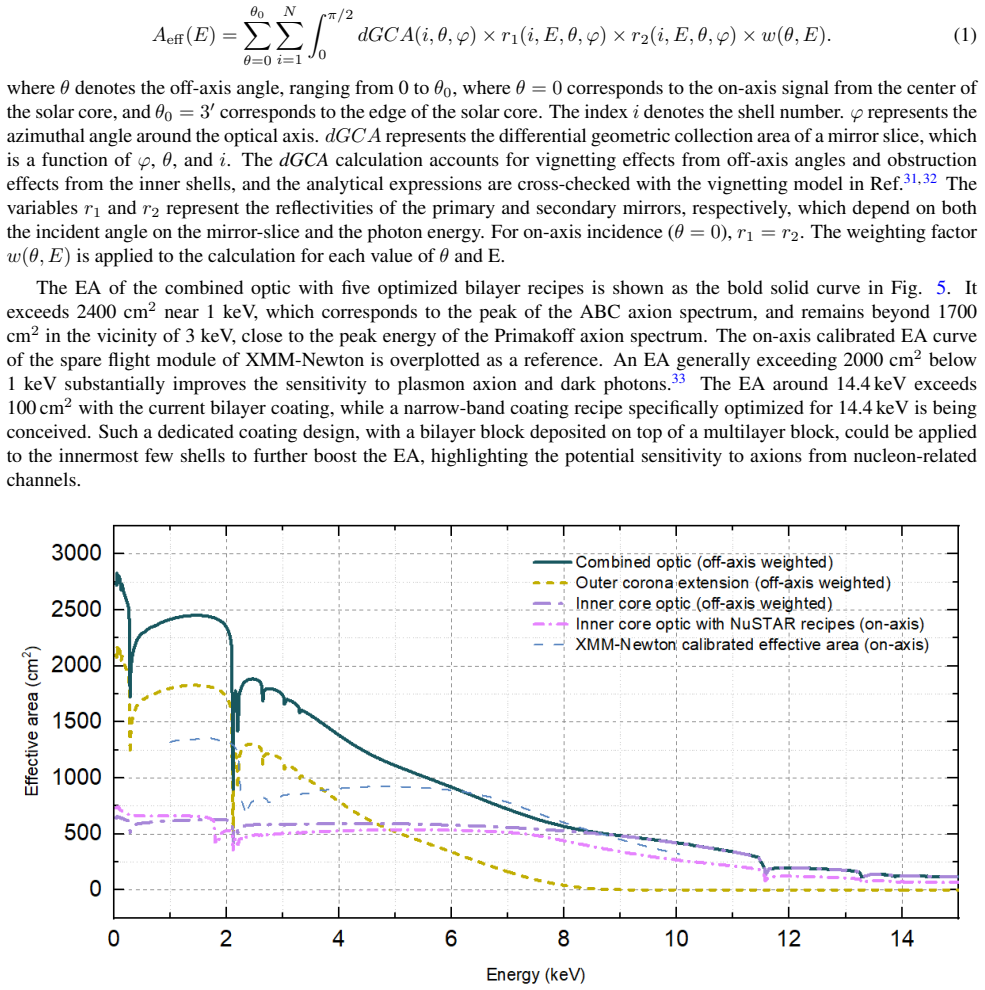
The load-bearing element is the hybrid optic itself: 157 nested grazing-incidence mirror shells spanning radii from 54 mm to 350 mm, split into an inner-core optic (103 shells, 5.6 m focal length) and an outer-corona optic (54 shells, 5.0 m focal length). The performance evaluation rests on Eq. (1), which computes the off-axis weighted effective area as the product of differential geometric collection area, two-bounce reflectivity, and an off-axis weighting factor w(θ,E) derived from the solar axion radial flux distribution; and Eq. (2), the SNR gain formula ΔSN = ε_t √(s/A), where ε_t is the total telescope efficiency and s/A is the ratio of focal-spot area to magnet-bore area.
What would settle it
A full-scale ground calibration of a prototype with the actual Pt/C coatings, measuring on-axis effective area at 1 keV and 3 keV and the focal-spot HPD for a simulated 3′ disk source, would settle the claim: if the effective area falls significantly short of 2400 cm² near 1 keV, or the disk-source HPD exceeds about 120″ by more than the error budget, the >55-fold SNR gain is contradicted.
Extended reading notes
Core claim
The central claim is that an optic assembled from an inner core of thermally slumped glass and an outer corona of cold slumped glass, with Pt/C bilayer coatings whose carbon thickness is graded by shell radius, delivers more than 2400 cm² effective area near 1 keV, above 1700 cm² near 3 keV, and roughly 100 cm² at 14.4 keV. Ray tracing with the expected solar-core axion distribution yields a focal-spot half-power diameter of about 120 arcseconds, while the on-axis PSF HPD is about 46 arcseconds. Accounting for a realistic fabrication-error budget, the authors expect a signal-to-noise enhancement above 55-fold relative to an unfocused magnet bore.
Load-bearing premise
The load-bearing premise is that solar axions arrive as flux confined within a roughly 3′ radius equivalent disk, so the off-axis weighting factor in the effective-area calculation matches the real angular distribution; a wider axion production region would lower the weighted effective area and shrink the predicted SNR gain.
Editorial extensions
If this is right
- If the predicted effective area is realized, the custom optic improves BabyIAXO's signal-to-noise by more than 55-fold over an unfocused bore, directly enhancing the experiment's reach in axion–photon coupling.
- The broad-band response below 1 keV (above 2000 cm²) extends sensitivity to plasmon axions and dark photons, not just Primakoff axions.
- The roughly 100 cm² effective area at 14.4 keV opens a path to nucleon-coupled axion searches, with a dedicated multilayer coating expected to raise it further.
- The segmented-glass fabrication chain is scalable to the eight optics IAXO will require, and the planned prototype build and calibration campaign will put the design to a direct test.
- Because the focal spot is dominated by the ~3′ solar-core angular size rather than the intrinsic PSF, the modest ~46″ on-axis HPD is adequate; further improvements in mirror figure error would not materially change the detected spot.
Reading between the lines
- The 55-fold SNR gain is computed relative to a bore with no focusing optics; absolute physics reach also depends on detector background and magnet field strength, so the gain translates into coupling sensitivity only under the paper's stated background assumptions.
- The assumed 3′ solar-core disk for axion production is the key geometric input; if additional production channels broaden the angular distribution, the weighted effective area and SNR gain will degrade, making the weighting scheme itself a testable prediction of the solar axion radial flux.
- The radially graded carbon thickness, optimized via MCMC, could be re-optimized for other target energies (for example, the 14.4 keV line) within the same framework, suggesting an extendable design tool for future helioscope optics.
- The hybrid geometry isolates the fabrication and testing of the outer corona from the inner core, meaning either section can be validated or upgraded independently without redesigning the full telescope.
Editorial analysis
A structured set of objections, weighed in public.
Referee Report
Summary. The manuscript presents the design optimization of a custom hybrid X-ray telescope for BabyIAXO/IAXO, combining an inner TGO core and an outer CGSO corona to cover the full 700-mm magnetic bore. The design optimizes five radial Pt/C coating recipes and shell spacing, computes the broad-band effective area from Eq. (1), and uses McXtrace ray tracing to obtain an on-axis PSF HPD of ~46" and an extended-source focal-spot HPD of ~120" at 3 keV. The paper reports an effective area exceeding 2400 cm² near 1 keV and above 1700 cm² near 3 keV, and claims a >55-fold SNR enhancement even after accounting for fabrication errors.
Significance. If realized, this optic would be a substantial step for the IAXO program: it offers full-bore coverage, a large effective area in the relevant axion energy range, modest spatial resolution well-matched to the solar-core source, and a cost-effective glass technology path validated at prototype level (POC-2023). The optimization methodology is generally sound, with analytical vignetting cross-checks and use of empirical error budgets from NuSTAR/HEFT. However, the central quantitative claim about post-fabrication SNR enhancement is not supported by the internal numbers, and the absolute effective-area normalization needs clarification. These issues are load-bearing for the headline results.
major comments (2)
- [§3.3–§4, Eq. (2)] The claim "ΔSN>55 with fabrication errors" is not substantiated by the paper's own numbers. The ideal extended-source focal-spot HPD is 120" at 3 keV (Fig. 6d), and Table 3 lists a total PSF HPD <90" after fabrication errors. The resulting focal spot for the axion source is the convolution of the source profile with the PSF. Even if one conservatively excludes the 46" design term (already present in the 120" ideal spot) and combines the remaining non-design errors (~sqrt(76²+15²+5²)=78") with the 120" spot in quadrature, one gets sqrt(120²+78²)≈143". Since ΔSN scales as 1/HPD, the ideal ΔSN>65 becomes ≈54.5, below 55. Using the full <90" PSF gives ≈52. The paper never presents this convolution or the error-degraded focal-spot HPD; the >55 claim therefore appears either unsupported or marginally contradicted by the stated numbers. The authors should either provide an explicit calculation/
- [§3.1, Eq. (1), Fig. 4(a)] The weighting factor w(θ,E) is defined as the ring-integrated radial flux normalized to its maximum. With this definition, Eq. (1) computes a peak-normalized weighted effective area, not the source-averaged effective area that should enter ε_t in Eq. (3). For an extended source, the appropriate normalization is w=F(θ)/∫F, or the final Aeff must be divided by the integrated source distribution. As written, the absolute values of Aeff (2400/1700 cm²) and hence ε_t and ΔSN depend on an arbitrary normalization convention. The relative comparison of narrow vs. wide shell spacing is unaffected, but the reported absolute effective areas and the SNR enhancement are not uniquely defined. Please specify the exact normalization and, if necessary, recompute the quoted numbers.
minor comments (6)
- [Eq. (2)] The expression is printed as ΔSN = ε_t √(s/A); given the text's definition of s and A, this should be √(A/s), otherwise a smaller spot would reduce the SNR. Please correct the typesetting or clarify the convention.
- [Eq. (1)] The sum over θ from 0 to θ0 should specify the angular binning and the conversion from degrees to radians; otherwise it is not clear whether this is a discretized integral or a simple sum of representative angles.
- [Table 3 / §4] The error budget table lists a design-approximation term of ~46" (inner) and ~20" (outer). Since the ideal focal spot of 120" already includes the design approximation, the way these terms enter the post-fabrication focal-spot estimate should be stated explicitly to avoid double counting.
- [Table 1 / §2.2] The MCMC optimization is not described in enough detail to be reproducible: no likelihood, priors, or convergence diagnostics are given, and the optimized C-layer thicknesses are quoted without uncertainties. At least a brief description or a reference is needed.
- [Fig. 5] The XMM-Newton on-axis calibrated EA curve is overplotted, but the comparison is not discussed in the text except in terms of PSF. Please clarify the energy range and purpose of this comparison.
- [§5] The POC-2023 HPD values (43–83") are quoted as validation of the CGSO approach, but no details or reference to a dedicated publication are given. A brief citation or description would strengthen the claim.
Circularity Check
No significant circularity: the design optimization is self-contained and the SNR estimate is a stated figure of merit, not a renamed input.
full rationale
The paper is an engineering design study, not a physical hypothesis test, so the usual circularity patterns do not apply. The coating thicknesses are optimized by MCMC (Sec. 2.2) to maximize reflectivity/EA, and the resulting effective area (Sec. 3.1, Eq. 1) is reported as the design's performance; this is an optimization objective, not a prediction forced by a fit. The off-axis weighting w(θ,E) in Eq. 1 is normalized to the adopted Primakoff/ABC/nucleon axion flux distributions (Sec. 2.3, Fig. 4), an external astrophysical input, and the focal spot is obtained by ray-tracing with an equivalent disk source (Sec. 3.2); the reported HPDs are simulation outputs, not inputs. The SNR formula ΔSN = ε_t sqrt(s/A) (Eq. 2) is a derived scaling relation from Nγ/√Nb, with ε_t defined by Aeff/GCA_total; no quantity is defined in terms of the claimed >55 result. Self-citations (e.g., Refs. 9, 24, 13) supply prior conceptual designs and coating studies, but the current optimization is performed here and is cross-checked against external tools (McXtrace) and benchmarks (XMM-Newton, NuSTAR, PANTER measurements). The fabrication-error budget (Table 3) is empirical and independently sourced. The >55 SNR after errors is asserted without showing the explicit convolution of the 120″ source spot with the <90″ PSF, but that is a quantitative-support gap or correctness risk, not a circular reduction: the number is not constructed to equal an input. Therefore no significant circularity is present.
Assumptions & free parameters
free parameters (7)
- C-layer thickness, recipe 1 (R=300–350 mm) =
5.6 nm
- C-layer thickness, recipe 2 (R=250–300 mm) =
7.9 nm
- C-layer thickness, recipe 3 (R=200–250 mm) =
10.1 nm
- C-layer thickness, recipe 4 (R=150–200 mm) =
13.5 nm
- C-layer thickness, recipe 5 (R=54–150 mm) =
18.0 nm
- Pt layer thickness =
10 nm
- Shell spacing =
4 mm inner core, 50 mm outer corona
assumptions (6)
- domain assumption Henke optical constants database accurately describes Pt/C reflectivity from 0.03–15 keV.
- domain assumption Solar axion emission is concentrated within r≲0.2 R_sun, corresponding to a 3′ angular radius.
- domain assumption Detector background is independent of the optic and scales with focal-spot area.
- domain assumption Fabrication-error budget from NuSTAR/HEFT and POC-2023 transfers to the full BabyIAXO optic.
- domain assumption Multilayer coatings provide no substantial advantage over bilayer coatings in this geometry.
- domain assumption McXtrace ray-tracing correctly models vignetting, obstruction, and reflectivity effects.
Cite this review
Pith. "Pith review of Overview and design optimization of a custom hybrid X-ray telescope for the International Axion Observatory (IAXO)." pith.science (2026). https://pith.science/paper/WPMCPFVG
@misc{pith2026260720390,
  author       = {Pith},
  title        = {Pith review of: Overview and design optimization of a custom hybrid X-ray telescope for the International Axion Observatory (IAXO)},
  year         = {2026},
  howpublished = {\url{https://pith.science/paper/WPMCPFVG}},
  note         = {Machine review of arXiv:2607.20390}
}
abstract
We present the design optimization for maximizing the effective area of a custom X-ray optic for the International Axion Observatory (IAXO) and BabyIAXO, including its novel hybrid configuration that enables full coverage of the 700-mm-diameter magnetic bore with minimal stress imposed on the mirrors; shell layout optimized for axion spectra and spatial distribution; and the coating recipes that enhance reflectivity in the energy range of interest. We evaluate how these design choices improve the observation signal-to-noise ratio (SNR) of BabyIAXO and IAXO by calculating the broad-band effective area and simulating the point spread function (PSF) and focal spot at the detector plane. The cost-effective and scalable optic offers an energy response from 0.03--15 keV, achieving an effective area that exceeds 2400 cm$^2$ near 1 keV - the peak of the ABC axion spectrum - and remains above 1700 cm$^2$ around 3 keV - the peak of the Primakoff axion spectrum. It yields a half-power diameter (HPD) of $\sim 46^{\prime\prime}$ for an on-axis point source at infinity, and a focal-spot HPD of $\sim 120^{\prime\prime}$ for the radial distribution expected for axion signals within the approximately $3^{\prime}$-radius solar core. A relatively generous fabrication-error budget is also summarized. The custom optic, accounting for fabrication errors, is anticipated to deliver a more than $55$-fold enhancement in the SNR.
Figures


Figures from the paper (3 more)


Reference graph
Works this paper leans on
-
[1]
Axion Dark Matter,
C. B. Adamset al., “Axion Dark Matter,” inSnowmass 2021, 3 2022
2021
-
[2]
The landscape of QCD axion models,
L. Di Luzio, M. Giannotti, E. Nardi, and L. Visinelli, “The landscape of QCD axion models,”Phys. Rept.870, pp. 1–117, 2020
2020
-
[3]
Axion astrophysics,
P. Carenza, M. Giannotti, J. Isern, A. Mirizzi, and O. Straniero, “Axion astrophysics,”Phys. Rept.1117, pp. 1–102, 2025
2025
-
[4]
First results from the CERN Axion Solar Telescope (CAST),
K. Zioutas, S. Andriamonje, V . Arsov, S. Aune, D. Autiero, F. T. Avignone, K. Barth, A. Belov, B. Beltr ´an, H. Br¨auninger,et al., “First results from the CERN Axion Solar Telescope (CAST),”Phys. Rev. Lett.94, p. 121301, 2005
2005
-
[5]
Cast constraints on the axion-electron coupling,
K. Barth, A. Belov, B. Beltran, H. Br ¨auninger, J. M. Carmona, J. I. Collar, T. Dafni, M. Davenport, L. Di Lella, C. Eleftheriadis,et al., “Cast constraints on the axion-electron coupling,”J. Cosmol. Astropart. Phys.2013, p. 010, may 2013
2013
-
[6]
Probing the axion–nucleon coupling with the next generation of axion helioscopes,
L. Di Luzio, J. Galan, M. Giannotti, I. G. Irastorza, J. Jaeckel, A. Lindner, J. Ruz, U. Schneekloth, L. Sohl, L. J. Thormaehlen,et al., “Probing the axion–nucleon coupling with the next generation of axion helioscopes,”Eur . Phys. J. C82, Feb. 2022
2022
-
[7]
Production of axionlike particles from photon con- versions in large-scale solar magnetic fields,
E. Guarini, P. Carenza, J. Gal ´an, M. Giannotti, and A. Mirizzi, “Production of axionlike particles from photon con- versions in large-scale solar magnetic fields,”Phys. Rev. D102, p. 123024, Dec 2020
2020
-
[8]
Towards a new generation axion helioscope,
I. Irastorza, F. Avignone, S. Caspi, J. Carmona, T. Dafni, M. Davenport, A. Dudarev, G. Fanourakis, E. Ferrer-Ribas, J. Gal´an, J. Garc´ıa, T. Geralis, I. Giomataris, H. G ´omez, D. Hoffmann, F. Iguaz, K. Jakovˇci´c, M. Krˇcmar, B. Laki´c, G. Luz´on, M. Pivovaroff, T. Papaevangelou, G. Raffelt, J. Redondo, A. Rodr´ıguez, S. Russenschuck, J. Ruz, I. Shilon...
2011
Show all 42 references
-
[9]
Conceptual design of BabyIAXO, the intermediate stage towards the International Axion Observatory,
A. Abeln, K. Altenm ¨uller, S. Arguedas Cuendis, E. Armengaud, D. Atti ´e, S. Aune, S. Basso, L. Berg ´e, B. Biasuzzi, P. T. C. Borges De Sousa,et al., “Conceptual design of BabyIAXO, the intermediate stage towards the International Axion Observatory,”J. High Energy Phys.05, p...
2021
-
[10]
Physics potential of the International Axion Observatory (IAXO),
E. Armengaud, D. Atti ´e, S. Basso, P. Brun, N. Bykovskiy, J. M. Carmona, J. F. Castel, S. Cebri ´an, M. Cicoli, M. Civitani,et al., “Physics potential of the International Axion Observatory (IAXO),”J. Cosmol. Astropart. Phys.06, p. 047, 2019
2019
-
[11]
New solar axion search using the CERN Axion Solar Telescope with 4He filling,
M. Arik, S. Aune, K. Barth, A. Belov, H. Br ¨auninger, J. Bremer, V . Burwitz, G. Cantatore, J. M. Carmona, S. A. Cetin,et al., “New solar axion search using the CERN Axion Solar Telescope with 4He filling,”Phys. Rev. D92(2), p. 021101, 2015
2015
-
[12]
New cast limit on the axion-photon interaction,
V . Anastassopoulos, S. Aune, K. Barth, A. Belov, G. Cantatore, J. Carmona, J. Castel, S. Cetin, F. Christensen, J. Collar,et al., “New cast limit on the axion-photon interaction,”Nat. Phys.13(6), pp. 584–590, 2017
2017
-
[13]
The pathfinder x-ray axion telescope for the international axion observatory (iaxo) and axion searches at the cern axion solar telescope (cast),
M. Pivovaroff, J. Ruz, J. V ogel, N. Brejnholt, B. Budau, V . Burwitz, F. Christensen, T. Decker, C. Hailey, R. Hill, et al., “The pathfinder x-ray axion telescope for the international axion observatory (iaxo) and axion searches at the cern axion solar telescope (cast),”J. In...
2026
-
[14]
An improved limit on the axion–photon coupling from the CAST experiment,
S. Andriamonje, S. Aune, D. Autiero, K. Barth, A. Belov, B. Beltr ´an, H. Br¨auninger, J. Carmona, S. Cebri´an, J. Col- lar,et al., “An improved limit on the axion–photon coupling from the CAST experiment,”J. Cosmol. Astropart. Phys.2007, p. 010–010, Apr. 2007
2007
-
[15]
Production and calibration of the first heft hard x-ray optics module,
J. E. Koglin, C. H. Chen, J. Chonko, F. E. Christensen, W. W. Craig, T. R. Decker, K. S. Gunderson, C. J. Hailey, F. A. Harrison, C. P. Jensen,et al., “Production and calibration of the first heft hard x-ray optics module,” inOptics for EUV , X-Ray, and Gamma-Ray Astronomy,516...
2004
-
[16]
Development of precision hard x-ray multilayer optics with sub-arcminute performance,
J. E. Koglin, H. C. Chen, F. E. Christensen, J. Chonko, W. W. Craig, T. R. Decker, M. A. Jimenez-Garate, C. J. Hailey, F. A. Harrison, C. P. Jensen, M. Sileo, D. L. Windt, and H. Yu, “Development of precision hard x-ray multilayer optics with sub-arcminute performance,” inX-Ra...
2003
-
[17]
NuSTAR hard x-ray optics,
J. E. Koglin, F. E. Christensen, W. W. Craig, T. R. Decker, C. J. Hailey, F. A. Harrison, C. Hawthorn, C. P. Jensen, K. K. Madsen, M. Stern, G. Tajiri, and M. D. Taylor, “NuSTAR hard x-ray optics,” inOptics for EUV , X-Ray, and Gamma-Ray Astronomy II, O. Citterio and S. L. O’D...
2005
-
[18]
Accurate integration of segmented x-ray optics using interfacing ribs,
M. M. Civitani, S. Basso, O. Citterio, P. Conconi, M. Ghigo, G. Pareschi, L. Proserpio, B. Salmaso, G. Sironi, D. Spiga,et al., “Accurate integration of segmented x-ray optics using interfacing ribs,”Opt. Eng.52(5), p. 051005, 2013
2013
-
[19]
Cold and hot slumped glass optics with interfacing ribs for high angular resolution x-ray telescopes,
M. Civitani, S. Basso, M. Ghigo, G. Pareschi, B. Salmaso, D. Spiga, G. Vecchi, R. Banham, E. Breuning, V . Burwitz, et al., “Cold and hot slumped glass optics with interfacing ribs for high angular resolution x-ray telescopes,” inSpace Telescopes and Instrumentation 2016: Ultr...
2016
-
[20]
A Micromegas-based low-background x-ray detector coupled to a slumped-glass telescope for axion research,
F. Aznar, J. Castel, F. Christensen, T. Dafni, T. Decker, E. Ferrer-Ribas, J. Garcia, I. Giomataris, J. Garza, C. Hailey, et al., “A Micromegas-based low-background x-ray detector coupled to a slumped-glass telescope for axion research,” J. Cosmol. Astropart. Phys.2015(12), pp...
2015
-
[21]
Search for dark matter axions with cast-capp,
C. Adair, K. Altenm ¨uller, V . Anastassopoulos, S. Arguedas Cuendis, J. Baier, K. Barth, A. Belov, D. Bozicevic, H. Br¨auninger, G. Cantatore,et al., “Search for dark matter axions with cast-capp,”Nat. Commun.13(1), p. 6180, 2022
2022
-
[22]
A. C. Jakobsen,X-ray optics in new instruments for astro-and astroparticle physics, DTU Space, 2015
2015
-
[23]
X-ray optics for axion helioscopes,
A. C. Jakobsen, M. J. Pivovaroff, and F. E. Christensen, “X-ray optics for axion helioscopes,” inOptics for EUV , X-Ray, and Gamma-Ray Astronomy VI, S. L. O’Dell and G. Pareschi, eds.,8861, p. 886113, International Society for Optics and Photonics, SPIE, 2013
2013
-
[24]
Iridium thin-film coatings for the babyiaxo hybridx-ray optic,
P. L. Henriksen, D. D. M. Ferreira, S. Massahi, M. C. Civitani, S. Basso, J. V ogel, J. R. Armendariz, E. B. Knudsen, I. G. Irastorza, and F. E. Christensen, “Iridium thin-film coatings for the babyiaxo hybridx-ray optic,”Appl. Opt.60, pp. 6671–6681, Aug 2021
2021
-
[25]
Development and production of hard X-ray multilayer optics for HEFT,
J. E. Koglin, F. E. Christensen, J. Chonko, W. W. Craig, T. R. Decker, M. A. Jimenez-Garate, K. S. Gunderson, C. J. Hailey, F. A. Harrison, C. P. Jensen, M. Sileo, D. L. Windt, and H. Yu, “Development and production of hard X-ray multilayer optics for HEFT,” inX-Ray and Gamma-...
2003
-
[26]
First results from the ground calibration of the nustar flight optics,
J. E. Koglin, H. An, N. Barri `ere, N. F. Brejnholt, F. E. Christensen, W. W. Craig, C. J. Hailey, A. C. Jakobsen, K. K. Madsen, K. Mori,et al., “First results from the ground calibration of the nustar flight optics,” inOptics for EUV , X-Ray, and Gamma-Ray Astronomy V,8147, p...
2011
-
[27]
The nuclear spectroscopic telescope array (nustar): optics overview and current status,
C. J. Hailey, H. An, K. L. Blaedel, N. F. Brejnholt, F. E. Christensen, W. W. Craig, T. A. Decker, M. Doll, J. Gum, J. E. Koglin,et al., “The nuclear spectroscopic telescope array (nustar): optics overview and current status,” inSpace Telescopes and Instrumentation 2010: Ultra...
2010
-
[28]
X-ray database
CXRO, “X-ray database.”https://henke.lbl.gov/optical_constants/
-
[29]
Search for 14.4 keV solar axions emitted in the M1-transition of 57Fe nuclei with CAST,
S. Andriamonje, S. Aune, D. Autiero, K. Barth, A. Belov, B. Beltr ´an, H. Br¨auninger, J. Carmona, S. Cebri´an, J. Col- lar,et al., “Search for 14.4 keV solar axions emitted in the M1-transition of 57Fe nuclei with CAST,”J. Cosmol. Astropart. Phys.2009, p. 002–002, Dec. 2009
2009
-
[30]
Coatings for the NuSTAR mis- sion,
F. E. Christensen, A. C. Jakobsen, N. F. Brejnholt, K. K. Madsen, A. Hornstrup, N. J. Westergaard, J. Momberg, J. Koglin, A. M. Fabricant, M. Stern, W. W. Craig, M. J. Pivovaroff, and D. Windt, “Coatings for the NuSTAR mis- sion,” inOptics for EUV , X-Ray, and Gamma-Ray Astron...
2011
-
[31]
Optics for x-ray telescopes: analytical treatment of the off-axis effective area of mirrors in optical mod- ules,
D. Spiga, “Optics for x-ray telescopes: analytical treatment of the off-axis effective area of mirrors in optical mod- ules,”Astronomy & Astrophysics529, p. A18, 2011
2011
-
[32]
Analytical computation of the off-axis effective area of grazing incidence x-ray mirrors,
D. Spiga, V . Cotroneo, S. Basso, and P. Conconi, “Analytical computation of the off-axis effective area of grazing incidence x-ray mirrors,”Astronomy & Astrophysics505(1), pp. 373–384, 2009
2009
-
[33]
Prospects on the detection of solar dark photons by the international axion observatory,
T. O’Shea, M. Giannotti, I. Irastorza, L. Plasencia, J. Redondo, J. Ruz, and J. V ogel, “Prospects on the detection of solar dark photons by the international axion observatory,”J. Cosmol. Astropart. Phys.2024, p. 070, June 2024
2024
-
[34]
Nustar hard x-ray optics design and performance,
J. E. Koglin, H. An, K. L. Blaedel, N. F. Brejnholt, F. E. Christensen, W. W. Craig, T. A. Decker, C. J. Hailey, L. C. Hale, and F. A. Harrison, “Nustar hard x-ray optics design and performance,” inInternational Society for Optics and Photonics, 2009
2009
-
[35]
Mcxtrace
SOLEIL and DTU, “Mcxtrace.”https://mcxtrace.org/documentation/
-
[36]
Xmm flight model mirror module testing,
Y . Stockman, P. Barzin, H. Hansen, E. Mazy, J. P. Tock, D. de Chambure, R. Laine, D. Kampf, R. Banham, M. Canali, et al., “Xmm flight model mirror module testing,” inX-Ray Optics, Instruments, and Missions II,3766, pp. 51–61, SPIE, 1999
1999
-
[37]
Fabrication of the nustar flight optics,
W. W. Craig, H. An, K. L. Blaedel, F. E. Christensen, T. A. Decker, A. Fabricant, J. Gum, C. J. Hailey, L. Hale, C. B. Jensen,et al., “Fabrication of the nustar flight optics,” inOptics for EUV , X-Ray, and Gamma-Ray Astronomy V,8147, pp. 151–164, SPIE, 2011
2011
-
[38]
Hard x-ray optics: from HEFT to NuSTAR,
J. E. Koglin, C. M. H. Chen, J. C. Chonko, F. E. Christensen, W. W. Craig, T. R. Decker, C. J. Hailey, F. A. Harrison, C. P. Jensen, K. K. Madsen, M. J. Pivovaroff, M. Stern, D. L. Windt, and E. Ziegler, “Hard x-ray optics: from HEFT to NuSTAR,” inUV and Gamma-Ray Space Telesc...
2004
-
[39]
Development of the x-ray optical units for the NHXM mission based on slumped glass foils,
S. Bassoet al., “Development of the x-ray optical units for the NHXM mission based on slumped glass foils,” in Techniques and Instrumentation for Detection of Exoplanets VII, S. Shaklan, ed.,9603, p. 96030R, International Society for Optics and Photonics, SPIE, 2015
2015
-
[40]
Fabrication status and expected performance of the inner-core x-ray optic for babyiaxo,
J. Wooet al., “Fabrication status and expected performance of the inner-core x-ray optic for babyiaxo,” inSpace Telescopes and Instrumentation 2026: Ultraviolet to Gamma-Ray,Proceedings of SPIE14146, p. 56, July 2026. (to be published)
2026
-
[41]
Design optimization of a high-throughput hybrid x-ray telescope for the international axion observatory (IAXO),
Y . Yuet al., “Design optimization of a high-throughput hybrid x-ray telescope for the international axion observatory (IAXO),”Physical Review D, 2026. (to be submitted)
2026
-
[42]
Cold glass slumping optics for the custom hybrid x-ray telescope of the international axion observatory (1axo),
M. C. Civitaniet al., “Cold glass slumping optics for the custom hybrid x-ray telescope of the international axion observatory (1axo),” inSpace Telescopes and Instrumentation 2026: Ultraviolet to Gamma-Ray,Proceedings of SPIE14146, p. 252, July 2026. (to be published)
2026
Reviewed August 1, 2026 · model on record in the stance chip above.
Discussion (0). Sign in to comment.