REVIEW 4 major objections 4 minor 21 references
Enabling Scalable Topology Inference in Distribution Systems via Constrained Multi-Source Inference
T0 review · 4 major / 4 minor · reviewed 2026-08-02 · deepseek-v4-flash
Pith's one-line read A distribution-grid topology solver treats utilities' imperfect connectivity records as a noisy prior, corrects only suspicious assignments in local neighborhoods, and reports over 95% reconstruction accuracy on 8,000+ smart meters.
desk verdict A sensible engineering idea for localized topology correction, but the headline 95% accuracy claim is nowhere backed by numbers in the paper—no defined ground truth, no accuracy table, no baseline comparison. read the letter →
The pith
A machine-rendered reading of the paper's core claim, the machinery that carries it, and where it could break.
The reading
What carries the argument
The load-bearing mechanism is the detect-suspect-then-repair loop built on the 'errors are localized' premise. Suspicious nodes are flagged by a distance ratio (distance to assigned transformer vs. closest transformer, threshold τ) and by persistently low voltage correlation with their assigned transformer's other meters. Reassignment is restricted to a candidate set of K geographically nearest transformers, turning an exponential global assignment problem into roughly linear cost; the paper formalizes this as Lemma 1, giving O(|O|K) per iteration where |O|=γN with γ≪1. The final confidence score fuses a Davies–Bouldin cluster-separation ratio and a correlation-support ratio via CL = 0.7·Sco
What would settle it
Apply the solver to a feeder where a substantial fraction of connections (say 40–50%) are deliberately corrupted in a spatially spread, uniform way rather than in a few clusters, with the true topology independently known; the paper's claimed >95% accuracy and near-linear runtime advantage over global inference should fail if the localized-error premise is what carries the result.
Extended reading notes
Core claim
The central claim is that topology identification should be cast as constrained inference over a noisy prior: minimize a weighted objective of electrical inconsistency, geographic implausibility, and deviation from the utility's base record, subject to physical feasibility constraints, and solve it by local repair rather than global search. The paper's solver detects inconsistent assignments using a distance ratio and weak voltage correlation with neighbors, restricts reconnection candidates to the K nearest transformers, assigns nodes by clustering in a spatial–voltage feature space, and only accepts updates that keep transformer loading and voltage within limits. It then assigns each resul
Load-bearing premise
The method depends on the premise that most record errors are few, small, and geographically clustered, and that the detection heuristics (distance ratio and voltage-correlation weakness) catch exactly those wrong nodes; if errors are widespread or the detector misses the right nodes, local repair cannot restore topology and the linear-scaling guarantee collapses.
Editorial extensions
If this is right
- Utilities can run periodic topology refreshes using only suspicious-node detection plus local rewiring, without full-network reconstruction, keeping runtime within operational refresh intervals.
- Ambiguous connections come with a falsification-based confidence score, so field verification can be targeted at low-confidence assignments instead of blanket inspections.
- In dense urban feeders where voltage correlations between different transformers exceed 0.95, combining spatial and physical constraints recovers assignments that correlation-only clustering cannot separate.
- The approach is robust to moderate parameter choices: assignment results are stable across small and medium candidate-set sizes K.
Reading between the lines
- If the locality premise does not hold—say, a feeder's records are broadly corrupted by a systematic data-migration error—the suspicious detector could flag too many nodes or miss the wrong ones, and the O(NK) guarantee and the high accuracy would both degrade; the paper does not report performance under such non-local corruption.
- The reliability score could be read as an implicit prioritization tool for verification budgets: a natural extension is to feed low-confidence assignments back into a data-collection plan (e.g., where to add sensors or field checks) rather than merely flagging them.
- The same detect-repair-feasibility pattern likely transfers to phase identification or medium-voltage switching topology, since those problems share the structure of noisy records plus physical constraints.
- The 95% figure's ground truth is not specified in the paper; an independent validation against a known-correct connectivity map on a feeder with a stated, controlled error rate would sharpen the claim.
Editorial analysis
A structured set of objections, weighed in public.
Referee Report
Summary. The paper proposes a constrained multi-source inference framework for distribution-system topology refinement. It takes a utility-provided base topology as a noisy prior, detects suspicious node-to-transformer assignments via spatial and voltage-correlation criteria, performs localized reconnection among the K nearest transformers, enforces physical/operational feasibility constraints, and outputs a reliability score for each inferred connection. The authors claim over 95% topology reconstruction accuracy and significantly reduced computational effort relative to global inference, based on operational data from three feeders with more than 8,000 AMI meters. The manuscript also argues that correlation-only methods are ambiguous in dense urban feeders and that combining electrical, spatial, and operational constraints enables scalable, reliable topology recovery.
Significance. If the claimed results were properly substantiated, this work would be practically significant: it addresses a real utility problem, uses heterogeneous operational data, and proposes an actionable reliability metric for prioritizing field verification. The localized-refinement idea is reasonable and the paper is written around a plausible engineering workflow. However, the manuscript as submitted provides almost no quantitative evidence for its central claims: there is no definition of ground truth, no accuracy/precision/recall table, no baseline comparison with actual numbers, and no error analysis. The main contribution is therefore currently unverifiable, and the scalability result rests on an unexamined locality assumption. The paper would need a substantially reworked evaluation section before it could be considered publishable.
major comments (4)
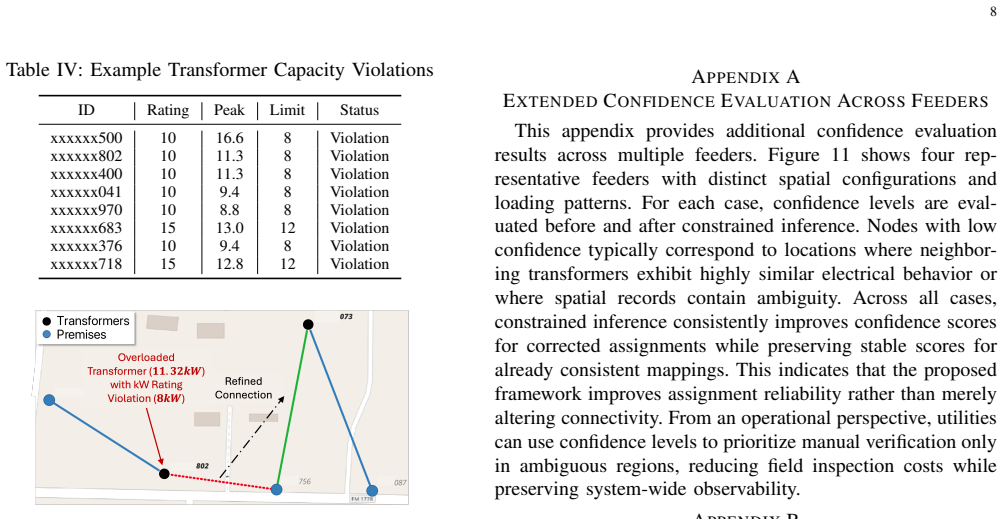
- [Abstract; Section VI, especially VI.A and VI.C] The headline claim of 'over 95% topology reconstruction accuracy' is not supported by any quantitative evaluation in the manuscript. Section VI reports feeder statistics (Table III), capacity violations (Table IV), and qualitative figures, but no accuracy table, no precision/recall, no confusion matrix, no error bars, and no numerical comparison to the 'baseline methods' mentioned in the abstract. In addition, the term 'ground truth' is never defined. If the ground truth is the same utility record that was used to construct the base topology G_B, then the result is partly circular because the solver preserves most of G_B by design (J_prior in Eq. (1)). The authors must state exactly what the 95% is measured against, provide per-feeder and overall accuracy numbers, and include a quantitative baseline comparison.
- [Section II.C, Eq. (1); Section V] The central inference objective in Eq. (1) is never made concrete. The terms J_elec, J_geo, and J_prior are described only in words, the weights α and β are not specified, and the feasible set Ω(C) is not formalized. More importantly, the actual solver in Section V uses heuristics—distance ratios, correlation thresholds, K-means, mutual information, and DBI-based scoring—with no derivation showing that these implement or approximately minimize Eq. (1). This makes the 'constrained inference' formulation and its implementation hard to connect, and it prevents reproducibility.
- [Section V.F, Lemma 1] The scalability guarantee is a tautological restatement of the locality assumption. Lemma 1 assumes |O|=γN with γ≪1 and bounded K, and then concludes the cost is O(NK). No evidence is given that γ is small in the studied feeders, and no sensitivity analysis is provided for how accuracy degrades when errors are not localized or when the suspicious-node detector in Section V.A misses the incorrect assignments. The paper's own §III.D offers only an anecdotal statement that 'utility record inaccuracies rarely corrupt entire feeders.' If that assumption fails, the localized reconnection procedure cannot recover the correct topology, and the claimed linear scaling is irrelevant to accuracy. The authors should empirically measure the size and spatial concentration of errors and the recall of the detection step.
- [Section V.D and VI.D] The reliability metric CL = 0.7·Score_DBI + 0.3·Score_corr is presented as a falsification-driven measure, but both components are the same clustering-quality and correlation criteria used to make the assignment in the first place. It is therefore unsurprising that the chosen assignment scores higher than alternatives; the metric may not provide independent evidence of confidence. The weights 0.7/0.3 are arbitrary, and Appendix B tests sensitivity only to K, not to these weights or to α, β, and τ. No comparison against field-verified connections is reported, so the operational value of the reliability scores is unvalidated.
minor comments (4)
- [Section II.B, Table II] The notation V is used both for the set of nodes and for voltage magnitudes (e.g., V_A_it), which is confusing. A distinct symbol for voltage, such as U or v, would improve readability.
- [Table IV] The column headings and units are unclear: 'Rating 10', 'Peak 16.6', and '8' are not explained. Is the rating in kVA? What is the limit column? The transformer IDs are redacted but the table still needs a self-contained caption.
- [Appendix B] The appendix is titled 'Sensitivity and Robustness Analysis' but it only varies the candidate-set size K. The hyperparameters α, β, τ, and the reliability weights 0.7/0.3 are not tested, so the claim that results are insensitive to parameter choices is broader than the presented evidence.
- [Section VI.C, Figure 8] The comparison among database, correlation-only, and proposed methods is qualitative. A numerical table showing the number/percentage of nodes corrected, incorrectly changed, or left unchanged would be much more informative.
Circularity Check
Confidence metric is self-referential; headline 95% accuracy has no defined ground truth, but core localized topology refinement is not itself circular.
-
self definitional
[Section V-D (Reliability Estimation via Falsification Testing) and Section VI-D]
"Reliability is therefore evaluated via falsification testing. Alternative candidate transformers are tested, and clustering quality is compared via Davies–Bouldin Index: ScoreDBI = σ(log DBIfalse/DBItrue) ... Correlation-based support is similarly evaluated: Scorecorr = σ(Corrours/Corralt). The final confidence score becomes CL = 0.7ScoreDBI + 0.3Scorecorr. ... Corrected assignments exhibit clear confidence increases, while already correct mappings remain stable, indicating the solver strengthens reliable assignments rather than introducing instability."
The reconnection step (V-C) selects assignments using K-means on the joint spatial-electrical feature space and statistical dependence (MI/correlation) with the same candidate transformer groups, accepting only updates that reduce the inference objective. The reliability score CL is a rescaled combination of the same kind of clustering-quality (DBI) and correlation criteria. Therefore the reported 'confidence increase' after correction is not independent falsification: it compares chosen versus alternative assignments on the same family of scores that steered the reassignment. The statement that the solver 'strengthens reliable assignments rather than introducing instability' is thus a restatement of the selection procedure, not confirmation from external or field-verified connections.
full rationale
The central inference chain is not circular: the solver starts from a noisy base record GB, detects suspicious nodes via distance/correlation heuristics, restricts candidates to local transformer neighborhoods, and reconnects by clustering plus feasibility constraints. The objective (1) includes J_prior, but that is a legitimate prior term rather than a hidden ground-truth fit. However, the paper never defines the ground truth for the abstract's 'over 95% topology reconstruction accuracy,' and the only topology comparison shown (Fig. 8) is against the 'database topology' GB, which is also the prior GB. If accuracy were measured against GB, it would be partly forced by J_prior and by the localized-preservation design (Ê = EB \ ΔE ∪ ΔÊ); because the metric is undefined, this remains a reporting gap rather than a demonstrated circular reduction. The concrete self-referential step is the reliability metric, which reuses the selection criteria as confidence evidence. The paper also contains several self-citations, but none is load-bearing for the central algorithm. Overall, the core derivation is independent; the self-referential confidence claim and the undefined accuracy basis justify a moderate score, not a high one.
Assumptions & free parameters
free parameters (6)
- α (J_geo weight) =
not specified
- β (J_prior weight) =
not specified
- distance-ratio threshold τ =
not specified
- K (candidate transformer count) =
K=2 or K=3 in reported examples; changes appear at K=4
- reliability weights 0.7/0.3 =
0.7, 0.3
- sigmoid mapping parameters =
not specified
assumptions (6)
- domain assumption Each node is connected to exactly one secondary transformer
- ad hoc to paper Most base-topology assignments are correct and errors are localized (|O|=γN with γ≪1)
- domain assumption K is small and independent of feeder size due to physical locality
- domain assumption Voltage correlation and geodetic distance are reliable discriminative signals inside local neighborhoods
- domain assumption Transformer capacity and nominal-voltage bands are sufficient to certify physical feasibility
- domain assumption Ground truth for the 95% accuracy is correct and independent of the base records used as prior
Cite this review
Pith. "Pith review of Enabling Scalable Topology Inference in Distribution Systems via Constrained Multi-Source Inference." pith.science (2026). https://pith.science/paper/VTCEBEA6
@misc{pith2026260720480,
  author       = {Pith},
  title        = {Pith review of: Enabling Scalable Topology Inference in Distribution Systems via Constrained Multi-Source Inference},
  year         = {2026},
  howpublished = {\url{https://pith.science/paper/VTCEBEA6}},
  note         = {Machine review of arXiv:2607.20480}
}
abstract
Accurate distribution system topology is essential for outage localization, voltage analytics, and operation of distribution grids, yet maintaining reliable connectivity records remains challenging in practice due to heterogeneous and imperfect utility data. Existing topology identification methods often rely primarily on electrical similarity or spatial records alone, which become unreliable in dense feeders and under inconsistent metadata conditions. This paper formulates distribution topology identification as a constrained inference problem that refines a utility-provided base topology using heterogeneous evidence while enforcing spatial feasibility and physical operational constraints. Instead of reconstructing connectivity from scratch, the proposed framework detects inconsistent assignments, performs localized reconnection within constrained neighborhoods to ensure scalability, and iteratively enforces physical feasibility to produce operationally consistent topology estimates. In addition, a falsification-driven reliability metric evaluates how strongly each inferred connection is supported relative to alternative feasible assignments, enabling utilities to prioritize verification efforts while preserving system-wide observability. The framework is validated using operational data from three feeders comprising more than $8{,}000$ AMI meters in collaboration with a large U.S. utility. Results demonstrate over $95\%$ topology reconstruction accuracy while significantly reducing computational effort compared with global inference approaches. The study further shows that correlation-based methods alone produce ambiguous assignments in dense urban feeders, whereas combining electrical measurements with spatial and operational constraints enables robust and scalable topology recovery under realistic deployment conditions.
Figures


Figures from the paper (6 more)




Reference graph
Works this paper leans on
-
[1]
Distribution grid impedance & topology estimation with limited or no micro-pmus,
H. Li, Y . Weng, Y . Liao, B. Keel, and K. E. Brown, “Distribution grid impedance & topology estimation with limited or no micro-pmus,” International Journal of Electrical Power & Energy Systems, vol. 129, p. 106794, 2021
2021
-
[2]
Hd-deep-em: Deep expectation maximization for dynamic hidden state recovery using heterogeneous data,
Z. Ma, H. Li, Y . Weng, E. Blasch, and X. Zheng, “Hd-deep-em: Deep expectation maximization for dynamic hidden state recovery using heterogeneous data,”IEEE Transactions on Power Systems, vol. 39, no. 2, pp. 3575–3587, 2023
2023
-
[3]
Distributed algorithms for convexified bad data and topology error detection and identification problems,
Y . Weng, M. D. Ili ´c, Q. Li, and R. Negi, “Distributed algorithms for convexified bad data and topology error detection and identification problems,”International Journal of Electrical Power & Energy Systems, vol. 83, pp. 241–250, 2016
2016
-
[4]
Machine learning-enabled distribution network phase identification,
Z. S. Hosseini, A. Khodaei, and A. Paaso, “Machine learning-enabled distribution network phase identification,”IEEE Transactions on Power Systems, vol. 36, no. 2, pp. 842–850, 2020. 9 CL: 0.574 CL: 0.426 TransformerThe transformer connected to the outlierEndpoints in different clusters Our method (a) Case 1 CL: 0.589 CL: 0.411Our method TransformerThe tra...
2020
-
[5]
Guaranteed con- version from static measurements into dynamic ones based on manifold feature interpolation,
L. Mai, H. Li, Y . Weng, E. Blasch, and X. Zheng, “Guaranteed con- version from static measurements into dynamic ones based on manifold feature interpolation,”IEEE Transactions on Power Systems, 2025
2025
-
[6]
Tajer, S
A. Tajer, S. M. Perlaza, and H. V . Poor,Advanced data analytics for power systems. Cambridge University Press, 2021
2021
-
[7]
Efficient manifold-constrained neural ode for high-dimensional datasets,
M. Guo, H. Li, and Y . Weng, “Efficient manifold-constrained neural ode for high-dimensional datasets,” inInternational Joint Conference on Neural Networks (IJCNN). IEEE, 2025, pp. 1–8
2025
-
[8]
Graph mining for classifying and localizing solar panels in distribution grids,
M. Guo, Q. Cui, and Y . Weng, “Graph mining for classifying and localizing solar panels in distribution grids,” inPanda Forum on Power and Energy (PandaFPE). IEEE, 2023, pp. 1743–1747
2023
Show all 21 references
-
[9]
Identifying errors in service transformer connections,
L. Blakely and M. J. Reno, “Identifying errors in service transformer connections,” inIEEE Power & Energy Society General Meeting (PESGM), 2020, pp. 1–5
2020
-
[10]
Core process representation in power system operational models: Gaps, challenges, and opportunities for multisector dynamics research,
K. Oikonomou, B. Tarroja, J. Kern, and N. V oisin, “Core process representation in power system operational models: Gaps, challenges, and opportunities for multisector dynamics research,”Energy, vol. 238, p. 122049, 2022
2022
-
[11]
Data quality challenges in existing distribution network datasets,
F. Geth, M. Vanin, and D. Hertem, “Data quality challenges in existing distribution network datasets,”IET, 2023
2023
-
[12]
An efficient approach to power system uncertainty analysis with high-dimensional dependencies,
Y . Wang, N. Zhang, C. Kang, M. Miao, R. Shi, and Q. Xia, “An efficient approach to power system uncertainty analysis with high-dimensional dependencies,”IEEE Transactions on Power Systems, vol. 33, no. 3, pp. 2984–2994, 2017
2017
-
[13]
Spatial-temporal deep learning for hosting capacity analysis in distribution grids,
J. Wu, J. Yuan, Y . Weng, and R. Ayyanar, “Spatial-temporal deep learning for hosting capacity analysis in distribution grids,”IEEE Transactions on Smart Grid, vol. 14, no. 1, pp. 354–364, 2022
2022
-
[14]
Solar photovoltaic assessment with large lan- guage model,
M. Guo and Y . Weng, “Solar photovoltaic assessment with large lan- guage model,”Applied Energy, vol. 402, p. 126835, 2025
2025
-
[15]
Topology identification and line parameter estimation for non-pmu distribution network: A numerical method,
J. Zhang, Y . Wang, Y . Weng, and N. Zhang, “Topology identification and line parameter estimation for non-pmu distribution network: A numerical method,”IEEE Transactions on Smart Grid, vol. 11, no. 5, pp. 4440– 4453, 2020
2020
-
[16]
Exarnn: An environment-driven adaptive rnn for learning non-stationary power dy- namics,
H. Li, M. Guo, Y . Weng, M. Ilic, and G. Ruan, “Exarnn: An environment-driven adaptive rnn for learning non-stationary power dy- namics,”arXiv preprint arXiv:2505.17488, 2025
2025 arXiv
-
[17]
Phase identification in electric power distribution systems by clustering of smart meter data,
W. Wang, N. Yu, B. Foggo, J. Davis, and J. Li, “Phase identification in electric power distribution systems by clustering of smart meter data,” in IEEE International Conference on Machine Learning and Applications (ICMLA), 2016, pp. 259–265
2016
-
[18]
An introduction to optimal power flow: Theory, formulation, and examples,
S. Frank and S. Rebennack, “An introduction to optimal power flow: Theory, formulation, and examples,”IIE Transactions, vol. 48, no. 12, pp. 1172–1197, 2016
2016
-
[19]
Physical equation discovery using physics- consistent neural network (pcnn) under incomplete observability,
H. Li and Y . Weng, “Physical equation discovery using physics- consistent neural network (pcnn) under incomplete observability,” in Proceedings of ACM SIGKDD Conference on Knowledge Discovery & Data Mining, 2021, pp. 925–933
2021
-
[20]
Adaptive data fusion for state estimation and control of power grids under attack,
T. Mortlock and M. A. Al Faruque, “Adaptive data fusion for state estimation and control of power grids under attack,”IEEE Transactions on Industrial Informatics, 2024
2024
-
[21]
A joint estimation method of distribution network topology and line parameters based on power flow graph convolutional networks,
Y . Wang, X. Shen, X. Tang, and J. Liu, “A joint estimation method of distribution network topology and line parameters based on power flow graph convolutional networks,”Energies, vol. 17, no. 21, p. 5272, 2024. 10 TransformerThe transformer connected to the outlierEndpoints i...
2024
Reviewed August 2, 2026 · model on record in the stance chip above.
Discussion (0). Sign in to comment.