REVIEW 4 major objections 5 minor 47 references
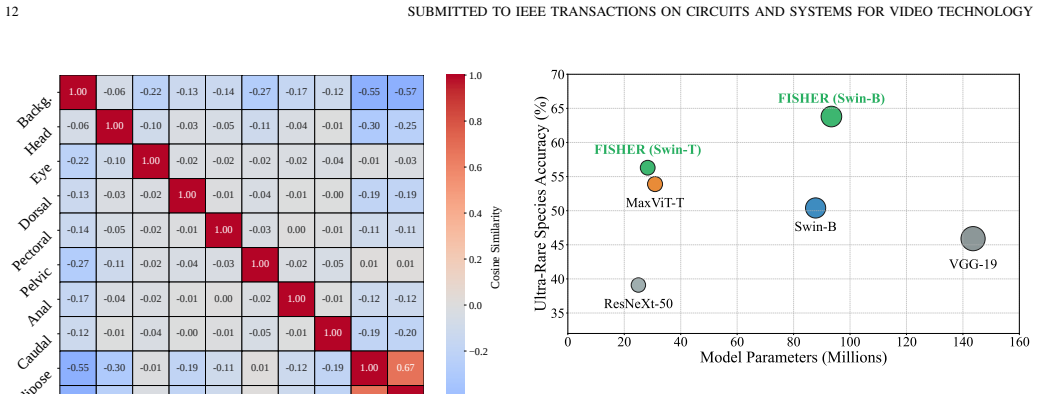
By blocking gradients between hierarchical tasks, FISHER raises ultra-rare fish species accuracy to 63.8%, 13.4 points over a strong baseline.
Reviewed by Pith at T0; open to challenge. T0 means a machine referee read the full paper against a public rubric. the ladder, T0–T4 →
T0 review · deepseek-v4-flash
2026-08-02 07:53 UTC pith:57GCBNON
load-bearing objection Gradient detachment is a sensible design for a biologically structured MTL hierarchy, but the decoupling-specific gains are small single-run margins; the headline 13.4-point ultra-rare gain is mostly auxiliary-task supervision. the 4 major comments →
FISHER: Gradient-Decoupled Hierarchical Multi-Task Learning for Fine-Grained Aquatic Species Recognition
The pith
A machine-rendered reading of the paper's core claim, the machinery that carries it, and where it could break.
Core claim
FISHER's core claim is that gradient conflicts between dense segmentation and global classification are a fundamental source of negative transfer, and that explicitly decoupling gradients across a biologically ordered task chain fixes it. The architecture factorizes the joint distribution as P(y,t,M|X)=P(y|t,X)P(t|M,X)P(M|X), and makes each factor a separate stage: a prototype-based segmentation head produces part masks, a trait head reads masked part evidence plus global features, and a species head combines trait embeddings with context. Stop-gradient operations at the boundary between stages ensure that species and trait losses never back-propagate into lower-level representations. Experi
What carries the argument
The load-bearing mechanism is the unidirectional information-flow chain enforced by stop-gradient (gradient-detach) operations, instantiated from the factorization P(y,t,M|X)=P(y|t,X)P(t|M,X)P(M|X). Segmentation evidence, summarized as max-pooled prototype responses, is concatenated into the trait head with gradients blocked; trait embeddings are then detached and fed to the species head. Around this chain sit two supporting devices: a prototype-based segmentation head whose learnable prototypes are regularized toward orthogonality, and homoscedastic uncertainty weighting that adaptively down-weights the species loss because its gradients are treated as high-variance noisy signals.
Load-bearing premise
The central premise is that species identity is mediated by the annotated morphological traits — that once traits are known, segmentation supplies no extra species information — and that those trait labels are reliable enough to carry the bridge.
What would settle it
Shuffle or corrupt the trait labels while keeping segmentation intact: if ultra-rare accuracy still climbs roughly 13 points over the baseline, the trait bridge contributes nothing and the gain must come from some other component. Alternatively, train FISHER on a class-balanced subset: if the advantage over parallel MTL disappears, the claim that gradient conflict is the bottleneck is not general.
If this is right
- If correct, the trait bridge lets ultra-rare species be recognized from shared morphological cues rather than memorized global patterns, so long-tail accuracy should improve on any fine-grained dataset with intermediate attributes.
- The gradient-alignment analysis predicts that parallel MTL baselines will show persistent negative cosine similarity between classification and segmentation gradients; FISHER keeps this positive, so the mechanism is measurable during training.
- Because the gains come from structure rather than capacity, the method should transfer to smaller backbones without losing the long-tail benefit.
- The Leave-Out-Species result implies the hierarchy learns species-agnostic trait representations that generalize to unseen taxa, which matters for open-set biodiversity monitoring.
Where Pith is reading between the lines
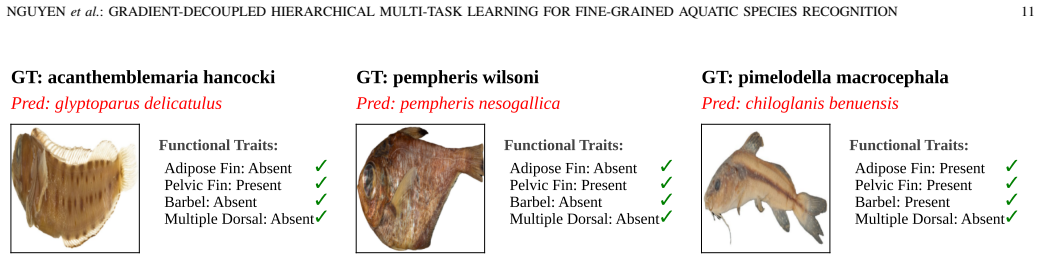
- The four binary traits (adipose, pelvic, barbel, dorsal) may be too coarse to capture all species-discriminative anatomy; the same architecture with a richer trait vocabulary could push the rare-species gains further — a natural extension the paper does not test.
- The decoupling principle is not fish-specific: any domain with a part→attribute→category hierarchy (plant identification, medical pathology, bird morphology) could adopt the same stop-gradient chain.
- One testable extension is to vary the strength of gradient coupling continuously instead of hard stop-gradients; the paper's ablation suggests even partial connectivity hurts OOD trait mAP by roughly ten points, implying an optimal-coupling regime worth mapping.
- The uncertainty-weighting analysis reveals the species loss is down-weighted to near zero; an inverse inference is that noisy long-tail labels may be actively harmful to shared features, so a label-cleaning or robust-loss variant might compound the gains.
Editorial analysis
A structured set of objections, weighed in public.
Referee Report
Summary. The paper proposes FISHER, a hierarchical multi-task architecture for fine-grained aquatic species recognition on the Fish-Vista benchmark. The model factorizes the prediction problem as segmentation → trait prediction → species classification, and enforces a unidirectional flow by applying gradient detachment at the task interfaces, so that higher-level losses do not backpropagate into lower-level representations. The segmentation head uses learnable prototypes with an orthogonality regularizer, and the three task losses are combined with homoscedastic uncertainty weighting. Experiments report improved species classification, particularly for ultra-rare classes (63.8% vs. 50.4% for Swin-B-22k), high OOD trait mAP (97.7% on the Leave-Out-Species split), and ablation results indicating that gradient conflicts degrade segmentation and trait generalization.
Significance. The paper addresses an important and timely problem—long-tailed fine-grained recognition in biodiversity monitoring—and its core idea is well motivated. The ablation pattern in Table VIII and the comparison with gradient-based MTL methods in Table IX provide useful evidence that negative transfer exists in this setting and that structural gradient decoupling is a plausible remedy. If the decoupling-specific gains are confirmed with repeated runs, the work would be a valuable contribution to hierarchical multi-task learning and fine-grained recognition. The manuscript is transparent about its components and reports a broad set of baselines.
major comments (4)
- [V-B/V-C, Tables III, VIII, IX] The headline claim '+13.4% ultra-rare accuracy' compares FISHER to a species-only Swin-B classifier. Fig. 4 shows that the uncertainty weight assigned to the species loss is below 1% while the trait loss receives ~90% of the total weight, so most of the gain over Swin-B can be explained by auxiliary segmentation/trait supervision rather than by gradient decoupling. The decoupling-specific comparisons are FISHER vs. Fully Connected in Table VIII (63.8 vs. 61.4) and vs. MTL+UW in Table IX (63.8 vs. 60.4). These margins are 2.4 and 3.4 points, and all results are single runs with no error bars, seeds, or significance tests. This is not sufficient to establish that the novel detachment mechanism causes the gain; report multi-seed means with standard deviations for at least Tables VIII and IX and for Fig. 5.
- [IV-B/IV-C, Eq. (12)] The species head receives bc=[g;p_detach;h_detach_t], so the global descriptor g and the segmentation evidence p are available to the classifier in addition to the trait embedding h_t. The factorization in Eq. (2) therefore does not enforce a trait bottleneck, and the claim that trait representations are the critical bridge to ultra-rare species is not directly tested. Please add an experiment in which the species head uses only the detached trait embedding (or in which g is ablated) to show that the hierarchy is load-bearing; otherwise the No-Trait ablation in Table VIII may be attributable to extra feature capacity rather than to the trait bridge.
- [IV-D Eq. (22), V-C Table VIII, Fig. 4] The uncertainty-weighting description is internally inconsistent. Eq. (22) gives a weight exp(-eta_m)=1/sigma_m^2, while Fig. 4 reports weights as 1/(2 sigma_m^2). More importantly, Table VIII shows that adding uncertainty weighting alone to the detached base reduces Species F1 from 58.1 to 55.7 and ultra-rare accuracy from 61.5 to 59.6, yet the text states that removing UW makes the species loss dominate and decreases ultra-rare accuracy from 63.8 to 61.5. Please correct the formula and characterize the actual task-loss/gradient magnitudes so the claimed interaction between UW and orthogonality is supported.
- [III-A Eq. (2), V-I Fig. 10] The hierarchical factorization assumes that the four binary traits are sufficient to connect segmentation and species classification. The paper does not analyze trait annotation quality or trait informativeness; the high Adipose-Barbel prototype correlation (0.67) in Fig. 10 suggests these traits may be difficult to separate. Since the biological-hierarchy motivation depends on the trait bridge, please report per-trait reliability/agreement or an experiment that uses predicted traits as the sole input to the species head, otherwise the sufficiency assumption is unverified.
minor comments (5)
- [Throughout, esp. V-C and Fig. 3] The manuscript contains multiple uninterpretable '/uni0000...' escape sequences (e.g., after 'C. Ablation Study' and in the Fig. 3 caption) that render parts of the text unreadable. The file must be re-typeset cleanly before any further review.
- [Abstract and Tables V-VI] The abstract says 'unseen trait identification,' but the experiments evaluate traits on Leave-Out-Species (unseen species), not on unseen traits. Please reword to avoid confusion.
- [Table VIII] For the 'Fully Connected' and 'Standard MTL' baselines, specify whether they use the same prototype segmentation head, orthogonality loss, and uncertainty weighting as FISHER. Without this, the ablation does not cleanly isolate gradient detachment.
- [V-F, Fig. 5] The curves labeled 'Baseline (Connected)', 'Baseline (Parallel)', and 'Orthogonal (Target)' are not all defined in the text. Define each variant, state the smoothing window, and report the number of runs used for the alignment curves.
- [V-A, Eq. (31)] Species F1 is reported as a macro-F1, but no formula or definition is given for species macro-F1. Please add the definition or a reference.
Circularity Check
No significant circularity: FISHER's performance claims are tested against external baselines and held-out frequency groups; the hierarchy equation is an assumption, not a fitted prediction.
full rationale
The paper's central claim is an architectural/empirical one: gradient-decoupled hierarchical multi-task learning improves fine-grained aquatic species recognition. The factorization in Eq. (1)-(2) is a modeling assumption rather than a derived prediction, and the architecture is evaluated against external baselines (Swin-B-22k, Q2L, MaxViT, etc.) on the Fish-Vista benchmark, including held-out unseen species and manually annotated data. The ultra-rare species accuracy gap (63.8% vs. 50.4%) is not equivalent to any fitted parameter or to the hierarchical factorization itself; it is an externally measured result. Ablations include connected/parallel baselines that do not use detachment, and the gradient-alignment analysis (Fig. 5) is a diagnostic observation, not a target that was fit. No load-bearing self-citations appear; citations to Fish-Vista, Swin, uncertainty weighting, PCGrad, and SimSiam are external prior work, not the authors' own unverified results. The single-run nature of the experiments and the absence of significance tests are legitimate correctness/robustness concerns but do not constitute circularity under the stated criteria.
Axiom & Free-Parameter Ledger
free parameters (4)
- Prototype temperature τ =
0.1
- Orthogonality weight λ_ortho =
0.5
- Label smoothing ε =
0.1
- Uncertainty weights η_m =
Learned; final relative weights shown in Fig. 4
axioms (4)
- domain assumption Species classification can be factorized through traits: P(y|t,M,X) = P(y|t,X)
- domain assumption The four binary traits (adipose, pelvic, barbel, dorsal) are sufficient to bridge segmentation and species classification
- ad hoc to paper Gradient interference between dense and high-level tasks is the primary cause of negative transfer in this setting
- domain assumption Swin-B pre-trained on ImageNet-22k provides a suitable shared backbone for aquatic recognition
invented entities (1)
-
Learnable prototype matrix P in the segmentation head
independent evidence
read the original abstract
Fine-grained recognition of aquatic species is challenging due to subtle morphological differences and long-tailed distributions, where ultra-rare species are underrepresented. A natural solution is to jointly model segmentation, morphological traits, and species classification within a multi-task learning (MTL) framework. However, existing MTL methods suffer from negative transfer caused by gradient conflicts between low-level dense tasks and high-level classification objectives, degrading fine-grained representations. To address this limitation, we identify gradient interference across hierarchical tasks as a fundamental bottleneck and propose FISHER, a gradient-decoupled hierarchical multi-task learning framework. FISHER aligns optimization with the biological hierarchy of aquatic species by enforcing a unidirectional information flow from segmentation to trait prediction and finally to species classification, while explicitly decoupling gradients across task boundaries. This design prevents high-level objectives from corrupting low-level morphological representations, effectively mitigating negative transfer while preserving the benefits of shared supervision. Furthermore, we introduce a prototype-based segmentation head with orthogonality regularization to encourage disentangled anatomical representations, and employ homoscedastic uncertainty weighting to dynamically balance task contributions during training. Our analysis shows that robust trait representations serve as a critical bridge for transferring knowledge to ultra-rare species. Extensive experiments on the Fish-Vista benchmark demonstrate that FISHER achieves 97.7% mAP for unseen trait identification and improves ultra-rare species classification accuracy by 13.4% over strong baselines, highlighting the effectiveness of gradient-decoupled hierarchical learning for long-tailed biodiversity recognition.
Figures



Reference graph
Works this paper leans on
-
[1]
Fish-vista: A multi-purpose dataset for understanding & identification of traits from images,
K. S. Mehrab, M. Maruf, A. Dawet al., “Fish-vista: A multi-purpose dataset for understanding & identification of traits from images,” inProc. IEEE/CVF Conf. Comput. Vis. Pattern Recognit. (CVPR), June 2025, pp. 24 275–24 285. NGUYENet al.: GRADIENT-DECOUPLED HIERARCHICAL MULTI-TASK LEARNING FOR FINE-GRAINED AQUATIC SPECIES RECOGNITION 13
2025
-
[2]
Autofish: Dataset and benchmark for fine-grained analysis of fish,
S. H. Bengtson, D. Lehotsk ´y, V . Ismiroglou, N. Madsen, T. B. Moeslund, and M. Pedersen, “Autofish: Dataset and benchmark for fine-grained analysis of fish,” inProc. IEEE/CVF Winter Conf. Appl. Comput. Vis. (WACV), February 2025, pp. 1598–1607
2025
-
[3]
M4FT: Mamba, migratory, mobile and multiple fish tracking,
W. Li, Y . Liu, W. Wang, and Z. Li, “M4FT: Mamba, migratory, mobile and multiple fish tracking,”IEEE Trans. Circuit Syst. Video Technol., pp. 1–1, 2026
2026
-
[4]
Fishnet: A large-scale dataset and benchmark for fish recognition, detection, and functional trait prediction,
F. F. Khanet al., “Fishnet: A large-scale dataset and benchmark for fish recognition, detection, and functional trait prediction,” inProc. IEEE/CVF Int. Conf. Comput. Vis. (ICCV), October 2023, pp. 20 496– 20 506
2023
-
[5]
A realistic fish-habitat dataset to evaluate algorithms for underwater visual analysis,
A. Saleh, I. H. Laradji, D. A. Konovalov, M. Bradley, D. Vazquez, and M. Sheaves, “A realistic fish-habitat dataset to evaluate algorithms for underwater visual analysis,”Scientific Reports, vol. 10, no. 1, p. 14671, 2020
2020
-
[6]
The deepfish computer vision dataset for fish instance segmentation, classification, and size estimation,
N. Garcia-d’Ursoet al., “The deepfish computer vision dataset for fish instance segmentation, classification, and size estimation,”Scientific Data, vol. 9, no. 1, p. 287, 2022
2022
-
[7]
Automatic estuarine fish species classification system based on deep learning techniques,
H. Tejaswini, M. M. Manohara Pai, and R. M. Pai, “Automatic estuarine fish species classification system based on deep learning techniques,” IEEE Access, vol. 12, pp. 140 412–140 438, 2024
2024
-
[8]
Fish tracking and segmentation from stereo videos on the wild sea surface for electronic monitoring of rail fishing,
T.-W. Huang, J.-N. Hwang, S. Romain, and F. Wallace, “Fish tracking and segmentation from stereo videos on the wild sea surface for electronic monitoring of rail fishing,”IEEE Trans. Circuit Syst. Video Technol, vol. 29, no. 10, pp. 3146–3158, 2019
2019
-
[9]
Fish tracking and continual behavioral pattern clustering using novel sillago sihama vid (ssvid),
S. Shreesha, M. M. M. Pai, U. Verma, and R. M. Pai, “Fish tracking and continual behavioral pattern clustering using novel sillago sihama vid (ssvid),”IEEE Access, vol. 11, pp. 29 400–29 416, 2023
2023
-
[10]
Fishnet: Fish visual recognition with one stage multi-task learning,
Z. Chen, L. Cao, Q. Wang, and Y . Cai, “Fishnet: Fish visual recognition with one stage multi-task learning,”IET Image Processing, vol. 16, no. 12, pp. 3237–3246, 2022
2022
-
[11]
Mtaffb: a multi-task active learning framework for analyzing fish school feeding behavior,
T. Zhou, X. Peng, and Y . Zhang, “Mtaffb: a multi-task active learning framework for analyzing fish school feeding behavior,”Smart Agricul- tural Technology, vol. 12, p. 101313, 2025
2025
-
[12]
Exploring simple siamese representation learning,
X. Chen and K. He, “Exploring simple siamese representation learning,” inProc. IEEE/CVF Conf. Comput. Vis. Pattern Recognit. (CVPR), 2021
2021
-
[13]
Interpretable image classi- fication via non-parametric part prototype learning,
Z. Zhu, L. Fan, M. Pagnucco, and Y . Song, “Interpretable image classi- fication via non-parametric part prototype learning,” inProc. IEEE/CVF Conf. Comput. Vis. Pattern Recognit. (CVPR), June 2025, pp. 9762– 9771
2025
-
[14]
Multi-task learning using uncer- tainty to weigh losses for scene geometry and semantics,
R. Cipolla, Y . Gal, and A. Kendall, “Multi-task learning using uncer- tainty to weigh losses for scene geometry and semantics,” inProc. IEEE/CVF Conf. Comput. Vis. Pattern Recognit. (CVPR), 2018, pp. 7482–7491
2018
-
[15]
Wildfish++: A comprehensive fish benchmark for multimedia research,
P. Zhuang, Y . Wang, and Y . Qiao, “Wildfish++: A comprehensive fish benchmark for multimedia research,”IEEE Trans. Multi., vol. 23, p. 3603–3617, 2021
2021
-
[16]
Fine-grained fish classification from small to large datasets with vision transformers,
R. J. M. Veiga and J. M. F. Rodrigues, “Fine-grained fish classification from small to large datasets with vision transformers,”IEEE Access, vol. 12, pp. 113 642–113 660, 2024
2024
-
[17]
A lightweight fine-grained pelagic fish recognition algorithm based on object detec- tion,
W. Ren, D. Shi, Y . Chen, L. Song, Q. Hu, and M. Wang, “A lightweight fine-grained pelagic fish recognition algorithm based on object detec- tion,”Aquaculture International, vol. 33, no. 2, Jan 2025
2025
-
[18]
BioCLIP: A vision foundation model for the tree of life,
S. Stevenset al., “BioCLIP: A vision foundation model for the tree of life,” inProc. IEEE/CVF Conf. Comput. Vis. Pattern Recognit. (CVPR), 2024, pp. 19 412–19 424
2024
-
[19]
Yolo-fd: An accurate fish disease detection method based on multi-task learning,
X. Li, S. Zhao, C. Chen, H. Cui, D. Li, and R. Zhao, “Yolo-fd: An accurate fish disease detection method based on multi-task learning,” Expert Systems with Applications, vol. 258, p. 125085, Dec 2024
2024
-
[20]
Deepseavision: Enhanced detection and classification of underwater species,
G. Joshita Reddy, K. Reddy, S. Ruthvik Athota, S. J. Narayanan, B. Perumal, and G. Kumar Nayak, “Deepseavision: Enhanced detection and classification of underwater species,”IEEE Access, vol. 13, pp. 173 347–173 367, 2025
2025
-
[21]
Optimizing fish classification with a hybrid sae-svm model: Perfor- mance and evaluation on fish-gres and fish4-knowledge datasets,
S. Senthil Pandi, R. Suguna Devi, A. Thanam, and S. M. Keerthana, “Optimizing fish classification with a hybrid sae-svm model: Perfor- mance and evaluation on fish-gres and fish4-knowledge datasets,” in Proc. Int. Conf. Recent Adv. Sci. Eng. Technol. (ICRASET), 2024, pp. 1–6
2024
-
[22]
Which tasks should be learned together in multi-task learning?
T. Standley, A. Zamir, D. Chen, L. Guibas, S. Savarese, and W. Saxe, “Which tasks should be learned together in multi-task learning?” inProc. Int. Conf. Mach. Learn. (ICML), 2020, pp. 9120–9132
2020
-
[23]
Model- protected multi-task learning,
J. Liang, Z. Liu, J. Zhou, X. Jiang, C. Zhang, and F. Wang, “Model- protected multi-task learning,”IEEE Trans. Patt. Anal. and Mach. Intell., vol. 44, no. 2, p. 1002–1019, Feb 2022
2022
-
[24]
Decoupling representation learning and classifier for long- tailed adversarial training,
H. Xiong, D. Man, J. Lv, C. Xu, F. Zeng, Y . Shi, M. Lai, and W. Yang, “Decoupling representation learning and classifier for long- tailed adversarial training,”Pattern Recognition, vol. 172, p. 112607, Apr 2026
2026
-
[25]
Gradient surgery for multi-task learning,
T. Yu, S. Kumar, A. Gupta, S. Levine, K. Hausman, and C. Finn, “Gradient surgery for multi-task learning,” inAdv. Neural Inf. Process. Syst. (NeurIPS), 2020
2020
-
[26]
Individual fish recognition method with coarse and fine-grained feature linkage learning for precision aquaculture,
J. Yin, J. Wu, C. Gao, H. Yu, L. Liu, Z. Jiang, and S. Guo, “Individual fish recognition method with coarse and fine-grained feature linkage learning for precision aquaculture,”Aquaculture Research, vol. 2023, p. 1–14, 2023
2023
-
[27]
Hierarchical feature attention learning network for detecting object and discriminative parts in fine-grained visual classification,
A. Yeong Han, K. Moo Yi, K. Tae Kim, and J. Young Choi, “Hierarchical feature attention learning network for detecting object and discriminative parts in fine-grained visual classification,”IEEE Access, vol. 13, pp. 19 533–19 544, 2025
2025
-
[28]
Concept bottleneck models,
P. W. Kohet al., “Concept bottleneck models,” inProc. Int. Conf. Mach. Learn. (ICML), 2020, pp. 5338–5348
2020
-
[29]
Very deep convolutional networks for large-scale image recognition,
K. Simonyan and A. Zisserman, “Very deep convolutional networks for large-scale image recognition,” inProc. Int. Conf. Learn. Represent. (ICLR), 2015
2015
-
[30]
Aggregated residual transformations for deep neural networks,
S. Xie, R. Girshick, P. Doll ´ar, Z. Tu, and K. He, “Aggregated residual transformations for deep neural networks,” inProc. IEEE/CVF Conf. Comput. Vis. Pattern Recognit. (CVPR), 2017, pp. 1492–1500
2017
-
[31]
Designing network design spaces,
I. Radosavovic, R. P. Kosaraju, R. Girshick, K. He, and P. Doll ´ar, “Designing network design spaces,” inProc. IEEE/CVF Conf. Comput. Vis. Pattern Recognit. (CVPR), 2020, pp. 10 428–10 436
2020
-
[32]
An image is worth 16x16 words: Transformers for image recognition at scale,
A. Dosovitskiyet al., “An image is worth 16x16 words: Transformers for image recognition at scale,” inProc. Int. Conf. Learn. Represent. (ICLR), 2021
2021
-
[33]
Swin transformer: Hierarchical vision transformer using shifted windows,
Z. Liuet al., “Swin transformer: Hierarchical vision transformer using shifted windows,” inProc. IEEE/CVF Int. Conf. Comput. Vis. (ICCV), 2021, pp. 10 012–10 022
2021
-
[34]
Maxvit: Multi-axis vision transformer,
Z. Tu, H. Talebi, H. Zhang, F. Yang, P. Milanfar, A. Bovik, and Y . Li, “Maxvit: Multi-axis vision transformer,” inProc. Eur. Conf. Comput. Vis. (ECCV). Springer, 2022, pp. 459–479
2022
-
[35]
Learning transferable visual models from natural language supervision,
A. Radfordet al., “Learning transferable visual models from natural language supervision,” inProc. Int. Conf. Mach. Learn. (ICML). PMLR, 2021, pp. 8748–8763
2021
-
[36]
DINOv2: Learning robust visual features without supervision,
M. Oquabet al., “DINOv2: Learning robust visual features without supervision,”Transactions on Machine Learning Research, 2024
2024
-
[37]
A simple interpretable transformer for fine-grained image classification and analysis,
D. Paulet al., “A simple interpretable transformer for fine-grained image classification and analysis,” inProc. Int. Conf. Learn. Represent. (ICLR), 2024
2024
-
[38]
Transfg: A transformer architecture for fine-grained recognition,
J. He, J.-N. Chen, S. Liu, A. Kortylewski, C. Yang, Y . Bai, and C. Wang, “Transfg: A transformer architecture for fine-grained recognition,” in Proc. AAAI Conf. Artif. Intell. (AAAI), vol. 36, 06 2022, pp. 852–860
2022
-
[39]
Pyramid scene parsing network,
H. Zhao, J. Shi, X. Qi, X. Wang, and J. Jia, “Pyramid scene parsing network,” inProc. IEEE/CVF Conf. Comput. Vis. Pattern Recognit. (CVPR), 2017
2017
-
[40]
Encoder- decoder with atrous separable convolution for semantic image segmen- tation,
L.-C. Chen, Y . Zhu, G. Papandreou, F. Schroff, and H. Adam, “Encoder- decoder with atrous separable convolution for semantic image segmen- tation,” inProc. Eur. Conf. Comput. Vis. (ECCV), 2018
2018
-
[41]
Per-pixel classification is not all you need for semantic segmentation,
B. Cheng, A. G. Schwing, and A. Kirillov, “Per-pixel classification is not all you need for semantic segmentation,” inAdv. Neural Inf. Process. Syst. (NeurIPS), 2021
2021
-
[42]
Yolov8: A novel object detection algorithm with enhanced performance and robustness,
R. Varghese and M. Sambath, “Yolov8: A novel object detection algorithm with enhanced performance and robustness,” inProc. Int. Conf. Adv. Data Eng. Intell. Comput. Syst. (ADICS). IEEE, 2024, pp. 1–6
2024
-
[43]
Molmo and pixmo: Open weights and open data for state-of-the-art vision-language models,
M. Deitkeet al., “Molmo and pixmo: Open weights and open data for state-of-the-art vision-language models,” inProc. IEEE/CVF Conf. Comput. Vis. Pattern Recognit. (CVPR), June 2025, pp. 91–104
2025
-
[44]
Query2label: A simple transformer way to multi-label classification,
S. Liu, L. Zhang, X. Yang, H. Su, and J. Zhu, “Query2label: A simple transformer way to multi-label classification,”arXiv preprint arXiv:2107.10834, 2021
Pith/arXiv arXiv 2021
-
[45]
GradNorm: Gradient normalization for adaptive loss balancing in deep multitask networks,
Z. Chen, V . Badrinarayanan, C.-Y . Lee, and A. Rabinovich, “GradNorm: Gradient normalization for adaptive loss balancing in deep multitask networks,” inProc. Int. Conf. Mach. Learn. (ICML), 2018
2018
-
[46]
Grad-cam: Visual explanations from deep networks via gradient-based localization,
R. R. Selvaraju, M. Cogswell, A. Das, R. Vedantam, D. Parikh, and D. Batra, “Grad-cam: Visual explanations from deep networks via gradient-based localization,” inProc. IEEE Int. Confe. Comp. Vis. (ICCV), Oct 2017
2017
-
[47]
Visualizing data using t-sne
L. Van der Maaten and G. Hinton, “Visualizing data using t-sne.”J. Mach. Lear. Res., vol. 9, no. 11, p. 2579–2605, 2008
2008
discussion (0)
Sign in with ORCID, Apple, or X to comment. Anyone can read and Pith papers without signing in.