REVIEW 3 major objections 5 minor 52 references
A Single-Trace Surface Integral Equation Solver for Simulation of Open Bianisotropic Metasurfaces Described by Generalized Sheet Transition Conditions
T0 review · 3 major / 5 minor · reviewed 2026-08-01 · deepseek-v4-flash
Pith's one-line read The paper claims that a three-dimensional open bianisotropic metasurface can be simulated full-wave by enforcing generalized sheet transition conditions from a single set of equivalent surface currents on the sheet itself, eliminating the a
desk verdict A clean single-trace SIE-GSTC formulation for open 3D metasurfaces; the core derivation holds up, but the numerical validation is mostly self-consistency checks rather than independent tests. read the letter →
The pith
A machine-rendered reading of the paper's core claim, the machinery that carries it, and where it could break.
The reading
What carries the argument
The load-bearing object is the single-trace current pair (JΣ, MΣ), defined on the sheet as the sum of the equivalent currents on its two faces. Because the K-operator free terms from the two face limits cancel, the generalized sheet transition conditions collapse into a system that acts only on this one pair; the surface divergence of the position-dependent susceptibility tensors then enters through non-vanishing line integrals along triangle edges, and the vanishing-current condition at the rim is imposed by omitting edge basis functions.
What would settle it
Take a metasurface whose retrieved susceptibility tensors include nonzero normal-polarizability terms, run the single-trace SIE-GSTC solver and a reference full-wave volume simulation of the same structure, and check whether the scattered-field error grows well beyond the roughly one-percent levels reported here; a large deviation would show that the tangential-only assumption is the limiting factor.
Extended reading notes
Core claim
The central claim is that the single-trace SIE-GSTC system (22)–(23), with unknowns JΣ and MΣ defined as the sums of the face currents on the two sides of the sheet, correctly enforces the generalized sheet transition conditions on an open surface without artificial closure. The scattered fields on both faces are written through surface integral operators acting on these same currents; the free terms of the K operator cancel as the two faces approach the sheet from opposite sides, leaving only a principal-value contribution. The paper then discretizes this system with divergence-conforming triangular edge basis functions, handling spatially varying tangential susceptibilities through a line-
Load-bearing premise
The method assumes the metasurface responds only to fields lying in the surface plane (χ_ab·n = n·χ_ab = 0), so any unit cell whose response depends on fields perpendicular to the sheet is not captured by this system.
Editorial extensions
If this is right
- Open metasurfaces on finite, curved platforms can be simulated without extending them into closed surfaces, so beam illumination, finite aperture, and conformal shape effects can be studied directly.
- The 2N-by-2N system uses roughly five times fewer unknowns than a multi-trace closure for the same accuracy, lowering memory and iteration cost for electrically large apertures.
- The formulation covers full bianisotropic coupling (χem and χme), not only monoanisotropic sheets, within a three-dimensional surface integral equation setting.
- Spatially varying susceptibility profiles are treated consistently, including the line-charge contribution at mesh edges, so gradient and conformal designs remain representable.
- Susceptibility tensors retrieved from unit-cell or other full-wave data can be passed directly into the forward solver, as demonstrated for the broadband absorber across a wide frequency range.
Reading between the lines
- A natural next step, which the authors leave for future work, is lifting the purely tangential susceptibility assumption; including normal polarizabilities will likely require extra degrees of freedom or modified jump identities and would extend the method to oblique-incidence unit cells.
- The cancellation of the free terms suggests the single-trace construction may generalize to other open transition-condition sheets, such as impedance sheets or higher-order GSTC models, where interior–exterior decomposition is also unnatural.
- Because the surface-divergence term creates line charges at mesh edges when the susceptibility tensor changes across a shared edge, the solver could be used to study the field behavior at boundaries and edges of metasurface patches, though the paper does not test this directly.
- The strong contrast in iteration counts between monoanisotropic and bianisotropic realizations indicates that preconditioning designed for the off-diagonal coupling blocks would be valuable for reciprocal bianisotropic designs.
Signed reviews
Editorial analysis
A structured set of objections, weighed in public.
Referee Report
Summary. The paper derives and discretizes a single-trace surface integral equation (SIE) formulation that enforces generalized sheet transition conditions (GSTCs) on an open, non-enclosing metasurface. A single equivalent electric/magnetic current pair is placed on the sheet; the average fields on the two faces are expressed through SIE operators, substituted into the GSTCs, and discretized with RWG basis functions. The resulting 2N x 2N linear system is derived explicitly, including a line-integral treatment of surface-divergence contributions from spatially varying susceptibility tensors. Numerical examples cover planar and curved polarization rotators, a perfect reflector, a broadband absorber with susceptibilities retrieved from FDTD data, and a comparison with a multi-trace formulation, with reported errors at the 1-4% level and roughly five times fewer unknowns than the multi-trace counterpart.
Significance. If correct, the single-trace system represents a genuine algorithmic advance: it avoids artificial closures for open metasurfaces and reduces the unknown count relative to multi-trace formulations. The derivation in Section 2 is self-contained and has no fitted parameters; the cancellation of the K-operator free terms, the M renormalization, and the Galerkin identities (34)-(35) are internally consistent. The treatment of the surface-divergence line charges in (40)-(42) is a nontrivial and credible contribution. The main reservation is that the numerical validation is presently a consistency check of the discretized GSTC model rather than an independent validation against physical scattering data, so the abstract's claim that the absorber response is 'modeled' is stronger than the evidence supports.
major comments (3)
- [§3, Eqs. (45), (47), (51), (53)] In all examples the validation is self-referential. The susceptibilities are synthesized from a prescribed field transformation (Eqs. (47), (51), (53)), and the reference field in the ℓ2 error (45) is obtained by applying the same transformation to the incident field. In §3.3 this is explicit: E_ref is "analytically obtained by applying the prescribed wave transformation (53) to E_inc". Hence the reported errℓ2 values quantify how well the discretized system reproduces the model used to define the susceptibilities, not whether the solver reproduces physical metasurface scattering. In particular, the broadband absorber is validated only against the retrieval model built from Γ(ω), never against the FDTD fields of [52] or the reflectance/absorptance curves of Fig. 8. This weakens the abstract claim that the solver "is used to model a realistic broadband absorber" whose response is reproduc
- [§3 (all examples)] There is no mesh-convergence study anywhere in Section 3. All simulations use a fixed ~λ/10 mesh. The formulation involves a principal-value K operator, a singular L operator, and boundary line-integral contributions from (36)-(41), all of which are nontrivial to implement and can interact with the open-surface edge behavior of the currents. Without a convergence study at, say, λ/20 and λ/40 showing that errℓ2 decreases, one cannot separate discretization error from a possible formulation error. A convergence table for the planar rotator and perfect-reflector cases would substantially strengthen the numerical evidence.
- [§3.1.2] The curved-metasurface error is computed against "the analytical solution obtained for the planar metasurface" as reference. But the susceptibility tensors are imposed patch-wise in the local tangent frame, so away from the apex the expected response of the curved sheet is not the planar response. The reported values (8.01×10^-3 and 1.26×10^-2) therefore conflate the intended geometry-dependent modification with numerical error and cannot be interpreted as an accuracy measure for curved surfaces. A proper reference should be defined for the curved problem, e.g., by applying the local-tangent transformation to the local incident field pointwise, or by comparing with an independent full-wave simulation; otherwise the comparison should be restricted to a region where the planar reference is valid.
minor comments (5)
- [Eq. (46)] The residual formula is garbled in the typesetting; please rewrite it with a clear norm expression.
- [Fig. 8] The figure lacks axis labels and units; add a frequency axis label and indicate that the curves are R(ω) and A(ω).
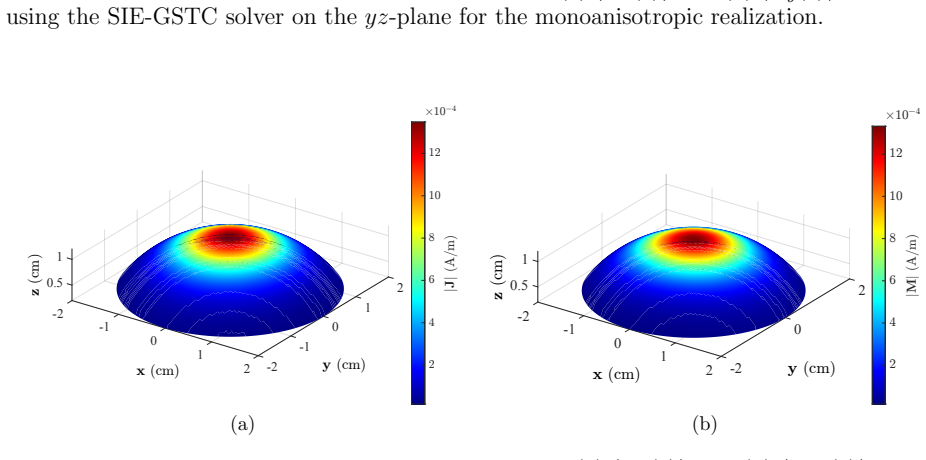
- [§3.3.2] For the curved absorber, only field plots are given, with no error metric or quantitative comparison. Either add axial-error values or explicitly state that the curved case is qualitative.
- [§3.4] The text says "trivial susceptibility tensors χee=χmm=0" are assigned to the remaining faces. For the monoanisotropic problem this is harmless, but the wording should say all four tensors are zero.
- [§2.2, Eq. (38)] The piecewise-constant approximation of χ on each patch is a modeling choice; its impact on accuracy is not discussed. This is related to the line-integral terms and should be mentioned, even briefly, in the convergence discussion.
Circularity Check
The SIE-GSTC derivation is self-contained, but the validation protocol is partially circular: susceptibility tensors are synthesized from a prescribed transformation and the reference fields are then defined by that same transformation, so the numerical checks largely demonstrate self-consistency rather than independent predictive power.
-
fitted input called prediction
[Section 3.3, Eq. (53) and error definition (45)]
"E(r−)=p̂(e^{−jk0z}−Γ(ω)e^{jk0z}), E(r+)=0 ... In the error calculation, E_ref(r) is analytically obtained by applying the prescribed wave transformation (53) to Einc(r)."
The same Γ(ω) retrieved from FDTD data is used to synthesize the susceptibility tensors via (53) and is then used again to construct the reference field E_ref via (53). The reported err_ℓ2 therefore compares the solver against the retrieval model's own input boundary condition, not against the FDTD scattered fields that supplied Γ(ω). This validates self-consistency of the GSTC model and its discretization, but not the ability of the solver to reproduce the physical absorber's scattering.
-
other
[Sections 3.1.1 and 3.2, Eqs. (47), (51), (45)]
"compared ... to those obtained from the analytical expressions derived by applying the prescribed wave transformation (47) to Einc(r) ... compared against the analytical expression derived by applying the prescribed wave transformation (51) to Einc(r)."
For the polarization rotator and perfect reflector, the susceptibility tensors are synthesized from the prescribed transformations (47) and (51), and the reference fields used in the ℓ2 error are obtained by applying those same transformations to the incident field. Thus the canonical validations check that the SIE-GSTC system reproduces the transformation that was used as input to the susceptibility synthesis. This is a consistency check of the discretization, not an independent test of the underlying metasurface model.
full rationale
The derivation of the single-trace SIE-GSTC system, Eqs. (22)–(23), is not circular: it follows directly from the GSTCs (5)–(6), the polarization constitutive relations (7)–(8), the tangential-susceptibility assumption (9), and the SIE field representations (14)–(15), with no fitted parameters and no load-bearing self-citation. The self-citations to prior work [31], [36], and [52] are used for comparison, for a preliminary version, and for the FDTD data source, respectively; they do not by themselves force the central claim. The circularity concern lies in the validation methodology: in every numerical example, the susceptibility tensors are synthesized from a prescribed wave transformation, and the reference field is then defined by applying that same transformation to the incident field. This is explicit in Section 3.3 for the absorber and in Sections 3.1.1 and 3.2 for the canonical cases. Consequently, the reported ~0.8–4% relative errors demonstrate that the discrete solver enforces the GSTC model consistently, but they do not independently establish that the model reproduces actual metasurface scattering, especially for the absorber, where no direct comparison to the FDTD results of [52] is made. The purely-tangential susceptibility restriction (9) is a transparent, stated limitation deferred to future work and is not itself circular. Overall, the central derivation has independent content, but the validation contains a self-referential component, warranting a score of 4 rather than a non-finding.
Assumptions & free parameters
assumptions (5)
- domain assumption GSTCs (5)-(6) with four surface susceptibility tensors are a valid homogenized model of the metasurface.
- domain assumption Susceptibility tensors are purely tangential, Eq. (9): χ_ab·n = n·χ_ab = 0.
- standard math A single set of equivalent currents JΣ, MΣ on an open sheet in an unbounded homogeneous medium represents the scattered fields on both faces through the same L and K operators (14)-(15).
- domain assumption Both faces of the sheet are exposed to the same unbounded homogeneous background medium (free space).
- domain assumption The susceptibility synthesis/retrieval procedures of [11-14] produce tensors that realize the prescribed field transformations.
Cite this review
Pith. "Pith review of A Single-Trace Surface Integral Equation Solver for Simulation of Open Bianisotropic Metasurfaces Described by Generalized Sheet Transition Conditions." pith.science (2026). https://pith.science/paper/7Q3ZCQSE
@misc{pith2026260720659,
  author       = {Pith},
  title        = {Pith review of: A Single-Trace Surface Integral Equation Solver for Simulation of Open Bianisotropic Metasurfaces Described by Generalized Sheet Transition Conditions},
  year         = {2026},
  howpublished = {\url{https://pith.science/paper/7Q3ZCQSE}},
  note         = {Machine review of arXiv:2607.20659}
}
read the original abstract
A single-trace surface integral equation (SIE) solver incorporating generalized sheet transition conditions (GSTCs) is presented for the simulation of three-dimensional (3D) open bianisotropic metasurfaces. The metasurface is modeled as an infinitesimally thin, non-enclosing sheet across which the GSTCs enforce the electromagnetic field discontinuities through four surface susceptibility tensors. The proposed solver uses a single set of equivalent surface currents on the sheet, in place of the two sets used by prior multi-trace formulations. The scattered fields on both faces of the sheet, expressed through SIE operators acting on these currents, are substituted into the GSTCs. The resulting system of equations is then discretized using Rao--Wilton--Glisson basis functions. This solver models an open metasurface directly, without an artificial closure, and applies to both planar and curved geometries. It is validated against analytical solutions for polarization rotation and perfect reflection, and is used to model a realistic broadband absorber whose susceptibility tensors are retrieved from full-wave simulation data. A direct comparison shows that the single-trace formulation attains lower error than a multi-trace formulation while using significantly fewer unknowns.
Figures


Figures from the paper (9 more)




Reference graph
Works this paper leans on
-
[34]
Three-dimensional integral equation-based GSTC method for composite structure with arbitrary-shaped nonpenetrating metasurface,
I. Kim, Y. Noh, H.-R. Im, I.-P. Hong, H. Lee, and J.-G. Yook, “Three-dimensional integral equation-based GSTC method for composite structure with arbitrary-shaped nonpenetrating metasurface,”IET Microw. Antennas Propag., vol. 19, no. 1, p. e70012, 2025. 30
2025
-
[52]
Enhanced absorption in thin-film silicon solar cells using a broadband plasmonic nanostructure,
P. Mondal, O. Alkhazragi, and H. Bagci, “Enhanced absorption in thin-film silicon solar cells using a broadband plasmonic nanostructure,”Opt. Express, vol. 33, no. 14, pp. 29 118–29 133, July 2025. 33 Figures <latexit sha1_base64="RCZZtud5zkkwuYXYVXiEW8wxoVw=">AAAB6nicbVDLSgNBEOyNrxhfUY9eBoMgCGE3SPQY8OIxEvOAJITZyWwyZHZ2mekVwpJP8OJBEa9+kTf/xkmyB00saCiquunu...
2025
-
[1]
A review of metasurfaces: Physics and applica- tions,
H.-T. Chen, A. J. Taylor, and N. Yu, “A review of metasurfaces: Physics and applica- tions,”Rep. Prog. Phys., vol. 79, no. 7, p. 076401, 2016
2016
-
[2]
Achouri and C
K. Achouri and C. Caloz,Electromagnetic Metasurfaces: Theory and Applications. Hoboken, NJ, USA: Wiley-IEEE Press, 2021
2021
-
[3]
Intelligent beamforming via physics-inspired neural networks on programmable metasurface,
S. Li, Z. Liu, S. Fu, Y. Wang, and F. Xu, “Intelligent beamforming via physics-inspired neural networks on programmable metasurface,”IEEE Trans. Antennas Propag., 26 vol. 70, no. 6, pp. 4589–4599, June 2022
2022
-
[4]
Controlling the most significant grating lobes in two-dimensional beam-steering systems with phase-gradient metasur- faces,
K. Singh, M. U. Afzal, M. Kovaleva, and K. P. Esselle, “Controlling the most significant grating lobes in two-dimensional beam-steering systems with phase-gradient metasur- faces,”IEEE Trans. Antennas Propag., vol. 68, no. 3, pp. 1389–1401, Mar. 2020
2020
-
[5]
Intelligent beam steering for wireless communication using programmable metasurfaces,
N. Ashraf, T. Saeed, H. Taghvaee, S. Abadal, V. Vassiliou, C. Liaskos, A. Pitsillides, and M. Lestas, “Intelligent beam steering for wireless communication using programmable metasurfaces,”IEEE Trans. Intell. Transp. Syst., vol. 24, no. 5, pp. 4848–4861, May 2023
2023
-
[6]
Wideband RCS reduction metasurface with a transmission window,
Y. Pang, Y. Li, B. Qu, M. Yan, J. Wang, S. Qu, and Z. Xu, “Wideband RCS reduction metasurface with a transmission window,”IEEE Trans. Antennas Propag., vol. 68, no. 10, pp. 7079–7087, May 2020
2020
Show all 52 references
-
[7]
A broadband metasurface antenna array with ultrawideband RCS reduction,
L. Qiu and G. Xiao, “A broadband metasurface antenna array with ultrawideband RCS reduction,”IEEE Trans. Antennas Propag., vol. 70, no. 9, pp. 8620–8625, Sep. 2022
2022
-
[8]
RCS reduction on pat- terned graphene-based transparent flexible metasurface absorber,
C. Fu, L. Zhang, L. Liu, S. Dong, W. Yu, and L. Han, “RCS reduction on pat- terned graphene-based transparent flexible metasurface absorber,”IEEE Trans. An- tennas Propag., vol. 71, no. 2, pp. 2005–2010, Feb. 2023
2005
-
[9]
Averaged transition conditions for electromagnetic fields at a metafilm,
E. F. Kuester, M. A. Mohamed, M. Piket-May, and C. L. Holloway, “Averaged transition conditions for electromagnetic fields at a metafilm,”IEEE Trans. Antennas Propag., vol. 51, no. 10, pp. 2641–2651, Oct. 2003
2003
-
[10]
M. M. Idemen,Discontinuities in the Electromagnetic Field. Hoboken, NJ, USA: Wiley-IEEE Press, 2011. 27
2011
-
[11]
General metasurface synthesis based on sus- ceptibility tensors,
K. Achouri, M. A. Salem, and C. Caloz, “General metasurface synthesis based on sus- ceptibility tensors,”IEEE Trans. Antennas Propag., vol. 63, no. 7, pp. 2977–2991, July 2015
2015
-
[12]
Synthesis of spherical metasurfaces based on susceptibility tensor GSTCs,
X. Jia, Y. Vahabzadeh, C. Caloz, and F. Yang, “Synthesis of spherical metasurfaces based on susceptibility tensor GSTCs,”IEEE Trans. Antennas Propag., vol. 67, no. 4, pp. 2542–2554, Apr. 2019
2019
-
[13]
Design, concepts, and applications of electromagnetic meta- surfaces,
K. Achouri and C. Caloz, “Design, concepts, and applications of electromagnetic meta- surfaces,”Nanophotonics, vol. 7, no. 6, pp. 1095–1116, May 2018
2018
-
[14]
Generalized boundary conditions in surface elec- tromagnetics: Fundamental theorems and surface characterizations,
X. Liu, F. Yang, M. Li, and S. Xu, “Generalized boundary conditions in surface elec- tromagnetics: Fundamental theorems and surface characterizations,”Appl. Sci., vol. 9, no. 9, p. 1891, May 2019
2019
-
[15]
Computational analysis of metasurfaces,
Y. Vahabzadeh, N. Chamanara, K. Achouri, and C. Caloz, “Computational analysis of metasurfaces,”IEEE J. Multiscale Multiphys. Comput. Tech., vol. 3, pp. 37–49, 2018
2018
-
[16]
Finite-element modeling of metasurfaces with generalized sheet transition conditions,
S. Sandeep, J.-M. Jin, and C. Caloz, “Finite-element modeling of metasurfaces with generalized sheet transition conditions,”IEEE Trans. Antennas Propag., vol. 65, no. 5, pp. 2413–2420, May 2017
2017
-
[17]
Fast nonuniform metasurface analysis in FDTD using surface susceptibility model,
X. Jia, F. Yang, X. Liu, M. Li, and S. Xu, “Fast nonuniform metasurface analysis in FDTD using surface susceptibility model,”IEEE Trans. Antennas Propag., vol. 68, no. 10, pp. 7121–7130, Oct. 2020
2020
-
[18]
Generalized sheet transition condition FDTD simulation of metasurface,
Y. Vahabzadeh, N. Chamanara, and C. Caloz, “Generalized sheet transition condition FDTD simulation of metasurface,”IEEE Trans. Antennas Propag., vol. 66, no. 1, pp. 271–280, Jan. 2018. 28
2018
-
[19]
Modelling of free-form conformal metasurfaces,
K. Wu, P. Coquet, Q. J. Wang, and P. Genevet, “Modelling of free-form conformal metasurfaces,”Nat. Commun., vol. 9, no. 1, p. 3494, 2018
2018
-
[20]
An improved DGTD-GSTC method equipped with normal surface polarizabilities for oblique incidence,
K. Wu and Q. Ren, “An improved DGTD-GSTC method equipped with normal surface polarizabilities for oblique incidence,”IEEE Trans. Antennas Propag., vol. 72, no. 12, pp. 9317–9328, Dec. 2024
2024
-
[21]
Modeling of metasurfaces using discontinuous Galerkin time domain method based on generalized sheet transition conditions,
S. Tian, K. Wu, and Q. Ren, “Modeling of metasurfaces using discontinuous Galerkin time domain method based on generalized sheet transition conditions,”IEEE Trans. Antennas Propag., vol. 70, no. 8, pp. 6905–6917, Aug. 2022
2022
-
[22]
A locally-implicit discontinuous Galerkin time-domain method to simulate metasurfaces using generalized sheet tran- sition conditions,
L. Chen, M. B. Ozakin, R. Zhao, and H. Bagci, “A locally-implicit discontinuous Galerkin time-domain method to simulate metasurfaces using generalized sheet tran- sition conditions,”IEEE Trans. Antennas Propag., vol. 71, no. 1, pp. 869–881, Jan. 2023
2023
-
[23]
Jin,Theory and Computation of Electromagnetic Fields
J.-M. Jin,Theory and Computation of Electromagnetic Fields. Hoboken, NJ, USA: Wiley-IEEE Press, 2015
2015
-
[24]
A. F. Peterson, S. L. Ray, and R. Mittra,Computational Methods for Electromagnetics. New York, NY, USA: IEEE Press, 1998
1998
-
[25]
IE-GSTC metasurface field solver using sur- face susceptibility tensors with normal polarizabilities,
T. J. Smy, V. Tiukuvaara, and S. Gupta, “IE-GSTC metasurface field solver using sur- face susceptibility tensors with normal polarizabilities,”IEEE Trans. Antennas Propag., vol. 70, no. 6, pp. 4752–4765, June 2022
2022
-
[26]
Scattering field solutions of metasurfaces based on the boundary element method for interconnected regions in 2-D,
S. A. Stewart, S. Moslemi-Tabrizi, T. J. Smy, and S. Gupta, “Scattering field solutions of metasurfaces based on the boundary element method for interconnected regions in 2-D,”IEEE Trans. Antennas Propag., vol. 67, no. 12, pp. 7487–7495, Dec. 2019. 29
2019
-
[27]
Simulation of circular cylindrical metasurfaces using GSTC-MoM,
S. Sandeep and S. Y. Huang, “Simulation of circular cylindrical metasurfaces using GSTC-MoM,”IEEE J. Multiscale Multiphys. Comput. Tech., vol. 3, pp. 185–192, 2018
2018
-
[28]
Simulation of two-dimensional prop- agation problems involving metasurfaces using a surface integral equation solver,
S. Celis Sierra, R. Zhao, R. Chen, and H. Bagci, “Simulation of two-dimensional prop- agation problems involving metasurfaces using a surface integral equation solver,” in Proc. Int. Appl. Comput. Electromagn. Soc. Symp., 2023, pp. 1–2
2023
-
[29]
Zero thickness surface suscep- tibilities and extended GSTCs—part I: Spatially dispersive metasurfaces,
J. G. N. Rahmeier, T. J. Smy, J. Dugan, and S. Gupta, “Zero thickness surface suscep- tibilities and extended GSTCs—part I: Spatially dispersive metasurfaces,”IEEE Trans. Antennas Propag., vol. 71, no. 7, pp. 5909–5919, July 2023
2023
-
[30]
Classification and analysis of IE-based zero-thickness meta- surface forward solvers,
M. Phaneuf and P. Mojabi, “Classification and analysis of IE-based zero-thickness meta- surface forward solvers,”IEEE Open J. Antennas Propag., vol. 6, no. 6, pp. 1750–1762, Dec. 2025
2025
-
[31]
A surface integral equation solver for simulation of metasurfaces described by monoanisotropic generalized sheet transition conditions,
S. Celis Sierra, R. Zhao, R. Chen, and H. Bagci, “A surface integral equation solver for simulation of metasurfaces described by monoanisotropic generalized sheet transition conditions,”IEEE Trans. Antennas Propag., vol. 74, no. 1, pp. 801–816, Jan. 2026
2026
-
[32]
An SIE-GSTC solver for simulation of monoanisotropic metasurfaces,
——, “An SIE-GSTC solver for simulation of monoanisotropic metasurfaces,” inProc. IEEE Int. Symp. Antennas Propag., 2023, pp. 553–554
2023
-
[33]
An SIE-GSTC formulation for 3D composite metasurface analy- sis,
J. Budhu and S. Xu, “An SIE-GSTC formulation for 3D composite metasurface analy- sis,” inProc. IEEE Int. Symp. Antennas Propag., 2024, pp. 1505–1506
2024
-
[35]
Electromagnetic scattering by surfaces of arbitrary shape,
S. Rao, D. Wilton, and A. Glisson, “Electromagnetic scattering by surfaces of arbitrary shape,”IEEE Trans. Antennas Propag., vol. 30, no. 3, pp. 409–418, May 1982
1982
-
[36]
Simulation of photonic metasurfaces using a surface integral equation solver with generalized sheet transition conditions,
S. Celis Sierra, P. Mondal, R. Zhao, and H. Bagci, “Simulation of photonic metasurfaces using a surface integral equation solver with generalized sheet transition conditions,” in Proc. IEEE Latin Amer. Conf. Antennas Propag. (LACAP), 2024, pp. 1–2
2024
-
[37]
Angular scattering properties of metasurfaces,
K. Achouri and O. J. F. Martin, “Angular scattering properties of metasurfaces,”IEEE Trans. Antennas Propag., vol. 68, no. 1, pp. 432–442, Jan. 2020
2020
-
[38]
High degree efficient symmetrical Gaussian quadrature rules for the triangle,
D. A. Dunavant, “High degree efficient symmetrical Gaussian quadrature rules for the triangle,”Int. J. Numer. Methods Eng., vol. 21, no. 6, pp. 1129–1148, June 1985
1985
-
[39]
Gaussian quadrature formulas for triangles,
G. R. Cowper, “Gaussian quadrature formulas for triangles,”Int. J. Numer. Methods Eng., vol. 7, no. 3, pp. 405–408, 1973
1973
-
[40]
Calculation of CFIE impedance matrix elements with R WG and n×R WG functions,
P. Yl¨ a-Oijala and M. Taskinen, “Calculation of CFIE impedance matrix elements with R WG and n×R WG functions,”IEEE Trans. Antennas Propag., vol. 51, no. 8, pp. 1837– 1846, Aug. 2003
2003
-
[41]
The evaluation of MFIE integrals with the use of vector triangle basis functions,
R. E. Hodges and Y. Rahmat-Samii, “The evaluation of MFIE integrals with the use of vector triangle basis functions,”Microw. Opt. Technol. Lett., vol. 14, no. 1, pp. 9–14, Jan. 1997
1997
-
[42]
Poten- tial integrals for uniform and linear source distributions on polygonal and polyhedral domains,
D. Wilton, S. Rao, A. Glisson, D. Schaubert, O. Al-Bundak, and C. Butler, “Poten- tial integrals for uniform and linear source distributions on polygonal and polyhedral domains,”IEEE Trans. Antennas Propag., vol. 32, no. 3, pp. 276–281, Mar. 1984
1984
-
[43]
On the numerical integration of the linear shape functions times the 3-D Green’s function or its gradient on a plane triangle,
R. D. Graglia, “On the numerical integration of the linear shape functions times the 3-D Green’s function or its gradient on a plane triangle,”IEEE Trans. Antennas Propag., vol. 41, no. 10, pp. 1448–1455, Oct. 1993. 31
1993
-
[44]
Integral equation based analysis of scattering from 3-D inhomogeneous anisotropic bodies,
G. Kobidze and B. Shanker, “Integral equation based analysis of scattering from 3-D inhomogeneous anisotropic bodies,”IEEE Trans. Antennas Propag., vol. 52, no. 10, pp. 2650–2658, Oct. 2004
2004
-
[45]
P. J. Davis and P. Rabinowitz,Methods of Numerical Integration, 2nd ed. New York, NY, USA: Academic Press, 1984
1984
-
[46]
A transpose-free quasi-minimal residual algorithm for non-hermitian linear systems,
R. W. Freund, “A transpose-free quasi-minimal residual algorithm for non-hermitian linear systems,”SIAM J. Sci. Comput., vol. 14, no. 2, pp. 470–482, Mar. 1993
1993
-
[47]
GMRES: A generalized minimal residual algorithm for solving nonsymmetric linear systems,
Y. Saad and M. H. Schultz, “GMRES: A generalized minimal residual algorithm for solving nonsymmetric linear systems,”SIAM J. Sci. Stat. Comput., vol. 7, no. 3, pp. 856–869, July 1986
1986
-
[48]
J. A. Kong,Electromagnetic Wave Theory. Cambridge, MA, USA: EMW Publishing, 2008
2008
-
[49]
Surface integral equation formulations for solving electromagnetic scattering problems with iterative methods,
P. Yl¨ a-Oijala, M. Taskinen, and S. J¨ arvenp¨ a¨ a, “Surface integral equation formulations for solving electromagnetic scattering problems with iterative methods,”Radio Sci., vol. 40, p. RS6002, Dec. 2005
2005
-
[50]
A metasurface light-trapping structure for solar cell applications,
B. Wei, X. Mao, W. Liu, C. Ji, G. Yang, Y. Bao, X. Chen, S. Wei, and X. Wang, “A metasurface light-trapping structure for solar cell applications,”Opt. Express, vol. 33, no. 1, pp. 858–866, 2025
2025
-
[51]
Thermoplasmonic and photothermal metamaterials for solar energy applications,
D. Shin, G. Kang, P. Gupta, S. Behera, H. Lee, A. M. Urbas, W. Park, and K. Kim, “Thermoplasmonic and photothermal metamaterials for solar energy applications,”Adv. Opt. Mater., vol. 6, no. 18, p. 1800317, July 2018. 32
2018
Reviewed August 1, 2026 · model on record in the stance chip above.
Discussion (0). Continue with ORCID to comment.