REVIEW 4 major objections 4 minor 27 references
Ocular Verification for Virtual Reality
T0 review · 4 major / 4 minor · reviewed 2026-08-01 · deepseek-v4-flash
Pith's one-line read Standard iris quality metrics and iris-only authentication fail on VR-headset imagery, and a periocular-weighted score fusion of iris and periocular cues cuts the equal error rate from 0.44 to 0.33.
desk verdict Useful benchmark for VR ocular verification, but its headline quality-metric failure claim is not established until the segmentation disagreement between MITRE and UND is resolved. read the letter →
The pith
A machine-rendered reading of the paper's core claim, the machinery that carries it, and where it could break.
The reading
What carries the argument
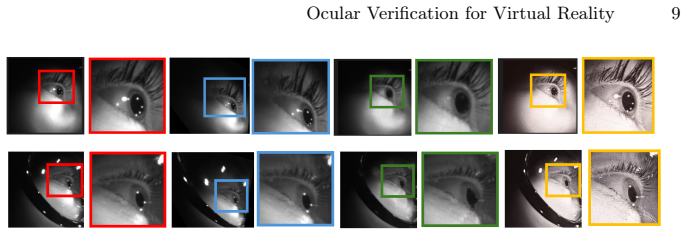
The load-bearing mechanism is score-level fusion of iris and periocular similarity scores, formalized as S_fused = w_i·S_iris + w_p·S_peri. The paper tests several weight pairs and finds the periocular-heavy 25/75 configuration optimal, yielding roughly triple the d' of iris-only. The secondary machinery is the ISO/IEC 29794-6 quality metric suite as implemented by two independent engines; the paper uses those outputs as evidence that margin adequacy and concentricity are unreliable for off-axis VR frames. A third component is a set of generative pre-processing operations—off-axis homography correction, specular reflection removal, and illumination restoration—applied individually, with the
What would settle it
Render synthetic eye images with known ground-truth iris and pupil boundary locations, apply off-axis perspective warps, reflections, and non-uniform illumination, then run the two quality implementations on the same images. If margin adequacy and concentricity still diverge drastically even when the boundaries are exactly known and consistent, the implementations' segmentation is the source of the reported metric failure; if they agree and produce low margin scores despite perfectly localizable boundaries, then the metrics themselves are acquisition-sensitive as the paper claims.
Extended reading notes
Core claim
The central claim is that VR-acquired ocular imagery constitutes a new acquisition regime for which current iris quality standards and iris-centric recognition are poorly matched. The paper demonstrates that margin adequacy—the ISO metric measuring iris centering in the frame—produces a mean score of 4.38±16.37 against a recommended threshold of ≥80, and that concentricity scores diverge widely between two implementations (75.4 vs 4.8), while usable iris area disagrees by roughly a factor of two. The authors argue these discrepancies signal that the metric framework, not necessarily the images, is failing for off-axis HMD captures. On the recognition side, iris-only verification has EER 0.44
Load-bearing premise
The claim that ISO quality metrics 'fail' on VR imagery assumes that the off-the-shelf segmentation routines inside the quality engines correctly identify the iris boundary on off-axis 400×400 frames; if those segmenters are simply failing on VR geometry, then the metric collapse is an artifact of the segmenter, not a property of the acquisition.
Editorial extensions
If this is right
- VR-specific recalibration of ISO/IEC 29794-6 thresholds is needed; current thresholds reject nearly all VR-acquired frames.
- Periocular-heavy fusion should be the default verification strategy for headset-based authentication, at least until iris capture geometry improves.
- Generative illumination restoration should not be applied blindly to iris images: it can damage the fine texture that iris matchers rely on.
- Off-axis homography warping, though it restores circular geometry, does not recover iris texture and can hurt periocular recognition due to padding.
- The choice of quality-metric implementation strongly changes the assessment of VR imagery, so future benchmarks should report multiple engines or a common segmentation routine.
Reading between the lines
- The paper's conclusion that 'margin adequacy fails' is entangled with the segmentation engines used: if those engines cannot locate the iris boundary on off-axis 400×400 frames, the low margin scores may reflect segmentation failure rather than a true property of the images. A synthetic-geometry experiment with known ground-truth boundaries would separate these.
- The relationship between the fusion weights and the quality gap is suggestive: as the iris channel degrades, the optimal weight shifts toward periocular. This could be turned into an adaptive, per-frame weighting rule based on the very quality metrics being criticized, rather than a fixed 25/75 split.
- Because the dataset contains only 25 subjects, the absolute error rates and the optimal fusion weight may not generalize; evaluating on more subjects and on other headset models is a testable next step.
- The paper confines its experiments to bona-fide samples, so the reported fusion gains are not evidence for anti-spoofing performance, another requirement for headset authentication.
Editorial analysis
A structured set of objections, weighed in public.
Referee Report
Summary. The paper evaluates iris quality metrics on the VRBiom dataset using two independent ISO/IEC 29794-6 implementations (MITRE BIQTIris and UND), applies three image-adjustment pipelines (off-axis correction with DINOv3+H8Net, specular-reflectance removal with UnReflect, and illumination restoration with UNIR-Net), and compares unimodal iris/periocular verification with weighted score-level fusion. It reports that some quality metrics, particularly margin adequacy, fail on VR-acquired images; that UnReflect mainly helps periocular recognition; and that periocular-heavy fusion reduces EER by about 11% relative to iris-only recognition.
Significance. The empirical question is timely: VR headset iris acquisition is unconstrained, and existing ISO quality standards were designed for cooperative frontal capture. The paper's strengths are its use of two independent quality implementations, a public dataset, systematic comparison of several adjustment methods, and a promise to release evaluation scripts. If the quality-metric claims were supported by validated segmentations and the fusion result by an honest evaluation protocol, this would be a useful contribution to VR biometric standardization. However, as presented, the central quality-metric conclusion is not established, and the headline fusion improvement appears to be an in-sample selected maximum with an unreported quality filter.
major comments (4)
- [Sec. 4.4, Table 2] The claim that ISO/IEC 29794-6 metrics such as margin adequacy and concentricity 'fail' on VR imagery is not established. The two quality engines disagree dramatically on the same frames: MITRE gives usable iris area 97.59±7.63 while UND gives 54.29±22.75; iris radius 145.27±42.39 vs 4.99±10.77; concentricity 75.41±9.70 vs 4.83±1.38; and margin adequacy 4.38±16.37 vs 96.76±9.65. This is exactly the pattern expected if one or both automatic segmentation routines fail on off-axis VR frames. The paper acknowledges 'significant divergence between algorithmic implementations based on segmentation routines' but never validates either segmentation against ground-truth iris boundaries. The conclusion is therefore indistinguishable from 'the segmenters fail on VR frames.' Manual or semi-automatic ground-truth segmentation on a representative subset is necessary before the metric-failure claim can
- [Algorithm 3 and Table 4] The headline fusion result (Fusion 25/75, EER=0.33) is selected from four weight pairs evaluated on the same data; reporting the best of these as an improvement over iris-only (EER=0.44) overstates the expected gain. Moreover, Algorithm 3 (line 18) only includes comparison pairs in which both iris images pass an unreported CheckQuality filter, with s_iris set to 0 otherwise. This changes the test set and can inflate fusion performance. Please report a pre-specified fusion weight, nested cross-validation, the discarded-pair count, and the result of the same fusion rule on all pairs without the quality filter.
- [Algorithm 3, Table 3] Periocular recognition results are based on RandomSample(V^(v), k=3) with no random seed or repeated sampling. The differences that drive the periocular conclusion are small — e.g., Table 3 EER 31.97 after UnReflect vs 34.70 original for MobileFaceNet. Without a fixed sampling protocol, the reported numbers are not reproducible and may reflect sampling noise as much as the effect of image adjustment. Please use a fixed seed, report variance over multiple samples, or sample deterministically (e.g., every N-th frame).
- [Sec. 4.4, margin adequacy discussion] The explanation that low margin adequacy is 'due to off-axis camera setup rather than evidence of poor image quality' undermines the paper's own 'metric fails' claim. Margin adequacy, as defined in Table 1, is the smallest normalized distance from the iris to the frame edge; an off-axis capture that places the iris near the boundary should receive a low score, and that is the metric working as designed. A concrete failure criterion — e.g., the metric's ordering of images disagrees with human-judged quality, or the metric is insensitive to known degradations — is needed before concluding the metric is inappropriate for VR data.
minor comments (4)
- [Sec. 3.1, Algorithm 1] H8Net is introduced without a reference, architecture description, or training details, while DINOv3 is cited. Please clarify whether H8Net is a new contribution and provide sufficient implementation detail for reproducibility.
- [Sec. 4.4, Table 2] OAC quality results are omitted from Table 2 with only a one-sentence justification. Since the paper claims to evaluate all three adjustment operations, the OAC quality numbers should be included in the supplementary material.
- [Algorithm 3, line 5] The condition 'I_iris ← {i | CheckQuality(M_iris, f_i^(OAC))}' is unclear: iris verification is run on OAC-quality survivors, but Table 4 reports it as 'Iris Only' without stating that a quality filter was applied. The exact filter and threshold should be defined and reported.
- [General] There are typos ('Convetnional' in Sec. 1) and undefined abbreviations (OAC, FTE). Figure 1's colored-box caption should include a legend mapping each color to the corresponding adjustment.
Circularity Check
Empirical measurements on external datasets/toolkits; no derivation reduces to its own inputs.
full rationale
The paper presents three sets of empirical measurements rather than a derivation that turns inputs into outputs. The ISO quality claims (Sec. 4.4, Table 2) are produced by running two external, independently developed engines on public VRBiom frames. The margin-adequacy result (4.38±16.37 under MITRE) is a measured value, and the explanation that it is low 'due to off-axis camera setup rather than evidence of poor image quality' is an interpretation of the metric's definition, not an equation that presupposes the conclusion. The sharp divergence between MITRE and UND segmentations is a validity threat — the 'metrics fail' conclusion may instead mean current segmenters fail on off-axis VR frames — but that is an empirical/correctness concern, not a circular step: the conclusion is not equivalent to its inputs by construction. The recognition and fusion results (Tables 3–4) use externally published models (ArcIris, MobileFaceNet/ResNet variants, UnReflectAnything, UNIR-Net) and compare fixed weight schemes. Choosing the best of four weight pairs on the same test set (Fusion 25/75 at EER 0.33) is in-sample model selection, which can overstate expected performance but is not the same as fitting a parameter and then claiming to predict it. There are no load-bearing self-citations: the 'VR-optimal' configuration is attributed to an external paper [27], and no uniqueness theorem or ansatz is imported from the authors' own prior work. The paper even self-reports the key limitation that UnReflect and UNIR-Net were trained on RGB rather than NIR data, which undercuts any claim that the adjustments are first-principles derivations but does not create circularity. No step in the claimed chain reduces to its own input.
Assumptions & free parameters
free parameters (3)
- Fusion weights (w_i, w_p) =
(0.25, 0.75) for best reported EER; alternatives 0.50/0.50, 0.75/0.25, 0.40/0.60
- Periocular frame sampling k =
3
- Iris quality survivor filter (CheckQuality) =
unspecified threshold
assumptions (4)
- domain assumption RGB-trained UnReflect and UNIR-Net models transfer to NIR VR ocular images.
- domain assumption MITRE and UND BIQT segmentation masks are accurate enough for metric computation on off-axis VR frames.
- domain assumption Pre-trained ArcIris and MobileFaceNet/ResNet models yield valid verification scores on VRBiom without domain adaptation.
- domain assumption VRBiom is representative of VR headset acquisition.
invented entities (1)
-
H8Net regression head
Cite this review
Pith. "Pith review of Ocular Verification for Virtual Reality." pith.science (2026). https://pith.science/paper/7LWGBUZS
@misc{pith2026260720790,
  author       = {Pith},
  title        = {Pith review of: Ocular Verification for Virtual Reality},
  year         = {2026},
  howpublished = {\url{https://pith.science/paper/7LWGBUZS}},
  note         = {Machine review of arXiv:2607.20790}
}
read the original abstract
Virtual reality (VR) headsets (e.g., Meta Quest, Apple Vision Pro) provide a seamless user experience due to their fast, frictionless interaction with the physical world in a simulated environment. User authentication relies on biometric cues such as iris in such headsets. However, traditional iris recognition protocols may not be adequate in cases of unconstrained acquisition, which is typical of VR-based data. In this work, we examine three crucial aspects: (1) evaluating ISO/IEC 29794-6 iris quality metrics on VRBiom dataset and analyzing their limitations, (2) addressing data-specific challenges such as off-axis gaze, non-uniform illumination, and specular reflection using generative models, and (3) performing unimodal (iris, periocular) recognition and multimodal score-level fusion (iris + periocular). We observe that some metrics (e.g., margin adequacy) fail on VR-acquired data; whereas, image adjustments primarily benefit periocular recognition, and multimodal fusion lowers EER by ~11% over unimodal iris recognition performance. We will release the evaluation scripts upon acceptance for reproducibility.
Figures


Reference graph
Works this paper leans on
-
[1]
Agarwal, A., Ramachandra, R., Venkatesh, S., Prasanna, S.R.M.: Biometrics in extended reality: A review (2024),https://arxiv.org/abs/2411.10489
arXiv 2024
-
[2]
Electronics 14(2) (2025)
Baek, J., Park, Y., Seok, C., Lee, E.C.: Noise-robust biometric authentication us- ing infrared periocular images captured from a head-mounted display. Electronics 14(2) (2025)
2025
-
[3]
In: 2020 IEEE 23rd International Conference on Information Fusion (FUSION)
Boutros, F., Damer, N., Raja, K., Ramachandra, R., Kirchbuchner, F., Kuijper, A.: Fusing iris and periocular region for user verification in head mounted displays. In: 2020 IEEE 23rd International Conference on Information Fusion (FUSION). pp. 1–8 (2020)
2020
-
[4]
Bowyer, K., Hollingsworth, K., Flynn, P.J.: Image understanding for iris biomet- rics: A survey. Comput. Vis. Image Underst.110, 281–307 (2008)
2008
-
[5]
IEEE Trans
Daugman, J.: How iris recognition works. IEEE Trans. Cir. and Sys. for Video Technol.14(1), 21–30 (Jan 2004)
2004
-
[6]
Brazilian Journal of Development6, 50471–50491 (07 2020)
França, R., Rosa, R., Rodriguez, D.Z.: Iris image quality assessment based on ISO/IEC 29794-6:2015 standard. Brazilian Journal of Development6, 50471–50491 (07 2020)
2015
-
[7]
Dasinya Journal for Engineering and Informatics2(02 2026)
Hussein, H., Abduallah, W., Omer, H.: Iris recognition based deep learning: A survey. Dasinya Journal for Engineering and Informatics2(02 2026)
2026
-
[8]
Khan, S.K., Flynn, P.J., Czajka, A.: Lowering the barrier to IREX participation: Open-source algorithms, toolkit, and benchmarking for iris recognition (2026), https://arxiv.org/abs/2605.20735
arXiv 2026
Show all 27 references
-
[9]
In: IEEE International Joint Conference on Biometrics (IJCB)
Kolf, J.N., Boutros, F., Kirchbuchner, F., Damer, N.: Lightweight periocular recog- nition through low-bit quantization. In: IEEE International Joint Conference on Biometrics (IJCB). pp. 1–12 (2022)
2022
-
[10]
Kotwal, K., Ulucan, I., Ozbulak, G., Selliah, J., Marcel, S.: VRBiom: a new peri- ocular dataset for biometric applications of hmd (2024),https://arxiv.org/abs/ 2407.02150
2024 arXiv
-
[11]
Journal of King Saud Uni- versity - Computer and Information Sciences34(4), 1086–1097 (2022)
Kumari, P., Seeja, K.: Periocular biometrics: A survey. Journal of King Saud Uni- versity - Computer and Information Sciences34(4), 1086–1097 (2022)
2022
-
[12]
IEEE Trans
Ma, L., Tan, T., Wang, Y., Zhang, D.: Personal identification based on iris texture analysis. IEEE Trans. Pattern Anal. Mach. Intell.25, 1519–1533 (2003)
2003
-
[13]
IEEE Transactions on Information Forensics and Security9(12), 2180–2192 (2014) Ocular Verification for Virtual Reality 15
Mahalingam, G., Ricanek, K., Albert, A.M.: Investigating the periocular-based face recognition across gender transformation. IEEE Transactions on Information Forensics and Security9(12), 2180–2192 (2014) Ocular Verification for Virtual Reality 15
2014
-
[14]
Mi, Y., Yuan, Q., Zhong, Z., Zhao, X., Zhou, J., Zhu, F., Guan, J., Zhou, S.: Immeriris: A large-scale dataset and benchmark for off-axis and unconstrained iris recognition in immersive applications (2026),https://arxiv.org/abs/2510. 10113
2026
-
[15]
In: 2009 IEEE 3rd International Conference on Biometrics: Theory, Applications, and Systems
Park, U., Ross, A., Jain, A.K.: Periocular biometrics in the visible spectrum: A fea- sibility study. In: 2009 IEEE 3rd International Conference on Biometrics: Theory, Applications, and Systems. pp. 1–6 (2009)
2009
-
[16]
Image and Vision Computing163, 105734 (Nov 2025)
Pérez-Zarate, E., Liu, C., Ramos-Soto, O., Oliva, D., Pérez-Cisneros, M.: UNIR- Net: a novel approach for restoring underwater images with non-uniform illumina- tion using synthetic data. Image and Vision Computing163, 105734 (Nov 2025)
2025
-
[17]
In: Proceedings of the IEEE/CVF Conference on Computer Vision and Pattern Recognition (CVPR)
Rota, A., Kiray, M., Karaoglu, M.A., Ruhkamp, P., De Momi, E., Navab, N., Busam, B.: UnReflectAnything: rgb-only highlight removal by rendering synthetic specular supervision. In: Proceedings of the IEEE/CVF Conference on Computer Vision and Pattern Recognition (CVPR). pp. 241...
2026
-
[18]
Shapira, G., Goldin, I., Artyomov, E., Kim, D., Keller, Y., Zehngut, N.: Gazeshift: Unsupervised gaze estimation and dataset for vr (2026),https://arxiv.org/abs/ 2603.07832
2026
-
[19]
Sharma, G., Nagaich, D., Jaswal, G., Nigam, A., Ramachandra, R.: Vreyesam: Virtual reality non-frontal iris segmentation using foundational model with uncer- tainty weighted loss (01 2026)
2026
-
[20]
Siméoni, O., Vo, H.V., Seitzer, M., Baldassarre, F., Oquab, M., Jose, C., Khalidov, V., Szafraniec, M., Yi, S., Ramamonjisoa, M., Massa, F., Haziza, D., Wehrstedt, L., Wang, J., Darcet, T., Moutakanni, T., Sentana, L., Roberts, C., Vedaldi, A., Tolan, J., Brandt, J., Couprie, ...
2025 arXiv
-
[21]
In: 2017 5th International Workshop on Biometrics and Forensics (IWBF)
Stokkenes, M., Ramachandra, R., Raja, K.B., Sigaard, M.K., Busch, C.: Feature level fused templates for multi-biometric system on smartphones. In: 2017 5th International Workshop on Biometrics and Forensics (IWBF). pp. 1–5 (2017)
2017
-
[22]
IEEE Transactions on Image Processing22(10), 3751– 3765 (2013)
Tan, C.W., Kumar, A.: Towards online iris and periocular recognition under re- laxed imaging constraints. IEEE Transactions on Image Processing22(10), 3751– 3765 (2013)
2013
-
[23]
TechRxiv2022(0517) (2022)
Wang, K., Kumar, A.: Human identification in metaverse using egocentric iris recognition. TechRxiv2022(0517) (2022)
2022
-
[24]
IEEE Communications Surveys and Tutorials25(1), 319–352 (2023)
Wang, Y., Su, Z., Zhang, N., Xing, R., Liu, D., Luan, T.H., Shen, X.: A survey on metaverse: Fundamentals, security, and privacy. IEEE Communications Surveys and Tutorials25(1), 319–352 (2023)
2023
-
[25]
Wildes, R.: Iris Recognition, pp. 63–95. Springer London, London (2005)
2005
-
[26]
In: 2010 20th International Con- ference on Pattern Recognition
Woodard, D.L., Pundlik, S., Miller, P., Jillela, R., Ross, A.: On the fusion of pe- riocular and iris biometrics in non-ideal imagery. In: 2010 20th International Con- ference on Pattern Recognition. pp. 201–204 (2010)
2010
-
[27]
IET Biometrics9(2), 68–77 (Feb 2020)
Zanlorensi, L.A., Lucio, D.R., Britto Junior, A.d.S., Proença, H., Menotti, D.: Deep representations for cross-spectral ocular biometrics. IET Biometrics9(2), 68–77 (Feb 2020)
2020
Reviewed August 1, 2026 · model on record in the stance chip above.
Discussion (0). Continue with ORCID to comment.