REVIEW 5 major objections 5 minor 54 references
Spectral-Spatial Synergistic Guided Network for Hyperspectral Salient Object Detection
T0 review · 5 major / 5 minor · reviewed 2026-08-01 · deepseek-v4-flash
Pith's one-line read The paper argues that hyperspectral saliency detection improves when spectral derivatives replace raw reflectance as the material signature, and supports this with a network that sets new benchmark records at lower cost.
desk verdict A sensible, well-ablated architecture with potentially strong gains, but the SOTA claim needs a controlled multi-seed comparison before it's credible. read the letter →
The pith
A machine-rendered reading of the paper's core claim, the machinery that carries it, and where it could break.
The reading
What carries the argument
The load-bearing mechanism is the first-order spectral derivative map G = {g_i}, where g_i = (v_{i+1} - v_i)/Δλ, normalized to a wavelength-invariant slope. This map replaces raw reflectance as the input to the Spectral Structure-Aware Module (SSAM), which partitions the image into superpixels, averages derivative features within each region, and scores each region's saliency as the area-weighted sum of Euclidean distances to all other regions. That spectral saliency prior S_m enters the network alongside a pseudo-color spatial stream; the Stream-Aware Attention Module (SAAM) fuses the streams through Weighted Correlation Attention (a 2x2 correlation matrix between streams mapped by an MLP t
What would settle it
A controlled illumination experiment—for example, taking hyperspectral images of the same scenes under different light intensities or with shadows, and checking whether the spectral saliency prior S_m stays stable—would directly test the core premise. If the prior changes substantially with lighting, the reported gains would not transfer to conditions with strong illumination gradients. Alternatively, an ablation that replaces first-order derivatives with normalized reflectance or second-order derivatives on a shadowed test set would show whether the derivative is the decisive factor.
Extended reading notes
Core claim
S3GNet's central claim is that a parameter-free spectral saliency prior computed from first-order spectral derivatives—rather than from raw reflectance—can serve as a reliable, illumination-robust input for hyperspectral saliency detection. The authors show that this prior, generated by the Spectral Structure-Aware Module (SSAM) through superpixel clustering and contrast weighting, combined with a dual-stream encoder that fuses spectral and spatial features via the Stream-Aware Attention Module (SAAM) and a Progressive Gated Refinement Decoder (PGRD), produces the best reported accuracy and efficiency on HSOD-BIT-V2 and HS-SOD benchmarks. On HSOD-BIT-V2, the method outperforms the previous l
Load-bearing premise
The method's gains rely on the untested premise that first-order spectral derivatives isolate intrinsic material properties from illumination effects; the paper provides no controlled lighting experiment, and the superpixel parameters that control the spectral prior are left unspecified.
Editorial extensions
If this is right
- If spectral derivatives indeed provide illumination-robust material signatures, HSOD models can be made simpler and faster without sacrificing accuracy, enabling real-time deployment (137 FPS reported).
- The same spectral-derivative prior could improve other hyperspectral tasks that suffer from lighting variation, such as material classification or change detection, by replacing raw reflectance inputs.
- The cross-stream attention mechanism, which adaptively weights spectral and spatial streams based on their statistical correlation, suggests a general recipe for fusing complementary modalities in multi-modal saliency detection, and the paper's RGB-T results support this.
- The progressive gated decoder offers a reusable component for boundary-preserving saliency prediction in other modalities.
- The result on HS-SOD (smaller dataset) indicates the method transfers to different spectral ranges (380-780 nm vs 400-1000 nm), pointing to cross-sensor robustness.
Reading between the lines
- Extending the paper's logic, an alternative explanation for the improvement is that derivatives act as a strong hand-crafted feature that discards low-frequency baseline shifts; a controlled comparison against other illumination-invariant features (e.g., continuum removal or normalized reflectance) would clarify whether derivatives are uniquely responsible.
- Since the spectral saliency prior is computed with an unspecified SLIC granularity (superpixel count N and spatial weight m are never reported), the method's sensitivity to these hyperparameters is unknown; ablation over N and m could reveal whether the prior's quality depends on them.
- The failure cases on hollow and fine-structured objects suggest the region-level prior may over-smooth thin structures; a pixel-level or adaptive-resolution variant of SSAM might extend the method to those cases, so the paper's own limitation points to a concrete next step.
- The RGB-T generalization, though promising, is demonstrated without SSAM, meaning the contribution of the spectral branch in that setting is untested; ablating the spectral prior on RGB-T would clarify whether the gains there come from the attention/decoder alone.
Signed reviews
Editorial analysis
A structured set of objections, weighed in public.
Referee Report
Summary. The paper proposes S3GNet, a dual-stream hyperspectral salient object detection network. It combines a parameter-free Spectral Structure-Aware Module (SSAM) that computes first-order spectral derivatives and superpixel regional contrast to produce a spectral saliency prior; a band-selection strategy (ONR) to form pseudo-color spatial features; a Stream-Aware Attention Module (SAAM) with Weighted Correlation Attention and Coupled Enhancement Attention for spectral-spatial fusion; and a Progressive Gated Refinement Decoder (PGRD) for multi-scale refinement. Experiments on HSOD-BIT-V2, HS-SOD, and RGB-T datasets report state-of-the-art results, including an Fβ gain of 0.108 over Hyper-HRNet on HSOD-BIT-V2 with 33.0% of the parameters and 48.0% of the FLOPs. The paper also provides component ablations and visualizations.
Significance. If the reported results are robust, the paper makes a useful contribution: it demonstrates a lightweight architecture with a parameter-free spectral prior, a cross-stream attention fusion mechanism, and a gated refinement decoder, and it reports strong efficiency-accuracy trade-offs. The authors provide code and include detailed ablations, which are commendable. However, the significance is conditional because the central state-of-the-art claim rests on single-run comparisons on small test sets and on several unreported hyperparameters. The core ideas are plausible and the empirical direction is sensible, but the evidence as presented does not yet support the strength of the claims.
major comments (5)
- [§IV-B, Table I; §IV-D, Tables III/V/VIII/IX] The state-of-the-art claim is not supported by adequate statistical evidence. All results appear to come from a single training run with no error bars, no multiple-seed experiments, and no significance testing. On HSOD-BIT-V2, the 94-image test split is moderate, but the HS-SOD test set has only 12 images (Table II). The manuscript also does not describe a validation split used for checkpoint selection or hyperparameter tuning; Table III alone shows Fβ varying from 0.523 to 0.699 across configurations. Since ablation and design choices (Tables V, VIII, IX) are evaluated on the test set, the reported configuration may be an optimistic selection. Please report mean±std over at least 3–5 seeds, state the validation protocol, and perform paired significance tests where feasible.
- [§IV-A, §IV-B] The comparison protocol for baselines is not described. It is unclear whether Hyper-HRNet, SMN, DMSSN, and the RGB methods were retrained under the same training/test split, input resolution, data augmentation, and evaluation code, or whether the numbers are quoted from prior publications. Uncontrolled training conditions can easily produce several points of Fβ difference. Please either retrain all baselines under a common protocol or clearly state the source of each baseline number and justify comparability.
- [§III-A, §III-B; Eq. (20)] Several hyperparameters that likely affect the reported performance are unreported: the number of superpixels N and compactness factor m in SLIC, the number of bands selected by ONR, and any weighting coefficients in the hybrid loss of Eq. (20). These are free parameters and should be specified or shown to have little influence. In addition, Eq. (3) defines the distance with a spatial weight of 1/m, which is the opposite of the standard SLIC compactness convention (where larger m increases spatial regularization); this inconsistency should be fixed and the adopted value of m reported.
- [§III-A] The paper's core motivation—that first-order spectral derivatives are robust to illumination variations and capture intrinsic material properties—is asserted but never directly tested. Eq. (2) is a finite difference: it removes additive offsets but not multiplicative illumination scaling or shadow-induced gains. A controlled experiment with synthetic illumination changes (e.g., multiplicative scaling, gradient illumination, cast shadows) on HSOD-BIT-V2/HS-SOD would be needed to justify the claim. Without this, the risk remains that SSAM injects a misleading prior in scenes with strong illumination gradients, and the reported gains would not transfer.
- [§IV-C, Table II] On HS-SOD, the quantitative evidence is weak. The dataset has only 12 test images, and the reported improvements over Hyper-HRNet are small in absolute terms (e.g., Eξ +0.021). Table II also omits Fβ, the metric used to headline the HSOD-BIT-V2 result. With n=12, the claim of 'stable performance improvement' is not justified without per-image results or statistical testing. Please include Fβ, report per-image or paired statistics, and temper the claim accordingly.
minor comments (5)
- [§IV-E] The text says 'follow the setup of Tu et al.' but the cited reference [53] is Cong et al. Please correct this citation.
- [Abstract / §IV-B.2] The phrase 'increases Fβ by 10.8%' is ambiguous: it is an absolute increase of 0.108 in Fβ (from 0.591 to 0.699), which is 18.3% relative. State this as percentage points or relative change to avoid confusion.
- [Fig. 2 and §III-C] Some notation in the figure (e.g., GConv, AVP, C×H×W reshaping) is not fully defined in the text. Please add a short legend or caption explanation for all abbreviations.
- [§III-A, Eq. (6)] The definition of ω_j normalizes over k≠i, but the textual description 'weighted average of the contrast' is correct. It may help to explicitly state that the weights sum to one over j≠i.
- [§IV-E, Table VII] The adaptation of S3GNet to RGB-T is not described. It is unclear which stream replaces the spectral stream, and why SSAM is omitted. Please provide a short architectural description of the RGB-T variant.
Circularity Check
No significant circularity: S3GNet is an empirical architecture paper whose modules are well-defined transformations of the input and whose final predictions are trained against ground truth; benchmark comparisons use fixed external test splits.
full rationale
This paper does not present a formal derivation chain that could reduce to its own inputs. The Spectral Structure-Aware Module computes spectral derivatives (Eq. 2), superpixel regional means (Eq. 4), pairwise contrasts (Eq. 5), and a weighted saliency score (Eq. 6) directly from the input hyperspectral image; no ground-truth information or target metric is used in computing this prior. The Stream-Aware Attention Module and Progressive Gated Refinement Decoder are learned feature-fusion components whose parameters are optimized by the hybrid BCE+IoU loss in Eq. 20 against ground-truth saliency maps. This is standard supervised learning, not a self-referential prediction. The self-citations present—notably the HSOD-BIT-V2 dataset and Hyper-HRNet baseline [13]—are used as a benchmark and a comparison method, respectively, not as load-bearing justifications for the method's correctness; the test split is fixed and the comparison is an empirical measurement. The untested motivation that first-order derivatives are robust to illumination is a scientific assumption, not a circular step: its validity is independent of whether the network's predictions are derived from its inputs. The paper even reports failure cases and limitations, further indicating that the claims are not being forced by construction. Therefore no claim reduces by definition or by self-citation to its own inputs.
Assumptions & free parameters
free parameters (5)
- Number of superpixels N in SLIC
- SLIC spatial weighting factor m
- Number of bands selected by ONR
- Loss weights for BCE and IoU terms
- Superpixel update iterations / SLIC convergence parameters
assumptions (4)
- domain assumption First-order spectral derivatives are approximately invariant to illumination-dependent additive/multiplicative shading across the HSI bands (Eq. 2).
- domain assumption Pixels within SLIC superpixels share approximately uniform spectral-derivative characteristics, so regional averaging (Eq. 4) preserves salient structure.
- domain assumption The ONR band selection (cited [35]) returns the most discriminative bands for spatial saliency, and pseudo-color mapping preserves edge/texture cues.
- domain assumption Ground-truth saliency maps in HS-SOD and HSOD-BIT-V2 are reliable and the 12-image HS-SOD test split is representative.
Cite this review
Pith. "Pith review of Spectral-Spatial Synergistic Guided Network for Hyperspectral Salient Object Detection." pith.science (2026). https://pith.science/paper/AID6VA6I
@misc{pith2026260721032,
  author       = {Pith},
  title        = {Pith review of: Spectral-Spatial Synergistic Guided Network for Hyperspectral Salient Object Detection},
  year         = {2026},
  howpublished = {\url{https://pith.science/paper/AID6VA6I}},
  note         = {Machine review of arXiv:2607.21032}
}
read the original abstract
Hyperspectral salient object detection aims to identify visually salient regions from hyperspectral images. Existing methods often fail because they fundamentally misunderstand the data, confusing incidental spectral variations caused by external factors such as illumination with essential spectral differences caused by the intrinsic material properties of the object. This leads to fragile representations and noisy predictions. To this end, we propose a lightweight and efficient Spectral-Spatial Synergistic Guided Network (S3GNet), with structure perception as the core, to build a closed-loop information flow around spectrum robust modeling, cross-stream co-perception and multi-scale refinement decoding. S3GNet introduces a parameter-free Spectral Structure-Aware Module that leverages spectral derivatives and regional hierarchical modeling to extract intrinsic features of robustness against illumination variations. Our Stream-Aware Attention Module achieves effective spectral-spatial collaboration through inter-stream global interaction and intra-stream spatial guidance. Furthermore, a Progressive Gated Refinement Decoder ensures precise object boundaries and detail recovery by optimally integrating multi-scale features. Experimental results show that S3GNet achieves superior performance in both computational efficiency and detection accuracy compared to existing methods.
Figures


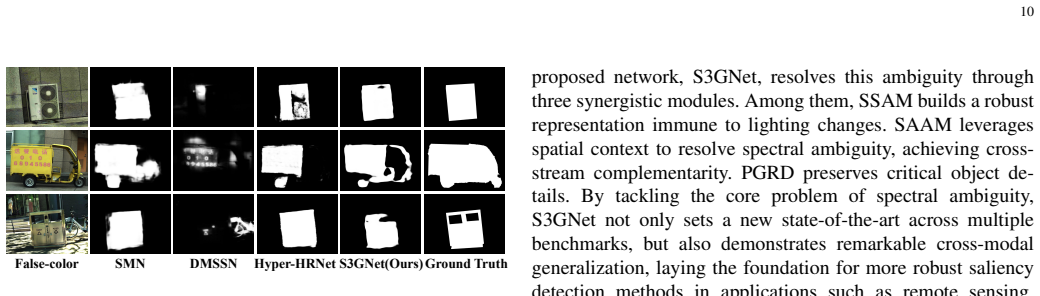
Figures from the paper (5 more)


Reference graph
Works this paper leans on
-
[1]
Cascaded partial decoder for fast and accurate salient object detection,
Z. Wu, L. Su, and Q. Huang, “Cascaded partial decoder for fast and accurate salient object detection,” inProceedings of the IEEE/CVF conference on computer vision and pattern recognition, 2019, pp. 3907– 3916
2019
-
[2]
Multispectral fusion transformer network for rgb-thermal urban scene semantic seg- mentation,
H. Zhou, C. Tian, Z. Zhang, Q. Huo, Y . Xie, and Z. Li, “Multispectral fusion transformer network for rgb-thermal urban scene semantic seg- mentation,”IEEE Geoscience and Remote Sensing Letters, vol. 19, pp. 1–5, 2022
2022
-
[3]
Position- aware relation learning for rgb-thermal salient object detection,
H. Zhou, C. Tian, Z. Zhang, C. Li, Y . Ding, Y . Xie, and Z. Li, “Position- aware relation learning for rgb-thermal salient object detection,”IEEE Transactions on Image Processing, vol. 32, pp. 2593–2607, 2023
2023
-
[4]
Lsnet: Lightweight spatial boosting network for detecting salient objects in rgb-thermal images,
W. Zhou, Y . Zhu, J. Lei, R. Yang, and L. Yu, “Lsnet: Lightweight spatial boosting network for detecting salient objects in rgb-thermal images,” IEEE Transactions on Image Processing, vol. 32, pp. 1329–1340, 2023
2023
-
[5]
Alignment-free rgbt salient object detection: Semantics-guided asymmetric correlation network and a unified benchmark,
K. Wang, D. Lin, C. Li, Z. Tu, and B. Luo, “Alignment-free rgbt salient object detection: Semantics-guided asymmetric correlation network and a unified benchmark,”IEEE Transactions on Multimedia, 2024
2024
-
[6]
Spectrum-driven mixed-frequency network for hyperspectral salient object detection,
P. Liu, T. Xu, H. Chen, S. Zhou, H. Qin, and J. Li, “Spectrum-driven mixed-frequency network for hyperspectral salient object detection,” IEEE Transactions on Multimedia, vol. 26, pp. 5296–5310, 2023
2023
-
[7]
Spectral-wise implicit neural representation for hyperspectral image reconstruction,
H. Chen, W. Zhao, T. Xu, G. Shi, S. Zhou, P. Liu, and J. Li, “Spectral-wise implicit neural representation for hyperspectral image reconstruction,”IEEE Transactions on Circuits and Systems for Video Technology, vol. 34, no. 5, pp. 3714–3727, 2024
2024
-
[8]
Hyperspectral remote sensing images salient object detection: The first benchmark dataset and baseline,
P. Liu, H. Bai, T. Xu, J. Wang, H. Chen, and J. Li, “Hyperspectral remote sensing images salient object detection: The first benchmark dataset and baseline,”IEEE Transactions on Geoscience and Remote Sensing, vol. 63, pp. 1–14, 2025
2025
Show all 54 references
-
[9]
A lightweight fusion strategy with enhanced inter-layer feature correlation for small object detection,
Y . Xiao, T. Xu, X. Yu, Y . Fang, and J. Li, “A lightweight fusion strategy with enhanced inter-layer feature correlation for small object detection,” IEEE Transactions on Geoscience and Remote Sensing, 2024
2024
-
[10]
Perceptive self-supervised learning network for noisy image watermark removal,
C. Tian, M. Zheng, B. Li, Y . Zhang, S. Zhang, and D. Zhang, “Perceptive self-supervised learning network for noisy image watermark removal,” IEEE Transactions on Circuits and Systems for Video Technology, vol. 34, no. 8, pp. 7069–7079, 2024
2024
-
[11]
Spectrum-oriented point-supervised saliency detector for hyperspectral images,
P. Liu, T. Xu, G. Shi, J. Xu, H. Chen, and J. Li, “Spectrum-oriented point-supervised saliency detector for hyperspectral images,”IEEE Transactions on Instrumentation and Measurement, vol. 74, pp. 1–15, 2025
2025
-
[12]
Salient object detection on hyperspectral images in wireless network using cnn and saliency optimization,
C. Huang, T. Xu, Y . Zhang, C. Pan, J. Hao, and X. Li, “Salient object detection on hyperspectral images in wireless network using cnn and saliency optimization,”Ad Hoc Networks, vol. 112, p. 102369, 2021
2021
-
[13]
Hsod-bit-v2: A challenging benchmark for hyperspectral salient object detection,
Y . Qiu, S. Bai, T. Xu, P. Liu, H. Qin, and J. Li, “Hsod-bit-v2: A challenging benchmark for hyperspectral salient object detection,” in Proceedings of the AAAI Conference on Artificial Intelligence, 2025, pp. 6630–6638
2025
-
[14]
Dmssn: Distilled mixed spectral–spatial network for hyperspectral salient object detection,
H. Qin, T. Xu, P. Liu, J. Xu, and J. Li, “Dmssn: Distilled mixed spectral–spatial network for hyperspectral salient object detection,”IEEE Transactions on Geoscience and Remote Sensing, vol. 62, pp. 1–18, 2024
2024
-
[15]
Salient object detection on hyperspectral images using features learned from unsupervised segmentation task,
N. ˙Imamo˘glu, G. Ding, Y . Fang, A. Kanezaki, T. Kouyama, and R. Nakamura, “Salient object detection on hyperspectral images using features learned from unsupervised segmentation task,” inProc. IEEE Int. Conf. Acoust., Speech Signal Process., 2019, pp. 2192–2196
2019
-
[16]
Salient object detection: A discriminative regional feature integration approach,
H. Jiang, J. Wang, Z. Yuan, Y . Wu, N. Zheng, and S. Li, “Salient object detection: A discriminative regional feature integration approach,” in Proceedings of the IEEE conference on computer vision and pattern recognition, 2013, pp. 2083–2090. 11
2013
-
[17]
A simple method for detecting salient regions,
P. L. Rosin, “A simple method for detecting salient regions,”Pattern recognition, vol. 42, no. 11, pp. 2363–2371, 2009
2009
-
[18]
Frequency-tuned salient region detection,
R. Achanta, S. Hemami, F. Estrada, and S. Susstrunk, “Frequency-tuned salient region detection,” in2009 IEEE conference on computer vision and pattern recognition. IEEE, 2009, pp. 1597–1604
2009
-
[19]
Frequency-aware feature aggregation network with dual-task consistency for rgb-t salient object detection,
H. Zhou, C. Tian, Z. Zhang, C. Li, Y . Xie, and Z. Li, “Frequency-aware feature aggregation network with dual-task consistency for rgb-t salient object detection,”Pattern Recognition, vol. 146, p. 110043, 2024
2024
-
[20]
A survey on deep learning fundamentals,
C. Tian, T. Cheng, Z. Peng, W. Zuo, Y . Tian, Q. Zhang, F.-Y . Wang, and D. Zhang, “A survey on deep learning fundamentals,”Artificial Intelligence Review, vol. 58, no. 12, p. 381, 2025
2025
-
[21]
A tree- guided cnn for image super-resolution,
C. Tian, M. Song, X. Fan, X. Zheng, B. Zhang, and D. Zhang, “A tree- guided cnn for image super-resolution,”IEEE Transactions on Consumer Electronics, 2025
2025
-
[22]
Multi-scale interactive network for salient object detection,
Y . Pang, X. Zhao, L. Zhang, and H. Lu, “Multi-scale interactive network for salient object detection,” inProceedings of the IEEE/CVF conference on computer vision and pattern recognition, 2020, pp. 9413–9422
2020
-
[23]
R2net: Residual refinement network for salient object detection,
J. Zhang, Q. Liang, Q. Guo, J. Yang, Q. Zhang, and Y . Shi, “R2net: Residual refinement network for salient object detection,”Image and Vision Computing, vol. 120, p. 104423, 2022
2022
-
[24]
Catnet: A cascaded and aggregated transformer network for rgb-d salient object detection,
F. Sun, P. Ren, B. Yin, F. Wang, and H. Li, “Catnet: A cascaded and aggregated transformer network for rgb-d salient object detection,”IEEE Transactions on Multimedia, vol. 26, pp. 2249–2262, 2023
2023
-
[25]
A model of saliency-based visual at- tention for rapid scene analysis,
L. Itti, C. Koch, and E. Niebur, “A model of saliency-based visual at- tention for rapid scene analysis,”IEEE Transactions on Pattern Analysis and Machine Intelligence, vol. 20, no. 11, pp. 1254–1259, 1998
1998
-
[26]
Salient object detection in hyperspectral imagery,
J. Liang, J. Zhou, X. Bai, and Y . Qian, “Salient object detection in hyperspectral imagery,” in2013 IEEE International Conference on Image Processing, 2013, pp. 2393–2397
2013
-
[27]
Saliency for spectral image analysis,
S. Le Moan, A. Mansouri, J. Y . Hardeberg, and Y . V oisin, “Saliency for spectral image analysis,”IEEE Journal of Selected Topics in Applied Earth Observations and Remote Sensing, vol. 6, no. 6, pp. 2472–2479, 2013
2013
-
[28]
Progressive attention guided recurrent network for salient object detection,
X. Zhang, T. Wang, J. Qi, H. Lu, and G. Wang, “Progressive attention guided recurrent network for salient object detection,” inProceedings of the IEEE conference on computer vision and pattern recognition, 2018, pp. 714–722
2018
-
[29]
Visual saliency transformer,
N. Liu, N. Zhang, K. Wan, L. Shao, and J. Han, “Visual saliency transformer,” inProceedings of the IEEE/CVF international conference on computer vision, 2021, pp. 4722–4732
2021
-
[30]
Heterogeneous window transformer for image denoising,
C. Tian, M. Zheng, C.-W. Lin, Z. Li, and D. Zhang, “Heterogeneous window transformer for image denoising,”IEEE Transactions on Sys- tems, Man, and Cybernetics: Systems, 2024
2024
-
[31]
Bi-directional progressive guidance network for rgb-d salient object detection,
Y . Yang, Q. Qin, Y . Luo, Y . Liu, Q. Zhang, and J. Han, “Bi-directional progressive guidance network for rgb-d salient object detection,”IEEE Transactions on Circuits and Systems for Video Technology, vol. 32, no. 8, pp. 5346–5360, 2022
2022
-
[32]
Derivative analysis of hyperspectral data,
F. Tsai and W. Philpot, “Derivative analysis of hyperspectral data,” Remote sensing of environment, vol. 66, no. 1, pp. 41–51, 1998
1998
-
[33]
Wavelets for computationally efficient hy- perspectral derivative analysis,
L. M. Bruce and J. Li, “Wavelets for computationally efficient hy- perspectral derivative analysis,”IEEE Transactions on Geoscience and Remote Sensing, vol. 39, no. 7, pp. 1540–1546, 2001
2001
-
[34]
Slic superpixels compared to state-of-the-art superpixel methods,
R. Achanta, A. Shaji, K. Smith, A. Lucchi, P. Fua, and S. S ¨usstrunk, “Slic superpixels compared to state-of-the-art superpixel methods,”IEEE transactions on pattern analysis and machine intelligence, vol. 34, no. 11, pp. 2274–2282, 2012
2012
-
[35]
Hyperspectral band selection via optimal neighborhood reconstruction,
Q. Wang, F. Zhang, and X. Li, “Hyperspectral band selection via optimal neighborhood reconstruction,”IEEE Transactions on Geoscience and Remote Sensing, vol. 58, no. 12, pp. 8465–8476, 2020
2020
-
[36]
Coordinate attention for efficient mobile network design,
Q. Hou, D. Zhou, and J. Feng, “Coordinate attention for efficient mobile network design,” inProceedings of the IEEE/CVF conference on computer vision and pattern recognition, 2021, pp. 13 713–13 722
2021
-
[37]
Basnet: Boundary-aware salient object detection,
X. Qin, Z. Zhang, C. Huang, C. Gao, M. Dehghan, and M. Jagersand, “Basnet: Boundary-aware salient object detection,” inProceedings of the IEEE/CVF conference on computer vision and pattern recognition, 2019, pp. 7479–7489
2019
-
[38]
U2-net: Going deeper with nested u-structure for salient object detection,
X. Qin, Z. Zhang, C. Huang, M. Dehghan, O. R. Zaiane, and M. Jager- sand, “U2-net: Going deeper with nested u-structure for salient object detection,”Pattern recognition, vol. 106, p. 107404, 2020
2020
-
[39]
Salient object detection via integrity learning,
M. Zhuge, D.-P. Fan, N. Liu, D. Zhang, D. Xu, and L. Shao, “Salient object detection via integrity learning,”IEEE Transactions on Pattern Analysis and Machine Intelligence, vol. 45, no. 3, pp. 3738–3752, 2022
2022
-
[40]
Multi-scale and detail-enhanced segment anything model for salient object detection,
S. Gao, P. Zhang, T. Yan, and H. Lu, “Multi-scale and detail-enhanced segment anything model for salient object detection,” 2024. [Online]. Available: https://arxiv.org/abs/2408.04326
2024 arXiv
-
[41]
Towards a complete and detail-preserved salient object detection,
Y . K. Yun and W. Lin, “Towards a complete and detail-preserved salient object detection,”IEEE Transactions on Multimedia, vol. 26, pp. 4667– 4680, 2024
2024
-
[42]
Admnet: Attention-guided densely multi-scale network for lightweight salient object detection,
X. Zhou, K. Shen, and Z. Liu, “Admnet: Attention-guided densely multi-scale network for lightweight salient object detection,”IEEE Transactions on Multimedia, vol. 26, pp. 10 828–10 841, 2024
2024
-
[43]
Rapid salient object detection with difference convo- lutional neural networks,
Z. Su, L. Liu, M. M ¨uller, J. Zhang, D. Wofk, M.-M. Cheng, and M. Pietik ¨ainen, “Rapid salient object detection with difference convo- lutional neural networks,”IEEE Transactions on Pattern Analysis and Machine Intelligence, vol. 47, no. 10, pp. 9061–9077, 2025
2025
-
[44]
Generative transformer for accurate and reliable salient object detection,
Y . Mao, J. Zhang, Z. Wan, X. Tian, A. Li, Y . Lv, and Y . Dai, “Generative transformer for accurate and reliable salient object detection,”IEEE Transactions on Circuits and Systems for Video Technology, vol. 35, no. 2, pp. 1041–1054, 2025
2025
-
[45]
Hyperspectral image dataset for benchmarking on salient object detection,
N. Imamoglu, Y . Oishi, X. Zhang, G. Ding, Y . Fang, T. Kouyama, and R. Nakamura, “Hyperspectral image dataset for benchmarking on salient object detection,” in2018 Tenth international conference on quality of multimedia experience (qoMEX). IEEE, 2018, pp. 1–3
2018
-
[46]
Delving into cal- ibrated depth for accurate rgb-d salient object detection,
J. Li, W. Ji, M. Zhang, Y . Piao, H. Lu, and L. Cheng, “Delving into cal- ibrated depth for accurate rgb-d salient object detection,”International Journal of Computer Vision, vol. 131, no. 4, pp. 855–876, 2023
2023
-
[47]
Adam: A method for stochastic optimization,
D. P. Kingma and J. Ba, “Adam: A method for stochastic optimization,” arXiv preprint arXiv:1412.6980, 2014
2014 arXiv
-
[48]
Rgb-t saliency detection benchmark: Dataset, baselines, analysis and a novel approach,
G. Wang, C. Li, Y . Ma, A. Zheng, J. Tang, and B. Luo, “Rgb-t saliency detection benchmark: Dataset, baselines, analysis and a novel approach,” inProc. 13th Image Graph. Technol. Appl., 2018, pp. 359–369
2018
-
[49]
Weakly alignment-free rgbt salient object detection with deep correlation network,
Z. Tu, Z. Li, C. Li, and J. Tang, “Weakly alignment-free rgbt salient object detection with deep correlation network,”IEEE Transactions on Image Processing, vol. 31, pp. 3752–3764, 2022
2022
-
[50]
Caver: Cross-modal view- mixed transformer for bi-modal salient object detection,
Y . Pang, X. Zhao, L. Zhang, and H. Lu, “Caver: Cross-modal view- mixed transformer for bi-modal salient object detection,”IEEE Trans- actions on Image Processing, vol. 32, pp. 892–904, 2023
2023
-
[51]
Learning adaptive fusion bank for multi-modal salient object detection,
K. Wang, Z. Tu, C. Li, C. Zhang, and B. Luo, “Learning adaptive fusion bank for multi-modal salient object detection,”IEEE Transactions on Circuits and Systems for Video Technology, vol. 34, no. 8, pp. 7344– 7358, 2024
2024
-
[52]
Cbam: Convolutional block attention module,
S. Woo, J. Park, J.-Y . Lee, and I. S. Kweon, “Cbam: Convolutional block attention module,” inProceedings of the European conference on computer vision (ECCV), 2018, pp. 3–19
2018
-
[53]
Does thermal really always matter for rgb-t salient object detection?
R. Cong, K. Zhang, C. Zhang, F. Zheng, Y . Zhao, Q. Huang, and S. Kwong, “Does thermal really always matter for rgb-t salient object detection?”IEEE Transactions on Multimedia, vol. 25, pp. 6971–6982, 2022. Yanyan Pengreceived the B.S. degree from the School of Physics, Northe...
2022
-
[2025]
degree in control science and engineering with the Col- lege of Control Science and Engineering, Zhejiang University, Hangzhou, China
He is currently pursuing the Ph.D. degree in control science and engineering with the Col- lege of Control Science and Engineering, Zhejiang University, Hangzhou, China. His research interests include object detection and related computer vision problems. Peifu Liureceived his...
2021
Reviewed August 1, 2026 · model on record in the stance chip above.
Discussion (0). Continue with ORCID to comment.