REVIEW 2 major objections 6 minor 69 references
A One-Dimensional Integral Equation for a Porous Horizontal Disc under Water Waves
T0 review · 2 major / 6 minor · reviewed 2026-08-01 · deepseek-v4-flash
Pith's one-line read A one-dimensional Fredholm integral equation captures the heave hydrodynamics of a submerged porous circular disc, with porosity encoded in logarithmic kernels.
desk verdict A real, incremental advance: the 1-D reduction for a porous heave plate checks out; the main weaknesses are a hand-waved derivation sketch and an abstract/conclusion contradiction, not the kernels. read the letter →
The pith
A machine-rendered reading of the paper's core claim, the machinery that carries it, and where it could break.
The reading
What carries the argument
The central object is the one-dimensional equation (21) for the heave mode: ψ(x) + ∫₀¹ ψ(y)K(x,y)dy + ∫₀ˣ ψ(y)I(x,y)dy + ∫ₓ¹ ψ(y)R(x,y)dy = x, for 0 ≤ x ≤ 1. Here K contains the free-surface kernel N0 built from the wave Green function, plus a term (4iKG/π)ln(|x|+|y|); I and R carry the porous contribution through log(x²−y²) and log(y²−x²). The derivation uses a Fourier expansion of the disc's angular coordinates, an integral identity for the potential-jump density borrowed from crack problems, and an auxiliary function ψ that is smoother than the jump density. When the wavenumber K vanishes, the equation reduces to the classical integral equation for two coaxial circular plates.
What would settle it
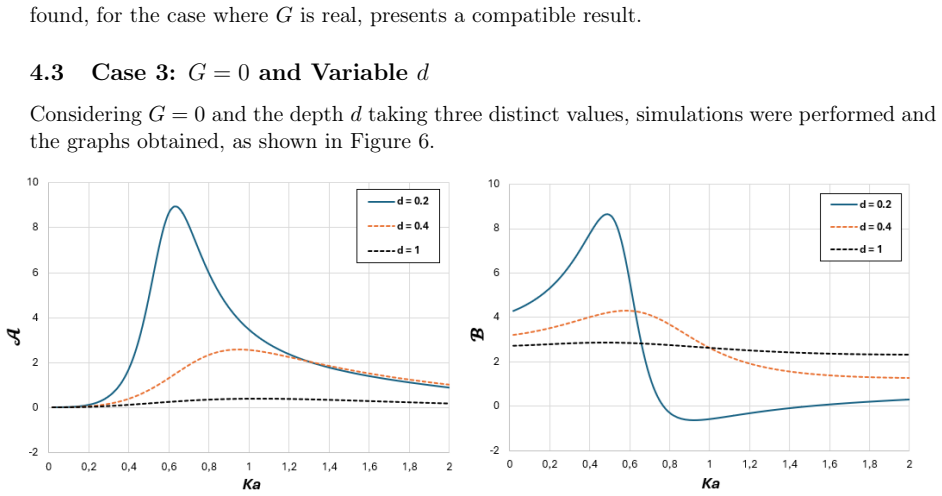
Compare the 1-D solution for d=0.1, G=0.1i against a direct high-resolution discretisation of the original hypersingular equation (6) over the disc, computing added mass and damping at the resonance peak; a deviation larger than the reported RMSE (~0.3) would show the logarithmic kernels miss part of the porous coupling. A more expensive but decisive check is a wave-tank experiment on a disc with independently calibrated G.
Extended reading notes
Core claim
For vertical heave of a thin, porous circular disc under a free surface, the full three-dimensional hypersingular boundary integral equation for the velocity-potential jump reduces to a one-dimensional second-kind Fredholm equation, equation (21), in which the porous boundary condition appears as three logarithmic kernel terms. Solving this single equation with a piecewise-constant collocation scheme produces added mass and damping coefficients that match published computations for real, imaginary, and complex porosity parameters over a range of submergence depths (reported RMSE ≈ 0.05–0.3). The reduction works mode-by-mode in principle; the heave mode n = 0 is worked out in detail, and the
Load-bearing premise
The reduction assumes Darcy-type linear porous flow with a single constant complex impedance G across the whole disc; if real porous plates have nonlinear or spatially varying flow resistance, the 1-D equation and its quantitative predictions do not apply.
Editorial extensions
If this is right
- Solving equation (21) gives added mass and damping coefficients for heave of a porous disc without meshing the disc's surface, provided the porosity parameter G and submergence depth are known.
- As the real part of G grows, the disc approaches rigid-plate behavior: added mass and damping decrease toward the G→∞ limit, consistent with reduced fluid penetration.
- As the imaginary part of G grows, inertial-dominant porosity produces pronounced resonance peaks in added mass and damping when the disc is near the free surface, as shown in the reported curves.
- In the zero-wavenumber limit, the 1-D equation reduces to a Love-Lieb-type integral equation for two coaxial discs, linking the hydrodynamics to a classical potential-theory problem.
Reading between the lines
- The iKG log-kernel structure cleanly separates porosity from geometry, so perturbative expansions for small or large G could yield closed-form approximations for added mass—something the paper does not derive.
- The same reduction should extend to annular or multi-ring porous plates, where axial symmetry is preserved and the log-kernel structure would remain unchanged after adjusting the kernel's domain.
- The resonant peaks in the inertial-porosity regime (imaginary G) are the most sensitive test: a high-resolution direct BEM or wave-tank experiment there would confirm or refute the linear-Darcy assumption more decisively than the reported aggregate error metrics.
Editorial analysis
A structured set of objections, weighed in public.
Referee Report
Summary. The manuscript proposes a one-dimensional second-kind Fredholm integral equation for the vertical-heave radiation problem of a thin horizontal porous disk in deep water. Starting from a hypersingular boundary integral equation with the Darcy-type porous condition (4), it follows the axisymmetric Fourier reduction of Farina & Martin (1997) and claims that the problem reduces to Eq. (21) with logarithmic kernels (22)--(24). The resulting boundary-element solution is used to compute added mass and damping coefficients for several values of porosity parameter G and submergence depth d, validated against De Freitas et al. (2021) via graphical comparisons and RMSE/MAE tables. A K=0 limit is connected to the Love-Lieb equation family.
Significance. The claimed reduction is potentially significant: it would turn a 3D hypersingular problem into a numerically cheap 1D equation, extending known reductions for rigid disks to porous boundary conditions and providing a testbed for porous wave-energy and heave-plate models. The explicit logarithmic kernel structure is plausible, and the paper provides a convergence study (Tables 1--2) and quantitative error summaries. However, the central derivation is not exhibited, and a direct check of Eq. (19) suggests that the printed kernels (23)--(24) are inconsistent with the double-integral term; the numerical validation is therefore not yet convincing evidence. The contribution is conditional on resolving this algebraic step.
major comments (2)
- [§2.2, Eq. (19) to Eqs. (21)–(24)] The central reduction is asserted rather than derived. For n=0, Eq. (19) gives z0(x) = (4/π)iKG ∫₀ˣ s/(√(x²−s²)) [∫ₛ¹ ψ(y)/(√(y²−s²)) dy] ds. Interchanging the order of integration produces kernels proportional to ln((x+y)/(x−y)) for y<x and ln((y+x)/(y−x)) for y>x, not the ln(x²−y²) and ln(y²−x²) displayed in (23)–(24). Because all numerical results and the validation against De Freitas et al. (2021) depend on (21), this is a load-bearing gap. Please provide the full derivation, or correct the kernels and recompute the results.
- [§4, Tables 3–4; §2.2] The validation is entirely against De Freitas et al. (2021), a benchmark sharing an author with the present manuscript. The RMSE/MAE values (0.05–0.3) are reported without explaining how the graphical data were digitized or sampled. More importantly, even good agreement with a benchmark would not resolve the analytical issue above: if (23)–(24) contain typos, the comparison may reflect code that differs from the printed equation. The paper should provide the complete derivation of (21), or an independent check against the full 3D hypersingular equation for at least one case.
minor comments (6)
- [References] The entry “Guidera, J. T. Lardner, R. W. (1975)” should be formatted as two authors, e.g., “Guidera, J. T. & Lardner, R. W. (1975).”
- [References] The Newman (1977) entry gives inconsistent bibliographic data: “Springer Briefs in Mathematics” conflicts with “The MIT Press.” Please correct.
- [Conclusion] The final paragraph cites “Farina & Martin (1998)” for the methodology, whereas the derivation section cites Farina & Martin (1997). Please harmonize the citation.
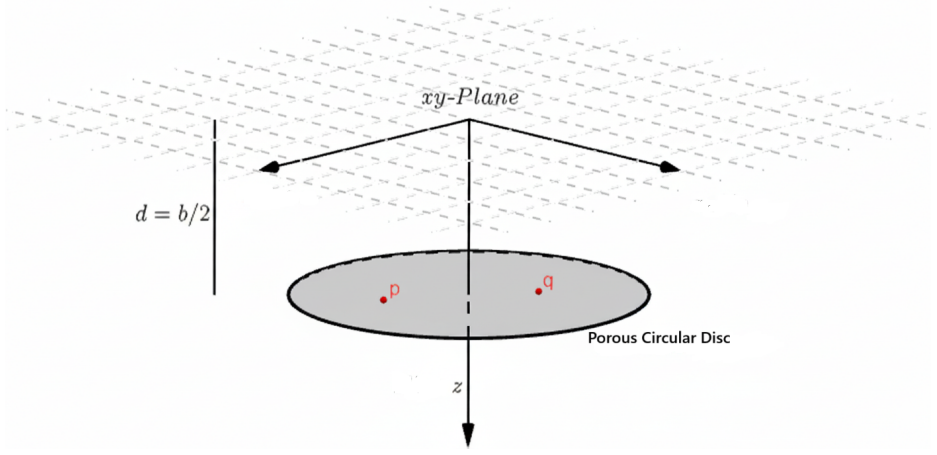
- [Notation, Eq. (1) vs Eq. (25)] The plate thickness is ar b in Eq. (1), while b is later used to denote 2d in Eqs. (25)–(28). This notational overlap is confusing; consider renaming one of them.
- [§2.3, Eq. (28)] The text calls Eq. (28) a “natural generalization” of the Love-Lieb equations, but it is the K=0 limit of Eq. (21) and is a special case rather than a generalization. This wording should be softened.
- [Tables 3–4] Please state the number of sample points and the method used to extract the benchmark curves; otherwise the RMSE/MAE values are not reproducible.
Circularity Check
No circular reduction found: the numerical results are computed, not fitted; the main caveat is an underived reduction step and in-family benchmarks, not circularity.
full rationale
Walking the derivation chain, the central claim is that the 3-D hypersingular BIE reduces to the 1-D equation (21). This reduction is asserted rather than fully exhibited: §2.2 states that 'Under the assumption of purely vertical (heave) oscillations, equation (18) reduces to' (21), and the log-kernels (22)-(24) are introduced without showing their algebraic derivation from (19)-(20). That is an omitted proof, and the skeptic's concern about whether (23)-(24) actually follow from (19) is a correctness risk. However, an omitted proof is not circularity under the given rules: the paper does not define the output in terms of the input, nor does it fit parameters to the benchmark. The coefficients A and B are computed from the solution of (21) via (34), and the validation against De Freitas et al. (2021) reports RMSE/MAE values without using those benchmark values as inputs to the calculation. The paper does lean on work co-authored by Farina: Farina & Martin (1997) supplies the reduction framework, and De Freitas et al. (2021) supplies the comparison data. This makes the validation in-family and weakens external independence, but the numerical results are still obtained from the stated equations rather than being reverse-engineered from the benchmark. The Love-Lieb comparison in Section 2.3 is presented as a resemblance/consistency check, not as a load-bearing derivation. The porous boundary condition (4) is an externally sourced linear Darcy-type law, not derived from this paper's own outputs. Overall there is no circular step in the sense of 'prediction equivalent to input by construction'; the score reflects only the self-citation-heavy validation context and the unproved critical reduction step, which are correctness and provenance concerns, not circularity.
Assumptions & free parameters
free parameters (3)
- porosity parameter G (complex) =
0.1, 1, 0.7+0.3i, and imaginary values in {0.1i, ...} (cases in Section 4)
- submergence depth d = b/2 =
0.1, 0.2, and other values in Section 4; d=10 excluded
- discretization n (BEM) =
80 (converged)
assumptions (6)
- domain assumption Linear small-amplitude water-wave theory with velocity potential φ and linearized free-surface condition (3).
- domain assumption Porous boundary condition (4): ∂φ/∂n = V + iKG[φ], i.e., the normal velocity jump is proportional to the potential jump.
- standard math Radiation condition (5) selects the outgoing wave.
- standard math Green's function G in (7)-(8) with the contour integral representation is correct and the hypersingular equation (6) follows.
- standard math Guidera-Lardner integral identity (10) relating w_n and f_n.
- standard math Yu & Ursell expansion (26) for Φ0 converges and is accurate for the parameter range.
Cite this review
Pith. "Pith review of A One-Dimensional Integral Equation for a Porous Horizontal Disc under Water Waves." pith.science (2026). https://pith.science/paper/KK2SS2V6
@misc{pith2026260721102,
  author       = {Pith},
  title        = {Pith review of: A One-Dimensional Integral Equation for a Porous Horizontal Disc under Water Waves},
  year         = {2026},
  howpublished = {\url{https://pith.science/paper/KK2SS2V6}},
  note         = {Machine review of arXiv:2607.21102}
}
read the original abstract
Wave scattering by a thin, porous circular plate submerged in deep water is investigated. The problem is formulated as a second-kind hypersingular Fredholm integral equation over the unit disk, solved numerically using the Boundary Element Method. The analysis focuses on calculating hydrodynamic forces, specifically added mass (real part) and damping coefficient (imaginary part). Results demonstrate the influence of the porosity parameter G: less porous plates (G real) increase added mass and hydrodynamic force, while more porous plates (G imaginary) reduce these effects but increase the damping coefficient. The proposed formulation is validated, showing excellent agreement with established literature.
Figures


Figures from the paper (5 more)




Reference graph
Works this paper leans on
-
[1]
SIAM Journal on Scientific Computing , volume=
Evaluation of single layer potentials over curved surfaces , author=. SIAM Journal on Scientific Computing , volume=. 2001 , publisher=
2001
-
[2]
International Series on Advances in Fluid Mechanics , volume=
Interaction of water waves with thin plates , author=. International Series on Advances in Fluid Mechanics , volume=. 1997 , publisher=
1997
-
[3]
Chwang, A. T. and Wu, J. , TITLE =. Journal of Engineering Mechanics , volume=
-
[4]
Applied Ocean Research , volume=
Scattering of Water Waves by a Submerged Disc Using a Hipersingular Integral Equation , author=. Applied Ocean Research , volume=
-
[5]
Applied Ocean Research , volume=
Linear free-surface effects on a horizontally submerged and perforated 2D thin plate in finite and infinite water depths , author=. Applied Ocean Research , volume=
-
[6]
Ocean Engineering , volume=
An investigation of the effects of wind-induced inclination on floating wind turbine dynamics: heave plate excursion , author=. Ocean Engineering , volume=
-
[7]
Renewable and Sustainable Energy Reviews , volume=
The economics of wave energy: A review , author=. Renewable and Sustainable Energy Reviews , volume=
-
[8]
Journal of Fluid Mechanics , volume=
A porous-wavemaker theory , author=. Journal of Fluid Mechanics , volume=
Show all 69 references
-
[9]
Ocean Engineering , volume=
The heaving motion of a porous disc submerged in deep water , author=. Ocean Engineering , volume=
-
[10]
Journal of Fluid Mechanics , volume=
Radiation of water waves by a heaving submerged horizontal disc , author=. Journal of Fluid Mechanics , volume=
-
[11]
Journal of Marine Science and Application , volume=
Wave analysis of porous geometry with linear resistance law , author=. Journal of Marine Science and Application , volume=
-
[12]
Journal of Engineering Mechanics , volume=
Asymptotic reflection of linear water waves by submerged horizontal porous plates , author=. Journal of Engineering Mechanics , volume=
-
[13]
2002 , publisher=
Ocean Waves and Oscillating Systems: Linear Interactions Including Wave-Energy Extraction , author=. 2002 , publisher=
2002
-
[14]
Applied Ocean Research , volume=
A hypersingular integral equation approach to the porous plate problem , author=. Applied Ocean Research , volume=
-
[15]
Ocean Engineering , volume=
Water wave interaction with two symmetric inclined permeable plates , author=. Ocean Engineering , volume=
-
[16]
Ocean Engineering , volume=
A review of very large floating structures (VLFS) for coastal and offshore uses , author=. Ocean Engineering , volume=
-
[17]
Renewable Energy , volume=
Hydrodynamic coefficients and pressure loads on heave plates for semi-submersible floating offshore wind turbines: a comparative analysis using large scale models , author=. Renewable Energy , volume=
-
[18]
Coastal Engineering Proceedings , volume=
Wave transmission through permeable breakwaters , author=. Coastal Engineering Proceedings , volume=
-
[19]
Journal of Engineering Mechanics , volume=
Short-wave and wave group scattering by submerged porous plate , author=. Journal of Engineering Mechanics , volume=
-
[20]
European Journal of Mechanics/B Fluids , volume=
Fredholm integral equation technique for hydroelastic analysis of a floating flexible porous plate , author=. European Journal of Mechanics/B Fluids , volume=
-
[21]
Applied Ocean Research , volume=
A new approximate analytic solution for water wave scattering by a submerged horizontal porous disk , author=. Applied Ocean Research , volume=
-
[22]
Proceedings of the 19th International Workshop on Water Waves and Floating Bodies , year=
Heave added mass and damping of a perforated disk below the free surface , author=. Proceedings of the 19th International Workshop on Water Waves and Floating Bodies , year=
-
[23]
Presented at 34th International Workshop on Water Waves and Floating Bodies , year=
On wave diffraction-radiation by bodies with porous thin plates , author=. Presented at 34th International Workshop on Water Waves and Floating Bodies , year=
-
[24]
Advances in Renewable Energies Offshore - Proceedings of the 3rd International Conference on Renewable Energies Offshore , pages=
Verification of a Boundary Element Model for Wave Forces on Structures with Porous Elements , author=. Advances in Renewable Energies Offshore - Proceedings of the 3rd International Conference on Renewable Energies Offshore , pages=
-
[25]
2018 , publisher=
Theory and Applications of Ocean Surface Waves: (in 2 Volumes) , author=. 2018 , publisher=
2018
-
[26]
Proceedings of the Royal Society of London
Fluid flow in regions bounded by porous surfaces , author=. Proceedings of the Royal Society of London. Series A. Mathematical and Physical Sciences , volume=
-
[27]
Coastal Engineering Journal , volume=
Porous effect parameter of thin permeable plates , author=. Coastal Engineering Journal , volume=
-
[28]
Newman, J. N. , title =. 1977 , isbn =
1977
-
[29]
Annual Review of Fluid Mechanics , volume =
Wehausen, J V , title =. Annual Review of Fluid Mechanics , volume =. 1971 , doi =
1971
-
[30]
Radiation of water waves by a submerged nearly circular plate , journal =
Leandro Farina and Rômulo L. Radiation of water waves by a submerged nearly circular plate , journal =. 2017 , note =. doi:https://doi.org/10.1016/j.cam.2016.04.009 , url =
2017 doi
-
[31]
2014 , issn =
Hypersingular integral equations over a disc: Convergence of a spectral method and connection with Tranter’s method , journal =. 2014 , issn =. doi:https://doi.org/10.1016/j.cam.2014.03.014 , url =
2014 doi
-
[33]
Gradshteyn, I. S. and Ryzhik, I. M. , title =
-
[34]
Mixed Boundary Value Problems in Potential Theory , author=
-
[35]
Journal of Elasticity , volume=
Penny-shaped cracks , author=. Journal of Elasticity , volume=. 1975 , doi =
1975
-
[36]
Martin, P. A. and Wickham, G. R. and Ursell, Fritz Joseph , title =. Proceedings of the Royal Society of London. A. Mathematical and Physical Sciences , volume =. 1983 , doi =
1983
-
[37]
Yu, Y. S. and Ursell, F. , year=. Surface waves generated by an oscillating circular cylinder on water of finite depth: theory and experiment , volume=. Journal of Fluid Mechanics , publisher=. doi:10.1017/S0022112061000718 , number=
-
[38]
Ocean Waves and Oscillating Systems: Linear Interactions Including Wave-Energy Extraction , DOI=
Falnes, Johannes , year=. Ocean Waves and Oscillating Systems: Linear Interactions Including Wave-Energy Extraction , DOI=
-
[39]
Journal of Waterway, Port, Coastal, and Ocean Engineering , author=
Wave-induced oscillation in harbor with porous breakwaters , volume=. Journal of Waterway, Port, Coastal, and Ocean Engineering , author=. 1994 , pages=
1994
-
[40]
Journal of Waterway, Port, Coastal, and Ocean Engineering , author=
Diffraction of water waves by porous breakwaters , volume=. Journal of Waterway, Port, Coastal, and Ocean Engineering , author=. 1995 , pages=
1995
-
[41]
Journal of Engineering Mechanics , author=
Water waves above submerged porous plate , volume=. Journal of Engineering Mechanics , author=. 1994 , pages=
1994
-
[42]
Gama, R. L. , title =
-
[43]
Stoker, J. J. , year=. Water Waves: The Mathematical Theory with Applications , publisher=
-
[44]
Japão Real , title =
-
[45]
Ziebell, J. S. , title =
-
[46]
and Poltavskii, L.N
Lifanov, I.K. and Poltavskii, L.N. and Vainikko, M.M. , year=. Hypersingular Integral Equations and Their Applications (1st ed.) , publisher=
-
[47]
2017 , note =
Water-wave scattering and energy dissipation by a floating porous elastic plate in three dimensions , journal =. 2017 , note =. doi:https://doi.org/10.1016/j.wavemoti.2016.06.014 , url =
2017 doi
-
[48]
2013 , publisher=
Cálculo - Volume 2 , author=. 2013 , publisher=
2013
-
[49]
1996 , publisher=
Numerical Recipes in Fortran 90 - Second Edition , author=. 1996 , publisher=
1996
-
[50]
The Journal of Chemical Physics , volume =
Conroy, Harold , title = ". The Journal of Chemical Physics , volume =. 2004 , month =. doi:10.1063/1.1701795 , url =
2004 doi
-
[51]
and Morozova, E.A
Demidov, S.S. and Morozova, E.A. and Chubarikov, Vladimir and Rebrov, I.Yu and Balaba, Irina and Dobrovol'Skii, N.N. and Dobrovol'Skii, N.M. and Dobrovol'Skaya, L.P. and Rodionov, A.V. and Pikhtil'Kova, O.A. , year =. Number-theoretic method in approximate analysis , volume =....
-
[52]
doi:10.1017/S0022112095000395 , author=
Trapping of water waves by submerged plates using hypersingular integral equations , journal=. doi:10.1017/S0022112095000395 , author=
-
[53]
Bentler , journal =
Kai-Tai Fang and Yuan Wang and Peter M. Bentler , journal =. Some Applications of Number-Theoretic Methods in Statistics , urldate =
-
[54]
2011 , publisher=
Iniciação à Física Matemática , author=. 2011 , publisher=
2011
-
[55]
2022 , issn =
Radiation of water waves by a heaving submerged disc in a three-layer fluid , journal =. 2022 , issn =. doi:https://doi.org/10.1016/j.jfluidstructs.2022.103575 , url =
2022
-
[56]
Scattering and radiation of water waves by a submerged rigid disc in a two-layer fluid , volume =
Islam, Najnin and Kundu, Souvik and Gayen, Rupanwita , year =. Scattering and radiation of water waves by a submerged rigid disc in a two-layer fluid , volume =. Proceedings of The Royal Society A Mathematical Physical and Engineering Sciences , doi =
-
[57]
2003 , publisher=
Lectures on Cauchy's Problem in Linear Partial Differential Equations , author=. 2003 , publisher=
2003
-
[58]
Farina, Leandro and Lang, Guillaume and Martin, PA , journal=. Love--. 2022 , publisher=
2022
-
[59]
doi:https://doi.org/10.1016/0141-1187(94)90024-8 , url =
Scattering of water waves by submerged curved plates and by surface-piercing flat plates , journal =. doi:https://doi.org/10.1016/0141-1187(94)90024-8 , url =
-
[60]
, title =
Yu, Xiping and Chwang, Allen T. , title =. 1994 , journal =. doi:10.1061/(ASCE)0733-9399(1994)120:6(1270) , type =
1994 doi
-
[61]
Ziebell and Leandro Farina , keywords =
Juliana S. Ziebell and Leandro Farina , keywords =. Water wave radiation by a submerged rough disc , journal =. 2012 , issn =. doi:https://doi.org/10.1016/j.wavemoti.2011.07.001 , url =
2012 doi
-
[62]
Brasil Escola , title =
-
[63]
Physics of Fluids , volume =
Farina, Leandro , title =. Physics of Fluids , volume =. 2010 , month =
2010
-
[64]
and Miller, David , title =
Abramowitz, Milton and Stegun, Irene A. and Miller, David , title =. Journal of Applied Mechanics , volume =. 1965 , month =. doi:10.1115/1.3625776 , url =
1965 doi
-
[65]
GETEC , volume =
Carmo, Carlos Roberto Souza and Silva, Jéssica Rayse de Melo , title =. GETEC , volume =. 2023 , page =
2023
-
[66]
, year =
Das, Arijit and De, Soumen and Mandal, B. , year =. Radiation and scattering of flexural-gravity waves by a submerged porous disc , volume =. Meccanica , doi =
-
[67]
Journal of Fluid Mechanics , author=
Wave forces on a circular dock , volume=. Journal of Fluid Mechanics , author=. 1971 , pages=. doi:10.1017/S0022112071000430 , number=
1971 doi
-
[68]
doi:https://doi.org/10.1016/0141-1187(92)90035-I , url =
Scattering of water waves by submerged plates using hypersingular integral equations , journal =. doi:https://doi.org/10.1016/0141-1187(92)90035-I , url =
-
[69]
n.d , note =
D01GCF: One-Dimensional Quadrature (General-Purpose Integrator) , author =. n.d , note =
-
[70]
2012 , publisher=
Ondas Oceânicas de Superfície , author=. 2012 , publisher=
2012
Reviewed August 1, 2026 · model on record in the stance chip above.
Discussion (0). Continue with ORCID to comment.