REVIEW 3 major objections 3 minor 209 references
Mixed-Binary Quadratic Programming via QUBO Sampling without Continuous-Variable Binarization
T0 review · 3 major / 3 minor · reviewed 2026-08-01 · deepseek-v4-flash
Pith's one-line read A finite-temperature QUBO formulation that integrates out continuous variables analytically, rather than binarizing them, can solve a separable class of mixed-binary quadratic programs without discretization.
desk verdict Clever finite-temperature QUBO reformulation for separable MBQPs, but the abstract's central construction likely fails when a continuous variable couples to three or more binaries — needs a stated restriction or approximation. read the letter →
The pith
A machine-rendered reading of the paper's core claim, the machinery that carries it, and where it could break.
The reading
What carries the argument
The central mechanism is the finite-temperature formulation in which the continuous sector is integrated out at fixed Lagrange multipliers, reducing the mixed-binary problem to a QUBO over the original binary variables with multipliers updated in the outer loop. The analytic integration requires the continuous part of the objective and constraints to factorize into independent one-dimensional (or Gaussian-type) integrals—the 'separable class' condition—and this is what carries the dimension reduction.
What would settle it
Run the method on a mixed-binary quadratic program whose continuous variables appear in products with each other (violating separability) and show there is no closed-form integration, forcing binarization again; or, within the separable class, find an instance where the reported feasibility and time-to-target advantages over penalty QUBO and a commercial MIQP solver reverse at a moderate size.
Extended reading notes
Core claim
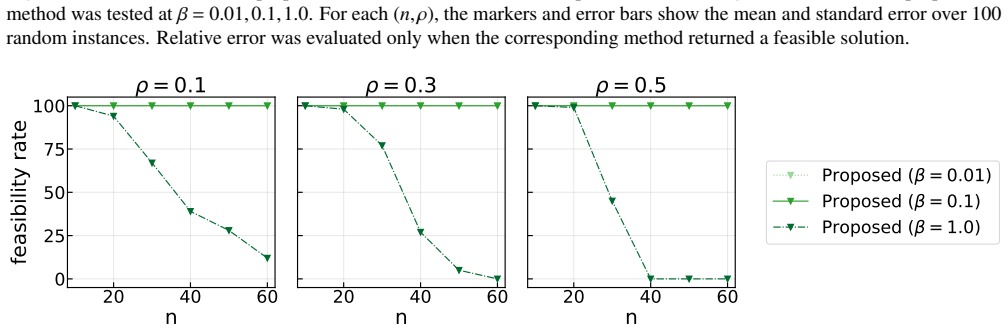
For a separable class of MBQPs, the continuous variables can be integrated out analytically at fixed Lagrange multipliers, so they appear only in the multiplier update and the binary part remains an exact QUBO over the original variables. The paper argues this avoids the dimension blowup and feasibility degradation caused by binarizing continuous variables, and backs it with numerical evidence on the quadratic p-median relaxation: feasible solutions more reliable than a penalty-based QUBO, relative error comparable to or better than local search, and faster time-to-target than a commercial solver at larger sizes.
Load-bearing premise
The continuous variables' contribution must factorize into independent one-dimensional or Gaussian integrals at fixed multipliers, so the method only applies to a separable class of MBQPs; if the continuous block couples variables, the analytic integration and all downstream claims collapse.
Editorial extensions
If this is right
- QUBO samplers (quantum annealing, simulated annealing) can attack separable MBQPs without inflating the binary variable count.
- Feasible solutions become easier to reach than with penalty-based QUBO conversions, since continuous feasibility is handled analytically rather than by penalty-weight tuning.
- Solution quality, measured by conditional relative error, is comparable to or better than local search on the tested p-median instances, especially as problem size grows.
- Time-to-target can beat a commercial MIQP solver for the larger instances tested, suggesting the method scales better in practice at the upper end.
- The method supplies a template for other mixed-integer problems whose continuous blocks are separable at fixed multipliers.
Reading between the lines
- The separable condition is the real boundary: any problem whose continuous variables couple in the objective or constraints cannot use this integration and would need a change of variables or a hybrid scheme, which the paper does not address.
- The role of the inverse temperature β is under-specified; a principled schedule or adaptive rule for β could be a direct extension and would determine how robust the feasibility gains are across problem classes.
- The approach could plausibly combine with other QUBO-based constraint-handling tools (e.g., disciplined convex QUBO conversion) to cover broader mixed-integer classes, with the same integration trick applied per separable block.
- The p-median test case suggests facility-location problems, where continuous demand allocations are standard, are a natural first application; other logistics or network-design MBQPs with separable continuous allocation variables could inherit these gains.
Editorial analysis
A structured set of objections, weighed in public.
Referee Report
Summary. The paper proposes a finite-temperature formulation for a separable class of mixed-binary quadratic programs (MBQPs) that avoids discretizing continuous variables. The central claim is that, at fixed Lagrange multipliers, the continuous sector can be integrated out analytically and enters only the multiplier update, leaving a QUBO over the original binary variables. The method is evaluated on the continuous relaxation of the quadratic p-median problem, with reported improvements in feasible-solution reliability over penalty-based QUBO, comparable or better conditional relative error relative to local search, and faster time-to-target than a commercial MIQP solver at the larger tested sizes. The supplied manuscript consists only of the abstract; no derivation, algorithmic details, or experimental statistics are included.
Significance. If the central construction is correct, the paper addresses a real bottleneck: standard QUBO conversions of continuous variables inflate binary dimension and can degrade feasibility. Avoiding discretization while retaining a QUBO at each multiplier step would be a practically valuable and falsifiable contribution, especially since the claims are benchmarked against external methods rather than fit to own data. The main significance hinges on whether the 'integrate out analytically' step genuinely preserves QUBO structure for the intended class of MBQPs; the abstract alone does not establish this.
major comments (3)
- [Abstract, central construction] The statement 'At fixed Lagrange multipliers, the continuous sector is integrated out analytically ... leaving a QUBO over the original binary variables' is not implied by separability of the continuous variables. For a single continuous variable y with fixed-multiplier contribution y(a0 + sum_j a_j x_j), the marginal weight is integral_0^1 exp[-beta y(a0+sum a_j x_j)] dy = (1 - exp[-beta(a0+sum a_j x_j)]) / (beta(a0+sum a_j x_j)). The effective binary Hamiltonian is the negative logarithm of this expression. When three or more binary variables couple to the same y, the multilinear expansion generically contains a third-order term x1 x2 x3, which is not representable as a QUBO on the original binary variables. The abstract must either explicitly restrict the class (e.g., each continuous variable couples to at most two binary variables) or describe an approximation that restores a quadrat
- [Abstract, empirical methodology] The reported comparisons are conditioned on 'an appropriate inverse temperature,' but no selection rule for beta, Lagrange multiplier update schedule, or step-size protocol is provided. Without these, the feasibility and conditional relative error results are not reproducible. Moreover, the empirical statements contain no sample sizes, error bars, or statistical tests, so the strength of the improvements cannot be assessed from the abstract.
- [Abstract, time-to-target comparison] The time-to-target claim ('reaches the target faster than a commercial mixed-integer optimization solver toward the upper end of the tested range') lacks a precise definition of the target, instance sizes, number of runs, hardware/software configuration, and the solver name and version. Because this is one of the three headline empirical claims, the missing experimental detail prevents verification.
minor comments (3)
- [Abstract, terminology] The phrase 'a separable class of MBQPs' is undefined. Please state the exact structural conditions on the objective and constraints, especially the allowed coupling between continuous and binary variables.
- [Abstract, metrics] Define 'conditional relative error' and 'feasible solutions' precisely. For a continuous relaxation, feasibility should specify which constraints are checked and to what tolerance.
- [Abstract, reproducibility] The commercial solver should be named with version, and the quantum annealer or QUBO sampler should be identified with parameters, so readers can reproduce the comparison.
Circularity Check
No demonstrated circularity: the method is benchmarked externally and the abstract's conditional construction is not shown to reduce to its inputs.
full rationale
The abstract's central claim—'At fixed Lagrange multipliers, the continuous sector is integrated out analytically and enters only the multiplier update, leaving a QUBO over the original binary variables'—is a mathematical construction conditioned on 'a separable class of mixed-binary quadratic programs (MBQPs).' No equation in the provided text shows a fitted parameter being renamed as a prediction, no self-citation is invoked as load-bearing evidence, and the reported comparisons are against external baselines: 'penalty-based QUBO formulation,' 'local search,' and 'a commercial mixed-integer optimization solver.' The phrase 'at an appropriate inverse temperature' identifies an unspecified hyperparameter, not a circular reduction; choosing a temperature does not make the feasibility or conditional-relative-error results equal to the input data. The skeptic's concern about possible cubic terms arising from integrating a continuous variable coupled bilinearly to three or more binaries is a substantive correctness or missing-restriction issue, but it is not circularity: it alleges the QUBO claim may fail for some problems, not that the paper derives a result from its own assumed conclusion. From the available manuscript text, no circular step can be quoted and exhibited, so the honest finding is no significant circularity.
Assumptions & free parameters
free parameters (2)
- Inverse temperature β =
not reported in abstract
- Lagrange multiplier update rule (step size / schedule) =
not reported in abstract
assumptions (3)
- domain assumption The MBQP continuous sector is separable (non-interacting continuous variables), so the partition function factorizes into analytically tractable integrals at fixed Lagrange multipliers.
- domain assumption Finite-temperature QUBO sampling with the Lagrange-multiplier update converges to feasible low-energy solutions at some choice of inverse temperature β.
- standard math Standard analytic integration of separable/Gaussian-type continuous sectors is taken as background mathematics.
Cite this review
Pith. "Pith review of Mixed-Binary Quadratic Programming via QUBO Sampling without Continuous-Variable Binarization." pith.science (2026). https://pith.science/paper/DA5WWBRO
@misc{pith2026260721286,
  author       = {Pith},
  title        = {Pith review of: Mixed-Binary Quadratic Programming via QUBO Sampling without Continuous-Variable Binarization},
  year         = {2026},
  howpublished = {\url{https://pith.science/paper/DA5WWBRO}},
  note         = {Machine review of arXiv:2607.21286}
}
abstract
Quantum annealing and related combinatorial optimization methods typically accept quadratic unconstrained binary optimization (QUBO) problems as input, whereas many practical models include constraints and continuous variables. Standard QUBO conversions discretize continuous variables, increasing the binary dimension and often making feasible low-energy states harder to sample. We develop a finite-temperature formulation for a separable class of mixed-binary quadratic programs (MBQPs) that avoids this discretization. At fixed Lagrange multipliers, the continuous sector is integrated out analytically and enters only the multiplier update, leaving a QUBO over the original binary variables. We evaluate the method on the continuous relaxation of the quadratic $p$-median problem. Compared with a penalty-based QUBO formulation, it generates feasible solutions more reliably. At an appropriate inverse temperature, its conditional relative error is comparable to that of local search for small instances and often lower for the larger tested instances. In the time-to-target experiment, it also reaches the target faster than a commercial mixed-integer optimization solver toward the upper end of the tested range.
Figures


Figures from the paper (2 more)

Reference graph
Works this paper leans on
-
[1]
and Vigerske, Stefan and Wiegele, Angelika , title=
Furini, Fabio and Traversi, Emiliano and Belotti, Pietro and Frangioni, Antonio and Gleixner, Ambros and Gould, Nick and Liberti, Leo and Lodi, Andrea and Misener, Ruth and Mittelmann, Hans and Sahinidis, Nikolaos V. and Vigerske, Stefan and Wiegele, Angelika , title=. Mathematical Programming Computation , year=. doi:10.1007/s12532-018-0147-4 , url=
-
[2]
ISIJ International , volume=
Quantum Optimization with Lagrangian Decomposition for Multiple-process Scheduling in Steel Manufacturing , author=. ISIJ International , volume=. 2022 , doi=
2022
-
[3]
S. Kirkpatrick and C. D. Gelatt and M. P. Vecchi , title =. Science , volume =. 1983 , doi =. https://www.science.org/doi/pdf/10.1126/science.220.4598.671 , abstract =
-
[4]
2019 , MONTH = Nov, KEYWORDS =
Bettiol, Enrico , URL =. 2019 , MONTH = Nov, KEYWORDS =
2019
-
[5]
Rubner, Yossi and Tomasi, Carlo and Guibas, Leonidas J. , title=. International Journal of Computer Vision , year=. doi:10.1023/A:1026543900054 , url=
-
[6]
G. E. Hinton and R. R. Salakhutdinov , title =. Science , volume =. 2006 , doi =. https://www.science.org/doi/pdf/10.1126/science.1127647 , abstract =
-
[7]
Johnson and George L
Cynthia Barnhart and Ellis L. Johnson and George L. Nemhauser and Martin W. P. Savelsbergh and Pamela H. Vance , journal =. Branch-and-Price: Column Generation for Solving Huge Integer Programs , urldate =
-
[8]
A survey on image data augmentation for deep learning
Shorten, Connor and Khoshgoftaar, Taghi M. A survey on image data augmentation for deep learning. Journal of Big Data. 2019
2019
Show all 209 references
-
[9]
Quant gans: Deep generation of financial time series
Wiese, Magnus and Knobloch, Robert and Korn, Ralf and Kretschmer, Peter. Quant gans: Deep generation of financial time series. Quantitative Finance. 2020
2020
-
[10]
Data augmentation based stock trend prediction using self-organising map
Zhang, Jiayi and Rong, Wenge and Liang, Qiubin and Sun, Haonan and Xiong, Zhang. Data augmentation based stock trend prediction using self-organising map. International Conference on Neural Information Processing. 2017
2017
-
[11]
Generating Realistic Stock Market Order Streams
Li, Junyi and Wang, Xintong and Lin, Yaoyang and Sinha, Arunesh and Wellman, Michael. Generating Realistic Stock Market Order Streams. Proceedings of the AAAI Conference on Artificial Intelligence. 2020
2020
-
[12]
Enhancing Stock Price Trend Prediction via a Time-Sensitive Data Augmentation Method
Teng, Xiao and Wang, Tuo and Zhang, Xiang and Lan, Long and Luo, Zhigang. Enhancing Stock Price Trend Prediction via a Time-Sensitive Data Augmentation Method. Complexity. 2020
2020
-
[13]
Mitigating overfitting on financial datasets with generative adversarial networks
Pardo, Fernando De Meer and L\'opez, Rafael Cobo. Mitigating overfitting on financial datasets with generative adversarial networks. The Journal of Financial Data Science. 2020
2020
-
[14]
Proceedings of the IEEE/CVF Conference on Computer Vision and Pattern Recognition (CVPR) , month =
Rombach, Robin and Blattmann, Andreas and Lorenz, Dominik and Esser, Patrick and Ommer, Bj\"orn , title =. Proceedings of the IEEE/CVF Conference on Computer Vision and Pattern Recognition (CVPR) , month =. 2022 , pages =
2022
-
[15]
and Welling, Max , biburl =
Kingma, Diederik P. and Welling, Max , biburl =. 2nd International Conference on Learning Representations,. http://arxiv.org/abs/1312.6114v10 , eprintclass =
-
[16]
Ohzeki, Masayuki , title=. Sci. Rep. , year=. doi:10.1038/s41598-020-60022-5 , url=
-
[17]
Calculation of Partition Functions , author =. Phys. Rev. Lett. , volume =. 1959 , month =. doi:10.1103/PhysRevLett.3.77 , url =
1959 doi
-
[18]
Soviet Physics Doklady , year = 1957, month = jul, volume =
On a Method of Calculating Quantum Distribution Functions. Soviet Physics Doklady , year = 1957, month = jul, volume =
1957
-
[19]
2023 , eprint=
Kernel Learning by quantum annealer , author=. 2023 , eprint=
2023
-
[20]
2022 , eprint=
Gaussian-Bernoulli RBMs Without Tears , author=. 2022 , eprint=
2022
-
[21]
Simulated quantum annealing as a simulator of nonequilibrium quantum dynamics , author =. Phys. Rev. A , volume =. 2021 , month =. doi:10.1103/PhysRevA.104.022607 , url =
2021 doi
-
[22]
Mean field analysis of reverse annealing for code-division multiple-access multiuser detection , author =. Phys. Rev. Research , volume =. 2021 , month =. doi:10.1103/PhysRevResearch.3.033006 , url =
2021 doi
-
[23]
Arai ,Shunta and Ohzeki ,Masayuki and Tanaka ,Kazuyuki , title =. J. Phys. Soc. Jpn. , volume =. 2021 , doi =
2021
-
[24]
Sato, Takehito and Ohzeki, Masayuki and Tanaka, Kazuyuki , title=. Sci. Rep. , year=. doi:10.1038/s41598-021-92295-9 , url=
-
[25]
Ohzeki ,Masayuki , title =. J. Phys. Soc. Jpn. , volume =. 2015 , doi =
2015
-
[26]
Quantum annealing in a kinetically constrained system , author =. Phys. Rev. E , volume =. 2005 , month =. doi:10.1103/PhysRevE.72.026701 , url =
2005 doi
-
[27]
Journal of Computational and Theoretical Nanoscience , volume=
Quantum annealing: An introduction and new developments , author=. Journal of Computational and Theoretical Nanoscience , volume=. 2011 , publisher=
2011
-
[28]
Colloquium: Quantum annealing and analog quantum computation , author =. Rev. Mod. Phys. , volume =. 2008 , month =. doi:10.1103/RevModPhys.80.1061 , url =
2008 doi
-
[29]
PRX Quantum , volume =
Simulating the Shastry-Sutherland Ising Model Using Quantum Annealing , author =. PRX Quantum , volume =. 2020 , month =. doi:10.1103/PRXQuantum.1.020320 , url =
2020 doi
-
[30]
and Raymond, Jack and Lanting, Trevor and Isakov, Sergei V
King, Andrew D. and Raymond, Jack and Lanting, Trevor and Isakov, Sergei V. and Mohseni, Masoud and Poulin-Lamarre, Gabriel and Ejtemaee, Sara and Bernoudy, William and Ozfidan, Isil and Smirnov, Anatoly Yu. and Reis, Mauricio and Altomare, Fabio and Babcock, Michael and Baron...
-
[31]
Probing the universality of topological defect formation in a quantum annealer: Kibble-Zurek mechanism and beyond , author =. Phys. Rev. Research , volume =. 2020 , month =. doi:10.1103/PhysRevResearch.2.033369 , url =
2020 doi
-
[32]
arXiv:2012.06119 , year=
Solving inequality-constrained binary optimization problems on quantum annealer , author=. arXiv:2012.06119 , year=
2012 arXiv
-
[33]
Oshiyama, Hiroki and Ohzeki, Masayuki , title=. Sci. Rep. , year=. doi:10.1038/s41598-022-06070-5 , url=
-
[34]
and Ohzeki ,Masayuki and Kadowaki ,Tadashi and Tanaka ,Kazuyuki , title =
Koshikawa ,Ami S. and Ohzeki ,Masayuki and Kadowaki ,Tadashi and Tanaka ,Kazuyuki , title =. J. Phys. Soc. Jpn. , volume =. 2021 , doi =
2021
-
[35]
Sherrington-Kirkpatrick model in a transverse field: Absence of replica symmetry breaking due to quantum fluctuations , author =. Phys. Rev. B , volume =. 1989 , month =. doi:10.1103/PhysRevB.39.11828 , url =
1989 doi
-
[36]
2020 International Symposium on Information Theory and Its Applications (ISITA) , pages=
Maximum Likelihood Channel Decoding with Quantum Annealing Machine , author=. 2020 International Symposium on Information Theory and Its Applications (ISITA) , pages=. 2020 , organization=
2020
-
[37]
2020 , eprint=
Maximum-Likelihood Channel Decoding with Quantum Annealing Machine , author=. 2020 , eprint=
2020
-
[38]
ICLR: International Conference on Learning Representations , pages=
Adam: A method for stochastic gradient descent , author=. ICLR: International Conference on Learning Representations , pages=
-
[39]
Dynamics of reverse annealing for the fully connected p -spin model , author =. Phys. Rev. A , volume =. 2019 , month =. doi:10.1103/PhysRevA.100.052321 , url =
2019 doi
-
[41]
Yamamoto ,Masayuki and Ohzeki ,Masayuki and Tanaka ,Kazuyuki , title =. J. Phys. Soc. Jpn. , volume =. 2020 , doi =
2020
-
[42]
Item listing optimization for e-commerce websites based on diversity , author=. Front. Comput. Sci. , volume=. 2019 , publisher=
2019
-
[43]
arXiv e-prints , keywords =
Item Listing Optimization for E-commerce Websites based on Diversity. arXiv e-prints , keywords =. 2019
2019
-
[44]
Driver Hamiltonians for constrained optimization in quantum annealing , author =. Phys. Rev. A , volume =. 2016 , month =. doi:10.1103/PhysRevA.93.062312 , url =
2016 doi
-
[45]
Quantum Annealing for Constrained Optimization , author =. Phys. Rev. Applied , volume =. 2016 , month =. doi:10.1103/PhysRevApplied.5.034007 , url =
2016 doi
-
[46]
OSMnx: New methods for acquiring, constructing, analyzing, and visualizing complex street networks
Geoff Boeing. OSMnx: New methods for acquiring, constructing, analyzing, and visualizing complex street networks. Computers, Environment and Urban Systems. 2017. doi:https://doi.org/10.1016/j.compenvurbsys.2017.05.004
2017 doi
-
[47]
Kadowaki ,Tadashi and Ohzeki ,Masayuki , title =. J. Phys. Soc. Jpn. , volume =. 2019 , doi =
2019
-
[48]
, title =
Tanaka, T. , title =. IEEE Trans. Inf. Theor. , issue_date =. 2006 , issn =
2006
-
[50]
arXiv e-prints , keywords =
The efficient quantum and simulated annealing of Potts models using a half-hot constraint. arXiv e-prints , keywords =. 2019
2019
-
[51]
Phase Diagrams of One-Dimensional Ising and XY Models with Fully Connected Ferromagnetic and Anti-Ferromagnetic Quantum Fluctuations , Url =
Okada ,Shuntaro and Ohzeki ,Masayuki and Tanaka ,Kazuyuki , Doi =. Phase Diagrams of One-Dimensional Ising and XY Models with Fully Connected Ferromagnetic and Anti-Ferromagnetic Quantum Fluctuations , Url =. https://doi.org/10.7566/JPSJ.88.024802 , Journal =
-
[52]
Denil, Misha and de Freitas, Nando , Title =
-
[53]
Replica symmetry breaking in bipartite spin glasses and neural networks , author =. Phys. Rev. E , volume =. 2018 , month =
2018
-
[54]
Quantum annealing of the traveling-salesman problem , author =. Phys. Rev. E , volume =. 2004 , month =
2004
-
[56]
Quantum Thouless-Anderson-Palmer equations for glassy systems , author =. Phys. Rev. B , volume =. 2001 , month =. doi:10.1103/PhysRevB.64.014206 , url =
2001 doi
-
[57]
Path-integral representation for quantum spin models: Application to the quantum cavity method and Monte Carlo simulations , author =. Phys. Rev. B , volume =. 2008 , month =. doi:10.1103/PhysRevB.78.134428 , url =
2008 doi
-
[58]
Phase Diagram of the p-Spin-Interacting Spin Glass with Ferromagnetic Bias and a Transverse Field in the Infinite- p Limit , Volume =
Obuchi ,Tomoyuki and Nishimori ,Hidetoshi and Sherrington ,David , Doi =. Phase Diagram of the p-Spin-Interacting Spin Glass with Ferromagnetic Bias and a Transverse Field in the Infinite- p Limit , Volume =. J. Phys. Soc. Jpn. , Number =
-
[59]
Numerical study of the two-dimensional Hubbard model , author =. Phys. Rev. B , volume =. 1989 , month =
1989
-
[60]
Yamaoka and C
M. Yamaoka and C. Yoshimura and M. Hayashi and T. Okuyama and H. Aoki and H. Mizuno , journal=. A 20k-Spin Ising Chip to Solve Combinatorial Optimization Problems With CMOS Annealing , year=. doi:10.1109/JSSC.2015.2498601 , ISSN=
2015
-
[61]
FUJITSU Sci
An Accelerator Architecture for Combinatorial Optimization Problems , author=. FUJITSU Sci. Tech. J. , VOLUME=
-
[62]
Proceedings of the Asian Conference on Machine Learning , pages =
QBoost: Large Scale Classifier Training withAdiabatic Quantum Optimization , author =. Proceedings of the Asian Conference on Machine Learning , pages =. 2012 , editor =
2012
-
[63]
Improving solutions by embedding larger subproblems in a D-Wave quantum annealer , Ty =
Okada, Shuntaro and Ohzeki, Masayuki and Terabe, Masayoshi and Taguchi, Shinichiro , Da =. Improving solutions by embedding larger subproblems in a D-Wave quantum annealer , Ty =. Sci. Rep. , Number =. 2019 , Bdsk-Url-1 =. doi:10.1038/s41598-018-38388-4 , Id =
2019 doi
-
[64]
and Sato, Y
Harris, R. and Sato, Y. and Berkley, A. J. and Reis, M. and Altomare, F. and Amin, M. H. and Boothby, K. and Bunyk, P. and Deng, C. and Enderud, C. and Huang, S. and Hoskinson, E. and Johnson, M. W. and Ladizinsky, E. and Ladizinsky, N. and Lanting, T. and Li, R. and Medina, T...
-
[65]
and Oliveira, Roberto and Terhal, Barbara M
Bravyi, Sergey and Divincenzo, David P. and Oliveira, Roberto and Terhal, Barbara M. , title =. Quantum Info. Comput. , issue_date =. 2008 , issn =
2008
-
[66]
Soviet Physics Doklady , year = 1957, month = jul, volume = 2, pages =
On a Method of Calculating Quantum Distribution Functions. Soviet Physics Doklady , year = 1957, month = jul, volume = 2, pages =
1957
-
[67]
Ohzeki ,Masayuki , title =. J. Phys. Soc. Jpn. , volume =. 2019 , doi =
2019
-
[68]
and Terabe, Masayoshi , TITLE=
Ohzeki, Masayuki and Miki, Akira and Miyama, Masamichi J. and Terabe, Masayoshi , TITLE=. Front. Comput. Sci. , VOLUME=. 2019 , URL=. doi:10.3389/fcomp.2019.00009 , ISSN=
2019
-
[69]
IEICE (NOLTA) , volume=
Quantum annealing: next-generation computation and how to implement it when information is missing , author=. IEICE (NOLTA) , volume=. 2018 , doi=
2018
-
[70]
Optimization of neural networks via finite-value quantum fluctuations , Ty =
Ohzeki, Masayuki and Okada, Shuntaro and Terabe, Masayoshi and Taguchi, Shinichiro , Journal =. Optimization of neural networks via finite-value quantum fluctuations , Ty =
-
[71]
Deep Neural Network Detects Quantum Phase Transition , Volume =
Arai ,Shunta and Ohzeki ,Masayuki and Tanaka ,Kazuyuki , Doi =. Deep Neural Network Detects Quantum Phase Transition , Volume =. https://doi.org/10.7566/JPSJ.87.033001 , Journal =
-
[72]
Statistical-Mechanical Analysis of Compressed Sensing for Hamiltonian Estimation of Ising Spin Glass , Volume =
Takahashi ,Chako and Ohzeki ,Masayuki and Okada ,Shuntaro and Terabe ,Masayoshi and Taguchi ,Shinichiro and Tanaka ,Kazuyuki , Doi =. Statistical-Mechanical Analysis of Compressed Sensing for Hamiltonian Estimation of Ising Spin Glass , Volume =. https://doi.org/10.7566/JPSJ.8...
-
[73]
ArXiv e-prints , archivePrefix = "arXiv", eprint =
Dynamics of Order Parameters of Non-stoquastic Hamiltonians in the Adaptive Quantum Monte Carlo Method. ArXiv e-prints , archivePrefix = "arXiv", eprint =
- [74]
- [75]
-
[76]
arXiv:1611.02163 , year=
Unrolled generative adversarial networks , author=. arXiv:1611.02163 , year=
-
[77]
Unrolled Generative Adversarial Networks , journal =
Luke Metz and Ben Poole and David Pfau and Jascha Sohl. Unrolled Generative Adversarial Networks , journal =. 2016 , url =
2016
-
[78]
arXiv:1611.06953 , year =
Arici, Tarik and Celikyilmaz, Asli , eprint =. arXiv:1611.06953 , year =
-
[79]
, title=
Wilson, Max and Vandal, Thomas and Hogg, Tad and Rieffel, Eleanor G. , title=. Quantum Machine Intelligence , year=. doi:10.1007/s42484-021-00047-9 , url=
-
[80]
Neural Comput
Training products of experts by minimizing contrastive divergence , author=. Neural Comput. , volume=. 2002 , publisher=
2002
-
[81]
arXiv:1606.03498 , year=
Improved techniques for training gans , author=. arXiv:1606.03498 , year=
-
[82]
Near-term quantum-classical associative adversarial networks , author=. Phys. Rev. A , volume=. 2019 , publisher=
2019
-
[83]
Searching for quantum speedup in quasistatic quantum annealers , author=. Phys. Rev. A , volume=. 2015 , publisher=
2015
-
[84]
arXiv:1705.07215 , year=
On convergence and stability of gans , author=. arXiv:1705.07215 , year=
-
[85]
D-Wave System Documentation , howpublished =
-
[86]
MNIST database of handwritten digits , howpublished =
-
[87]
Quantum annealing in the transverse Ising model , author =. Phys. Rev. E , volume =. 1998 , month =. doi:10.1103/PhysRevE.58.5355 , url =
1998 doi
-
[88]
Quantum boltzmann machine , author=. Phys. Rev. X , volume=. 2018 , publisher=
2018
-
[89]
and Andriyash, Evgeny and Rolfe, Jason and Kulchytskyy, Bohdan and Melko, Roger , eprint =
Amin, Mohammad H. and Andriyash, Evgeny and Rolfe, Jason and Kulchytskyy, Bohdan and Melko, Roger , eprint =. Phys. Rev. X , publisher =
-
[90]
Quantum Inf
Kumar, Vaibhaw and Bass, Gideon and Tomlin, Casey and Dulny, Joseph , title=. Quantum Inf. Process. , year=. doi:10.1007/s11128-017-1809-2 , url=
-
[92]
and Henderson, Maxwell P
Adachi, Steven H. and Henderson, Maxwell P. , eprint =
-
[93]
2017 , publisher=
Quantum spin glasses, annealing and computation , author=. 2017 , publisher=
2017
-
[94]
Imagenet classification with deep convolutional neural networks , author=. Adv. Neural Inf. Process. Syst. , volume=
-
[95]
arXiv:1610.09975 , year=
Neural speech recognizer: Acoustic-to-word LSTM model for large vocabulary speech recognition , author=. arXiv:1610.09975 , year=
-
[96]
arXiv:1906.01529 , year=
Generative adversarial networks in computer vision: A survey and taxonomy , author=. arXiv:1906.01529 , year=
1906 arXiv
-
[97]
2021 , eprint=
Assessment of image generation by quantum annealer , author=. 2021 , eprint=
2021
- [98]
-
[99]
Advances in neural information processing systems , volume=
Gans trained by a two time-scale update rule converge to a local nash equilibrium , author=. Advances in neural information processing systems , volume=
-
[100]
Estimation of effective temperatures in quantum annealers for sampling applications: A case study with possible applications in deep learning , author=. Phys. Rev. A , volume=. 2016 , publisher=
2016
-
[101]
Solving the optimal trading trajectory problem using a quantum annealer , author=. IEEE J. Sel. Top. Signal Process. , volume=. 2016 , publisher=
2016
-
[102]
Traffic flow optimization using a quantum annealer , author=. Front. ICT , volume=. 2017 , publisher=
2017
-
[103]
arXiv:2001.00234 , year=
Reinforcement quantum annealing: A quantum-assisted learning automata approach , author=. arXiv:2001.00234 , year=
2001 arXiv
-
[104]
Useful Quantum Advantage with an Ising Born Machine , author=
-
[105]
NPJ Quantum Inf
The Born supremacy: quantum advantage and training of an Ising Born machine , author=. NPJ Quantum Inf. , volume=. 2020 , publisher=
2020
-
[106]
Available at SSRN 2543990 , year=
Foundations of factor investing , author=. Available at SSRN 2543990 , year=
-
[107]
The Journal of Portfolio Management , volume=
On the Theory and Practice of Multifactor Portfolios , author=. The Journal of Portfolio Management , volume=. 2019 , publisher=
2019
-
[108]
IEEE Access , volume=
An Enriched Time-Series Forecasting Framework for Long-Short Portfolio Strategy , author=. IEEE Access , volume=. 2020 , publisher=
2020
-
[109]
Urushibata ,Mitsuru and Ohzeki ,Masayuki and Tanaka ,Kazuyuki , title =. J. Phys. Soc. Jpn. , volume =. 2022 , doi =. https://doi.org/10.7566/JPSJ.91.074008 , abstract =
2022 doi
-
[110]
Adaptive hyperparameter updating for training restricted Boltzmann machines on quantum annealers , author=. Sci. Rep. , volume=. 2021 , publisher=
2021
-
[111]
Neural computation , volume=
Training products of experts by minimizing contrastive divergence , author=. Neural computation , volume=. 2002 , publisher=
2002
-
[113]
Quantum annealing in the transverse Ising model , author=. Phys. Rev. E , volume=. 1998 , publisher=
1998
-
[114]
New method for parameter estimation in probabilistic models: minimum probability flow , author=. Phys. Rev. letters , volume=. 2011 , publisher=
2011
-
[115]
Cognitive science , volume=
A learning algorithm for Boltzmann machines , author=. Cognitive science , volume=. 1985 , publisher=
1985
-
[116]
Neural computation , volume=
A fast learning algorithm for deep belief nets , author=. Neural computation , volume=. 2006 , publisher=
2006
-
[117]
Proceedings of the IEEE conference on computer vision and pattern recognition , pages=
Facial expression recognition via a boosted deep belief network , author=. Proceedings of the IEEE conference on computer vision and pattern recognition , pages=
-
[118]
IEEE/ACM Transactions on Audio, Speech, and Language Processing , volume=
Application of deep belief networks for natural language understanding , author=. IEEE/ACM Transactions on Audio, Speech, and Language Processing , volume=. 2014 , publisher=
2014
-
[119]
Energy , volume=
Deep belief network based electricity load forecasting: An analysis of Macedonian case , author=. Energy , volume=. 2016 , publisher=
2016
-
[120]
2013 Humaine Association Conference on Affective Computing and Intelligent Interaction , pages=
Facial expression recognition using deep Boltzmann machine from thermal infrared images , author=. 2013 Humaine Association Conference on Affective Computing and Intelligent Interaction , pages=. 2013 , organization=
2013
-
[121]
Proceedings of the thirteenth international conference on artificial intelligence and statistics , pages=
Efficient learning of deep Boltzmann machines , author=. Proceedings of the thirteenth international conference on artificial intelligence and statistics , pages=. 2010 , organization=
2010
-
[122]
Journal of Ambient Intelligence and Humanized Computing , volume=
Deep Boltzmann machine based condition prediction for smart manufacturing , author=. Journal of Ambient Intelligence and Humanized Computing , volume=. 2019 , publisher=
2019
-
[123]
Training restricted boltzmann machines with a d-wave quantum annealer , author=. Front. Phys. 9: 589626. doi: 10.3389/fphy , year=
-
[124]
Traffic signal optimization on a square lattice with quantum annealing , author=. Sci. Rep. , volume=. 2021 , publisher=
2021
-
[125]
Asian Conference on Machine Learning , pages=
Qboost: Large scale classifier training withadiabatic quantum optimization , author=. Asian Conference on Machine Learning , pages=. 2012 , organization=
2012
-
[126]
Quantum Science and Technology , volume=
Quantum variational autoencoder , author=. Quantum Science and Technology , volume=. 2018 , publisher=
2018
-
[127]
PloS one , volume=
Nonnegative/binary matrix factorization with a d-wave quantum annealer , author=. PloS one , volume=. 2018 , publisher=
2018
-
[128]
Frontiers in Computer Science , volume=
Control of automated guided vehicles without collision by quantum annealer and digital devices , author=. Frontiers in Computer Science , volume=. 2019 , publisher=
2019
-
[129]
Frontiers in physics , volume=
Ising formulations of many NP problems , author=. Frontiers in physics , volume=. 2014 , publisher=
2014
-
[130]
Quantum annealing in a kinetically constrained system , author =. Phys. Rev. E , volume =. 2005 , month =
2005
-
[131]
Journal of Computational and Theoretical Nanoscience
Quantum Annealing: An Introduction and New Developments. Journal of Computational and Theoretical Nanoscience. 2011. doi:doi:10.1166/jctn.2011.1776963
2011
-
[132]
Colloquium: Quantum annealing and analog quantum computation , author =. Rev. Mod. Phys. , volume =. 2008 , month =
2008
-
[133]
PRX Quantum , volume =
Simulating the Shastry-Sutherland Ising Model Using Quantum Annealing , author =. PRX Quantum , volume =. 2020 , month =
2020
-
[134]
and Raymond, Jack and Lanting, Trevor and Isakov, Sergei V
King, Andrew D. and Raymond, Jack and Lanting, Trevor and Isakov, Sergei V. and Mohseni, Masoud and Poulin-Lamarre, Gabriel and Ejtemaee, Sara and Bernoudy, William and Ozfidan, Isil and Smirnov, Anatoly Yu. and Reis, Mauricio and Altomare, Fabio and Babcock, Michael and Baron...
-
[135]
Sherrington-Kirkpatrick model in a transverse field: Absence of replica symmetry breaking due to quantum fluctuations , author =. Phys. Rev. B , volume =. 1989 , month =
1989
-
[136]
Ide, Naoki and Asayama, Tetsuya and Ueno, Hiroshi and Ohzeki, Masayuki , year =. Maximum. 2020
2020
-
[137]
Dynamics of reverse annealing for the fully connected p -spin model , author =. Phys. Rev. A , volume =. 2019 , publisher =
2019
-
[138]
doi:http://doi.org/10.1088/1367-2630/11/7/073021 , year = 2009, month =
Yoshiki Matsuda and Hidetoshi Nishimori and Helmut G Katzgraber , title =. doi:http://doi.org/10.1088/1367-2630/11/7/073021 , year = 2009, month =
2009 doi
-
[139]
and Ohzeki, Masayuki , year =
Nishimura, Naoki and Tanahashi, Kotaro and Suganuma, Koji and Miyama, Masamichi J. and Ohzeki, Masayuki , year =. Item. Frontiers in Computer Science , volume =
-
[140]
Driver Hamiltonians for constrained optimization in quantum annealing , author =. Phys. Rev. A , volume =. 2016 , month =
2016
-
[141]
Quantum Annealing for Constrained Optimization , author =. Phys. Rev. Applied , volume =. 2016 , month =
2016
-
[142]
Efficient partition of integer optimization problems with one-hot encoding , Ty =. Sci. Rep. , Number =. 2019 , Bdsk-Url-1 =. doi:http://doi.org/10.1038/s41598-019-49539-6 , Id =
2019 doi
-
[143]
and Marto
Santoro, Giuseppe E. and Marto. Theory of Quantum Annealing of an Ising Spin Glass , Volume =. Science , Number =. doi:http://doi.org/10.1126/science.1068774 , Issn =
-
[144]
2018 , journal =
Quantum Annealing for Combinatorial Clustering , author =. 2018 , journal =
2018
-
[145]
and Henderson, Maxwell P
Adachi, Steven H. and Henderson, Maxwell P. , year =. Application of. arXiv:1510.06356 [quant-ph, stat] , eprint =
-
[146]
McGeoch, Catherine and Farre, Pau , institution =. The
-
[147]
Tanaka ,Takuro and Sako ,Masami and Chiba ,Mahito and Lee ,Chul and Cha ,Hyukgeun and Ohzeki ,Masayuki , title =. J. Phys. Soc. Jpn. , volume =. 2023 , doi =
2023
-
[148]
Haba, Renichiro and Ohzeki, Masayuki and Tanaka, Kazuyuki , title=. Sci. Rep. , year=. doi:10.1038/s41598-022-22704-0 , url=
-
[149]
Urushibata ,Mitsuru and Ohzeki ,Masayuki and Tanaka ,Kazuyuki , title =. J. Phys. Soc. Jpn. , volume =. 2022 , doi =
2022
-
[150]
and Suzuki, Sei and Raymond, Jack and Zucca, Alex and Lanting, Trevor and Altomare, Fabio and Berkley, Andrew J
King, Andrew D. and Suzuki, Sei and Raymond, Jack and Zucca, Alex and Lanting, Trevor and Altomare, Fabio and Berkley, Andrew J. and Ejtemaee, Sara and Hoskinson, Emile and Huang, Shuiyuan and Ladizinsky, Eric and MacDonald, Allison J. R. and Marsden, Gaelen and Oh, Travis and...
-
[151]
IEEE Transactions on Transportation Electrification , volume=
Optimal sizing of battery energy storage system in a fast EV charging station considering power outages , author=. IEEE Transactions on Transportation Electrification , volume=. 2020 , publisher=
2020
-
[152]
Forecasting financial crashes with quantum computing , author=. Phys. Rev. A , volume=. 2019 , publisher=
2019
-
[153]
Quantum Machine Intelligence , volume=
Reverse quantum annealing approach to portfolio optimization problems , author=. Quantum Machine Intelligence , volume=. 2019 , publisher=
2019
-
[154]
Frontiers in ICT , volume=
A hybrid solution method for the capacitated vehicle routing problem using a quantum annealer , author=. Frontiers in ICT , volume=. 2019 , publisher=
2019
-
[155]
SN Computer Science , volume=
Implementation of a hybrid classical-quantum annealing algorithm for logistic network design , author=. SN Computer Science , volume=. 2021 , publisher=
2021
-
[156]
, journal=
Quantum Annealing Implementation of Job-Shop Scheduling , author=. , journal=. 1506.08479 , archivePrefix=
-
[157]
Mathematical programming , volume=
Properties of vertex packing and independence system polyhedra , author=. Mathematical programming , volume=. 1974 , publisher=
1974
-
[158]
Mixed-integer linear programming solver using Benders decomposition assisted by a neutral-atom quantum processor , author =. Phys. Rev. A , volume =. 2024 , month =. doi:10.1103/PhysRevA.110.012434 , url =
2024 doi
-
[159]
2022 , eprint=
On Hybrid Quantum and Classical Computing Algorithms for Mixed-Integer Programming , author=. 2022 , eprint=
2022
-
[160]
2024 , eprint=
Fully and partially distributed Quantum Generalized Benders Decomposition for Unit Commitment Problems , author=. 2024 , eprint=
2024
-
[161]
Hybrid Quantum-Classical Computing for Future Network Optimization , year=
Fan, Lei and Han, Zhu , journal=. Hybrid Quantum-Classical Computing for Future Network Optimization , year=
-
[162]
2023 , volume =
Franco, Nicola and Wollschlager, Tom and Poggel, Benedikt and Gunnemann, Stephan and Lorenz, Jeanette Miriam , booktitle =. 2023 , volume =. doi:10.1109/QCE57702.2023.00066 , url =
2023
-
[163]
Quantum-Assisted Joint Caching and Power Allocation for Integrated Satellite-Terrestrial Networks , year=
Zhang, Yu and Gong, Yanmin and Fan, Lei and Wang, Yu and Han, Zhu and Guo, Yuanxiong , journal=. Quantum-Assisted Joint Caching and Power Allocation for Integrated Satellite-Terrestrial Networks , year=
-
[164]
Computers & Chemical Engineering , author =
Integrating quantum and classical computing for multi-energy system optimization using Benders decomposition , PAGES =. Computers & Chemical Engineering , author =. doi:10.3929/ethz-b-000679356 , year =
-
[165]
2014 , publisher=
Applications of Combinatorial Optimization , author=. 2014 , publisher=
2014
-
[166]
2025 , eprint=
Enhancing the Performance of Quantum Neutral-Atom-Assisted Benders Decomposition , author=. 2025 , eprint=
2025
-
[167]
2025 , eprint=
Qubit-Efficient Quantum Annealing for Stochastic Unit Commitment , author=. 2025 , eprint=
2025
-
[168]
Benders, J. F. , title=. Numerische Mathematik , year=. doi:10.1007/BF01386316 , url=
-
[169]
Hirama ,Sota and Ohzeki ,Masayuki , title =. J. Phys. Soc. Jpn. , volume =. 2023 , doi =
2023
-
[170]
Shikanai ,Reo and Ohzeki ,Masayuki and Tanaka ,Kazuyuki , title =. J. Phys. Soc. Jpn. , volume =. 2025 , doi =
2025
-
[171]
Frontiers in Computer Science , VOLUME=
Doi, Mikiya and Nakao, Yoshihiro and Tanaka, Takuro and Sako, Masami and Ohzeki, Masayuki , TITLE=. Frontiers in Computer Science , VOLUME=. 2023 , URL=. doi:10.3389/fcomp.2023.1286226 , ISSN=
2023
-
[172]
Goto ,Takeru and Ohzeki ,Masayuki , title =. J. Phys. Soc. Jpn. , volume =. 2025 , doi =. https://doi.org/10.7566/JPSJ.94.034002 , abstract =
2025 doi
-
[173]
, title =
Djidjev, Hristo N. , title =. Advanced Quantum Technologies , volume =. doi:https://doi.org/10.1002/qute.202300104 , url =. https://advanced.onlinelibrary.wiley.com/doi/pdf/10.1002/qute.202300104 , year =
-
[174]
Cellini, Lorenzo and Macaluso, Antonio and Lombardi, Michele , title=. Sci. Rep. , year=. doi:10.1038/s41598-023-50540-3 , url=
-
[175]
Annals of Operations Research , author =
Quantum bridge analytics. Annals of Operations Research , author =. 2022 , pages =. doi:10.1007/s10479-022-04634-2 , abstract =
2022 doi
-
[176]
Geoffrion, A. M. , year =. Lagrangean relaxation for integer programming , isbn =. Approaches to. doi:10.1007/BFb0120690 , pages =
-
[177]
, title=
Michelot, C. , title=. Journal of Optimization Theory and Applications , year=. doi:10.1007/BF00938486 , url=
-
[178]
Takabayashi ,Taisei and Goto ,Takeru and Ohzeki ,Masayuki , title =. J. Phys. Soc. Jpn. , volume =. 2025 , doi =
2025
-
[179]
Quantum Information Processing , year=
Karimi, Sahar and Ronagh, Pooya , title=. Quantum Information Processing , year=. doi:10.1007/s11128-017-1639-2 , url=
-
[180]
2006 , publisher=
Nonlinear Integer Programming , author=. 2006 , publisher=
2006
-
[181]
1987 , publisher=
Introduction to Optimization , author=. 1987 , publisher=
1987
-
[182]
Takabayashi, Taisei and Sudo, Shoichi and Aoki, Toshihiro and Seo, Shun and Ohzeki, Masayuki , title=. Sci. Rep. , year=. doi:10.1038/s41598-025-09230-5 , url=
-
[183]
arXiv:2601.20887 , year=
Micro-mobility dispatch optimization via quantum annealing incorporating historical data , author=. arXiv:2601.20887 , year=. 2601.20887 , archivePrefix=
-
[184]
, journal=
Demonstration of a Compatibility-Based Childcare Support Service using Quantum Annealing , author=. , journal=. 2509.08520 , archivePrefix=
-
[185]
Graph minor embedding of degenerate systems in quantum annealing
Maruyama, Naoki and Ohzeki, Masayuki and Tanaka, Kazuyuki. Graph minor embedding of degenerate systems in quantum annealing. 2021. arXiv:2110.10930
2021
-
[186]
Sawamura ,Kenta and Araki ,Kensuke and Maruyama ,Naoki and Haba ,Renichiro and Ohzeki ,Masayuki , title =. J. Phys. Soc. Jpn. , volume =. 2026 , doi =
2026
-
[187]
PLOS ONE , publisher =
Relaxation-assisted reverse annealing on nonnegative/binary matrix factorization , year =. PLOS ONE , publisher =. doi:10.1371/journal.pone.0323232 , author =
-
[188]
Haba, Renichiro and Mano, Takuya and Ueda, Ryosuke and Ebe, Genichiro and Takeda, Kohei and Terabe, Masayoshi and Ohzeki, Masayuki , title=. Sci. Rep. , year=. doi:10.1038/s41598-025-86843-w , url=
-
[189]
Shikanai, Reo and Haba, Renichiro and Okazaki, Yusuke and Matsumoto, Kazumichi and Ohzeki, Masayuki , title=. Sci. Rep. , year=. doi:10.1038/s41598-026-51943-8 , url=
-
[190]
Quang, Thinh Nguyen and Matsuyama, Kosuke and Shimizu, Keisuke and Sugano, Hiroki and Kurimoto, Eiji and Miki, Masahiro and Suzuki, Jumpei and Chen, Ziyi and Waidyasooriya, Hasitha Muthumala and Hariyama, Masanori and Hitomi, Masaru and Sawamura, Kenta and Ohzeki, Masayuki , t...
-
[191]
Yoshihara ,Takuma and Ohzeki ,Masayuki , title =. J. Phys. Soc. Jpn. , volume =. 2026 , doi =
2026
-
[192]
, journal=
Hybrid Quantum Benders' Decomposition For Mixed-integer Linear Programming , author=. , journal=. 2112.07109 , archivePrefix=
-
[193]
Qubit-Efficient Quantum Annealing for Stochastic Unit Commitment
Hong, Wei and Xu, Wangkun and Teng, Fei. Qubit-Efficient Quantum Annealing for Stochastic Unit Commitment. arXiv:2502.15917. arXiv:2502.15917
-
[194]
Binary optimization by momentum annealing , author =. Phys. Rev. E , volume =. 2019 , month =. doi:10.1103/PhysRevE.100.012111 , url =
2019 doi
-
[195]
, title =
BARZILAI, JONATHAN and BORWEIN, JONATHAN M. , title =. IMA Journal of Numerical Analysis , volume =. 1988 , month =. doi:10.1093/imanum/8.1.141 , url =
1988 doi
-
[196]
The unconstrained binary quadratic programming problem: a survey , journal =
Kochenberger, Gary and Hao, Jin-Kao and Glover, Fred and Lewis, Mark and L. The unconstrained binary quadratic programming problem: a survey , journal =. 2014 , doi =
2014
-
[197]
4OR , volume =
Glover, Fred and Kochenberger, Gary and Du, Yu , title =. 4OR , volume =. 2019 , doi =
2019
-
[198]
Acta Numerica , volume =
Belotti, Pietro and Kirches, Christian and Leyffer, Sven and Linderoth, Jeff and Luedtke, James and Mahajan, Ashutosh , title =. Acta Numerica , volume =. 2013 , doi =
2013
-
[199]
Algorithms and software for convex mixed integer nonlinear programs , booktitle =
Bonami, Pierre and K. Algorithms and software for convex mixed integer nonlinear programs , booktitle =. 2012 , doi =
2012
-
[200]
Symmetry , VOLUME =
Adasme, Pablo and Viveros, Andrés and Dehghan Firoozabadi, Ali , TITLE =. Symmetry , VOLUME =. 2024 , NUMBER =
2024
-
[201]
Quantum annealing by the path-integral Monte Carlo method: The two-dimensional random Ising model , author =. Phys. Rev. B , volume =. 2002 , doi =
2002
-
[202]
Takabayashi ,Taisei and Maruyama ,Naoki and Yoshihara ,Takuma and Haba ,Renichiro and Ohzeki ,Masayuki , title =. J. Phys. Soc. Jpn. , volume =. 2025 , doi =
2025
-
[203]
Estimation of effective temperatures in quantum annealers for sampling applications: A case study with possible applications in deep learning , author =. Phys. Rev. A , volume =. 2016 , month =. doi:10.1103/PhysRevA.94.022308 , url =
2016 doi
-
[204]
High-Quality Thermal Gibbs Sampling with Quantum Annealing Hardware , author =. Phys. Rev. Appl. , volume =. 2022 , month =. doi:10.1103/PhysRevApplied.17.044046 , url =
2022 doi
-
[205]
Quantum Approximate Optimization Algorithm Pseudo-Boltzmann States , author =. Phys. Rev. Lett. , volume =. 2023 , month =. doi:10.1103/PhysRevLett.130.050601 , url =
2023 doi
-
[206]
arXiv:2512.02323 , year=
Unlocking the Power of Boltzmann Machines by Parallelizable Sampler and Efficient Temperature Estimation , author=. arXiv:2512.02323 , year=. 2512.02323 , archivePrefix=
-
[207]
1997 , doi =
Primal-Dual Interior-Point Methods , author =. 1997 , doi =
1997
-
[208]
Dixon , title =
Hayato Goto and Kosuke Tatsumura and Alexander R. Dixon , title =. Science Advances , volume =. 2019 , doi =
2019
-
[209]
, TITLE=
Aramon, Maliheh and Rosenberg, Gili and Valiante, Elisabetta and Miyazawa, Toshiyuki and Tamura, Hirotaka and Katzgraber, Helmut G. , TITLE=. Frontiers in Physics , VOLUME=. 2019 , URL=. doi:10.3389/fphy.2019.00048 , ISSN=
2019
-
[210]
arXiv:1411.4028 , archivePrefix=
A Quantum Approximate Optimization Algorithm , author=. arXiv:1411.4028 , archivePrefix=. , eprint=
-
[211]
, journal=
Optuna: A Next-generation Hyperparameter Optimization Framework , author=. , journal=. 1907.10902 , archivePrefix=
1907 arXiv
-
[212]
Benders decomposition without separability: A computational study for capacitated facility location problems , journal =
Matteo Fischetti and Ivana Ljubić and Markus Sinnl , keywords =. Benders decomposition without separability: A computational study for capacitated facility location problems , journal =. 2016 , issn =. doi:https://doi.org/10.1016/j.ejor.2016.03.002 , url =
2016 doi
-
[213]
Projected mixed integer programming formulations for unit commitment problem , journal =
Linfeng Yang and Jinbao Jian and Yuanyuan Wang and Zhaoyang Dong , keywords =. Projected mixed integer programming formulations for unit commitment problem , journal =. 2015 , issn =. doi:https://doi.org/10.1016/j.ijepes.2014.12.054 , url =
2015 doi
-
[214]
The Annals of Statistics , volume =
Dimitris Bertsimas and Angela King and Rahul Mazumder , title =. The Annals of Statistics , volume =. 2016 , publisher =
2016
Reviewed August 1, 2026 · model on record in the stance chip above.
Discussion (0). Sign in to comment.