REVIEW 4 major objections 5 minor 30 references
This paper claims that bimanual object reorientation—pick, handover, regrasp, place—can be planned as a single composition of a pretrained grasp diffusion prior and differentiable task energies, and that this outperforms sample-and-filter b
Reviewed by Pith at T0; open to challenge. T0 means a machine referee read the full paper against a public rubric. the ladder, T0–T4 →
T0 review · deepseek-v4-flash
2026-08-01 07:42 UTC pith:GIODKU57
load-bearing objection Clean integration paper with a genuinely new joint formulation for bimanual reorientation, but the success claims rest on simulation-feasibility metrics and benchmark-tuned hyperparameters, so the reported margins are optimistic. the 4 major comments →
Grasp, Handover, Rotate: Bimanual Object Reorientation via Compositional Diffusion and Energy-Based Optimization
The pith
A machine-rendered reading of the paper's core claim, the machinery that carries it, and where it could break.
Core claim
The central claim is that simultaneously optimizing the four key poses—pick grasp, handover pose, regrasp pose, and place grasp—through gradient guidance inside reverse diffusion, rather than sampling each stage independently and filtering, yields better bimanual reorientation plans. The paper reports over 20% higher path success rate (81.7% versus 58.3% against a strong sampling baseline) and up to 37% lower joint displacement, with collision-free trajectories produced in simulated household scenes spanning easy, medium, and hard clutter. The mechanism is that a pretrained grasp diffusion model supplies the learned grasp manifold while energy-based planning terms supply corrective gradients
What carries the argument
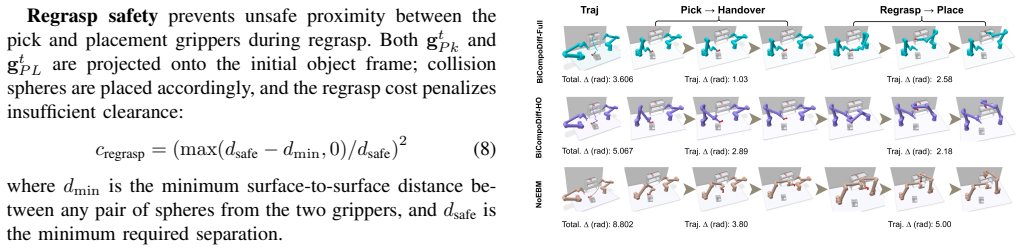
The load-bearing mechanism is guided reverse diffusion with annealed MCMC: at each denoising step the pretrained grasp model predicts the noise/mean, then a weighted sum of gradients from task energy functions—grasp collision, trajectory smoothness, handover feasibility, and regrasp safety—is added before advancing to the next timestep. A learned differentiable inverse-kinematics model called SubnetIK converts the six-degree-of-freedom poses into joint configurations with autograd gradients, which is what makes the smoothness term differentiable. The regrasp pose is a deterministic function of the other three poses, so the optimizer only moves pick, place, and handover while the regrasp foll
Load-bearing premise
The reported success rates treat a collision-free trajectory through optimized key poses as success, with grasping and placement simulated by rigidly attaching and detaching the object mesh, so the higher-success claim depends on the unverified assumption that trajectory-level feasibility transfers to real contact-rich execution.
What would settle it
Repeat the benchmark on a physical dual-arm rig (or in a contact-rich simulator) and count actual grasp-and-placement completions; if the real success rate is close to baseline rather than the reported roughly 82%, the central claim is refuted. The paper itself runs only two qualitative real-world scenes under perfect perception.
If this is right
- Simulation success on reorientation tasks rises by more than 20 percentage points over a sampling baseline while joint motion drops by up to 37%, so the composition of grasp prior and task energies is a viable planning objective.
- The framework improves both trajectory smoothness and regrasp safety at the same time, which sampling-and-filter pipelines trade off against each other.
- The grasp diffusion prior is pretrained and frozen; only the energy weights are selected, so the method can adapt to new bimanual constraints by editing energies rather than retraining.
- Because all key poses are optimized together, the resulting plans transfer to a real dual-arm setup in qualitative tests, suggesting trajectory-level optimization is the bottleneck that this method addresses.
Where Pith is reading between the lines
- If trajectory-level feasibility is the metric, then the method's gains would likely shrink in contact-rich execution, where grasp stability, slip, and perception noise dominate; the paper's own limitation statement concedes perfect perception and indirect trajectory optimization.
- The differentiable IK model is a separable contribution: any task needing smooth gradients from Cartesian poses to joint motion could reuse it, which may be the most transferable piece if the planning gains turn out to be metric-specific.
- The same energy-composition recipe could extend to other multi-stage manipulation problems—insertion, assembly, tool handover—by swapping the energy terms while keeping the diffusion prior, a testable extension the paper does not make.
- A natural quantitative extension is to benchmark against a contact-rich simulator with the same benchmark; that would isolate whether the 20%+ success gain survives physics.
Editorial analysis
A structured set of objections, weighed in public.
Referee Report
Summary. The paper proposes BiCompoDiff, a compositional diffusion and energy-based framework for bimanual object reorientation. The method combines a pretrained grasp diffusion model (GraspGen) with differentiable planning energy functions (collision avoidance, trajectory smoothness via a learned IK model, handover feasibility, regrasp safety) and annealed MCMC guidance during reverse diffusion, jointly refining pick, handover, regrasp, and place poses. The authors report over 20% higher success rates and up to 37% smoother trajectories (joint displacement) than an adapted ReorientBot baseline on a 60-task simulated benchmark, plus real-world qualitative and joint-displacement validation.
Significance. If the performance claims hold, BiCompoDiff is a meaningful step toward tightly integrating grasp selection with bimanual motion feasibility, avoiding the sample-and-filter bottlenecks of prior pipelines. The compositional use of a pretrained diffusion model without retraining, the differentiable IK surrogate, and the unified energy landscape are technically interesting and could generalize to other multi-stage manipulation problems. The 60-task benchmark is also a useful resource. However, the central success-rate claim is currently supported only by trajectory-level simulation metrics and hyperparameters selected on the same benchmark used for evaluation, so the reported gains are not yet established as independent predictions. The paper's negative results are limited to ablations; no physical success rates are reported.
major comments (4)
- [§V-A.5, §V-B.3, Table I/II] The cost weights (Table V) and the number of constrained denoising steps k are selected by optimizing performance on the same 60-task benchmark used for evaluation. §V-A.5 states the weights were 'tuned through extensive experimentation ... which yielded the best overall performance,' and §V-B.3 uses Figure 6, computed on all tasks, to justify the default k=3. This makes the reported 20%+ success gain partly a fitted quantity. Please report results on a held-out task split or use cross-validation/scene-level folds, and state variance over seeds or task difficulty strata.
- [§V-A.1, §V-A.3, §VI] Succ.% is defined as the percentage of fully collision-free trajectories (no robot-robot or robot-scene collisions), and grasping/placement are simulated by rigidly attaching/detaching the object mesh to the gripper. This is trajectory-level feasibility, not physical task completion; it does not model grip stability, slip, contact dynamics, or handover misalignment. The Abstract's 'over 20% higher success rates' therefore refers to collision-free keyframe plans. The unverified assumption that such plans transfer to physical success is acknowledged only as a limitation in §VI. Please either evaluate success with contact-aware dynamics/physics (even in simulation) or explicitly restrict all success claims to trajectory-level feasibility and remove the 'real-robot results show higher success rates' statement in §VI.
- [§V-D, §VI] The real-world experiments report only joint-displacement reductions for two scenes (T-shape: 59.7% improvement; cup: 46.4% improvement) under perfect perception, with no success counts, repeated trials, or collision/regrasp failure statistics. The conclusion nonetheless states 'real-robot results show higher success rates (>20%↑)', which overstates the evidence. Please report the number of real-world trials and success/failure outcomes, or soften the conclusion to match the quantitative data actually presented.
- [Tables I and II] All metrics are reported as single averages over the 60-task benchmark, with no error bars, confidence intervals, or statistical significance tests. Given that hyperparameters were tuned on these same tasks and the absolute differences are not huge in some metrics (e.g., Traj. Len. in Table II), it is essential to report dispersion (e.g., standard deviation across seeds, task difficulty groups, or bootstrap resampling) to assess whether the differences are reliable.
minor comments (5)
- [§IV-D, Algorithm 1] The 'predefined handover region' used to sample g_HO is not specified. Please define its geometry and how it is obtained for each scene.
- [§V-A.4, Table II] The ReorientBot adaptation changes the original method substantially (heuristic filtering instead of learned filtering, bimanual extension, same GraspGen sampling). This is acceptable, but the paper should state clearly that ReorientBot* is a re-implementation/adaptation, not the original method's reported performance, to avoid misleading comparisons.
- [§IV-D] The description of SubnetIK training for unreachable poses ('the closest reachable pose provides supervision') is vague. Please specify how the closest reachable pose is computed and how the network handles the non-differentiability of that mapping.
- [Equation (7)] The orientation cost uses max(c_min - |(R e_z)_x|, 0), but the text says it penalizes near-planar alignments of the gripper z-axis with the robot's xz-plane. Please double-check the sign/indices and clarify the intended geometric meaning, since as written it penalizes small absolute x-components of the z-axis.
- [§V-C, Table II] The row 'Full (w/o ∇g coll)' is mentioned in the text but not listed in Table I; please add a table footnote or clarify the relationship between the two tables.
Circularity Check
Headline success/smoothness gains are in-sample: cost weights and k were tuned on the same benchmark whose success rates are then reported.
specific steps
-
fitted input called prediction
[Section V-A.5 (Parameters), Eq. (5); Section V-B.3 (effect of k); Tables I-II]
"We tuned several cost weights through extensive experimentation. The final values used in all reported experiments are listed in Table V, which yielded the best overall performance. ... We set k=3 by default for the best quality–efficiency trade-off."
The λ_c weights in Eq. (5) are free method parameters, and the number of constrained denoising steps k was likewise chosen from ablation on the same tasks. These parameters directly steer the collision, smoothness, handover, and regrasp energies, while the headline metrics—especially Succ.% ('fully collision-free trajectories') and Traj.Δ—are the same objective family. Selecting the weights to yield the 'best overall performance' on the reported experiments and then reporting those experiments as evidence of >20% higher success makes the headline quantitative claim an in-sample fitted result rather than an independent prediction. The method retains independent content via ablations and a ReorientBot-style baseline, but a held-out validation split is needed to remove this circularity.
full rationale
The derivation chain itself is largely self-contained: the grasp prior is the external pretrained GraspGen model, the planning EBMs are constructed from task geometry and kinematics, SubnetIK is trained from analytical IK, and the final trajectories are generated by the external cuRobo planner. There is no load-bearing self-citation or imported uniqueness theorem. The main circularity is evaluation-side: hyperparameters (cost weights and k, plus default M=5) are selected on the same benchmark from which the success and smoothness numbers are reported, so the central 'over 20% higher success' claim is partly fitted rather than predicted. A separate validity gap, not circularity, is that 'success' is defined as a collision-free keyframe trajectory under rigid attachment, and the real-world section reports smoothness but not success; the conclusion's statement that 'real-robot results show higher success rates (>20%↑)' overstates the evidence. These concerns affect transferability and evidence strength, not the self-containedness of the method's derivation, so they are weighed in the rationale but do not by themselves raise the circularity score above the tuning issue.
Axiom & Free-Parameter Ledger
free parameters (5)
- bimanual planning energy weights (w_smooth, w_coll, w_region, w_orient, w_regrasp) =
Table V: 0.005, 0.01, 0.025, 0.1, 0.3, 0.0001, 0.001
- composite score weights w_conf, w_plan =
0.4, 0.6
- number of constrained denoising steps k =
3
- MCMC steps per denoising step M =
5
- safety margins δ, d_safe, c_min =
not specified
axioms (5)
- domain assumption GraspGen pretrained model provides a valid multi-modal prior over 6-DoF grasps
- domain assumption Gradient composition during reverse diffusion approximately samples from the constrained posterior
- domain assumption SubnetIK's learned IK gradients are accurate enough to steer optimization toward feasible poses
- domain assumption L1 joint displacement between key poses is a reliable proxy for actual trajectory cost
- ad hoc to paper Rigid-attachment simulation is sufficient to measure task success
read the original abstract
Bimanual object reorientation - picking an object, handing it over between two arms, and placing it in a desired target pose - is valuable when direct placement from the initial grasp is infeasible due to collisions, kinematic constraints, or poor final orientation. However, achieving this under multiple competing objectives remains challenging. We introduce BiCompoDiff, a compositional diffusion and energy-based framework that jointly optimizes grasp selection, handover, regrasp, and motion planning under multiple constraints. By combining a pretrained grasp diffusion model with bimanual planning energy-based models (EBMs), our method injects gradient guidance during reverse diffusion to enforce collision avoidance, trajectory smoothness (via differentiable inverse kinematics), handover feasibility, and regrasp safety. Annealed MCMC sampling further refines grasp poses over the composite energy landscape. Experiments across diverse simulated household reorientation tasks demonstrate that BiCompoDiff achieves over 20% higher success rates and up to 37% smoother trajectories (measured by joint displacement) compared to strong sampling-based baselines. Real-world validation confirms effective sim-to-real transfer and robust performance on challenging scenes.
Figures




Reference graph
Works this paper leans on
-
[1]
Fmb: a functional manipulation benchmark for generalizable robotic learning,
J. Luo, C. Xu, F. Liu, L. Tan, Z. Lin, J. Wu, P. Abbeel, and S. Levine, “Fmb: a functional manipulation benchmark for generalizable robotic learning,”The International Journal of Robotics Research, vol. 44, no. 4, pp. 592–606, 2025
2025
-
[2]
Soft regrasping tool inspired by jamming gripper,
T. Kiyokawa, Z. Hu, W. Wan, and K. Harada, “Soft regrasping tool inspired by jamming gripper,”arXiv preprint arXiv:2509.13815, 2025
arXiv 2025
-
[3]
Reorientbot: Learning object reorientation for specific-posed placement,
K. Wada, S. James, and A. J. Davison, “Reorientbot: Learning object reorientation for specific-posed placement,” in2022 International Conference on Robotics and Automation (ICRA). IEEE, 2022, pp. 8252–8258
2022
-
[4]
Reorientdiff: Diffusion model based reorientation for object manipulation,
U. A. Mishra and Y . Chen, “Reorientdiff: Diffusion model based reorientation for object manipulation,” in2024 IEEE International Conference on Robotics and Automation (ICRA). IEEE, 2024, pp. 10 867–10 873
2024
-
[5]
Energy-based models,
J. M. Tomczak, “Energy-based models,” inDeep Generative Modeling. Springer, 2021, pp. 143–158
2021
-
[6]
Reduce, reuse, recycle: Compositional generation with energy-based diffusion models and mcmc,
Y . Du, C. Durkan, R. Strudel, J. B. Tenenbaum, S. Dieleman, R. Fer- gus, J. Sohl-Dickstein, A. Doucet, and W. S. Grathwohl, “Reduce, reuse, recycle: Compositional generation with energy-based diffusion models and mcmc,” inInternational conference on machine learning. PMLR, 2023, pp. 8489–8510
2023
-
[7]
PDDLStream: Integrating symbolic planners and blackbox samplers via optimistic adaptive planning,
C. R. Garrett, T. Lozano-P ´erez, and L. P. Kaelbling, “PDDLStream: Integrating symbolic planners and blackbox samplers via optimistic adaptive planning,” inInternational Conference on Automated Plan- ning and Scheduling (ICAPS), 2020
2020
-
[8]
Learning symbolic operators for task and motion planning,
T. Silver, R. Chitnis, J. Tenenbaum, L. P. Kaelbling, and T. Lozano- P´erez, “Learning symbolic operators for task and motion planning,” in2021 IEEE/RSJ International Conference on Intelligent Robots and Systems (IROS), 2021, pp. 3182–3189
2021
-
[9]
Learn- ing feasibility for task and motion planning in tabletop environments,
A. M. Wells, N. T. Dantam, A. Shrivastava, and L. E. Kavraki, “Learn- ing feasibility for task and motion planning in tabletop environments,” IEEE Robotics and Automation Letters, vol. 4, no. 2, pp. 1255–1262, 2019
2019
-
[10]
Dall-e-bot: Introducing web- scale diffusion models to robotics,
I. Kapelyukh, V . V osylius, and E. Johns, “Dall-e-bot: Introducing web- scale diffusion models to robotics,”IEEE Robotics and Automation Letters, vol. 8, no. 7, pp. 3956–3963, 2023
2023
-
[11]
Grasp, see, and place: Efficient unknown object rearrangement with policy structure prior,
K. Xu, Z. Zhou, J. Wu, H. Lu, R. Xiong, and Y . Wang, “Grasp, see, and place: Efficient unknown object rearrangement with policy structure prior,”IEEE Transactions on Robotics, vol. 41, pp. 464–483, 2024
2024
-
[12]
Dream2real: Zero- shot 3d object rearrangement with vision-language models,
I. Kapelyukh, Y . Ren, I. Alzugaray, and E. Johns, “Dream2real: Zero- shot 3d object rearrangement with vision-language models,” in2024 IEEE International Conference on Robotics and Automation (ICRA). IEEE, 2024, pp. 4796–4803
2024
-
[13]
Energy-based models are zero-shot planners for compositional scene rearrangement,
N. Gkanatsios, A. Jain, Z. Xian, Y . Zhang, C. Atkeson, and K. Fragki- adaki, “Energy-based models are zero-shot planners for compositional scene rearrangement,”arXiv preprint arXiv:2304.14391, 2023
Pith/arXiv arXiv 2023
-
[14]
“set it up
Y . Xu, J. Mao, L. Li, Y . Du, T. Loz ´ano-P´erez, L. P. Kaelbling, and D. Hsu, ““set it up”: Functional object arrangement with compositional generative models,”The International Journal of Robotics Research, p. 02783649251378198, 2024
2024
-
[15]
Learning to assemble with alternative plans,
Z. Wang, W. Liu, J. Wang, G. Vallat, F. Shi, S. Parascho, and M. Kamgarpour, “Learning to assemble with alternative plans,”ACM Transactions on Graphics (TOG), vol. 44, no. 4, pp. 1–16, 2025
2025
-
[16]
Adaptive coordinated impedance control for dual-arm robot symmetric bimanual tasks,
Y . Zhang, “Adaptive coordinated impedance control for dual-arm robot symmetric bimanual tasks,”Robotics and Autonomous Systems, vol. 193, p. 105110, 2025
2025
-
[17]
Learning dual-arm object rearrangement for cartesian robots,
S. Zhang, Q. She, W. Li, C. Zhu, Y . Wang, R. Hu, and K. Xu, “Learning dual-arm object rearrangement for cartesian robots,” in2024 IEEE International Conference on Robotics and Automation (ICRA). IEEE, 2024, pp. 7440–7446
2024
-
[18]
Efficient bimanual han- dover and rearrangement via symmetry-aware actor-critic learning,
Y . Li, C. Pan, H. Xu, X. Wang, and Y . Wu, “Efficient bimanual han- dover and rearrangement via symmetry-aware actor-critic learning,” in2023 IEEE International Conference on Robotics and Automation (ICRA). IEEE, 2023, pp. 3867–3874
2023
-
[19]
A tutorial on energy-based learning,
Y . LeCun, S. Chopra, R. Hadsell, M. Ranzato, F. Huang,et al., “A tutorial on energy-based learning,”Predicting structured data, vol. 1, no. 0, 2006
2006
-
[20]
Diffusion models: A comprehensive survey of methods and applications,
L. Yang, Z. Zhang, Y . Song, S. Hong, R. Xu, Y . Zhao, W. Zhang, B. Cui, and M.-H. Yang, “Diffusion models: A comprehensive survey of methods and applications,”ACM computing surveys, vol. 56, no. 4, pp. 1–39, 2023
2023
-
[21]
Implicit generation and modeling with energy based models,
Y . Du and I. Mordatch, “Implicit generation and modeling with energy based models,”Advances in neural information processing systems, vol. 32, 2019
2019
-
[22]
Hgdiffuser: efficient task-oriented grasp generation via human-guided grasp diffusion mod- els,
D. Huang, W. Dong, C. Tang, and H. Zhang, “Hgdiffuser: efficient task-oriented grasp generation via human-guided grasp diffusion mod- els,” in2025 IEEE/RSJ International Conference on Intelligent Robots and Systems (IROS). IEEE, 2025, pp. 19 538–19 545
2025
-
[23]
Se (3)- diffusionfields: Learning smooth cost functions for joint grasp and motion optimization through diffusion,
J. Urain, N. Funk, J. Peters, and G. Chalvatzaki, “Se (3)- diffusionfields: Learning smooth cost functions for joint grasp and motion optimization through diffusion,” in2023 IEEE international conference on robotics and automation (ICRA). IEEE, 2023, pp. 5923–5930
2023
-
[24]
Denoising diffusion probabilistic models,
J. Ho, A. Jain, and P. Abbeel, “Denoising diffusion probabilistic models,”Advances in neural information processing systems, vol. 33, pp. 6840–6851, 2020
2020
-
[25]
Score-based generative modeling through stochastic differential equations,
Y . Song, J. Sohl-Dickstein, D. P. Kingma, A. Kumar, S. Ermon, and B. Poole, “Score-based generative modeling through stochastic differential equations,”arXiv preprint arXiv:2011.13456, 2020
Pith/arXiv arXiv 2011
-
[26]
Graspgen: A diffusion-based framework for 6-dof grasping with on- generator training,
A. Murali, B. Sundaralingam, Y .-W. Chao, W. Yuan, J. Yamada, M. Carlson, F. Ramos, S. Birchfield, D. Fox, and C. Eppner, “Graspgen: A diffusion-based framework for 6-dof grasping with on- generator training,”arXiv preprint arXiv:2507.13097, 2025
Pith/arXiv arXiv 2025
-
[27]
Denoising diffusion implicit models,
J. Song, C. Meng, and S. Ermon, “Denoising diffusion implicit models,”arXiv preprint arXiv:2010.02502, 2020
Pith/arXiv arXiv 2010
-
[28]
curobo: Parallelized collision-free minimum-jerk robot motion generation,
B. Sundaralingam, S. K. S. Hari, A. Fishman, C. Garrett, K. V . Wyk, V . Blukis, A. Millane, H. Oleynikova, A. Handa, F. Ramos, N. Ratliff, and D. Fox, “curobo: Parallelized collision-free minimum-jerk robot motion generation,”arXiv preprint arXiv:2310.17274, 2023. [Online]. Available: https://arxiv.org/abs/2310.17274
Pith/arXiv arXiv 2023
-
[29]
Inference-time policy steering through human interactions,
Y . Wang, L. Wang, Y . Du, B. Sundaralingam, X. Yang, Y .-W. Chao, C. P ´erez-D’Arpino, D. Fox, and J. Shah, “Inference-time policy steering through human interactions,” in2025 IEEE International Conference on Robotics and Automation (ICRA). IEEE, 2025, pp. 15 626–15 633
2025
-
[30]
Examining the frictional behavior of primitive contact geometries for use as robotic finger pads,
M. T. Leddy and A. M. Dollar, “Examining the frictional behavior of primitive contact geometries for use as robotic finger pads,”IEEE Robotics and Automation Letters, vol. 5, no. 2, pp. 3137–3144, 2020. APPENDIX A. Joint-Decoupled SubnetMLP Model (SubnetIK) SubnetIK (Figure 5) takes as input a 9D pose representa- tion (first two columns of the rotation ma...
2020
discussion (0)
Sign in with ORCID, Apple, or X to comment. Anyone can read and Pith papers without signing in.