REVIEW 2 major objections 4 minor 46 references
GrainGS: Gradient-Decoupled Gaussian Splatting for Efficient Dynamic Novel View Synthesis
T0 review · 2 major / 4 minor · reviewed 2026-08-01 · deepseek-v4-flash
Pith's one-line read GrainGS shows that blocking deformation gradients from reaching canonical Gaussian positions lets a dynamic scene stay stable while per-Gaussian motion remains expressive.
desk verdict Stop-gradient trick is simple and effective; the 'stable canonical' claim is oversold but the paper is solid. read the letter →
The pith
A machine-rendered reading of the paper's core claim, the machinery that carries it, and where it could break.
The reading
What carries the argument
The key machinery is the stop-gradient operator sg(·) applied to canonical positions before they enter the time-conditioned deformation network (Eq. 7). It blocks the indirect gradient path ∂L/∂x_can · ∂∆x/∂x_can (the 'deformation' term in Eq. 8), preserving the direct reconstruction path. This works together with a two-phase schedule: a static warm-up that first fits a canonical anchor scaffold from all timestamps without deformation, and a canonical-residual appearance model that keeps frame-dependent color and opacity changes out of the geometry. Per-Gaussian offsets (∆x, ∆r, ∆ρ) are predicted independently for each child Gaussian, giving local motion freedom within the scaffold's structu
What would settle it
Take a synthetic scene with a fast-moving object and restrict the warm-up to a narrow set of timestamps. If the stop-gradient model's canonical positions drift substantially after joint training begins, or if its quality is no better than a model trained without the stop-gradient, the claimed decoupling is not doing the work. A direct check is to measure the average canonical-position update norm in the first post-warm-up iterations with and without the stop-gradient: the paper's account predicts it should be much smaller with the stop-gradient.
Extended reading notes
Core claim
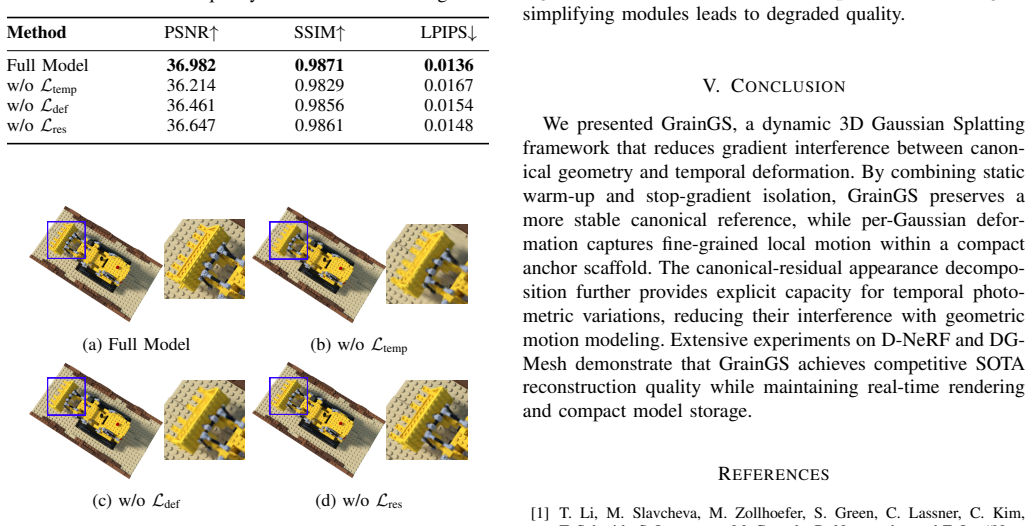
The central discovery is that deformation-mediated gradient interference — the second term in the chain rule for x_can — is a major source of instability in dynamic Gaussian splatting. By inserting a stop-gradient boundary at the input to the deformation network, GrainGS removes that term from the canonical scaffold's gradient, leaving only the direct reconstruction term. This makes the canonical geometry a genuinely time-invariant reference while the deformation network independently learns per-frame offsets. The paper supports this with ablations showing the stop-gradient alone contributes +1.34 dB, and with visualisations where, without it, canonical Gaussians become irregular and concent
Load-bearing premise
The load-bearing premise is that the static warm-up, trained on images sampled across all timestamps, builds a canonical rest pose that stays useful once deformation begins; if motion is large or unevenly sampled, direct reconstruction gradients can still pull canonical positions in conflicting directions and the per-Gaussian deformation may not compensate.
Editorial extensions
If this is right
- Dynamic Gaussian systems can maintain a stable canonical reference during training without architectural changes beyond a gradient cutoff, so any future method can adopt the trick directly.
- Because appearance changes are routed to a residual branch, moving shadows or specular highlights should no longer warp the geometric model; this may improve relighting and editing of dynamic scenes.
- The compact scaffold and 435.6 FPS render rate make the representation practical for real-time free-viewpoint video and interactive viewing.
- The decomposition into canonical, deformation, and appearance branches suggests that each module can be trained or fine-tuned independently, simplifying extensions to longer sequences or user control.
- If the reported gains hold across more varied scenes, the warm-up-plus-stop-gradient schedule may become a standard training recipe for dynamic scene representation methods.
Reading between the lines
- Editorial extension: the same gradient-decoupling principle could be applied to any two-branch representation that pairs a stable canonical field with a residual deformation branch, where the canonical field would also benefit from being sheltered from deformation gradients.
- Editorial extension: the paper's warm-up implicitly assumes that early samples cover the full motion range; a natural stress test is to deliberately expose the model to new poses only after joint training begins and watch for canonical drift.
- Editorial extension: the canonical-residual appearance split could be reused for per-frame exposure correction or lighting editing in otherwise static scenes, independent of motion modeling.
- Editorial extension: the reported storage is the final Gaussian count; a fuller efficiency comparison would also count the cost of the anchor-growing process and intermediate anchors during training, which the paper does not report.
Editorial analysis
A structured set of objections, weighed in public.
Referee Report
Summary. The paper presents GrainGS, a dynamic 3D Gaussian Splatting method that combines a hierarchical anchor scaffold with per-Gaussian deformation, a static warm-up phase, a stop-gradient operator on the deformation input, and a canonical-residual appearance decomposition. The authors claim that this design reduces gradient interference between canonical geometry and temporal deformation, yielding state-of-the-art quality, real-time rendering, and compact storage. Experiments on D-NeRF and DG-Mesh report an average PSNR of 36.98 dB on D-NeRF, 435.6 FPS, and 4.67 MB storage, with top-three results in all 24 D-NeRF metric entries and first in PSNR on all six DG-Mesh scenes.
Significance. If the empirical results hold, GrainGS is a practically valuable contribution: it is compact, real-time, and competitive across synthetic and real-world benchmarks. The chain-rule identity in Eqs. (8)-(9) is correct, and the ablation tables are internally consistent and support the claim that removing the deformation-mediated gradient path improves quality. However, the central theoretical narrative overstates what the stop-gradient guarantees: Eq. (9) still leaves direct per-frame photometric gradients flowing into the canonical positions. The warm-up/rest-pose assumption is also unverified. These issues are fixable with additional analysis and revised wording, but they are load-bearing for the paper's conceptual contribution.
major comments (2)
- [Sec. III-C, Eq. (9)] The text states that the stop-gradient 'ensures that the canonical geometry remains a stable, time-invariant reference.' Eq. (9) does not establish this: it gives ∂L/∂x_can = ∂L/∂x(t), so the direct photometric gradient from every frame still flows into x_can. Under large motion, gradients from different timestamps can pull the same canonical Gaussian in conflicting directions; the stop-gradient removes only the second term in Eq. (8). The warm-up (§III-B) is the intended safeguard, but the paper provides no quantitative check of canonical drift during joint training (e.g., displacement of x_can or anchor positions from the end of warm-up to convergence, or a warm-up-length sweep). The 'ensures' wording should be softened to 'reduces one identified interference pathway,' and a canonical-stability experiment should be added.
- [Sec. III-B, static warm-up] The warm-up phase assumes that optimizing the canonical scaffold for T_w=3,000 iterations on images sampled across all timestamps establishes a rest pose that spans the motion range. Because deformation is disabled, the static scaffold can instead place Gaussians along the union of observed positions or blur regions with large motion; it is not shown that this canonical remains a coherent time-invariant reference when joint training begins. The ablation in Table IV (stop-gradient vs. no stop-gradient) does not isolate the effect of the warm-up or the benignness of the surviving direct pathway. Please add an ablation varying T_w (including T_w=0), report canonical motion/drift metrics, and discuss cases where per-frame conflicts overcome the L_def regularization.
minor comments (4)
- [Eq. (8), surrounding text] The phrase 'back-propagates through the DeformNet into the Static MLP via the shared variable x_can' is inaccurate: x_can is computed from the anchor position, anchor scale, and child offset (Eq. 4), not by the Static MLP (Eq. 5). The affected parameters are the anchor tuple and child offsets. Please correct this description.
- [Sec. IV-A, implementation details] Hyperparameters (λ1, λ2, λ3, λssim, T_w, k, η, L, τobs, τg, v) are set once without sensitivity analysis. A short sensitivity table for λ's, T_w, and η would strengthen the robustness claims, especially since the two-phase schedule is central to the method.
- [Throughout] Minor typos: 'the DeformNet and Appearance Residual Field remains frozen' should be 'remain frozen'; 'We evaluate our methods on different datasets, results show' should be 'We evaluate our methods on different datasets; results show'. Also, the text in Fig. 4 appears truncated ('anchor feature').
- [Figs. 8-10] The qualitative ablation claims would be more convincing if accompanied by quantitative metrics for the visualized regions (e.g., patch PSNR/LPIPS) or error maps, rather than visual inspection alone.
Circularity Check
No significant circularity: the stop-gradient derivation is a chain-rule identity, and the empirical claims are validated against external baselines and controlled ablations.
full rationale
The paper's central mechanism is the stop-gradient operator in Eqs. (7)-(9). Eq. (8) writes ∂L/∂x_can as the sum of a direct reconstruction term and a deformation-mediated term; Eq. (9) states that with sg(x_can) as DeformNet input the second term vanishes. This is a direct application of the chain rule under the paper's own definition x(t)=x_can+Δx(sg(x_can),t); it is an identity, not a fitted result. The claim that canonical geometry remains a stable reference is an empirical design claim, and the paper provides an ablation (Table IV, +1.34 dB with stop-gradient) and a qualitative comparison (Fig. 8). Nothing in the derivation is defined in terms of the evaluation metric. The only author-overlap citation identified is [30] (4D-GS, with co-author Qi Tian), and it is used as a compared baseline in Tables I-III, not as authority for the stop-gradient mechanism; hence it is not load-bearing. Hyperparameters (η=0.1, λ1=0.01, λ2=0.001, λ3=0.01, T_w=3000) are hand-set and not fitted to the reported test scores, so no fitted-input-called-prediction pattern is present. A residual risk noted by a skeptical reader is that Eq. (9) still leaves direct per-frame reconstruction gradients flowing to x_can, so 'ensuring stability' is not proven by the algebra alone; however, that is a correctness/robustness concern, not circularity, because the claim is testable and is in fact tested by ablations against external baselines. Overall, the derivation chain is self-contained and the empirical evaluation is externally benchmarked.
Assumptions & free parameters
free parameters (10)
- lambda_1 (L_temp weight) =
0.01
- lambda_2 (L_def weight) =
0.001
- lambda_3 (L_res weight) =
0.01
- lambda_ssim (D-SSIM weight) =
0.2
- T_w (warm-up iterations) =
3000
- k (child Gaussians per anchor) =
10
- eta (appearance residual scale) =
0.1
- L (positional encoding frequencies) =
6
- tau_obs, tau_g (anchor growing thresholds)
- v (voxel downsampling resolution)
assumptions (7)
- standard math Gaussian splatting forward model and alpha blending (Eqs. 1-2)
- standard math Chain rule decomposition of gradient through deformed position (Eq. 8)
- domain assumption SfM point cloud provides reliable anchor initialization
- domain assumption A single time-invariant canonical rest pose explains all frames via per-Gaussian deformation
- ad hoc to paper Static warm-up across all timestamps yields a valid rest pose
- ad hoc to paper DeformNet can learn useful offsets from a detached canonical position
- ad hoc to paper Appearance residual scale eta=0.1 is small enough to avoid overriding canonical appearance
Cite this review
Pith. "Pith review of GrainGS: Gradient-Decoupled Gaussian Splatting for Efficient Dynamic Novel View Synthesis." pith.science (2026). https://pith.science/paper/DDYBJ4DZ
@misc{pith2026260721448,
  author       = {Pith},
  title        = {Pith review of: GrainGS: Gradient-Decoupled Gaussian Splatting for Efficient Dynamic Novel View Synthesis},
  year         = {2026},
  howpublished = {\url{https://pith.science/paper/DDYBJ4DZ}},
  note         = {Machine review of arXiv:2607.21448}
}
read the original abstract
Dynamic scene reconstruction with 3D Gaussian Splatting requires a balance between fine-grained motion modeling, structural stability, and compact representation. Existing per-primitive methods provide flexible local deformation but often suffer from redundant primitive growth, while anchor-based methods improve spatial regularity at the cost of suppressing locally varying motion. To address these issues, we present GrainGS, a dynamic Gaussian framework that combines a hierarchical anchor scaffold with per-Gaussian deformation. A static warm-up stage first establishes a time-invariant canonical representation from observations across all timestamps. During joint training, a stop-gradient operation blocks the deformation-mediated gradient pathway to the canonical positions while preserving their direct refinement through the reconstruction objective. Each Gaussian then predicts independent temporal offsets for position, rotation, and scale, enabling detailed local motion within a structurally constrained scaffold. A canonical-residual appearance decomposition further models frame-dependent photometric changes without forcing them into geometric deformation. Experiments on synthetic monocular and real-world multiview benchmarks show that GrainGS achieves high reconstruction quality, real-time novel view synthesis, and compact storage. Under the synthetic benchmark setting, it reaches an average peak signal-to-noise ratio of 36.98 decibels, renders at 435.6 frames per second, and requires 4.67 megabytes of storage.
Figures


Figures from the paper (7 more)


Reference graph
Works this paper leans on
-
[1]
Neu- ral 3D Video Synthesis from Multi-view Video,
T. Li, M. Slavcheva, M. Zollhoefer, S. Green, C. Lassner, C. Kim, T. Schmidt, S. Lovegrove, M. Goesele, R. Newcombe, and Z. Lv, “Neu- ral 3D Video Synthesis from Multi-view Video,” in2022 IEEE/CVF Conference on Computer Vision and Pattern Recognition (CVPR). IEEE, 2022, pp. 5511–5521
2022
-
[2]
Real-Time Free Viewpoint Video Synthesis System Based on DIBR and a Depth Estimation Network,
S. Guo, J. Hu, K. Zhou, J. Wang, L. Song, R. Xie, and W. Zhang, “Real-Time Free Viewpoint Video Synthesis System Based on DIBR and a Depth Estimation Network,”IEEE Transactions on Multimedia, vol. 26, pp. 6701–6716, 2024
2024
-
[3]
Advancing Generalizable Occlusion Modeling for Neural Human Radiance Field,
B. Liu, J. Lei, B. Peng, Z. Zhang, J. Zhu, and Q. Huang, “Advancing Generalizable Occlusion Modeling for Neural Human Radiance Field,” IEEE Transactions on Multimedia, vol. 27, pp. 1362–1373, 2025
2025
-
[4]
GS-SFS: Joint Gaussian Splatting and Shape-From-Silhouette for Multiple Human Reconstruction in Large-Scale Sports Scenes,
Y . Jiang, J. Li, H. Qin, Y . Dai, J. Liu, G. Zhang, C. Zhang, and T. Yang, “GS-SFS: Joint Gaussian Splatting and Shape-From-Silhouette for Multiple Human Reconstruction in Large-Scale Sports Scenes,”IEEE Transactions on Multimedia, vol. 26, pp. 11 095–11 110, 2024
2024
-
[5]
Neural V olumetric Video Coding With Hierarchical Coded Representation of Dynamic V olume,
J.-Y . Shin, J.-K. Lee, G. Bang, J.-S. Kim, and J.-W. Kang, “Neural V olumetric Video Coding With Hierarchical Coded Representation of Dynamic V olume,”IEEE Transactions on Multimedia, vol. 27, pp. 4412– 4426, 2025
2025
-
[6]
Neural Body: Implicit Neural Representations with Structured La- tent Codes for Novel View Synthesis of Dynamic Humans,
S. Peng, Y . Zhang, Y . Xu, Q. Wang, Q. Shuai, H. Bao, and X. Zhou, “Neural Body: Implicit Neural Representations with Structured La- tent Codes for Novel View Synthesis of Dynamic Humans,” in2021 IEEE/CVF Conference on Computer Vision and Pattern Recognition (CVPR). IEEE, 2021, pp. 9050–9059
2021
-
[7]
4K4D: Real-Time 4D View Synthesis at 4K Resolution,
Z. Xu, S. Peng, H. Lin, G. He, J. Sun, Y . Shen, H. Bao, and X. Zhou, “4K4D: Real-Time 4D View Synthesis at 4K Resolution,” in2024 IEEE/CVF Conference on Computer Vision and Pattern Recognition (CVPR). IEEE, 2024, pp. 20 029–20 040
2024
-
[8]
Dynamic Gaussians Mesh: Consistent Mesh Reconstruction from Dynamic Scenes,
I. Liu, H. Su, and X. Wang, “Dynamic Gaussians Mesh: Consistent Mesh Reconstruction from Dynamic Scenes,” inThe Thirteenth International Conference on Learning Representations (ICLR), 2025. [Online]. Available: https://openreview.net/forum?id=LuGHbK8qTa 10
2025
Show all 46 references
-
[9]
Monocular Dynamic View Synthesis: A Reality Check,
H. Gao, R. Li, S. Tulsiani, B. Russell, and A. Kanazawa, “Monocular Dynamic View Synthesis: A Reality Check,” inAdvances in Neural Information Processing Systems, vol. 35. Curran Associates, Inc., 2022, pp. 33 768–33 780
2022
-
[10]
NeRF: Representing Scenes as Neural Radiance Fields for View Synthesis,
B. Mildenhall, P. P. Srinivasan, M. Tancik, J. T. Barron, R. Ramamoorthi, and R. Ng, “NeRF: Representing Scenes as Neural Radiance Fields for View Synthesis,” inComputer Vision - ECCV 2020, ser. Lecture Notes in Computer Science. Springer International Publishing, 2020, pp. 405– 421
2020
-
[11]
Local light field fusion: practical view synthesis with prescriptive sampling guidelines,
B. Mildenhall, P. P. Srinivasan, R. Ortiz-Cayon, N. K. Kalantari, R. Ra- mamoorthi, R. Ng, and A. Kar, “Local light field fusion: practical view synthesis with prescriptive sampling guidelines,”ACM Transactions on Graphics, vol. 38, no. 4, pp. 1–14, 2019
2019
-
[12]
CBARF: Cascaded Bundle- Adjusting Neural Radiance Fields From Imperfect Camera Poses,
H. Fu, X. Yu, L. Li, and L. Zhang, “CBARF: Cascaded Bundle- Adjusting Neural Radiance Fields From Imperfect Camera Poses,”IEEE Transactions on Multimedia, vol. 26, pp. 9304–9315, 2024
2024
-
[13]
Msa-Splatting: Multi- Scale Adaptive Gaussian Splatting for High-Fidelity View Synthesis,
Y . Zhao, G. Chen, B. Wu, Q. Jin, and T. Zeng, “Msa-Splatting: Multi- Scale Adaptive Gaussian Splatting for High-Fidelity View Synthesis,” IEEE Transactions on Multimedia, vol. 28, pp. 5357–5367, 2026
2026
-
[14]
Ref-NeRF: Structured View-Dependent Appearance for Neural Radiance Fields,
D. Verbin, P. Hedman, B. Mildenhall, T. Zickler, J. T. Barron, and P. P. Srinivasan, “Ref-NeRF: Structured View-Dependent Appearance for Neural Radiance Fields,” in2022 IEEE/CVF Conference on Computer Vision and Pattern Recognition (CVPR). IEEE, 2022, pp. 5481–5490
2022
-
[15]
StructGS: Adaptive Spherical Harmon- ics and Rendering Enhancements for Superior 3D Gaussian Splatting,
Z. Huang, M. Xu, and S. Perry, “StructGS: Adaptive Spherical Harmon- ics and Rendering Enhancements for Superior 3D Gaussian Splatting,” IEEE Transactions on Multimedia, vol. 28, pp. 1499–1510, 2026
2026
-
[16]
Nerfies: Deformable Neural Radiance Fields,
K. Park, U. Sinha, J. T. Barron, S. Bouaziz, D. B. Goldman, S. M. Seitz, and R. Martin-Brualla, “Nerfies: Deformable Neural Radiance Fields,” in 2021 IEEE/CVF International Conference on Computer Vision (ICCV). IEEE, 2021, pp. 5845–5854
2021
-
[17]
Neural Scene Flow Fields for Space-Time View Synthesis of Dynamic Scenes,
Z. Li, S. Niklaus, N. Snavely, and O. Wang, “Neural Scene Flow Fields for Space-Time View Synthesis of Dynamic Scenes,” in2021 IEEE/CVF Conference on Computer Vision and Pattern Recognition (CVPR). IEEE, 2021, pp. 6494–6504
2021
-
[18]
HyperNeRF: a higher-dimensional representation for topologically varying neural radiance fields,
K. Park, U. Sinha, P. Hedman, J. T. Barron, S. Bouaziz, D. B. Goldman, R. Martin-Brualla, and S. M. Seitz, “HyperNeRF: a higher-dimensional representation for topologically varying neural radiance fields,”ACM Transactions on Graphics, vol. 40, no. 6, pp. 1–12, 2021
2021
-
[19]
ATM-NeRF: Accelerating Training for NeRF Rendering on Mobile Devices via Geometric Regu- larization,
Y . Chen, L. Zhang, S. Zhao, and Y . Zhou, “ATM-NeRF: Accelerating Training for NeRF Rendering on Mobile Devices via Geometric Regu- larization,”IEEE Transactions on Multimedia, vol. 27, pp. 3279–3293, 2025
2025
-
[20]
Robust Dynamic Radiance Fields,
Y .-L. Liu, C. Gao, A. Meuleman, H.-Y . Tseng, A. Saraf, C. Kim, Y .-Y . Chuang, J. Kopf, and J.-B. Huang, “Robust Dynamic Radiance Fields,” in2023 IEEE/CVF Conference on Computer Vision and Pattern Recognition (CVPR). IEEE, 2023, pp. 13–23
2023
-
[21]
NeRFPlayer: A Streamable Dynamic Scene Representation with Decomposed Neural Radiance Fields,
L. Song, A. Chen, Z. Li, Z. Chen, L. Chen, J. Yuan, Y . Xu, and A. Geiger, “NeRFPlayer: A Streamable Dynamic Scene Representation with Decomposed Neural Radiance Fields,”IEEE Transactions on Visualization and Computer Graphics, vol. 29, no. 5, pp. 2732–2742, 2023
2023
-
[22]
3D Gaussian Splatting for Real-Time Radiance Field Rendering,
B. Kerbl, G. Kopanas, T. Leimkuehler, and G. Drettakis, “3D Gaussian Splatting for Real-Time Radiance Field Rendering,”ACM Transactions on Graphics, vol. 42, no. 4, pp. 1–14, 2023
2023
-
[23]
Pulsar: Efficient Sphere-based Neural Rendering,
C. Lassner and M. Zollhofer, “Pulsar: Efficient Sphere-based Neural Rendering,” in2021 IEEE/CVF Conference on Computer Vision and Pattern Recognition (CVPR). IEEE, 2021, pp. 1440–1449
2021
-
[24]
Surface splatting,
M. Zwicker, H. Pfister, J. van Baar, and M. Gross, “Surface splatting,” inProceedings of the 28th annual conference on Computer graphics and interactive techniques. ACM, 2001, pp. 371–378
2001
-
[25]
EW A splatting,
——, “EW A splatting,”IEEE Transactions on Visualization and Com- puter Graphics, vol. 8, no. 3, pp. 223–238, 2002
2002
-
[26]
Object Space EW A Surface Splatting: A Hardware Accelerated Approach to High Quality Point Rendering,
L. Ren, H. Pfister, and M. Zwicker, “Object Space EW A Surface Splatting: A Hardware Accelerated Approach to High Quality Point Rendering,”Computer Graphics Forum, vol. 21, no. 3, pp. 461–470, 2002
2002
-
[27]
Dynamic 3D Gaussians: Tracking by Persistent Dynamic View Synthesis,
J. Luiten, G. Kopanas, B. Leibe, and D. Ramanan, “Dynamic 3D Gaussians: Tracking by Persistent Dynamic View Synthesis,” in2024 International Conference on 3D Vision (3DV). IEEE, 2024, pp. 800– 809
2024
-
[28]
Gaussian-Flow: 4D Reconstruction with Dynamic 3D Gaussian Particle,
Y . Lin, Z. Dai, S. Zhu, and Y . Yao, “Gaussian-Flow: 4D Reconstruction with Dynamic 3D Gaussian Particle,” in2024 IEEE/CVF Conference on Computer Vision and Pattern Recognition (CVPR). IEEE, 2024, pp. 21 136–21 145
2024
-
[29]
Deformable 3D Gaussians for High-Fidelity Monocular Dynamic Scene Reconstruc- tion,
Z. Yang, X. Gao, W. Zhou, S. Jiao, Y . Zhang, and X. Jin, “Deformable 3D Gaussians for High-Fidelity Monocular Dynamic Scene Reconstruc- tion,” in2024 IEEE/CVF Conference on Computer Vision and Pattern Recognition (CVPR). IEEE, 2024, pp. 20 331–20 341
2024
-
[30]
4D Gaussian Splatting for Real-Time Dynamic Scene Rendering,
G. Wu, T. Yi, J. Fang, L. Xie, X. Zhang, W. Wei, W. Liu, Q. Tian, and X. Wang, “4D Gaussian Splatting for Real-Time Dynamic Scene Rendering,” in2024 IEEE/CVF Conference on Computer Vision and Pattern Recognition (CVPR). IEEE, 2024, pp. 20 310–20 320
2024
-
[31]
SC-GS: Sparse-Controlled Gaussian Splatting for Editable Dynamic Scenes,
Y .-H. Huang, Y .-T. Sun, Z. Yang, X. Lyu, Y .-P. Cao, and X. Qi, “SC-GS: Sparse-Controlled Gaussian Splatting for Editable Dynamic Scenes,” in2024 IEEE/CVF Conference on Computer Vision and Pattern Recognition (CVPR). IEEE, 2024, pp. 4220–4230
2024
-
[32]
Street Gaussians: Modeling Dynamic Urban Scenes with Gaussian Splatting,
Y . Yan, H. Lin, C. Zhou, W. Wang, H. Sun, K. Zhan, X. Lang, X. Zhou, and S. Peng, “Street Gaussians: Modeling Dynamic Urban Scenes with Gaussian Splatting,” inComputer Vision - ECCV 2024, ser. Lecture Notes in Computer Science. Springer Nature Switzerland, 2025, pp. 156–173
2024
-
[33]
4D Scaffold Gaussian Splatting with Dynamic-Aware Anchor Growing for Efficient and High-Fidelity Dynamic Scene Reconstruction,
W. O. Cho, I. Cho, S. Kim, J. Bae, Y . Uh, and S. J. Kim, “4D Scaffold Gaussian Splatting with Dynamic-Aware Anchor Growing for Efficient and High-Fidelity Dynamic Scene Reconstruction,” inProceedings of the AAAI Conference on Artificial Intelligence, vol. 40, no. 5, 2026, pp....
2026
-
[34]
MoDec-GS: Global-to-Local Motion Decomposition and Temporal Interval Adjustment for Compact Dynamic 3D Gaussian Splatting,
S. Kwak, J. Kim, J. Y . Jeong, W.-S. Cheong, J. Oh, and M. Kim, “MoDec-GS: Global-to-Local Motion Decomposition and Temporal Interval Adjustment for Compact Dynamic 3D Gaussian Splatting,” inProceedings of the IEEE/CVF Conference on Computer Vision and Pattern Recognition (CVP...
2025
-
[35]
Scaffold- GS: Structured 3D Gaussians for View-Adaptive Rendering,
T. Lu, M. Yu, L. Xu, Y . Xiangli, L. Wang, D. Lin, and B. Dai, “Scaffold- GS: Structured 3D Gaussians for View-Adaptive Rendering,” in2024 IEEE/CVF Conference on Computer Vision and Pattern Recognition (CVPR). IEEE, 2024, pp. 20 654–20 664
2024
-
[36]
Octree- GS: Towards Consistent Real-time Rendering with LOD-Structured 3D Gaussians,
K. Ren, L. Jiang, T. Lu, M. Yu, L. Xu, Z. Ni, and B. Dai, “Octree- GS: Towards Consistent Real-time Rendering with LOD-Structured 3D Gaussians,”IEEE Transactions on Pattern Analysis and Machine Intelligence, pp. 1–15, 2025
2025
-
[37]
D- NeRF: Neural Radiance Fields for Dynamic Scenes,
A. Pumarola, E. Corona, G. Pons-Moll, and F. Moreno-Noguer, “D- NeRF: Neural Radiance Fields for Dynamic Scenes,” in2021 IEEE/CVF Conference on Computer Vision and Pattern Recognition (CVPR). IEEE, 2021, pp. 10 313–10 322
2021
-
[38]
Instant Neural Graphics Primitives with a Multiresolution Hash Encoding,
T. M ¨uller, A. Evans, C. Schied, and A. Keller, “Instant Neural Graphics Primitives with a Multiresolution Hash Encoding,”ACM Transactions on Graphics, vol. 41, no. 4, pp. 1–15, 2022
2022
-
[39]
Fast Dynamic Radiance Fields with Time-Aware Neural V oxels,
J. Fang, T. Yi, X. Wang, L. Xie, X. Zhang, W. Liu, M. Nießner, and Q. Tian, “Fast Dynamic Radiance Fields with Time-Aware Neural V oxels,” inSIGGRAPH Asia 2022 Conference Papers. ACM, 2022, pp. 1–9
2022
-
[40]
HexPlane: A Fast Representation for Dynamic Scenes,
A. Cao and J. Johnson, “HexPlane: A Fast Representation for Dynamic Scenes,” in2023 IEEE/CVF Conference on Computer Vision and Pattern Recognition (CVPR). IEEE, 2023, pp. 130–141
2023
-
[41]
K-Planes: Explicit Radiance Fields in Space, Time, and Appearance,
S. Fridovich-Keil, G. Meanti, F. R. Warburg, B. Recht, and A. Kanazawa, “K-Planes: Explicit Radiance Fields in Space, Time, and Appearance,” in2023 IEEE/CVF Conference on Computer Vision and Pattern Recog- nition (CVPR). IEEE, 2023, pp. 12 479–12 488
2023
-
[42]
Real-time Photorealistic Dynamic Scene Representation and Rendering with 4D Gaussian Splatting,
Z. Yang, H. Yang, Z. Pan, and L. Zhang, “Real-time Photorealistic Dynamic Scene Representation and Rendering with 4D Gaussian Splatting,” inThe Twelfth International Conference on Learning Representations (ICLR), 2024. [Online]. Available: https://openreview. net/forum?id=WhgB5sispV
2024
-
[43]
DynamicFusion: Recon- struction and Tracking of Non-rigid Scenes in Real-Time,
R. A. Newcombe, D. Fox, and S. M. Seitz, “DynamicFusion: Recon- struction and Tracking of Non-rigid Scenes in Real-Time,” in2015 IEEE Conference on Computer Vision and Pattern Recognition (CVPR). IEEE, 2015, pp. 343–352
2015
-
[44]
V olumeDeform: Real-Time V olumetric Non-rigid Reconstruc- tion,
M. Innmann, M. Zollh ¨ofer, M. Nießner, C. Theobalt, and M. Stam- minger, “V olumeDeform: Real-Time V olumetric Non-rigid Reconstruc- tion,” inComputer Vision - ECCV 2016, ser. Lecture Notes in Computer Science. Springer International Publishing, 2016, pp. 362–379
2016
-
[45]
Fourier Features Let Networks Learn High Frequency Functions in Low Dimen- sional Domains,
M. Tancik, P. P. Srinivasan, B. Mildenhall, S. Fridovich-Keil, N. Ragha- van, U. Singhal, R. Ramamoorthi, J. T. Barron, and R. Ng, “Fourier Features Let Networks Learn High Frequency Functions in Low Dimen- sional Domains,” inAdvances in Neural Information Processing Systems, ...
2020
-
[46]
Tensor4D: Efficient Neural 4D Decomposition for High-Fidelity Dynamic Recon- struction and Rendering,
R. Shao, Z. Zheng, H. Tu, B. Liu, H. Zhang, and Y . Liu, “Tensor4D: Efficient Neural 4D Decomposition for High-Fidelity Dynamic Recon- struction and Rendering,” in2023 IEEE/CVF Conference on Computer Vision and Pattern Recognition (CVPR). IEEE, 2023, pp. 16 632– 16 642
2023
Reviewed August 1, 2026 · model on record in the stance chip above.
Discussion (0). Sign in to comment.