REVIEW 4 major objections 7 minor 86 references
This paper claims that building a recommender on a discrete diffusion language model—rather than an autoregressive one—with a collaborative-aware stochastic tokenizer, curriculum masking, and stability-aware voting outperforms all baselines
Reviewed by Pith at T0; open to challenge. T0 means a machine referee read the full paper against a public rubric. the ladder, T0–T4 →
T0 review · deepseek-v4-flash
2026-08-01 07:11 UTC pith:MO7UXHBK
load-bearing objection A novel and coherent diffusion-recommender system, but the headline comparison is confounded by the backbone choice and the main table has impossible values. the 4 major comments →
Diffusion Language Model for Recommendation
The pith
A machine-rendered reading of the paper's core claim, the machinery that carries it, and where it could break.
Core claim
We show that a discrete diffusion language model can beat autoregressive LLM recommenders when adapted to recommendation through three key designs. The collaborative-aware stochastic tokenizer (CAST) quantizes hop-wise LightGCN embeddings into separate codebooks with stochastic assignment, preserving multi-hop collaborative structure without imposing the sequential dependencies that would clash with diffusion's parallel denoising. A curriculum-driven training strategy first masks whole item blocks to align collaborative tokens with textual descriptions, then masks individual tokens while adding a preference loss against hard negatives to sharpen discrimination. During inference, stability-aw
What carries the argument
The central mechanism is the masked-diffusion generative loop over discrete item tokens. CAST converts each user and item into K hop-wise discrete tokens by sampling from similarity-based distributions over per-hop codebooks, then reconstructs embeddings with a decoder; because each token is independent per hop, the representation is compatible with bidirectional diffusion. Training alternates two curricula: item-level masking, which corrupts whole item token and description blocks to force semantic grounding, and token-level masking, which corrupts individual tokens and adds a differentiable soft-quantization preference loss against hard-negative items. At inference, a prediction-guided ref
Load-bearing premise
The discrete codebook-decoder space created by CAST must preserve item similarity well enough that correctly predicted tokens translate into correctly retrieved items, but the paper never measures tokenizer retrieval accuracy or token-prediction accuracy in isolation.
What would settle it
Replace the diffusion model with an oracle that always emits the ground-truth item's CAST token sequence and run the same CAST-decoder nearest-neighbor retrieval. If the oracle's Recall@20 is materially lower than DLMRec's reported Recall@20, then the codebook-decoder mapping caps accuracy regardless of diffusion quality; if it is near ceiling, the diffusion denoiser is the binding constraint.
If this is right
- Generative recommenders can be built on masked diffusion LMs at 8B scale and outperform autoregressive LLM baselines without causal decoding.
- Only 2-3 diffusion sampling steps are needed for best results; more steps degrade performance, so iterative refinement should be stability-aware rather than exhaustive.
- A hybrid prompt that pairs discrete collaborative tokens with textual descriptions gives the denoiser enough semantic grounding to recover masked item identities.
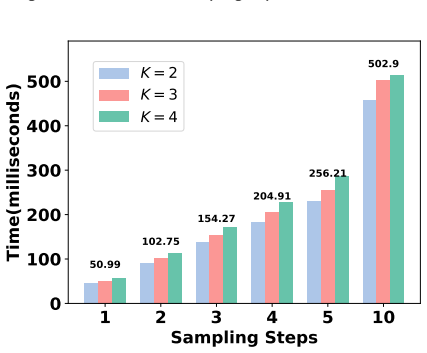
- Diffusion-based LLM recommendation can be more efficient than autoregressive discrete-token generation at the same tokenization setting, with competitive latency at 1-3 steps.
- The recipe of item-level semantic alignment followed by token-level preference denoising is a reusable curriculum for injecting out-of-vocabulary collaborative tokens into a pretrained language model.
Where Pith is reading between the lines
- The paper leaves implicit that its final accuracy is capped by the CAST codebook-decoder space: the diffusion model is only as good as the item similarities preserved in the discrete tokens, and tokenizer retrieval accuracy is never measured in isolation.
- Because performance peaks at 2-3 refinement steps, much of the gain may come from bidirectional context and the two-stage curriculum rather than from long denoising chains; a version with a single well-trained denoising pass might capture most of the benefit at lower inference cost.
- CAST's hop-wise stochastic quantization is a general way to discretize graph-based collaborative signals without imposing sequential order, and could be transplanted to other LLM tasks where input structure is order-insensitive.
- A testable extension: report Recall/NDCG with an oracle tokenizer that always emits ground-truth item tokens, separating generation quality from codebook quality; this would tell researchers where to invest next.
Editorial analysis
A structured set of objections, weighed in public.
Referee Report
Summary. The paper proposes DLMRec, a discrete diffusion language model for top-K recommendation. It replaces the autoregressive next-token paradigm with a masked-diffusion (absorbing-state) objective over a hybrid prompt consisting of CAST-discretized collaborative tokens and textual item descriptions. Three components are introduced: a collaborative-aware stochastic tokenizer (CAST) that quantizes multi-hop LightGCN embeddings into diffusion-compatible discrete codes; a two-stage curriculum training strategy with item-level then token-level masking plus a preference-aware ranking loss; and a voting-based iterative refinement procedure that stabilizes decoding. Experiments on LastFM, MovieLens-1M, and Amazon-Beauty compare DLMRec (LLaDA-8B backbone) against GNN, sequential, diffusion, and LLM baselines, reporting consistent gains in Recall@K and NDCG@K. The authors conclude that discrete diffusion language modeling is a compelling alternative to autoregressive generation for recommendation.
Significance. If the reported results hold, this is one of the first demonstrations that a diffusion language model at the 8B scale can match or exceed autoregressive LLM-based recommenders on standard benchmarks. The paper makes several concrete contributions that are valuable independent of the headline comparison: CAST is a principled attempt to make discrete tokenization compatible with bidirectional denoising; the curriculum from item-level to token-level masking is a sensible way to adapt a language-model objective to preference recovery; and the stability-aware voting mechanism is a reusable decoding strategy. The authors release code, use a leakage-aware Split-by-Timepoint protocol, evaluate under full ranking, and report five-run averages. The main scientific claim, however, requires a controlled comparison that isolates the generative paradigm from the pretrained backbone, which the current experimental design does not provide. The presence of impossible numbers in Table 2 further weakens confidence in the reported margins.
major comments (4)
- [§4.1.4, Table 2] The central claim — that discrete diffusion is a compelling alternative to autoregressive generation — is not supported by the main comparison because the generative paradigm is confounded with the backbone model. DLMRec uses LLaDA-8B-Base, while all LLM baselines use Llama-3-8B-Base. Any performance gap could reflect differences in pretraining data, architecture, or optimization rather than the diffusion vs. autoregressive formulation. The only attempt to control this is the preliminary MovieLens-1M experiment in Fig. 2, but that figure reports no numerical values, no error bars, and does not include the full DLMRec pipeline (CAST, curriculum masking, voting). Please provide a same-backbone controlled comparison — e.g., an autoregressive model trained on the same CAST tokens with the same prompt and LoRA setup, or a diffusion model built on Llama-3-8B — so that the paradigm is the only
- [Table 2] Table 2 contains at least two impossible entries that call the reliability of the reported numbers into question. TIGER on LastFM lists R@10 = 0.470 while R@20 = 0.0718, violating the monotonicity R@10 ≤ R@20. SASRec on MovieLens-1M lists N@10 = 0.882, which is implausibly high and inconsistent with its N@20 = 0.1001. These appear to be typographical errors (likely a missing decimal), but they undermine confidence in the table's accuracy. The authors must correct these entries and carefully re-verify all reported values, ideally against a released evaluation script.
- [§4.1.2, Table 2, Fig. 2] No error bars, standard deviations, or significance tests are reported for any result, despite the claim that results are averaged over five runs. Many of the headline improvements are small relative to the likely run-to-run variance (e.g., 3.25% NDCG@10 on ML-1M, 4.42% on Beauty). Without variance estimates or significance tests, a reader cannot distinguish a real effect from noise. This is particularly important for the central claim, since the comparison is confounded with the backbone. Please report per-metric standard deviations and, where appropriate, paired significance tests (e.g., paired t-test or Wilcoxon) across the five runs.
- [§3.4, Algorithm 3] The final prediction pipeline is a nearest-neighbor retrieval: the CAST token sequence is decoded into a continuous representation and matched against the item bank (Algorithm 3, lines 27-28). This means the end-to-end accuracy depends on whether the codebook-decoder space preserves fine-grained item similarity. The paper never evaluates the tokenizer in isolation — e.g., reconstruction retrieval accuracy of the CAST decoder, or token-prediction accuracy of the diffusion model against ground-truth token sequences. Without such measurements, it is unclear whether the observed gains come from the diffusion language model or from the quality of the discrete item representation space. Please add an analysis that separates tokenizer quality from generation quality (e.g., oracle tokenization upper bound, item-retrieval accuracy from reconstructed embeddings, and token-level accuracy of the dif
minor comments (7)
- [§4.1.4] Typo: 'DLRMRec' should be 'DLMRec' in the first line of the hyper-parameter section.
- [§4.4.1] The text says 'larger K=3 may over-fragment tokenization' but K=3 is the optimal setting; the phrasing is confusing. Also 'overly large codebooks as overly large codebooks' is duplicated.
- [§3.3.3] The hard-negative sentence 'we compute the similarity between ˆz and all items... and randomly sample one from the top-5 most similar most similar remaining candidates as as z neg' contains duplicated words. Please correct.
- [Fig. 2] The preliminary comparison figure lacks axis labels for the first subplot, no numerical values, and no measure of variability. If the authors intend Fig. 2 to support the backbone-controlled argument, it needs to be fully specified (dataset split, hyperparameters, exact metric values, standard deviation).
- [§4.5.2] The case study reports token distributions for only one dataset and one hop-wise configuration. It would be helpful to quantify 'broad codebook utilization' with an entropy or coverage metric rather than relying on visual inspection.
- [Algorithm 2] The pseudo-code evaluates early stopping at the end of each cycle (line 20-23), but the text in §3.3.3 describes alternating Stage 1 and Stage 2 over multiple cycles. Please clarify whether early stopping is applied per cycle or globally, and how validation is used to select hyperparameters like S, K, and L.
- [§5.2.2] The related-work discussion of LLaDA-Rec (Ref. [54]) is brief. Since LLaDA-Rec is a diffusion LLM baseline, it would be useful to state explicitly what backbone it uses in this paper's experiments and how it differs from DLMRec (especially given the backbone-confound concern).
Circularity Check
No material circularity: DLMRec is an empirical systems contribution whose components are evaluated on held-out interactions; no prediction reduces by construction to a fitted constant or load-bearing self-citation.
full rationale
DLMRec is an empirical systems paper. The central claim—that a discrete-diffusion LM backbone plus CAST tokenization, curriculum masking, and voting improves recommendation—is supported by held-out Recall/NDCG comparisons (Table 2), not by a derivation in which an output is defined as an input. CAST is trained with reconstruction, codebook, commitment, and contrastive losses over LightGCN embeddings (Eqs. 14–17); the diffusion model is trained with masked-token cross-entropy and a pairwise preference loss (Eqs. 8, 22–23); the final retrieval (Algorithm 3) is a nearest-neighbor lookup in the same embedding bank. These are standard autoencoding/ranking objectives, and the test-time retrieval is not the same object as any fitted parameter: target tokens must be predicted from a user's history, and evaluation is on interactions not used in training. Hyperparameters (K, L, S, temperatures, thresholds) are tuned on validation, which is normal. Self-citations to TokenRec, CDRec, and related work are to baselines and context; none is a load-bearing uniqueness theorem or a smuggled ansatz. The LLaDA-vs-Llama backbone mismatch is a genuine external-validity confound for the 'diffusion vs AR' attribution, and the missing tokenizer-retrieval diagnostic is a limitation, but neither is a circular reduction under the rubric.
Axiom & Free-Parameter Ledger
free parameters (11)
- K (number of sub-codebooks) =
3
- L (codewords per sub-codebook) =
varies by dataset (e.g., larger for Amazon-Beauty)
- Top-S candidate size for stochastic assignment =
2
- Temperature schedule tau_min, tau_max, alpha (Eq. 12) =
tau_min/tau_max tuned from {0.05,0.5}/{0.1,1.0}; alpha=1.1
- Curriculum strength lambda for item-token and text blocks (Eq. 18) =
not reported
- Preference loss weight w_pref (Eq. 23) =
not reported
- Balancing coefficients lambda_cm, lambda_cl (Eq. 17) =
not reported
- User guidance weight lambda and mixing threshold tau (Eqs. 25-26) =
tau tuned from {0.1,0.3,0.5}; lambda not reported
- Stability confidence threshold gamma (Eq. 27) =
not reported
- Refinement steps S and maximum diffusion steps T =
optimal S = 2-3 depending on dataset
- Curriculum training cycles C, epochs N and M (Algorithm 2) =
not reported
axioms (4)
- domain assumption Multi-hop LightGCN embeddings (Eqs. 9-10) encode collaborative semantics that can be discretized into K independent codebook tokens without losing information needed for preference modeling.
- domain assumption The masked diffusion objective (Eq. 8) with an absorbing [M] state is a suitable surrogate for recovering user preferences from masked item tokens.
- ad hoc to paper The user-conditioned prior embedding b^(k) = e_mask + lambda e_u^(k) (Eq. 25) is a valid DLM input that helps denoising, and training with this same embedding ensures train-inference consistency.
- domain assumption Nearest-neighbor retrieval over the item bank Q using the decoded representation z_hat (Algorithm 3, lines 27-28) recovers the correct item if the token sequence is correct.
invented entities (2)
-
Hop-wise discrete collaborative tokens from CAST
no independent evidence
-
User-conditioned prior embedding b^(k)
no independent evidence
read the original abstract
Large language model (LLM)-empowered recommender systems have emerged as a promising paradigm for generative recommendation, leveraging their strong semantic reasoning and generative capacity to model complex, diverse user preferences. However, most existing approaches rely on an autoregressive paradigm that is suboptimal for recommendation. The next-token objective emphasizes sequential order rather than the structural inter-item dependencies underlying user preferences. In addition, prefix-constrained generation restricts bidirectional context and commits to left-to-right decoding, causing early errors to accumulate without correction. Inspired by the success of diffusion language models, we propose \textbf{DLMRec}, a discrete diffusion language model tailored for recommendation that offers a compelling alternative to autoregressive generation. Specifically, DLMRec introduces three key components to bridge diffusion language modeling with recommendation. First, a collaborative-aware stochastic tokenizer encodes multi-hop collaborative signals into expressive discrete tokens compatible with diffusion modeling. Second, a curriculum-driven training strategy aligns the denoising process with preference recovery through progressive item- and token-level learning. Third, a stability-aware voting mechanism aggregates iterative predictions to improve generation consistency and robustness.
Figures


Reference graph
Works this paper leans on
-
[1]
Josh Achiam, Steven Adler, Sandhini Agarwal, Lama Ahmad, Ilge Akkaya, Florencia Leoni Aleman, Diogo Almeida, Janko Altenschmidt, Sam Altman, Shyamal Anadkat, et al. 2023. Gpt-4 technical report.arXiv preprint arXiv:2303.08774(2023)
Pith/arXiv arXiv 2023
-
[2]
Jacob Austin, Daniel D Johnson, Jonathan Ho, Daniel Tarlow, and Rianne Van Den Berg. 2021. Structured denoising diffusion models in discrete state-spaces.Proc. Adv. Neural Inf. Process. Syst.34 (2021), 17981–17993
2021
-
[3]
Keqin Bao, Jizhi Zhang, Yang Zhang, Wenjie Wang, Fuli Feng, and Xiangnan He. 2023. Tallrec: An effective and efficient tuning framework to align large language model with recommendation. InProc. 17th ACM Conf. Recomm. Syst.1007–1014
2023
-
[4]
Andrew Campbell, Joe Benton, Valentin De Bortoli, Thomas Rainforth, George Deligiannidis, and Arnaud Doucet. 2022. A continuous time framework for discrete denoising models.Proc. Adv. Neural Inf. Process. Syst.35 (2022), 28266–28279
2022
-
[5]
Xiao Chen et al. 2023. Fairly adaptive negative sampling for recommendations. InProc. World Wide Web Conf.3723–3733
2023
-
[6]
Jeongwhan Choi, Seoyoung Hong, Noseong Park, and Sung-Bae Cho. 2023. Blurring-sharpening process models for collaborative filtering. InProc. 46th Int. ACM SIGIR Conf. Res. Develop. Inf. Retrieval. 1096–1106
2023
-
[7]
Jiaxin Deng, Shiyao Wang, Kuo Cai, Lejian Ren, Qigen Hu, Weifeng Ding, Qiang Luo, and Guorui Zhou. 2025. Onerec: Unifying retrieve and rank with generative recommender and iterative preference alignment.arXiv preprint arXiv:2502.18965(2025)
Pith/arXiv arXiv 2025
-
[8]
Wenqi Fan, Yujuan Ding, Liangbo Ning, Shijie Wang, Hengyun Li, Dawei Yin, Tat-Seng Chua, and Qing Li. 2024. A survey on rag meeting llms: Towards retrieval-augmented large language models. InProc. ACM SIGKDD Int. Conf. Knowl. Discov. Data Min.6491–6501
2024
-
[9]
Wenqi Fan, Xiaorui Liu, Wei Jin, Xiangyu Zhao, Jiliang Tang, and Qing Li. 2022. Graph trend filtering networks for recommendation. InProc. 45th Int. ACM SIGIR Conf. Res. Develop. Inf. Retrieval. 112–121
2022
-
[10]
Wenqi Fan, Yao Ma, Qing Li, Yuan He, Eric Zhao, Jiliang Tang, and Dawei Yin. 2019. Graph neural networks for social recommendation. InProc. World Wide Web Conf.417–426
2019
-
[11]
Wenqi Fan, Yao Ma, Qing Li, Jianping Wang, Guoyong Cai, Jiliang Tang, and Dawei Yin. 2020. A graph neural network framework for social recommendations.IEEE Trans. Knowl. Data Eng.34, 5 (2020), 2033–2047
2020
-
[12]
Mengyao Gao, Chongming Gao, Haoyan Liu, Qingpeng Cai, Peng Jiang, Jiajia Chen, Shuai Yuan, and Xiangnan He. 2025. MindRec: A Diffusion-driven Coarse-to-Fine Paradigm for Generative Recommendation.arXiv preprint arXiv:2511.12597(2025)
arXiv 2025
-
[13]
Shijie Geng, Shuchang Liu, Zuohui Fu, Yingqiang Ge, and Yongfeng Zhang. 2022. Recommendation as language processing (rlp): A unified pretrain, personalized prompt & predict paradigm (p5). InProc. 16th 12th ACM Conf. Recomm. Syst.299–315
2022
-
[14]
Shansan Gong, Mukai Li, Jiangtao Feng, Zhiyong Wu, and LingPeng Kong. 2022. Diffuseq: Sequence to sequence text generation with diffusion models.arXiv preprint arXiv:2210.08933(2022)
Pith/arXiv arXiv 2022
-
[15]
Xiaochuang Han, Sachin Kumar, and Yulia Tsvetkov. 2023. Ssd-lm: Semi-autoregressive simplex-based diffusion language model for text generation and modular control. InProc. Annu. Meet. Assoc. Comput. Linguist.11575–11596
2023
-
[16]
Xiangnan He, Kuan Deng, Xiang Wang, Yan Li, Yongdong Zhang, and Meng Wang. 2020. Lightgcn: Simplifying and powering graph convolution network for recommendation. InProc. 43rd Int. ACM SIGIR Conf. Res. Develop. Inf. Retrieval. 639–648
2020
-
[17]
Xin He, Wenqi Fan, Yili Wang, Chengyi Liu, Rui Miao, Xin Juan, and Xin Wang. 2026. Graph defense diffusion model. InProc. ACM SIGKDD Int. Conf. Knowl. Discov. Data Min.416–427
2026
-
[18]
Zhengfu He, Tianxiang Sun, Qiong Tang, Kuanning Wang, Xuan-Jing Huang, and Xipeng Qiu. 2023. Diffusionbert: Improving generative masked language models with diffusion models. InProc. Annu. Meet. Assoc. Comput. Linguist.4521–4534
2023
-
[19]
Jonathan Ho, Ajay Jain, and Pieter Abbeel. 2020. Denoising diffusion probabilistic models.Proc. Adv. Neural Inf. Process. Syst.33 (2020), 6840–6851
2020
-
[20]
Yupeng Hou, An Zhang, Leheng Sheng, Jiancan Wu, Xiang Wang, Tat-Seng Chua, and Julian McAuley. 2025. Towards Large Generative Recommen- dation: A Tokenization Perspective. InProc. 34th ACM Int. Conf. Inf. Knowl. Manag.6821–6824
2025
-
[21]
Edward J Hu, Yelong Shen, Phillip Wallis, Zeyuan Allen-Zhu, Yuanzhi Li, Shean Wang, Liang Wang, Weizhu Chen, et al. 2022. Lora: Low-rank adaptation of large language models.. InProc. 10th Int. Conf. Learn. Represent., Vol. 1. 12513–12525
2022
-
[22]
Guoqing Hu, An Zhang, Shuchang Liu, Wenyu Mao, Jiancan Wu, Xun Yang, Xiang Li, Lantao Hu, Han Li, et al. 2026. Fading to Grow: Growing Preference Ratios via Preference Fading Discrete Diffusion for Recommendation.Proc. Adv. Neural Inf. Process. Syst.38 (2026), 135766–135804
2026
-
[23]
Wenyue Hua, Shuyuan Xu, Yingqiang Ge, and Yongfeng Zhang. 2023. How to index item ids for recommendation foundation models. InProceedings of the Annual International ACM SIGIR Conference on Research and Development in Information Retrieval in the Asia Pacific Region. 195–204
2023
-
[24]
Jiani Huang, Shijie Wang, Liangbo Ning, Wenqi Fan, Shuaiqiang Wang, Dawei Yin, and Qing Li. 2026. Towards next-generation recommender systems: A benchmark for personalized recommendation assistant with llms. InProc. 19th ACM Int. Conf. Web Search Data Mining. 217–226
2026
-
[25]
Daniel Mingyi Israel, Aditya Grover, and Guy Van den Broeck. 2026. Enabling autoregressive models to fill in masked tokens. InFindings of the Association for Computational Linguistics: EACL 2026. 4954–4965
2026
-
[26]
Yitong Ji, Aixin Sun, Jie Zhang, and Chenliang Li. 2023. A critical study on data leakage in recommender system offline evaluation.ACM Trans. Inf. Syst.41, 3 (2023), 1–27
2023
-
[27]
Jaehyeong Jo and Sung Ju Hwang. 2026. Continuous diffusion model for language modeling.Proc. Adv. Neural Inf. Process. Syst.38 (2026), 97394–97430
2026
-
[28]
Wang-Cheng Kang and Julian McAuley. 2018. Self-attentive sequential recommendation. In2018 IEEE international conference on data mining (ICDM). IEEE, 197–206. Manuscript submitted to ACM Diffusion Language Model for Recommendation 29
2018
-
[29]
Inception Labs, Samar Khanna, Siddhant Kharbanda, Shufan Li, Harshit Varma, Eric Wang, Sawyer Birnbaum, Ziyang Luo, Yanis Miraoui, Akash Palrecha, et al. 2025. Mercury: Ultra-Fast Language Models Based on Diffusion.arXiv preprint arXiv:2506.17298(2025)
Pith/arXiv arXiv 2025
-
[30]
Gen Li and Changxiao Cai. 2025. Breaking AR’s Sampling Bottleneck: Provable Acceleration via Diffusion Language Models. InProc. Adv. Neural Inf. Process. Syst
2025
-
[31]
Tianyi Li, Mingda Chen, Bowei Guo, and Zhiqiang Shen. 2025. A survey on diffusion language models.arXiv preprint arXiv:2508.10875(2025)
Pith/arXiv arXiv 2025
-
[32]
Xinhang Li, Chong Chen, Xiangyu Zhao, Yong Zhang, and Chunxiao Xing. 2023. E4srec: An elegant effective efficient extensible solution of large language models for sequential recommendation.arXiv preprint arXiv:2312.02443(2023)
Pith/arXiv arXiv 2023
-
[33]
Xiang Li, John Thickstun, Ishaan Gulrajani, Percy S Liang, and Tatsunori B Hashimoto. 2022. Diffusion-lm improves controllable text generation. Proc. Adv. Neural Inf. Process. Syst.35 (2022), 4328–4343
2022
-
[34]
Yifan Li, Kun Zhou, Wayne Xin Zhao, and Ji-Rong Wen. 2023. Diffusion models for non-autoregressive text generation: A survey.arXiv preprint arXiv:2303.06574(2023)
Pith/arXiv arXiv 2023
-
[35]
Jiayi Liao, Sihang Li, Zhengyi Yang, Jiancan Wu, Yancheng Yuan, Xiang Wang, and Xiangnan He. 2024. Llara: Large language-recommendation assistant. InProc. 47th Int. ACM SIGIR Conf. Res. Develop. Inf. Retrieval. 1785–1795
2024
-
[36]
Xiao Lin, Xiaokai Chen, Chenyang Wang, Hantao Shu, Linfeng Song, Biao Li, and Peng Jiang. 2024. Discrete conditional diffusion for reranking in recommendation. InCompanion proceedings of the ACM web conference 2024. 161–169
2024
-
[37]
Chengyi Liu et al. 2025. Score-based generative diffusion models for social recommendations.IEEE Trans. Knowl. Data Eng.(2025)
2025
-
[38]
Chengyi Liu, Xiao Chen, Shijie Wang, Wenqi Fan, and Qing Li. 2026. Continuous-time Discrete-space Diffusion Model for Recommendation. InProc. 19th ACM Int. Conf. Web Search Data Mining. 406–415
2026
-
[39]
Shuo Liu, An Zhang, Guoqing Hu, Hong Qian, and Tat-Seng Chua. 2025. Preference Diffusion for Recommendation. InProc. 13th Int. Conf. Learn. Represent.11043–11081
2025
-
[40]
Aaron Lou, Chenlin Meng, and Stefano Ermon. 2024. Discrete Diffusion Modeling by Estimating the Ratios of the Data Distribution. InProc. Int. Conf. Mach. Learn
2024
-
[41]
Lingyu Mu, Hao Deng, Haibo Xing, Jinxin Hu, Yu Zhang, Xiaoyi Zeng, and Jing Zhang. 2026. Masked Diffusion Generative Recommendation.arXiv preprint arXiv:2601.19501(2026)
arXiv 2026
-
[42]
Jinjie Ni, Qian Liu, Longxu Dou, Chao Du, Zili Wang, Hang Yan, Tianyu Pang, and Michael Qizhe Shieh. 2025. Diffusion language models are super data learners.arXiv preprint arXiv:2511.03276(2025)
arXiv 2025
-
[43]
Shen Nie, Fengqi Zhu, Chao Du, Tianyu Pang, Qian Liu, Guangtao Zeng, Min Lin, and Chongxuan Li. 2025. Scaling up Masked Diffusion Models on Text. InProc. 13th Int. Conf. Learn. Represent.92913–92936
2025
-
[44]
Shen Nie, Fengqi Zhu, Zebin You, Xiaolu Zhang, Jingyang Ou, Jun Hu, JUN ZHOU, Yankai Lin, Ji-Rong Wen, and Chongxuan Li. 2025. Large Language Diffusion Models. InProc. Adv. Neural Inf. Process. Syst
2025
-
[45]
Liangbo Ning, Wenqi Fan, and Qing Li. 2026. Retrieval-augmented purifier for robust LLM-empowered recommendation.ACM Trans. Inf. Syst.44, 4 (2026), 1–42
2026
-
[46]
Liang-Bo Ning, Yuchen Zhu, Heqing Huang, Xin Wang, Yi Chang, Qing Li, and Wenqi Fan. 2026. When Efficiency Becomes a Vulnerability: Computational Cost Attacks on WebAgents. InProc. Annu. Meet. Assoc. Comput. Linguist.38315–38335
2026
-
[47]
Mihir Prabhudesai, Mengning Wu, Amir Zadeh, Katerina Fragkiadaki, and Deepak Pathak. 2025. Diffusion Beats Autoregressive in Data-Constrained Settings. InProc. Adv. Neural Inf. Process. Syst
2025
-
[48]
Patrick Pynadath, Jiaxin Shi, and Ruqi Zhang. 2025. Candi: Hybrid discrete-continuous diffusion models.arXiv preprint arXiv:2510.22510(2025)
Pith/arXiv arXiv 2025
-
[49]
Hang Qi et al . 2025. A comparative trade-off analysis on accuracy and efficiency for federated learning in demand forecasting.Applied Soft Computing182 (2025), 113561
2025
-
[50]
Haohao Qu, Wenqi Fan, Zihuai Zhao, and Qing Li. 2025. TokenRec: Learning to Tokenize ID for LLM-Based Generative Recommendations.IEEE Trans. Knowl. Data Eng.37, 10 (2025), 6216–6231. doi:10.1109/TKDE.2025.3599265
arXiv 2025
-
[51]
Haohao Qu, Shanru Lin, Yujuan Ding, Yiqi Wang, and Wenqi Fan. 2026. Diffusion Generative Recommendation with Continuous Tokens. InProc. World Wide Web Conf.(United Arab Emirates)(WWW ’26). Association for Computing Machinery, New York, NY, USA, 7259–7270
2026
-
[52]
Shashank Rajput, Nikhil Mehta, Anima Singh, Raghunandan Hulikal Keshavan, Trung Vu, Lukasz Heldt, Lichan Hong, Yi Tay, Vinh Tran, Jonah Samost, et al. 2023. Recommender systems with generative retrieval.Proc. Adv. Neural Inf. Process. Syst.36 (2023), 10299–10315
2023
-
[53]
Subham S Sahoo, Marianne Arriola, Yair Schiff, Aaron Gokaslan, Edgar Marroquin, Justin T Chiu, Alexander Rush, and Volodymyr Kuleshov. 2024. Simple and effective masked diffusion language models.Proc. Adv. Neural Inf. Process. Syst.37 (2024), 130136–130184
2024
-
[54]
Teng Shi, Chenglei Shen, Weijie Yu, Shen Nie, Chongxuan Li, Xiao Zhang, Ming He, Yan Han, and Jun Xu. 2025. LLaDA-Rec: Discrete Diffusion for Parallel Semantic ID Generation in Generative Recommendation.arXiv preprint arXiv:2511.06254(2025)
arXiv 2025
-
[55]
Yuxuan Song, Zheng Zhang, Cheng Luo, Pengyang Gao, Fan Xia, Hao Luo, Zheng Li, Yuehang Yang, Hongli Yu, Xingwei Qu, et al. 2025. Seed diffusion: A large-scale diffusion language model with high-speed inference.arXiv preprint arXiv:2508.02193(2025)
Pith/arXiv arXiv 2025
-
[56]
Fei Sun, Jun Liu, Jian Wu, Changhua Pei, Xiao Lin, Wenwu Ou, and Peng Jiang. 2019. BERT4Rec: Sequential recommendation with bidirectional encoder representations from transformer. InProc. 28th ACM Int. Conf. Inf. Knowl. Manag.1441–1450
2019
-
[57]
Haoran Sun, Lijun Yu, Bo Dai, Dale Schuurmans, and Hanjun Dai. 2023. Score-based Continuous-time Discrete Diffusion Models. InProc. 11th Int. Conf. Learn. Represent.30767–30782
2023
-
[58]
Sho Takase and Sosuke Kobayashi. 2020. All word embeddings from one embedding.Proc. Adv. Neural Inf. Process. Syst.33 (2020), 3775–3785. Manuscript submitted to ACM 30 Liu et al
2020
-
[59]
Hugo Touvron, Thibaut Lavril, Gautier Izacard, Xavier Martinet, Marie-Anne Lachaux, Timothée Lacroix, Baptiste Rozière, Naman Goyal, Eric Hambro, Faisal Azhar, et al. 2023. Llama: Open and efficient foundation language models.arXiv preprint arXiv:2302.13971(2023)
Pith/arXiv arXiv 2023
-
[60]
Aaron Van Den Oord, Oriol Vinyals, et al. 2017. Neural discrete representation learning.Proc. Adv. Neural Inf. Process. Syst.30 (2017)
2017
-
[61]
Shijie Wang, Wenqi Fan, Yue Feng, Lin Shanru, Xinyu Ma, Shuaiqiang Wang, and Dawei Yin. 2025. Knowledge graph retrieval-augmented generation for llm-based recommendation. InProc. Annu. Meet. Assoc. Comput. Linguist.27152–27168
2025
-
[62]
Shijie Wang, Chengyi Liu, Yujuan Ding, Shanru Lin, See-Kiong Ng, Xu Xin, and Wenqi Fan. 2026. Mixture-of-Experts Knowledge Graph Retrieval- Augmented Generation for Multi-Agent LLM-based Recommendation.arXiv preprint arXiv:2605.28175(2026)
Pith/arXiv arXiv 2026
-
[63]
Wenjie Wang, Honghui Bao, Xinyu Lin, Jizhi Zhang, Yongqi Li, Fuli Feng, See-Kiong Ng, and Tat-Seng Chua. 2024. Learnable item tokenization for generative recommendation. InProc. 33rd ACM Int. Conf. Inf. Knowl. Manag.2400–2409
2024
-
[64]
Wenjie Wang, Yiyan Xu, Fuli Feng, Xinyu Lin, Xiangnan He, and Tat-Seng Chua. 2023. Diffusion recommender model. InProc. 46th Int. ACM SIGIR Conf. Res. Develop. Inf. Retrieval. 832–841
2023
-
[65]
Xu Wang et al. 2025. Diffusion llms can do faster-than-ar inference via discrete diffusion forcing.arXiv preprint arXiv:2508.09192(2025)
Pith/arXiv arXiv 2025
-
[66]
Xiang Wang, Xiangnan He, Meng Wang, Fuli Feng, and Tat-Seng Chua. 2019. Neural graph collaborative filtering. InProc. 46th Int. ACM SIGIR Conf. Res. Develop. Inf. Retrieval. 165–174
2019
-
[67]
Jiancan Wu, Xiang Wang, Fuli Feng, Xiangnan He, Liang Chen, Jianxun Lian, and Xing Xie. 2021. Self-supervised graph learning for recommendation. InProc. 44th Int. ACM SIGIR Conf. Res. Develop. Inf. Retrieval. 726–735
2021
-
[68]
Likang Wu, Zhi Zheng, Zhaopeng Qiu, Hao Wang, Hongchao Gu, Tingjia Shen, Chuan Qin, Chen Zhu, Hengshu Zhu, Qi Liu, et al. 2024. A survey on large language models for recommendation. InProc. World Wide Web Conf., Vol. 27. Springer, 60
2024
-
[69]
Yao Wu, Chengyi Liu, Wenqi Fan, and Rui Zhang. 2026. Beyond Static Diffusion: Explicitly Modeling Temporal Patterns in Sequential Recommendation. InProc. 49th Int. ACM SIGIR Conf. Res. Develop. Inf. Retrieval. 1983–1993
2026
-
[70]
Wenjia Xie, Hao Wang, Luankang Zhang, Rui Zhou, Defu Lian, and Enhong Chen. 2024. Breaking determinism: Fuzzy modeling of sequential recommendation using discrete state space diffusion model.Proc. Adv. Neural Inf. Process. Syst.37 (2024), 22720–22744
2024
-
[71]
Zhe Xu, Ruizhong Qiu, Yuzhong Chen, Huiyuan Chen, Xiran Fan, Menghai Pan, Zhichen Zeng, Mahashweta Das, and Hanghang Tong. 2024. Discrete-state continuous-time diffusion for graph generation.Proc. Adv. Neural Inf. Process. Syst.37 (2024), 79704–79740
2024
-
[72]
Yuhao Yang, Chao Huang, Lianghao Xia, Chunzhen Huang, Da Luo, and Kangyi Lin. 2023. Debiased contrastive learning for sequential recommen- dation. InProc. World Wide Web Conf.1063–1073
2023
-
[73]
Zhengyi Yang, Jiancan Wu, Zhicai Wang, Xiang Wang, Yancheng Yuan, and Xiangnan He. 2023. Generate what you prefer: Reshaping sequential recommendation via guided diffusion.Proc. Adv. Neural Inf. Process. Syst.36 (2023), 24247–24261
2023
-
[74]
Jiacheng Ye et al. 2025. Dream 7b: Diffusion large language models.arXiv preprint arXiv:2508.15487(2025)
Pith/arXiv arXiv 2025
-
[75]
Yushi Ye, Feng Hong, Huangjie Zheng, Xu Chen, Zhiyong Chen, Yanfeng Wang, and Jiangchao Yao. 2026. Rejection Mixing: Fast Semantic Propagation of Mask Tokens for Efficient DLLM Inference. InICLR Workshop on DeLTa
2026
-
[76]
Haonan Yuan, Qingyun Sun, Junhua Shi, Xingcheng Fu, Bryan Hooi, Jianxin Li, and Philip S Yu. 2026. GRAVER: Generative graph vocabularies for robust graph foundation models fine-tuning.Proc. Adv. Neural Inf. Process. Syst.38 (2026), 16639–16684
2026
-
[77]
Jiahao Zhang, Rui Xue, Wenqi Fan, Xin Xu, Qing Li, Jian Pei, and Xiaorui Liu. 2024. Linear-time graph neural networks for scalable recommendations. InProc. World Wide Web Conf.3533–3544
2024
-
[78]
Siyue Zhang, Yilun Zhao, Liyuan Geng, Arman Cohan, Luu Anh Tuan, and Chen Zhao. 2025. Diffusion vs. autoregressive language models: A text embedding perspective. InConf. Empir. Methods Nat. Lang. Process.4273–4303
2025
-
[79]
Yang Zhang, Fuli Feng, Jizhi Zhang, Keqin Bao, Qifan Wang, and Xiangnan He. 2025. Collm: Integrating collaborative embeddings into large language models for recommendation.IEEE Trans. Knowl. Data Eng.(2025)
2025
-
[80]
Wenhao Zhao, Qiran Zou, Zhouhan Lin, and Dianbo Liu. 2026. Mitigating Premature Discretization with Progressive Quantization for Robust Vector Tokenization.arXiv preprint arXiv:2603.22304(2026)
arXiv 2026
discussion (0)
Sign in with ORCID, Apple, or X to comment. Anyone can read and Pith papers without signing in.