REVIEW 4 major objections 5 minor 23 references
GRACE estimates the mean of a cost-conditioned guidance posterior at each reverse-diffusion step from cost-weighted MPPI rollouts, so binary collision checks and joint limits can steer a pretrained diffusion policy with no gradients and no
Reviewed by Pith at T0; open to challenge. T0 means a machine referee read the full paper against a public rubric. the ladder, T0–T4 →
T0 review · deepseek-v4-flash
2026-08-01 09:22 UTC pith:X3XUENRY
load-bearing objection GRACE is a genuine incremental contribution—gradient-free diffusion guidance via in-loop MPPI mean estimation—but the unquantified exploration-kernel approximation and partially confounded experiments keep it short of a strong accept. the 4 major comments →
GRACE: Gradient-Free Robot Action Generation via Combined Diffusion-MPPI Posterior Mean Estimation
The pith
A machine-rendered reading of the paper's core claim, the machinery that carries it, and where it could break.
Core claim
GRACE's central claim is that at every reverse step i, the mean of the cost-conditioned guidance posterior — the Boltzmann-reweighted exploration kernel centered at the diffusion reverse mean with an inflated guidance covariance — can be estimated by K cost-weighted MPPI rollouts, and that this estimated mean, plugged into a projected reverse kernel with the schedule covariance, defines a valid guided denoising step. Under a first-order cost approximation and matched covariance, the estimated mean collapses to the classic gradient-guided update, positioning GRACE as a generalization of gradient guidance rather than a departure from it. The paper reports that this posterior-mean guidance pres
What carries the argument
The central object is the exploration-kernel guidance posterior, proportional to the Boltzmann cost weight times a Gaussian centered at the diffusion reverse mean with an inflated guidance covariance. GRACE projects this posterior onto a Gaussian with the schedule covariance by forward KL divergence, which reduces the projection to matching the first moment of the posterior. That first moment is a ratio of cost-weighted expectations under the exploration kernel, exactly the MPPI update form, and is estimated with K sampled rollouts. The estimated mean then centers the projected reverse kernel from which the next denoising iterate is sampled, transferring cost information through the mean whi
Load-bearing premise
The load-bearing assumption is that reweighting rollouts drawn from a widened Gaussian around the diffusion reverse mean faithfully approximates the true reverse-step conditional distribution of the diffusion model, even though the widening changes the conditioning distribution itself and no bound on the divergence between the two posteriors is given.
What would settle it
Compute the exact mean of the guidance posterior for a quadratic cost, where the integral is closed-form, and compare it to GRACE's Monte Carlo estimate with large K: if the estimates do not track the exact mean as the guidance covariance grows, the surrogate posterior is not the posterior the method claims to estimate. Alternatively, in a narrow-gap planning task, increase the guidance covariance until most rollouts collide; if success rate does not collapse, the mean-shift mechanism is not responsible for the reported avoidance.
If this is right
- Deployment-time obstacles, binary collision checks, and joint-limit constraints can be imposed on a pretrained diffusion policy using only forward cost evaluations, eliminating the need for differentiable surrogate costs or retraining.
- For differentiable costs, GRACE recovers conventional gradient guidance as a first-order, matched-covariance special case, so it does not sacrifice the established behavior of gradient-guided diffusion when gradients are available.
- Because the guidance machinery keeps the diffusion schedule covariance in the sampling step, the multimodal structure of the learned prior is preserved rather than collapsed onto a single solution.
- In simulation, GRACE attains the highest success rates among diffusion-based and sampling-based planners while keeping guidance computation lower than gradient-guided baselines.
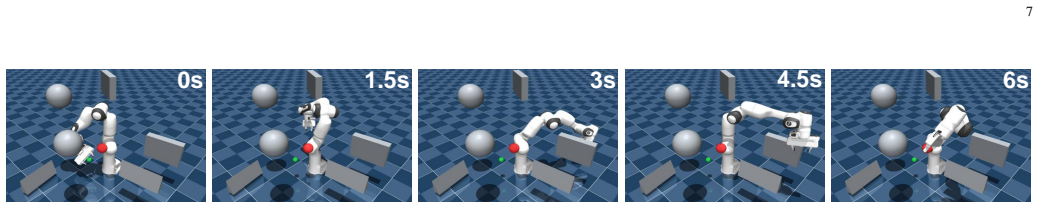
- On a physical 7-DoF manipulator, the method converted a policy that collided with a deployment-time obstacle in every trial into one that cleared the obstacle in all ten trials, with a single placement inaccuracy.
Where Pith is reading between the lines
- A natural extension the paper leaves implicit is to let the guidance covariance vary per step as a function of the schedule covariance; the paper does not provide a sensitivity analysis, so tuning this inflation is currently an empirical question.
- The averaging mechanism suggests a failure mode: when every rollout at a reverse step intersects an obstacle, the cost-weighted mean can remain in collision, which the paper notes; a robust estimator that keeps a fraction of samples outside the mode might extend GRACE to heavier clutter.
- Because GRACE's derivation needs only the score-ascent correspondence, the same posterior-mean scheme could in principle be applied to any generative model whose reverse step is a Gaussian kernel, including latent action spaces or hierarchical diffusion policies.
- The theoretical recovery of gradient guidance only holds in the infinite-sample, first-order limit; in finite-sample settings the divergence between the estimated mean and the true conditional mean under the diffusion reverse kernel is unquantified, which suggests a benchmark where quadratic costs allow the true posterior mean to be computed and compared.
Editorial analysis
A structured set of objections, weighed in public.
Referee Report
Summary. The paper proposes GRACE, an inference-time guidance method for pretrained diffusion policies. At each reverse step, it samples K rollouts from a Gaussian N(μ_i, Σ_g^i) centered at the diffusion reverse mean, weights them by exp(−J/λ) for a deployment-time cost J, estimates the mean of the resulting 'guidance posterior', and uses that mean to parameterize a projected reverse kernel with the schedule covariance Σ_i. For differentiable costs, it claims to recover one-step gradient guidance in a first-order, matched-covariance limit. Experiments in 2D and 3D simulation and on a real 7-DoF FR3 manipulator report higher success rates than gradient-guided and sampling-based baselines.
Significance. The problem is timely: injecting nondifferentiable deployment-time constraints into pretrained diffusion policies without retraining is practically important, and the MPPI-based mean estimator plus the gradient-recovery argument are clean and well presented. The paper ships code and videos and compares against several external baselines. However, the load-bearing exploration-kernel substitution is an approximation with no quantified error, and the empirical comparisons as presented do not cleanly isolate the guidance mechanism. The contribution is therefore a promising heuristic with a partially supported empirical claim, not yet a fully established method.
major comments (4)
- [§III-B, Eqs. (26)–(30)] The 'guidance posterior' ρ_i is the posterior under the inflated exploration kernel r_g, not under the diffusion reverse kernel p_θ. Since Σ_g^i is inflated precisely where Σ_i→0, the estimated mean is the mean of a different, broader posterior. The paper offers no divergence bound or sensitivity analysis for Σ_g; the exact case Σ_g=Σ_i is not the operating regime. This makes the theoretical claims in §III-C and the multimodality-preservation claim properties of a surrogate. Please add an analysis or ablation, or reframe the method as defining a new guided kernel rather than estimating the true reverse-step posterior.
- [§IV-A, Table III] The 3D comparison confounds algorithm with cost-model fidelity: gradient-guided baselines use a smoothed approximate geometry, while GRACE uses the exact geometry with the binary and soft-penetration terms. The larger success rate (27/30 vs. 15/30 for GG-DP) may therefore reflect the better cost model rather than the guidance mechanism. Include a controlled comparison in which all methods share the same cost geometry, or a version of GG-DP using the same exact-geometry cost, and report uncertainty.
- [§IV-B, Table II] The 2D advantage over the main gradient-guided baseline is not statistically significant: GRACE (UNet) 25/30 vs. GG-DP 18/30, Fisher exact p≈0.14; the 95% CI for the difference includes 0. The significant comparison with MPPI/CEM/DA-MPPI does not isolate the guidance mechanism because those methods lack the learned prior and use a different goal cost. Present confidence intervals/hypothesis tests and either more trials or tempered claims.
- [§III-D, Eq. (39)] The 'recovery' of gradient guidance is derived only in the matched-covariance limit Σ_g^i=Σ_i, which is not what Algorithm 1 uses (Σ_g^i is inflated). Thus Eq. (39) is a limiting special case and does not characterize the actual guided kernel. This should be stated explicitly to avoid implying that the theoretical result explains the method's behavior in its operating regime.
minor comments (5)
- [§III-A, Eq. (18)] The approximate score-ascent form drops a (β/2)U term from the exact DDPM mean. Please state the small-β assumption or include the term.
- [§IV-A] The sentence 'sampling-based methods ... evaluate the exact geometry through the binary term alone' is ambiguous in relation to J_obs in Eq. (40), which also contains a soft-penetration term. Clarify which methods use which cost terms in 3D.
- [§IV-B, Fig. 4a] Mode counts are reported without error bars or a statistical test; the comparison would be stronger with repeated seeds or a diversity metric with variance.
- [Table III] Clarify what 'Guidance Time' includes for baselines and whether the same parallelization was used for all methods.
- [§II-B, Eq. (12)] The notation E_{N(U,Σ)}[·] is nonstandard; define the expectation direction explicitly.
Circularity Check
No significant circularity: GRACE's derivation constructs a surrogate guidance posterior and estimates its mean; the central comparisons are external and no self-citation chain is load-bearing.
full rationale
The derivation chain is self-contained. The paper starts from Bayes' rule (Eqs. 24-25), introduces an exploration kernel r_g^(i) with an explicitly chosen covariance (Eq. 28), defines the guidance posterior ρ_i as the Boltzmann-reweighted version of that kernel (Eq. 30), and then shows that the mean of ρ_i equals the MPPI importance-weighted ratio (Eqs. 33-34) and estimates it by Monte Carlo (Algorithm 1). This is a constructive identity, not a circular prediction: ρ_i is introduced as a surrogate and is not asserted to equal the true reverse-step posterior p(U^(i-1)|U^(i),C); the paper states that when Σ_g^(i) ≠ Σ^(i) the exploration kernel is a broadened version of the diffusion kernel (Eq. 29). The gradient-guidance recovery (Eqs. 38-39) is a Taylor-expansion special case, not an input assumption. There are no self-citations or imported uniqueness theorems; the comparisons are against external baselines (CEM, MPPI, DA-MPPI, PO-DP, GG-DP, Diffusion-ES) and an unguided prior on hardware. The only definitional aspect is that the guidance posterior is chosen so that its mean is the MPPI update, but that is a design choice with independent empirical evaluation, not a result that reduces to its own input. The acknowledged averaging limitation when all rollouts collide is a robustness caveat, not circularity.
Axiom & Free-Parameter Ledger
free parameters (6)
- λ (MPPI temperature) =
not reported in text
- Σ_g^(i) (guidance covariance schedule) =
not reported in text
- w_obs, w_prior, w_self, w_floor, w_jl (cost weights) =
not reported in text
- ℓ_o (per-obstacle normalization length) =
not reported in text
- guidance window (number of final denoising steps guided) =
not reported in text
- K (number of MPPI rollouts per reverse step) =
not reported in text
axioms (8)
- standard math The DDPM reverse kernel is Gaussian with covariance Σ^(i) (Eq. 4).
- domain assumption At the optimum of the denoising objective, the learned noise predictor yields the marginal score ∇ log q(U^(i)) (Eq. 17).
- domain assumption The MPPI optimal control distribution is q* ∝ exp(-J/λ) N(V; Ū, Σ) (Eq. 8).
- ad hoc to paper The deployment constraint C has likelihood p(C|U) ∝ exp(-J(U)/λ), conditionally independent of U^(i) given U^(i-1) (Eq. 25).
- ad hoc to paper The exploration kernel r_g = N(μ^(i), Σ_g^(i)) with Σ_g - Σ_i ⪰ 0 is a valid stand-in for the reverse kernel (Eqs. 28-29).
- standard math The forward-KL projection with covariance fixed to Σ^(i) reduces to first-moment matching (Eqs. 32-33).
- standard math For differentiable costs, the first-order Taylor expansion of J around μ^(i) is valid (Eq. 37).
- domain assumption A dynamics model f and forward cost evaluator J are available at inference time (Section IV).
invented entities (1)
-
Guidance posterior ρ_i (exploration-kernel posterior)
no independent evidence
Cite this review
Pith. "Pith review of GRACE: Gradient-Free Robot Action Generation via Combined Diffusion-MPPI Posterior Mean Estimation." pith.science (2026). https://pith.science/paper/X3XUENRY
@misc{pith2026260721661,
  author       = {Pith},
  title        = {Pith review of: GRACE: Gradient-Free Robot Action Generation via Combined Diffusion-MPPI Posterior Mean Estimation},
  year         = {2026},
  howpublished = {\url{https://pith.science/paper/X3XUENRY}},
  note         = {Machine review of arXiv:2607.21661}
}
read the original abstract
Diffusion policies generate multimodal robot action sequences from demonstrations, but steering them toward deployment-time constraints typically relies on differentiable guidance costs. This excludes many practical safety constraints, such as binary collision checks, joint limits, and black-box rollout costs that are nondifferentiable. We propose Gradient-free Robot Action generation via Combined diffusion-MPPI posterior mean Estimation (GRACE), which guides a pretrained diffusion policy with Model Predictive Path Integral (MPPI) control using only forward cost evaluations. Building on the common score-ascent structure of diffusion and MPPI, GRACE constructs a cost-conditioned guidance posterior at each reverse step and estimates its mean with a single MPPI update centered at the diffusion reverse mean. For differentiable costs, GRACE recovers conventional gradient guidance under a first-order, matched-covariance approximation. GRACE attains higher success rates than diffusion-based and sampling-based baselines in simulation. On a real 7-DoF manipulator, GRACE avoids a deployment-time obstacle that the unguided prior collides with in every trial. Code and experiment videos are available at https://anonymous.4open.science/w/grace-70BB/.
Figures



Reference graph
Works this paper leans on
-
[1]
A formal basis for the heuristic determination of minimum cost paths,
P. E. Hart, N. J. Nilsson, and B. Raphael, “A formal basis for the heuristic determination of minimum cost paths,”IEEE Transactions on Systems Science and Cybernetics, vol. 4, no. 2, pp. 100–107, 1968
1968
-
[2]
Rapidly-exploring random trees: Progress and prospects,
S. M. LaValle and J. J. Kuffner, “Rapidly-exploring random trees: Progress and prospects,” inAlgorithmic and Computational Robotics: New Directions, B. R. Donald, K. M. Lynch, and D. Rus, Eds. A K Peters, 2001, pp. 293–308
2001
-
[3]
Chomp: Gradient optimization techniques for efficient motion planning,
N. Ratliff, M. Zucker, J. A. Bagnell, and S. Srinivasa, “Chomp: Gradient optimization techniques for efficient motion planning,” in2009 IEEE International Conference on Robotics and Automation (ICRA). IEEE, 2009, pp. 489–494
2009
-
[4]
Stomp: Stochastic trajectory optimization for motion planning,
M. Kalakrishnan, S. Chitta, E. Theodorou, P. Pastor, and S. Schaal, “Stomp: Stochastic trajectory optimization for motion planning,” in2011 IEEE International Conference on Robotics and Automation (ICRA). IEEE, 2011, pp. 4569–4574
2011
-
[5]
Multimodal trajectory optimization for motion planning,
T. Osa, “Multimodal trajectory optimization for motion planning,”The International Journal of Robotics Research, vol. 39, no. 8, pp. 983–1001, 2020
2020
-
[6]
Denoising diffusion probabilistic models,
J. Ho, A. Jain, and P. Abbeel, “Denoising diffusion probabilistic models,” inAdvances in Neural Information Processing Systems (NeurIPS), H. Larochelle, M. Ranzato, R. Hadsell, M. Balcan, and H. Lin, Eds., vol. 33. Curran Associates, Inc., 2020, pp. 6840–6851
2020
-
[7]
Is conditional generative modeling all you need for decision-making?
A. Ajay, Y . Du, A. Gupta, J. B. Tenenbaum, T. S. Jaakkola, and P. Agrawal, “Is conditional generative modeling all you need for decision-making?” inInternational Conference on Learning Represen- tations (ICLR), 2023
2023
-
[8]
Diffusion policy: Visuomotor policy learning via action diffusion,
C. Chi, Z. Xu, S. Feng, E. Cousineau, Y . Du, B. Burchfiel, R. Tedrake, and S. Song, “Diffusion policy: Visuomotor policy learning via action diffusion,”The International Journal of Robotics Research, vol. 44, no. 10-11, pp. 1684–1704, 2025
2025
-
[9]
Planning with diffusion for flexible behavior synthesis,
M. Janner, Y . Du, J. B. Tenenbaum, and S. Levine, “Planning with diffusion for flexible behavior synthesis,” inInternational Conference on Machine Learning (ICML), 2022
2022
-
[10]
Classifier-free diffusion guidance,
J. Ho and T. Salimans, “Classifier-free diffusion guidance,” inNeurIPS 2021 Workshop on Deep Generative Models and Downstream Applica- tions, 2021
2021
-
[11]
Inference-time policy steering through human interactions,
Y . Wang, L. Wang, Y . Du, B. Sundaralingam, X. Yang, Y .-W. Chao, C. P´erez-D’Arpino, D. Fox, and J. Shah, “Inference-time policy steering through human interactions,” in2025 IEEE International Conference on Robotics and Automation (ICRA). IEEE, 2025, pp. 15 626–15 633
2025
-
[12]
Motion planning diffusion: Learning and planning of robot motions with diffu- sion models,
J. Carvalho, A. T. Le, M. Baierl, D. Koert, and J. Peters, “Motion planning diffusion: Learning and planning of robot motions with diffu- sion models,” in2023 IEEE/RSJ International Conference on Intelligent Robots and Systems (IROS). IEEE, 2023, pp. 1916–1923
2023
-
[13]
Edmp: Ensemble-of-costs-guided diffu- sion for motion planning,
K. Saha, V . Mandadi, J. Reddy, A. Srikanth, A. Agarwal, B. Sen, A. Singh, and M. Krishna, “Edmp: Ensemble-of-costs-guided diffu- sion for motion planning,” in2024 IEEE International Conference on Robotics and Automation (ICRA). IEEE, 2024, pp. 10 351–10 358
2024
-
[14]
Dynaguide: Steering diffusion polices with active dynamic guidance,
M. Du and S. Song, “Dynaguide: Steering diffusion polices with active dynamic guidance,” inAdvances in Neural Information Processing Systems, vol. 38, 2025, pp. 44 192–44 221
2025
-
[15]
Potential based diffusion motion planning,
Y . Luo, C. Sun, J. B. Tenenbaum, and Y . Du, “Potential based diffusion motion planning,”arXiv preprint arXiv:2407.06169, 2024
Pith/arXiv arXiv 2024
-
[16]
Diffusion-es: Gradient-free planning with diffusion for autonomous and instruction-guided driving,
B. Yang, H. Su, N. Gkanatsios, T.-W. Ke, A. Jain, J. Schneider, and K. Fragkiadaki, “Diffusion-es: Gradient-free planning with diffusion for autonomous and instruction-guided driving,” inProceedings of the IEEE/CVF conference on computer vision and pattern recognition, 2024, pp. 15 342–15 353
2024
-
[17]
Joint model-based model-free diffusion for planning with constraints,
W. Jung, U. A. Mishra, N. R. Arachchige, Y . Chen, D. Xu, and S. Kousik, “Joint model-based model-free diffusion for planning with constraints,” in9th Annual Conference on Robot Learning, 2025
2025
-
[18]
Y . Li and M. Chen, “Unifying model predictive path integral control, reinforcement learning, and diffusion models for optimal control and planning,”arXiv preprint arXiv:2502.20476, 2025
Pith/arXiv arXiv 2025
-
[19]
Full-order sampling-based mpc for torque-level locomotion control via diffusion-style annealing,
H. Xue, C. Pan, Z. Yi, G. Qu, and G. Shi, “Full-order sampling-based mpc for torque-level locomotion control via diffusion-style annealing,” in2025 IEEE International Conference on Robotics and Automation (ICRA). IEEE, 2025, pp. 4974–4981
2025
-
[20]
Information-theoretic model predictive control: Theory and applications to autonomous driving,
G. Williams, P. Drews, B. Goldfain, J. M. Rehg, and E. A. Theodorou, “Information-theoretic model predictive control: Theory and applications to autonomous driving,”IEEE Transactions on Robotics, vol. 34, no. 6, pp. 1603–1622, 2018
2018
-
[21]
Model predictive path integral control: From theory to parallel computation,
G. Williams, A. Aldrich, and E. A. Theodorou, “Model predictive path integral control: From theory to parallel computation,”Journal of Guidance, Control, and Dynamics, vol. 40, no. 2, pp. 344–357, 2017
2017
-
[22]
The cross-entropy method for combinatorial and contin- uous optimization,
R. Rubinstein, “The cross-entropy method for combinatorial and contin- uous optimization,”Methodology and computing in applied probability, vol. 1, no. 2, pp. 127–190, 1999
1999
-
[23]
Single-instance sampling for computationally efficient and accurate real-time task space mppi control,
D. Kim, E. Im, Y . Kim, M. Lim, and Y . Lee, “Single-instance sampling for computationally efficient and accurate real-time task space mppi control,”IEEE Transactions on Robotics, vol. 41, pp. 6327–6344, 2025
2025
discussion (0)
Sign in with ORCID, Apple, or X to comment. Anyone can read and Pith papers without signing in.