REVIEW 3 minor 70 references
Load-dependent Taylor dispersion in a compliant electroosmotic pump conveying a simplified Phan-Thien-Tanner fluid
T0 review · 0 major / 3 minor · reviewed 2026-08-01 · deepseek-v4-flash
Pith's one-line read Under hydraulic loading, the thin-double-layer Taylor dispersion coefficient saturates at a finite value instead of decaying as 1/K², so electroosmotic separations should be optimized at partial throughput rather than at free flow.
desk verdict The loaded plateau result is real and the paper deserves a serious referee; the caveats are same-model validation and marginal bulk-Ohmic assumptions near the optimum, neither of which overturns the central claim. read the letter →
The pith
A machine-rendered reading of the paper's core claim, the machinery that carries it, and where it could break.
The reading
What carries the argument
The load-bearing identity is Eq. (33), the plateau of the loaded Taylor coefficient in the thin-Debye-layer limit. It follows from the asymptotic velocity profile u − ū = [U_s(1−r)/2](3y²/h² − 1) — electroosmotic slip plus a parabolic back-pressure shear whose amplitude is proportional to the throughput deficit (1−r) — for which the Taylor cell problem gives K → (2/105) U_s² h² (1−r)². Around this, the paper assembles a coupled semianalytical framework: Debye-Hückel electrostatics with local half-height h(x), lubrication momentum balance with an elastic-foundation wall law h = 1 + C_m p, bulk-Ohmic current conservation hE_x = const (for both constant-voltage and constant-current protocols),
What would settle it
Measure the Taylor dispersion coefficient (or plate number) in an electroosmotic slit operated at fixed partial throughput r against a controlled back-pressure, sweeping K from, say, 10 to 100. If the claim is right, the loaded coefficient flattens onto the plateau (2/105) U_s² h² (1−r)² at large K; if it continues to fall as 1/K², the plateau is an artifact of the closure. A control run at r=1 should reproduce the 1/(3K²) decay.
Extended reading notes
Core claim
The central discovery is the loaded thin-double-layer limit of Eq. (33): for throughput fraction r and slip velocity U_s, the local Taylor coefficient approaches (2/105) U_s² h² (1−r)² as K→∞, instead of the pressure-free 1/(3K²) decay. The reason is that the back-pressure superimposes a parabolic counterflow on the electroosmotic slip; the transverse shear of this counterflow is set by (1−r) and remains nonzero no matter how thin the double layer becomes. Because the loaded pump's velocity field is never plug-like, the plate number at fixed r attains an interior maximum at finite K (near K≈6 at half throughput) and at partial throughput (r≈0.45–0.84), where the electroosmotic and pressure-d
Load-bearing premise
The whole argument rests on the bulk-Ohmic current-conservation closure hE_x = constant along the channel, with uniform conductivity and no surface conduction; the paper's own estimates put the Dukhin number at 0.18 for K=2 and 0.06 at the K≈6 optimum, so this assumption is only marginally satisfied in exactly the regime where the partial-load resolution maximum is predicted.
Editorial extensions
If this is right
- Plug-flow suppression of Taylor dispersion is unavailable in loaded operation: the thin-EDL coefficient saturates at (2/105) U_s² h² (1−r)², so thinning the double layer cannot reduce dispersion below that floor at fixed r.
- At fixed throughput fraction there is an interior optimum of plate number at moderate double-layer thickness (K≈6 at r=0.5) and partial loading, with resolution gains up to ~4× over free flow; separating devices should be run at this operating point.
- The optimal double-layer thickness increases with the load, reversing the pressure-free rule that ever-thinner double layers always improve resolution.
- Wall compliance reduces the attainable plate number by roughly 1–2.5% per fourfold increase in C_m and lowers the optimal throughput slightly, while viscoelasticity (through the group ε_p De_κ²) can raise the attainable plate number by up to ≈40% at K=10, shifting the pump characteristic; both effects must be evaluated at the operating point.
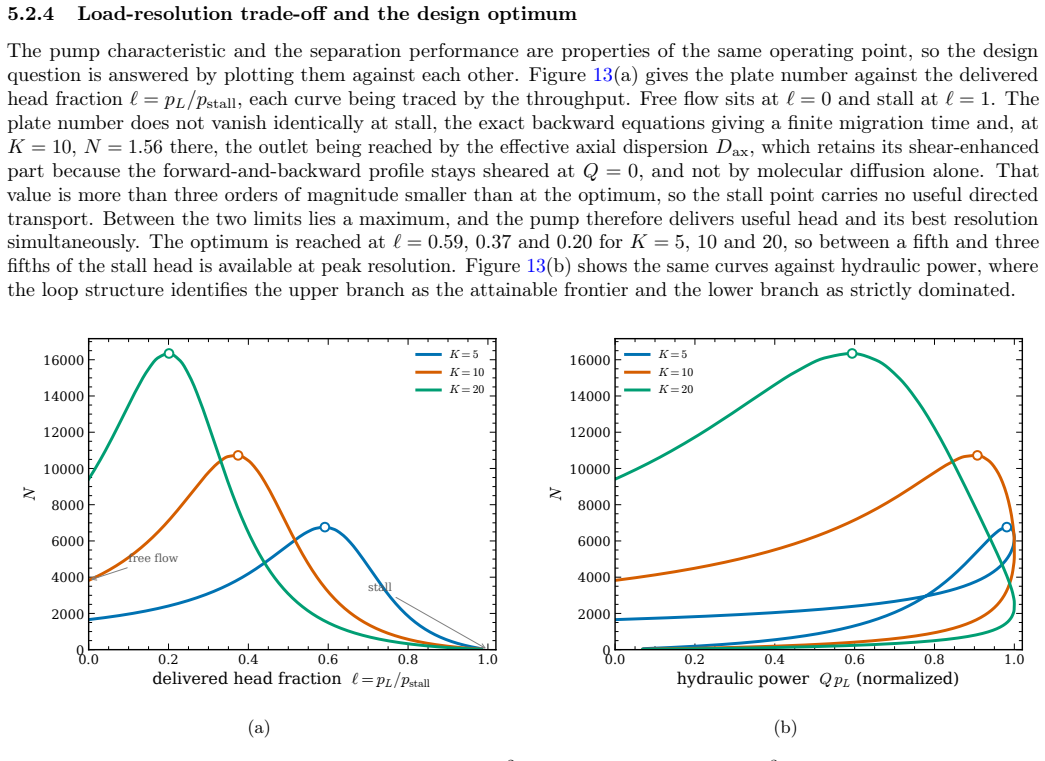
- There is a load-resolution trade-off: the best resolution is delivered at head fractions ℓ≈0.20–0.59 of stall head, so a loaded pump can simultaneously deliver useful pressure and its sharpest bands.
Reading between the lines
- Because the plateau formula depends only on U_s, h, and (1−r), the same saturation should appear for any fluid whose loaded profile is slip-plus-parabolic shear; a straightforward experimental test is to measure the effective dispersivity at high K at, say, r=0.5 and r=0.75 and check the (1−r)² scaling.
- The paper's own surface-conduction estimate (Dukhin ≈0.18 at K=2, ≈0.06 at the K≈6 optimum) suggests the bulk-Ohmic plateau is least reliable exactly where the partial-load optimum lies; extending the closure to (h+Du)E_x = const would test whether the interior maximum survives real electrolytes.
- The mechanism identified here should generalize beyond sPTT fluids: any electroosmotic pump with a loaded counterflow will show a finite dispersion floor, since that floor comes from the parabolic core shear, not from rheology. That suggests re-examining separation figures of merit for closed-end or heavily loaded electrokinetic devices.
- The paper compares constant-current and constant-voltage drives without ranking them energetically; an obvious extension is to include input power and efficiency (Q p_L/(I ΔΦ)) and test whether the partial-load separation optimum coincides with the maximum-efficiency operating point.
Editorial analysis
A structured set of objections, weighed in public.
Referee Report
Summary. This paper develops a coupled lubrication-scale model of electroosmotic pumping of a solvent-free simplified Phan-Thien-Tanner (sPTT) fluid in a deformable slit microchannel, including Debye-Hückel double layers, a Winkler-type wall law, and bulk-Ohmic current conservation under constant-voltage and constant-current operation. It derives a closed-form mixed electroosmotic/pressure-driven flux relation, proves monotonic inversion of the pressure gradient at prescribed throughput, and evaluates Taylor-Aris dispersion on the loaded operating state via local cell problems and first-passage moment equations. The central claim is that hydraulic loading changes the thin-double-layer dispersion limit: the Taylor coefficient saturates at the finite plateau of Eq. (33) rather than decaying as K^-2, producing an interior maximum of the plate number at finite Debye parameter for fixed throughput. Viscoelasticity and wall compliance are shown to shift the pump characteristic and the separation optimum, and Brownian dynamics is used to check the reduced transport model.
Significance. If the result holds, it is significant for electrokinetic separations: loaded electroosmotic pumps cannot rely on plug-flow suppression of Taylor dispersion, and separation should be optimized along the pump characteristic rather than at free flow. The paper has notable strengths: the closed-form flux Eq. (H.1) is checked against direct quadrature to 3×10^-11; classical Newtonian and EOF limits are recovered; Eq. (33) is derived analytically and reproduced to ten decimal places; and the Brownian simulations confirm the multiple-scales reduction. The main caveat is that the Brownian check shares the same physical closures and is therefore not independent validation of the model. The bulk-Ohmic assumption is marginal at small K (Dukhin number 0.18 at K=2), but at the reported optimum K≈6 the Dukhin number is 0.06, and the authors' modified current-law check changes N_max by only 2.4% while leaving the optimal throughput fraction unchanged. The central plateau and the qualitative interior optimum are therefore robust to this closure concern.
minor comments (3)
- [Eq. (33), Section 3.4] The symbol K is used for both the Debye parameter and the Taylor dispersion coefficient (compare Eq. (27) K(x) with the K→∞ limit in Eq. (33)). As written, Eq. (33) reads as the coefficient tending to a constant as the coefficient itself tends to infinity. Please introduce a distinct symbol for the Taylor coefficient, e.g., \mathcal{K}, and use it consistently in Sections 3–5.
- [Figures 2–6] Several axis labels appear as 'De_{\bullet}', evidently a rendering artifact for De_\kappa. The symbols should be corrected.
- [Abstract and Section 4.2] The statement that 'Brownian dynamics validates the reduced transport model' is stronger than what is actually demonstrated: the Brownian simulation shares the same lubrication flow, Debye-Hückel, wall-law, and constitutive assumptions, so it validates the multiple-scales/Aris reduction for that model rather than the physical model itself. The paper is transparent about this in Section 4.2, but the abstract and conclusions should be reworded to say 'confirms the reduction' or 'is consistent with the reduced model'.
Circularity Check
No significant circularity: the central plateau and partial-load optimum follow from the stated asymptotic/cell-problem reduction, with no fitted parameter and no load-bearing self-citation.
full rationale
The paper's central result, Eq. (33) with K → (2/105) U_s² h² (1−r)², is obtained in Sec. 3.4 and Appendix G from the thin-EDL effective-slip profile u−ū = U_s(1−r)(3y²/h²−1)/2 and the Neumann cell problem; this is a direct mathematical consequence of the loaded profile, not a fitted value disguised as a prediction. The finite-K plate-number maximum is likewise computed from the loaded cell problem and the first-passage moment equations, not imposed by an input. The mixed-flux verification in Sec. 4.1 compares closed forms against quadrature of the same integral and against classical limits, which are consistency checks rather than circular predictions. The Brownian-dynamics comparison in Sec. 4.2 explicitly shares the lubrication flow, Debye–Hückel description, wall law, and constitutive reduction, and tests only the multiple-scales/Taylor–Aris reduction; the paper states this scope honestly and does not make the central derivation depend on that validation. The bulk-Ohmic/current-conservation closure is indeed called marginal in Sec. 4.4 (Du = 0.18 at K = 2, 0.06 near the K≈6 optimum), but the paper explicitly quantifies the modified current law and reports only a 2.4% change in N_max with unchanged optimal throughput, so the main conclusion is robust to the weakest assumption rather than circularly defined by it. Own-group citations (refs. 9, 13, 16, 40, 52) are contextual and are not used as load-bearing uniqueness claims or substituted for derivation. No circular step is present.
Assumptions & free parameters
assumptions (6)
- domain assumption Debye-Hückel linearization of the Poisson-Boltzmann equation, valid for |ζ| ≲ 25 mV and used for all K.
- domain assumption Bulk-Ohmic current conservation with uniform conductivity and no surface conduction, giving d(h E_x)/dx = 0.
- domain assumption Lubrication (creeping-flow, shallow-gap) reduction: Re ≪ 1, δ ≪ 1, leading-order Stokes equations and ∂y p = 0.
- domain assumption Solvent-free simplified Phan-Thien-Tanner constitutive closure with cubic shear-stress term and neglect of axial stress transport under δ Wi_loc ≪ 1.
- domain assumption Linear Winkler elastic-foundation wall law h = 1 + Cm p with small constrained strain max|h−1|/β ≤ 0.10.
- domain assumption Taylor-Aris multiple-scales reduction with Pe δ ≪ 1 and neglected O(δ|h'|, μ²) remainders.
Cite this review
Pith. "Pith review of Load-dependent Taylor dispersion in a compliant electroosmotic pump conveying a simplified Phan-Thien-Tanner fluid." pith.science (2026). https://pith.science/paper/7ZLYV5PK
@misc{pith2026260721791,
  author       = {Pith},
  title        = {Pith review of: Load-dependent Taylor dispersion in a compliant electroosmotic pump conveying a simplified Phan-Thien-Tanner fluid},
  year         = {2026},
  howpublished = {\url{https://pith.science/paper/7ZLYV5PK}},
  note         = {Machine review of arXiv:2607.21791}
}
read the original abstract
We develop a coupled model for electroosmotic pumping and passive-solute dispersion of a solvent-free simplified Phan-Thien-Tanner fluid in a compliant slit microchannel. Pressure, wall deformation, axial field, velocity, and dispersion are evaluated self-consistently along the finite-throughput pump characteristic. Lubrication theory, Debye-Huckel electrostatics, an elastic-foundation wall law, and Taylor-Aris macrotransport yield a closed-form flux relation for combined electroosmotic and pressure-driven forcing. Because the shear rate depends cubically on the total shear stress, the two contributions cannot be superposed. The flux decreases monotonically with pressure gradient, ensuring a unique inversion at prescribed throughput. Current conservation couples the axial field to the deformed gap under constant-current and constant-voltage operation. In pressure-free flow, thinning the electric double layer produces a plug-like profile and the Newtonian Taylor coefficient decays as the inverse square of the Debye parameter. Under hydraulic loading, an adverse pressure gradient drives a sheared core counterflow that persists in the thin-double-layer limit, causing the coefficient to approach a finite plateau. At fixed nonzero throughput, partial cancellation between electroosmotic and pressure-driven shear yields a maximum plate number at finite double-layer thickness. This optimum is conditional: joint optimization over throughput and double-layer thickness shifts the overall optimum toward free-flow, thin-double-layer operation. Viscoelasticity can enhance or suppress loaded dispersion, while compliance shifts the pump characteristic and separation optimum. Brownian dynamics validates the reduced model. The resulting load-resolution relation identifies conditions that balance pressure delivery and separation performance.
Figures


Figures from the paper (12 more)




Reference graph
Works this paper leans on
-
[1]
W., ``Volume and surface propellant heating in an electrothermal radio-frequency plasma micro-thruster'', Applied Physics Letters 105(5) (2014)
Greig, A., Charles, C., Paulin, N., & Boswell, R. W., ``Volume and surface propellant heating in an electrothermal radio-frequency plasma micro-thruster'', Applied Physics Letters 105(5) (2014)
2014
-
[2]
Kjeang, E., Djilali, N., & Sinton, D., ``Microfluidic fuel cells: A review'', Journal of Power Sources 186, 353-369 (2009)
2009
-
[3]
Sajeesh, P., & Sen, A. K. ``Particle separation and sorting in microfluidic devices: a review'', Microfluidics and nanofluidics 17, 1-52(2014)
2014
-
[4]
Zhao, Z., Ukidve, A., Krishnan, V., & Mitragotri, S., ``Effect of physicochemical and surface properties on in vivo fate of drug nanocarriers'', Advanced drug delivery reviews 143, 3-21 (2019)
2019
-
[5]
H., & Bhattacharjee, S., ``Electrokinetic and colloid transport phenomena'', John Wiley & Sons (2006)
Masliyah, J. H., & Bhattacharjee, S., ``Electrokinetic and colloid transport phenomena'', John Wiley & Sons (2006)
2006
-
[6]
P., & L o wen, H., ``Effective interactions between electric double layers'', Annual Review of Physical Chemistry 51, 209-242 (2000)
Hansen, J. P., & L o wen, H., ``Effective interactions between electric double layers'', Annual Review of Physical Chemistry 51, 209-242 (2000)
2000
-
[7]
T., ``Electro-osmotic flow in two-dimensional charged micro-and nanochannels'', Journal of Fluid Mechanics 540, 247-267 (2005)
Bhattacharyya, S., Zheng, Z., & Conlisk, A. T., ``Electro-osmotic flow in two-dimensional charged micro-and nanochannels'', Journal of Fluid Mechanics 540, 247-267 (2005)
2005
-
[8]
Ghosal, S., ``Electrokinetic flow and dispersion in capillary electrophoresis'', Annu. Rev. Fluid Mech. 38, 309-338 (2006)
2006
Show all 70 references
-
[9]
K., & Weigand, B., ``Effect of electromigration dispersion and non-Newtonian rheology of a charged solute in a microcapillary'', Physics of Fluids 34(11) (2022)
Chatterjee, A., Nayak, A. K., & Weigand, B., ``Effect of electromigration dispersion and non-Newtonian rheology of a charged solute in a microcapillary'', Physics of Fluids 34(11) (2022)
2022
-
[10]
Dehe, S., Rofman, B., Bercovici, M., & Hardt, S., ``Electro-osmotic flow enhancement over superhydrophobic surfaces'', Physical Review Fluids 5, 053701 (2020)
2020
-
[11]
Ajdari, A., ``Electro-osmosis on inhomogeneously charged surfaces'', Physical Review Letters 75, 755 (1995)
1995
-
[12]
N., Mehta, S
Vasista, K. N., Mehta, S. K., Pati, S., & Sarkar, S., ``Electroosmotic flow of viscoelastic fluid through a microchannel with slip-dependent zeta potential'', Physics of Fluids 33(12) (2021)
2021
-
[13]
K., & Sahoo, S., ``Effects of hydrophobic slips in non-uniform electrokinetic transport of charged viscous fluid in nozzle-diffuser'', Physics of Fluids 35(1) (2023)
Majhi, M., Nayak, A. K., & Sahoo, S., ``Effects of hydrophobic slips in non-uniform electrokinetic transport of charged viscous fluid in nozzle-diffuser'', Physics of Fluids 35(1) (2023)
2023
-
[14]
S\'anchez, S., Arcos, J., Bautista, O., & M\'endez, F., ``Joule heating effect on a purely electroosmotic flow of non-Newtonian fluids in a slit microchannel'', Journal of Non-Newtonian Fluid Mechanics 192, 1-9 (2013)
2013
-
[15]
Azari, M., Sadeghi, A., & Chakraborty, S., ``Electroosmotic flow and heat transfer in a heterogeneous circular microchannel'', Applied Mathematical Modeling 87, 640-654 (2020)
2020
-
[16]
K., ``Effect of sinusoidal heated blocks on electroosmotic flow mixing in a microchannel with modified topology'', Physics of Fluids 35(7) (2023)
Sahoo, S., Majhi, M., & Nayak, A. K., ``Effect of sinusoidal heated blocks on electroosmotic flow mixing in a microchannel with modified topology'', Physics of Fluids 35(7) (2023)
2023
-
[17]
C., & Whitesides, G
McDonald, J. C., & Whitesides, G. M., ``Poly (dimethylsiloxane) as a material for fabricating microfluidic devices'', Accounts of chemical research 35, 491-499 (2002)
2002
-
[18]
Sollier, E., Murray, C., Maoddi, P., & Di Carlo, D., ``Rapid prototyping polymers for microfluidic devices and high pressure injections'', Lab on a Chip 11, 3752-3765 (2011)
2011
-
[19]
K., Fulton, A
Sackmann, E. K., Fulton, A. L., & Beebe, D. J., ``The present and future role of microfluidics in biomedical research'', Nature 507, 181-189 (2014)
2014
-
[20]
K., & Whitesides, G
Sia, S. K., & Whitesides, G. M., ``Microfluidic devices fabricated in poly (dimethylsiloxane) for biological studies,'' Electrophoresis 24, 3563-3576 (2003)
2003
-
[21]
D., Mammoto, A., Montoya-Zavala, M., Hsin, H
Huh, D., Matthews, B. D., Mammoto, A., Montoya-Zavala, M., Hsin, H. Y., & Ingber, D. E., ``Reconstituting organ-level lung functions on a chip'', Science 328, 1662-1668 (2010)
2010
-
[22]
R., Friend, J., & Yeo, L., ``Fluid-structure interaction in deformable microchannels'', Physics of Fluids 24(10) (2012)
Chakraborty, D., Prakash, J. R., Friend, J., & Yeo, L., ``Fluid-structure interaction in deformable microchannels'', Physics of Fluids 24(10) (2012)
2012
-
[23]
Q., ``In situ pressure measurement within deformable rectangular polydimethylsiloxane microfluidic devices'', Biomicrofluidics 6(2) (2012)
Cheung, P., Toda-Peters, K., & Shen, A. Q., ``In situ pressure measurement within deformable rectangular polydimethylsiloxane microfluidic devices'', Biomicrofluidics 6(2) (2012)
2012
-
[24]
Kang, C., Roh, C., & Overfelt, R. A., ``Pressure-driven deformation with soft polydimethylsiloxane (PDMS) by a regular syringe pump: challenge to the classical fluid dynamics by comparison of experimental and theoretical results'', RSC advances 4, 3102-3112 (2014)
2014
-
[25]
K., DasGupta, S., & Chakraborty, S., ``Hydrodynamics in deformable microchannels'', Microfluidics and Nanofluidics 21, 1-12 (2017)
Raj, M. K., DasGupta, S., & Chakraborty, S., ``Hydrodynamics in deformable microchannels'', Microfluidics and Nanofluidics 21, 1-12 (2017)
2017
-
[26]
B., Fulford, G
Jones, M. B., Fulford, G. R., Please, C. P., McElwain, D. L. S., & Collins, M. J., ``Elastohydrodynamics of the eyelid wiper'', Bulletin of mathematical biology 70, 323-343 (2008)
2008
-
[27]
Selway, N., & Stokes, J. R., ``Soft materials deformation, flow, and lubrication between compliant substrates: Impact on flow behavior, mouthfeel, stability, and flavor'', Annual review of food science and technology 5, 373-393 (2014)
2014
-
[28]
M., & Mahadevan, L., ``Soft lubrication: The elastohydrodynamics of nonconforming and conforming contacts'', Physics of Fluids 17(9) (2005)
Skotheim, J. M., & Mahadevan, L., ``Soft lubrication: The elastohydrodynamics of nonconforming and conforming contacts'', Physics of Fluids 17(9) (2005)
2005
-
[29]
(2008), ``Nanoscale flow on a bubble mattress: Effect of surface elasticity'', Physical review letters 100, 134501
Steinberger, A., Cottin-Bizonne, C., Kleimann, P., & Charlaix, E. (2008), ``Nanoscale flow on a bubble mattress: Effect of surface elasticity'', Physical review letters 100, 134501
2008
-
[30]
C., Cognet, V., Shidhore, T
Christov, I. C., Cognet, V., Shidhore, T. C., & Stone, H. A., ``Flow rate–pressure drop relation for deformable shallow microfluidic channels'', Journal of Fluid Mechanics 841, 267-286 (2018)
2018
-
[31]
C., ``Theory of the flow-induced deformation of shallow compliant microchannels with thick walls'', Proceedings of the Royal Society A 475, 20190513 (2019)
Wang, X., & Christov, I. C., ``Theory of the flow-induced deformation of shallow compliant microchannels with thick walls'', Proceedings of the Royal Society A 475, 20190513 (2019)
2019
-
[32]
A., & Christov, I
Boyko, E., Stone, H. A., & Christov, I. C., ``Flow rate-pressure drop relation for deformable channels via fluidic and elastic reciprocal theorems'', Physical Review Fluids 7, L092201 (2022)
2022
-
[33]
C., & Christov, I
Shidhore, T. C., & Christov, I. C., ``Static response of deformable microchannels: a comparative modeling study'', Journal of Physics: Condensed Matter 30, 054002 (2018)
2018
-
[34]
Ding, L., Wang, T., & Roper, M., ``Thin-gap approximations for microfluidic device design'', Journal of Fluid Mechanics 1031, A12 (2026)
2026
-
[35]
Chakraborty, J., & Chakraborty, S., ``Influence of streaming potential on the elastic response of a compliant microfluidic substrate subjected to dynamic loading'', Physics of Fluids 22(12) (2010)
2010
-
[36]
Chakraborty, J., & Chakraborty, S., ``Combined influence of streaming potential and substrate compliance on load capacity of a planar slider bearing'', Physics of Fluids 23(8) (2011)
2011
-
[37]
D., & Bercovici, M., ``Elastic deformations driven by nonuniform lubrication flows'', Journal of Fluid Mechanics 812, 841-865 (2017)
Rubin, S., Tulchinsky, A., Gat, A. D., & Bercovici, M., ``Elastic deformations driven by nonuniform lubrication flows'', Journal of Fluid Mechanics 812, 841-865 (2017)
2017
-
[38]
Boyko, E., Eshel, R., Gommed, K., Gat, A. D., & Bercovici, M., ``Elastohydrodynamics of a pre-stretched finite elastic sheet lubricated by a thin viscous film with application to microfluidic soft actuators'', Journal of Fluid Mechanics 862, 732-752 (2019)
2019
-
[39]
Roy, A., & Dhar, P., ``Fluid-structure-interactive elasto- and thermo-hydrodynamics of electrokinetic binary fluid flows in compliant micro-confinements'', Physics of Fluids 36(3) (2024)
2024
-
[40]
K., ``Electroosmotic lubrication in constricted microchannels with a compliant wall and DLVO disjoining pressure'', Physical Review Fluids 11, 064201 (2026)
Sahoo, S., & Nayak, A. K., ``Electroosmotic lubrication in constricted microchannels with a compliant wall and DLVO disjoining pressure'', Physical Review Fluids 11, 064201 (2026)
2026
-
[41]
Gachelin, J., Mino, G., Berthet, H., Lindner, A., Rousselet, A., & Cl\'ement, \'E., ``Non-Newtonian viscosity of Escherichia coli suspensions'', Physical review letters 110, 268103 (2013)
2013
-
[42]
V., & Waigh, T
Malm, A. V., & Waigh, T. A., ``Elastic turbulence in entangled semi-dilute DNA solutions measured with optical coherence tomography velocimetry'', Scientific Reports 7, 1186 (2017)
2017
-
[43]
M., & Lee, W
Park, H. M., & Lee, W. M., ``Effect of viscoelasticity on the flow pattern and the volumetric flow rate in electroosmotic flows through a microchannel'', Lab on a Chip 8(7), 1163-1170 (2008)
2008
-
[44]
H., & Pinho, F
Sadek, S. H., & Pinho, F. T., ``Electro-osmotic oscillatory flow of viscoelastic fluids in a microchannel'', Journal of Non-Newtonian Fluid Mechanics 266, 46-58 (2019)
2019
-
[45]
C., ``Non-Newtonian fluid-structure interaction: Flow of a viscoelastic Oldroyd-B fluid in a deformable channel'', Journal of Non-Newtonian Fluid Mechanics 313, 104990 (2023)
Boyko, E., & Christov, I. C., ``Non-Newtonian fluid-structure interaction: Flow of a viscoelastic Oldroyd-B fluid in a deformable channel'', Journal of Non-Newtonian Fluid Mechanics 313, 104990 (2023)
2023
-
[46]
Mukherjee, S., Dhar, S., DasGupta, S., & Chakraborty, S., ``Electrokinetically augmented load bearing capacity of a deformable microfluidic channel'', Physics of Fluids 34, 082019 (2022)
2022
-
[47]
Ramos-Arzola, L., & Bautista, O., ``Fluid structure-interaction in a deformable microchannel conveying a viscoelastic fluid'', Journal of Non-Newtonian Fluid Mechanics 296, 104634 (2021)
2021
-
[48]
Dietzel, M., & Hardt, S., ``Flow and streaming potential of an electrolyte in a channel with an axial temperature gradient'', Journal of Fluid Mechanics 813, 1060-1111 (2017)
2017
-
[49]
Sadeghi, A., ``Hydrodynamic dispersion by electroosmotic flow of viscoelastic fluids within a slit microchannel'', Microfluidics and Nanofluidics 22, 4 (2018)
2018
-
[50]
C., M\'endez, F., Bautista, E
Arcos, J. C., M\'endez, F., Bautista, E. G., & Bautista, O., ``Dispersion coefficient in an electro-osmotic flow of a viscoelastic fluid through a microchannel with a slowly varying wall zeta potential'', Journal of Fluid Mechanics 839, 348-386 (2018)
2018
-
[51]
Ghosal, S., & Chen, Z., ``Electromigration dispersion in a capillary in the presence of electro-osmotic flow'', Journal of Fluid Mechanics 697, 436-454 (2012)
2012
-
[52]
Chatterjee, A., & Nayak, A. K., ``Effect of the global electroneutrality condition on electromigration Taylor-Aris dispersion in a microcapillary with finite Debye layer thickness'', Journal of Chemical Physics 160(19), 194507 (2024)
2024
-
[53]
Singh, S., & Murthy, P. V. S. N., ``Significance of skewness and kurtosis on the solute dispersion in pulsatile Carreau-Yasuda fluid flow in a tube with wall absorption'', Journal of Fluid Mechanics 962, A42 (2023)
2023
-
[54]
K., B\'eg, O
Roy, A. K., B\'eg, O. A., & Rana, A. S., ``Dispersion of neutral solutes in viscoelastic microflows under combined electroosmotic and pressure-driven forcing'', Physics of Fluids 37, 082054 (2025)
2025
-
[55]
Hossain, S., Dhar, S., Poddar, N., & Barik, S., ``Electro-osmotic effect on solute dispersion in viscoelastic fluid through a microchannel with reactive boundaries'', Physics of Fluids 37, 053112 (2025)
2025
-
[56]
J., Chang, R., Ma, K., & Santiago, J
Samuel, C. J., Chang, R., Ma, K., & Santiago, J. G., ``Taylor dispersion for coupled electroosmotic and pressure-driven flows in all time regimes'', Journal of Fluid Mechanics 1011, A36 (2025)
2025
-
[57]
N., & Sadeghi, A., ``Solute dispersion by electroosmotic flow through soft microchannels'', Sensors and Actuators B: Chemical 255, 3585-3600 (2018)
Hoshyargar, V., Khorami, A., Ashrafizadeh, S. N., & Sadeghi, A., ``Solute dispersion by electroosmotic flow through soft microchannels'', Sensors and Actuators B: Chemical 255, 3585-3600 (2018)
2018
-
[58]
Talebi, R., Ashrafizadeh, S. N., & Sadeghi, A., ``Hydrodynamic dispersion by electroosmotic flow in soft microchannels: consideration of different properties for electrolyte and polyelectrolyte layer'', Chemical Engineering Science 229, 116058 (2021)
2021
-
[59]
D., Amarouchene, Y., & Salez, T., ``Taylor dispersion in a soft channel'', arXiv preprint arXiv:2604.05592 (2026)
Jha, A., Gunny, M., McGraw, J. D., Amarouchene, Y., & Salez, T., ``Taylor dispersion in a soft channel'', arXiv preprint arXiv:2604.05592 (2026)
2026 arXiv
-
[60]
Ding, L., ``Shear dispersion of multispecies electrolyte solutions in the channel domain'', Journal of Fluid Mechanics 970, A27 (2023)
2023
-
[61]
Ding, L., ``Long-time asymptotics of passive scalar transport in periodically modulated channels'', Journal of Fluid Mechanics 1023, A19 (2025)
2025
-
[62]
M., ``Determinism and invariant measures for diffusing passive scalars advected by unsteady random shear flows'', Physical Review Fluids 7(7), 074502 (2022)
Ding, L., & McLaughlin, R. M., ``Determinism and invariant measures for diffusing passive scalars advected by unsteady random shear flows'', Physical Review Fluids 7(7), 074502 (2022)
2022
-
[63]
M., ``Dispersion induced by unsteady diffusion-driven flow in a parallel-plate channel'', Physical Review Fluids 8(8), 084501 (2023)
Ding, L., & McLaughlin, R. M., ``Dispersion induced by unsteady diffusion-driven flow in a parallel-plate channel'', Physical Review Fluids 8(8), 084501 (2023)
2023
-
[64]
I., ``A new constitutive equation derived from network theory'', Journal of Non-Newtonian Fluid Mechanics 2, 353-365 (1977)
Phan-Thien, N., & Tanner, R. I., ``A new constitutive equation derived from network theory'', Journal of Non-Newtonian Fluid Mechanics 2, 353-365 (1977)
1977
-
[65]
M., Alves, M
Afonso, A. M., Alves, M. A., & Pinho, F. T., ``Analytical solution of mixed electro-osmotic/pressure driven flows of viscoelastic fluids in microchannels'', Journal of Non-Newtonian Fluid Mechanics 159(1-3), 50-63 (2009)
2009
-
[66]
I., ``Dispersion of soluble matter in solvent flowing slowly through a tube'', Proceedings of the Royal Society of London A 219, 186-203 (1953)
Taylor, G. I., ``Dispersion of soluble matter in solvent flowing slowly through a tube'', Proceedings of the Royal Society of London A 219, 186-203 (1953)
1953
-
[67]
Aris, R., ``On the dispersion of a solute in a fluid flowing through a tube'', Proceedings of the Royal Society of London A 235, 67-77 (1956)
1956
-
[68]
J., & Santiago, J
Laser, D. J., & Santiago, J. G., ``A review of micropumps'', Journal of Micromechanics and Microengineering 14, R35-R64 (2004)
2004
-
[69]
M., & Bazant, M
Squires, T. M., & Bazant, M. Z., ``Induced-charge electro-osmosis'', Journal of Fluid Mechanics 509, 217-252 (2004)
2004
-
[70]
H., Garguilo, M
Paul, P. H., Garguilo, M. G., & Rakestraw, D. J., ``Imaging of pressure- and electrokinetically driven flows through open capillaries'', Analytical Chemistry 70, 2459-2467 (1998)
1998
Reviewed August 1, 2026 · model on record in the stance chip above.
Discussion (0). Continue with ORCID to comment.