REVIEW 3 major objections 4 minor 54 references
A fully unsupervised multimodal intent discovery method uses MLLM-generated concepts to guide semantic propagation, beating existing methods on three benchmarks while producing interpretable concept labels.
Reviewed by Pith at T0; open to challenge. T0 means a machine referee read the full paper against a public rubric. the ladder, T0–T4 →
MCSP improves unsupervised multimodal intent discovery by using MLLM-generated semantic concepts as anchors and propagating them over a concept-weighted graph before contrastively refining representations.
T0 review reviewed 2026-08-01 challenge →
load-bearing objection Useful pipeline with real ablations, but the headline empirical claim is not yet supported: the evaluation mixes two split protocols and tunes key temperatures on test labels. the 3 major comments →
Unsupervised Multimodal Intent Discovery via MLLM-Guided Concept Generation and Semantic Propagation
The pith
A machine-rendered reading of the paper's core claim, the machinery that carries it, and where it could break.
The reading
Core claim
MCSP claims that semantic concepts, not geometry, should anchor unsupervised multimodal intent discovery. Starting from k-means++ clusters, it picks high-margin representative samples per cluster (Eq. 2-3), uses an MLLM to contrast the target cluster against its nearest neighbor and produce a 2-6 word gerund phrase naming the cluster's communicative function (Eq. 4), and globally normalizes the resulting concept set (Eq. 5). The concepts are encoded as anchors, a k-NN graph is built with edge weights modulated by semantic consistency between concept distributions (Eq. 6-8), and a random walk initialized at representatives propagates conceptual beliefs to all samples (Eq. 9). The propagated p
What carries the argument
The central mechanism is the combination of MLLM-guided contrastive concept generation with semantic propagation over a concept-aware graph: high-margin representatives seed the MLLM with clean evidence, the MLLM outputs a short concept phrase per cluster, and those phrases are encoded into anchors that modulate graph edge weights and initialize a random-walk label diffusion; a concept-supervised contrastive loss then closes the loop. In one phrase: 'random walk on a semantically weighted graph seeded by MLLM-generated concepts.' This carries the argument because it converts abstract cluster geometry into explicit semantics that can be propagated locally and used to re-shape the embedding ma
Load-bearing premise
The load-bearing assumption is that the initial k-means clusters are coherent enough that the top margin-ranked representatives are semantically pure, and that the number of intent categories is known and matches the ground truth; if either fails, the MLLM generates a wrong or noisy concept and the random-walk propagation reinforces that error.
What would settle it
Run MCSP on a benchmark where the ground-truth category count is deliberately mis-estimated by a small margin (e.g., K true 20 versus K set to 18 or 22) and compare against UMC with the correct K: the paper's F.1 experiment already reports a narrowing of the advantage to 0.72 average points when K is estimated, so a setting where the estimate is off by more than a couple of categories would show whether the method still beats the baseline.
If this is right
- If MCSP is correct, fully unsupervised intent discovery no longer has to choose between accuracy and interpretability: clusters come with human-readable concept labels (e.g., 'announcing departure', 'confronting or accusing').
- The method shows that a small number of MLLM calls (one per cluster plus one global refinement) can inject semantic guidance into clustering, suggesting a practicable route to semantic discovery at scale without exhaustive labeling.
- Since the pseudo-labels arise from propagated concepts, the resulting representation is structured by semantics, which could make downstream tasks like intent classification and out-of-scope detection start from better organization of unlabeled data.
- The ablation study (w/o G etc.) indicates that the graph propagation step, not just the concept names, is responsible for the gains; thus concept-driven diffusion is the load-bearing component.
- The reported stability across seeds and concepts suggests the discovered intents are reproducible, which is a prerequisite for treating them as reliable labels.
Where Pith is reading between the lines
- The paper assumes K is known; when K is estimated, the advantage over UMC shrinks to under one average point (F.1), so the practical upside may be smaller in genuinely open-world settings where the number of intents is unknown.
- If the MLLM's reasoning fails on a dataset whose intents are more visually/graphically nuanced or where the top-3 representatives are not semantically pure, the propagation will reinforce wrong boundaries; a natural test is to swap the MLLM for a text-only LLM and see whether the multimodal grounding contributes.
- The concept-stability metric (0.91 average cosine similarity across seeds) suggests the method could generate reusable intent taxonomies for a domain; these taxonomies might bootstrap few-shot intent classifiers, but that extrapolation goes beyond the paper.
Editorial analysis
A structured set of objections, weighed in public.
Referee Report
Summary. The paper proposes MCSP, an unsupervised multimodal intent discovery method. It first uses UMC-style contrastive pre-training, then selects high-margin representatives from k-means clusters, prompts an MLLM to generate discriminative semantic concepts for each cluster (Eqs. 2–5), and finally propagates these concepts over a semantically reweighted k-NN graph to produce pseudo-labels that supervise a concept-contrastive loss (Eqs. 6–12). The authors claim MCSP consistently outperforms existing methods on MIntRec, MIntRec2.0, and MELD-DA while yielding interpretable concept labels.
Significance. If the empirical claims are supported, the paper would make a useful contribution: it moves multimodal intent clustering from purely geometric refinement toward semantically interpretable, MLLM-grounded concepts, and it backs this with a coherent three-stage pipeline. The ablation study (Table 2) is informative, the stability analyses (Tables 7–8) and cost analysis (Appendix G) are thoughtful, and the case study (Section 5.4) illustrates interpretability. The main positive result is not verified by released code, but the appendices contain enough detail for replication attempts. The contribution is significant for the multimedia clustering community, provided the evaluation-protocol and hyperparameter-selection concerns below are resolved.
major comments (3)
- [§4.1 vs. Appendix C.2] The evaluation protocol is internally contradictory and this is load-bearing for every number in Table 1. Section 4.1 states that 'we merge the original train, validation, and test splits and repartition the data 4:1 for training and testing.' Appendix C.2 states, for the same datasets, that 'we merge the original training and validation splits for unlabeled training and retain the original test split for evaluation.' These protocols produce different test sets, so the reported gains over UMC and SPILL cannot be interpreted unless all methods were re-run under exactly one protocol. Please specify the single protocol used for all methods, confirm that every baseline was re-evaluated under that protocol, and report the results in a way that removes split incomparability.
- [§4.3, §5.2, and §D.3] The temperature triplets (tau, tau_c, tau_g) are tuned with ground-truth labels, which contradicts the claim of a fully unsupervised evaluation. Section 4.3 says the triplets are configured 'as discussed in Section 5.2,' and Section 5.2 reports accuracy peaks on MIntRec2.0—necessarily using ground-truth labels to compute accuracy. The label-free stability criterion in Appendix D.3, run on MIntRec, selects a different configuration (0.3, 1.5, 1.0) rather than the used (0.5, 1.0, 0.7). Thus the main results are not label-free. Report the main table under the label-free stability criterion of D.3, or clearly separate oracle-tuned upper-bound results from label-free results.
- [§F.1 and §4.4] The paper's central claim is stated without the caveat that the main experiments assume K is known and equal to the ground-truth category count. Section F.1 shows that with estimated K, MCSP's advantage over UMC shrinks to 0.72 average points (24.47 vs. 23.75), much smaller than the 1.5-point margin in the main table. This is not a fatal flaw—known K is a standard assumption in unsupervised clustering—but the abstract and conclusion should qualify 'fully unsupervised' and the consistency claim accordingly, since the discovery setting in the title implies unknown K.
minor comments (4)
- [References] References [2] and [3] are the same Ben-Hur et al. paper duplicated with different citation years (2002 in both). Please merge them and fix the citations in §D.3 and §F.3.
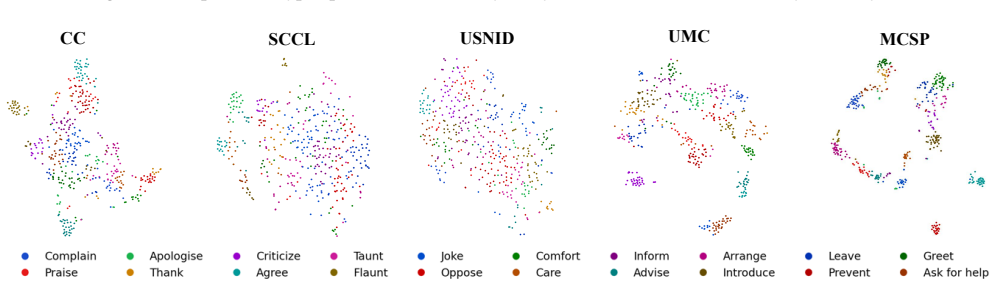
- [Figures 10–11] The captions for Figures 10 and 11 say 'MIntRec2.0' and 'MELD-DA', respectively, but the panel labels inside the figures appear to be carried over from Figure 5 (e.g., 'MIntRec / MIntRec2.0'). Please make the panel labels consistent with the dataset actually shown.
- [§5.2] The sensitivity analysis reports only accuracy ('peaks at 29.19%') for each temperature. Since the main evaluation uses four metrics, specify whether other metrics behave similarly or provide the curves for ARI/NMI/FMI in Figure 4.
- [§4.3] The statement 'we keep most hyperparameters the same across datasets and adjust only a few parameters' is followed by per-dataset temperatures, learning rates, and batch size. Clarify which are considered 'training stability' parameters and which are method hyperparameters, since the latter should not be tuned per dataset in a fully unsupervised claim.
Circularity Check
Reported SOTA gains are partly fitted: temperature hyperparameters are chosen by test-set accuracy, not by the paper's label-free criterion.
specific steps
-
fitted input called prediction
[Section 4.3; Section 5.2; Appendix D.3]
""The temperature triplets (τ,τ_c,τ_g) are configured as (0.5, 1.0, 0.7), (0.3, 0.3, 7.5), and (2.5, 1.0, 3.5), respectively, as discussed in Section 5.2." In Section 5.2: "For the τ in concept-supervised contrastive learning, the accuracy reaches a peak of 29.19% when τ is set to 0.5.""
The paper's central empirical claim is that MCSP is a fully unsupervised method that 'consistently outperforms' baselines. But the per-dataset temperature triplets used in the final tables are selected through Section 5.2, which maximizes ground-truth ACC on MIntRec2.0. The reported 29.19% accuracy on MIntRec2.0 is the very peak used to choose the temperature, so that result (and the correlated gains) are not independent predictions; they are the result of fitting control parameters to the evaluation labels. Appendix D.3's label-free stability criterion selects different configurations (e.g., highest stability 0.4000 at (0.3,1.5,1.0)), so the paper's own unsupervised selection procedure does not justify the configurations used to claim SOTA performance.
full rationale
The clearest circular element is in the evaluation, not the algorithm: Section 4.3 fixes the temperature triplets 'as discussed in Section 5.2', and Section 5.2 explicitly reports peaks in accuracy (ground-truth) on MIntRec2.0. Thus the Table 1 performance numbers are selected on the test labels, undermining the 'fully unsupervised ... consistently outperforms' claim. I do not count the Eq. (3)->Eq. (9)->Eq. (12) pseudo-label loop as a definitional circularity: representatives are chosen from an initial k-means partition and their labels seed the random walk, but propagation can reassign non-anchor samples, so the final clustering is not identical to the input by construction; it is a self-training loop with external MLLM naming. This loop does mean the 'semantic concepts' are summaries of the same clusters they later supervise, so they are not independent evidence, but that is a limitation of the method, not a formal reduction. The UMC architecture citation is legitimate prior work, not load-bearing self-citation. The paper also contains a non-circular evaluation inconsistency: Section 4.1 says all splits are merged and repartitioned 4:1, while Appendix C.2 says the original train+val are used and the original test is retained; this should be resolved but is not itself circularity.
Axiom & Free-Parameter Ledger
free parameters (6)
- cluster number K =
20 (MIntRec), 30 (MIntRec2.0), 12 (MELD-DA)
- temperature triplets (tau, tau_c, tau_g) =
(0.5,1.0,0.7), (0.3,0.3,7.5), (2.5,1.0,3.5) per dataset
- confidence ratio rho =
0.6
- graph size k and semantic weight lambda =
k=10, lambda=3.0
- diffusion factor alpha and propagation steps =
alpha=0.95, steps=40
- representative/candidate counts (m, N_r) =
m=40, N_r=3
axioms (6)
- domain assumption k-means++ clusters in the fused embedding space approximate the true latent intents
- domain assumption Euclidean margin score identifies semantically unambiguous, prototypical samples
- domain assumption MLLM contrastive reasoning over three representatives yields correct, generalizable concepts
- standard math Random-walk label propagation on a k-NN graph with fixed alpha converges to meaningful soft labels
- domain assumption Multi-view masking preserves the semantic identity of an utterance
- ad hoc to paper True category count K is available in the main evaluation
invented entities (1)
-
MLLM-generated concept anchors (t'_k encoded as c_k)
no independent evidence
Cite this review
Pith. "Pith review of Unsupervised Multimodal Intent Discovery via MLLM-Guided Concept Generation and Semantic Propagation." pith.science (2026). https://pith.science/paper/JKO5OMSN
@misc{pith2026260721908,
  author       = {Pith},
  title        = {Pith review of: Unsupervised Multimodal Intent Discovery via MLLM-Guided Concept Generation and Semantic Propagation},
  year         = {2026},
  howpublished = {\url{https://pith.science/paper/JKO5OMSN}},
  note         = {Machine review of arXiv:2607.21908}
}
read the original abstract
Unsupervised multimodal intent discovery aims to uncover latent intents from unlabeled multimodal dialogues, but remains challenging due to the lack of explicit semantic supervision. Existing methods often provide limited interpretability, as their refinement mainly relies on geometric similarity rather than high-level semantic guidance. To address these limitations, we propose MCSP, a fully unsupervised method that introduces semantic refinement based on concepts into multimodal intent discovery. To obtain reliable semantic evidence for intent discovery, we identify high-quality representative samples for each cluster and use them to support MLLM-guided contrastive reasoning against neighboring clusters, which produces interpretable high-level semantic concepts. Building on these concepts, we perform semantic propagation over a semantically weighted graph to align conceptual information with local structural consistency and generate reliable pseudo-labels for representation refinement. Extensive experiments on three challenging multimodal intent datasets show that MCSP consistently outperforms state-of-the-art methods while producing interpretable clusters grounded in semantic concepts.
Figures




Reference graph
Works this paper leans on
-
[1]
David Arthur and Sergei Vassilvitskii. 2007. k-means++: The Advantages of Careful Seeding. InProceedings of the Eighteenth Annual ACM-SIAM Symposium on Discrete Algorithms (SODA ’07), Vol. 8. 1027–1035. doi:10.1145/1283383.1283494
arXiv 2007
-
[3]
Asa Ben-Hur, Andre Elisseeff, and Isabelle Guyon. 2002. A Stability Based Method for Discovering Structure in Clustered Data.Pacific Symposium on Biocomputing. Pacific Symposium on Biocomputing2002 (02 2002), 6–17. doi:10.1142/9789812799623_0002
-
[4]
Mathilde Caron, Piotr Bojanowski, Armand Joulin, and Matthijs Douze. 2018. Deep Clustering for Unsupervised Learning of Visual Features. InProceedings of the European Conference on Computer Vision (ECCV)
2018
-
[6]
Sanyuan Chen, Chengyi Wang, Zhengyang Chen, Yu Wu, Shujie Liu, Zhuo Chen, Jinyu Li, Naoyuki Kanda, Takuya Yoshioka, Xiong Xiao, Jian Wu, Long Zhou, Shuo Ren, Yanmin Qian, Yao Qian, Jian Wu, Michael Zeng, Xiangzhan Yu, and Furu Wei. 2022. WavLM: Large-Scale Self-Supervised Pre-Training for Full Stack Speech Processing.IEEE Journal of Selected Topics in Sig...
arXiv 2022
-
[7]
Zhanpeng Chen, Zhihong Zhu, Xianwei Zhuang, Zhiqi Huang, and Yuexian Zou
-
[8]
Jackie Chi Kit Cheung and Xiao Li. 2012. Sequence clustering and labeling for unsupervised query intent discovery. InProceedings of the Fifth ACM International Conference on Web Search and Data Mining(Seattle, Washington, USA)(WSDM ’12). Association for Computing Machinery, New York, NY, USA, 383–392. doi:10. 1145/2124295.2124342
arXiv 2012
-
[9]
Jacob Devlin, Ming-Wei Chang, Kenton Lee, and Kristina Toutanova. 2019. BERT: Pre-training of Deep Bidirectional Transformers for Language Understanding. In Proceedings of the 2019 Conference of the North American Chapter of the Association for Computational Linguistics: Human Language Technologies, Volume 1 (Long and Short Papers), Jill Burstein, Christy...
2019
-
[10]
Jairo Diaz-Rodriguez. 2026. Summaries as Centroids for Interpretable and Scal- able Text Clustering. InThe Fourteenth International Conference on Learning Representations. https://openreview.net/forum?id=Uzku7RZXvI
2026
-
[11]
Zomaya, Sebti Foufou, and Abdelaziz Bouras
Adil Fahad, Najlaa Alshatri, Zahir Tari, Abdullah Alamri, Ibrahim Khalil, Albert Y. Zomaya, Sebti Foufou, and Abdelaziz Bouras. 2014. A Survey of Clustering Algorithms for Big Data: Taxonomy and Empirical Analysis.IEEE Transactions on Emerging Topics in Computing2, 3 (2014), 267–279. doi:10.1109/TETC.2014. 2330519
-
[12]
Zijin Feng, Luyang Lin, Lingzhi Wang, Hong Cheng, and Kam-Fai Wong. 2024. LLMEdgeRefine: Enhancing Text Clustering with LLM-Based Boundary Point Refinement. InProceedings of the 2024 Conference on Empirical Methods in Natural Language Processing, Yaser Al-Onaizan, Mohit Bansal, and Yun-Nung Chen (Eds.). Association for Computational Linguistics, Miami, Fl...
-
[13]
John J. Godfrey, Edward C. Holliman, and Jane McDaniel. 1992. SWITCHBOARD: Telephone speech corpus for research and development. InProceedings of the IEEE International Conference on Acoustics, Speech and Signal Processing (ICASSP). IEEE, I/517–I/520. doi:10.1109/ICASSP.1992.225957
arXiv 1992
-
[14]
K. Chidananda Gowda and G. Krishna. 1978. Agglomerative clustering using the concept of mutual nearest neighbourhood.Pattern Recognition10, 2 (1978), 105–112. doi:10.1016/0031-3203(78)90018-3
-
[15]
Derek Greene, Derek O’Callaghan, and Padraig Cunningham. 2014. How Many Topics? Stability Analysis for Topic Models. doi:10.1007/978-3-662-44848-9_32
-
[16]
Dilek Hakkani-Tür, Yun-Cheng Ju, Geoffrey Zweig, and Gokhan Tur. 2015. Clus- tering novel intents in a conversational interaction system with semantic parsing. InInterspeech 2015. 1854–1858. doi:10.21437/Interspeech.2015-70
-
[17]
Iryna Haponchyk, Antonio Uva, Seunghak Yu, Olga Uryupina, and Alessandro Moschitti. 2018. Supervised Clustering of Questions into Intents for Dialog System Applications. InProceedings of the 2018 Conference on Empirical Methods in Natural Language Processing, Ellen Riloff, David Chiang, Julia Hockenmaier, and Jun’ichi Tsujii (Eds.). Association for Comput...
-
[18]
Sua Kim, Taeyoung Jeong, Seokyoung Hong, Seongjun Kim, Jeongpil Lee, Du- Seong Chang, and Myoung-Wan Koo. 2025. KSTC: Keyphrase-driven Sentence embedding and Task independent prompting for filling slot in the Generation of theme label. InProceedings of the Twelfth Dialog System Technology Challenge, Behnam Hedayatnia, Vivian Chen, Zhang Chen, Raghav Gupta...
2025
-
[19]
Peper, Christopher Clarke, Andrew Lee, Parker Hill, Jonathan K
Stefan Larson, Anish Mahendran, Joseph J. Peper, Christopher Clarke, Andrew Lee, Parker Hill, Jonathan K. Kummerfeld, Kevin Leach, Michael A. Laurenzano, Lingjia Tang, and Jason Mars. 2019. An Evaluation Dataset for Intent Clas- sification and Out-of-Scope Prediction. InProceedings of the 2019 Conference on Empirical Methods in Natural Language Processing...
2019
-
[20]
Yunfan Li, Peng Hu, Zitao Liu, Dezhong Peng, Joey Tianyi Zhou, and Xi Peng
-
[21]
Jinggui Liang and Lizi Liao. 2023. ClusterPrompt: Cluster Semantic Enhanced Prompt Learning for New Intent Discovery. InFindings of the Association for Computational Linguistics: EMNLP 2023, Houda Bouamor, Juan Pino, and Kalika Bali (Eds.). Association for Computational Linguistics, Singapore, 10468–10481. doi:10.18653/v1/2023.findings-emnlp.702
-
[22]
I-Fan Lin, Faegheh Hasibi, and Suzan Verberne. 2025. SPILL: Domain-Adaptive Intent Clustering based on Selection and Pooling with Large Language Models. InFindings of the Association for Computational Linguistics: ACL 2025, Wanxiang Che, Joyce Nabende, Ekaterina Shutova, and Mohammad Taher Pilehvar (Eds.). Association for Computational Linguistics, Vienna...
2025
-
[23]
Jianghan Liu, Ziyu Shang, Wenjun Ke, Peng Wang, Zhizhao Luo, Jiajun Liu, Guozheng Li, and Yining Li. 2025. LLM-Guided Semantic-Aware Clustering for Topic Modeling. InProceedings of the 63rd Annual Meeting of the Association for Computational Linguistics (Volume 1: Long Papers), Wanxiang Che, Joyce Nabende, Ekaterina Shutova, and Mohammad Taher Pilehvar (E...
doi:10.18653/v1/ 2025
-
[24]
Ze Liu, Yutong Lin, Yue Cao, Han Hu, Yixuan Wei, Zheng Zhang, Stephen Lin, and Baining Guo. 2021. Swin Transformer: Hierarchical Vision Transformer using Shifted Windows . In2021 IEEE/CVF International Conference on Computer Vision (ICCV). IEEE Computer Society, Los Alamitos, CA, USA, 9992–10002. doi:10.1109/ICCV48922.2021.00986
arXiv 2021
-
[25]
Ilya Loshchilov and Frank Hutter. 2019. Decoupled Weight Decay Regularization. InProceedings of the International Conference on Learning Representations (ICLR). https://openreview.net/forum?id=Bkg6RiCqY7
2019
-
[26]
J. B. MacQueen. 1967. Some Methods for Classification and Analysis of Multi- Variate Observations. InProc. of the fifth Berkeley Symposium on Mathematical Statistics and Probability, L. M. Le Cam and J. Neyman (Eds.), Vol. 1. University of California Press, 281–297
1967
-
[27]
Yutao Mou, Keqing He, Pei Wang, Yanan Wu, Jingang Wang, Wei Wu, and Weiran Xu. 2022. Watch the Neighbors: A Unified K-Nearest Neighbor Contrastive Learn- ing Framework for OOD Intent Discovery. InProceedings of the 2022 Conference on Empirical Methods in Natural Language Processing, Yoav Goldberg, Zornitsa Kozareva, and Yue Zhang (Eds.). Association for C...
-
[28]
Yutao Mou, Keqing He, Yanan Wu, Pei Wang, Jingang Wang, Wei Wu, Yi Huang, Junlan Feng, and Weiran Xu. 2022. Generalized Intent Discovery: Learning from Open World Dialogue System. InProceedings of the 29th International Conference on Computational Linguistics, Nicoletta Calzolari, Chu-Ren Huang, Hansaem Kim, James Pustejovsky, Leo Wanner, Key-Sun Choi, Pu...
2022
-
[29]
A Padmasundari and Srinivas Bangalore. 2018. Intent Discovery Through Unsu- pervised Semantic Text Clustering. InInterspeech 2018. 606–610. doi:10.21437/ Interspeech.2018-2436
2018
-
[30]
Anup Pattnaik, Cijo George, Rishabh Kumar Tripathi, Sasanka Vutla, and Jithen- dra Vepa. 2024. Improving Hierarchical Text Clustering with LLM-guided Multi- view Cluster Representation. InProceedings of the 2024 Conference on Empirical Methods in Natural Language Processing: Industry Track, Franck Dernoncourt, Daniel Preoţiuc-Pietro, and Anastasia Shimori...
-
[31]
Tulika Saha, Aditya Patra, Sriparna Saha, and Pushpak Bhattacharyya. 2020. Towards Emotion-aided Multi-modal Dialogue Act Classification. InProceedings of the 58th Annual Meeting of the Association for Computational Linguistics, Dan Jurafsky, Joyce Chai, Natalie Schluter, and Joel Tetreault (Eds.). Association for MM ’26, November 10–14, 2026, Rio de Jane...
-
[32]
Amit Saxena, Mukesh Prasad, Akshansh Gupta, Neha Bharill, Om Prakash Patel, Aruna Tiwari, Meng Joo Er, Weiping Ding, and Chin-Teng Lin. 2017. A Review of Clustering Techniques and Developments.Neurocomputing267 (2017), 664–681. doi:10.1016/j.neucom.2017.06.053
-
[33]
Wenkai Shi, Wenbin An, Feng Tian, Qinghua Zheng, QianYing Wang, and Ping Chen. 2023. A Diffusion Weighted Graph Framework for New Intent Discovery. InProceedings of the 2023 Conference on Empirical Methods in Natural Language Processing, Houda Bouamor, Juan Pino, and Kalika Bali (Eds.). Association for Computational Linguistics, Singapore, 8033–8042. doi:...
-
[34]
Xiaoshuai Song, Yutao Mou, Keqing He, Yueyan Qiu, Jinxu Zhao, Pei Wang, and Weiran Xu. 2023. Continual Generalized Intent Discovery: Marching Towards Dynamic and Open-world Intent Recognition. InFindings of the Association for Computational Linguistics: EMNLP 2023, Houda Bouamor, Juan Pino, and Kalika Bali (Eds.). Association for Computational Linguistics...
-
[35]
Zico Kolter, Louis-Philippe Morency, and Ruslan Salakhutdinov
Yao-Hung Hubert Tsai, Shaojie Bai, Paul Pu Liang, J. Zico Kolter, Louis-Philippe Morency, and Ruslan Salakhutdinov. 2019. Multimodal Transformer for Unaligned Multimodal Language Sequences. InProceedings of the 57th Annual Meeting of the Association for Computational Linguistics, Anna Korhonen, David Traum, and Lluís Màrquez (Eds.). Association for Comput...
-
[36]
Laurens J. P. van der Maaten and Geoffrey E. Hinton. 2008. Visualizing Data Using t-SNE.Journal of Machine Learning Research9 (2008), 2579–2605
2008
-
[37]
Ashish Vaswani, Noam Shazeer, Niki Parmar, Jakob Uszkoreit, Llion Jones, Aidan N Gomez, Łukasz Kaiser, and Illia Polosukhin. 2017. Attention is all you need. InAdvances in neural information processing systems. 5998–6008. http://arxiv.org/abs/1706.03762
Pith/arXiv arXiv 2017
-
[38]
Vijay Viswanathan, Kiril Gashteovski, Carolin Lawrence, Tongshuang Wu, and Graham Neubig. 2024. Large Language Models Enable Few-Shot Clustering. Transactions of the Association for Computational Linguistics12 (2024), 321–333. doi:10.1162/tacl_a_00648
-
[39]
Junyuan Xie, Ross Girshick, and Ali Farhadi. 2016. Unsupervised deep embedding for clustering analysis. InProceedings of the 33rd International Conference on International Conference on Machine Learning - Volume 48(New York, NY, USA) (ICML’16). JMLR.org, 478–487
2016
-
[40]
Sidiropoulos, and Mingyi Hong
Bo Yang, Xiao Fu, Nicholas D. Sidiropoulos, and Mingyi Hong. 2017. Towards K- means-friendly spaces: simultaneous deep learning and clustering. InProceedings of the 34th International Conference on Machine Learning - Volume 70(Sydney, NSW, Australia)(ICML’17). JMLR.org, 3861–3870
2017
-
[41]
Arnold, and Bing Xiang
Dejiao Zhang, Feng Nan, Xiaokai Wei, Shang-Wen Li, Henghui Zhu, Kathleen McKeown, Ramesh Nallapati, Andrew O. Arnold, and Bing Xiang. 2021. Support- ing Clustering with Contrastive Learning. InProceedings of the 2021 Conference of the North American Chapter of the Association for Computational Linguistics: Human Language Technologies, Kristina Toutanova, ...
2021
-
[42]
Hanlei Zhang, Xiaoteng Li, Hua Xu, Panpan Zhang, Kang Zhao, and Kai Gao
-
[43]
Hanlei Zhang, Xin Wang, Hua Xu, Qianrui Zhou, Kai Gao, Jianhua Su, jinyue Zhao, Wenrui Li, and Yanting Chen. 2024. MIntRec2.0: A Large-scale Benchmark Dataset for Multimodal Intent Recognition and Out-of-scope Detection in Conversations. InThe Twelfth International Conference on Learning Representations. https: //openreview.net/forum?id=nY9nITZQjc
2024
-
[44]
Hanlei Zhang, Hua Xu, Fei Long, Xin Wang, and Kai Gao. 2024. Unsupervised Multimodal Clustering for Semantics Discovery in Multimodal Utterances. In Proceedings of the 62nd Annual Meeting of the Association for Computational Linguistics (Volume 1: Long Papers), Lun-Wei Ku, Andre Martins, and Vivek Srikumar (Eds.). Association for Computational Linguistics...
-
[45]
TEXTOIR: An Integrated and Visualized Platform for Text Open Intent Recognition. InProceedings of the 59th Annual Meeting of the Association for Computational Linguistics and the 11th International Joint Conference on Natural Language Processing: System Demonstrations, Heng Ji, Jong C. Park, and Rui Xia (Eds.). Association for Computational Linguistics, O...
2021
-
[46]
Hanlei Zhang, Hua Xu, Xin Wang, Qianrui Zhou, Shaojie Zhao, and Jiayan Teng
-
[47]
Yuwei Zhang, Zihan Wang, and Jingbo Shang. 2023. ClusterLLM: Large Language Models as a Guide for Text Clustering. InProceedings of the 2023 Conference on Empirical Methods in Natural Language Processing, Houda Bouamor, Juan Pino, and Kalika Bali (Eds.). Association for Computational Linguistics, Singapore, 13903–13920. doi:10.18653/v1/2023.emnlp-main.858
-
[48]
Hanlei Zhang, Hua Xu, Xin Wang, Fei Long, and Kai Gao. 2024. A Clustering Framework for Unsupervised and Semi-Supervised New Intent Discovery.IEEE Transactions on Knowledge and Data Engineering36, 11 (2024), 5468–5481. doi:10. 1109/TKDE.2023.3340732
arXiv 2024
-
[49]
Qianrui Zhou, Hua Xu, Hao Li, Hanlei Zhang, Xiaohan Zhang, Yifan Wang, and Kai Gao. 2024. Token-Level Contrastive Learning with Modality-Aware Prompting for Multimodal Intent Recognition. InProceedings of the 37th AAAI Conference on Artificial Intelligence. AAAI Press, 17114–17122. doi:10.1609/aaai. v38i15.29656
doi:10.1609/aaai 2024
-
[50]
Xiaojin Zhu, Zoubin Ghahramani, and John Lafferty. 2003. Semi-supervised learning using Gaussian fields and harmonic functions. InProceedings of the Twentieth International Conference on International Conference on Machine Learn- ing(Washington, DC, USA)(ICML’03). AAAI Press, 912–919
2003
-
[51]
Zhihong Zhu, Xuxin Cheng, Zhaorun Chen, Yuyan Chen, Yunyan Zhang, Xian Wu, Yefeng Zheng, and Bowen Xing. 2024. InMu-Net: Advancing Multi-modal Intent Detection via Information Bottleneck and Multi-sensory Processing. In Proceedings of the 32nd ACM International Conference on Multimedia(Melbourne VIC, Australia)(MM ’24). Association for Computing Machinery...
arXiv 2024
-
[52]
Yuwei Zhang, Haode Zhang, Li-Ming Zhan, Xiao-Ming Wu, and Albert Y.S. Lam
-
[53]
https://api.semanticscholar.org/CorpusID:248780207
New Intent Discovery with Pre-training and Contrastive Learning.ArXiv abs/2205.12914 (2022). https://api.semanticscholar.org/CorpusID:248780207
Pith/arXiv arXiv 2022
-
[2021]
InProceedings of the AAAI Conference on Artificial Intelligence, Vol
Contrastive Clustering. InProceedings of the AAAI Conference on Artificial Intelligence, Vol. 35. AAAI Press, 8547–8555. doi:10.1609/aaai.v35i10.17037
-
[2022]
InProceedings of the 30th ACM International Conference on Multimedia(Lisboa, Portugal)(MM ’22)
MIntRec: A New Dataset for Multimodal Intent Recognition. InProceedings of the 30th ACM International Conference on Multimedia(Lisboa, Portugal)(MM ’22). Association for Computing Machinery, New York, NY, USA, 1688–1697. doi:10.1145/3503161.3547906
-
[2024]
Dual-oriented Disentangled Network with Counterfactual Intervention for Multimodal Intent Detection. InProceedings of the 2024 Conference on Empirical Methods in Natural Language Processing, Yaser Al-Onaizan, Mohit Bansal, and Yun-Nung Chen (Eds.). Association for Computational Linguistics, Miami, Florida, USA, 17554–17567. doi:10.18653/v1/2024.emnlp-main.972
This paper was first reviewed by deepseek-v4-flash on August 1, 2026.
discussion (0)
Sign in with ORCID, Apple, or X to comment. Anyone can read and Pith papers without signing in.