REVIEW 3 major objections 5 minor 81 references
VisionPulse shows that blind and low vision users can explore virtual environments by turning their head and using layered audio, haptic, and text-to-speech feedback, with 10 of 12 study participants preferring this discovery-driven approac
Reviewed by Pith at T0; open to challenge. T0 means a machine referee read the full paper against a public rubric. the ladder, T0–T4 →
T0 review · deepseek-v4-flash
2026-08-01 06:13 UTC pith:44JA26BR
load-bearing objection A genuinely useful accessible-VR system and a credible preference study, but the abstract's 'no negative impact' claim runs ahead of the statistics. the 3 major comments →
VisionPulse: A Virtual Reality System Enabling Accessible Discovery and Navigation for Blind and Low Vision Users
The pith
A machine-rendered reading of the paper's core claim, the machinery that carries it, and where it could break.
Core claim
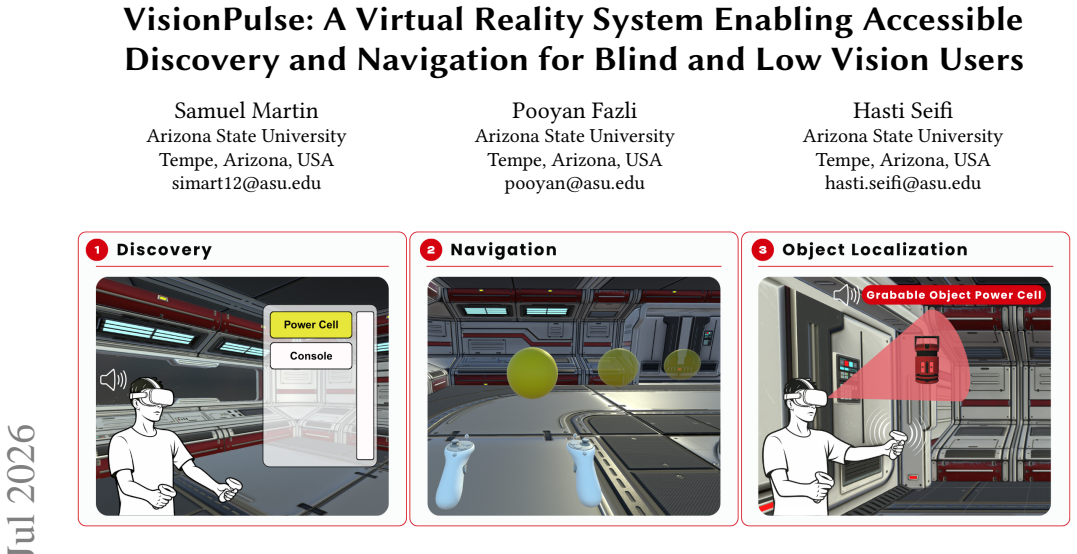
The central claim, stated on the authors' own terms, is that embodied head-and-hand interaction can substitute for visual feedback as the primary channel for free-form VR exploration by BLV users. VisionPulse operationalizes attention as a camera frustum: any unoccluded object or section that intersects the headset's view is 'discovered,' added to a spoken discovery menu, and sorted by proximity, with undiscovered sections prioritized. At distance, a responsive audio beacon—a spatialized hum discretized into four tonal levels by angular deviation—tells users when they are aligned with a waypoint; within two meters, controller vibration, weighted 85% by the angle between the controller's forw
What carries the argument
The load-bearing mechanism is a spatial hierarchy of regions, sections, and objects coupled to three feedback systems: (1) camera-frustum discovery, where bounds checks against the headset camera and occlusion tests decide what gets revealed and added to the dynamic discovery menu; (2) waypoint-based navigation with a responsive audio beacon, a spatialized hum whose pitch and volume drop off in four discrete tonal steps as the angle between head orientation and target increases (0–10°, 10–45°, 45–90°, >90°); and (3) orientation-based haptics, where controller vibration turns on within 2 meters and intensifies with the angular alignment of the controller toward the target, with distance contr
Load-bearing premise
The system assumes that head orientation reliably reflects what a BLV user wants to discover; if a user moves the camera by joystick or chair rotation without turning the head, objects sweep into the discovery menu by accident and the menu stops being a trustworthy map of attention.
What would settle it
A session where participants explore a scene while keeping their head still and rotating only via joystick or chair (so the frustum sweeps the environment incidentally) would test the proxy directly: if discovered-object lists become dominated by swept-past items and users report the menu as noise rather than a memory aid, the head-as-attention assumption fails. A simpler check: compare discovery accuracy under fast versus slow deliberate head turns, or solicit ratings of 'the menu felt like it knew what I was interested in' across joystick-rotation and head-rotation trials.
If this is right
- Discovery need not cost efficiency: the study found no significant increase in task completion time or workload in the discovery condition, even though path lengths were significantly longer and wandering more frequent, suggesting free-form exploration can be layered onto VR tasks without penalty.
- Multimodal feedback is complementary, not redundant: participants described audio as supplying direction, haptics as confirming alignment and proximity, and TTS as providing semantic context, which argues for designing accessible VR with coordinated audio-haptic-voice cues rather than single modalities.
- The discrete tonal levels of the responsive audio beacon give users a way to know they are precisely facing a target—something a fixed spatialized beacon does not—offering a concrete recipe for navigation cues in nonvisual interfaces.
- Prioritizing 'undiscovered section' entries in the dynamic menu gives users a built-in nudge toward unexplored areas, a lightweight mechanism for encouraging progressive exploration without explicit instructions.
- The authors acknowledge that the system currently depends on manually authored region/section/object metadata and labels, and identify automated scene understanding as the path to scaling this approach to arbitrary VR environments.
Where Pith is reading between the lines
- The head-as-attention proxy has a known boundary case: if a BLV user rotates by joystick or swivels their chair without rotating the head, objects will stream through the frustum incidentally, and the discovery menu could become a record of sweeps rather than intentions. An interface that distinguishes deliberate gaze pauses (e.g., dwell time or a confirm gesture) from passing glances would plausi
- The same interaction grammar generalizes beyond the head: hand-pointing, foot orientation, or a white-cane sweep could stand in for the camera frustum, and the angular-alignment haptics could guide corridor following or stair climbing, potentially carrying the system beyond the single-floor layouts tested here.
- Because the study is a single session with 12 participants of mixed vision status, the null performance result is better read as 'discovery can be offered without demonstrated cost' than as 'discovery is performance-neutral as a general law'; a longitudinal study with repeated use would be needed to see whether learning effects, menu-scale growth, or fatigue change the tradeoff.
- The paper's own concern about menu scalability in larger environments suggests a concrete experiment: replace the sequential list with voice commands or filtered search and measure whether the preference for discovery persists when a space contains far more than three regions, or whether the linear menu becomes the bottleneck.
Editorial analysis
A structured set of objections, weighed in public.
Referee Report
Summary. The paper presents VisionPulse, a VR system for blind and low vision (BLV) users that supports free-form discovery of virtual environments through head-based scanning, a dynamic discovery menu, waypoint-based navigation, and responsive audio/haptic feedback. The central contribution is an embodied alternative to prebuilt menus and static audio beacons. A within-subject study with 12 BLV participants compared two exploration types (discovery vs. prebuilt) and three feedback modalities (audio beacon, responsive audio, responsive audio plus haptics). The authors report a strong qualitative preference for discovery and multimodal feedback, and claim that discovery does not negatively affect task performance or workload. Quantitative results show significantly longer path lengths in discovery but no significant effects on completion time, workload, or presence; qualitative themes emphasize autonomy, engagement, and the value of combined audio-haptic cues.
Significance. If the core claims hold, VisionPulse is a meaningful step toward accessible free-form VR exploration: it is an open-source system, evaluated with a BLV participant sample, and it directly addresses a gap left by menu- and beacon-based approaches. The study design is generally sound for an HCI accessibility contribution: within-subject comparison, appropriate non-parametric statistics (ART ANOVA for non-normal measures), effect sizes reported, and a qualitative analysis that gives voice to participant experience. The system design is clearly described and reproducible from the text. However, the manuscript's headline claim of 'without negatively impacting task performance' is not supported by the evidence as analyzed, and the paper itself includes a caution that contradicts the abstract. The contribution remains valuable as a design exploration with strong qualitative support, but the quantitative equivalence claim needs substantial revision.
major comments (3)
- [§5.1, Table 2] The claim 'without negatively impacting task performance' rests on a null result from an underpowered and selectively analyzed sample. Seven of seventy-two scenes were excluded from the completion-time analysis because participants exceeded the 10-minute limit or stopped due to frustration; four of those exclusions came from a single participant (P3B). With the remaining trials, completion time was not significant (p=.19) but the observed mean difference was substantial (301.6s vs. 261.9s, roughly 40s slower in discovery), and path length was significantly longer (p=.003). A non-significant p-value after removing the hardest trials cannot support the abstract's equivalence claim. Please re-run the analysis with all scenes, e.g., conservatively assigning the maximum time or using a survival/censoring approach, and report the sensitivity of the result to the exclusions. At minimum, the abs
- [Abstract vs. §6.1] There is an internal inconsistency that is load-bearing for the paper's framing. The abstract states discovery is supported 'without negatively impacting task performance or perceived workload,' but Section 6.1 explicitly cautions that the findings 'should not be interpreted as evidence that discovery-based exploration or multimodal feedback are objectively superior to existing approaches' and notes that preference may reflect experimental biases. The abstract's categorical phrasing overstates the strength of the evidence. The authors should align the abstract, introduction (last paragraph), and conclusion with the more careful language used in the Discussion.
- [§3.2, §6.3] The discovery mechanism uses head orientation and camera frustum as a proxy for user attention, but the system's own limitation section (6.3) acknowledges that joystick-based movement can diverge from head direction, causing confusion. The study does not report how often or in which conditions this mismatch occurred, nor does it analyze whether the discovery menu's usefulness degraded under that mismatch. Since the discovery advantage is the paper's central claim, please provide at least a descriptive analysis of head-orientation/joystick-direction consistency (e.g., from positional and head-tracking logs) or explicitly discuss how chair swiveling and joystick movement interacted with discovery in the results. Without this, it is difficult to know whether the reported preference for discovery would survive realistic use cases where users do not continuously turn their head.
minor comments (5)
- [§5.2.2] Participant identifiers are inconsistent: P9 is labelled P9B in the demographics table and in one quotation, but later appears as 'P9LV' in the snap-turn sentence. P11 is sometimes written without the LV suffix. Please standardize all participant identifiers.
- [Table 2] Typographical issues: 'ANOV A' appears in the caption, and the degrees of freedom for 'Feedback Modality' rows appear correct but should be double-checked (e.g., df2=22 for interaction may be unusual for ART with within-subject; confirm the model specification). Also, please report confidence intervals or at least standard errors for the main completion-time comparisons, since the reported standard deviations are large.
- [§3.4.1] The descriptions '85% of intensity' and '15%' for haptic weighting are clear, but it would help to state whether these weights were tuned a priori or during piloting, and whether the 2m activation distance and 90° cone were fixed across all scenes.
- [§4, Procedure] The procedure states participants were 'advanced to the next scene' after timeout or frustration. It would be useful to report exactly how many scenes were timed out vs. stopped by choice, and to provide a CONSORT-style flow of participants through conditions, since the exclusion pattern is relevant to the main result.
- [§5.1, Movement Patterns] The movement-pattern categories (deliberate, wandering, erratic) are coded from positional logs; please report inter-rater reliability (e.g., Cohen's kappa) for the two independent coders, as the categorization summary in Table 3 is used interpretively.
Circularity Check
No significant circularity: VisionPulse is an empirically evaluated VR system; no prediction reduces to fitted input, and self-citations are peripheral.
full rationale
VisionPulse makes no formal derivation claims. Its contributions are a system implementation and a within-subjects user study with 12 BLV participants (Sec 4-5). The paper does not fit a parameter to a subset of data and then 'predict' a closely related quantity: completion time, path length, NASA-TLX, MEC-SPQ, and preference ratings are directly measured outcomes, not quantities derived from the system's parameters. There are no equations linking inputs to outputs, no uniqueness theorem invoked to force a design choice, and no ansatz smuggled in via a self-citation. The design assumption that head orientation is a proxy for attention (Sec 3.2) is an explicit design choice, and its limitation is acknowledged in Sec 6.3 ('head orientation ... can cause user confusion when the head direction diverges from joystick input'); this is a validity/assumption concern, not circularity. Self-citations (e.g., refs 5, 6, 30-33, 39-40, 44, 73) appear only in related work, future-work, or literature-support contexts and are not load-bearing for the empirical findings. The Sec 6.1 disclaimer that findings 'should not be interpreted as evidence that discovery-based exploration or multimodal feedback are objectively superior' is a caution about generalization, not evidence of circularity. The abstract's 'without negatively impacting task performance' phrasing is stronger than the underpowered null result supports, but that is a statistical-robustness/correctness concern outside the circularity definition. Therefore no circular step can be exhibited, and the appropriate score is 0.
Axiom & Free-Parameter Ledger
free parameters (5)
- Haptic activation distance threshold (2 m)
- Haptic angle threshold (90°) and intensity mix (85% angular, 15% Euclidean distance)
- Responsive audio tonal discretization (0–10°, 10–45°, 45–90°, >90°)
- Waypoint post-processing thresholds ('too close', 'large gaps', corner density)
- Study task time budget (10 minutes) and scene scales (80–95 m perimeters, 15–25 m path lengths)
axioms (5)
- domain assumption Head orientation is a valid proxy for user attention and exploration intent
- domain assumption Responsive audio beacon pitch/volume mapping is comprehensible to BLV users without extensive training
- domain assumption Controller angular aim is a reliable interaction channel for users with no touch impairments
- domain assumption Unity NavMesh and the waypoint post-processing generate navigable, smooth paths
- domain assumption Twelve participants with varied vision conditions are sufficient to support the stated preference and workload claims
read the original abstract
Free exploration is an important aspect of many engaging virtual reality (VR) experiences, yet remains largely inaccessible to blind and low vision (BLV) users due to its reliance on visual feedback. Existing approaches support BLV navigation through prebuilt menus of environment and audio beacons, but offer limited support for free-form discovery. We present VisionPulse, an accessible VR system that enables BLV users to explore virtual environments through natural head and hand movements, combined with auditory, haptic, and text-to-speech feedback. VisionPulse introduces a discovery-driven approach that allows users to progressively uncover regions and objects, alongside navigation support through waypoint guidance and object localization via responsive audio and orientation-based haptics. A study with 12 BLV participants showed a strong preference for VisionPulse's discovery-based exploration and multimodal feedback, without negatively impacting task performance or perceived workload. Our findings underscore the importance of accessible, free-form VR experiences, and contribute insights for inclusive VR design.
Figures


Reference graph
Works this paper leans on
-
[1]
Taslima Akter, Bryan Dosono, Tousif Ahmed, Apu Kapadia, and Bryan Semaan
-
[2]
Ronny Andrade, Steven Baker, Jenny Waycott, and Frank Vetere. 2018. Echo- house: exploring a virtual environment by using echolocation. InProceedings of the 30th Australian Conference on Computer-Human Interaction(Melbourne, Australia)(OzCHI ’18). Association for Computing Machinery, New York, NY, USA, 278–289. https://doi.org/10.1145/3292147.3292163
arXiv 2018
-
[3]
Rogerson, Jenny Waycott, Steven Baker, and Frank Vetere
Ronny Andrade, Melissa J. Rogerson, Jenny Waycott, Steven Baker, and Frank Vetere. 2019. Playing Blind: Revealing the World of Gamers with Visual Impair- ment. InProceedings of the 2019 CHI Conference on Human Factors in Computing Systems(Glasgow, Scotland Uk)(CHI ’19). Association for Computing Machinery, New York, NY, USA, 1–14. https://doi.org/10.1145/...
arXiv 2019
-
[4]
Ronny Andrade, Jenny Waycott, Steven Baker, and Frank Vetere. 2021. Echolo- cation as a means for people with visual impairment (PVI) to acquire spatial knowledge of virtual space.ACM Transactions on Accessible Computing (TACCESS) 14, 1 (2021), 1–25
2021
-
[5]
Maryam Cheema, Sina Elahimanesh, Pooyan Fazli, and Hasti Seifi. 2026. ViD- scribe: Multimodal AI for Customizing Audio Description and Question Answer- ing in Online Videos. InACM SIGCHI Conference Extended Abstracts on Human Factors in Computing Systems (CHI EA)
2026
-
[6]
Maryam Cheema, Hasti Seifi, and Pooyan Fazli. 2025. Describe now: User-driven audio description for blind and low vision individuals. InProceedings of the 2025 ACM Designing Interactive Systems Conference. 458–474
2025
-
[7]
Ruijia Chen, Junru Jiang, Pragati Maheshwary, Brianna R Cochran, and Yuhang Zhao. 2025. VisiMark: Characterizing and Augmenting Landmarks for People with Low Vision in Augmented Reality to Support Indoor Navigation. InProceed- ings of the 2025 CHI Conference on Human Factors in Computing Systems (CHI ’25). Association for Computing Machinery, New York, NY...
arXiv 2025
-
[8]
2021.Thematic Analysis: A Practical Guide
Victoria Clarke and Virginia Braun. 2021.Thematic Analysis: A Practical Guide. Sage Publications Ltd, Thousand Oaks, California, USA
2021
-
[9]
The Guide Has Your Back
Jazmin Collins, Crescentia Jung, Yeonju Jang, Danielle Montour, Andrea Steven- son Won, and Shiri Azenkot. 2023. “The Guide Has Your Back”: Exploring How Sighted Guides Can Enhance Accessibility in Social Virtual Reality for Blind and Low Vision People. InProceedings of the 25th international ACM SIGACCESS conference on computers and accessibility. 1–14
2023
-
[10]
Connors, Elizabeth R
Erin C. Connors, Elizabeth R. Chrastil, Jaime Sánchez, and Lotfi B. Merabet
-
[11]
Yours is better!
Nicola Dell, Vidya Vaidyanathan, Indrani Medhi, Edward Cutrell, and William Thies. 2012. "Yours is better!" participant response bias in HCI. InProceedings of the ACM CHI conference on Human Factors in Computing Systems. 1321–1330
2012
-
[12]
Massimiliano Di Luca, Hasti Seifi, Simon Egan, and Mar Gonzalez-Franco. 2021. Locomotion vault: the extra mile in analyzing vr locomotion techniques. In Proceedings of the 2021 CHI conference on human factors in computing systems. 1–10
2021
-
[13]
Agebson Rocha Façanha, Ticianne Darin, Windson Viana, and Jaime Sánchez
-
[14]
2026.Augmented Reality (AR) Market Size, Share & In- dustry Analysis, By Industry, By Application and Regional Forecast, 2026–2034
Fortune Business Insights. 2026.Augmented Reality (AR) Market Size, Share & In- dustry Analysis, By Industry, By Application and Regional Forecast, 2026–2034. For- tune Business Insights. https://www.fortunebusinessinsights.com/augmented- reality-ar-market-102553 Accessed 27 February 2026
2026
-
[15]
Diogo Furtado, Renato Alexandre Ribeiro, Manuel Piçarra, Letícia Seixas Pereira, Carlos Duarte, André Rodrigues, and João Guerreiro. 2025. Designing and Evalu- ating a VR Boxing Experience with Blind People. InProceedings of the ACM CHI Conference on Human Factors in Computing Systems. 1–17
2025
-
[16]
O&M Indoor Virtual Environments for People Who Are Blind: A Systematic Literature Review.ACM Trans. Access. Comput.13, 2, Article 9a (Aug. 2020), 42 pages. https://doi.org/10.1145/3395769
-
[17]
João Guerreiro, Dragan Ahmetovic, Kris M. Kitani, and Chieko Asakawa. 2017. Virtual Navigation for Blind People: Building Sequential Representations of the Real-World. InProceedings of the 19th International ACM SIGACCESS Conference on Computers and Accessibility(Baltimore, Maryland, USA)(ASSETS ’17). Association for Computing Machinery, New York, NY, USA...
arXiv 2017
-
[18]
João Guerreiro, Yujin Kim, Rodrigo Nogueira, SeungA Chung, André Rodrigues, and Uran Oh. 2023. The Design Space of the Auditory Representation of Objects and Their Behaviours in Virtual Reality for Blind People.IEEE Transactions on Visualization and Computer Graphics29, 5 (May 2023), 2763–2773. https: VisionPulse: A Virtual Reality System Enabling Accessi...
arXiv 2023
-
[19]
João Guerreiro, Yujin Kim, Rodrigo Nogueira, SeungA Chung, André Rodrigues, and Uran Oh. 2023. The design space of the auditory representation of objects and their behaviours in virtual reality for blind people.IEEE Transactions on Visualization and Computer Graphics29, 5 (2023), 2763–2773
2023
-
[20]
Sandra G. Hart and Lowell E. Staveland. 1988. Development of NASA-TLX (Task Load Index): Results of Empirical and Theoretical Research. InHuman Mental Workload, Peter A. Hancock and Najmedin Meshkati (Eds.). Advances in Psychology, Vol. 52. North-Holland, 139–183. https://doi.org/10.1016/S0166- 4115(08)62386-9
doi:10.1016/s0166- 1988
-
[21]
Gesu India, Mohit Jain, Pallav Karya, Nirmalendu Diwakar, and Manohar Swami- nathan. 2021. VStroll: An Audio-based Virtual Exploration to Encourage Walking among People with Vision Impairments. InProceedings of the 23rd International ACM SIGACCESS Conference on Computers and Accessibility(Virtual Event, USA) (ASSETS ’21). Association for Computing Machine...
arXiv 2021
-
[22]
João Guerreiro, Daisuke Sato, Dragan Ahmetovic, Eshed Ohn-Bar, Kris M. Kitani, and Chieko Asakawa. 2020. Virtual navigation for blind people: Transferring route knowledge to the real-World.Int. J. Hum.-Comput. Stud.135, C (March 2020), 14 pages. https://doi.org/10.1016/j.ijhcs.2019.102369
arXiv 2020
-
[23]
Ji, Brianna Cochran, and Yuhang Zhao
Tiger F. Ji, Brianna Cochran, and Yuhang Zhao. 2022. VRBubble: Enhancing Peripheral Awareness of Avatars for People with Visual Impairments in So- cial Virtual Reality. InProceedings of the 24th International ACM SIGACCESS Conference on Computers and Accessibility(Athens, Greece)(ASSETS ’22). As- sociation for Computing Machinery, New York, NY, USA, Artic...
arXiv 2022
-
[24]
Arata Jingu, Easa AliAbbasi, Paul Strohmeier, and Jürgen Steimle. 2026. Scene2Hap: Combining LLMs and physical modeling for automatically gen- erating vibrotactile signals for full VR scenes. InProceedings of the ACM CHI conference on human factors in computing systems. 1–21
2026
-
[25]
Dhruv Jain, Sasa Junuzovic, Eyal Ofek, Mike Sinclair, John Porter, Chris Yoon, Swetha Machanavajhala, and Meredith Ringel Morris. 2021. A taxonomy of sounds in virtual reality. InProceedings of the 2021 ACM Designing Interactive Systems Conference. 160–170
2021
-
[26]
Hyunjeong Kim, Sang-Bin Jeon, and In-Kwon Lee. 2024. Locomotion techniques for dynamic environments: Effects on spatial knowledge and user experiences. IEEE transactions on visualization and computer graphics30, 5 (2024), 2184–2194
2024
-
[27]
Melanie Jo Kneitmix and Jacob O. Wobbrock. 2025. From Screen Reading to “Scene Reading” in SceneVR: Touch-Based Interaction Techniques for Use in Virtual Reality by Blind and Low-Vision Users. InProceedings of the 27th Interna- tional ACM SIGACCESS Conference on Computers and Accessibility (ASSETS ’25). Association for Computing Machinery, New York, NY, U...
arXiv 2025
-
[28]
Daniel Killough, Justin Feng, Zheng Xue Ching, Daniel Wang, Rithvik Dyava, Yapeng Tian, and Yuhang Zhao. 2025. VRSight: An AI-Driven Scene Description System to Improve Virtual Reality Accessibility for Blind People. InProceedings of the 38th Annual ACM Symposium on User Interface Software and Technology (UIST ’25). Association for Computing Machinery, Ne...
arXiv 2025
-
[29]
Masaya Kubota, Masaki Kuribayashi, Seita Kayukawa, Hironobu Takagi, Chieko Asakawa, and Shigeo Morishima. 2024. Snap&Nav: Smartphone-based Indoor Navigation System For Blind People via Floor Map Analysis and Intersection Detection.Proc. ACM Hum.-Comput. Interact.8, MHCI, Article 275 (Sept. 2024), 22 pages. https://doi.org/10.1145/3676522
-
[30]
Yogesh Kulkarni and Pooyan Fazli. 2025. EgoVITA: Learning to Plan and Verify for Egocentric Video Reasoning.arXiv preprint arXiv:2511.18242(2025)
Pith/arXiv arXiv 2025
-
[31]
Julian Kreimeier, Pascal Karg, and Timo Götzelmann. 2020. BlindWalkVR: for- mative insights into blind and visually impaired people’s VR locomotion using commercially available approaches. InProceedings of the 13th ACM International Conference on PErvasive Technologies Related to Assistive Environments. 1–8
2020
-
[32]
Yogesh Kulkarni and Pooyan Fazli. 2025. VideoSAVi: Self-Aligned Video Lan- guage Models without Human Supervision. InConference on Language Modeling (COLM)
2025
-
[33]
Yogesh Kulkarni and Pooyan Fazli. 2026. AVATAR: Reinforcement Learning to See, Hear, and Reason Over Video. InIEEE/CVF Conference on Computer Vision and Pattern Recognition (CVPR)
2026
-
[34]
Yogesh Kulkarni and Pooyan Fazli. 2025. VideoPASTA: 7K Pairs That Matter for Video-LLM Alignment. InEmpirical Methods in Natural Language Processing (EMNLP)
2025
-
[35]
Orly Lahav. 2022. Virtual Reality Systems as an Orientation Aid for People Who Are Blind to Acquire New Spatial Information.Sensors22, 4 (2022). https: //doi.org/10.3390/s22041307
-
[36]
Diogo Lança, Manuel Piçarra, Inês Gonçalves, Uran Oh, André Rodrigues, and João Guerreiro. 2024. Speed-of-Light VR for Blind People: Conveying the Location of Arm-Reach Targets. InProceedings of the 26th International ACM SIGACCESS Conference on Computers and Accessibility(St. John’s, NL, Canada)(ASSETS ’24). Association for Computing Machinery, New York,...
arXiv 2024
-
[37]
Masaki Kuribayashi, Tatsuya Ishihara, Daisuke Sato, Jayakorn Vongkulbhisal, Karnik Ram, Seita Kayukawa, Hironobu Takagi, Shigeo Morishima, and Chieko Asakawa. 2023. PathFinder: Designing a Map-less Navigation System for Blind People in Unfamiliar Buildings. InProceedings of the 2023 CHI Conference on Human Factors in Computing Systems(Hamburg, Germany)(CH...
arXiv 2023
-
[38]
Franklin Mingzhe Li, Michael Xieyang Liu, Cynthia L Bennett, and Shaun K Kane
-
[39]
Yinan Li and Hasti Seifi. 2026. Sound2Hap: Learning Audio-to-Vibrotactile Haptic Generation from Human Ratings. InProceedings of the ACM CHI conference on human factors in computing systems. 1–19
2026
-
[40]
Chaoyu Li, Sid Padmanabhuni, Maryam S Cheema, Hasti Seifi, and Pooyan Fazli. 2025. Videoa11y: Method and dataset for accessible video description. In Proceedings of the 2025 CHI Conference on Human Factors in Computing Systems. 1–29
2025
-
[41]
Wobbrock
Yumeng Ma, Alexis Hiniker, and Jacob O. Wobbrock. 2026. Quantifying the Novelty Bias when Evaluating Interactive Prototypes. InProceedings of the ACM CHI Conference on Human Factors in Computing Systems. 1–19
2026
-
[42]
Jesse J Martinez, Jon E. Froehlich, and James Fogarty. 2024. Playing on Hard Mode: Accessibility, Difficulty and Joy in Video Game Adoption for Gamers with Disabilities. InProceedings of the 2024 CHI Conference on Human Factors in Computing Systems(Honolulu, HI, USA)(CHI ’24). Association for Computing Machinery, New York, NY, USA, Article 524, 17 pages. ...
arXiv 2024
-
[43]
Masaki Matsuo, Takahiro Miura, Masatsugu Sakajiri, Junji Onishi, and Tsukasa Ono. 2016. Audible mapper & ShadowRine: development of map editor using only sound in accessible game for blind users, and accessible action RPG for visually impaired gamers. InInternational Conference on Computers Helping People with Special Needs. Springer, 537–544
2016
-
[44]
Tianhang Liu, Pooyan Fazli, and Heejin Jeong. 2024. Artificial Intelligence in Virtual Reality for Blind and Low Vision Individuals: A Literature Review. In Proceedings of the Human Factors and Ergonomics Society Annual Meeting
2024
-
[45]
João Mendes, Manuel Piçarra, Inês Gonçalves, André Rodrigues, and João Guer- reiro. 2025. Exploring Aiming Techniques for Blind People in Virtual Reality.IEEE Transactions on Visualization and Computer Graphics31, 5 (May 2025), 3267–3274. https://doi.org/10.1109/TVCG.2025.3549847
arXiv 2025
-
[46]
Yusuke Miura, Erwin Wu, Masaki Kuribayashi, Hideki Koike, and Shigeo Mor- ishima. 2023. Exploration of sonification feedback for people with visual impair- ment to use ski simulator. InProceedings of the Augmented Humans International Conference 2023. 147–158
2023
-
[47]
Tony Morelli, John Foley, and Eelke Folmer. 2010. Vi-bowling: a tactile spatial exergame for individuals with visual impairments. InProceedings of the 12th In- ternational ACM SIGACCESS Conference on Computers and Accessibility(Orlando, Florida, USA)(ASSETS ’10). Association for Computing Machinery, New York, NY, USA, 179–186. https://doi.org/10.1145/1878...
arXiv 2010
-
[48]
Martin Maunsbach, Kasper Hornbæk, and Hasti Seifi. 2023. Mediated social touching: Haptic feedback affects social experience of touch initiators. In2023 IEEE World Haptics Conference (WHC). IEEE, 93–100
2023
-
[49]
Vishnu Nair, Hanxiu ’Hazel’ Zhu, Peize Song, Jizhong Wang, and Brian A. Smith
-
[50]
2020.The Last of Us Part II
Naughty Dog. 2020.The Last of Us Part II. Sony Interactive Entertainment, San Mateo, CA
2020
-
[51]
Manuel Piçarra, André Rodrigues, and João Guerreiro. 2023. Evaluating Accessible Navigation for Blind People in Virtual Environments. InExtended Abstracts of the 2023 CHI Conference on Human Factors in Computing Systems(Hamburg, Germany)(CHI EA ’23). Association for Computing Machinery, New York, NY, USA, Article 105, 7 pages. https://doi.org/10.1145/3544...
arXiv 2023
-
[52]
Vishnu Nair, Jay L Karp, Samuel Silverman, Mohar Kalra, Hollis Lehv, Faizan Jamil, and Brian A. Smith. 2021. NavStick: Making Video Games Blind-Accessible via the Ability to Look Around. InThe 34th Annual ACM Symposium on User Interface Software and Technology(Virtual Event, USA)(UIST ’21). Association for Computing Machinery, New York, NY, USA, 538–551. ...
arXiv 2021
-
[53]
Renato Alexandre Ribeiro, Inês Gonçalves, Manuel Piçarra, Letícia Seixas Pereira, Carlos Duarte, André Rodrigues, and João Guerreiro. 2024. Investigating Virtual Reality Locomotion Techniques with Blind People. InProceedings of the 2024 CHI Conference on Human Factors in Computing Systems(Honolulu, HI, USA) (CHI ’24). Association for Computing Machinery, ...
arXiv 2024
-
[54]
Schloerb, Orly Lahav, Joseph G
David W. Schloerb, Orly Lahav, Joseph G. Desloge, and Mandayam A. Srinivasan
-
[55]
Oliver Schneider, Jotaro Shigeyama, Robert Kovacs, Thijs Jan Roumen, Sebastian Marwecki, Nico Boeckhoff, Daniel Amadeus Gloeckner, Jonas Bounama, and Patrick Baudisch. 2018. DualPanto: A haptic device that enables blind users to continuously interact with virtual worlds. InProceedings of the annual ACM symposium on user interface software and technology. 877–887
2018
-
[56]
Katie Seaborn and Deborah I Fels. 2015. Gamification in theory and action: A survey.International Journal of human-computer studies74 (2015), 14–31
2015
-
[57]
Zihe Ran, Xiyu Li, Qing Xiao, Xianzhe Fan, Franklin Mingzhe Li, Yanyun Wang, and Zhicong Lu. 2025. How Users Who are Blind or Low Vision Play Mobile Games: Perceptions, Challenges, and Strategies. InProceedings of the 2025 CHI Conference on Human Factors in Computing Systems (CHI ’25). Association for Computing Machinery, New York, NY, USA, Article 1160, ...
arXiv 2025
-
[58]
Siu, Mike Sinclair, Robert Kovacs, Eyal Ofek, Christian Holz, and Edward Cutrell
Alexa F. Siu, Mike Sinclair, Robert Kovacs, Eyal Ofek, Christian Holz, and Edward Cutrell. 2020. Virtual Reality Without Vision: A Haptic and Auditory White Cane to Navigate Complex Virtual Worlds. InProceedings of the 2020 CHI Conference on Human Factors in Computing Systems(Honolulu, HI, USA)(CHI ’20). Association for Computing Machinery, New York, NY, ...
arXiv 2020
-
[59]
Brian A. Smith and Shree K. Nayar. 2018. The RAD: Making Racing Games Equivalently Accessible to People Who Are Blind. InProceedings of the 2018 CHI Conference on Human Factors in Computing Systems(Montreal QC, Canada) (CHI ’18). Association for Computing Machinery, New York, NY, USA, 1–12. https://doi.org/10.1145/3173574.3174090
arXiv 2018
-
[60]
Yunlong Tang, JunJia Guo, Hang Hua, Susan Liang, Fengm Mingqian, Xinyang Li, Maom Rui, Chao Huang, Jing Bi Bi, Zeliang Zhang, Pooyan Fazli, and Chenliang Xu. 2025. VidComposition: Can MLLMs Analyze Compositions in Compiled Video?. InIEEE/CVF Conference on Computer Vision and Pattern Recognition (CVPR)
2025
-
[61]
Lauren Thevin, Carine Briant, and Anke M. Brock. 2020. X-Road: Virtual Reality Glasses for Orientation and Mobility Training of People with Visual Impairments. ACM Trans. Access. Comput.13, 2, Article 7 (April 2020), 47 pages. https://doi. org/10.1145/3377879
-
[62]
Shari Trewin, Vicki L Hanson, Mark R Laff, and Anna Cavender. 2008. PowerUp: an accessible virtual world. InProceedings of the 10th international ACM SIGAC- CESS conference on Computers and accessibility. 177–184
2008
-
[63]
Aayush Shrestha and Joseph Malloch. 2025. Virtual Worlds Beyond Sight: Design- ing and Evaluating an Audio-Haptic System for Non-Visual VR Exploration. In Proceedings of the ACM CHI Conference on Human Factors in Computing Systems. 1–19
2025
-
[64]
Social Security Administration
U.S. Social Security Administration. 1983. 20 CFR §404.1581: Meaning of blindness as defined in the law. https://www.ssa.gov/OP_Home/cfr20/404/404-1581.htm Accessed 18 April 2026
1983
-
[65]
Peter Vorderer, Werner Wirth, Feliz Gouveia, Frank Biocca, Timo Saari, Lutz Jäncke, Saskia Böcking, Holger Schramm, Andre Gysbers, Tilo Hartmann, Christoph Klimmt, Jari Laarni, Niklas Ravaja, Ana Sacau, Thomas Baumgartner, and Petra Jäncke. 2004. MEC spatial presence questionnaire (MEC-SPQ, Eng- lish and German version): Short documentation and instructio...
arXiv 2004
-
[66]
Iddo Yehoshua Wald, Donald Degraen∗, Amber Maimon∗, Jonas Keppel, Stefan Schneegass, and Rainer Malaka. 2025. Spatial Haptics: A Sensory Substitution Method for Distal Object Detection Using Tactile Cues. InProceedings of the 2025 CHI Conference on Human Factors in Computing Systems (CHI ’25). Association for Computing Machinery, New York, NY, USA, Articl...
arXiv 2025
-
[67]
Bruce N Walker and Jeff Lindsay. 2003. Effect of beacon sounds on navigation per- formance in a virtual reality environment. InProceedings of the 2003 International Conference on Auditory Display. 204–207
2003
-
[68]
Bruce N Walker and Jeffrey Lindsay. 2006. Navigation performance with a virtual auditory display: Effects of beacon sound, capture radius, and practice.Human factors48, 2 (2006), 265–278
2006
-
[69]
Unity Inc. [n. d.].Unity Documentation: NavMesh. https://docs.unity3d.com/6000. 3/Documentation/ScriptReference/AI.NavMesh.html Accessed 15 April 2026
2026
-
[70]
Ryan Wedoff, Lindsay Ball, Amelia Wang, Yi Xuan Khoo, Lauren Lieberman, and Kyle Rector. 2019. Virtual showdown: An accessible virtual reality game with scaffolds for youth with visual impairments. InProceedings of the ACM CHI conference on human factors in computing systems. 1–15
2019
-
[71]
Wobbrock, Leah Findlater, Darren Gergle, and James J
Jacob O. Wobbrock, Leah Findlater, Darren Gergle, and James J. Higgins. 2011. The aligned rank transform for nonparametric factorial analyses using only anova pro- cedures. InProceedings of the SIGCHI Conference on Human Factors in Computing Systems(Vancouver, BC, Canada)(CHI ’11). Association for Computing Machin- ery, New York, NY, USA, 143–146. https:/...
arXiv 2011
-
[72]
World Health Organization. 2026. Blindness and Visual Impairment. https://www. who.int/news-room/fact-sheets/detail/blindness-and-visual-impairment Ac- cessed: 2026-04-21
2026
-
[73]
Yuksel, Pooyan Fazli, Umang Mathur, Vaishali Bisht, Soo Jung Kim, Joshua Junhee Lee, Seung Jung Jin, Yue-Ting Siu, Joshua A
Beste F. Yuksel, Pooyan Fazli, Umang Mathur, Vaishali Bisht, Soo Jung Kim, Joshua Junhee Lee, Seung Jung Jin, Yue-Ting Siu, Joshua A. Miele, and Ilmi Yoon
-
[74]
Bennett, Hrvoje Benko, Edward Cutrell, Christian Holz, Meredith Ringel Morris, and Mike Sinclair
Yuhang Zhao, Cynthia L. Bennett, Hrvoje Benko, Edward Cutrell, Christian Holz, Meredith Ringel Morris, and Mike Sinclair. 2018. Enabling People with Visual Impairments to Navigate Virtual Reality with a Haptic and Auditory Cane Simulation. InProceedings of the 2018 CHI Conference on Human Factors in Computing Systems(Montreal QC, Canada)(CHI ’18). Associa...
arXiv 2018
-
[75]
Yi Wang, Xiao Liu, Chetan Arora, John Grundy, and Thuong Hoang. 2025. Un- derstanding vr accessibility practices of vr professionals. InProceedings of the 2025 CHI Conference on Human Factors in Computing Systems. 1–17
2025
-
[80]
InACM SIGCHI Conference on Designing Interactive Systems (DIS)
Human-in-the-Loop Machine Learning to Increase Video Accessibility for Visually Impaired and Blind Users. InACM SIGCHI Conference on Designing Interactive Systems (DIS). 47–60
-
[2010]
BlindAid: Virtual environment system for self-reliant trip planning and orientation and mobility training. In2010 IEEE Haptics Symposium. 363–370. https://doi.org/10.1109/HAPTIC.2010.5444631
arXiv 2010
-
[2014]
video game based learning approaches
Virtual environments for the transfer of navigation skills in the blind: a comparison of directed instruction vs. video game based learning approaches. Frontiers in Human NeuroscienceVolume 8 - 2014 (2014). https://doi.org/10.3389/ fnhum.2014.00223
arXiv 2014
-
[2020]
I am uncomfortable sharing what I can’t see
" I am uncomfortable sharing what I can’t see": Privacy Concerns of the Visually Impaired with Camera Based Assistive Applications. In29th USENIX Security Symposium (USENIX Security 20). 1929–1948
1929
-
[2024]
Surveyor: Facilitating Discovery Within Video Games for Blind and Low Vision Players. InProceedings of the 2024 CHI Conference on Human Factors in Computing Systems(Honolulu, HI, USA)(CHI ’24). Association for Computing Machinery, New York, NY, USA, Article 10, 15 pages. https://doi.org/10.1145/ 3613904.3642615
arXiv 2024
discussion (0)
Sign in with ORCID, Apple, or X to comment. Anyone can read and Pith papers without signing in.