REVIEW 4 major objections 5 minor 45 references
Huge ensembles of ML hindcasts show tropical cyclones spread super-diffusively, approaching the ballistic limit of travel through background winds.
Reviewed by Pith at T0; open to challenge. T0 means a machine referee read the full paper against a public rubric. the ladder, T0–T4 →
T0 review · deepseek-v4-flash
2026-08-01 06:13 UTC pith:7AUBZ6YF
load-bearing objection The HENS ensemble is a valuable resource and the spread-error analysis is solid, but the central claim of reproducing anomalous TC diffusion is not supported because Eq. 3 measures absolute displacement, making e≈2 the null expectation for steadily translating storms. the 4 major comments →
Anomalous Diffusion of Tropical Cyclones Observed in Huge Ensembles of Hindcasts
The pith
A machine-rendered reading of the paper's core claim, the machinery that carries it, and where it could break.
Core claim
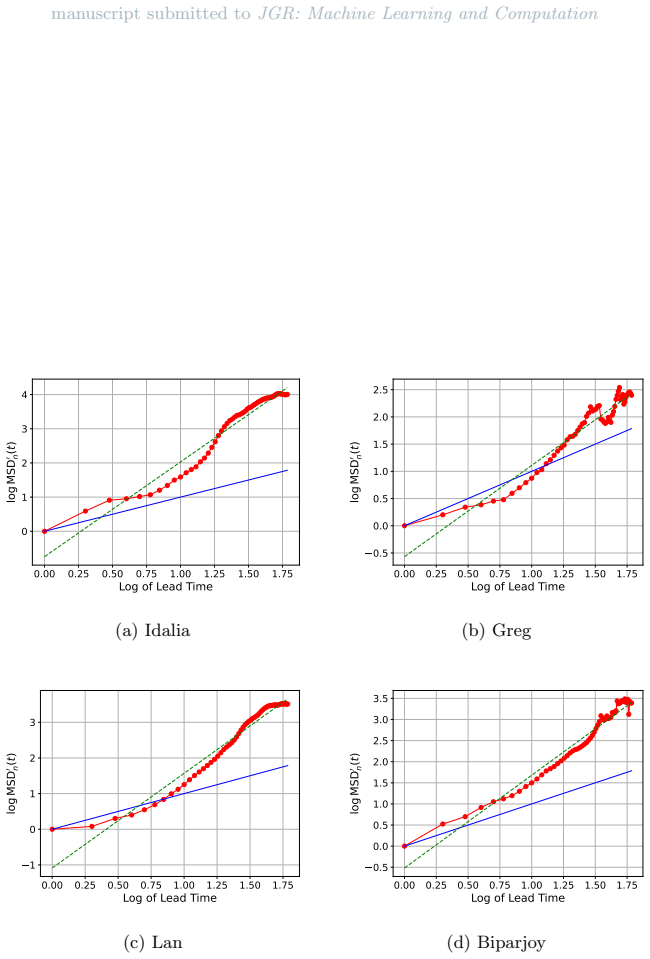
The central claim is that HENS reproduces the anomalous super-diffusion previously inferred for real tropical cyclones: the mean-square displacement of a storm's replicated tracks grows as t^e with e>1 for every storm examined, and individual ensemble members cluster between the Brownian limit e=1 and the ballistic limit e=2. The paper computes two versions of mean-square displacement—one measuring spread about the ensemble-mean track and one measuring each member's squared distance from its own starting point—and finds the fitted exponents exceed 1 for all four representative storms. It further shows that the distribution of per-member exponents across thousands of replays of a single storm
What carries the argument
The key object is the huge ensemble of hindcasts (HENS): 7,424 fifteen-day forecasts initialized daily from observed atmospheric states during summer 2023, generated by a spherical Fourier neural operator (SFNO) weather emulator with bred-vector perturbations to the initial conditions. Storm tracks are extracted by a detection/tracking pipeline with adjusted thresholds and matched to real storms via dynamic time warping plus a stable-matching algorithm. The load-bearing quantity is the diffusion exponent e, the power-law slope of mean-square displacement versus time, which is the variable that carries the argument from ensemble spread to the claim of super-diffusion.
Load-bearing premise
The load-bearing premise is that the mean-square displacement computed from each ensemble member's own starting point (Eq. 3) measures the same diffusive process that earlier observational studies characterized using fluctuations of tracks about the shortest path between initiation and termination; if this equivalence fails, the claim that HENS reproduces the observed anomalous-diffusion power laws collapses, even though the ensemble-spread growth itself is real.
What would settle it
Compute the ensemble-relative mean-square displacement (Eq. 1) for every storm after subtracting the ensemble-mean track, and check whether the fitted exponent e' remains significantly above 1; or repeat the individual-member analysis with displacement measured relative to each storm's own shortest path (great-circle line) instead of its starting point. If e' ≈ 1 once the mean drift is removed, the super-diffusion is an artifact of storm translation rather than of turbulent dispersion.
If this is right
- If e is consistently greater than 1 and sometimes near 2, tropical cyclone track uncertainty grows much faster than Brownian motion predicts, so forecast cones should widen more aggressively with lead time.
- Because the emulator is cheap enough to generate thousands of members, the diffusion exponent can be estimated separately for each storm, something impossible with observational records that yield one exponent per storm.
- The resemblance between HENS and observed exponent distributions supports the use of machine-learning emulators for studying tropical cyclone dynamics and predictability.
- Since the paper treats e as an intrinsic property of the storm and its environment, improving initial conditions alone would not reduce super-diffusive spread; ensemble systems must account for the exponent.
Where Pith is reading between the lines
- Inference: The high individual-member exponents may partly reflect the storm's net translation rather than anomalous dispersion, because Eq. (3) measures displacement from the storm's own starting point; a storm moving at near-constant speed yields e≈2 by construction. The ensemble-relative metric (Eq. 1) is the cleaner test, and the case would be stronger if e' > 1 held robustly across all storms
- Inference: All results rest on a single summer (2023); extending HENS to multiple seasons would test whether the exponent distribution is a universal feature of tropical cyclones or specific to that unusually warm period.
- Inference: A direct falsification check is to compute the ensemble-relative exponent e' for all 33 storms and compare it to the per-member e; disagreement would confirm that ballistic advection inflates the per-member exponents.
- Inference: If the super-diffusive spread is real, operational centers could use ML-ensemble-derived exponents to recalibrate track cone sizes, but this requires verifying that the emulator's ensemble spread is calibrated for lead times beyond 7 days, where the current verification is thin.
Editorial analysis
A structured set of objections, weighed in public.
Referee Report
Summary. The paper analyzes tropical cyclone (TC) tracks in a 7,424-member ensemble of 15-day SFNO-based hindcasts for summer 2023. It detects and matches emulated TCs to IBTrACS tracks, then computes two mean-squared-displacement (MSD) metrics: an ensemble-relative spread (Eq. 1) and a per-member absolute displacement (Eq. 3). The authors report power-law exponents in both cases, claim that the exponents exceed 1 and approach the ballistic limit 2, and conclude that HENS reproduces the anomalous super-diffusion of TCs previously inferred by Meuel et al. (2012).
Significance. If the central claim were established, the paper would offer a new per-storm, ensemble-based estimate of TC track uncertainty growth and a striking confirmation of anomalous diffusion using ML-based huge ensembles. The resource itself is impressive: 7,424-member hindcasts with open data and code, plus a credible spread-error calibration in Appendix C. However, the central claim is not supported as stated because Eq. (3) is an absolute-displacement MSD that is dominated by uniform TC translation, making exponents near 2 expected by construction. The comparison to Meuel et al. (2012) is also not like-for-like, since that work used fluctuations about the shortest path between genesis and lysis. These are load-bearing issues that affect the title, abstract, and conclusions.
major comments (4)
- [§3.2, Eq. (3)–(4); Table A1; Fig. D1] The per-member MSD, MSD_j(t)=⟨(X_j(t+t')−X_j(t'))²⟩, contains no subtraction of the mean track or of a shortest-path reference. For a storm translating at roughly constant velocity v, this quantity is approximately v²t² and yields e≈2 by construction. The near-universal e_j values clustered between 1.8 and 2.0 in Table A1 and the IBTrACS values in Fig. D1 are exactly the signature of uniform drift, not of anomalous diffusion about a preferred path. The statement in §3.2 that 'e_j appreciably exceed 1 ... implying super-diffusive behavior' is therefore not supported by Eq. (3).
- [§3.2 and Appendix D, claim of reproducing Meuel et al. (2012)] The paper claims to reproduce the anomalous-diffusion power laws of Meuel et al. (2012). However, Meuel et al. computed fluctuations of hurricane tracks about the shortest path between genesis and lysis, whereas Eq. (3) measures absolute displacement from an arbitrary starting time. Appendix D recomputes exponents on IBTrACS using the same Eq. (3), so it cannot serve as a validation of the Meuel et al. result. The qualitative resemblance of the CDFs in Fig. 4 to Meuel et al. is not evidence of reproduction because the estimators differ.
- [§3.2, Eq. (1)–(2) and Fig. 3; Plain Language Summary] The ensemble-relative MSD'_n(t) in Eq. (1) is a legitimate measure of ensemble dispersion, and the spread–error calibration in Appendix C is a creditable contribution. However, e'_n>1 in Fig. 3 describes growth of ensemble variance about the ensemble-mean track, not the diffusion of individual TC tracks through the background flow. The conclusion in the Plain Language Summary that 'tropical cyclones can move ... in a ballistic manner' is drawn from the per-member estimator (Eq. 3), not from Eq. (1). These two different quantities should be cleanly separated, and only the latter can support the per-track diffusion claim.
- [§3.2 and Fig. 2/Fig. 4] The matched replicates for a given storm come from 15-day hindcasts initialized on consecutive days (Fig. 2), so the same synoptic evolution contributes to many ensemble members at overlapping lead times. The per-storm distributions of e_j in Fig. 4 and Table A1 treat all matched replicates as independent samples. No account is given of this dependence, so the reported CDFs and percentile spreads may overstate the robustness of the per-storm exponent distributions. An effective-sample-size calculation or subsampling of non-overlapping windows is needed.
minor comments (5)
- [Abstract vs. §3.1/Table A1] The abstract states 34 individual TCs, while Section 3.1 and Table A1 list 33 observed TCs. Please reconcile the count.
- [Figure 4 caption] The caption says the MSD is 'from its initial position at its start time t0,' but Eq. (3) averages over t' and does not fix the reference at t0. The caption should be reworded to match the estimator actually used.
- [Eq. (1)] The double-angle-bracket notation ⟪...⟫ is never defined. Please define it explicitly as the ensemble-mean operator.
- [Appendix C] The caveat in Appendix C that the verification uses a single summer and leaves substantial sampling uncertainty should be reflected in the conclusions, which currently make general claims without this qualification.
- [General] There are several typographical and formatting slips (e.g., 'V ariable' in Table 1, 'T racks' in the Figure 1 caption, 'Tempest Extremes' vs. 'TempestExtremes'). A careful proofreading pass is needed.
Circularity Check
Central 'reproduction' of anomalous TC diffusion is built into Eq. 3's absolute-displacement MSD; near-ballistic exponents are definitional for translating tracks.
specific steps
-
self definitional
[Abstract; Section 3.2, Eqs. (3)-(4)]
"Anomalous diffusion has been inferred for actual TCs from the fluctuations in their tracks from the shortest paths between the initiation and termination of each cyclone. ... Following (Meuel et al., 2012), the MSD for individual ensemble members indexed by j can be computed by MSDj(t)=⟨(X_j(t+t′)−X_j(t′))²⟩ (3) ... The vast majority of individual ensemble members exhibit super-diffusive behavior with e_j > 1."
Eq. 3 is an absolute-displacement MSD about an arbitrary start time, not the shortest-path fluctuation measure the abstract identifies with the prior observational result. For a track translating at roughly constant velocity, X_j(t+t')−X_j(t') ≈ v t, so Eq. 3 gives v²t² and the fitted exponent e_j in Eq. 4 is ≈2 by construction. The 'super-diffusive' and 'ballistic limit' statements are therefore mathematical consequences of the estimator for any persistently moving object; they do not reproduce Meuel et al.'s fluctuation-based exponents, and the like-for-like comparison collapses.
full rationale
The paper's headline physical claim—that HENS reproduces the anomalous super-diffusion of individual TC tracks found by Meuel et al.—reduces to the absolute-displacement MSD in Eq. 3. A track with persistent velocity automatically yields e≈2, so the near-ballistic exponents in Figure 4 and Table A1 are largely definitional rather than a discovery about TC diffusion. The Abstract itself states that the prior observational inference used fluctuations about the shortest path, so Eq. 3 is not the same estimator; Appendix D repeats the same estimator on IBTrACS and thus cannot serve as an independent confirmation. The ensemble-spread metric (Eq. 1) and the spread–error calibration (Appendix C) are legitimate forecast-uncertainty diagnostics, and the citations to the authors' HENS/SFNO papers are provenance for the dataset rather than a self-citation chain that forces the result. However, because the central 'reproduction' claim is compromised by construction, a partial circularity score of 6 is appropriate.
Axiom & Free-Parameter Ledger
free parameters (3)
- TempestExtremes detection thresholds =
≥6 grid points, latitude 5°S–36.25°N, wind speed >10 m/s, MSL pressure increase ≥170 Pa over 5.5° GCD, (z300-z500) decre
- Initial-distance matching filter =
723 km
- Per-storm diffusion exponents e_j and e'_n =
Table A1: medians range 1.13–1.99; e' fitted per storm in Figure 3
axioms (6)
- domain assumption The HENS/SFNO ensemble members provide realistic counterfactual tropical cyclone tracks.
- domain assumption The mean-squared displacement of TC positions follows a power law in time.
- domain assumption The variance of ensemble positions (Eq. 1) and the single-track MSD (Eq. 3) measure the same diffusive process as the fluctuation-from-shortest-path estimator of prior observational work.
- domain assumption TempestExtremes thresholds calibrated on ERA5 transfer to HENS tracks.
- domain assumption Matched HENS ensemble members are approximately independent counterfactual recreations.
- domain assumption IBTrACS best-track positions and ERA5 reanalyses are adequate ground truth for TC tracks.
read the original abstract
We examine whether tropical cyclones (TCs) obey ordinary Brownian or anomalous diffusion using a huge ensemble (HENS) of hindcasts for summer 2023. Anomalous diffusion has been inferred for actual TCs from the fluctuations in their tracks from the shortest paths between the initiation and termination of each cyclone. We reproduce the same anomalous diffusion power laws connecting spatial position and time using HENS. In addition, we show that the variance in the position of a single TC across HENS since initiation follows a scaling law with time that, in some cases, corresponds to ballistic motion of the TC through the background atmospheric flow. This determination was enabled by the exceptional statistics determined from thousands of plausible yet counterfactual recreations of 34 individual TCs. HENS consists of 7424 15-day hindcasts initiated from observed atmospheric conditions each day from June 1, 2023 to August 31, 2023 using the ECMWF ERA5 meteorological reanalysis. The hindcasts were generated using NVIDIA's Spherical Fourier Neural Operator (SFNO) machine-learning-based weather and climate emulator. We identify tropical cyclones in HENS using a variant of the Tempest Extremes detection and tracking frameworks for TCs with adjustments to the disposable parameters to minimize the numbers of false positives and negatives relative to the International Best Track Archive for Climate Stewardship (IBTrACS) records for TCs observed in summer 2023. We conclude with the implications of our findings for the predictability of TC tracks and landfall locations on lead times of days to weeks.
Figures



Reference graph
Works this paper leans on
-
[1]
Christopher C. Bernido and M. Victoria Carpio-Bernido and Matthew G.O. Escobido , keywords =. Physics Letters A , volume = 378, number = 30, pages =. doi:https://doi.org/10.1016/j.physleta.2014.06.003 , url =
-
[2]
Bernido, C.C. and Carpio-Bernido, M.V. and Escobido, M.G.O. , year = 2015, month = jan, pages =. doi:10.1016/j.physleta.2014.10.043 , number = 3, journal =
-
[3]
Blender, R. and Fraedrich, K. and Lunkeit, F. , year = 1997, month = apr, pages =. doi:10.1002/qj.49712353910 , number = 539, journal =
-
[4]
doi:10.48550/ARXIV.2306.03838 , url =
Bonev, Boris and Kurth, Thorsten and Hundt, Christian and Pathak, Jaideep and Baust, Maximilian and Kashinath, Karthik and Anandkumar, Anima , keywords =. doi:10.48550/ARXIV.2306.03838 , url =
-
[5]
doi:10.1038/s41612-024-00568-7 , number = 1, journal =
-
[6]
IFS Documentation CY41R2 , number = 5, omonth = 2016, publisher =
ECMWF , title =. IFS Documentation CY41R2 , number = 5, omonth = 2016, publisher =. doi:10.21957/4btqaug2x , language =
-
[7]
doi:10.1038/s41586-024-07512-y , number = 8019, journal =
Esper, Jan and Torbenson, Max and B\". doi:10.1038/s41586-024-07512-y , number = 8019, journal =
-
[8]
doi:10.1038/s41467-023-40112-4 , number = 1, journal =
-
[9]
and Smith, Chris and Walsh, Tristram and Lamb, William F
Forster, Piers M. and Smith, Chris and Walsh, Tristram and Lamb, William F. and Lamboll, Robin and Hall, Bradley and Hauser, Mathias and Ribes, Aurélien and Rosen, Debbie and Gillett, Nathan P. and Palmer, Matthew D. and Rogelj, Joeri and von Schuckmann, Karina and Trewin, Blair and Allen, Myles and Andrew, Robbie and Betts, Richard A. and Borger, Alex an...
2024
-
[10]
Fortin, V. and Abaza, M. and Anctil, F. and Turcotte, R. , year = 2014, month =. doi:10.1175/jhm-d-14-0008.1 , number = 4, journal =
-
[11]
Knapp and Carl J
Jennifer Gahtana and Kenneth R. Knapp and Carl J. Schreck III and Howard J. Diamond and James P. Kossin and Michael C. Kruk , title =
-
[12]
doi:10.5061/DRYAD.2RBNZS80N , url =
Mahesh, Ankur and Collins, William and Bonev, Boris and Brenowitz, Noah and Cohen, Yair and Harrington, Peter and Kashinath, Karthik and Kurth, Thorsten and North, Joshua and O'Brien, Travis and Pritchard, Mike and Pruitt, David and Risser, Mark and Subramanian, Shashank and Willard, Jared , keywords =. doi:10.5061/DRYAD.2RBNZS80N , url =
-
[13]
Hall and J
D. Hall and J. Pathak and K. Kashinath and M. Pritchard and P. Messmer and F. Hariri and N. Brenowitz and Y. Cohen and A. Anandkumar and S. Posey , title =
-
[14]
Hamill, Thomas M. and Bates, Gary T. and Whitaker, Jeffrey S. and Murray, Donald R. and Fiorino, Michael and Galarneau, Thomas J. and Zhu, Yuejian and Lapenta, William , year = 2013, month = Oct, pages =. doi:10.1175/bams-d-12-00014.1 , number = 10, journal =
-
[15]
Hegerl, Gabriele C. and Taylor, Katherine L. , year = 2024, pmonth = jul, pages =. doi:10.1038/d41586-024-02057-6 , number = 8019, journal =
-
[16]
doi:10.1002/qj.3803 , number = 730, journal =
Hersbach, Hans and Bell, Bill and Berrisford, Paul and Hirahara, Shoji and Hor\'. doi:10.1002/qj.3803 , number = 730, journal =
-
[17]
and Ghil, Michael , year = 2001, month = aug, pages =
Huber, Matthew and McWilliams, James C. and Ghil, Michael , year = 2001, month = aug, pages =. doi:10.1175/1520-0469(2001)058<2377:acotdi>2.0.co;2 , number = 16, journal =
-
[18]
, year = 2024, month = nov, pages =
Jarvis, Andrew and Forster, Piers M. , year = 2024, month = nov, pages =. doi:10.1038/s41561-024-01580-5 , number = 12, journal =
-
[19]
and Kelley, Douglas I
Jones, Matthew W. and Kelley, Douglas I. and Burton, Chantelle A. and Di Giuseppe, Francesca and Barbosa, Maria Lucia F. and Brambleby, Esther and Hartley, Andrew J. and Lombardi, Anna and Mataveli, Guilherme and McNorton, Joe R. and Spuler, Fiona R. and Wessel, Jakob B. and Abatzoglou, John T. and Anderson, Liana O. and Andela, Niels and Archibald, Sally...
2024
-
[20]
Knapp, Kenneth R. and Kruk, Michael C. and Levinson, David H. and Diamond, Howard J. and Neumann, Charles J. , year = 2010, omonth = mar, pages =. doi:10.1175/2009bams2755.1 , number = 3, journal =
-
[21]
Kurth, Thorsten and Subramanian, Shashank and Harrington, Peter and Pathak, Jaideep and Mardani, Morteza and Hall, David and Miele, Andrea and Kashinath, Karthik and Anandkumar, Animashree , keywords =. doi:10.48550/ARXIV.2208.05419 , url =
work page internal anchor Pith review Pith/arXiv arXiv doi:10.48550/arxiv.2208.05419
-
[22]
Landsea, Christopher W. and Cangialosi, John P. , year = 2018, omonth = nov, pages =. doi:10.1175/bams-d-17-0136.1 , number = 11, journal =
-
[23]
doi:10.48550/ARXIV.2010.08895 , url =
Li, Zongyi and Kovachki, Nikola and Azizzadenesheli, Kamyar and Liu, Burigede and Bhattacharya, Kaushik and Stuart, Andrew and Anandkumar, Anima , keywords =. doi:10.48550/ARXIV.2010.08895 , url =
-
[24]
and Collins, W
Mahesh, A. and Collins, W. D. and Bonev, B. and Brenowitz, N. and Cohen, Y. and Elms, J. and Harrington, P. and Kashinath, K. and Kurth, T. and North, J. and O'Brien, T. and Pritchard, M. and Pruitt, D. and Risser, M. and Subramanian, S. and Willard, J. , TITLE =. Geoscientific Model Development , VOLUME = 18, YEAR = 2025, NUMBER = 17, PAGES =
2025
-
[25]
Mahesh, A. and D. Collins, W. and Bonev, B. and Brenowitz, N. and Cohen, Y. and Harrington, P. and Kashinath, K. and Kurth, T. and North, J. and O'Brien, T. A. and Pritchard, M. and Pruitt, D. and Risser, M. and Subramanian, S. and Willard, J. , TITLE =. Geoscientific Model Development , VOLUME = 18, YEAR = 2025, NUMBER = 17, PAGES =
2025
-
[26]
and Bianchette, T
McCloskey, T. and Bianchette, T. and Liu, K. , title =. American Journal of Climate Change , year = 2013, volume = 2, pages =
2013
-
[27]
Meuel, Tinihau and Prado, Ga. doi:10.1038/srep00446 , PDF =
-
[28]
Noto, D. and Tasaka, Y. and Yanagisawa, T. and Murai, Y. , year = 2019, pages =. doi:10.1017/jfm.2019.313 , journal =
-
[29]
doi:10.48550/ARXIV.2202.11214 , url =
Pathak, Jaideep and Subramanian, Shashank and Harrington, Peter and Raja, Sanjeev and Chattopadhyay, Ashesh and Mardani, Morteza and Kurth, Thorsten and Hall, David and Li, Zongyi and Azizzadenesheli, Kamyar and Hassanzadeh, Pedram and Kashinath, Karthik and Anandkumar, Animashree , keywords =. doi:10.48550/ARXIV.2202.11214 , url =
-
[30]
Jaideep Pathak and Shashank Subramanian and Peter Harrington and Sanjeev Raja and Ashesh Chattopadhyay and Morteza Mardani and Thorsten Kurth and David Hall and Zongyi Li and Kamyar Azizzadenesheli and Pedram Hassanzadeh and Karthik Kashinath and Animashree Anandkumar , year = 2022, eprint =
2022
-
[31]
doi:10.1073/pnas.1712645115 , number = 1, journal =
Ragone, Francesco and Wouters, Jeroen and Bouchet, Freddy , year = 2017, omonth = dec, pages =. doi:10.1073/pnas.1712645115 , number = 1, journal =
-
[32]
Journal of Statistical Physics , publisher =
Ragone, Francesco and Bouchet, Freddy , year = 2019, omonth = nov, pages =. Journal of Statistical Physics , publisher =. doi:10.1007/s10955-019-02429-7 , number =
-
[33]
doi:10.1098/rspa.1926.0043 , number = 756, journal =
Lewis Richardson , title =. doi:10.1098/rspa.1926.0043 , number = 756, journal =
arXiv 1926
-
[34]
doi:10.1093/biosci/biad080 , number = 12, journal =
Ripple, William J and Wolf, Christopher and Gregg, Jillian W and Rockstr\". doi:10.1093/biosci/biad080 , number = 12, journal =
-
[35]
, journal =
Saffir, Herbert S. , journal =
-
[36]
doi:10.1038/d41586-024-00816-z , number = 8004, journal =
Schmidt, Gavin , year = 2024, omonth = mar, pages =. doi:10.1038/d41586-024-00816-z , number = 8004, journal =
-
[37]
, journal =
Simpson, Robert H. , journal =
-
[38]
doi:10.5061/DRYAD.TTDZ08MBT , url =
Zeba, Abdoul Rahin and Collins, William and Mahesh, Ankur , keywords =. doi:10.5061/DRYAD.TTDZ08MBT , url =
-
[39]
doi:10.5281/zenodo.21158620 , url =
Zeba, Abdoul Rahin and Collins, William and Mahesh, Ankur , keywords =. doi:10.5281/zenodo.21158620 , url =
-
[40]
Vikki Thompson and Nick J. Dunstone and Adam A. Scaife and Doug M. Smith and Julia M. Slingo and Simon Brown and Stephen E. Belcher , title =. doi:10.1038/s41467-017-00275-3 , url =
-
[41]
Ullrich, P. A. and Zarzycki, C. M. , TITLE =. Geoscientific Model Development , VOLUME = 10, YEAR = 2017, NUMBER = 3, PAGES =
2017
-
[42]
Ullrich, P. A. and Zarzycki, C. M. and McClenny, E. E. and Pinheiro, M. C. and Stansfield, A. M. and Reed, K. A. , TITLE =. Geoscientific Model Development , VOLUME = 14, YEAR = 2021, NUMBER = 8, PAGES =
2021
-
[43]
doi:10.1175/bams-d-20-0308.1 , number = 2, journal =
Yu, Hui and Chen, Guomin and Zhou, Cong and Wong, Wai Kin and Yang, Mengqi and Xu, Yinglong and Chen, Peiyan and Wan, Rijin and Hu, Xinrong , year = 2022, omonth = feb, pages =. doi:10.1175/bams-d-20-0308.1 , number = 2, journal =
-
[44]
Zehnder, J. A. , title =
-
[45]
doi:10.1175/bams-d-19-0166.1 , number = 12, journal =
Zhou, Feifan and Toth, Zoltan , year = 2020, omonth = dec, pages =. doi:10.1175/bams-d-19-0166.1 , number = 12, journal =
discussion (0)
Sign in with ORCID, Apple, or X to comment. Anyone can read and Pith papers without signing in.