REVIEW 4 major objections 5 minor 14 references
Analysing Self-Harm Representations in Language Models: a Cross-Architecture Study
T0 review · 4 major / 5 minor · reviewed 2026-08-01 · deepseek-v4-flash
Pith's one-line read Self-harm concepts crystallize in the final 3–7% of layers across four LLMs
desk verdict Solid empirical probe study of self-harm representations, with an overstated depth claim and a pooling-choice confound that should be checked. read the letter →
The pith
A machine-rendered reading of the paper's core claim, the machinery that carries it, and where it could break.
The reading
What carries the argument
The central object is the last-token residual-stream activation at each transformer layer, extracted via hook_resid_post. Two analytic tools carry the argument: (1) a linear probe (ℓ2-regularized logistic regression, 5-fold CV, ROC-AUC) trained on these activations at each layer, which locates the depth where self-harm information becomes linearly decodable; and (2) the contrastive self-harm direction dℓ, the normalized mean difference between self-harm and control activations, whose scalar projections and Cohen's d measure geometric separability, while the L×L cosine matrix measures directional stability across layers. The combination of these two tools lets the paper separate 'linearly sep
What would settle it
A direct test is to re-run the layer-wise probes on the same four models and datasets but average activations over all tokens (or over content tokens only) instead of taking the last token. If the peak probe layer no longer falls in the final 3–7% of layers—or if the peak shifts substantially—the crystallization claim is an artifact of the last-token aggregation. A second falsifier is to train probes on a held-out self-harm dataset (e.g., a third corpus) and check whether the 93–97% depth range reproduces; if it does not, the result is dataset-specific rather than a general property of self-ha
Extended reading notes
Core claim
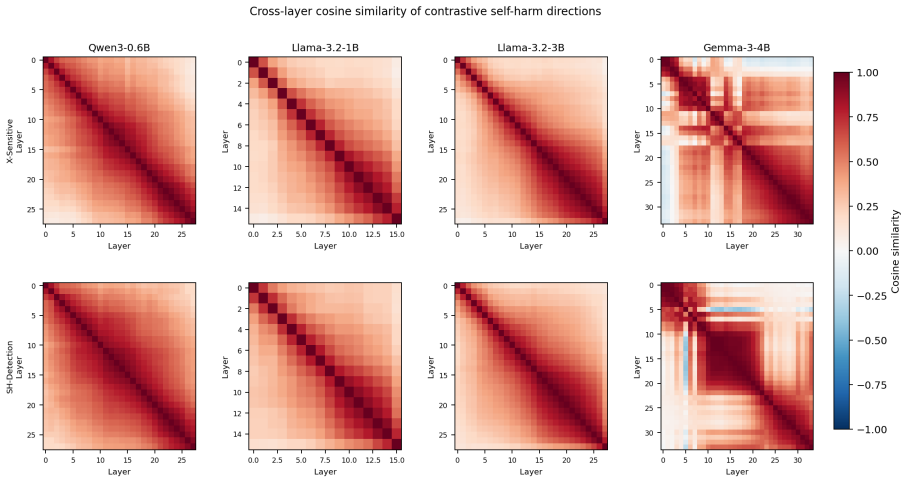
The central claim is that self-harm content is represented in a stable, cross-architecture way: in all four tested models (Qwen3-0.6B, Llama 3.2-1B, Llama 3.2-3B, Gemma-3-4B) and on both self-harm datasets, a linear probe trained on last-token residual-stream activations reaches peak ROC-AUC only in the final 3–7% of layers. The paper also establishes that the contrastive self-harm direction (mean difference between self-harm and control activations) is not stable across depth: adjacent layers are highly aligned (cosine 0.76–0.92) but directions from the first and last thirds are nearly orthogonal (0.14–0.38), forming a block-diagonal structure. Finally, it reports a dissociation between lin
Load-bearing premise
The load-bearing assumption is that the last token's residual-stream activation is a sufficient representation of the entire social-media post; if the final token does not fully aggregate the post's meaning (e.g., when it is punctuation or a common word), the measured layer-wise accuracy and the resulting 'crystallization depth' may reflect where last-token information becomes decodable rather than where self-harm concepts genuinely reside.
Editorial extensions
If this is right
- If self-harm information consistently crystallizes in the final few layers, downstream detectors can save compute by probing only that late-layer block rather than the full network.
- The block-diagonal structure implies that activation steering or intervention at an early layer will not transfer to the late-layer representation; safety interventions must target the late-layer block.
- The dissociation between probe AUC and Cohen's d warns that a model's high detection accuracy does not imply a single steerable self-harm direction, so representation-engineering methods that assume one direction may fail on models like Gemma-3-4B.
- The systematic AUC gap between X-Sensitive and SH-Detection (0.12–0.17 AUC, ~1 Cohen's d) indicates that corpus composition and labelling quality strongly affect how cleanly self-harm is represented, not just classifier performance.
Reading between the lines
- A testable extension is to check whether the late-layer crystallization depth shifts if the last-token representation is replaced by mean-pooling over all tokens; if the 93–97% result persists, the finding is robust to the choice of token aggregation, but if it shifts, the 'crystallization' may be an artifact of where the final token's context aggregation completes.
- The near-orthogonality of early and late directions suggests a possible safety mechanism: monitoring the cosine angle of a running contrastive direction could detect when a model is about to transition into a 'self-harm-decodable' state, enabling mid-generation intervention.
- The Gemma-specific dissociation could be probed further by training probes on projected subspaces of increasing rank; if AUC rises gradually with rank, it would confirm that Gemma distributes self-harm signal across many dimensions, offering a concrete way to find the effective dimensionality of the concept.
- Comparing these results with a non-instruction-tuned base model of similar size would separate the effect of instruction tuning from architecture and scale on the crystallization depth.
Editorial analysis
A structured set of objections, weighed in public.
Referee Report
Summary. The paper investigates where self-harm information is encoded in four instruction-tuned LLMs (Qwen3-0.6B, Llama 3.2-1B/3B, Gemma-3-4B) by training linear probes on last-token residual-stream activations at every layer and evaluating ROC-AUC on two balanced social-media datasets (X-Sensitive, SH-Detection). It reports that discriminative information is concentrated in the final layers (93–97% depth), and that contrastive mean-difference directions rotate across depth with a block-diagonal similarity structure. It also reports a dissociation for Gemma-3-4B between high probe accuracy and lower Cohen's d along the contrastive direction, interpreted as a more distributed representation.
Significance. If the pooling-robustness and statistical concerns are addressed, the study would be a useful empirical contribution to representation analysis of mental-health-related content and to safety/representation-engineering applications. Strengths: the manuscript provides code, uses two independent publicly available datasets, uses TransformerLens for hooking, reports error analysis, and includes cross-layer cosine matrices. The findings are falsifiable and straightforward to reproduce. The main value is in the cross-architecture comparison, especially the Gemma dissociation, but that claim currently rests on a methodological comparison that needs tightening.
major comments (4)
- [Abstract; §4.1, Table 2] The headline 'self-harm information crystallizes in the final 3–7% of layers (93–97% depth)' is not supported by Table 2 as printed. Under the natural definition depth = ℓ/L, six of the eight best-layer entries are the final layer (100% depth) and the remaining two are ℓ = L−1 (96.4% depth); no entry is near 93%. If a different depth normalization is intended (e.g., ℓ/(L+1) or (ℓ−1)/(L−1)), it must be stated in §3/§4.1 and applied consistently. As it stands, the quantitative claim is inconsistent with the reported table and should be corrected or rephrased.
- [§3, §4.1] The central localization claim is derived exclusively from last-token residual-stream activations. For causal LMs, the final token is a practical summary, but it is not necessarily a faithful aggregate of the full post: when the last token is punctuation or a high-frequency word, early layers may not have mixed the left context into that position. This could produce a late-layer AUC rise that reflects the probing interface rather than the locus of self-harm information in the post representation. I request a robustness comparison with mean pooling over all (non-padding) tokens, or an all-token probe, for at least these models, and the resulting layer-wise curves. If the final-layer peak disappears under pooling, the 'crystallization' claim must be qualified as last-token-specific.
- [§4.2, Table 3] The Gemma dissociation (high probe AUC, low Cohen's d) compares cross-validated probe AUC from Table 2 with a Cohen's d computed in-sample on the same data used to estimate the direction dℓ in Eq. (1). No confidence intervals, bootstrap resampling, or significance tests are reported, and the observed differences (e.g., 0.969 AUC vs. 0.972 AUC with d=1.18 vs. 2.08) are not shown to be outside sampling variability. To support this secondary claim, report bootstrap CIs for d, compute d within the same CV folds as the probes, and test a model × metric interaction. Without this, the 'more intricate' interpretation is not established.
- [§4.1, Figs. 1–2] The best layer is selected by maximizing mean 5-fold CV AUC, but no multiple-comparison control or comparison with neighboring layers is reported. In several cases, the difference between the selected layer and adjacent layers is within one standard deviation (e.g., Qwen3-0.6B on X-S: 0.703±0.016; Table 2). This does not invalidate the trend, but it weakens the precision of 'best layer' statements and, consequently, the depth percentages. I recommend reporting whether the selected layer is significantly better than nearby layers (e.g., paired bootstrap or corrected repeated CV) or at least showing all pairwise layer comparisons in the appendix.
minor comments (5)
- [Abstract] Typo: 'normaliation' should be 'normalization'. Also 'posts.We' is missing a space.
- [§1] Typo: 'more effecrtive intervention' should be 'more effective intervention'.
- [§4.1] The text says 'full layer-wise increasing AUC curves'; the curves in Figures 1–2 are generally increasing but not strictly monotone. Suggest 'generally increasing' or 'layer-wise AUC curves'.
- [Table 4 caption] Define 'Adj.' and 'Cross' in the caption (adjacent-layer mean cosine vs. mean cosine between first and last thirds).
- [§4.2, Eqs. (1)–(2)] State explicitly whether the means, standard deviations, and direction dℓ are computed on the full dataset or within training folds, and whether Cohen's d uses pooled or unpooled standard deviations. This matters for interpreting the values.
Circularity Check
No significant circularity: the paper's load-bearing claims are empirical measurements on external datasets, not derivations from their own outputs.
full rationale
The paper's main claims — late-layer crystallization of self-harm information and the dissociation between probe AUC and contrastive-direction Cohen's d — are empirical results obtained by training linear probes and computing contrastive directions on public datasets (X-Sensitive, SH-Detection) across four open-weight LLMs. No parameter is fitted to a subset of data and then reported as a prediction of the same quantity: probes are evaluated with 5-fold stratified cross-validation, and the 'best layer' is selected on held-out folds. The contrastive direction in Eq. 1 is a mean-difference vector used for descriptive geometric analysis, not presented as a predictive claim that reduces to its construction. The last-token pooling choice is an assumption about representation quality, and the in-sample contrastive statistics could overstate separability, but these are methodological validity concerns, not circular reasoning in which the conclusion is equivalent to an input by construction. The paper cites prior work by its own authors (Antypas et al. 2025 for one dataset; Siddique et al. 2026 as related work on bias mitigation), but these citations are not load-bearing in the derivation chain: the dataset is an external resource and the related-work citations do not supply the paper's conclusions. There is no self-citation of a uniqueness theorem, no ansatz smuggled in via citation, and no renaming of a known result as a new derivation. The central findings are self-contained empirical measurements against external benchmarks, so the appropriate circularity score is 0.
Assumptions & free parameters
assumptions (3)
- domain assumption Last-token residual-stream activation represents the entire post.
- domain assumption Linear probe accuracy reflects how strongly the model 'represents' a concept.
- domain assumption The mean-difference contrastive direction is a meaningful summary of concept geometry.
Cite this review
Pith. "Pith review of Analysing Self-Harm Representations in Language Models: a Cross-Architecture Study." pith.science (2026). https://pith.science/paper/RJ6KJNDA
@misc{pith2026260721988,
  author       = {Pith},
  title        = {Pith review of: Analysing Self-Harm Representations in Language Models: a Cross-Architecture Study},
  year         = {2026},
  howpublished = {\url{https://pith.science/paper/RJ6KJNDA}},
  note         = {Machine review of arXiv:2607.21988}
}
read the original abstract
Self-harm content is particularly challenging to detect using NLP techniques, and is also a high-stakes task which requires the highest accuracy to enable timely intervention or flagging at-risk users. We therefore present an analysis of how LLMs represent such self-harm content, which has downstream applications in self-harm detection, LLM intervention and governance and policing. In this paper, we focus on two datasets and four models, and perform two main experiments: (1) We train and evaluate linear probes across all layers of each model on two self-harm datasets: X-Sensitive and SH-Detection. Across both corpora, self-harm information crystallizes in the final 3 - 7% of network layers (93 to 97% depth). (2) We extract contrastive self-harm directions and, after performing a normaliation step, we find that the most accurate probes are not necessarily the most linearly separable. In particular, we find Gemma-3-4B to represent this \textit{contrastive self-harm direction} in a slightly different, more intricate way than the other LLMs.
Figures


Figures from the paper (2 more)

Reference graph
Works this paper leans on
-
[6]
Qwen3 technical report.arXiv preprint arXiv:2505.09388. Pavan Reddy and Nithin Reddy
-
[7]
In 2025 IEEE International Symposium on Technology and Society (ISTAS), pages 1–7
‘for argument’s sake, show me how to harm myself!’: Jail- breaking llms in suicide and self-harm contexts. In 2025 IEEE International Symposium on Technology and Society (ISTAS), pages 1–7. Zara Siddique, Irtaza Khalid, Liam Turner, and Luis Espinosa-Anke
2025
-
[11]
Andrew Yates, Arman Cohan, and Nazli Goharian
Mentalllama: Interpretable mental health analysis on social me- dia with large language models.arXiv preprint arXiv:2309.13567. Andrew Yates, Arman Cohan, and Nazli Goharian
-
[12]
InProceedings of the 2017 Conference on Empirical Methods in Natural Language Processing, pages 2968–2978, Copenhagen, Denmark
Depression and self-harm risk assessment in online forums. InProceedings of the 2017 Conference on Empirical Methods in Natural Language Processing, pages 2968–2978, Copenhagen, Denmark. Associa- tion for Computational Linguistics. Yuyou Zhang, Miao Li, William Han, Yihang Yao, Zhep- eng Cen, and Ding Zhao
2017
-
[14]
Representation engineering: A top- down approach to AI transparency.arXiv preprint arXiv:2310.01405. A Cross-layer Directional Stability Figure 5 shows the full L×L pairwise cosine simi- larity matrices between contrastive self-harm direc- tions across all layers, for all four models on both datasets. The block-diagonal structure is remark- ably consisten...
-
[2016]
Under- standing intermediate layers using linear classifier probes.arXiv preprint arXiv:1610.01644. Dimosthenis Antypas, Indira Sen, Carla Perez Almen- dros, Jose Camacho-Collados, and Francesco Barbi- eri
-
[2017]
InInternet Science - 4th International Confer- ence, INSCI 2017, Thessaloniki, Greece, November 22-24, 2017, Proceedings, Lecture Notes in Com- puter Science, pages 428–436
Towards suicide prevention: Early detection of depression on social media. InInternet Science - 4th International Confer- ence, INSCI 2017, Thessaloniki, Greece, November 22-24, 2017, Proceedings, Lecture Notes in Com- puter Science, pages 428–436. Springer. Kenneth Li, Oam Patel, Fernanda Viégas, Hanspeter Pfister, and Martin Wattenberg
2017
-
[2019]
Fine-tuning lan- guage models from human preferences.arXiv preprint arXiv:1909.08593. Andy Zou, Long Phan, Sarah Chen, James Campbell, Phillip Guo, Richard Ren, Alexander Pan, Xuwang Yin, Mantas Mazeika, Ann-Kathrin Dombrowski, Shashwat Goel, Nathaniel Li, Michael J Byun, Zifan Wang, Alex Mallen, Steven Basart, Sanmi Koyejo, Dawn Song, Matt Fredrikson, J....
arXiv 1909
Show all 14 references
-
[2021]
PLoS one, 16(8):e0253809
Devel- oping a natural language processing tool to identify perinatal self-harm in electronic healthcare records. PLoS one, 16(8):e0253809. Yuntao Bai, Andy Jones, Kamal Ndousse, Amanda Askell, Anna Chen, Nova DasSarma, Dawn Drain, Stanislav Fort, Deep Ganguli, Tom Henighan, e...
-
[2022]
InFind- ings of the Association for Computational Linguistics: ACL 2022, pages 566–581
Extracting latent steering vectors from pretrained language models. InFind- ings of the Association for Computational Linguistics: ACL 2022, pages 566–581. Sivasothy Tharsi
2022
-
[2023]
Kailai Yang, Tianlin Zhang, Ziyan Kuang, Qianqian Xie, and Sophia Ananiadou
Activation addition: Steering language models with- out optimization.arXiv preprint arXiv:2308.10248. Kailai Yang, Tianlin Zhang, Ziyan Kuang, Qianqian Xie, and Sophia Ananiadou
-
[2024]
Shaoxiong Ji, Shirui Pan, Xue Li, Erik Cambria, Guodong Long, and Zi Huang
The Llama 3 herd of models.arXiv preprint arXiv:2407.21783. Shaoxiong Ji, Shirui Pan, Xue Li, Erik Cambria, Guodong Long, and Zi Huang
-
[2025]
Soumitra Ghosh, Gopendra Vikram Singh, Shambhavi, Sabarna Choudhury, and Asif Ekbal
Gemma 3 technical report.arXiv preprint arXiv:2503.19786. Soumitra Ghosh, Gopendra Vikram Singh, Shambhavi, Sabarna Choudhury, and Asif Ekbal
-
[2026]
In Findings of the Association for Computational Lin- guistics: EACL 2026, pages 809–820, Rabat, Mo- rocco
Shifting perspectives: Steer- ing vectors for robust bias mitigation in LLMs. In Findings of the Association for Computational Lin- guistics: EACL 2026, pages 809–820, Rabat, Mo- rocco. Association for Computational Linguistics. Caitlin A. Stamatis, Jonah Meyerhoff, Richard Zh...
2026
Reviewed August 1, 2026 · model on record in the stance chip above.
Discussion (0). Sign in to comment.