REVIEW 3 major objections 5 minor 22 references
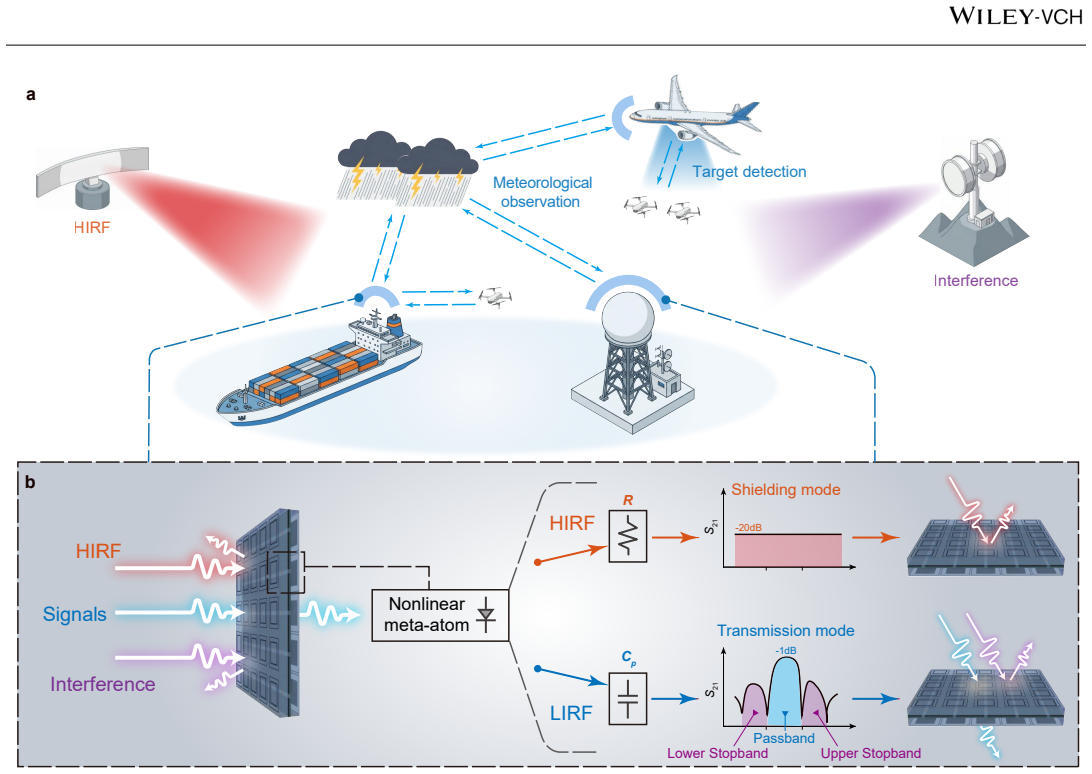
A single nonlinear metasurface acts as a steep bandpass filter under weak signals and as a broadband shield under strong ones, switching automatically with incident power.
Reviewed by Pith at T0; open to challenge. T0 means a machine referee read the full paper against a public rubric. the ladder, T0–T4 →
A power-dependent metasurface demonstrates steep roll-off transmission filtering and wideband high-power shielding in one X-band prototype, verified by simulation and measurement.
T0 review reviewed 2026-08-01 challenge →
load-bearing objection A useful dual-function metasurface with solid low-power filtering measurements, but the headline broadband-shielding claim rests on a single spot measurement and is overstated. the 3 major comments →
Field-driven nonlinear metasurface: self-adaptive transition between high-selectivity transmission and broadband shielding
The pith
A machine-rendered reading of the paper's core claim, the machinery that carries it, and where it could break.
The reading
Core claim
The paper establishes that a nonlinear metasurface whose equivalent circuit is a three-resonator hybrid coupling network—with a frequency-variant cross-coupling branch between resonators I and III and a central resonator loaded with PIN diodes—can reconfigure itself from a quasi-elliptic bandpass filter into a broadband shield purely through the intensity of the incident field. In the diode-OFF state, the non-cascaded topology sustains multipath destructive interference, producing two finite transmission zeros at about 8.2 and 11.6 GHz; the zeros confine a passband with insertion loss below 1 dB from 9.3 to 10.7 GHz and give steep roll-off rates of 20.6 and 31.8 dB/GHz. In the diode-ON state
What carries the argument
The hybrid coupling network topology: three mutually coupled resonators (I, II, III) where a cross-coupling branch (Cm13, Lm13) between resonators I and III provides a frequency-variant coupling M13(ω). In the OFF state, this non-cascaded topology creates two transmission zeros through destructive interference between the main path (1→2→3) and the cross-coupling path (1→3), yielding a quasi-elliptic filter response. In the ON state, PIN diodes in resonator II short the coupling, causing a broadband impedance mismatch. This mechanism—reconfigurable from 'filter' to 'shield' by the incident field—is the load-bearing idea of the paper.
Load-bearing premise
The broadband shielding claim assumes that the high-intensity behavior measured quantitatively only at 10 GHz on a 2×1 array in a waveguide genuinely holds across the entire 7–13 GHz band; the edge-of-band values are inferred from full-wave simulation and detection-threshold measurements rather than direct high-power excitation.
What would settle it
Measure the power-dependent transmission coefficient |S21| at many frequencies across 7–13 GHz under high-power excitation (e.g., by sweeping a high-power source through the band in the waveguide setup or using a focused beam on a larger sample). If the SE falls below 23.6 dB at any in-band frequency—especially near 7 or 13 GHz—the 60%-bandwidth shielding claim is falsified. Alternatively, biasing the diodes at their OFF capacitance and checking whether the transmission zeros remain at 8.2 and 11.6 GHz would test the high-selectivity mechanism.
If this is right
- RF front-ends could use a single passive surface that protects against high-power interference while preserving low-loss, highly selective reception of weak signals.
- The mapping from coupling topology to geometry can be scaled to Ku/Ka bands with proportional downscaling and appropriate fabrication, and the PIN diodes can be replaced by varactors or phase-change materials for adjustable switching thresholds.
- The measured performance—roll-off above 20.6 dB/GHz, out-of-band suppression of 17.7/28.4 dB, SE above 23.6 dB with 60% bandwidth—exceeds the reported values in prior energy-selective surfaces, which typically trade selectivity against shielding.
- The 60% shielding bandwidth eliminates the spectral leakage windows near the passband that earlier nonlinear shielding designs (20–30% bandwidth) left unprotected.
Where Pith is reading between the lines
- The 60% shielding bandwidth is the least directly measured claim: the high-power waveguide experiment quantifies SE only at 10 GHz on a 2×1 meta-atom array; the 7 and 13 GHz points are detection thresholds, and the full 7–13 GHz curve rests on simulation and circuit fitting. A direct sweep of SE versus frequency under high power would test this.
- The design's practical viability hinges on diode parasitics and fabrication tolerances: the paper notes a slight frequency shift due to manufacturing, which could move the transmission zeros or alter the turn-on threshold; a study of sensitivity to C_off and R_on would reveal how robust the dual-mode behavior is.
- The five-layer stack adds fabrication complexity; a simpler geometry preserving the same hybrid-coupling degrees of freedom would make the approach more deployable—this is left open by the authors.
- The same field-driven switching principle could be applied to adaptive spatial filtering in wireless systems where weak signals and strong blockers coexist, not just radar front-ends.
Editorial analysis
A structured set of objections, weighed in public.
Referee Report
Summary. The paper presents a field-driven nonlinear metasurface (NMS) that combines a three-resonator hybrid-coupling topology with embedded PIN diodes. Under low-intensity radiated fields (LIRF) the device behaves as a high-selectivity spatial filter with a measured passband insertion loss below 1 dB, sharp roll-off rates (20.6 and 31.8 dB/GHz at the lower and upper skirts), and out-of-band suppression of 17.7/28.4 dB. Under high-intensity radiated fields (HIRF) the diodes switch to a low-resistance state, collapsing the impedance and producing broadband shielding. The authors report a measured shielding effectiveness of 23.6 dB at 10 GHz and claim a 60% shielding bandwidth, exceeding prior work. The claims are supported by an equivalent-circuit model, full-wave CST simulations, field-distribution analysis, and two experimental setups (free-space LIRF and waveguide HIRF).
Significance. If the broadband-shielding claim were fully supported, the paper would represent a valuable advance in nonlinear metasurfaces for electromagnetic protection, because it unifies high-selectivity filtering with a self-adaptive power-dependent shielding function in one device. The LIRF results are convincing: the measured passband shape, transmission zeros, and roll-off rates agree well with full-wave simulation, and the hybrid-coupling explanation via cross-coupling and field distributions is physically coherent. The 10 GHz HIRF measurement with a clamped output waveform is also a positive, directly measured indicator. However, the headline claim of 'SE exceeding 23.6 dB and 60% bandwidth' is not fully established by the presented data, as detailed below. Because that number is the main point of comparison against prior art, the manuscript needs a substantive revision before publication.
major comments (3)
- [Section 2.3, Figure 5f, Table 1, Abstract] The claim 'broadband shielding with shielding effectiveness exceeding 23.6 dB and 60% bandwidth' is not quantitatively supported. The only measured SE value is 23.6 dB at 10 GHz (Section 2.3, Eq. (1)). At 7 and 13 GHz the paper reports only input-power thresholds at which the output becomes detectable (9.5 and 27.2 dBm); these are detection thresholds, not SE values. The full-wave simulation in Section 2.2 gives an SE that 'exceeds 17.6 dB' across 7-13 GHz and peaks at 26.8 dB, so even the simulation does not establish a 23.6 dB floor over the whole band. The abstract and Table 1 nevertheless present this as a measured result. Please provide direct full-band HIRF measurements with a calibrated noise floor, or revise the claim to 'measured SE = 23.6 dB at 10 GHz; simulated SE >= 17.6 dB over 7-13 GHz (60% bandwidth)'.
- [Section 2.3 / Methods (HIRF setup)] The HIRF experiment is conducted in a WR-90 waveguide housing a 2x1 meta-atom array, whereas the LIRF measurement and the comparison with free-space metasurface literature use a 20x20 free-space array. The manuscript does not analyze how the waveguide side walls, finite array size, or evanescent modes affect the measured 23.6 dB SE or the extrapolation to infinite-periodic free-space behavior. Since the shielding-mode S21 in Fig. 3c and Fig. 5c is simulated for a periodic unit cell under free-space Floquet conditions, the measured waveguide value is not automatically comparable. Please show a full-wave model of the actual 2x1 waveguide-loaded structure or otherwise quantify this effect; otherwise the measured SE cannot be directly cited as the free-space performance.
- [Conclusions and Table 1] The conclusion states 'From measurement, we obtain a ... shielding with 60% bandwidth,' but the 60% bandwidth is not a directly measured quantity; it is an inference from the simulation-based full-wave response and the two threshold measurements. Table 1 also labels the 60% as 'Measured Shielding BW'. This conflation of simulation and measurement is significant because the comparison in Table 1 and Figure 5g relies on that number. Please explicitly label which entries are measured and which are simulated, and adjust the text accordingly.
minor comments (5)
- [Keywords] Typo: 'Nonlieanr' should be 'Nonlinear'.
- [Section 2.3] Typo: 'mouanted' should be 'mounted' in the Methods sentence about the prototype.
- [Section 1] The spacing in 'UA Vs' is irregular; use 'UAVs'.
- [Section 2.1 / Table S1] The equivalent-circuit model is a design tool whose L/C values are fitted in ADS to the target response. Please state explicitly that the ECM is a fitting/design tool rather than an independent first-principles prediction. This will prevent a perceived circularity.
- [Figure 5f / Methods] Add to the figure caption or Methods the noise floor of the spectrum analyzer and the calibration/attenuator settings, so the detection thresholds can be interpreted quantitatively.
Circularity Check
No circularity found; load-bearing validation comes from independent full-wave simulation and measurement.
full rationale
The derivation chain is: (i) generalized Chebyshev theory requires finite-frequency transmission zeros and therefore a non-cascaded coupling topology; (ii) a three-resonator cross-coupled network is proposed to realize those zeros; (iii) lumped LC values are extracted by ADS optimization to meet a stated design target ('the targeted high-selectivity transmission mode is centered near the middle of the X-band with a fractional bandwidth (FBW) of approximately 15%'); (iv) full-wave CST simulation with fixed geometry and manufacturer diode SPICE parameters reproduces the response; (v) free-space LIRF and waveguide HIRF measurements validate it. The ECM parameters are indeed fitted to the target, but the paper does not present the ECM output as a prediction; the load-bearing transmission claims (roll-off 20.6/31.8 dB/GHz, out-of-band suppression 17.7/28.4 dB) come from measured S21 and are independently reproduced by full-wave simulation. The shielding mode is supported by full-wave simulation (SE > 17.6 dB over 7-13 GHz, peak 26.8 dB) and one measured 23.6 dB SE at 10 GHz. The 7 and 13 GHz measured points are only detection thresholds ('we cannot detect the output with low PTE10 due to the attenuation falling below the noise floor of the spectrum analyzer. The thresholds of PTE10 that make the output signals appear are about 9.5 and 27.2 dBm for 7 and 13 GHz'), so the abstract's 'exceeding 23.6 dB and 60% bandwidth' overstates the direct measurement support; this is an evidence-sufficiency/correctness concern, not circularity. Several comparison references are from the same group, but they are used only as benchmark values in Table 1 and are not used to justify the topology or to force the design choice; there is no self-citation-based uniqueness argument. No self-definitional step, no fitted parameter renamed as a prediction, and no ansatz smuggled in via self-citation was found.
Axiom & Free-Parameter Ledger
free parameters (2)
- ADS-optimized equivalent-circuit LC values =
C1=21.5 fF, L1=17.46 nH, C1'=12.23 fF, L1'=15.8 nH, C2=0.712 pF, L2=45 pH, C3=48 fF, L3=19.4 nH, C3'=12.44 fF, L3'=8.6 n
- CST-optimized geometry parameters =
p=10.16 mm, l1=7.9 mm, l2=5.7 mm, l3=9.66 mm, l4=6.35 mm, w1=0.15 mm, w2=0.2 mm, g=6.7 mm, s=0.35 mm, d=1.1 mm; h1=4 mm,
axioms (6)
- domain assumption Equivalent-medium relation |S21|^2 = 1 - |Gamma|^2 for a single impedance discontinuity
- standard math Generalized Chebyshev/coupling-matrix filter theory from Refs. [44-46]
- domain assumption Sub-wavelength condition p << lambda for analytical L/C extraction
- domain assumption Diode SPICE/datasheet model (MA4AGP907, R_ON=4.2 ohm, C_OFF=30 fF) accurately represents fabricated diodes
- domain assumption Periodic-boundary unit-cell simulation represents the finite 20x20 array
- domain assumption Waveguide HIRF measurement with a 2x1 meta-atom array is representative of full-array shielding
Cite this review
Pith. "Pith review of Field-driven nonlinear metasurface: self-adaptive transition between high-selectivity transmission and broadband shielding." pith.science (2026). https://pith.science/paper/ZRN76WIE
@misc{pith2026260722144,
  author       = {Pith},
  title        = {Pith review of: Field-driven nonlinear metasurface: self-adaptive transition between high-selectivity transmission and broadband shielding},
  year         = {2026},
  howpublished = {\url{https://pith.science/paper/ZRN76WIE}},
  note         = {Machine review of arXiv:2607.22144}
}
read the original abstract
The escalating complexity of electromagnetic (EM) environment is posing a significant challenge to the reliability of modern electronic information systems. To address the need for the spatial EM safety of electronic devices, we present a field-driven nonlinear metasurface (NMS) that enables effective protection against out-of-band interference and in-band high-intensity radiation. By constructing a reconfigurable hybrid coupling topology and mapping it to the metasurface geometry, the proposed NMS achieves a self-adaptive transition between its transmission and shielding mode depending on the incident power. The experimental results are in good agreement with theoretical analysis and full-wave simulation. We obtain a highly selective passband with roll-off rate larger than 20.6dB/GHz and a broadband shielding with shielding effectiveness exceeding 23.6dB and 60% bandwidth, demonstrating a significantly enhanced performance relative to the literature. Our findings establish a promising route toward comprehensive EM protection on radio frequency front-end systems.
Figures


Reference graph
Works this paper leans on
-
[27]
Liu, H.-Q
P. Liu, H.-Q. Liu, J. Zhang, Y . Zhao, H. Xu, F. Costa, T. J. Cui,The Innovation2023,4, 6 100513
-
[28]
J. C. Ke, J. Y . Dai, M. Z. Chen, L. Wang, C. Zhang, W. Tang, J. Yang, W. Liu, X. Li, Y . Lu, et al.,Small Structures2021,2, 1 2000060
-
[29]
Z. Luo, J. Long, X. Chen, D. Sievenpiper,Applied Physics Letters2016,109, 7
-
[30]
Huang, X
T. Huang, X. Zhao, S. Zeng, A. Crunteanu, P. P. Shum, N. Yu,Reports on Progress in Physics2020,83, 12 126101
-
[31]
Z. Luo, X. Ren, L. Zhou, Y . Chen, Q. Cheng, H. F. Ma, T. J. Cui,Advanced Functional Materials2022,32, 16 2109544
-
[32]
N. Hu, C. Liu, T. Tian, Y . Xu, P. Liu,IEEE Transactions on Electromagnetic Compatibility2023,65, 2 386
-
[33]
N. Hu, S. Zha, T. Tian, P. Liu,IEEE Transactions on Electromagnetic Compatibility2022,64, 4 1076
-
[34]
Xiong, W
X. Xiong, W. Xue, J. Qi, W. Shang, W. Li,IEEE Antennas and Wireless Propagation Letters2024,24, 1 3
-
[35]
V . K. Kanth, S. Raghavan,IEEE Transactions on Microwave Theory and Techniques2019,67, 5 1727
-
[36]
T. Hong, S. Guo, W. Jiang, S. Gong,IEEE Transactions on Antennas and Propagation2021,70, 5 3459
-
[37]
Z. Zhao, A. Zhang, X. Chen, G. Peng, J. Li, H. Shi, A. A. Kishk,IEEE Antennas and Wireless Propagation Letters2019,18, 6 1184
-
[38]
T. Tian, P. Liu, X. Huang, Y . Xu, N. Hu, B. Deng,IEEE Microwave and Wireless Technology Letters2025
-
[39]
Zhao, C.-F
C. Zhao, C.-F. Wang, S. Aditya,IEEE Transactions on Antennas and Propagation2019,67, 5 3215
-
[40]
L. Yao, X. Huang, H. Chen, H. Jiang, Y . Liang, P. Liu,IEEE Transactions on Antennas and Propagation 2024
2024
-
[41]
Huang, W
X. Huang, W. Hou, Y . Zang, L. Lin, W. Yao, B. Liang, K.-D. Xu,IEEE Transactions on Microwave Theory and Techniques2024,73, 6 3388
-
[42]
T. Tian, X. Huang, Y . Xu, P. Liu, C. Liu, N. Hu, J. Zhang, Z. Wu,IEEE Transactions on Electromagnetic Compatibility2023,66, 1 224
-
[43]
N. Hu, Y . Zhao, J. Zhang, P. Liu, H. Xu, F. Costa,IEEE Transactions on Antennas and Propagation2021, 70, 6 4526
-
[44]
R. J. Cameron,IEEE Transactions on Microwave Theory and Techniques2002,47, 4 433
-
[45]
R. J. Cameron,IEEE Transactions on Microwave Theory and Techniques2003,51, 1 1
-
[46]
Tamiazzo, G
S. Tamiazzo, G. Macchiarella,IEEE Transactions on Microwave Theory and Techniques2016,65, 3 775
-
[47]
G. H.-h. Sung, K. W. Sowerby, M. J. Neve, A. G. Williamson,IEEE Antennas and Propagation Magazine 2006,48, 5 29
2006
-
[48]
Z. Yao, S. Xiao, B.-Z. Wang,IEEE Transactions on Antennas and Propagation2020,69, 5 2741. 11 S1 Equivalent Circuit Model Analysis Supporting Information Field-driven nonlinear metasurface: self-adaptive transitions between high-selectivity transmission and broadband shielding Yuan Xu1,3, Hanqing Liu∗,1,3, Shangjing Xi1, Xiaodi Zhang1, Yanqing Cheng1, Weny...
This paper was first reviewed by deepseek-v4-flash on August 1, 2026.
discussion (0)
Sign in with ORCID, Apple, or X to comment. Anyone can read and Pith papers without signing in.