REVIEW 3 major objections 5 minor 45 references
Universal scaling of electrochemical information transfer at solid-liquid interfaces
T0 review · 3 major / 5 minor · reviewed 2026-08-01 · deepseek-v4-flash
Pith's one-line read This paper claims that the maximum electrochemical information transmissible across a solid–liquid interface is set by a single dimensionless ratio u, yielding a universal inverse-square attenuation law I*/I0 = 1/(1+u)^2.
desk verdict A plausible, potentially useful design rule—Fisher info ~ 1/(1+u)^2—but the derivation sits in a missing supplement and the experimental check fits the one parameter that matters, so treat it as unverified until the supplement appears. read the letter →
The pith
A machine-rendered reading of the paper's core claim, the machinery that carries it, and where it could break.
The reading
What carries the argument
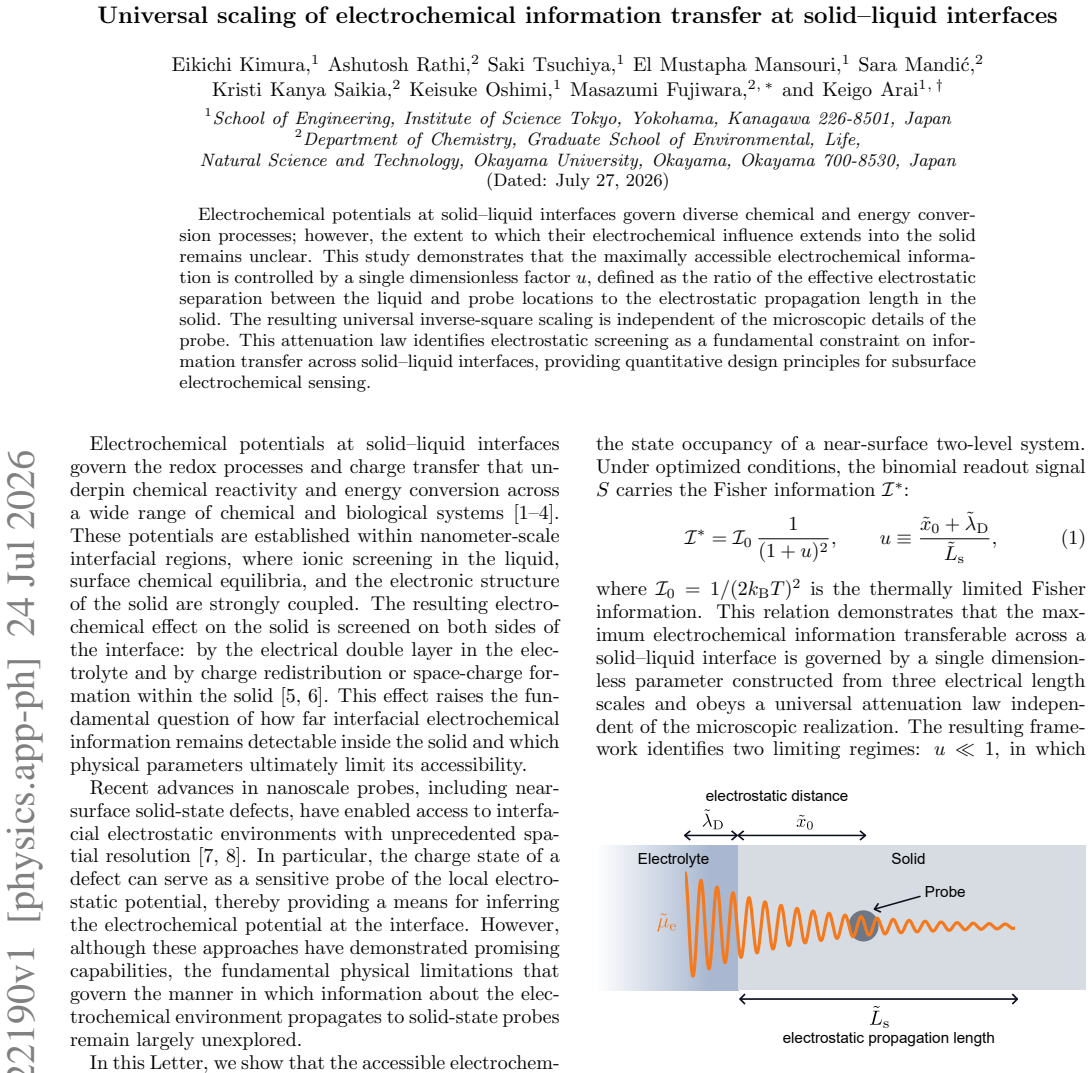
The central object is the dimensionless electrostatic screening parameter u = (x~0 + λ~D)/L~s, built from three electrical length scales: the probe's depth below the interface, the Debye screening length in the liquid, and the propagation length over which the solid transmits electrostatic information. Its role is to absorb all microscopic detail: after the bias is set to its optimal value, the maximum Fisher information collapses to I0/(1+u)^2, a universal inverse-square attenuation. The work of u is to encode whether the interface is 'electrostatically transparent' (u≪1) or 'screened' (u≫1), directly setting the Cramér–Rao precision floor for estimating the electrochemical potential.
What would settle it
Measure the optimally biased Fisher information for two systems with the same u but different microscopic parameters (e.g., dopant density, Fermi-to-transition energy gap); the universal law predicts identical I*/I0, so any significant deviation would falsify it. Alternatively, sweep u over at least two orders of magnitude and test the exact 1/(1+u)^2 functional form.
Extended reading notes
Core claim
Treating a planar solid–liquid interface with Debye–Hückel screening on the liquid side and a depletion layer in the solid, the authors model a near-surface two-level system whose occupation probability follows Fermi–Dirac statistics in thermal equilibrium. The Fisher information of this binary readout with respect to the liquid's electrochemical potential, maximized over the applied bias voltage, takes the closed form I* = I0/(1+u)^2, with I0 = 1/(2k_B T)^2 and u = (x~0 + λ~D)/L~s. Here x~0 is the electrical depth of the probe, λ~D the Debye screening length, and L~s the electrostatic propagation length in the solid. The paper argues that this reduction holds for any localized probe whose s
Load-bearing premise
The derivation assumes that after tuning the bias voltage to its optimum, the Fisher information is a function only of the ratio u, with no residual dependence on the Fermi energy, the defect's transition level, the dopant concentration, or the shape of the potential; if any of these enter the optimized information, the claimed universality breaks down.
Editorial extensions
If this is right
- The best possible precision in estimating the liquid's electrochemical potential is bounded below by σ ≥ 1/√I*, so minimizing u directly improves measurement precision.
- In the screened regime u ≫ 1, information dies off as u^{-2}, making deep probes or dilute electrolytes fundamentally worse.
- Design rules follow: shallow probe depth, high ionic strength (small λ~D), and a long propagation length (low dopant density, large Fermi-to-transition energy gap) all increase accessible information.
- Fitting four published charge-state experiments gives u_fit clustered near 1, indicating those systems already sit at the transparent-to-screened crossover.
- The scaling law applies beyond solid-state defects to any localized probe governed by electronic free-energy shifts, so it can guide optimization of diverse sensing platforms.
Reading between the lines
- If the 1/(1+u)^2 law holds, it should also describe molecular redox probes and electrochemical transistors whose occupation is Fermi–Dirac-like, an extension beyond the defect case the paper studies.
- The same ratio may govern kinetic or nonequilibrium sensing where the occupation probability is modulated by current flow rather than thermal equilibrium; the paper does not address this.
- The optimal-bias expression could be inverted: fitting the response curve to the model yields u and thus the propagation length from existing data, giving a non-invasive way to measure L~s.
- Because the attenuation is quadratic in distance, burying a probe to avoid surface chemistry costs information steeply, suggesting lateral probe geometries or 2D materials may outperform depth-separated ones.
Signed reviews
Editorial analysis
A structured set of objections, weighed in public.
Referee Report
Summary. The paper claims that the maximum Fisher information about the liquid electrochemical potential obtainable by a solid-embedded two-level probe, after optimizing the bias voltage, obeys a universal inverse-square law I* = I0/(1+u)^2, where u = (x̃0 + λ̃D)/L̃s, with I0 = 1/(2kBT)^2. The model treats a planar Debye–Hückel electrolyte in contact with a solid, a two-level defect probe, and a binomial readout. The authors present information landscapes, propose design guidelines, and report fits of four experimental diamond charge-state datasets, all with u ≈ 1.
Significance. If the derivation of Eq. (1) is correct and the collapse to the single parameter u is genuine, the result would be a valuable and general design principle for subsurface electrochemical sensing, showing that the fundamental limit is set by three electrical length scales. The paper formulates a clean Fisher-information framework and explicitly targets falsifiable predictions. However, the central claim is currently unverifiable because the derivation is deferred to a missing Supplemental Material, and the experimental support is not independent, since the free parameter N_D^+ used to compute u is fitted per dataset. The idea is promising, but the manuscript in its present form does not establish the universal law.
major comments (3)
- [Eq. (1), p.2 and p.3] The central universal scaling law is stated without derivation in the main text. The only reference is [9], which reads 'See Supplemental Material that will be uploaded with the next version.' The collapse from the full electrostatic model (Fermi–Dirac occupancy, Debye–Hückel/depletion potential, bias optimization) to I* = I0/(1+u)^2 with no residual dependence on E_T0 − E_F0, N_D^+, or the shape of φ(x̃) must be shown explicitly. This is the load-bearing step; without it, Eq. (1) is an unsupported assertion. The derivation must be supplied in a form the referee can check.
- [Table I and §'The charge-state responses...'] The experimental 'validation' is not independent: N_D^+ is fitted separately for each dataset, and u_fit is computed from that fitted N_D^+. Thus the agreement of I*/I0 with the theoretical curve is a consequence of the fit, not a prediction. Additionally, all four datasets cluster around u ≈ 1, so they do not span the predicted (1+u)^{-2} dependence across different regimes. To support the universality claim, the authors should either fix N_D^+ from independent measurements or show a test that varies u over a wider range, or otherwise reframe Table I as a consistency check rather than a validation.
- [p.3, relationship L̃s ∝ sqrt((E_F0 − E_T0)/N_D^+)] This relation is used to connect the fitted N_D^+ to u and to the design guidelines, but it is nowhere derived in the main text. It appears to follow from a depletion-layer model, but the derivation is deferred to [9]. Like Eq. (1), this is part of the missing machinery. The expression for φ(x̃), the derivation of V*, and the calculation of the optimized Fisher information must be provided in the main text or a complete Supplemental Material.
minor comments (5)
- [p.3, sentence before Eq. (1)] The sentence 'By tuning the bias voltage to the optimal value V*, we maximize Eq. (1)' is confusing: Eq. (1) is the result after maximization. It should say 'we maximize the Fisher information I' or similar.
- [Funding statement] There is a typo: 'This study was supported by the JST K Program ... (grant number JPMJKP24F3). and by JSPS' — the period before 'and' should be a comma, and 'JST K Program' is likely an incomplete program name.
- [Reference [9]] The reference to the Supplemental Material is a placeholder and should be resolved before submission; a published paper cannot have 'will be uploaded'.
- [Units and notation, Fig. 2 caption] The electrical length coordinate x̃ = x/ε uses ε with different values for liquid and solid, but the units (e.g., 'nm/(80ε0)') are unusual. Please define clearly the physical dimension of x̃ and the relation to the permittivity, and check that all expressions are dimensionally consistent.
- [Fig. 4(a)] This panel claims 'universal scaling' but shows only the theoretical curve. Overlaying the four data points from Table I, with error bars, would make the agreement or scatter visible.
Circularity Check
Experimental 'validation' of Eq. (1) is a fitted-parameter re-expression: u_fit is computed from a per-dataset fit of N_D^+, and I*/I0 = (1+u_fit)^-2 follows by construction; the central derivation is deferred to missing SM [9].
-
fitted input called prediction
[p.4, Table I paragraph ('The charge-state responses ...')]
"We fitted these experimental data using the present electrostatic model, with the ionized dopant concentration N_D^+ treated as the fitting parameter [9]. The dimensionless parameter u_fit, calculated from the fitted N_D^+, and the corresponding optimal Fisher information I* are summarized in Table I."
N_D^+ is a free parameter fitted to each dataset; u_fit is then computed from that fitted N_D^+, and I*/I0 is taken from Eq. (1) as 1/(1+u_fit)^2. Thus Table I's agreement with the inverse-square law is imposed by construction rather than tested. The datasets are all diamond charge-state measurements clustered near u≈1, so the table neither varies u independently nor checks the predicted u-dependence; the 'analysis revealed' a similar intermediate regime only because the fit parameter was used to compute u.
full rationale
The central analytical claim, Eq. (1), is a claimed Fisher-information optimization result; the derivation is entirely deferred to reference [9], which at the time of writing reads 'See Supplemental Material that will be uploaded with the next version.' That is a serious uncheckability/evidence gap but not in itself a circular reduction. No self-citation chain or imported uniqueness theorem is used to force Eq. (1). The only presented empirical support, however, is circular in the pattern-2 sense: the model is fitted to each experiment through N_D^+, u_fit is derived from the fit, and I*/I0 is then read off the same formula being 'validated.' Nothing in the paper predicts u_fit before fitting or tests the claimed collapse across varied microscopic parameters. Because the theoretical law itself could be independently derived from the model (if the SM is supplied and checked), this is partial circularity in the validation, not a fully forced derivation; score 5, not 8.
Assumptions & free parameters
free parameters (1)
- N_D^+ (ionized dopant concentration) =
per dataset (not reported directly; u_fit ≈ 1.06–1.20)
assumptions (5)
- domain assumption Debye–Hückel approximation for the liquid: linear screening with length λ~D.
- domain assumption Depletion-layer approximation in the solid: the potential drop occurs across a layer of width L~s, with L~s ∝ sqrt((E_F0−E_T0)/N_D^+).
- domain assumption The probe is a two-level system whose occupancy follows Fermi–Dirac statistics with E_T(x~) = E_T0 − eφ(x~).
- domain assumption The electron-accumulation regime (μ~e > E_F0) is excluded from the model.
- standard math Fisher information for a binomial readout: I = S'^2/(S(1−S)).
invented entities (1)
-
L~s — 'electrostatic propagation length in the solid'
Cite this review
Pith. "Pith review of Universal scaling of electrochemical information transfer at solid-liquid interfaces." pith.science (2026). https://pith.science/paper/5RQ7GFSZ
@misc{pith2026260722190,
  author       = {Pith},
  title        = {Pith review of: Universal scaling of electrochemical information transfer at solid-liquid interfaces},
  year         = {2026},
  howpublished = {\url{https://pith.science/paper/5RQ7GFSZ}},
  note         = {Machine review of arXiv:2607.22190}
}
abstract
Electrochemical potentials at solid-liquid interfaces govern diverse chemical and energy conversion processes; however, the extent to which their electrochemical influence extends into the solid remains unclear. This study demonstrates that the maximally accessible electrochemical information is controlled by a single dimensionless factor $u$, defined as the ratio of the effective electrostatic separation between the liquid and probe locations to the electrostatic propagation length in the solid. The resulting universal inverse-square scaling is independent of the microscopic details of the probe. This attenuation law identifies electrostatic screening as a fundamental constraint on information transfer across solid-liquid interfaces, providing quantitative design principles for subsurface electrochemical sensing.
Figures


Figures from the paper (1 more)

Reference graph
Works this paper leans on
-
[9]
See Supplemental Material that will be uploaded with the next version
-
[1]
A. J. Bard, L. R. Faulkner, and H. S. White,Electro- chemical Methods: Fundamentals and Applications, 3rd ed. (Wiley, Hoboken, NJ, 2022)
2022
-
[2]
Schmickler and E
W. Schmickler and E. Santos,Interfacial Electrochem- istry, 2nd ed. (Springer, Berlin, Heidelberg, 2010)
2010
-
[3]
H. Sies, R. J. Mailloux, and U. Jakob, Fundamentals of redox regulation in biology, Nat. Rev. Mol. Cell Biol.25, 701 (2024)
2024
-
[4]
B. Li, H. Ming, S. Qin, E. C. Nice, J. Dong, Z. Du, and C. Huang, Redox regulation: Mechanisms, biology and therapeutic targets in diseases, Signal Transduct. Target. Ther.10, 72 (2025)
2025
-
[5]
Sagar Shrikrishna, R
N. Sagar Shrikrishna, R. Sharma, J. Sahoo, A. Kaushik, and S. Gandhi, Navigating the landscape of optical biosensors, Chemical Engineering Journal490, 151661 (2024)
2024
-
[6]
Abramczyk, J
H. Abramczyk, J. M. Surmacki, M. Kope’c, K. Jar- czewska, and B. Romanowska-Pietrasiak, Hemoglobin and cytochromec. reinterpreting the origins of oxygena- tion and oxidation in erythrocytes and in vivo cancer lung cells, Sci. Rep.13, 14731 (2023)
2023
-
[7]
D. J. McCloskey, N. Dontschuk, A. Stacey, C. Pattinson, A. Nadarajah, L. T. Hall, L. C. L. Hollenberg, S. Prawer, and D. A. Simpson, A diamond voltage imaging micro- scope, Nat. Photon.16, 730 (2022)
2022
Show all 45 references
-
[8]
K. Bian, W. Zheng, X. Zeng, X. Chen, R. St¨ ohr, A. Denisenko, S. Yang, J. Wrachtrup, and Y. Jiang, Nanoscale electric-field imaging based on a quantum sen- sor and its charge-state control under ambient condition, Nat. Commun.12, 2457 (2021). 5
2021
-
[10]
Chakrapani, J
V. Chakrapani, J. C. Angus, A. B. Anderson, S. D. Wolter, B. R. Stoner, and G. U. Sumanasekera, Charge transfer equilibria between diamond and an aqueous oxygen electrochemical redox couple, Science318, 1424 (2007)
2007
-
[11]
M. Sow, H. Steuer, S. Adekanye, L. Gin´ es, S. Mandal, B. Gilboa, O. A. Williams, J. M. Smith, and A. N. Ka- panidis, High-throughput nitrogen-vacancy center imag- ing for nanodiamond photophysical characterization and pH nanosensing, Nanoscale12, 21821 (2020)
2020
-
[12]
Karaveli, O
S. Karaveli, O. Gaathon, A. Wolcott, R. Sakakibara, O. A. Shemesh, D. S. Peterka, E. S. Boyden, J. S. Owen, R. Yuste, and D. Englund, Modulation of nitrogen va- cancy charge state and fluorescence in nanodiamonds us- ing electrochemical potential, Proc. Natl. Acad. Sci. USA 11...
2016
-
[13]
Grotz, M
B. Grotz, M. V. Hauf, M. Dankerl, B. Naydenov, S. Pez- zagna, J. Meijer, F. Jelezko, J. Wrachtrup, M. Stutz- mann, F. Reinhard, and J. A. Garrido, Charge state ma- nipulation of qubits in diamond, Nat. Commun.3, 729 (2012)
2012
-
[14]
Fulton, J
S. Fulton, J. Stropko, R. Vitale, and A. O. Sushkov, Probing nanoscale electrochemical phenom- ena with nitrogen-vacancy centers in diamond (2024), bioRxiv:2024.11.29.626096
2024
-
[15]
R. A. Fisher, Theory of statistical estimation, Proc. Cam- bridge Philos. Soc.22, 700 (1925)
1925
-
[16]
T. M. Cover and J. A. Thomas,Elements of Information Theory, 2nd ed. (Wiley, Hoboken, NJ, 2006)
2006
-
[17]
X. Fan, Y. Xing, Z. Wu, B. Li, P. Huang, and L. Liu, Electrochemical-enhanced charge state modulation of nitrogen-vacancy centers for ultrasensitive biodetection of microRNA-155, ACS Appl. Mater. Interfaces17, 2592 (2025)
2025
-
[18]
Petrakova, I
V. Petrakova, I. Rehor, J. Stursa, M. Ledvina, M. Nesladek, and P. Cigler, Charge-sensitive fluorescent nanosensors created from nanodiamonds, Nanoscale7, 12307 (2015)
2015
-
[19]
Menon, A
S. Menon, A. Tyler, and M. Mather, Quantum- enabled electrochemical sensing of redox-driven nitrogen- vacancy charge state dynamics, Academia Quantum2, 10.20935/AcadQuant7913 (2025)
2025 doi
-
[20]
Bhaumik, R
A. Bhaumik, R. Sachan, and J. Narayan, Tunable charge states of nitrogen-vacancy centers in diamond for ultra- fast quantum devices, Carbon142, 662 (2019)
2019
-
[21]
Kreˇ cmarov´ a, M
M. Kreˇ cmarov´ a, M. Gulka, T. Vandenryt, J. Hrub´ y, L. Fekete, P. Hub ´ ık, A. Taylor, V. Mortet, R. Thoelen, E. Bourgeois, and M. Nesl´ adek, A label-free diamond mi- crofluidic DNA sensor based on active nitrogen-vacancy center charge state control, ACS Appl. Mater. Inter...
2021
-
[22]
M. Tian, Y. Xing, W. Wang, Z. Wu, P. Huang, B. Li, and L. Liu, Ultra-wide linear miRNA detection through dia- mond quantum charge state modulation, Sens. Actuators B Chem.442, 138013 (2025)
2025
-
[23]
Pfender, N
M. Pfender, N. Aslam, P. Simon, D. Antonov, G. Thier- ing, S. Burk, F. F´ avaro de Oliveira, A. Denisenko, H. Fed- der, J. Meijer, J. A. Garrido, A. Gali, T. Teraji, J. Isoya, M. W. Doherty, A. Alkauskas, A. Gallo, A. Gr¨ uneis, P. Neumann, and J. Wrachtrup, Protecting a diamo...
2017
-
[24]
Styles, M
R. Styles, M. Han, T. Goris, J. G. Partridge, B. C. Johnson, B. del Rosal, A. N. Abraham, H. Ebendorff- Heidepriem, B. C. Gibson, N. Dontschuk, J.-P. Tetienne, and P. Reineck, All-optical electric field sensing with nanodiamond-doped polymer thin films, Adv. Funct. Mater.35, e...
2025
-
[25]
Schreyvogel, V
C. Schreyvogel, V. Polyakov, R. Wunderlich, J. Meijer, and C. E. Nebel, Active charge state control of single NV centres in diamond by in-plane Al-Schottky junctions, Sci. Rep.5, 12160 (2015)
2015
-
[26]
Rathi, K
A. Rathi, K. Oshimi, K. Sasaki, K. Kobayashi, Y. Shikano, O. Benson, T. Schr¨ oder, S. L. Y. Chang, and M. Fujiwara, Engineering nanodiamonds for quan- tum sensing: Material constraints at the nanoscale, ACS Nano20, 17143 (2026)
2026
-
[27]
Yamano, S
H. Yamano, S. Kawai, K. Kato, T. Kageura, M. In- aba, T. Okada, I. Higashimata, M. Haruyama, T. Tanii, K. Yamada, S. Onoda, W. Kada, O. Hanaizumi, T. Ter- aji, J. Isoya, and H. Kawarada, Charge state stabilization of shallow nitrogen vacancy centers in diamond by oxy- gen surf...
2017
-
[28]
Kawai, H
S. Kawai, H. Yamano, T. Sonoda, K. Kato, J. J. Buendia, T. Kageura, R. Fukuda, T. Okada, T. Tanii, T. Higuchi, M. Haruyama, K. Yamada, S. Onoda, T. Ohshima, W. Kada, O. Hanaizumi, A. Stacey, T. Teraji, S. Kono, J. Isoya, and H. Kawarada, Nitrogen-terminated dia- mond surface f...
2019
-
[29]
M. V. Hauf, B. Grotz, B. Naydenov, M. Dankerl, S. Pez- zagna, J. Meijer, F. Jelezko, J. Wrachtrup, M. Stutz- mann, F. Reinhard, and J. A. Garrido, Chemical control of the charge state of nitrogen-vacancy centers in dia- mond, Phys. Rev. B83, 081304 (2011)
2011
-
[30]
Janitz, K
E. Janitz, K. Herb, L. A. V¨ olker, W. S. Huxter, C. L. Degen, and J. M. Abendroth, Diamond surface engineer- ing for molecular sensing with nitrogen-vacancy centers, J. Mater. Chem. C10, 13533 (2022)
2022
-
[31]
T. W. Shanley, A. A. Martin, I. Aharonovich, and M. Toth, Localized chemical switching of the charge state of nitrogen-vacancy luminescence centers in diamond, Appl. Phys. Lett.105, 063103 (2014)
2014
-
[32]
Zhang, J
Z.-H. Zhang, J. A. Zuber, L. V. H. Rodgers, X. Gui, P. Stevenson, M. Li, M. Batzer, M. Grimau Puigib- ert, B. J. Shields, A. M. Edmonds, N. Palmer, M. L. Markham, R. J. Cava, P. Maletinsky, and N. P. de Leon, Neutral silicon vacancy centers in undoped diamond via surface contr...
2023
-
[33]
Pattinson, D
C. Pattinson, D. J. McCloskey, N. Dontschuk, B. C. Johnson, A. A. Wood, and D. A. Simpson, Solution gate control of shallow silicon vacancy charge states in dia- mond (2026), arXiv:2606.18819
2026 arXiv
-
[34]
L¨ uhmann, J
T. L¨ uhmann, J. K¨ upper, S. Dietel, R. Staacke, J. Mei- jer, and S. Pezzagna, Charge-state tuning of single SnV centers in diamond, ACS Photonics7, 3376 (2020)
2020
-
[35]
Ilkhani, H
S. Ilkhani, H. Highland, Y. Song, S. Weng, E. Shamsi, S. Nakamura, S. Takahashi, and S. B. Cronin, Fermi level-mediated charge-state control of multicolor dia- mond microcrystals using high-voltage pulses, ACS Pho- tonics13, 2215 (2026)
2026
-
[36]
Widmann, M
M. Widmann, M. Niethammer, D. Y. Fedyanin, I. A. Khramtsov, T. Rendler, I. D. Booker, J. Ul Hassan, N. Morioka, Y.-C. Chen, I. G. Ivanov, N. T. Son, T. Ohshima, M. Bockstedte, A. Gali, C. Bonato, S.-Y. 6 Lee, and J. Wrachtrup, Electrical charge state manipula- tion of single s...
2019
-
[37]
Steidl, P
T. Steidl, P. Kuna, E. Hesselmeier-H¨ uttmann, D. Liu, R. St¨ ohr, W. Knolle, M. Ghezellou, J. Ul-Hassan, M. Schober, M. Bockstedte, G. Bian, A. Gali, V. Vorobyov, and J. Wrachtrup, Single V2 defect in 4H silicon carbide Schottky diode at low temperature, Nat Commun16, 4669 (2025)
2025
-
[38]
C. F. de las Casas, D. J. Christle, J. Ul Hassan, T. Ohshima, N. T. Son, and D. D. Awschalom, Stark tuning and electrical charge state control of single diva- cancies in silicon carbide, Appl. Phys. Lett.111, 262403 (2017)
2017
-
[39]
A. Gale, D. Scognamiglio, I. Zhigulin, B. Whitefield, M. Kianinia, I. Aharonovich, and M. Toth, Manipulat- ing the charge state of spin defectsin hexagonal boron nitride, Nano Lett.23, 6141 (2023)
2023
-
[40]
S. J. U. White, T. Yang, N. Dontschuk, C. Li, Z.-Q. Xu, M. Kianinia, A. Stacey, M. Toth, and I. Aharonovich, Electrical control of quantum emitters in a van der waals heterostructure, Light Sci. Appl.11, 186 (2022)
2022
-
[41]
M. Yu, D. Yim, H. Seo, and J. Lee, Electrical charge con- trol of h-BN single photon sources, 2D Mater.9, 035020 (2022)
2022
-
[42]
D. S. Kim, R. C. Dominguez, R. Mayorga-Luna, D. Ye, J. Embley, T. Tan, Y. Ni, Z. Liu, M. Ford, F. Y. Gao, S. Arash, K. Watanabe, T. Taniguchi, S. Kim, C.-K. Shih, K. Lai, W. Yao, L. Yang, X. Li, and Y. Miya- hara, Electrostatic moir´ e potential from twisted hexago- nal boron ...
2024
-
[43]
Frauni´ e, T
J. Frauni´ e, T. Clua-Provost, S. Roux, Z. Mu, A. Delpoux, G. Seine, D. Lagarde, K. Watanabe, T. Taniguchi, X. Marie, T. Poirier, J. H. Edgar, J. Grisolia, B. Las- sagne, A. Claverie, V. Jacques, and C. Robert, Charge state tuning of spin defects in hexagonal boron nitride, Na...
2025
-
[44]
Y. Gao, Y. Xie, C. H¨ ohn, M. Wollgarten, H. Kropf, F. Fan, C. Li, R. van de Krol, and D. Friedrich, Interface- driven energy-independent charge extraction in GaN photocatalysts, Nat. Commun.17, 1853 (2026)
2026
-
[45]
Kimura, A
E. Kimura, A. Rathi, S. Tsuchiya, E. M. Mansouri, S. Mandi´ c, K. K. Saikia, K. Oshimi, M. Fujiwara, and K. Arai, Replication data for: Universal scaling of elec- trochemical information transfer at solid–liquid inter- faces (2026), zenodo, doi:10.5281/zenodo.21188865
2026 doi
Reviewed August 1, 2026 · model on record in the stance chip above.
Discussion (0). Continue with ORCID to comment.