REVIEW 4 major objections 4 minor 59 references
The deeper-than-predicted maximum of air showers and the excess of ground muons are traced to one modification of the first proton–air collision: a small increase in hadronic-energy fraction, amplified three- to fivefold down the cascade.
Reviewed by Pith at T0; open to challenge. T0 means a machine referee read the full paper against a public rubric. the ladder, T0–T4 →
T0 review · deepseek-v4-flash
2026-08-01 05:05 UTC pith:G3SYVT6R
load-bearing objection The universal-relation part is real and worth reading; the 2.8–4.6 muon amplification number is assumed, not derived, and the abstract oversells it. the 4 major comments →
Proton-air interaction properties at sqrt{s} simeq 100 TeV from shower-depth measurements with the Pierre Auger Observatory and their connection to the Muon Puzzle
The pith
A machine-rendered reading of the paper's core claim, the machinery that carries it, and where it could break.
Core claim
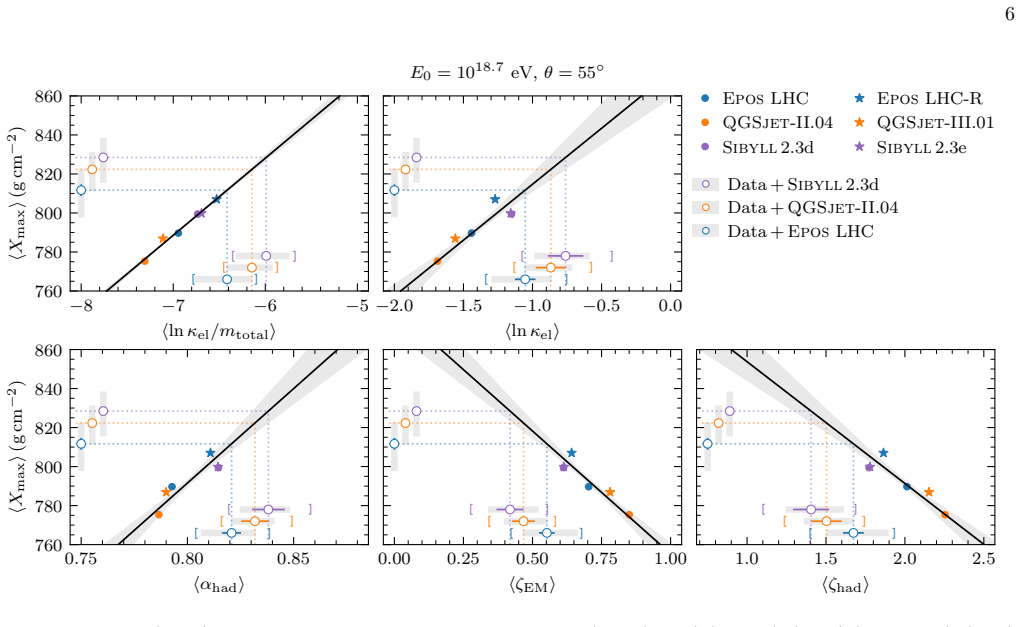
The central claim is that the predicted average depth of the shower maximum, <X_max>, is controlled to within a few g/cm^2 by the mean values of first-interaction production variables, with only a mild residual dependence on the rest of the shower development. Denoting by alpha_had the fraction of the primary energy carried by hadronically interacting secondaries, by kappa_el the elasticity of the leading secondary, and by zeta_had and zeta_EM entropy-like measures of energy partition, the paper fits common linear calibration curves to six model versions (EPOS-LHC and EPOS-LHC-R, QGSjet-II.04 and QGSjet-III.01, Sibyll2.3d and Sibyll2.3e) at E0 = 10^18.7 eV and theta = 55 degrees. The Auger d
What carries the argument
The load-bearing object is the set of first-interaction production variables of a proton–air collision: alpha_had (the sum of energy fractions carried by hadronically interacting secondaries), kappa_el (the energy fraction of the leading secondary), and the entropy-like variables zeta_had and zeta_EM, each defined as minus the energy-weighted sum of x ln x over the hadronic or electromagnetic secondaries. The paper establishes nearly model-independent linear calibration curves of <X_max> versus the mean of each variable, with residual scatter of 1.7–5.2 g/cm^2, far smaller than the ~34 g/cm^2 spread of model predictions. These curves do the work: they allow the single measured quantity <X_ma
Load-bearing premise
The load-bearing premise is that the nearly linear relations between predicted shower depth and the mean first-interaction production variables, fitted with only six model versions at a single energy and zenith angle, are valid in Nature, so that the entire observed X_max shift is imputed to the first proton–air interaction rather than to later pion–air interactions, exotic physics, or an alternative primary mass composition.
What would settle it
A concrete falsifier would be a hadronic interaction model, or a dedicated accelerator measurement, that reproduces the same mean first-interaction production variables at sqrt(s) about 100 TeV but predicts an <X_max> that deviates from the universal calibration curve by more than the observed residual scatter of about 5 g/cm^2; alternatively, an air-shower measurement in which the zenith-angle dependence of the muon excess and the X_max shift require different amplification factors g_mod would break the proposed link between the two observables.
If this is right
- All three model families require the same qualitative modification of the first proton–air interaction: increased mean elasticity and hadronic-energy fraction, reduced zeta values, and an energy flow shifted toward high pseudorapidities with a very asymmetric partition of the primary energy.
- The required increase in the hadronic-energy fraction is small, 3.1–6.0%, but is amplified by a factor of 2.8–4.6 over the cascade generations to reproduce the 14–17% muon excess, directly linking the shower-depth shift and the muon excess to a single cause.
- The updated model EPOS-LHC-R, with more diffractive proton–air interactions and a smaller pion–air cross section, satisfies the X_max shift inferred for its predecessor at this zenith angle, indicating the required modification is plausible within standard-physics variations, whereas QGSjet-III.01 only partially matches and Sibyll2.3e does not.
- The inferred modification of forward, far-forward energy flow can be probed, at lower energies, by forward and far-forward measurements in proton–oxygen collisions at the LHC, which are sensitive to energy flow at high pseudorapidity.
- The framework turns air-shower measurements into constraints on hadron production at sqrt(s) about 100 TeV, a kinematic region beyond direct accelerator reach, and does so through a small set of physically interpretable variables rather than through ad hoc reweighting of shower simulations.
Where Pith is reading between the lines
- If the universal calibration curves extend beyond the fitted six model versions, the same mapping could be applied at other primary energies and zenith angles, turning the full energy and angular dependence of Auger <X_max> into a continuous measurement of first-interaction variables; the paper only demonstrates the curves at a single energy and zenith angle.
- The preference for low zeta values implies more diffraction-like, rapidity-gap-like, or strongly asymmetric non-diffractive configurations; a testable extension is to compare the predicted shape of the muon production depth distribution and the fluctuations of X_max, not just the mean, since the paper notes these distributions could distinguish cross-section changes from production-variable change
- The amplification-factor derivation assumes that a small modification recurs, with decreasing weight, at every shower generation; an alternative reading is that a single very large change confined to the first interaction would need to be much bigger and would likely alter fluctuation patterns in ways that the current mean-based analysis does not test.
- The inferred production variables are, in principle, measurable in collider phase space, so a direct comparison of energy flow at high pseudorapidity in proton–oxygen collisions at the LHC with the values implied here would test whether the trend toward far-forward energy flow extrapolates from accelerator energies to 100 TeV.
Editorial analysis
A structured set of objections, weighed in public.
Referee Report
Summary. The paper uses hybrid Pierre Auger data at sqrt(s) ≈ 100 TeV to infer properties of the first proton-air interaction. Using six LHC-tuned hadronic interaction models (EPOS LHC-R, QGSJet-III.01, Sibyll2.3e and their predecessors), it shows that predicted <X_max> lies on approximately universal linear relations with mean values of first-interaction production variables: the elasticity, the hadronic energy fraction α_had, and the entropy-like variables ζ_had and ζ_EM. Assuming these relations hold in Nature, the Auger <X_max> shifts of Ref. [2] are mapped into changes of these variables, yielding increased elasticity and α_had and decreased ζ_had and ζ_EM for all models. Using Eq. (3), the paper claims that a 2.8–4.6 amplification of the α_had increase suffices to explain the muon puzzle. The claim rests on assumed generation-dependent modification factors f_g, with only f_1=1 specified.
Significance. If the universal relations and their extrapolation to Nature hold, the paper offers a new way to convert X_max measurements into constraints on forward particle production that are testable at LHCf, FASER, and in proton-oxygen collisions. The paper is commendably explicit about its assumptions, quantifies several systematics, validates the relations with pre-LHC models, and tabulates all inferred values. However, the quantitative capstone—the 2.8–4.6 amplification—is not an independent prediction: it is the ratio of the inferred muon rescaling to the inferred α_had shift, divided by an assumed, unmeasured f_g profile. This limits the strength of the muon-puzzle connection.
major comments (4)
- [Sec. IV, Eq. (3)] The amplification factor g_mod = Σ f_g is the load-bearing element of the muon-puzzle claim, but it is unconstrained: only f_1=1 is specified ('decreasing progressively with g'), with no functional form, derivation, or simulation. The quoted values g_mod=2.8–4.6 are obtained by dividing the Auger muon rescaling R_μ by the inferred δln⟨α_had⟩ (Fig. 2), so the claim that the α_had shift 'must be amplified' restates the assumed propagation. If modifications were confined to the first generation, g_mod=1 and the same X_max shift would not explain the muon excess; if f_g=1 for all g, g_mod≈c≈26 and the required α_had change would be tiny. Provide explicit CONEX simulations with chosen f_g profiles, or reframe the 2.8–4.6 factor as a scenario rather than a prediction.
- [Sec. III / SM Eq. (4)] The 'universal relations' for ζ_had and ζ_EM are partly by construction: these variables were designed in Ref. [8] to maximize correlation with X_max, and SM Eq. (4) is a linear estimator of ΔX_max in terms of α_had, ζ_had, ζ_EM. The small residual scatter in the ζ panels of Fig. 1 is therefore not an independent test of a universal law. The independent content resides in α_had and κ_el, which were not constructed for this purpose, and in the model-to-model scatter about the common lines. Please state this explicitly and restrict the 'discovered universality' claim accordingly.
- [Sec. III, Fig. 1] The calibration uses six points from three model families at a single energy/zenith (E0=10^18.7 eV, θ=55°). The claim that Nature lies on the model locus is assumed, not tested. The pre-LHC validation in the Supplemental Material (E0=10^19 eV, θ=60°) is helpful but uses a different energy/zenith and shows increased scatter. Please add cross-checks against model-independent observables—e.g., X_max fluctuations, the elongation rate, or the measured proton-air cross section at √s=57 TeV—or validate the curves at a second energy/zenith with the same model set.
- [Sec. IV / SM §3] The pion-air cross-section freedom, estimated at ~10 g/cm^2, is of the same order as the systematic uncertainties and as a substantial fraction of the X_max shift being interpreted. The estimate rests on a single model-pair comparison (EPOS LHC-R vs. Sibyll2.3e) that confounds σ_π–air with other model differences. A systematic two-dimensional scan (production variables vs. σ_π–air) is needed to quantify how much of the inferred first-interaction changes could be absorbed by pion-air modifications. The paper's stated caveat is clear, but the current estimate understates the degeneracy.
minor comments (4)
- [Abstract / Sec. V] The range '2.8–4.6' refers to central values across the three models; the asymmetric uncertainties (e.g., 4.0^{+7.5}_{-2.5}) are much larger. Please quote the range as central values across models and give the uncertainties.
- [Fig. 1] The meaning of the open 'Data' markers is hard to parse; the caption should state explicitly that they are the Auger-shifted <X_max> projected onto the x-axis along the fit curves.
- [Sec. IV] The sentence linking the inferred changes to Ref. [37] conflates a generation-averaged α_had with the first-interaction α_had used in Fig. 2; clarify the distinction.
- [Throughout] The naming of the EPOS model is inconsistent ('Epos LHC', 'EPOS LHC', 'EposLHC'); please standardize.
Circularity Check
The 2.8–4.6 muon amplification is the ratio of two inputs by construction; the ζ-variable mapping adds a self-citation layer.
specific steps
-
fitted input called prediction
[Sec. IV, Eq. (3) and Fig. 2 caption]
"This yields δln⟨Nµ⟩ = g_mod × δln⟨α_had⟩ (3) where g_mod = Σ fg ... Using Eq. (3), we estimate the values of g_mod that match the muon rescalings inferred by Auger ... The slope of the dashed lines gives the amplification of the increase in ln⟨α_had⟩ required to account for the measured ln⟨Nµ⟩."
Eq. (3) defines g_mod as the proportionality constant between δln⟨Nµ⟩ and δln⟨α_had⟩. The paper then solves for g_mod from the already-adopted R_µ (from Ref. [2]) and the Xmax-derived δln⟨α_had⟩, so g_mod = ln R_µ / δln⟨α_had⟩ by construction. No independent functional form or external constraint for f_g is provided; the text only says f_1=1 and 'decreasing progressively with increasing g'. The headline factor 2.8–4.6 is therefore the ratio of the two input shifts, and the statement that this amplification 'accounts for the Muon Puzzle' restates the muon rescaling input rather than deriving a new consequence.
-
ansatz smuggled in via citation
[Sec. II, Eq. (1); Supplemental Sec. 2, Eq. (4)]
"The variables ζ_had and ζ_EM encode the stochastic energy partition among secondary particles in the primary proton–air interaction in a way that maximally correlates with the shower-to-shower values of X_max [8]."
The ζ variables used to define the 'universal relation' were introduced in Ref. [8] by the same group specifically to maximize correlation with Xmax, and the Supplemental estimator ξ ≃ 917 − (311−9.6ω)α_had − 37(ωζ_had + ζ_EM) is imported from that work. The inferred direction of the mapping (deeper ⟨Xmax⟩ implies higher ⟨α_had⟩ and lower ⟨ζ_had⟩/⟨ζ_EM⟩) is therefore partly encoded in the variable construction rather than independently established here. The paper's own six-model calibration and legacy-model validation reduce but do not remove this self-referential element.
full rationale
The main Xmax-to-production-variable calibration is a real, in-paper computation: six LHC-tuned model points are simulated with CONEX and fitted; legacy-model checks are shown in the Supplemental Material. That part is not circular because the production variables are defined from first-interaction energy fractions, not from measured ⟨Xmax⟩, and the fitted curves are testable. However, the capstone muon-puzzle claim is a consistency relation: Eq. (3) defines g_mod as the ratio of the muon and α_had shifts, and the paper then estimates g_mod from those same two quantities. With no specified f_g profile, the 2.8–4.6 amplification factor is the two-point slope in Fig. 2, i.e., the ratio of the inputs by construction. The paper's own caveat that modifications must 'evolve continuously with projectile energy throughout the shower cascade' is precisely the untested f_g assumption. Additionally, the ζ variables and the Supplemental estimator ξ are inherited from Ref. [8] by the same group, which partially pre-loads the Xmax correlation into the variables. These issues make the derivation partially circular, though the central calibration retains independent content and the paper does not merely rename a known result.
Axiom & Free-Parameter Ledger
free parameters (2)
- Calibration slopes and intercepts m,b of the linear universal relations between ⟨Xmax⟩ and each production variable =
Not quoted individually in the main text; one (m,b) per variable: ⟨ln(κel/mtotal)⟩, ⟨lnκel⟩, ⟨αhad⟩, ⟨ζhad⟩, ⟨ζEM⟩
- Amplification factor g_mod for each model =
EposLHC 4.0(+7.5/−2.5); QGSjet-II.04 2.8(+2.9/−1.8); Sibyll2.3d 4.6(+18.6/−3.3)
axioms (7)
- domain assumption The six LHC-tuned hadronic models span a physically plausible parameter space, and the linear relation between ⟨Xmax⟩ and mean first-interaction variables holds in Nature.
- domain assumption A shift in ⟨Xmax⟩ can be attributed to modifications of the first proton–air interaction; later-generation interactions such as pion–air do not produce sizeable independent shifts.
- domain assumption The proton–air cross section is correctly described by the models.
- domain assumption Primary composition is bounded by proton and iron, and shower-to-shower fluctuations are fixed to model predictions.
- ad hoc to paper The Heitler-style cascade formula Nμ = E0/ξπ^c ∏_g αhad,g, together with the modification lnαhad,g → lnαhad,g + f_g δln⟨αhad⟩, is valid.
- domain assumption The ζ variables and the ξ estimator from Ref. [8] capture the shower-to-shower fluctuations of Xmax.
- domain assumption Pion–air cross-section variations affect ⟨Xmax⟩ by at most ~10 g cm−2.
read the original abstract
Hybrid measurements at the Pierre Auger Observatory indicate that most high-energy hadronic interaction models underestimate the average depth of the shower maximum, $\langle X_{\max} \rangle$, at a center-of-mass energy of $\sqrt{s}=97.7 \pm 0.4^{+6.6}_{-6.2}\,\mathrm{TeV}$. In this Letter, the hadronic interaction models are shown to follow a universal relation between the predicted $\langle X_{\max} \rangle$ and the mean values of variables characterizing the energy spectra of secondary particles produced in the first interaction of proton-induced air showers. Assuming the validity of these relations in Nature, we map the values of $\langle X_{\max} \rangle$ favored by Auger data into mean values of these variables. All models favor an increase in the mean elasticity and in the fraction of hadronic energy in proton--air interactions. The latter must be amplified by a factor of $2.8$ to $4.6$ to account for the muon puzzle.
Figures


Reference graph
Works this paper leans on
-
[1]
The Muon Puzzle in cosmic- ray induced air showers and its connection to the Large Hadron Collider,
Johannes Albrechtet al., “The Muon Puzzle in cosmic- ray induced air showers and its connection to the Large Hadron Collider,” Astrophys. Space Sci.367, 27 (2022), arXiv:2105.06148 [astro-ph.HE]
Pith/arXiv arXiv 2022
-
[2]
A. Abdul Halimet al.(Pierre Auger Collaboration), “Testing hadronic-model predictions of depth of maxi- mum of air-shower profiles and ground-particle signals us- ing hybrid data of the Pierre Auger Observatory,” Phys. Rev. D109, 102001 (2024), arXiv:2401.10740 [astro- ph.HE]
Pith/arXiv arXiv 2024
-
[3]
The Pierre Auger Cosmic Ray Observatory,
Alexander Aabet al.(Pierre Auger Collaboration), “The Pierre Auger Cosmic Ray Observatory,” Nucl. Instrum. Meth. A798, 172–213 (2015), arXiv:1502.01323 [astro- ph.IM]
Pith/arXiv arXiv 2015
-
[4]
Adila Abdul Halimet al.(Pierre Auger Collabora- tion), “Update on testing of air-shower modelling us- ing combined data of the Pierre Auger Observatory and phenomenological consequences,” PoSICRC2025, 431 (2025), arXiv:2507.09802 [astro-ph.HE]
arXiv 2025
-
[5]
Measure- ment of the Proton-Air Cross Section at √s=57 TeV with the Pierre Auger Observatory,
P. Abreuet al.(Pierre Auger Collaboration), “Measure- ment of the Proton-Air Cross Section at √s=57 TeV with the Pierre Auger Observatory,” Phys. Rev. Lett. 109, 062002 (2012)
2012
-
[6]
Studies of the mass composition of cosmic rays and proton-proton interaction cross-sections at ultra-high en- ergies with the Pierre Auger Observatory,
Olena Tkachenko, for the Pierre Auger Collaboration, “Studies of the mass composition of cosmic rays and proton-proton interaction cross-sections at ultra-high en- ergies with the Pierre Auger Observatory,” inProceed- ings of 38th International Cosmic Ray Conference — PoS(ICRC2023), Vol. 444 (2023) p. 438
2023
-
[7]
Lorenzo Cazon, Ruben Concei¸ c˜ ao, and Felix Riehn, “Probing the energy spectrum of hadrons in proton air in- teractions at ultrahigh energies through the fluctuations of the muon content of extensive air showers,” Phys. Lett. B784, 68–76 (2018), arXiv:1803.05699 [hep-ph]
Pith/arXiv arXiv 2018
-
[8]
Lorenzo Cazon, Ruben Concei¸ c˜ ao, Miguel Alexandre Martins, and Felix Riehn, “Probabilistic mapping be- tween multiparticle production variables and the depth of maximum in proton-induced extensive air showers,” (2025), arXiv:2504.08610 [astro-ph.HE]
arXiv 2025
-
[9]
A Heitler model of extensive air showers,
J. Matthews, “A Heitler model of extensive air showers,” Astropart. Phys.22, 387–397 (2005)
2005
-
[10]
A mathematical theory of communica- tion,
C. E. Shannon, “A mathematical theory of communica- tion,” Bell Syst. Tech. J.27, 379–423 (1948)
1948
-
[11]
Hadronic multiparticle production at ultra-high energies and ex- tensive air showers,
Ralf Ulrich, Ralph Engel, and Michael Unger, “Hadronic multiparticle production at ultra-high energies and ex- tensive air showers,” Phys. Rev.D83, 054026 (2011)
2011
-
[12]
Impact of modified characteristics of hadronic interactions on cosmic-ray observables for proton and nuclear primaries,
Jan Ebr, Jir ´ ı Blaˇ zek, Jakub V ´ ıcha, Tanguy Pierog, Eva Santos, Petr Tr´ avn ´ ıcek, and Nikolas Denner, “Impact of modified characteristics of hadronic interactions on cosmic-ray observables for proton and nuclear primaries,” PoSICRC2023, 245 (2023)
2023
-
[13]
Felix Riehn, Anatoli Fedynitch, and Ralph En- gel, “Sibyll⋆,” Astropart. Phys.160, 102964 (2024), arXiv:2404.02636 [hep-ph]
Pith/arXiv arXiv 2024
-
[14]
Modified hadronic interactions in 3-dimensional simulations,
Jiˇ r ´ ı Blaˇ zek, Jan Ebr, Jakub V ´ ıcha, Eva dos Santos, Tanguy Pierog, and Ralf Ulrich, “Modified hadronic interactions in 3-dimensional simulations,” (2026), arXiv:2601.12422 [astro-ph.HE]
Pith/arXiv arXiv 2026
-
[15]
One-dimensional hybrid approach to extensive air shower simulation,
T. Bergmann, R. Engel, D. Heck, N.N. Kalmykov, S. Ostapchenko, T. Pierog, T. Thouw, and K. Werner, “One-dimensional hybrid approach to extensive air shower simulation,” Astroparticle Physics26, 420–432 (2007)
2007
-
[16]
First results of fast one-dimensional hybrid simulation of EAS using CONEX,
T. Pieroget al., “First results of fast one-dimensional hybrid simulation of EAS using CONEX,” Nucl. Phys. B Proc. Suppl.151, 159–162 (2004), arXiv:astro- ph/0411260
arXiv 2004
-
[17]
EPOS LHC-R : a global approach to solve the muon puzzle,
Tanguy Pierog and Klaus Werner, “EPOS LHC-R : a global approach to solve the muon puzzle,” PoSICRC2025, 358 (2025), arXiv:2508.07105 [astro- ph.HE]
Pith/arXiv arXiv 2025
-
[18]
QGSJET-III model of high energy hadronic interactions: The formalism,
Sergey Ostapchenko, “QGSJET-III model of high energy hadronic interactions: The formalism,” Phys. Rev. D 109, 034002 (2024), arXiv:2401.06202 [hep-ph]
Pith/arXiv arXiv 2024
-
[19]
Hadronic interaction model SIBYLL 2.3d and extensive air showers,
Felix Riehn, Ralph Engel, Anatoli Fedynitch, Thomas K. Gaisser, and Todor Stanev, “Hadronic interaction model SIBYLL 2.3d and extensive air showers,” Phys. Rev. D 102, 063002 (2020)
2020
-
[20]
This could lead to different shifts in⟨X max⟩required of both models, so both models were kept in this Letter
This version handles hadronic interactions in the same manner as Sibyll2.3d, but it corrects a feature affecting the particle signal at ground. This could lead to different shifts in⟨X max⟩required of both models, so both models were kept in this Letter
-
[21]
EPOS LHC: Test of collective hadronization with data measured at the CERN Large Hadron Col- lider,
T. Pierog, Iu. Karpenko, J. M. Katzy, E. Yatsenko, and K. Werner, “EPOS LHC: Test of collective hadronization with data measured at the CERN Large Hadron Col- lider,” Phys. Rev. C92, 034906 (2015), arXiv:1306.0121 [hep-ph]
Pith/arXiv arXiv 2015
-
[22]
Monte Carlo treatment of hadronic interactions in enhanced Pomeron scheme: I. QGSJET-II model,
Sergey Ostapchenko, “Monte Carlo treatment of hadronic interactions in enhanced Pomeron scheme: I. QGSJET-II model,” Phys. Rev. D83, 014018 (2011), arXiv:1010.1869 [hep-ph]
Pith/arXiv arXiv 2011
-
[23]
Measure- ments of the Cosmic Ray Composition with Air Shower Experiments,
Karl-Heinz Kampert and Michael Unger, “Measure- ments of the Cosmic Ray Composition with Air Shower Experiments,” Astropart. Phys.35, 660–678 (2012), arXiv:1201.0018 [astro-ph.HE]
Pith/arXiv arXiv 2012
-
[24]
Depth of maximum of air-shower profiles at the Pierre Auger Ob- servatory. I. Measurements at energies above 1017.8 eV,
A. Aabet al.(Pierre Auger Collaboration), “Depth of maximum of air-shower profiles at the Pierre Auger Ob- servatory. I. Measurements at energies above 1017.8 eV,” Phys. Rev. D90, 122005 (2014)
2014
-
[25]
Constrain- ing pion interactions at very high energies by cosmic ray data,
Sergey Ostapchenko and Marcus Bleicher, “Constrain- ing pion interactions at very high energies by cosmic ray data,” Phys. Rev. D93, 051501 (2016), arXiv:1601.06567 [hep-ph]
Pith/arXiv arXiv 2016
-
[26]
NA61/SHINE facility at the CERN SPS: beams and detector system,
N. Abgrallet al.(NA61), “NA61/SHINE facility at the CERN SPS: beams and detector system,” JINST9, 10 P06005 (2014), arXiv:1401.4699 [physics.ins-det]
Pith/arXiv arXiv 2014
-
[27]
Measurement of meson resonance production inπ −+ C interactions at SPS energies,
A. Aduszkiewiczet al.(NA61/SHINE), “Measurement of meson resonance production inπ −+ C interactions at SPS energies,” Eur. Phys. J. C77, 626 (2017), arXiv:1705.08206 [nucl-ex]
Pith/arXiv arXiv 2017
-
[28]
The Fluorescence Detector of the Pierre Auger Observa- tory,
J. Abrahamet al.(Pierre Auger Collaboration), “The Fluorescence Detector of the Pierre Auger Observa- tory,” Nucl. Instrum. Meth. A620, 227–251 (2010), arXiv:0907.4282 [astro-ph.IM]
Pith/arXiv arXiv 2010
-
[29]
The Surface Detector System of the Pierre Auger Obser- vatory,
I. Allekotteet al.(Pierre Auger Collaboration), “The Surface Detector System of the Pierre Auger Obser- vatory,” Nucl. Instrum. Meth. A586, 409–420 (2008), arXiv:0712.2832 [astro-ph]
Pith/arXiv arXiv 2008
-
[30]
Features of the Energy Spectrum of Cosmic Rays above 2.5× 10¹⁸ eV Using the Pierre Auger Observatory,
A. Aabet al.(Pierre Auger Collaboration), “Features of the Energy Spectrum of Cosmic Rays above 2.5× 10¹⁸ eV Using the Pierre Auger Observatory,” Phys. Rev. Lett.125, 121106 (2020)
2020
-
[31]
The faser de- tector,
Henso Abreu and F ASER Collaboration, “The faser de- tector,” Journal of Instrumentation19, P05066 (2024)
2024
-
[32]
Roshan Mammen Abrahamet al.(F ASER), “First Mea- surement of the Muon Neutrino Interaction Cross Sec- tion and Flux as a Function of Energy at the LHC with F ASER,” Phys. Rev. Lett.134, 211801 (2025), arXiv:2412.03186 [hep-ex]
Pith/arXiv arXiv 2025
-
[33]
The LHCf de- tector at the CERN Large Hadron Collider,
O. Adrianiet al.(LHCf Collaboration), “The LHCf de- tector at the CERN Large Hadron Collider,” JINST3, S08006 (2008)
2008
-
[34]
Measurements of longitudinal and transverse momentum distributions for neutral pions in the forward-rapidity region with the LHCf detector,
O. Adrianiet al.(LHCf Collaboration), “Measurements of longitudinal and transverse momentum distributions for neutral pions in the forward-rapidity region with the LHCf detector,” Phys. Rev. D94, 032007 (2016)
2016
-
[35]
O. Adrianiet al.(LHCf), “Measurement of energy flow, cross section and average inelasticity of forward neu- trons produced in √s= 13 TeV proton-proton collisions with the LHCf Arm2 detector,” JHEP07, 016 (2020), arXiv:2003.02192 [hep-ex]
Pith/arXiv arXiv 2020
-
[36]
Georges Aadet al.(ATLAS), “Measurement of charged- particle production in √sNN = 9.62 TeV proton-oxygen collisions as a probe of cosmic-ray air showers with the ATLAS detector,” (2026), arXiv:2604.05512 [hep-ex]
Pith/arXiv arXiv 2026
-
[37]
Alexander Aabet al.(Pierre Auger Collaboration), “Measurement of the Fluctuations in the Number of Muons in Extensive Air Showers with the Pierre Auger Observatory,” Phys. Rev. Lett.126, 152002 (2021), arXiv:2102.07797 [hep-ex]
Pith/arXiv arXiv 2021
-
[38]
Muons in Air Showers at the Pierre Auger Observatory: Measurement of Atmospheric Production Depth,
Alexander Aabet al.(Pierre Auger Collaboration), “Muons in Air Showers at the Pierre Auger Observatory: Measurement of Atmospheric Production Depth,” Phys. Rev. D90, 012012 (2014), [Addendum: Phys.Rev.D 90, 039904 (2014), Erratum: Phys.Rev.D 92, 019903 (2015)], arXiv:1407.5919 [hep-ex]
Pith/arXiv arXiv 2014
-
[39]
Model uncer- tainties for the predicted maximum depth of exten- sive air showers,
Sergey Ostapchenko and Guenter Sigl, “Model uncer- tainties for the predicted maximum depth of exten- sive air showers,” Phys. Rev. D110, 063041 (2024), arXiv:2409.05501 [hep-ph]
Pith/arXiv arXiv 2024
-
[40]
A Heavy- metal Scenario of Ultra-high-energy Cosmic Rays,
Jakub V ´ ıcha, Alena Bakalov´ a, Ana L. M¨ uller, Olena Tkachenko, and Maximilian K. Stadelmaier, “A Heavy- metal Scenario of Ultra-high-energy Cosmic Rays,” As- trophys. J. Lett.986, L34 (2025), arXiv:2504.11985 [astro-ph.HE]
Pith/arXiv arXiv 2025
-
[41]
Binary Neutron Star Mergers as the Source of the Highest Energy Cosmic Rays,
Glennys R. Farrar, “Binary Neutron Star Mergers as the Source of the Highest Energy Cosmic Rays,” Phys. Rev. Lett.134, 081003 (2025), arXiv:2405.12004 [astro- ph.HE]
Pith/arXiv arXiv 2025
-
[42]
Ultra-High-energy Cosmic Ray Pro- duction in Binary Neutron Star Mergers,
Glennys R. Farrar, “Ultra-High-energy Cosmic Ray Pro- duction in Binary Neutron Star Mergers,” Astrophys. J. Lett.994, L7 (2025), arXiv:2506.22625 [astro-ph.HE]
arXiv 2025
-
[43]
thesis, U
Miguel Alexandre Jesus da Silva Martins,Inferring hadronic interaction properties from the 2D distribution of muon content and depth of maximum of extensive air showers, Ph.D. thesis, U. Santiago de Compostela (main) (2025)
2025
-
[44]
Cosmic ray interaction event generator SIBYLL 2.1,
Eun-Joo Ahn, Ralph Engel, Thomas K. Gaisser, Paolo Lipari, and Todor Stanev, “Cosmic ray interaction event generator SIBYLL 2.1,” Phys. Rev. D80, 094003 (2009), arXiv:0906.4113 [hep-ph]
Pith/arXiv arXiv 2009
-
[45]
The Nucleus- nucleus interaction, nuclear fragmentation, and fluctua- tions of extensive air showers,
N. N. Kalmykov and S. S. Ostapchenko, “The Nucleus- nucleus interaction, nuclear fragmentation, and fluctua- tions of extensive air showers,” Phys. Atom. Nucl.56, 346–353 (1993)
1993
-
[46]
Quark-Gluon String Model and EAS Simulation Prob- lems at Ultra-High Energies,
N. N. Kalmykov, S. S. Ostapchenko, and A. I. Pavlov, “Quark-Gluon String Model and EAS Simulation Prob- lems at Ultra-High Energies,” Nucl. Phys. B Proc. Suppl. 52, 17–28 (1997)
1997
-
[47]
QGSJET-II: Towards reliable descrip- tion of very high energy hadronic interactions,
S. Ostapchenko, “QGSJET-II: Towards reliable descrip- tion of very high energy hadronic interactions,” Nucl. Phys. B Proc. Suppl.151, 143–146 (2006), arXiv:hep- ph/0412332
arXiv 2006
-
[48]
Hadronic interaction model sibyll 2.3c and inclusive lepton fluxes,
Anatoli Fedynitch, Felix Riehn, Ralph Engel, Thomas K. Gaisser, and Todor Stanev, “Hadronic interaction model sibyll 2.3c and inclusive lepton fluxes,” Phys. Rev. D100, 103018 (2019), arXiv:1806.04140 [hep-ph]
Pith/arXiv arXiv 2019
-
[49]
Lorenzo Cazon (Pierre Auger Collaboration), “Mea- surements and tests of hadronic interactions at ultra- high energies with the Pierre Auger Observatory,” EPJ Web Conf.210, 02002 (2019), arXiv:1905.06251 [astro- ph.HE]. 11 SUPPLEMENT AL MA TERIAL
Pith/arXiv arXiv 2019
-
[50]
1 of the main text, and all figures relating mean values of production variables of the primary interaction with⟨X max⟩, is obtained as follows
Fit algorithm The fit curve shown in Fig. 1 of the main text, and all figures relating mean values of production variables of the primary interaction with⟨X max⟩, is obtained as follows. First, we fit the model predictions to a linear function by minimizing aχ 2-fit assuming a unit standard deviation as the error in⟨X max⟩. The standard deviation of the r...
-
[51]
Compound multiparticle production variables As detailed in Ref. [8], shower-to-shower fluctuations in the energy spectra of secondary particles produced in the primary interaction are captured by the estimatorξof the shower observable ∆X max ≡X max −X 1, whereX 1 is the depth of the first interaction. In this framework, ξ≃917−(311−9.6ω)α had −37(ωζ had +ζ...
-
[52]
The pion-air interaction cross-section The energy dependence of the pion–air interaction cross section differs substantially among hadronic interaction models, as shown in Fig. 4. A decrease inσ π–air can deepen the overall scale ofX max through an increase in 12 the interaction length of charged pions in air. However, despite the important role of pion–a...
-
[53]
The corresponding bands are shown in Figures 5 and 6
Legacy hadronic interaction models The universality of the relations between⟨X max⟩and multiparticle-production variables of the first interaction is further validated including the pre-LHC models Sibyll2.1 [44], QGSjet01 [45, 46], and QGSjet-II.03 [47], together with the LHC-tuned model Sibyll2.3c [48]. The corresponding bands are shown in Figures 5 and ...
-
[54]
8 shows a scatter plot of⟨X max⟩versus⟨lnm total⟩, illustrating the weak correlation between these quantities
Relation between⟨X max⟩and mean multiplicity in the primary interaction Fig. 8 shows a scatter plot of⟨X max⟩versus⟨lnm total⟩, illustrating the weak correlation between these quantities
-
[55]
However, the slope,m, and intercept,b, of the relation,⟨X max⟩=m⟨v⟩+b, exhibit a mild dependence on energy
Propagation of the FD energy-scale systematic uncertainty The universality of the relations between⟨X max⟩and the mean values of the production variables of the first proton– air interaction,⟨v⟩, used in the main text remain valid, at least, in the primary energy rangeE 0 ∈[10 17.0,10 19.5] eV. However, the slope,m, and intercept,b, of the relation,⟨X max...
-
[56]
V alues of changed production variables of proton-air interactions Tab. I lists the values of the proton–air multiparticle production variables that reproduce the⟨X max⟩shifts inferred from Auger data, together with the corresponding default predictions of the hadronic interaction models used in the main text. TABLE I. Default and shifted values of multip...
-
[57]
Interpretation of⟨ζ had⟩and⟨ζ EM⟩ The relationship betweenζ had,ζ EM, and hadron production across different regions of phase space is illustrated by theζdependence of the differential energy flow in proton–air interactions atE 0 = 1018.7 eV. Fig. 10 shows this dependence by splitting the ensemble of proton–air interactions into two subsets: the lowest-ζ ...
-
[58]
2 into a single panel, shown in Fig
Relation between increasedα had and the Muon Puzzle To better compare the muon rescaling factors across hadronic interaction models and the corresponding values of ⟨αhad⟩preferred by the shifted⟨X max⟩values, we merge the panels of Fig. 2 into a single panel, shown in Fig. 13. □0.275 □0.250 □0.225 □0.200 □0.175 □0.150 ln⟨αhad⟩ 16.4 16.5 16.6 16.7 16.8 16....
-
[59]
[2], following the prescription of Ref
Experimental values of the muon rescalingRµ The values ofR µ used in this work are derived from the hadronic rescaling factorR had reported in Ref. [2], following the prescription of Ref. [49] and assuming electromagnetic scalingR E = 1. The factorR had is extracted from the shower signal at 1000 m from the shower core,S(1000), which is sensitive to the m...
discussion (0)
Sign in with ORCID, Apple, or X to comment. Anyone can read and Pith papers without signing in.